Eurovision Song Contest 1988
 | This article needs additional citations for verification. (August 2009) |
| Eurovision Song Contest 1988 | |
|---|---|
 | |
| Dates | |
| Final | 30 April 1988 |
| Host | |
| Venue | RDS Simmonscourt Pavilion, Ballsbridge, Dublin, Ireland |
| Presenter(s) | |
| Musical director | Noel Kelehan |
| Directed by | Declan Lowney |
| Executive supervisor | Frank Naef |
| Executive producer | Liam Miller |
| Host broadcaster | Radio Telefís Éireann (RTÉ) |
| Website | eurovision |
| Participants | |
| Number of entries | 21 |
| Debuting countries | None |
| Returning countries | None |
| Non-returning countries |  Cyprus Cyprus |
| |
| Vote | |
| Voting system | Each country awarded 12, 10, 8-1 point(s) to their 10 favourite songs |
| Winning song |  Switzerland Switzerland"Ne partez pas sans moi" |


The Eurovision Song Contest 1988 was the 33rd edition of the annual Eurovision Song Contest. It took place in Dublin, Ireland, following Johnny Logan's win at the 1987 contest with the song "Hold Me Now". Organised by the European Broadcasting Union (EBU) and host broadcaster Radio Telefís Éireann (RTÉ), the contest was held at the RDS Simmonscourt on 30 April 1988 and was hosted by Irish broadcaster Pat Kenny and the Miss Ireland 1980 Michelle Rocca, marking the first time since the 1979 contest that two presenters had hosted the contest.
Twenty-one countries took part, after an initial plan of twenty-two, as Cyprus' song was disqualified for breaching the contest's rules by being published a few years earlier, in an attempt to represent the country at a prior edition of the contest. The Cypriot song had been drawn to be performed 2nd in the running order.
The winner was Switzerland with the song "Ne partez pas sans moi", performed by Canadian singer Céline Dion and composed by Atilla Şereftuğ with lyrics in French by Nella Martinetti. Switzerland beat the United Kingdom by just one point in the last vote to win the title. The victory helped launch Dion's international career, subsequently leading her to become one of the best-selling artists of all time.
Location[edit]

Dublin is the capital and largest city of Ireland. The contest took place at the Simmonscourt Pavilion of the Royal Dublin Society, which was normally used for agricultural and horse shows. The same venue had hosted the 1981 contest. The staging of the contest in Dublin in 1988 formed part of Dublin's year long celebration of 1000 years since it was established by Scandinavian settlers in 988.
Participating countries[edit]
| Eurovision Song Contest 1988 – Participation summaries by country | |
|---|---|
Twenty-one countries took part, after an initial plan of twenty-two, as Cyprus was disqualified after it had already submitted an entry. Cypriot broadcaster CyBC had selected the song "Thimame" sung by Yiannis Dimitrou, and at a late stage saw that the song was ineligible to represent them as it had been presented to jurors in the Cypriot internal selection for the 1984 contest, where it had finished in 3rd place. This was classed as a breach of the Cypriot rules of selecting their entry at this time as well as an infringement of the Eurovision Song Contest rules. It was a very late decision as the song was already drawn to perform second in the contest, advertised in the Radio Times information about the preview programme of the contest, and appears as song number two in accordance to its initial performance draw, on the record release "Melodi Grand Prix 1988" – the compilation disc of the contest's entries.[1]
Each performance had a conductor who was maestro to the orchestra, except for Iceland and Italy.[1]
| Country | Broadcaster | Artist | Song | Language | Songwriter(s) | Conductor |
|---|---|---|---|---|---|---|
 Austria Austria
|
ORF | Wilfried | "Lisa Mona Lisa" | German |
|
Harald Neuwirth |
 Belgium Belgium
|
RTBF | Reynaert | "Laissez briller le soleil" | French |
|
Dany Willem |
 Denmark Denmark
|
DR | Hot Eyes | "Ka' du se hva' jeg sa'" | Danish | Henrik Krogsgaard | |
 Finland Finland
|
YLE | Boulevard | "Nauravat silmät muistetaan" | Finnish |
|
Ossi Runne |
 France France
|
Antenne 2 | Gérard Lenorman | "Chanteur de charme" | French |
|
Guy Mattéoni |
 Germany Germany
|
BR[a] | Maxi and Chris Garden | "Lied für einen Freund" | German | Michael Thatcher | |
 Greece Greece
|
ERT | Afroditi Fryda | "Clown" (Κλόουν) | Greek | Dimitris Sakislis | Haris Andreadis |
 Iceland Iceland
|
RÚV | Beathoven | "Sókrates" | Icelandic | Sverrir Stormsker | No conductor |
 Ireland Ireland
|
RTÉ | Jump the Gun | "Take Him Home" | English | Peter Eades | Noel Kelehan |
 Israel Israel
|
IBA | Yardena Arazi | "Ben Adam" (בן אדם) | Hebrew |
|
Eldad Shrem |
 Italy Italy
|
RAI | Luca Barbarossa | "Ti scrivo" | Italian | Luca Barbarossa | No conductor |
 Luxembourg Luxembourg
|
CLT | Lara Fabian | "Croire" | French |
|
Régis Dupré |
 Netherlands Netherlands
|
NOS | Gerard Joling | "Shangri-La" | Dutch | Peter de Wijn | Harry van Hoof |
 Norway Norway
|
NRK | Karoline Krüger | "For vår jord" | Norwegian | Arild Stav | |
 Portugal Portugal
|
RTP | Dora | "Voltarei" | Portuguese |
|
José Calvário |
 Spain Spain
|
TVE | La Década | "La chica que yo quiero (Made in Spain)" | Spanish |
|
Javier de Juan |
 Sweden Sweden
|
SVT | Tommy Körberg | "Stad i ljus" | Swedish | Py Bäckman | Anders Berglund |
| Switzerland
|
SRG SSR | Céline Dion | "Ne partez pas sans moi" | French | Atilla Şereftuğ | |
 Turkey Turkey
|
TRT | MFÖ | "Sufi (Hey Ya Hey)" | Turkish | Turhan Yükseler | |
 United Kingdom United Kingdom
|
BBC | Scott Fitzgerald | "Go" | English | Julie Forsyth | Ronnie Hazlehurst |
 Yugoslavia Yugoslavia
|
JRT | Srebrna krila[b] | "Mangup" (Мангуп) | Serbo-Croatian |
|
Nikica Kalogjera |
Returning artists[edit]
Bold indicates a previous winner.
| Artist | Country | Previous year(s) |
|---|---|---|
| Hot Eyes | Denmark
|
1984, 1985 |
| Boulevard | Finland
|
1987 (as backing group for Vicky Rosti) |
| Yardena Arazi | Israel
|
1976 (as part of Chocolate, Menta, Mastik), 1979 (as presenter)[c] |
| Reuven Gvirtz (backing singer) | 1979 (as part of Milk and Honey) | |
| Yehuda Tamir (backing singer) | ||
| Dora | Portugal
|
1986 |
| Tommy Körberg | Sweden
|
1969 |
| MFÖ | Turkey
|
1985 |
Format[edit]
Graphic design[edit]
Host broadcaster RTÉ, employed Declan Lowney, who was notable for being a director of music videos and youth programming, as director for this edition, in order to revamp the contest to attract and sustain a younger audience. The traditional scoreboard was replaced with two giant Vidiwalls located on either side of the stage, which also projected live images of the performers from the green room where the competitors sat during the votes announcements, and a new computer-generated scoreboard was used.
The stage itself, conceived by Paula Farrell under chief production designer Michael Grogan, was also the largest and most elaborate ever constructed for the Eurovision Song Contest to date. To compensate for the fact that the vast stage took up most of the room in what is really an average size exhibition hall, the director deliberately darkened the hall where the audience was located and refused to use wide angled shots of the audience, in order to create the illusion of the venue being bigger than it actually was.
The Postcards featured the participants doing things in Ireland from culture, to tradition, to sports or sightseeing.
Lowney was also the director of the show's interval act, introduced after the competing songs and before the votes announcement. The interval act was a video of the popular Irish rock group Hothouse Flowers, which was filmed in eleven countries around Europe and was the most expensive music video ever produced in Ireland at the time.
Voting segment[edit]
Each country had a jury who awarded 12, 10, 8, 7, 6, 5, 4, 3, 2 and 1 point(s) for its top ten songs. The number of jury members changed this year from 11 which had been the limit since 1975 to 16 which would be used until 1996 when five countries tested the televoting in 1997.
This edition features one of the closest and most fickle-ending votes in the history of the contest. With three countries left to vote, the UK was well in the lead with 133 points against Switzerland's 118. With the third last country, France, only awarding Switzerland one point, the UK looked certain of victory, as even if Switzerland scooped the two final 12s, the UK would only need to gather eleven points from three juries combined to be unbeatable. However, France didn't award the UK any points, and the following country, Portugal, gave the UK a meagre three points while giving the maximum 12 to Switzerland, making the contest blown open between the two countries until the end of the voting.
With the conclusion of voting from the penultimate jury, the UK was holding a five-point lead over Switzerland. As the final jury, that of Yugoslavia, began to award its points in the customary ascending order, a lot of excitement-sighs were heard from the audience to see how the two rivals for victory would fare. Switzerland was the first to be named with six points, edging it into a one-point lead over the UK. After earlier strong votes from most countries to the UK, it seemed highly likely that the UK would be given one of the higher remaining set of points. However, as Yugoslavia announced its seven, eight, ten and twelve points, it transpired that it had awarded the UK no points at all (12 points from Yugoslavia went to France), [d] and Switzerland was left with its one-point lead to savour a dramatic triumph.
Contest overview[edit]
This was the second victory for Switzerland at the Eurovision Song Contest after winning the first edition in 1956. It also remains the last time a song in French has won the contest, the language having dominated the event in earlier years.
The contest helped launch an international career for two now world-famous artists, the winner for Switzerland Céline Dion and Luxembourg's representative Lara Fabian. Canadian Céline Dion was a rising star in the French-speaking world at the time of the contest. Shortly afterwards she started recording songs in English to great worldwide success.[6] As Dion, Belgian-Canadian Lara Fabian also achieved a successful career after the contest with becoming established in various countries worldwide, with a mainly French-sung repertoire.[6] The UK entry was written and composed by Julie Forsyth, the daughter of the entertainer Bruce Forsyth who was present. When interviewed afterwards he was particularly annoyed at the Dutch jury not having given a vote to the UK, as they had done some work there.
| R/O | Country | Artist | Song | Points | Place |
|---|---|---|---|---|---|
| 1 | Iceland
|
Beathoven | "Sókrates" | 20 | 16 |
| 2 | Sweden
|
Tommy Körberg | "Stad i ljus" | 52 | 12 |
| 3 | Finland
|
Boulevard | "Nauravat silmät muistetaan" | 3 | 20 |
| 4 | United Kingdom
|
Scott Fitzgerald | "Go" | 136 | 2 |
| 5 | Turkey
|
MFÖ | "Sufi (Hey Ya Hey)" | 37 | 15 |
| 6 | Spain
|
La Década | "La chica que yo quiero (Made in Spain)" | 58 | 11 |
| 7 | Netherlands
|
Gerard Joling | "Shangri-La" | 70 | 9 |
| 8 | Israel
|
Yardena Arazi | "Ben Adam" | 85 | 7 |
| 9 | Switzerland
|
Céline Dion | "Ne partez pas sans moi" | 137 | 1 |
| 10 | Ireland
|
Jump the Gun | "Take Him Home" | 79 | 8 |
| 11 | Germany
|
Maxi and Chris Garden | "Lied für einen Freund" | 48 | 14 |
| 12 | Austria
|
Wilfried | "Lisa Mona Lisa" | 0 | 21 |
| 13 | Denmark
|
Hot Eyes | "Ka' du se hva' jeg sa'" | 92 | 3 |
| 14 | Greece
|
Afroditi Fryda | "Clown" | 10 | 17 |
| 15 | Norway
|
Karoline Krüger | "For vår jord" | 88 | 5 |
| 16 | Belgium
|
Reynaert | "Laissez briller le soleil" | 5 | 18 |
| 17 | Luxembourg
|
Lara Fabian | "Croire" | 90 | 4 |
| 18 | Italy
|
Luca Barbarossa | "Ti scrivo" | 52 | 12 |
| 19 | France
|
Gérard Lenorman | "Chanteur de charme" | 64 | 10 |
| 20 | Portugal
|
Dora | "Voltarei" | 5 | 18 |
| 21 | Yugoslavia
|
Srebrna krila[b] | "Mangup" | 87 | 6 |
Spokespersons[edit]
Each country nominated a spokesperson who was responsible for announcing the votes for their respective country via telephone. Known spokespersons at the 1988 contest are listed below.
 Iceland – Guðrún Skúladóttir[8]
 Ireland – John Skehan[e]
 Sweden – Maud Uppling[10]
 United Kingdom – Colin Berry[1]
 Yugoslavia – Miša Molk[11]
Detailed voting results[edit]

| Iceland | 20 | 1 | 4 | 4 | 1 | 2 | 8 | |||||||||||||||
|---|---|---|---|---|---|---|---|---|---|---|---|---|---|---|---|---|---|---|---|---|---|---|
| Sweden | 52 | 3 | 2 | 8 | 5 | 8 | 12 | 1 | 3 | 10 | ||||||||||||
| Finland | 3 | 3 | ||||||||||||||||||||
| United Kingdom | 136 | 1 | 5 | 10 | 12 | 10 | 10 | 5 | 7 | 10 | 10 | 10 | 6 | 5 | 12 | 8 | 12 | 3 | ||||
| Turkey | 37 | 4 | 1 | 5 | 1 | 8 | 8 | 4 | 6 | |||||||||||||
| Spain | 58 | 2 | 5 | 2 | 6 | 8 | 1 | 8 | 2 | 6 | 6 | 8 | 4 | |||||||||
| Netherlands | 70 | 6 | 6 | 7 | 7 | 2 | 6 | 12 | 12 | 5 | 7 | |||||||||||
| Israel | 85 | 6 | 6 | 4 | 6 | 3 | 10 | 1 | 5 | 2 | 3 | 10 | 5 | 3 | 10 | 10 | 1 | |||||
| Switzerland | 137 | 7 | 12 | 5 | 10 | 10 | 8 | 10 | 4 | 10 | 12 | 10 | 8 | 4 | 1 | 7 | 1 | 12 | 6 | |||
| Ireland | 79 | 7 | 2 | 3 | 2 | 12 | 6 | 4 | 7 | 6 | 7 | 7 | 5 | 4 | 5 | 2 | ||||||
| Germany | 48 | 8 | 5 | 1 | 3 | 5 | 6 | 6 | 4 | 2 | 8 | |||||||||||
| Austria | 0 | |||||||||||||||||||||
| Denmark | 92 | 10 | 3 | 4 | 1 | 12 | 6 | 1 | 4 | 4 | 12 | 10 | 7 | 12 | 6 | |||||||
| Greece | 10 | 3 | 7 | |||||||||||||||||||
| Norway | 88 | 5 | 8 | 7 | 12 | 7 | 1 | 8 | 1 | 3 | 5 | 7 | 3 | 4 | 7 | 10 | ||||||
| Belgium | 5 | 5 | ||||||||||||||||||||
| Luxembourg | 90 | 4 | 10 | 12 | 7 | 5 | 12 | 12 | 1 | 2 | 2 | 6 | 8 | 2 | 4 | 3 | ||||||
| Italy | 52 | 8 | 4 | 7 | 8 | 2 | 5 | 3 | 2 | 8 | 5 | |||||||||||
| France | 64 | 2 | 3 | 8 | 2 | 2 | 3 | 3 | 7 | 3 | 5 | 1 | 2 | 10 | 1 | 12 | ||||||
| Portugal | 5 | 4 | 1 | |||||||||||||||||||
| Yugoslavia | 87 | 12 | 6 | 1 | 8 | 7 | 12 | 2 | 3 | 4 | 12 | 4 | 7 | 6 | 3 | |||||||
12 points[edit]
Below is a summary of all 12 points in the final:
| N. | Contestant | Nation(s) giving 12 points |
|---|---|---|
| 3 | Denmark |
Austria, France, Netherlands
|
| Luxembourg |
Finland, Ireland, Switzerland
| |
| Switzerland |
Germany, Portugal, Sweden
| |
| United Kingdom |
Belgium, Italy, Turkey
| |
| Yugoslavia |
Denmark, Iceland, Israel
| |
| 2 | Netherlands |
Greece, Luxembourg
|
| 1 | France |
Yugoslavia
|
| Ireland |
Spain
| |
| Norway |
United Kingdom
| |
| Sweden |
Norway
|
Broadcasts[edit]
Each participating broadcaster was required to relay the contest via its networks. Non-participating EBU member broadcasters were also able to relay the contest as "passive participants". Broadcasters were able to send commentators to provide coverage of the contest in their own native language and to relay information about the artists and songs to their television viewers.[14]
Known details on the broadcasts in each country, including the specific broadcasting stations and commentators are shown in the tables below. According to the host Pat Kenny, the contest was also broadcast in Soviet Union and Middle East.
| Country | Broadcaster | Channel(s) | Commentator(s) | Ref(s) |
|---|---|---|---|---|
 Australia Australia
|
SBS | SBS TV[f] | Terry Wogan | [47] |
| Cyprus
|
CyBC | RIK | [48] | |
| A Programma | [49] | |||
 Estonian SSR Estonian SSR
|
ETV[g] | [50] | ||
 Poland Poland
|
TP | TP1[h] | [52] | |
 Soviet Union Soviet Union
|
CT USSR | Programme One[g] | [50][51] | |
Notes[edit]
- ^ On behalf of the German public broadcasting consortium ARD[5]
- ^ a b Credited on screen as "Silver Wings"
- ^ With this, she became the first person to compete in the contest after hosting an earlier edition; before her, there were few competitors that hosted later editions of the contest.
- ^ Yugoslavia, as being the last jury to announce its votes, had caused the same situation to happen when after their voting UK lost to Spain by 1 point in the 1968 contest
- ^ Confirmed by host Pat Kenny during the broadcast.[9]
- ^ Deferred broadcast on 1 May at 19:30 AEST (09:30 UTC)[47]
- ^ a b Delayed broadcast on 28 May 1988 at 22:10 MSD (18:10 UTC)[50][51]
- ^ Delayed broadcast on 14 May 1988 at 20:00 CEST (18:00 UTC)[52]
References[edit]
- ^ a b c d e Roxburgh, Gordon (2017). Songs For Europe - The United Kingdom at the Eurovision Song Contest. Volume Three: The 1980s. UK: Telos Publishing. pp. 336–350. ISBN 978-1-84583-118-9.
- ^ "Participants of Dublin 1988". European Broadcasting Union. Archived from the original on 3 February 2023. Retrieved 4 July 2023.
- ^ "1988 – 33rd edition". diggiloo.net. Archived from the original on 22 March 2022. Retrieved 4 July 2023.
- ^ "Detailed overview: conductors in 1988". And the conductor is... Retrieved 4 July 2023.
- ^ "Alle deutschen ESC-Acts und ihre Titel" [All German ESC acts and their songs]. www.eurovision.de (in German). ARD. Archived from the original on 12 June 2023. Retrieved 12 June 2023.
- ^ a b "Eurovision Song Contest 1998". European Broadcasting Union official website – History by year section. Retrieved 5 March 2012.
- ^ "Final of Dublin 1988". European Broadcasting Union. Archived from the original on 16 April 2021. Retrieved 16 April 2021.
- ^ "Fór út með vinningsglampann í sólgleraugunum – segir Sverrir Stormsker". Morgunblaðið (in Icelandic). Reykjavík, Iceland. 3 May 1988. pp. 66–67. Retrieved 15 January 2023 – via Timarit.is.
- ^ Eurovision Song Contest: Dublin 1988 (Television programme) (in English and French). Dublin, Ireland: Radio Téléfis Éireann. 30 April 1988.
- ^ a b c Thorsson, Leif; Verhage, Martin (2006). Melodifestivalen genom tiderna : de svenska uttagningarna och internationella finalerna (in Swedish). Stockholm: Premium Publishing. pp. 200–201. ISBN 91-89136-29-2.
- ^ "Vas zanima, kakšno vlogo igra Miša Molk na letošnji Emi?" [Are you interested in what role Miša Molk plays at this year's EMA?]. Elle Slovenija. 24 February 2018. Retrieved 11 December 2023.
- ^ "Results of the Final of Dublin 1988". European Broadcasting Union. Archived from the original on 16 April 2021. Retrieved 16 April 2021.
- ^ "Eurovision Song Contest 1988 – Scoreboard". European Broadcasting Union. Archived from the original on 24 September 2015. Retrieved 23 October 2021.
- ^ "The Rules of the Contest". European Broadcasting Union. 31 October 2018. Archived from the original on 4 October 2022. Retrieved 19 December 2022.
- ^ a b c "TV + Radio · Samstag". Bieler Tagblatt (in German). Zürich, Switzerland. 30 April 1988. p. 22. Retrieved 15 January 2023 – via e-newspaperarchives.ch.
- ^ Halbhuber, Axel (22 May 2015). "Ein virtueller Disput der ESC-Kommentatoren". Kurier (in German). Archived from the original on 23 May 2015. Retrieved 5 January 2023.
- ^ a b c "T.V. Programma's". De Voorpost (in Dutch). Aalst, Belgium. 29 April 1987. p. 15. Retrieved 15 January 2023.
- ^ a b "Televisie buitenland". De Telegraaf Weekeinde (in Dutch). Amsterdam, Netherlands. 30 April 1988. p. 4. Retrieved 15 January 2023 – via Delpher.
- ^ "Lørdag den 30. april 1988". www.dr.dk (in Danish). DR. 30 April 1988. Retrieved 24 March 2024.
- ^ "Radio & TV". Grimstad Adressetidende (in Norwegian). Grimstad, Norway. 30 April 1988. pp. 14–15. Retrieved 15 January 2023 – via National Library of Norway.
- ^ a b "Radio · Televisio". Helsingin Sanomat (in Finnish). 30 April 1988. pp. 52–53. Retrieved 23 December 2022.
- ^ "Euroviisut Dublinista". Helsingin Sanomat (in Finnish). 30 April 1988. p. 53. Retrieved 23 December 2022.
- ^ a b "Samedi TV – 30 avril". Radio TV8 (in French). Lausanne, Switzerland: Héliographia SA. 21 April 1988. pp. 60–63. Retrieved 15 January 2023.
- ^ 33ème Concours Eurovision de la chanson 1988 (Television broadcast) (in French). Antenne 2, RTÉ. 30 April 1988. Retrieved 18 January 2023 – via Institut national de l'audiovisuel.
- ^ a b c "Televisie en radio". Limburgs Dagblad (in Dutch). Heerlen, Netherlands. 30 April 1988. p. 50. Retrieved 15 January 2023 – via Delpher.
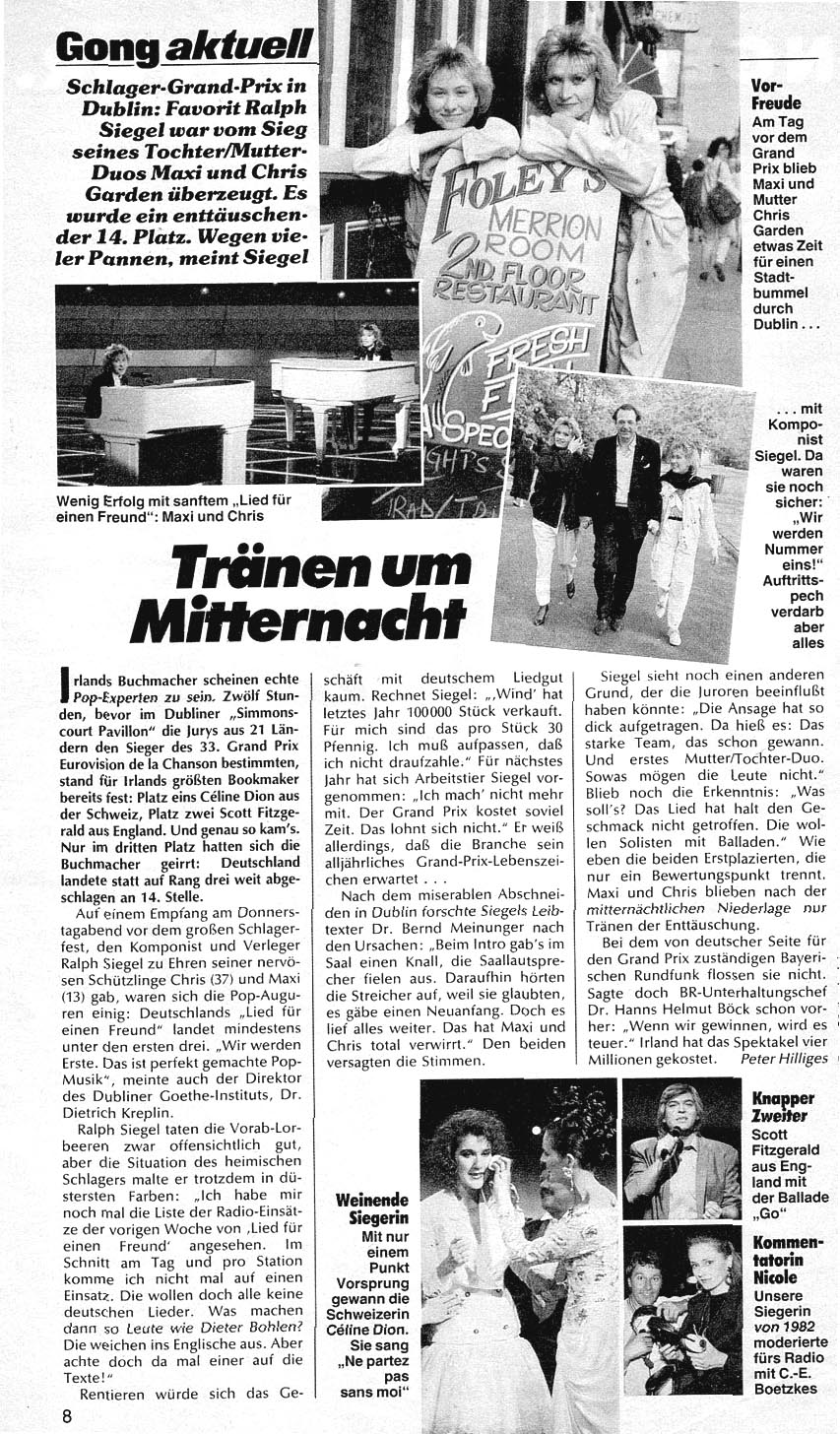
- ^ "Tränen um Mitternacht". Gong (in German). Retrieved 18 January 2023.
- ^ "ERT – Sabbato" ΕΡΤ – Σάββατο (PDF). Laos (in Greek). Veria, Greece. 30 April 1988. p. 6. Archived (PDF) from the original on 15 January 2023. Retrieved 15 January 2023 – via Public Central Library of Veria.
- ^ "Útvarp/Sjónvarp". Morgunblaðið (in Icelandic). Reykjavík, Iceland. 30 April 1988. p. 6. Retrieved 15 January 2023 – via Timarit.is.
- ^ "Saturday's Television". The Irish Times Weekend. 30 April 1986. p. 6. Retrieved 22 December 2022.
- ^ "Radio". The Irish Times Weekend. 30 April 1986. p. 6. Retrieved 22 December 2022.
- ^ "Celebrities and public figures launch Irish campaign to boycott Eurovision 2019 in Israel". Boycott, Divestment and Sanctions. 30 July 2018. Archived from the original on 22 February 2019. Retrieved 22 December 2022.
- ^ "Shabat 30.4.88 – Televizia" שבת 30.4.88 – טלוויזיה. Maariv (in Hebrew). Tel Aviv, Israel. 29 April 1988. pp. 150–151. Retrieved 15 January 2023 – via National Library of Israel.
- ^ "In televisione". La Stampa (in Italian). Turin, Italy. 30 April 1988. p. 17. Retrieved 15 January 2023.
- ^ Langerak, Henk (30 April 1988). "Een groot gezelschapssel". AD Zaterdag 2 (in Dutch). Rotterdam, Netherlands. p. 5. Retrieved 15 January 2023 – via Delpher.
- ^ a b c "TV lørdag". Sarpsborg Arbeiderblad (in Norwegian). Sarpsborg, Norway. 30 April 1988. pp. 22–23. Retrieved 15 January 2023 – via National Library of Norway.
- ^ "P2 – Kjøreplan lørdag 30. avril 1988" (in Norwegian). NRK. 30 April 1988. p. 3. Retrieved 15 January 2023 – via National Library of Norway. (subscription may be required or content may be available in libraries)
- ^ "Televisão". Diário de Lisboa (in Portuguese). Lisbon, Portugal. 30 April 1988. p. 27. Retrieved 15 January 2023 – via Casa Comum.
- ^ "Televisión". La Vanguardia (in Spanish). Barcelona, Spain. 30 April 1988. p. 76. Retrieved 15 January 2023.
- ^ J.M.; B.H. (30 April 1988). "Esta noche, en directo, el XXXIII Festival de Eurovisión". La Vanguardia (in Spanish). Barcelona, Spain. p. 76. Retrieved 15 January 2023.
- ^ "Musica nazionale". Gazzetta Ticinese (in Italian). Lugano, Switzerland. 30 April 1988. p. 16. Retrieved 14 January 2023 – via Sistema bibliotecario ticinese.
- ^ "Televizyon". Cumhuriyet (in Turkish). Istanbul, Turkey. 30 April 1988. p. 4. Archived from the original on 15 January 2023. Retrieved 15 January 2023.
- ^ "Eurovision Song Contest – BBC1". Radio Times. 30 April 1988. Retrieved 15 January 2023 – via BBC Genome Project.
- ^ "Eurovision Song Contest – BBC Radio 2". Radio Times. 30 April 1988. Retrieved 15 January 2023 – via BBC Genome Project.
- ^ "Televizijski spored – sobota, 30. IV" (PDF). Dolenjski list (in Slovenian). Novo Mesto, SR Slovenia, Yugoslavia. 28 April 1988. p. 8. Archived (PDF) from the original on 3 November 2021. Retrieved 15 January 2023.
- ^ "'Mangup' za Evropu". Slobodna Dalmacija RTV Spektar (in Serbo-Croatian). Split, SR Croatia, Yugoslavia. 28 April 1988. p. 1. Retrieved 15 January 2023.
- ^ "RTV Spektar – subota 30. IV". Slobodna Dalmacija RTV Spektar (in Serbo-Croatian). Split, SR Croatia, Yugoslavia. 28 April 1988. p. 7. Retrieved 15 January 2023.
- ^ a b "Sunday's TV Programs". The Canberra Times. Canberra, Australian Capital Territory, Australia. 1 May 1988. p. 2. Retrieved 15 January 2023 – via Trove.
- ^ "Το αποψινο προγραμμα – ΡΙΚ" [Tonight's programme – RIK]. I Simerini (in Greek). Nicosia, Cyprus. 30 April 1988. p. 4. Retrieved 4 March 2024 – via Press and Information Office.
- ^ "Ραδιόφωνο – Σαββατο – 30 Απριλιου" [Radio – Saturday – 30 April]. O Phileleftheros (in Greek). Nicosia, Cyprus. 30 April 1988. p. 2. Retrieved 4 March 2024 – via Press and Information Office.
- ^ a b c "TV – laupäev 28. mai". Leninlik Lipp (in Estonian). Kohtla-Järve, Estonian SSR, Soviet Union. 27 May 1988. p. 4. Retrieved 15 January 2023 – via DIGAR Eesti artiklid.
- ^ a b "Телевидение, программа на неделю" (PDF). Pravda (in Russian). Moscow, Russian SFSR, Soviet Union. 28 May 1988. p. 6. Archived (PDF) from the original on 19 February 2018. Retrieved 15 January 2023.
- ^ a b "Telewizja – sobota – 14 V". Dziennik Polski (in Polish). Kraków, Poland. 13 May 1988. p. 8. Retrieved 15 January 2023 – via Digital Library of Małopolska.
External links[edit]