Eurovision Song Contest 1985
 | This article's tone or style may not reflect the encyclopedic tone used on Wikipedia. (January 2012) |
| Eurovision Song Contest 1985 | |
|---|---|
 | |
| Dates | |
| Final | 4 May 1985 |
| Host | |
| Venue | Scandinavium Gothenburg, Sweden |
| Presenter(s) | Lill Lindfors |
| Musical director | Curt-Eric Holmquist |
| Directed by | Steen Priwin |
| Executive supervisor | Frank Naef |
| Executive producer | Steen Priwin |
| Host broadcaster | Sveriges Television (SVT) |
| Website | eurovision |
| Participants | |
| Number of entries | 19 |
| Debuting countries | None |
| Returning countries | |
| Non-returning countries | |
| |
| Vote | |
| Voting system | Each country awarded 12, 10, 8-1 point(s) to their 10 favourite songs |
| Winning song |  Norway Norway"La det swinge" |


The Eurovision Song Contest 1985 was the 30th edition of the annual Eurovision Song Contest. It took place in Gothenburg, Sweden, following the country's victory at the 1984 contest with the song "Diggi-Loo Diggi-Ley" by Herreys.
Organised by the European Broadcasting Union (EBU) and the host broadcaster Sveriges Television (SVT), the contest was held at the Scandinavium on 4th May 1985. It was hosted by previous Swedish contestant Lill Lindfors.
Nineteen countries participated in the contest, with Norway winning the contest for the first time with "La det swinge" by Bobbysocks!.
Location[edit]

Gothenburg is the second-most populated city in Sweden and the fifth-most populated in the Nordic countries. The construction of the arena commenced in 1969, following numerous setbacks over the years. The arena was opened on May 18, 1971, and played a role in the city's unsuccessful attempt to host the 1984 Winter Olympics. Scandinavium was the largest indoor venue in Sweden at the time. It remained the largest arena to host the event until the 2000 contest in Stockholm. The venue is currently home to the Frölunda HC team of the Swedish Hockey League and also hosts the annual Gothenburg Horse Show.
Participating countries[edit]
| Eurovision Song Contest 1985 – Participation summaries by country | |
|---|---|
A total of nineteen countries took part in the competition. Both Greece and Israel re-entered the competition following their absence in the preceding year. The Netherlands did not take part in the contest because of the national Remembrance of the Dead, while Yugoslavia also did not participate due to the anniversary of the death of Josip Broz Tito.
In 1985, the final competition had fewer than 20 participants, marking the last occurrence of such a low number. Every show included a symphony led by a maestro. In 1985, there was a unique occurrence where multiple conductors were featured for several entries and countries.[1][2]
Returning artists[edit]
In 1985, 13 previous Eurovision artists took part for a second or third time, including the members of eventual winners Bobbysocks! who previously participated as soloists. Notably, Kikki Danielsson returned for host country Sweden, competing against Elisabeth Andreasson with whom she had participated alongside in the 1982 contest as part of the group Chips.
Bold indicates a previous winner.
| Artist | Country | Previous year(s) |
|---|---|---|
| Gary Lux |  Austria Austria
|
1983 (member of Westend), 1984 (backing vocal of Anita) |
| Rhonda Heath (backing singer) | 1977 (member of Silver Convention for  Germany) Germany)
| |
| Lia Vissi |  Cyprus Cyprus
|
1979 (backing vocal of Elpida), 1980 (backing vocal of Anna Vissi and The Epikouri), both times for  Greece Greece
|
| Hot Eyes |  Denmark Denmark
|
1984 |
| Izhar Cohen |  Israel Israel
|
1978 (along with the Alphabeta) |
| Al Bano and Romina Power |  Italy Italy
|
1976 |
| Ireen Sheer |  Luxembourg Luxembourg
|
1974, 1978 (for Germany)
|
| Hanne Krogh (part of Bobbysocks!) | Norway
|
1971 |
| Elisabeth Andreasson (part of Bobbysocks!) | 1982 (for  Sweden, as part of Chips) Sweden, as part of Chips)
| |
| Kikki Danielsson | Sweden
|
1982 (as part of Chips) |
| Pino Gasparini |  Switzerland Switzerland
|
1977 (part of Pepe Lienhard Band) |
| Mariella Farré | 1983 |
Contest overview[edit]
Lill Lindfors staged a deliberate wardrobe malfunction as she proceeded to the stage to present the voting procedure; the skirt of her dress appeared to come away accidentally, leaving her in just her underwear and the top half of her dress. After a few seconds, however, Lindfors unfastened the flaps of her dress across her shoulders to reveal a full-length white gown. Lindfors then took her seat to start calling in the votes, stating "I just wanted to wake you up a little."[6]
| R/O | Country | Artist | Song | Points | Place |
|---|---|---|---|---|---|
| 1 |  Ireland Ireland
|
Maria Christian | "Wait Until the Weekend Comes" | 91 | 6 |
| 2 |  Finland Finland
|
Sonja Lumme | "Eläköön elämä" | 58 | 9 |
| 3 | Cyprus
|
Lia Vissi | "To katalava arga" | 15 | 16 |
| 4 | Denmark
|
Hot Eyes | "Sku' du spørg' fra no'en" | 41 | 11 |
| 5 |  Spain Spain
|
Paloma San Basilio | "La fiesta terminó" | 36 | 14 |
| 6 |  France France
|
Roger Bens | "Femme dans ses rêves aussi" | 56 | 10 |
| 7 |  Turkey Turkey
|
MFÖ | "Didai didai dai" | 36 | 14 |
| 8 |  Belgium Belgium
|
Linda Lepomme | "Laat me nu gaan" | 7 | 19 |
| 9 |  Portugal Portugal
|
Adelaide | "Penso em ti, eu sei" | 9 | 18 |
| 10 | Germany
|
Wind | "Für alle" | 105 | 2 |
| 11 | Israel
|
Izhar Cohen | "Olé, Olé" | 93 | 5 |
| 12 | Italy
|
Al Bano and Romina Power | "Magic, Oh Magic" | 78 | 7 |
| 13 | Norway
|
Bobbysocks! | "La det swinge" | 123 | 1 |
| 14 |  United Kingdom United Kingdom
|
Vikki | "Love Is" | 100 | 4 |
| 15 | Switzerland
|
Mariella Farré and Pino Gasparini | "Piano, piano" | 39 | 12 |
| 16 | Sweden
|
Kikki Danielsson | "Bra vibrationer" | 103 | 3 |
| 17 | Austria
|
Gary Lux | "Kinder dieser Welt" | 60 | 8 |
| 18 | Luxembourg
|
Margo, Franck Olivier, Chris Roberts, Malcolm Roberts, Ireen Sheer and Diane Solomon | "Children, Kinder, Enfants" | 37 | 13 |
| 19 | Greece
|
Takis Biniaris | "Miazoume" | 15 | 16 |
Spokespersons[edit]
Each country nominated a spokesperson who was responsible for announcing the votes for their respective country via telephone. Known spokespersons at the 1985 contest are listed below:
 |
 Sweden – Agneta Bolme Börjefors[8]
 United Kingdom – Colin Berry[1]
Detailed voting results[edit]
As in previous contests, each country had a jury who awarded a set number of points for each of their top ten songs. Norway took and kept the lead with only three countries remaining to vote, in one of the shortest winning stretches during voting in the contest's history.[citation needed]
| Ireland | 91 | 1 | 7 | 3 | 4 | 3 | 5 | 8 | 8 | 4 | 8 | 12 | 3 | 3 | 5 | 7 | 10 | |||
|---|---|---|---|---|---|---|---|---|---|---|---|---|---|---|---|---|---|---|---|---|
| Finland | 58 | 6 | 6 | 6 | 3 | 1 | 7 | 7 | 2 | 10 | 10 | |||||||||
| Cyprus | 15 | 1 | 3 | 3 | 8 | |||||||||||||||
| Denmark | 41 | 3 | 10 | 3 | 1 | 6 | 2 | 6 | 5 | 5 | ||||||||||
| Spain | 36 | 2 | 8 | 1 | 12 | 2 | 4 | 1 | 6 | |||||||||||
| France | 56 | 5 | 4 | 1 | 3 | 3 | 10 | 2 | 4 | 6 | 3 | 3 | 12 | |||||||
| Turkey | 36 | 7 | 2 | 3 | 1 | 2 | 1 | 8 | 12 | |||||||||||
| Belgium | 7 | 7 | ||||||||||||||||||
| Portugal | 9 | 2 | 7 | |||||||||||||||||
| Germany | 105 | 4 | 10 | 12 | 10 | 10 | 8 | 10 | 7 | 7 | 8 | 1 | 8 | 10 | ||||||
| Israel | 93 | 8 | 5 | 4 | 8 | 12 | 5 | 7 | 5 | 10 | 5 | 7 | 2 | 7 | 6 | 2 | ||||
| Italy | 78 | 6 | 10 | 1 | 12 | 5 | 8 | 2 | 12 | 4 | 6 | 12 | ||||||||
| Norway | 123 | 12 | 4 | 12 | 1 | 2 | 12 | 12 | 12 | 6 | 12 | 6 | 12 | 12 | 7 | 1 | ||||
| United Kingdom | 100 | 5 | 7 | 5 | 5 | 6 | 10 | 6 | 6 | 5 | 2 | 8 | 7 | 10 | 4 | 2 | 8 | 4 | ||
| Switzerland | 39 | 3 | 2 | 6 | 6 | 5 | 4 | 1 | 5 | 1 | 1 | 2 | 3 | |||||||
| Sweden | 103 | 10 | 12 | 8 | 2 | 7 | 4 | 7 | 8 | 6 | 4 | 12 | 6 | 8 | 4 | 5 | ||||
| Austria | 60 | 3 | 7 | 1 | 4 | 10 | 10 | 2 | 10 | 1 | 3 | 4 | 5 | |||||||
| Luxembourg | 37 | 2 | 4 | 10 | 3 | 5 | 1 | 4 | 8 | |||||||||||
| Greece | 15 | 8 | 7 | |||||||||||||||||
12 points[edit]
Below is a summary of all 12 points, the highest scoring amount, given by juries in the final:
| N. | Contestant | Nations' juries giving 12 points |
|---|---|---|
| 8 | Norway |
Austria, Belgium, Denmark, Germany, Ireland, Israel, Sweden, United Kingdom
|
| 3 | Italy |
Luxembourg, Portugal, Spain
|
| 2 | Sweden |
Finland, Norway
|
| 1 | France |
Greece
|
| Germany |
Cyprus
| |
| Ireland |
Italy
| |
| Israel |
France
| |
| Spain |
Turkey
| |
| Turkey |
Switzerland
|
Broadcasts[edit]
Each participating broadcaster was required to relay the contest via its networks, with non-participating EBU member broadcasters also able to relay the contest as "passive participants". Broadcasters were able to send commentators to provide coverage of the contest in their own native language and to relay information about the artists and songs to their television viewers.[11] Known details on the broadcasts in each country, including the specific broadcasting stations and commentators, are shown in the tables below:
| Country | Broadcaster | Channel(s) | Commentator(s) | Ref(s) |
|---|---|---|---|---|
 Australia Australia
|
SBS | SBS TV[d] | [41] | |
 Czechoslovakia Czechoslovakia
|
ČST | ČST2[e] | [42] | |
 Iceland Iceland
|
RÚV | Sjónvarpið | Hinrik Bjarnason | [43] |
 Netherlands Netherlands
|
Olympus[f] | Gerrit den Braber | [44][45] | |
 Poland Poland
|
TP | TP1[g] | [46] | |
Notes[edit]
- ^ On behalf of the German public broadcasting consortium ARD[5]
- ^ a b Deferred broadcast at 22:30 CEST (20:30 UTC)[31]
- ^ Deferred broadcast at 22:55 CEST (20:55 UTC)[33]
- ^ Deferred broadcast on 5 May at 19:30 AEST (09:30 UTC)[41]
- ^ Delayed broadcast on 1 June 1985 at 11:05 CEST (09:05 UTC)[42]
- ^ Deferred broadcast on 6 May at 10:00 CEST (08:00 UTC)[44]
- ^ Delayed broadcast on 25 May 1985 at 20:00 CEST (18:00 UTC)[46]
References[edit]
- ^ a b c d e Roxburgh, Gordon (2017). Songs For Europe - The United Kingdom at the Eurovision Song Contest. Volume Three: The 1980s. UK: Telos Publishing. pp. 227–239. ISBN 978-1-84583-118-9.
- ^ a b "Detailed overview: conductors in 1985". And the conductor is... Retrieved 4 July 2023.
- ^ "Participants of Gothenburg 1985". European Broadcasting Union. Archived from the original on 1 April 2023. Retrieved 4 July 2023.
- ^ "1985 – 30th edition". diggiloo.net. Archived from the original on 22 March 2022. Retrieved 4 July 2023.
- ^ "Alle deutschen ESC-Acts und ihre Titel" [All German ESC acts and their songs]. www.eurovision.de (in German). ARD. Archived from the original on 12 June 2023. Retrieved 12 June 2023.
- ^ "Lill Lindfors voted the most popular presenter of the 1980s". eurovision.tv. 16 October 2016. Retrieved 4 December 2023.
- ^ "Final of Gothenburg 1985". European Broadcasting Union. Archived from the original on 16 April 2021. Retrieved 16 April 2021.
- ^ a b c Thorsson, Leif; Verhage, Martin (2006). Melodifestivalen genom tiderna : de svenska uttagningarna och internationella finalerna (in Swedish). Stockholm: Premium Publishing. pp. 180–181. ISBN 91-89136-29-2.
- ^ "Results of the Final of Gothenburg 1985". European Broadcasting Union. Archived from the original on 16 April 2021. Retrieved 16 April 2021.
- ^ "Eurovision Song Contest 1985 – Scoreboard". European Broadcasting Union. Archived from the original on 24 September 2015. Retrieved 22 October 2021.
- ^ "The Rules of the Contest". European Broadcasting Union. 31 October 2018. Archived from the original on 4 October 2022. Retrieved 19 December 2022.
- ^ a b c "TV + Radio · Samstag". Bieler Tagblatt (in German). Biel, Switzerland. 4 May 1985. p. 30. Retrieved 14 January 2023 – via e-newspaperarchives.ch.
- ^ Halbhuber, Axel (22 May 2015). "Ein virtueller Disput der ESC-Kommentatoren". Kurier (in German). Archived from the original on 23 May 2015. Retrieved 5 January 2023.
- ^ Versteeg, Dick (3 May 1985). "Buiten beeld". Leeuwarder Courant (in Dutch). Leeuwarden, Netherlands. p. 2. Retrieved 18 January 2023 – via Delpher.
- ^ a b c "T.V. Programma's". De Voorpost (in Dutch). Aalst, Belgium. 3 May 1985. p. 47. Retrieved 14 January 2023.
- ^ a b c d "Zaterdag 4 mei 1985". Limburgs Dagblad TV Week (in Dutch). Heerlen, Netherlands. 3 May 1985. p. 4. Retrieved 14 January 2023 – via Delpher.
- ^ "TV – Το πληρες προγραμμα" [TV – The full programme]. I Simerini (in Greek). Nicosia, Cyprus. 4 May 1985. p. 4. Retrieved 4 March 2024 – via Press and Information Office.
- ^ "Ραδιόφωνο" [Radio]. O Phileleftheros (in Greek). Nicosia, Cyprus. 4 May 1985. p. 2. Retrieved 4 March 2024 – via Press and Information Office.
- ^ "Programoversigt – 04/05/1985" (in Danish). LARM.fm. Retrieved 14 January 2023.
- ^ "Lørdag den 4. maj 1985". www.dr.dk (in Danish). DR. 4 May 1985. Retrieved 24 March 2024.
- ^ a b "Radio · TV". Helsingin Sanomat (in Finnish). 4 May 1985. p. 59. Retrieved 14 November 2022.
- ^ a b "TV – samedi 4 mai". Radio TV - Je vois tout (in French). Lausanne, Switzerland: Héliographia SA. 2 May 1985. pp. 24–25. Retrieved 14 January 2023.
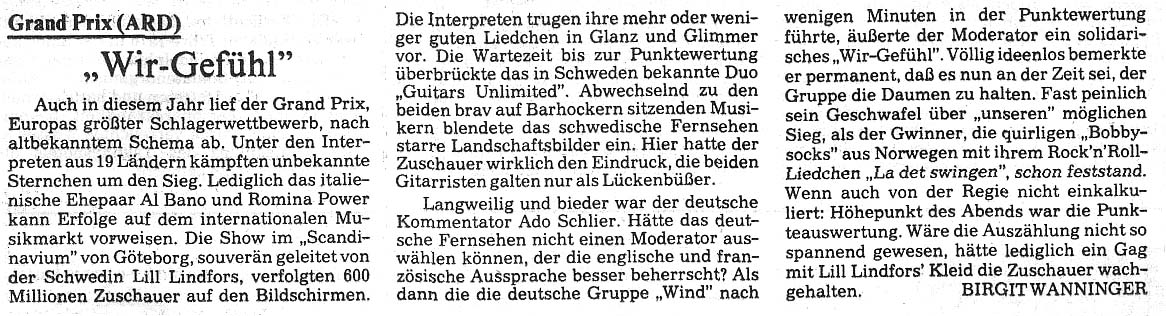
- ^ Wanninger, Birgit. "'Wir-Gefühl'". Rheinische Post (in German). Retrieved 18 January 2023.
- ^ "ΕΡΤ – Σάββατο" [ERT – Saturday] (PDF). Laos (in Greek). Veria, Greece. 4 May 1985. p. 6. Archived (PDF) from the original on 14 January 2023. Retrieved 14 January 2023 – via Public Central Library of Veria.
- ^ "Television – Saturday". The Irish Times Weekend. 4 May 1985. p. 7. Retrieved 22 December 2022.
- ^ Rowe, John (1985). Broadcaster Gay Byrne (1985) (Photograph). Archived from the original on 4 July 2023. Retrieved 4 July 2023 – via RTÉ Libraries and Archives.
- ^ "Radio – Saturday". The Irish Times Weekend. 4 May 1985. p. 7. Retrieved 22 December 2022.
- ^ Rowe, John (4 May 1985). RTÉ broadcaster Larry Gogan (1985) (Photograph). Scandinavium, Gothenburg, Sweden. Archived from the original on 4 July 2023. Retrieved 4 July 2023 – via RTÉ Libraries and Archives.
- ^ "Madrikh televizia – Shabat 4.5" מדריך טלוויזיה – שבת 4.5. Hadashot (in Hebrew). Tel Aviv, Israel. 3 May 1985. p. 42. Retrieved 14 January 2023 – via National Library of Israel.
- ^ "Madrikh radio – Shabat 4.5" מדריך רדיו – שבת 4.5. Hadashot (in Hebrew). Tel Aviv, Israel. 3 May 1985. p. 45. Retrieved 14 January 2023 – via National Library of Israel.
- ^ a b "In televisione". La Stampa (in Italian). Turin, Italy. 4 May 1985. p. 19. Retrieved 14 January 2023.
- ^ "Alla radio". Stampa Sera (in Italian). Turin, Italy. 4 May 1985. p. 21. Retrieved 14 January 2023.
- ^ a b c d "Dagens radio/TV". Moss Avis (in Norwegian). Moss, Norway. 4 May 1985. p. 16. Retrieved 14 January 2023 – via National Library of Norway.
- ^ "Televisão". Diário de Lisboa (in Portuguese). Lisbon, Portugal. 4 May 1985. p. 23. Retrieved 14 January 2023 – via Casa Comum.
- ^ Firmino, Tiago (7 April 2018). "O número do dia. Quantos festivais comentou Eládio Clímaco na televisão portuguesa?" (in Portuguese). N-TV. Archived from the original on 4 November 2022. Retrieved 13 January 2023.
- ^ "Televisión/Radio". La Vanguardia (in Spanish). Barcelona, Spain. 4 May 1985. p. 56. Retrieved 14 January 2023.
- ^ HerGar, Paula (28 March 2018). "Todos los comentaristas de la historia de España en Eurovisión (y una única mujer en solitario)" (in Spanish). Los 40. Archived from the original on 26 September 2021. Retrieved 14 January 2023.
- ^ "Programmi tv". Gazzetta Ticinese (in Italian). Lugano, Switzerland. 4 May 1985. p. 17. Retrieved 14 January 2023 – via Sistema bibliotecario ticinese.
- ^ "Televizyon". Cumhuriyet (in Turkish). Istanbul, Turkey. 4 May 1985. p. 4. Archived from the original on 14 January 2023. Retrieved 14 January 2023.
- ^ "Eurovision Song Contest 1985 – BBC1". Radio Times. 4 May 1985. Retrieved 14 January 2023 – via BBC Genome Project.
- ^ a b "Television". The Canberra Times. Canberra, Australian Capital Territory, Australia. 5 May 1985. p. 12. Retrieved 14 January 2023 – via Trove.
- ^ a b "Csehszlovák televízió – szombat június 1". Rádió- és Televízió-újság (in Hungarian). 27 May 1985. p. 26. Archived from the original on 14 January 2023. Retrieved 14 January 2023 – via MTVA Archívum.
- ^ "Laugardagur 4. maí – Sjónvarp". DV (in Icelandic). Reykjavík, Iceland. 4 May 1985. p. 23. Retrieved 14 January 2023 – via Timarit.is.
- ^ a b "Televisie & Radio". De Volkskrant (in Dutch). Amsterdam, Netherlands. 4 May 1985. p. 43. Retrieved 14 January 2023 – via Delpher.
- ^ "Pioniersgeest NOS door project Olympus". Leeuwarder Courant (in Dutch). Leeuwarden, Netherlands. 6 May 1985. p. 2. Retrieved 14 January 2023 – via Delpher.
- ^ a b "Telewizja – sobota 25. V." Dziennik Polski (in Polish). Kraków, Poland. 24 May 1985. p. 8. Retrieved 14 January 2023 – via Digital Library of Małopolska.
External links[edit]