


Toyota Auris
| Toyota Auris | |
|---|---|
_%E2%80%93_Frontansicht,_1._Juni_2013,_D%C3%BCsseldorf_(cropped).jpg) 2013 Toyota Auris Executive D-4D (ADE180, Germany) | |
| Overview | |
| Manufacturer | Toyota |
| Also called |
|
| Production | October 2006 – July 2020 |
| Body and chassis | |
| Class | Compact car (C) |
| Layout | |
| Chronology | |
| Predecessor | Toyota Corolla (E120) – hatchback |
| Successor | Toyota Corolla (E210) – hatchback, wagon |
The Toyota Auris (Japanese: トヨタ・オーリス, Hepburn: Toyota Ōrisu) is a compact car derived from the Corolla, manufactured and sold by Toyota. Introduced in 2006, the first generation three/five-door hatchback shared the platform with the E150 series Corolla, while the second generation five-door hatchback and station wagon called "Touring Sports" uses the E180 platform. The "Auris" name is based on the Latin word for "gold", "aurum".
In Europe, Toyota positioned the Auris as the replacement for the Corolla hatchback, while the saloon version continued with the Corolla nameplate. Starting with the E210 model, the Auris nameplate was discontinued and used the Corolla nameplate instead, except for Taiwan, retained the Auris nameplate for the hatchback version until July 2020.
For the first generation only, the more luxurious Auris was named Toyota Blade (Japanese: トヨタ・ブレイド, Hepburn: Toyota Bureido) in Japan. The Auris succeeded the Allex in Japan and the Corolla RunX. Toyota Australia and Toyota New Zealand resisted suggestions from Toyota Japan to adopt the new European Auris name for the Corolla.[1]
The Japanese model went on sale at Netz dealerships on 23 October 2006, while European models went on sale in early 2007.[2] The second generation was later available at Toyopet Store dealerships from 18 April 2016.
First generation (E150; 2006)[edit]
| First generation (E150) | |
|---|---|
_%E2%80%93_Frontansicht,_21._Juni_2011,_Ratingen.jpg) | |
| Overview | |
| Also called |
|
| Production | October 2006[3] – July 2012 |
| Assembly |
|
| Designer | Koichi Suga and Samuel Guinefoleau (2004)[5] |
| Body and chassis | |
| Body style | |
| Platform | Toyota New MC platform |
| Related | |
| Powertrain | |
| Engine | |
| Transmission | |
| Dimensions | |
| Wheelbase | 2,600 mm (102.4 in) |
| Length | 4,224 mm (166.3 in) |
| Width | 1,760 mm (69.3 in) |
| Height | 1,516 mm (59.7 in) |
| Curb weight | 1,240–1,370 kg (2,734–3,020 lb) |
| Test | Score | Rating |
|---|---|---|
| Adult occupant: | 35 | 
|
| Child occupant: | 37 | 
|
| Pedestrian: | 21 |
|
The Auris space concept is a concept using Vibrant Clarity design philosophy. It included panoramic glass roof, flat rear passenger floor, high window surfaces, 19-inch alloy wheels, free form geometric lamps, prominent brake callipers, deep rear bumper with integrated chrome exhausts, gold coloured body.
The vehicle was unveiled at the October 2006 Paris Motor Show.[9] Exterior styling was done by ED², Toyota's European design base located in southern France.
The former Kanto Auto Works produced the Auris and Blade from October 2006 to November 2011.[3]
The Auris received a five star cabin protection rating from Euro NCAP for adults, but four stars for children.[8]
Markets[edit]
Japan[edit]
Introduced as a new model in 2006, the Auris replaced the Corolla Runx and Allex. Trim levels were 150X,180G and RS. For model year 2007 on Japanese models only, G-BOOK, a subscription telematics service, was offered as an option. Japanese models were built by Iwate Plant, Kanto Auto Works, Ltd.
- S package TUMI version (2007)
Designed by TUMI, this was a Japanese market limited edition (1000 units) version. It included model specific seat cloth, floor mats, a luggage mat, illuminated scuff plates, shift knob, instrument panel ornament and badging.[10]
The vehicles were sold through Toyota's Netz dealers. Prices were between ¥2,058,000 and ¥2,499,000.[11]
- Grayge selection (2008)
This version came with a grey interior, dual zone climate control, passenger side under seat tray. The 150X M package version added rear privacy glass, smart entry and start system and anti theft system. The models went on sale on 29 January 2008, through Toyota's Netz dealers.[12]
With the update of 2008, keyless entry, under seat tray became standard on all models.[13]
- Auris GT Concept
In January 2011, Toyota revealed the Toyota Auris GT at the Tokyo Auto Salon. Based on a 1.8L Auris.[14] All equipment is available for purchase individually except for the supercharger.[15] The concept was shown in Gold metallic paint with a black TRD graphic along the lower side of the car.
| Chassis codes | (DBA-)ZRE152H-BHFEP | (DBA-)ZRE152H-BHXEK | (DBA-)ZRE154H-BHXEK | (DBA-)NZE151H-BHXNK | (DBA-)NZE154H-BHXNK | (DBA-)ZRE152H-BHXEP | (DBA-)ZRE154H-BHXEP |
|---|---|---|---|---|---|---|---|
| Model | RS | 180G 2WD | 180G 4WD | 150X 2WD | 150X 4WD | MY09 180G 2WD | MY09 180G 4WD |
| Drive | FWD | FWD | 4WD | FWD | 4WD | FWD | 4WD |
| Engine | 2ZR-FAE | 2ZR-FE | 2ZR-FE | 1NZ-FE | 1NZ-FE | 2ZR-FAE | 2ZR-FAE |
| Model | Years | Type/code | Power at rpm | Torque at rpm |
|---|---|---|---|---|
| 150X 2WD | 2006–2012 | 1,496 cc (91.3 cu in) 1NZ-FE | 110 PS (81 kW; 108 hp) at 6000 | 140 N⋅m (103 lbf⋅ft) at 4400 |
| 150X 4WD | 2006–2012 | 1,496 cc (91.3 cu in) 1NZ-FE | 105 PS (77 kW; 104 hp) at 6000 | 135 N⋅m (100 lb⋅ft) at 4400 |
| 180G 2WD | 2006–2009 | 1,797 cc (109.7 cu in) 2ZR-FE | 136 PS (100 kW; 134 hp) at 6000 | 175 N⋅m (129 lb⋅ft) at 4400 |
| 180G 2WD | 2009–2012 | 1,797 cc (109.7 cu in) 2ZR-FAE | 144 PS (106 kW; 142 hp) at 6400 | 176 N⋅m (130 lb⋅ft) at 4400 |
| 180G 4WD | 2006–2009 | 1,797 cc (109.7 cu in) 2ZR-FE | 127 PS (93 kW; 125 hp) at 6000 | 166 N⋅m (122 lb⋅ft) at 4400 |
| 180G 4WD | 2009–2012 | 1,797 cc (109.7 cu in) 2ZR-FAE | 136 PS (100 kW; 134 hp) at 6400 | 167 N⋅m (123 lb⋅ft) at 4400 |
| RS | 2009–2012 | 1,797 cc (109.7 cu in) 2ZR-FAE | 147 PS (108 kW; 145 hp) at 6400 | 180 N⋅m (130 lb⋅ft) at 4000 |
| Model | Years | Type | Forward ratio | Reverse ratio | Final drive ratio |
|---|---|---|---|---|---|
| 150X 2WD | 2006–2012 | Super CVT-i with 6-speed | 2.386–0.411 | 2.505 | 5.698 |
| 150X 4WD | 2006–2012 | Super CVT-i with 6-speed | |||
| 180G 2WD | 2006–2012 | Super CVT-i with 7-speed sequential shiftmatic | 5.356 | ||
| 180G 4WD | 2006–2012 | Super CVT-i with 7-speed sequential shiftmatic | 5.698 | ||
| RS | 2009–2012 | 6-speed manual | 3.538–0.7 | 3.333 | 4.294 |
Australia[edit]
In Australia, the Auris was sold as "Corolla" hatchback with "Seca" emblem on the hatch door above the licence plate. Grades were: base-model "Ascent", mid-spec "Conquest", sports "Levin SX" and sports luxury "Levin ZR". All models are powered by the 1.8-litre 2ZR-FE engine, with either a six-speed manual or four-speed automatic. All but the Ascent came with standard alloy wheels and fog lights.
The Levin models had sports style body kits. Electric moonroof was only available as an option on Levin ZR. As of January 2009, ESC was available as standard on Conquest and Levin ZR and as an option on Ascent and Levin SX.
The Australian Corolla Hatchback received a facelift during the fourth quarter of 2009. The entire body design was given a sporty makeover. Major changes were made to the front and rear fascia, wheel designs and interior trims. The "Seca" branding was removed, and the tail light design was changed.
A newer bumper design was also adapted with a special "diffuser" fitted at the bottom to give the rear a sportier look; on either side of the diffuser are reflectors which were not featured on any previous Corolla Hatchback models. The front received new grille and revised headlamps.
Fog lights were removed from the Conquest model. Ascent continued with 15-inch steel wheels, while the rest received 16-inch alloys — Conquest and Levin SX shared the same alloys. Side mirrors now featured indicators. The trim materials were also changed, along with a new D-shaped sports steering wheel available on Conquest and Levin models. Other changes were also made to equipment and technology. Moonroof was still only available as an option on Levin ZR alone.
-
 Corolla hatchback (Australia; pre-facelift)
 -
 Corolla hatchback (Australia; pre-facelift)
 -
 Corolla hatchback (Australia; facelift)
 -
 Corolla hatchback (Australia; facelift)
 -
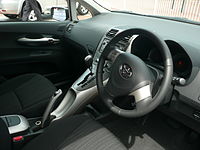 Interior (pre-facelift, Australia)
_Conquest_Seca_5-door_hatchback_(2015-07-03)_01_(cropped).jpg)
_Conquest_Seca_5-door_hatchback_(2015-07-03)_02.jpg)
_Conquest_5-door_hatchback_(2015-07-24)_(cropped).jpg)
_Ascent_Sport_5-door_hatchback_(2015-07-03)_02.jpg)
_Levin_ZR_hatchback_04.jpg)
New Zealand[edit]
 |
In New Zealand, the Auris was sold as "Corolla" hatchback. Grades were: base-model "GX", sports luxury "GLX". All models were powered by the 1.8-litre Petrol 2ZR-FE engine, with either a six speed manual or four speed automatic. GX models came with steel wheels and hubcaps, whilst GLX models came with alloys, front fog lights, leather bound steering wheel & shifter knob and cruise control. Diesel models were also available in a 1.4L and 2.0L D-4D both being a 6-speed manual only.
The New Zealand Corolla Hatchback, like Australia, received a facelift during the fourth quarter of 2009. The entire body design was given a sporty makeover. Major changes were made to the front and rear fascia, wheel designs and interior trims. Tail lights design was also changed.
A newer bumper design was also adapted with a special "diffuser" fitted at the bottom to give the rear a sportier look and on either side of the diffuser were reflectors which had not featured on any other previous Corolla Hatchback models. The front received new grille and revised headlamps.
Trim lines and options remained the same with both the GX and GLX models pre-facelifted versions.
Europe[edit]
The Auris was released on 1 February 2007 in the United Kingdom, replacing the E120 series Corolla hatchback. Toyota positioned the Auris at the lower medium segment to compete with cars such as Volkswagen Golf, Vauxhall/Opel Astra, Hyundai i30 and the Ford Focus.
Trim levels were T2, T3 and T Spirit – followed by the T180 model in April 2007. European trim levels were Terra, Strata, Luna, Sol, Premium and Prestige. In February 2007, Toyota announced an investment of £100 million in its Deeside engine factory to build a petrol engine for the Auris.[16]
The Deeside plant would start building 1.33-litre Dual VVT-i engine beginning in 2009–10, and would also produce Auris engines previously built in Japan.[17]
-
 Auris 3-door (pre-facelift; Germany)
 -
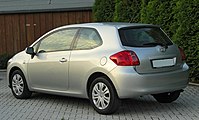 Auris 3-door (pre-facelift; Germany)
 -
 Auris 5-door (facelift; Germany)
 -
 Auris 5-door (facelift; Germany)


_%E2%80%93_Frontansicht,_18._M%C3%A4rz_2012,_Wuppertal.jpg)
_%E2%80%93_Heckansicht,_18._M%C3%A4rz_2012,_Wuppertal.jpg)
Engines for the European Auris are:
| Model | Years | Type/code | Power@rpm | torque@rpm |
|---|---|---|---|---|
| Petrol engines | ||||
| 1.33 Dual VVT-i | 2008–2012 | 1,329 cc (81.1 cu in) I4 1NR-FE | 101 PS (74 kW; 100 hp)@6000 | 132 N⋅m (97 lb⋅ft)@3800 |
| 1.4 VVT-i | 2007–2008 | 1,398 cc (85.3 cu in) I4 4ZZ-FE | 97 PS (71 kW; 96 hp)@6000 | 130 N⋅m (96 lb⋅ft)@4600 |
| 1.6 Dual VVT-i | 2007–2009 | 1,598 cc (97.5 cu in) I4 1ZR-FE | 124 PS (91 kW; 122 hp)@6000 | 157 N⋅m (116 lb⋅ft)@5200 |
| 1.6 Valvematic | 2009–2012 | 1,598 cc (97.5 cu in) I4 1ZR-FAE | 132 PS (97 kW; 130 hp)@6400 | 160 N⋅m (118 lbf⋅ft)@4400 |
| 1.8 Dual VVT-i | 2007–2009 | 1,797 cc (109.7 cu in) I4 2ZR-FE | 136 PS (100 kW; 134 hp)@6000 | 175 N⋅m (129 lb⋅ft)@4400 |
| 1.8 Valvematic | 2009–2012 | 1,797 cc (109.7 cu in) I4 2ZR-FAE | 147 PS (108 kW; 145 hp)@6400 | 180 N⋅m (133 lbf⋅ft)@4000 |
| Diesel engines | ||||
| 1.4 D-4D | 2007–2009 | 1,364 cc (83.2 cu in) I4 turbo 1ND-TV | 90 PS (66 kW; 89 hp)@3800 | 190 N⋅m (140 lbf⋅ft)@1800–3000 |
| 1.4 D-4D | 2009–2012 | 1,364 cc (83.2 cu in) I4 turbo 1ND-TV | 90 PS (66 kW; 89 hp)@3800 | 205 N⋅m (151 lb⋅ft)@1800–3000 |
| 2.0 D-4D | 2007–2009 | 1,998 cc (121.9 cu in) I4 turbo 1AD-FTV | 126 PS (93 kW; 124 hp)@3600 | 300 N⋅m (221 lbf⋅ft)@1800 |
| 2.0 D-4D | 2009–2012 | 1,998 cc (121.9 cu in) I4 turbo 1AD-FTV | 126 PS (93 kW; 124 hp)@3600 | 310 N⋅m (229 lbf⋅ft)@1800–2400 |
| 2.2 D-CAT | 2007–2009 | 2,231 cc (136.1 cu in) I4 turbo 2AD-FHV | 177 PS (130 kW; 175 hp)@3600 | 400 N⋅m (295 lbf⋅ft)@2000–2600 |
| 2.2 D-CAT | 2009–2012 | 2,231 cc (136.1 cu in) I4 turbo 2AD-FHV | 177 PS (130 kW; 175 hp)@3600 | 400 N⋅m (295 lbf⋅ft)@2000–2800 |
TOD[clarification needed] engines were introduced in 2008. The 1NR-FE 1.33 Dual VVT-i engine featured Toyota's first Stop & Start system sold in Europe, and replaced the 1.4 VVT-i engine.[18] The 2.0 D-4D engine added a diesel particulate filter.[19] A 1.6 Valvematic replaced the 1.6 Dual VVT-i engine.
| Model | Years | Type | ||
|---|---|---|---|---|
| Petrol engines | ||||
| 1.33 Dual VVT-i | 2008–2012 | 6-speed manual | ||
| 1.4 VVT-i | 2007–2008 | 5-speed manual | ||
| 1.6 Dual VVT-i | 2007–2009 | 5-speed manual, MultiMode | ||
| 1.6 Valvematic | 2009–2012 | 6-speed manual, MultiMode | ||
| 1.8 Dual VVT-i | 2007–2009 | 6-speed manual | ||
| 1.8 Valvematic | 2009–2012 | 6-speed manual | ||
| Diesel engines | ||||
| 1.4 D-4D | 2007–2009 | 5-speed manual | ||
| 1.4 D-4D | 2009–2012 | 6-speed manual, MultiMode | ||
| 2.0 D-4D | 2007–2009 | 6-speed manual | ||
| 2.0 D-4D | 2009–2012 | 6-speed manual | ||
| 2.2 D-CAT | 2007–2009 | 6-speed manual | ||
| 2.2 D-CAT | 2009–2012 | 6-speed manual | ||
Auris Hybrid[edit]


The Auris HSD Full Hybrid Concept was unveiled at the September 2009 Frankfurt Motor Show.[20] The concept version included Hybrid Synergy Drive technology, 18-inch alloy wheels with low rolling resistance tyres, a larger, more efficient rear spoiler, 20 mm lower ride height, seats and upper dashboard with blue Gaucholino leather upholstery, instrument cluster with hybrid blue illumination, solar panel roof with ventilation.
On 17 July 2009, Toyota announced the production of hybrid Auris by Toyota Manufacturing UK (TMUK) beginning in 2010. It is equipped with engines produced at TMUK's Deeside Plant and produced at TMUK's Burnaston Plant.[21][22]
The production version of the Auris Hybrid was presented at the March 2010 Geneva Motor Show.[23] Mass production began in May 2010 at Toyota Manufacturing UK (TMUK) Burnaston plant and became the first mass-produced hybrid vehicle to be built in Europe.[24] Sales in the United Kingdom began on 1 July 2010, at a price starting at £18,950 (US$27,450), £550 (US$800) less than the Toyota Prius.[25][26]
The Auris Hybrid shares the same powertrain and batteries as the Prius.[27] Combined fuel economy is 74.3 mpg‑imp (3.80 L/100 km; 61.9 mpg‑US).[25][28][29] Carbon dioxide emissions (CO2) are 89 g/km on the standard test cycle which allows the model to be exempted from paying Vehicle Excise Duty (for cars registered prior to 1 April 2017) and the London congestion charge.[29] In July 2010, the Auris Hybrid was selected as "WhatGreenCar Car of the Year 2010" by magazine What Car?.[29]
In 2010, Toyota sold 15,237 Auris Hybrids in Europe,[30] and 32,725 in 2011.[31]
Toyota Blade[edit]
The upscale sibling of the Auris is called the Blade. It replaced the Toyota Allex, which, in turn, was the replacement for the Toyota Sprinter. The Blade was sold at Japanese Toyota dealerships Toyota Store and Toyopet Store locations, while the Auris was exclusive to Toyota Corolla Store and Toyota NETZ Store locations. It has different front and rear sheetmetal, and is powered by Toyota's 2.4-litre 2AZ-FE engine.[citation needed] All 2.4-litre models have CVT automatic gearboxes.
In August 2007, Toyota released the Blade Master, an upgraded trim of the Blade which features Toyota's 280 PS (206 kW), 3.5-litre 2GR-FE V6 engine, larger brakes, and an upgraded suspension. Toyota discontinued the Blade in April 2012, ahead of the replacement of the Auris, without a direct successor.[citation needed]
-
 Toyota Blade front
 -
 Toyota Blade rear
 -
 2009–2012 Toyota Blade Master G 3.5 (GRE156H)


.jpg)
Second generation (E180; 2012)[edit]
| Second generation (E180) | |
|---|---|
_%E2%80%93_Frontansicht,_25._August_2013,_D%C3%BCsseldorf.jpg) Auris Touring (pre-facelift) | |
| Overview | |
| Also called |
|
| Production | August 2012 – December 2018 |
| Model years | 2015–2018 (North America) |
| Assembly |
|
| Designer | Koichi Suga (2010)[33] |
| Body and chassis | |
| Body style |
|
| Platform | Toyota New MC platform |
| Related | |
| Powertrain | |
| Engine | |
| Transmission | |
| Dimensions | |
| Wheelbase | 2,600 mm (102.4 in) |
| Length |
|
| Width | 1,760 mm (69.3 in) |
| Height |
|
| Curb weight | 1,190–1,480 kg (2,624–3,263 lb) |
| Chronology | |
| Predecessor |
|
The second generation Auris was revealed on 20 August 2012.[35] It features a wider, lower stance with a more luxurious interior. Its dashboard was later used on the E170 series Corolla saloon that was released later in 2013.
It was first shown at the 2012 Paris Motor Show, with European sales starting in early 2013.[36] It went on sale in Japan in September 2012, and in Australia and New Zealand in October 2012, as the Corolla Hatchback.[37] In some parts of Asia, the sales of the new Auris was sold from the second quarter of 2013.
-
 Hatchback (pre-facelift)
 -
 Estate (pre-facelift)
 -
 Interior
_%E2%80%93_Heckansicht,_1._Juni_2013,_D%C3%BCsseldorf.jpg)
_%E2%80%93_Heckansicht,_25._August_2013,_D%C3%BCsseldorf.jpg)

Touring Sports (station wagon)[edit]
Toyota unveiled a world premiere at the 2012 Paris Motor Show of the Auris in a new estate or station wagon variant, which is 285 mm longer than the five-door hatchback. It also represents the first model in its segment to be offered with a full hybrid powertrain.
The wheelbase is kept to 2600 mm just like its five-door twin however its profile of the estate version is different, with the steeply raked windscreen flowing into the extended roofline. The estate is 285 mm longer, providing more loadspace.[38]
The rear bumper and the tailgate has a different styling, while the sill is set to be 80 mm lower than it is on its hatchback twin. The engine lineup is carried over from the hatchback, including 1.33-litre Dual VVT-i and 1.6-litre Valvematic petrol units, plus a 1.4-litre D-4D diesel. A hybrid is also sold with a 1.8-litre VVT-i petrol engine and an electric motor, providing a maximum output of 136 HP (100 kW), enough for a 0–62 mph (0–100 km/h) sprint in 10.9 seconds and a top speed of 180 km/h (112 mph).[39]
Facelift[edit]
-
 Auris Hybrid (facelift)
 -
 Auris Hybrid (facelift)
 -
 Auris Estate (facelift)
 -
 Auris Estate (facelift)


Markets[edit]
Japan[edit]
For the Japanese market, the Auris is available with either 1.2-litre turbocharged 8NR-FTS, 1.5-litre 1NZ-FE or 1.8-litre 2ZR-FAE engine. The smaller motor is installed in the base model 150X. Front-wheel drive and full-time 4WD are offered. The more powerful engine is reserved for the more luxurious 180S and sporty RS models. The 180S comes only with CVT, while the sole transmission for the RS is six-speed manual. All cars with 1.8-litre engine are front-wheel-drive.
In August 2013, Toyota in Japan launched an advertising campaign for the Auris, featuring Char Aznable from the Mobile Suit Gundam series. As part of the collaboration, Toyota unveiled a one off "MS-186H-CA" Auris that takes styling cues from the anime.[40]
The facelift model went on sale in Japan on 6 April 2015, while the Hybrid model went on sale on 18 April 2016. When the sales of the Hybrid model began, the Netz logo emblem on the front grille was replaced by the Toyota logo emblem, and it began to be sold at Toyopet Store dealerships. The Auris was discontinued there on 20 March 2018.
| Model | Years | Type/code | Power at rpm | Torque at rpm |
|---|---|---|---|---|
| 120T 2WD | 2012–2018 | 1,196 cc (73.0 cu in) 8NR-FTS | 116 PS (85 kW; 114 hp) at 5200-5600 | 185 N⋅m (136 lb⋅ft) at 1500-4000 |
| 150X 2WD | 2012–2018 | 1,496 cc (91.3 cu in) 1NZ-FE | 108 PS (79 kW; 107 hp) at 6000 | 135 N⋅m (100 lb⋅ft) at 4400 |
| 150X 4WD | 2012–2018 | 1,496 cc (91.3 cu in) 1NZ-FE | 105 PS (77 kW; 104 hp) at 6000 | 135 N⋅m (100 lb⋅ft) at 4800 |
| 180S 2WD | 2012–2018 | 1,797 cc (109.7 cu in) 2ZR-FAE | 143 PS (105 kW; 141 hp) at 6200 | 173 N⋅m (128 lb⋅ft) at 4000 |
| RS 2WD | 2012–2018 | 1,797 cc (109.7 cu in) 2ZR-FAE | 144 PS (106 kW; 142 hp) at 6200 | 180 N⋅m (133 lbf⋅ft) at 3800 |
Australia and New Zealand[edit]
In Australia, the Auris continued to be called the Corolla Hatchback. Model grades are Ascent, Ascent Sport, Levin SX and Levin ZR. All models are motored by 1.8-litre engine matched to six-speed manual or CVT gearbox. The Levin sport models have front sports seats, carbon fiber-like interior trim and 17-inch alloys. Panoramic roof is available for the top-of-the-line Levin ZR.
Meanwhile, for the New Zealand market the GX and GLX are the equivalent of Ascent and Ascent Sport. Manual transmission is only for the base GX. The GLX, as well as the sporty Levin SX and ZR come with CVT only.
Based on the Ascent hatchback, the limited edition Corolla RZ was released in 2014. It has black alloys, special decals, and upgraded interior.
The facelift model Corolla hatchback is introduced in mid-2015 with new front fascia and restyled tail lights. The Levin moniker was dropped from the sporty models, which are now simply called Corolla SX and ZR. The SX and ZR have sporty front bumper and lower body kits which distinguish them from the Ascent and Ascent Sport. The ZR is only offered with CVT.
The Hybrid model based on the Ascent Sport was released on 14 June 2016.
-
 Corolla Hatchback (pre-facelift; Australia)
 -
 Corolla Hatchback (pre-facelift; Australia)
 -
 Corolla Hybrid (facelift, Australia)
 -
 Corolla Hybrid (facelift, Australia)
 -
 Corolla ZR hatchback (facelift, Australia)
 -
 Corolla ZR hatchback (facelift, Australia)
_Ascent_Sport_hatchback_(2015-11-11)_01.jpg)
_Ascent_Sport_hatchback_(2015-11-11)_02.jpg)
_Hybrid_hatchback_(2018-10-22)_01.jpg)
_Hybrid_hatchback_(2018-10-22)_02.jpg)
_ZR_hatchback_(2018-09-17)_01.jpg)
_ZR_hatchback_(2018-09-17)_02.jpg)
Ireland[edit]
In Ireland, the Auris is available in a 5-door van form. This model is closely related to the 5-door hatchback. The main changes are a flat floor pan instead of the rear seat, black glass on the rear doors and a divider between the front seats and the load area. As of June 2019, this model is still in production.[41]
North America[edit]


Toyota introduced the Scion iM concept car at the November 2014 Los Angeles Auto Show.[42] It was based on the Auris five-door hatchback with aggressive body kits, lowered suspension, high performance brakes and 19-inch alloy wheels. The production version for the North American market debuted at the New York International Auto Show in April 2015.[43]
While the 2016 iM partially filled the void left by the discontinued Scion xB, Toyota stated that it was not a direct replacement.[44] The iM was only offered with a 1.8 L 2ZR-FAE Valvematic DOHC 16-valve inline-four engine that produces 102 kW (137 bhp) and 171 N⋅m (126 lbf⋅ft). The engine is mated to a six-speed manual transmission or a continuously variable transmission (CVTi-S).
In the United States, the Scion iM sold 5,097 units in 2015.[45] Due to the discontinuation of the Scion marque in 2016, the vehicle was re-branded as the Toyota Corolla iM for the 2017 model year.[45][46] The Toyota Corolla iM therefore has the Toyota and iM emblem, but the Corolla emblem was never applied to the cars. Changes with the Corolla iM included a smaller under carriage shield that does not require removal for easier oil changes. The replaceable oil filter was changed to the spin-on type. The Corolla iM continued until it was replaced by the E210 series Corolla hatchback in March 2018, for the 2019 model year.[47] All iM cars were manufactured in Japan.
Third generation (E210; 2018)[edit]
.jpg)
.jpg)
The third generation Auris is based on the Toyota New Global Architecture (TNGA) platform. It was unveiled as a pre-production model in March 2018 at the Geneva Motor Show.[48] The Auris nameplate was discontinued across Europe with the production version of the E210 series Corolla in January 2019,[49][50] but it had been used in Taiwan from September 2018 to July 2020. The Taiwanese Auris is powered by a 2.0-litre M20A-FKS petrol engine mated to a simulated 10-speed Direct Shift K120 continuously variable transmission. It is equipped with TSS, VSC, TRC, HAC, Head-Up-Display, Push Start and Smart Entry.[51]
On 15 July 2020, the Taiwanese Auris was renamed to Corolla Sport.[52]
Sales[edit]
| Calendar year | Europe | Japan | United States | Canada |
|---|---|---|---|---|
| 2007 | 12,490 | N/A | ||
| 2008 | 132,605 | |||
| 2009 | 98,373 | |||
| 2010 | 15,237 hybrid | |||
| 2011 | 32,725 hybrid | |||
| 2013 | 39,348 hybrid 15,175 Touring hybrid |
|||
| 2014 | 85,754 including 33,984 hybrid 56,351 Touring including 36,163 Touring Hybrid[53] |
|||
| 2015 | 142,369 including 78,515 hybrid[54] | 5,097[55] | 943 | |
| 2016 | 144,052 including 85,838 hybrid[56] | 17,727[57] | 2,569 | |
| 2017 | 121,725 including 82,388 hybrid[58] | 2,900 hybrid | 20,501[59] | |
| 2018 | 116,129 including 89,761 hybrid[60] | 19,471 | ||
Motorsports[edit]
.jpg)
The Auris-based Corolla hatchback was the winner of 2008 and 2009 Australian Rally Championship. This so-called Corolla S2000 has a modified 2.0-litre naturally aspirated 3S-GE engine as used by the Celica SS-III, all-wheel-drive system from the Celica GT-Four, and six-speed sequential gearbox. Neal Bates and co-driver Coral Taylor won the series of 2008, while Simon and Sue Evans were the winner in 2009.
References[edit]
- ^ Mathioudakis, Byron (18 May 2007). "First drive: All-new Corolla steps up a grade". GoAuto. John Mellor. Archived from the original on 6 January 2009. Retrieved 19 July 2009.
- ^ "Toyota Launches Auris Compact in Japan". Archived from the original on 6 February 2010.
- ^ a b c "Affiliates (Toyota wholly-owned subsidiaries)-Toyota Motor East Japan, Inc". Toyota Motor Corporation. 2012. Retrieved 21 July 2014.
- ^ "Takaoka Plant". Toyota Motor Corporation. 2012. Retrieved 31 March 2015.
- ^ "Automobile and/or toy replica thereof: US D563833 S1". Google Patents. Retrieved 20 November 2016.
- ^ "Toyota.ie Model Line up 2012". Archived from the original on 12 July 2012.
- ^ "Toyota.ie Auris Van 2010". Archived from the original on 17 June 2010.
- ^ a b "Euro NCAP results for Toyota Auris". euroncap.com. 2006.
- ^ "Paris Motor Show: Toyota Auris space concept".
- ^ "オーリス > スペック > 主要装備" [Auris > Specs > Main equipment]. Archived from the original on 17 January 2008.
- ^ "TOYOTA、オーリスの特別仕様車を発売". Archived from the original on 4 December 2007.
- ^ "TOYOTA、オーリスの特別仕様車を発売". Archived from the original on 1 May 2010.
- ^ "TOYOTA、オーリスを一部改良". Archived from the original on 1 February 2010.
- ^ "Auris TRD Performance Line".
- ^ "New Product Information Auris TRD Performance Line" (PDF).
- ^ "Toyota £100 m safeguards 700 jobs". BBC News. Retrieved 26 February 2007.
- ^ "Toyota Auris to Offer New 1.33L Dual VVT-i with Stop&Start".
- ^ "Toyota Auris gets stop/start in U.K., introduces Optimal Drive".
- ^ "Toyota Optimal Drive".
- ^ "Frankfurt Preview: Toyota unleashes the goods on its Auris HSD Concept".
- ^ "TMC's U.K. Vehicle Production Base to Build Hybrid Auris".
- ^ "Toyota UK to make hybrids in 2010". BBC News. 17 July 2009. Retrieved 19 July 2009.
- ^ "Toyota Introduces Hybrid Version of the Auris 2010, Optimal Drive for Gasoline and Diesel Units". Green Car Congress. 3 March 2010. Retrieved 27 May 2010.
- ^ "UK: Toyota prepares for hybrid production". Just-auto. 12 May 2010. Retrieved 27 May 2010.
- ^ a b "Toyota Auris Hybrid Starts at $27,450". Edmunds Inside Line. 18 May 2010. Retrieved 27 May 2010.
- ^ "Hybrid Invasion of Europe Begins with Auris Hybrid". HybridCars. 30 June 2010. Retrieved 1 July 2010.
- ^ "Toyota Plug-in Hybrid PHV and Battery-Electric Cars FT-EV for 2012". Clean Fleet Report. 7 July 2010. Retrieved 12 December 2010.
- ^ "2011 Toyota Auris HSD T Spirit First Drive". Edmunds Inside Line. 26 May 2010. Retrieved 27 May 2010.
- ^ a b c "What Car? Green Awards 2010 – And the 2010 Award winner is..." What Car?. 1 July 2010. Retrieved 1 July 2010.
- ^ "2010 Sales Results for Toyota Motor Europe". Auto-Media.Info. 13 January 2011. Archived from the original on 6 January 2012. Retrieved 23 January 2010.
- ^ "Toyota Motor Europe posts year-on-year sales increase despite supply disruptions". Auto-Media.Info. 9 January 2012. Archived from the original on 4 June 2013. Retrieved 23 January 2010.
- ^ "Japanese Production Sites" (Press release). Japan: Toyota. 6 March 2015. Archived from the original on 18 March 2015.
- ^ "Automobile and/or toy replica thereof: US D696990 S1". Google Patents. Retrieved 16 September 2016.
- ^ Panait, Mircea (6 April 2015). "Toyota 8NR-FTS 1.2L Turbo Engine Detailed". autoevolution. Retrieved 15 April 2015.
- ^ "Toyota Auris (2013)". NetCarShow.com. 20 August 2012. Retrieved 20 August 2012.
- ^ "All-new Toyota Auris breaks cover". WorldCarFans.com. 20 August 2012. Retrieved 22 August 2012.
- ^ "First drive review: Toyota Corolla". News.com.au. 19 October 2012. Retrieved 27 November 2012.
- ^ "First wagon variant for the Auris". Retrieved 28 September 2012.
- ^ "2013 Auris Touring Sports information".
- ^ "Gundam's Char Collaboration Toyota Auris Previewed in Promo". Anime News Network. 26 August 2013. Retrieved 28 August 2013.
- ^ "2019 Auris Van". Retrieved 4 June 2019.
- ^ Holmes, Jake (12 November 2014). "Scion Reveals iM Concept Ahead of L.A. Debut". Motor Trend. Retrieved 15 November 2014.
- ^ Lienert, Anita (21 November 2014). "Production Version of Scion iM Concept Bound for Showrooms in 2015". Edmunds. Retrieved 21 November 2014.
- ^ Mihalascu, Dan (30 June 2015). "Scion xB Will Be Discontinued At The End Of The Year". Carscoops. Retrieved 3 February 2016.
- ^ a b "Scion Brand to Transition to Toyota" (Press release). Toyota Motor Sales, U.S.A., Inc. 3 February 2016. Archived from the original on 24 October 2016. Retrieved 3 February 2016.
- ^ Capparella, Joseph (17 March 2016). "Scion, Living On: Scion iM, iA To Be Renamed Toyota Corolla iM, Yaris iA". Car and Driver. Archived from the original on 20 March 2016. Retrieved 17 March 2016.
- ^ "2018 Toyota Corolla iM". Retrieved 19 July 2020.
- ^ Szymkowski, Sean (26 February 2018). "Toyota to debut 2019 Corolla hatchback at Geneva motor show". Motor Authority. Australia. Retrieved 28 February 2018.
- ^ "Toyota Corolla enters an exciting new era" (Press release). UK: The official blog of Toyota GB. 28 August 2018. Archived from the original on 31 August 2018. Retrieved 31 August 2018.
- ^ "An exciting new era for Corolla" (Press release). Toyota Europe. 28 August 2018. Retrieved 31 August 2018.
- ^ "Toyota Auris 將於 9 月初台灣上市,頂規售價不會超過 93 萬元!" [Toyota Auris will be launched in Taiwan in early September, and the top price will not exceed NTD 930,000!]. Liberty Times Net (in Chinese). Taiwan. 26 June 2018. Retrieved 30 June 2018.
- ^ "Toyota Auris 建議售價 84.9 萬元起 Toyota Corolla Sport 正式上市" [Proposed specifications start from NTD 840,000 Toyota Corolla Sport officially launched]. 7-car Net (in Chinese). Taiwan. 15 July 2020. Retrieved 15 July 2020.
- ^ "Fourth consecutive year of sales growth for Toyota" (Press release). Ireland: Toyota. 14 January 2015. Archived from the original on 5 July 2018. Retrieved 4 July 2018.
- ^ "TME sold 874,000 vehicles in 2015" (Press release). Belgium: Toyota. 14 January 2016. Retrieved 4 July 2018.
- ^ "December 2015 Sales Chart" (Press release). US: Toyota. 5 January 2016. Archived from the original on 18 January 2016. Retrieved 17 May 2018.
- ^ "TME sold 928,500 vehicles in 2016" (Press release). Belgium: Toyota. 6 January 2017. Retrieved 4 July 2018.
- ^ "December 2016 Sales Chart" (Press release). US: Toyota. 4 January 2017. Retrieved 17 May 2018.
- ^ "TME sales reach the 1 million mark" (Press release). Belgium: Toyota. 10 January 2018. Retrieved 4 July 2018.
- ^ "December 2017 Sales Chart" (Press release). US: Toyota. 3 January 2017. Archived from the original on 13 July 2018. Retrieved 17 May 2018.
- ^ "TME sales reach the 1 million mark" (Press release). Belgium: Toyota. 10 January 2019. Retrieved 1 February 2019.
External links[edit]


