


Toyota Hilux
| Toyota Hilux | |
|---|---|
 2016 Toyota Hilux Invincible (GUN125) | |
| Overview | |
| Manufacturer | Toyota |
| Also called | Toyota Pickup (United States, 1972–1995) |
| Production | March 1968 – present |
| Body and chassis | |
| Class |
|
| Chassis | Body-on-frame |
| Chronology | |
| Predecessor |
|
| Successor | Toyota Tacoma (North America, for N140/N150/N160/N170 model) |
The Toyota Hilux (Japanese: トヨタ・ハイラックス, Hepburn: Toyota Hairakkusu), stylized as HiLux and historically as Hi-Lux, is a series of pickup trucks produced and marketed by the Japanese automobile manufacturer Toyota. The majority of these vehicles are sold as pickup truck or cab chassis variants, although they could be configured in a variety of body styles.
The pickup truck was sold with the Hilux name in most markets, but in North America, the Hilux name was retired in 1976 in favor of Truck, Pickup Truck, or Compact Truck. In North America, the popular option package, the SR5 (Sport Runabout 5-Speed), was colloquially used as a model name for the truck, even though the option package was also used on other Toyota models, like the 1972 to 1979 Corolla. In 1984, the Trekker, the wagon version of the Hilux, was renamed the 4Runner in Venezuela, Australia and North America, and the Hilux Surf in Japan. In 1992, Toyota introduced a newer pickup model, the mid-size T100 in North America, necessitating distinct names for each vehicle other than Truck and Pickup Truck. Since 1995, the 4Runner is a standalone SUV, while in the same year Toyota introduced the Tacoma to replace the Hilux pickup in North America.
Since the seventh-generation model released in 2004, the Hilux shares the same ladder frame chassis platform called the IMV with the Fortuner SUV and the Innova minivan.
Cumulative global sales in 2017 reached 17.7 million units.[2] In 2019, Toyota revealed plans to introduce an electric-powered Hilux within six years.[3]
First generation (N10; 1968)[edit]
| First generation | |
|---|---|
 | |
| Overview | |
| Model code | N10 |
| Production | March 1968 – April 1972 |
| Assembly |
|
| Designer | Takayuki Otsuka[4] |
| Body and chassis | |
| Body style | 2-door truck |
| Layout | Front-engine, rear-wheel-drive |
| Powertrain | |
| Engine | |
| Transmission | 4-speed manual |
| Dimensions | |
| Length | 4,300–4,690 mm (169.3–184.6 in)[5] |
| Width | 1,610 mm (63.4 in)[5] |
| Height | 1,560–1,565 mm (61.4–61.6 in)[5] |
| Curb weight | 1,050–1,085 kg (2,314.9–2,392.0 lb)[5] |
The Hilux started production in March 1968[6] as the RN10 in short-wheelbase form with a 1.5 L inline-four engine, generating a maximum power output of 77 PS (57 kW; 76 hp) in Japanese market specification. The vehicle was conceived by Toyota, and was developed and manufactured by Hino Motors at its Hamura Plant.[7] In Japan, it was available at the Toyota Japan dealership retail chains called Toyota Store and Toyopet Store. The modification to the engine was enough for a claimed top speed of 130 km/h (81 mph).[8] The 1.5-litre engine was upgraded to a 1.6 L inline-four in February 1971.
In April 1969, a long-wheelbase version was added to the range. The short-wheelbase version also continued in production for many more years.[citation needed] The long-wheelbase version was not sold in the North American market until 1972, allowing the Datsun Truck to maintain a strong market presence. The Hilux was offered as a replacement to the Toyota Crown, Toyota Corona, and Toyota Corona Mark II based pickup trucks in Japan, as the Crown, Corona, and Corona Mark II were repositioned as passenger sedans.
In spite of the name "Hilux", it was a luxury vehicle only when compared to the Stout. The Hilux was engineered and assembled by Hino Motors to replace the earlier vehicle that the Hilux was derived from, called the Briska[9] in the niche beneath the larger and older Stout – it replaced the Stout fully in some markets. For the North American market, the only body style was a regular cab short bed and all were rear-wheel drive. It used a typical truck setup of A-arms and coil springs in front and a live axle with leaf springs in back. A four-speed manual transmission was standard.
Starting in November 1971, final assembly of trucks for the US market was completed by Atlas Fabricators in Long Beach, California, later renamed Toyota Auto Body California.[10][11][12] Trucks were shipped from the factory in Japan as a chassis cab (the entire truck, less the truck bed). When the trucks arrived in the United States, a truck bed would be locally built and attached to the chassis before being sent to dealers. The arrangement was a form of tariff engineering, allowing Toyota to circumvent the chicken tax, a 25 percent tariff on imported light trucks.[13] By only importing a chassis cab, Toyota only had to pay a 4% tariff.[14]
Engines[edit]
Global markets:
North American markets:
- 1969: 1.9 L (1,897 cc) 3R I4, 85 hp (63 kW; 86 PS)
- 1970–1972: 1.9 L (1,858 cc) 8R SOHC I4, 97 hp (72 kW; 98 PS)
- 1972: 2.0 L (1,968 cc) 18R SOHC I4, 108 hp (81 kW; 109 PS)
Second generation (N20; 1972)[edit]
| Second generation (N20) | |
|---|---|
.jpg) | |
| Overview | |
| Model code | N20 |
| Production | May 1972 – July 1978 |
| Assembly |
|
| Designer | Masao Morimoto[4] |
| Body and chassis | |
| Body style | 2-door truck |
| Layout | Front-engine, rear-wheel-drive |
| Powertrain | |
| Engine | |
| Transmission |
|
| Dimensions | |
| Wheelbase |
|
| Length |
|
| Width | 1,580 mm (62.2 in) |
| Height | 1,570 mm (61.8 in) |
| Curb weight | 1,075–1,100 kg (2,370–2,425 lb) |
.jpg)
In May 1972,[6] the 1973 model year Hilux was introduced, designated the RN20. Nicknamed the "RokeHi" (ロケハイ), a portmanteau of "Rocket Hilux", it has a more comfortable interior along with exterior updates. A 2.25 m (7.4 ft) "long bed" was an option for the first time in North American markets, although such a version had been available worldwide since April 1969.[6] This received the "RN25" chassis code.[15] The 2.0 litre 18R engine was available in Japan as well, with a three-speed automatic transmission available as an option. The 2.0-litre automatic model managed a "gentle" 136.1 km/h (84.6 mph) top speed in a period road test conducted in South Africa, in spite of a claimed 89 kW (121 PS; 119 hp).[16]
The Hilux was radically redesigned in 1975 to be larger and with increased standard equipment. In North America, the new version also meant the introduction of the larger (2.2 L) 20R engine and the SR5 upscale trim package. A five-speed manual transmission became optional. In North America, the Hilux name was fully phased out in favour of "Truck" by that year, having been dropped from brochures and advertising campaigns, starting in 1973. Some North American motor-coach manufacturers began building Toyota motor-homes from the Hilux.
Engines[edit]
Global markets:
- 1972–1978: 1.6 L (1587 cc) 12R I4, 83 PS (61 kW) (SAE gross, Japan),[15] 67 PS (49 kW) (SAE net, general export)
- 1973–1978: 2.0 L (1968 cc) 18R I4, 105 PS (77 kW) (SAE gross, Japan)[6][17]
North American markets:
- 1973–1974: 2.0 L (1968 cc) 18R SOHC I4, 108 hp (81 kW; 109 PS)
- 1975–1978: 2.2 L (2189 cc) 20R SOHC I4, 96 hp (72 kW; 97 PS)
Third generation (N30, N40; 1978)[edit]
| Third generation | |
|---|---|
.JPG) | |
| Overview | |
| Model code |
|
| Production | August 1978 – August 1983 |
| Assembly |
|
| Designer | Minoru Oya[4] |
| Body and chassis | |
| Body style |
|
| Layout | |
| Related | |
| Powertrain | |
| Engine | |
| Transmission | |
| Dimensions | |
| Wheelbase | |
| Curb weight |
|
.jpg)
_(2).jpg)
The redesigned Hilux was introduced in August 1978,[6] with a 4WD variant introduced in January 1979.[6] The newer model was of similar dimensions to its predecessor, but both front and rear tracks were wider. Another change was the front suspension was changed from coil springs to a torsion bar design, still with a double wishbone layout.[20] The 4WD variant – not offered with any engines smaller than the two-litre "18R" – featured some common technology with the larger Toyota Land Cruiser.[9] Its front axle was a live, leaf-sprung design unlike the more car-like type used on rear-wheel drive Hiluxes. Production of the four-wheel drive models stopped in July 1983, but some 2WD variations continued production in parallel with the next generation models.[6] The L series diesel engine was offered on the 2WD variants from September 1979 and also on the 4WD variants beginning in March 1983.[6] In Japan, the Hilux was joined with the all new Toyota MasterAce, sharing load carrying duties which was sold at Toyota Store locations alongside the Hilux.
The Australian market originally received the 1.6-litre 12R engine in rear-wheel drive models, while 4WD models have the 2-litre 18R-C engine with 63 kW (86 PS).[21] These were all built on the longer wheelbase, with either pickup or cab-chassis bodywork. Top speed of the Australian Hilux 4WD was 130 km/h (81 mph).[22]
In North American markets, the Hilux (known as the Pickup) saw the use of four-wheel drive. It had a solid front axle and leaf suspension. The body saw a redesign that included single round headlights and a less complex body. This new 4WD setup featured a gear driven RF1A transfer case. This transfer case is unique in that its low-range reduction portion can be replicated, using what some refer to as a dual or triple transfer case. This results in a much lower overall gear ratio.[23] It was the first Hilux available with an automatic transmission in that market.
In 1981, a vehicle development agreement was established between Toyota, Winnebago Industries and two other aftermarket customisers. This was to allow Toyota to enter the SUV market in North America. The vehicles which resulted from this collaboration were the Trekker (Winnebago), Wolverine, and the Trailblazer (Griffith). All three used the Hilux 4×4 RV cab and chassis, and an all-fiberglass rear section (the Trailblazer had a steel bed with a fiberglass top). Research and development work on the Trekker led to the development of the 4Runner/Hilux Surf, which was introduced in 1984.
Toward the end of the SR5's production run (19831⁄2 model year), Toyota introduced the luxury Mojave trim for the US market as a limited-production (3,500 units) model with options not available on any other Toyota pickup.[24] With a list price of US$8,308 (equivalent to $25,415 in 2023),[24] it had bucket seats, two-speaker multiplex radio, chrome front and rear bumpers, and deleted Toyota logos on either the grille or the tailgate.[24] Cruise control, power steering, and air conditioning were optional.[24] It was powered by the SR5's standard 2.4 L (150 cu in) inline-four engine.[24]
In Thailand, this model was sold as the Toyota Hilux Super Star.
Engines[edit]
- 1978–1983: 1.6 L (1,587 cc) 12R SOHC I4, 80 PS (59 kW) at 5,200 rpm and 12.5 kg⋅m (123 N⋅m) of torque at 3,000 rpm (RN30/40, Japan)[19] 51 kW (69 PS; 68 hp) at 5,200 rpm[20]
- 1981–1983: 1.8 L preflow, 4-speed manual (Australia),[citation needed]
- 1978–1983: 2.0 L (1,968 cc) 18R SOHC I4, 89 PS (65 kW) at 5,000 rpm and 14.8 kg⋅m (145 N⋅m) of torque at 3,600 rpm (1983 European specifications)[25]
- 1978–1980: 2.2 L (2,189 cc) 20R SOHC I4, 67 kW (91 PS; 90 hp) at 4,800 rpm and 165 N⋅m (122 lb⋅ft) of torque at 2,400 rpm
- 1981–1983: 2.4 L (2,366 cc) 22R SOHC I4, 98 PS; 97 hp (72 kW) at 4,800 rpm and 175 N⋅m (129 lb⋅ft) of torque at 2,800 rpm
- 1979–1983: 2.2 L diesel I4, 46 kW (63 PS; 62 hp) at 4,200 rpm and 126 N⋅m (93 lb⋅ft) of torque (SR5 long bed only in the US), LN30/40
Fourth generation (N50, N60, N70; 1983)[edit]
| Fourth generation | |
|---|---|
_2-door_utility_(2015-06-15)_01.jpg) | |
| Overview | |
| Model code |
|
| Also called |
|
| Production |
|
| Model years | 1984–1988 |
| Assembly |
|
| Designer | Hiroshi Osawa[4] |
| Body and chassis | |
| Body style |
|
| Layout | |
| Related | |
| Powertrain | |
| Engine | |
| Transmission |
|
| Dimensions | |
| Wheelbase |
|
| Length |
|
| Width |
|
| Height |
|
| Curb weight | 1,270 kg (2,800 lb) |
_4-door_utility_01.jpg)
.jpg)
The August 1983 redesign (sold as model year 1984 vehicles in North America) introduced the Xtracab extended cab option, with six inches of space behind the seat for in-cab storage. These models carried over the carbureted 22R engine while model year 1984 also saw the introduction of the fuel injected 22R-E engine. Two diesel engines were also offered, the 2L and the turbocharged 2L-T. The engines were discontinued in the U.S. after the 1986 model year, this was due to higher performance expectations from customers and the wide availability of inexpensive petrol. The next year saw the introduction of a turbocharged option, the 22R-TE, perhaps due to increasing competition from Nissan who already offered a V6 truck at this time. The solid front axle was replaced with an independent front suspension/torsion bar setup in the 4×4 model in 1986, and optional automatic differential disconnect for the front differential (an alternative to automatic locking hubs). 1985 was the last year of the solid front axle in most markets. The solid front axle would remain in the 5th generation 4×4 LN106 model until 1997. Solid front axles had been present in all 4×4 Toyota models until 1986.
In late 1986 for the 1987 model year, the truck went through a minor interior and exterior redesign, that included a new grille, a new 1 piece front bumper, an updated interior with full high door panels with faux leather stitching on the base and DLX models, the gauge cluster surround was more rounded and featured faux leather stitching on it, the dash pad featured a shorter tray than earlier models, the steering wheels were changed from black to gray, red, brown, or blue depending on the interior colour, the radio bezel was also colour matched to the rest of the interior, the SR-5 tach gauge clusters had the pattern on the face changed from a grid pattern to horizontal lines, the outside door mirrors were also changed to have a more stream lined appearance, the faceplate for the heater controls was also redesigned. A V6 engine was introduced in 1988. The Hilux-based 4Runner which made its entry in Australia, North America and the United Kingdom was based on this generation of the Hilux; in some other markets, such as Japan, it was called the Hilux Surf. In North America, the automatic shifter on 2WD models was relocated to the column.[citation needed]
Toyota introduced a new generation of the Hilux in most markets in late 1988 but the fourth generation remained in production until 1997 in South Africa. This was due to South African "content laws" which made it cheaper to continue the production of the fourth generation of the Hilux, rather than to retool the plant for the fifth generation model.[26]
In Thailand, this generation was sold as the Toyota Hilux Hercules/Hero.
Engines[edit]
| Calendar years | capacity | code | features | power | torque | comments |
|---|---|---|---|---|---|---|
| 1983– | 1,626 cc | 1Y | I4 | |||
| 1983– | 1,998 cc | 3Y | I4 | |||
| 1983–1984 | 2,366 cc | 22R | SOHC I4 | 72 kW (98 PS; 97 hp) at 4,800 rpm | 174 N⋅m (128 lb⋅ft) at 2,800 rpm | |
| 1983–1988 | 2,366 cc | 22R-E | SOHC fuel injected I4 | 78 kW (106 PS; 105 hp) at 4,800 rpm | 185 N⋅m (136 lb⋅ft) at 2,800 rpm | |
| 1983–1985 | 2,188 cc | L | I4 Diesel | 46 kW (63 PS; 62 hp) at 4,200 rpm | 126 N⋅m (93 lb⋅ft) at 2,200 rpm | (SR5 long bed only in the US) |
| 1983–1988 | 2,446 cc | 2L | I4 Diesel | 62 kW (84 PS; 83 hp) at 4,200 rpm | 165 N⋅m (122 lb⋅ft) at 2,200 rpm | |
| 1984–1987 | 2,366 cc | 22R | SOHC I4 (2nd gen 22R engine) | 81 kW (110 PS; 109 hp) at 5,000 rpm | 187 N⋅m (138 lb⋅ft) at 3,400 rpm | revised engine design for 1985 MY |
| 1985– | 2,237 cc | 4Y | OHV I4 | 70 kW (95 PS; 94 hp) at 4,400 rpm | 182 N⋅m (134 lb⋅ft) at 3,000 rpm | |
| 1985–1986 | 2,366 cc | 22R-TE | SOHC turbocharged fuel injected I4 | 101 kW (137 PS; 135 hp) at 4,800 rpm | 234 N⋅m (173 lb⋅ft) at 2,800 rpm | |
| 1986–1988 | 2,446 cc | 2L-T | turbocharged fuel injected I4 Diesel | 69 kW (94 PS; 93 hp) at 4,000 rpm | 216 N⋅m (159 lb⋅ft) at 2,400 rpm | |
| 1987– | 2,958 cc | 3VZ-E | fuel injected V6 | 112 kW (152 PS; 150 hp) at 4,800 rpm | 244 N⋅m (180 lb⋅ft) at 2,400 rpm |
Fifth generation (N80, N90, N100, N110; 1988)[edit]
| Fifth generation | |
|---|---|
 1991 Toyota Hilux 4×4 (pre-facelift) | |
| Overview | |
| Model code |
|
| Also called |
|
| Production | August 1988–1997 |
| Assembly |
|
| Designer | Shigeo Asai[27] |
| Body and chassis | |
| Body style |
|
| Layout | |
| Related | |
| Powertrain | |
| Engine | |
| Transmission |
|
| Dimensions | |
| Wheelbase |
|
| Length |
|
| Width | 1,689 mm (66.5 in) |
| Height |
|


The next redesign, in 1988, introduced a longer-wheelbase option, 3,099 mm (122 in) rather than 2,616 mm (103 in) for the regular wheelbase. Its one-piece cargo-box walls eliminated the rust-prone seams that were found in earlier models. The V6 Xtracab SR5 earned Motor Trend magazine's Truck of the Year award that year. The Xtra Cabs now featured more room behind the front seats than the last generation which allowed optional jump-seats for rear passengers, a feature more in line with competitors of the time.
In 1991, North American production began at the NUMMI plant in Fremont, California. The Hilux received a minor facelift in 1991 (for the 1992 model year), which was a grille change incorporating the new Toyota emblem that had been recently adopted.
It was during this generation that Toyota discontinued the Hilux line in North America (where it was marketed as the "Toyota Pickup"), replacing it with the new Tacoma for the 1995 model year.[28]
Engines[edit]
- 1988–1995: 1.8 L (1,812 cc) 2Y-U I4, 58 kW (79 PS; 78 hp) at 5,000rpm 140 N⋅m (100 lb⋅ft) at 3,200rpm
- 1988–1995: 1.8 L (1,812 cc) 2Y I4, 61 kW (83 PS; 82 hp) at 4,800rpm 140 N⋅m (100 lb⋅ft) at 2,800rpm (export markets)[29]
- 1989–1997: 2.4 L (2,366 cc) 22R SOHC I4, 81 kW (110 PS; 109 hp) at 5,000 rpm and 187 N⋅m (138 lb⋅ft) at 3,400 rpm
- 1989–1997: 2.4 L (2,366 cc) 22R-E SOHC EFI I4, 84 kW (114 PS; 113 hp) at 4,600 rpm and 192 N⋅m (142 lb⋅ft) at 3,400 rpm
- 1989–1995: 3.0 L (2,958 cc) 3VZ-E V6, 112 kW (152 PS; 150 hp) at 4,800 rpm
- 1989–1997: 2.4 L (2,446 cc) 2L-II diesel I4, 66 kW (90 PS; 89 hp) at 4,200 rpm and 167 N⋅m (123 lb⋅ft) at 2,400 rpm[30]
- 2.8 L (2,779 cc) 3L diesel I4, 67 kW (91 PS; 90 hp) at 4,000 rpm and 188 N⋅m (139 lb⋅ft) at 2,400 rpm

Volkswagen built and marketed the Hilux under the Volkswagen Taro name from February 1989 to March 1997.
This generation of the Hilux was sold in Thailand as the Toyota Hilux Mighty-X.
Sales in South America[edit]
- Colombia, Ecuador and Venezuela: the Hilux was produced in Colombia from 1994 to 1997 by the Sofasa company equipped with the 22R-E 2.4 L petrol engine. For these markets the model number for the 4WD double cabin was RN106 -instead of the standard number LN106-.
- For sales in Argentina, Brazil, and Uruguay, the Hilux was produced in Argentina from 1997 through 2005 (Zárate Plant – both petrol and diesel engines).
- For sales in Bolivia, Chile, Paraguay and Peru, the Hilux was imported from factories in Japan from 1989 to 1997 (petrol and diesel engines).
The available options for these markets were:
- single cab chassis (2WD, 4WD, petrol engines) (Colombia and Ecuador)
- single cab long bed (2WD, 4WD, petrol and diesel engines - all South American markets; diesel engine not available in Colombia, Ecuador, and Venezuela)
- Xtracab (2WD, 4WD, petrol - only Bolivia)
- crew cab (2WD, 4WD, petrol and diesel engines - all South American markets; Diesel engine not available in Colombia, Ecuador, and Venezuela)
North America[edit]
_SR5_Xtra_Cab_2-door_utility_(2011-06-15)_02.jpg)

In North America, the Hilux continued to be sold simply as the "Toyota Pickup". A wide range of models were available (excluding the Crew Cab model available internationally), mixing four- and six-cylinder engines, long and short beds, regular and Xtracabs, manual and automatic transmissions, and two- or four-wheel drive.[31] The cargo capacity was typically 1,640 lb (744 kg) for two-wheel drives and 1,400 lb (635 kg) for four-wheel drive models. GVWRs ranged from 2,565 to 5,350 lb (1,163 to 2,427 kg).[31] Initially only imported from Japan, NUMMI-built trucks began appearing in 1990.[32] The VIN on these trucks starts with '4T', while Japanese-made ones begin with 'JT'. However, some trucks sold in the United States during the 1991 through 1995 model years were still manufactured in Japan as not all versions were built in California.
While the fifth generation Hilux continued to be sold elsewhere in the world until 1997, in North America it was replaced by the new Tacoma after an abbreviated 1995 model year.[28]
Sixth generation (N140, N150, N160, N170; 1997)[edit]
| Sixth generation | |
|---|---|
 1998 Toyota HiLux 4WD (pre-facelift) | |
| Overview | |
| Model code |
|
| Production | 1997–2005 |
| Assembly |
|
| Designer | Masaaki Ishiko[36] |
| Body and chassis | |
| Body style |
|
| Layout | |
| Related | |
| Powertrain | |
| Engine | |
| Transmission | |
| Dimensions | |
| Wheelbase |
|
| Length |
|
| Width |
|
| Height |
|
| Curb weight | 1,650 kg (3,640 lb) |
| Chronology | |
| Successor |
|

_2-door_utility_(2011-07-17)_02.jpg)


The Hilux received a minor design update for 1997 and the addition of a few more engine options. The Hilux was then facelifted in 2001 for the 2002 model year.
In 2005, Toyota ceased production of the Hilux truck for the Japanese market. This was the last generation of the Hilux to be built in Japan.[citation needed]
Engines[edit]
- 1998–2001 2.0 L (1,998 cc) 1RZ-E 8-valve SOHC I4 (Hilux 'Workmate' models in Australia) (4×2)
- 1998–1999 3.0 L (2,986 cc) 5L diesel I4, 72 kW (98 PS; 97 hp) (4×2, 4×4)
- 1995–2004 2.4 L (2,438 cc) 2RZ-FE 16-valve DOHC I4, 106 kW (144 PS; 142 hp) (4×2, 4×4)
- 1995–2004 2.7 L (2,693 cc) 3RZ-FE 16-valve DOHC I4, 112 kW (152 PS; 150 hp) (4×2, 4×4)[37]
- 1995–2004 3.4 L (3,378 cc) 5VZ-FE 24-valve DOHC V6, 142 kW (193 PS; 190 hp)
- 1998–2001 2.4 L (2,446 cc) 2L-T UK Spec - Turbo Diesel single valve 8-valve I4 83/62 hp/kW at 4,000 rpm, 16.8/165 kg⋅m/N⋅m at 2,200 rpm (4×4)
- 1998–2004 2.8 L (2,779 cc) 3L diesel I4, 65 kW (89 PS; 88 hp) (4×4) (Philippines, Malaysia, SAE Net, UN Spec)
- South American markets
The Hilux was produced in Colombia for sales in Colombia, Venezuela, and Ecuador from 1998 to 2005 by the SOFASA company (with only petrol engines 2.7 L). In Venezuela and Ecuador, the single-cab 2WD chassis/long bed is called the Stout II. For sales in Bolivia, Chile, Paraguay, Peru, it was imported from Japan from 1998 through 2004 (petrol engined 2.7 L, and diesel engined 2.8 L). This model was not sold in Argentina or Brazil because the fifth-generation Hilux had received a redesign and upgrade. Options for South American markets included:
- Single cab chassis (2WD, 4WD, petrol engines) (for sales in Colombia and Ecuador)
- Single cab long bed (2WD, 4WD, petrol and diesel engines) (all South American countries)
- Xtracab (4WD, petrol and diesel engines) (in Bolivia only)
- Crew cab (2WD, 4WD, petrol and diesel engines) (all South American countries, named the Hilux Millenium from 2002 through to the present)
- Thailand market
Toyota shifted production from the Hilux Mighty-X (fifth generation) to the Hilux Tiger (sixth generation) in the late 1990s and made it the global export hub. The Thailand-made Hilux Tiger went through the following versions:
- 1998–1999: Hilux Tiger with the 3.0 L 5L engine
- 2000–2001: Hilux Tiger with the 3.0 L 5L-E EFI engine
- 2001: Hilux Tiger with 1KZ engine (short-lived and immediately replaced by D4D engine)
- Late 2001 – late 2004: Hilux Tiger SportCruiser with D4D engine[38]
Sport Rider[edit]
 |
Toyota introduced a mid-size SUV variant of the Hilux in 1998. The variant called the Sport Rider was sold only in Thailand. The Sport Rider is based on the Hilux, both in style and underpinnings it is similar in concept to the Toyota 4Runner—however, it's not a rebadged 4Runner. The Sport Rider frame and suspension system are derived from the Hilux, including the Hilux's independent front suspension and leaf-sprung rear suspension. The vehicles began as four-door pickup trucks and were then modified into wagons on arrival in Thailand by Thai Auto Works Co (a majority Thai-owned company in which Toyota has a 20 percent stake).
Engine options for the Sport Rider included the 5L engine for the PreRunner (2WD), the 5L, and the 5L-E engine for 4WD. Toyota introduced the first facelift in 2001 with the 1KZ-TE engine and foglamps integrated with the front bumper, Toyota introduced the second facelift in 2002 with the 1KD-FTV engine for 4WD and the 2KD-FTV engine for the PreRunner (2WD) and 4WD, a new front bumper, new projector-style headlights, and new rear lamps. Toyota discontinued the Sport Rider in 2004 and replaced it with the Toyota Fortuner in 2005.
-
 Hilux Sport Rider 3.0D PreRunner
 -
 Hilux Sport Rider 3.0D PreRunner
 -
 Hilux Sport Rider SR5 Limited 4WD
 -
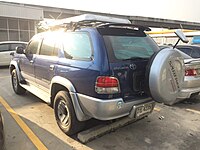 Hilux Sport Rider SR5 Limited 4WD


Engines[edit]
- 1998–2002: 3.0 L (2,986 cc) 5L-E I4 SOHC EFI, 77 kW (105 PS; 103 hp) at 4,000 rpm 200 N⋅m (150 lb⋅ft) at 2,600 rpm
- 1998–2002: 3.0 L (2,986 cc) 5L I4, 72 kW (98 PS; 97 hp) at 4,000 rpm 192 N⋅m (142 lb⋅ft) at 2,400 rpm (Prerunner)
- 2001–2002: 3.0 L (2,982 cc) 1KZ-TE I4 SOHC, 92 kW (125 PS; 123 hp) at 3,600 rpm and 315 N⋅m (232 lb⋅ft) at 2,000 rpm
- 2002–2004: 3.0 L (2,982 cc) 1KD-FTV I4 DOHC, 93 kW (126 PS; 125 hp) at 4,800 rpm and 315 N⋅m (232 lb⋅ft) at 1,800–2,600 rpm
- 2002–2004: 2.5 L (2,494 cc) 2KD-FTV I4 DOHC, 75 kW (102 PS; 101 hp) at 3,600 rpm and 260 N⋅m (190 lb⋅ft) at 1,400–3,400 rpm
Seventh generation (AN10, AN20, AN30; 2004)[edit]
| Seventh generation | |
|---|---|
 2005 Toyota Hilux pre-facelift (KUN26R) | |
| Overview | |
| Model code |
|
| Also called | TruckMasters OX (Finland) |
| Production | August 2004[39] – May 2015 |
| Assembly | |
| Designer | Satoru Oya, Yoshikazu Harada and Takumi Nakamura[47] |
| Body and chassis | |
| Body style |
|
| Layout | |
| Platform | Toyota IMV |
| Related | |
| Powertrain | |
| Engine |
|
| Transmission | |
| Dimensions | |
| Wheelbase |
|
| Length |
|
| Width |
|
| Height |
|
The seventh-generation Hilux (designated the AN10/AN20/AN30), part of the IMV program led by chief engineer Kaoru Hosokawa,[48] started production in Thailand during August 2004.[39] Three pickup truck body variants were initially produced: a two-door Single Cab (referred to by Toyota as IMV1), a two-door Xtra Cab (IMV2), and four-door Double Cab (IMV3).[49] In September 2008, Toyota introduced the Smart Cab, a four-door cab with hidden rear clamshell doors.[50] The IMV program also spawned the Toyota Innova (AN40) minivan (IMV4) and Toyota Fortuner (AN50/AN60) SUV (IMV5).[39][51]
Mainly developed in Thailand, this seventh-generation Hilux was the first to not be produced in Japan.[7] Hilux models sold in Asian, European, Middle Eastern and Oceanian markets were initially built and assembled in Thailand with targeted annual production of 280,000 units, with 140,000 allocated for exports.[52] Later, production was delegated to Malaysia and Southeast Asia in order to increase sales in those regions.[39] In Thailand, the vehicle is called the Hilux Vigo.[49] For other European markets and South Africa, the Hilux was built in Durban, South Africa.[39] Hiluxes sold in Argentina and Brazil were built in Argentina, as with the previous generation Hilux.[53]
The double cab model has an automatic transmission. It uses the same engine as other Asian countries (in-line, 4-cylinder, 16-valve, DOHC Turbo Diesel with common rail direct injection), however engines used in Malaysia differ in their maximum output of 75 kW (102 PS; 101 hp) at 3,600 rpm and maximum torque of 260 N⋅m (192 lb⋅ft) at 1,600–2,400 rpm.
The ladder frame chassis used by the seventh-generation Hilux is 45 percent stiffer compared to its predecessor. Combined with a reduction in the number of welded joints with the use of a unified inner frame, it has a higher torsional stiffness while the vertical rigidity is improved by stronger crossmembers. The model also used a new double wishbone front suspension which was said to improve stability and ride comfort.[54]
The model is also considerably larger than the previous generation Hilux. For the double cab variant, the 2005 model is 400 mm (15.7 in) longer and 45 mm (1.8 in) wider. The deck is 165 mm (6.5 in) longer and both wider and taller by 50 mm (2.0 in). The increased size was achieved without a significant increase in the kerb weight. Drag coefficient is rated 0.36 (0.39 with over fenders), which was claimed to be "class-leading" during the time of its introduction.[54]
In Singapore, the Hilux was available as a single cab with the 2.5 L engine or a double cab with the 3.0 L engine.
This generation of the Hilux was introduced for Argentina on 2 March 2005 in Buenos Aires with a market launch in April.[55]
This generation of the Hilux was also sold in Finland as the TruckMasters OX by Truck Masters Finland. Because of a modified rear suspension, the truck is registered in Finland as a light truck. The OX was only available with a 3.0-litre D-4D diesel engine.[56]
-
 2005 pre-facelift Rear view
 -
 Interior

_SR5_4-door_utility_(2011-04-22).jpg)
Engines[edit]
- 2005 2.0 L petrol VVT-i DOHC I4 (South Africa, Indonesia and Middle East)
- 2005 2.5 L diesel D-4D DOHC I4, Turbo-diesel 76 kW (103 PS; 102 hp) – 107 kW (145 PS; 143 hp) (Asia, Europe, South Africa, South America)
- 2005 2.7 L petrol VVT-i DOHC I4, 119 kW (162 PS; 160 hp) (Australia, Arabian Peninsula, Philippines, South Africa, Venezuela)
- 2005 3.0 L diesel D-4D DOHC I4, Turbo-diesel, common rail 16-valve direct injection, 121 kW (165 PS; 162 hp) (Asia, South Africa, South America, Australia, Europe). This version is made at Toyota's facility in Zárate, Argentina.
- 2005 4.0 L petrol VVT-i DOHC V6, 170–176 kW (231–239 PS; 228–236 hp) (Australia, South Africa, Venezuela, China)
- 2008 4.0 L Supercharged DOHC V6 225 kW (306 PS; 302 hp) (Australia only, TRD Hilux 4000S & 4000SL)[57]
2008 facelift[edit]
A facelifted version of the Hilux was unveiled by Toyota's Malaysian distributors, UMW Toyota Motor, in August 2008. Toyota has introduced a left hand drive Hilux Vigo in August 2008 while a right hand drive facelifted model was introduced in September 2008. These facelifted models were introduced in the Philippines in October 2008.
Toyota also introduced a four-door extended cab called "Smart Cab" to replace all Xtra Cab models in E and G grade. The Smart Cab models were developed in Thailand and were only sold in the Thai market.[50]
-
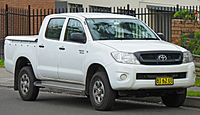 first facelift (front)
 -
 first facelift (rear)
_SR_4-door_utility_(2011-11-30)_01.jpg)
_SR_4-door_utility_(2011-11-30)_02.jpg)
2011 facelift[edit]
On 13 July 2011, Toyota announced that the Hilux would receive a facelift, including a redesigned front end (front grille similar to IMV-based Innova and Fortuner) and other external styling changes, changes to the interior and a new turbocharged diesel engine rated at 107 kW (144 hp) and 343 N⋅m (253 lb⋅ft) of torque, as well as lower fuel consumption compared to the previous model.[58] This update was initially launched in Thailand.[59]
-
 second facelift (front)
 -
 second facelift (rear)
_SR5_4-door_utility_(2015-08-07)_01.jpg)
_SR5_4-door_utility_(2015-08-07)_02.jpg)
Hilux Vigo Champ[edit]
The Hilux Vigo Champ was introduced in Thailand in August 2012 as a significant "minor change" with a new front design and a revamped interior to reinforce perceived luxury. The front was redesigned from the A pillar forwards. With the exception of the doors, roof and tailgate, everything else was new: new guards, new headlights, new bumper, new bonnet, new three-bar grille, new taillights, a new rear bumper and new badges. There were also new mirrors and new alloy wheel designs. The interior features a new upper dashboard design with a new horizontal center instrument cluster. Perceived quality was improved through the adoption of uniformly darker finishes with greater colour consistency throughout the interior. The high-end Double Cab version now came with a DVD player, rear camera and Bluetooth functionality.[60]
This minor update upgraded the emission standard to Euro 4, updated the four-speed automatic transmission to five-speed, upgraded power rating of the 3.0-litre model from 122 to 128 kW (166 to 174 PS; 164 to 172 hp), increased torque from 343 to 360 N⋅m (253 to 266 ft⋅lb) for the five-speed automatic transmission, and the Smart Cab Prerunner 4×2 was introduced with automatic transmission. Other changes included a more efficient fuel injection system and the addition of a center headrest on the rear double cab seat.
The Vigo Champ CNG included the 2.7-litre 2TR-FE bi-fuel engine that could run on compressed natural gas (CNG).
Safety[edit]
The Hilux in its most basic Latin American market configuration with 3 airbags received 5 stars for adult occupants and 5 stars for infants from Latin NCAP in 2015.[61]
Eighth generation (AN110, AN120, AN130; 2015)[edit]
| Eighth generation | |
|---|---|
_SR5_4-door_utility_(2018-09-03)_01.jpg) 2016 Toyota Hilux SR5 (GUN136; pre-facelift) | |
| Overview | |
| Model code |
|
| Also called | TruckMasters OX (Finland) |
| Production | May 2015 – present |
| Assembly | |
| Designer | |
| Body and chassis | |
| Body style |
|
| Layout | |
| Platform | Toyota IMV |
| Related | |
| Powertrain | |
| Engine | |
| Power output | 10 kW (13 hp) electric motor (MHEV)[76] |
| Transmission | |
| Battery | 0.5 kWh, 48V (MHEV)[77] |
| Dimensions | |
| Wheelbase |
|
| Length |
|
| Width | 1,800–1,935 mm (70.9–76.2 in)[78] |
| Height |
|
| Curb weight | 1,955–2,100 kg (4,310–4,630 lb) |
The eighth-generation Hilux was introduced simultaneously on 21 May 2015 in Bangkok, Thailand and Sydney, Australia.[79] It is the first of the Toyota IMV family to receive a new generation, with the related Fortuner and Innova received a new generation in July and November respectively.[80][81][82] In some Asian markets such as Thailand, Laos, Cambodia and Pakistan, the model also adopted a new moniker, Hilux Revo.[83][84]
The model was subsequently introduced in the Philippines in July 2015,[85] Mexico and GCC countries in August 2015,[86][87][88] Argentina and Brazil in November 2015,[89][90] while in Europe specifications was unveiled in September 2015 for a mid-2016 market introduction.[91][92] Introductions of the model in more markets started in 2016. In March 2016, the model was released in South Africa, where it is also produced.[93] In Malaysia, it was launched in May 2016,[94] while in Pakistan it was launched in September 2016.[84] In September 2017, Toyota released the Hilux in Japan for the first time since 2004.[95]
The eighth-generation Hilux features the "Keen Look" design language with a slimmer headlight shape (with optional projector headlights and LED daytime running lights). This design continues into the interior with similar AC vents and center fascia design, which has been described as more "car-like".[96] First for a Hilux, this generation is available with optional autonomous emergency braking system (AEB).[97]
-
 2016 Hilux Invincible (GUN125; pre-facelift)
 -
 Interior


Development[edit]
Development of the vehicle was led by Hiroki Nakajima as a chief engineer, which visited 120 countries during its development. It was reported that in 2011, Toyota started over on the new Hilux just six months into development due to the release of the Volkswagen Amarok and Ford Ranger that reset Toyota's benchmark for "car-like driving". Toyota President and CEO Akio Toyoda personally intervened to set the Hilux on a new development path.[96]
Toyota stated the eighth-generation Hilux received larger cabin space front and rear with 19 mm (0.7 in) extra shoulder room, 8 mm (0.3 in) extra head room, 15 mm (0.6 in) higher seat height and 35 mm (1.4 in) larger rear knee room. It also feature a broader seat adjustment range and a larger 80-litre (17.6 imp gal; 21.1 US gal) fuel tank. It is also equipped with rear air vents as an option, making it one of the few pickups in its segment with rear air vents at the time of its launch.[98]
The front bumper has a bigger bulge to meet new pedestrian safety regulations, while the lower section of the front bumper has been shaped to ensure the Hilux is more agile than its predecessor in off-road conditions. In the Middle East, the Hilux received an optional steel front bumper.[99] The approach angle is 31 degrees and the departure angle is 26 degrees, compared to the previous 30 and 23 respectively.[96]
The new ladder-frame chassis gives the vehicle a 20 percent increase in torsional rigidity compared to the previous generation model.[100] The stronger FIRM (Frame with Integrated Rigidity Mechanism) makes use of high-tensile strength steel and more spot welds. The improved body structure is said to yield lower noise, vibration and harshness levels. It is also equipped with a newly developed Dynamic Control Suspension system and Body Control with Torque Demand.[101]
Three different suspension setups are available for the Hilux for different markets. Vehicles destined for Australia, South Africa, Russia and South America receive an Australian-developed heavy-duty suspension setup that offers improved off-road performance, better vibration suppression and improved roll stiffness. Vehicles sold in Thailand receive a comfort-biased setup due to the large market of pickup trucks for personal use. The third suspension setup is a general setup that is "suited to all road conditions the world over." The suspension setups consist of front double wishbone with a thicker front stabiliser bar and rear leaf spring configuration.[101] It is aimed to give the Hilux a more "car-like" driving experience.[98]
Markets[edit]
Argentina[edit]
As of 2016, the Argentine version has about 40% of locally and 60% of regionally made parts.[102]
Australia[edit]
During its introduction in Australia, the eighth-generation Hilux was offered with 31 variants, eight more than its predecessor, with 4×2 and 4×4, single, extra and double cabin styles, and WorkMate, SR and SR5 grade levels.[101] Toyota has also added Hi-Rider variants for SR and SR5 models, with added ride height, heavy-duty suspensions, larger front ventilated disc brakes and larger rear drum brakes.[103]
Four engine options are offered in the market, ranging from the 2.4-litre turbo-diesel, 2.8-litre turbo-diesel (with different outputs for both 4×2 and 4×4), 2.7-litre petrol and 4.0-litre V6 petrol, and continues to be imported from Thailand.[98]
The Australian specification Hilux offers an upgraded 3,500 kg (7,716 lb) towing capacity (for diesel manual) or 3,200 kg (7,055 lb) for diesel automatic model, while it also offer a payload of up to 1,240 kg (2,734 lb). It comes equipped with a standard reversing camera, up to seven airbags, electronic stability control, trailer sway control and rear parking sensors.
In March 2017, the TRD appearance package became available.[104] In January 2018, Toyota introduced the Hilux Rugged X, Rogue and Rugged variants which was fully designed, developed and engineered in Australia. Based on the double-cab 4×4 Hilux, the three variants are targeted towards "urban adventurers" with off-road related changes and additions.[105][106] The 2020 facelift was presented in August, which also introduced upgraded diesel engines and Toyota Safety Sense.[107]
In September 2022, the Hilux Rogue received upgrades such as wider tracks and fenders, larger 18-inch wheels, rear disc brakes replacing drum brakes and larger front brake discs. It also gained extended front suspension arms, a lengthened rear axle, revised rear dampers, and a rear anti-roll bar, which are claimed to increase the vehicle's roll rigidity by 20 percent.[108]
In January 2023, the GR Sport model became available in Australia with a different styling compared to the Hilux GR Sport in other markets, by sharing many elements with the Hilux Rogue. Powered with the 2.8-litre diesel engine, it received engine upgrades, heavy-duty suspension, wider fenders and wider track.[109]
Europe[edit]
The eighth-generation Hilux entered the European market such as the UK in April 2016 with customer deliveries in July. It was available in Active, Icon, Invincible and Invincible X grade levels and single, extra and double cab body styles. The sole powertrain option is the 2.4-litre diesel engine.[100] The 2020 facelift model received an optional 2.8-litre diesel engine, and a GR Sport variant since 2022.[110][111]
Like the previous generation, this generation has also been sold as the TruckMasters OX in Finland by Truck Masters Finland since 2017. The modified suspension means that the truck is registered as a light truck in Finland, leading to lower taxes.[112]
India[edit]
In India, the Hilux was unveiled in January 2022 and went on sale in late March 2022. Mainly marketed as a "lifestyle utility vehicle",[113] it is offered in Low and High trim levels.[68] Models sold in India are assembled at Toyota Kirloskar Motor's plant in Bidadi, Karnataka and 30 percent of its components are sourced locally.[114]
Japan[edit]
The Hilux was reintroduced in Japan on 12 September 2017, after 13 years of hiatus. Initial orders for the vehicle exceeded 2,000 in the first month of sales.[115] For the Japanese market, the Hilux is imported from Thailand, with only double-cab 4WD configuration available in two trim levels "X" and "Z", both equipped with 2.4-litre 2GD-FTV engine and a 6-speed automatic transmission.
Philippines[edit]
The eighth-generation Hilux was launched in the Philippines in July 2015. It was initially offered in 2.4 Cab & Chassis (manual only), 2.4 J (manual only), 2.4 E (manual only), 2.4 G 4×2 (manual and automatic) and 2.8 G 4×4 (manual and automatic) grades.[116]
In September 2020, the Hilux received a facelift and is offered in 2.4 Cab & Chassis (manual only), 2.4 Cargo (manual only) 2.4 FX (manual only), 2.4 J (available either in 4×2 or 4×4, manual only), 2.4 E 4×2 (manual only), 2.4 G 4×2 (manual and automatic), 2.4 Conquest 4×2 (manual and automatic) and 2.8 Conquest 4×4 (manual and automatic) grades.[117] In August 2022, the Hilux gained a feature list upgrade.[118]
In September 2023, the Hilux GR-S was updated similar to the Australian market.[119]
South Africa[edit]
As of 2016[update], Toyota South Africa Motors (TSAM) would export more than 55,000 Hilux and Fortuner units to 74 countries, including Africa (43 markets), Europe (28 markets) and Latin America (three markets). Hilux vehicles sold in South Africa are marketed as 2.4 and 2.8 GD-6 respectively which signifies engine displacement, the GD engine series and the 6 speed transmission. Exports included right-hand-drive and left-hand-drive variants, and would consist of more than 50 percent of TSAM’s total 2016 Hilux and Fortuner production.[120]
Thailand[edit]
Thailand is the major export hub for the Hilux, with 60 percent of local production allocated for exports as of 2015[update]. Initial plans were to export 186,000 units to over 130 countries with a focus on major markets such as Australia, New Zealand, the Middle East, South America, and UK.[121]
The domestic market model is marketed as the Hilux Revo, which consists of single, extra cab (Smart Cab) and double cabin (Double Cab) body styles, with both Smart Cab and Double Cab model receiving an optional high-riding Prerunner model.[122]
In March 2016, the TRD Sportivo appearance package became available.[123] In November 2017, Hilux Revo Rocco also introduced as the highest grade level. The Rocco features a grey rear bumper bar, 18-inch alloy wheels with all-terrain tyres, a black sports bar with bed liner, Rocco insignia, gloss black grille, black metallic trim on the interior along with a redesigned instrument cluster. The engine and safety features for the Rocco remain unchanged.[124] Since September 2018, the Hilux Revo Rocco is also available with the 2.4-litre diesel engine.[125] In August 2021, the Hilux Revo received GR Sport variants for low-riding and high-riding models.[126][127]
2017 facelift[edit]
A minor redesign of the Hilux was unveiled in November 2017 in Thailand. It features a different front grille styling similar to the North American market Tacoma and a different front bumper with LED fog lights. In Thailand, the redesigned front fascia is only applied to the 4×4 and high-riding 4×2 Prerunner variants, while the entry-level, low-riding 4×2 versions was largely unchanged with minor revisions. In Australia, it was released in August 2018 with the changes restricted to the higher grade levels, SR and SR5, while the basic WorkMate models are unchanged.[128] The rest of the exterior is identical to the initial model.[124] A range-topping Hilux Revo Rocco was also introduced in Thailand, which features exterior accessories.[124]
The Rocco was introduced in Malaysia as Hilux L-Edition in 2018.[129] In the Philippines, the Rocco was introduced in February 2018 as the Conquest.[130] In the UK, this styling was only available for the 'Invincible X' variant,[131] which was launched at the Commercial Vehicle Show on 24 April 2018.[132] In Japan, this model was sold as the Z "Black Rally Edition", which was announced on 12 November 2018 and released on 17 December 2018 to commemorate the 50th anniversary since the launch of the first generation Hilux.[133]
-
 2018 Hilux SR5 4WD (GUN126; 2017 facelift)
 -
 2018 Hilux SR5 4WD (GUN126; 2017 facelift)
_SR5_4x4_Double_Cab_(2018-10-19)_01.jpg)
_SR5_4x4_Double_Cab_(2018-10-19)_02.jpg)
2020 facelift[edit]
In June 2020, Toyota unveiled the second facelift of the AN110/120/130 series Hilux for Asia, Europe and South America. The second facelift model received revised front and rear with LED headlamps and tail-lamps and front LED indicators, a first for the Hilux, and redesigned 18-inch alloy wheels. Revisions inside the interior include a new design for the instrument cluster and the 4.2-inch multi-info display. A more rugged-styled Hilux with larger front grille surface and black fender flares was introduced with different names, such as the Rocco in Thailand and Pakistan, Rogue in Australia and Malaysia,[134] Conquest in the Philippines[135] and South America,[136] Adventure in the UAE,[137] and Invincible X in Europe.
The power and torque figures for 2.8-litre 1GD-FTV diesel engine has been upgraded to 204 PS (150 kW; 201 hp) and 500 N⋅m (51.0 kg⋅m; 369 lb⋅ft) (with automatic transmission), while its 2.4-litre counterpart, the 2GD-FTV diesel engine received a higher-pressure common-rail fuel injection system, along with optimised pistons, piston rings and an uprated alternator to better handle heavier workloads.[134][107]
Dampers on the 4×4 and 4×2 high-riding versions of the 2020 facelift Hilux have been revised for improved ride comfort with less vibration, particularly with less payload. Leaf spring bushings have been updated for better comfort on rough roads, as well as steering response during cornering and lane changes. A self-lubricating rubber for the rear shackle bush is also added for better ride comfort.[107]
For some Southeast Asian markets, the Hilux became available with Toyota Safety Sense. This facelift of the Hilux was introduced in Japan in August 2020 and is offered in base X and Z trim levels.
-
 Hilux Invincible (Europe; 2020 facelift)
 -
 Hilux Rogue (Australia; 2020 facelift)
 -
 Hilux Rogue (Australia; 2020 facelift)


2024 facelift[edit]
The third facelift of the AN110/120/130 series Hilux was introduced in Australia and Indonesia on 1 February 2024.[138][139]
-
 2024 facelift
_front_view.jpg)
GR Sport[edit]
The GR Sport version of the Hilux was first released in São Paulo, Brazil in November 2018.[140] It is based on the flagship SRX variant available in South America with additional stiffer front springs, monotube dampers, Gazoo Racing exterior graphics, a new design honeycomb grille insert with 'Toyota' badging, matte black wheel arch extensions, a black bonnet and roof, side steps, 17-inch alloy wheels with all-terrain tyres, and GR badging, without performance upgrades.[141]
The GR Sport version based on the 2020 facelift model was released in Thailand on 25 August 2021,[126][127] in Japan on 8 October 2021,[142] in the Philippines in October 2021,[143] in Europe in January 2022,[144] in Indonesia in December 2022[145] and in Pakistan in March 2023. The model was also released in South Africa in September 2022, with the 1GD-FTV engine is further upgraded to produce 224 PS (165 kW; 221 hp) and 550 N⋅m (56.1 kg⋅m; 406 lb⋅ft).[146][147]
In January 2023, a specialised GR Sport model for the Australian market was released. It received a different styling compared to the Hilux GR Sport in other markets, with more off-road focused upgrades such as extended wheel-arch fender flares, wider track, heavy-duty suspension, and heavy-duty 'rock sliders' instead of side-steps. Powered with the 2.8-litre diesel engine, it is upgraded to produce 224 PS (165 kW; 221 hp) and 550 N⋅m (56.1 kg⋅m; 406 lb⋅ft).[109]
To commemorate Toyota Gazoo’s 9th Safari Rally victory in 2021, the Hilux GR Safari Rally limited edition was released in Kenya by CFAO Motors Toyota, available in automatic and manual with GR's racing colours (black, red, white).[148]
-
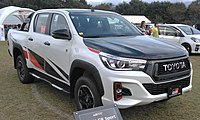 Hilux GR Sport (2017 facelift)
 -
 Hilux GR Sport (2020 facelift)
 -
 Hilux GR Sport (2020 facelift, Europe)
 -
 Hilux GR Sport (2023 facelift, Philippines)
.jpg)


.jpg)
Hilux Revo BEV Concept[edit]
The Hilux Revo BEV Concept is an EV conversion prototype based on the eighth-generation Hilux (Hilux Revo in Thailand) single cab that was presented on 14 December 2022 at the 60th anniversary event of Toyota Motor Thailand.[149]
-
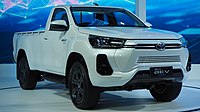 Hilux Revo BEV Concept (Thailand)

Hilux FCEV concept[edit]
The Hilux FCEV concept is a hydrogen powered fuel cell electric vehicle (FCEV) prototype based on the eighth-generation Hilux two-wheel drive space-cab.[150][151] It was unveiled in September 2023 and was developed in the UK at Toyota Manufacturing UK's Burnaston car plant with funding provided by the UK government.[150] The prototype uses the same powertrain as Toyota's full production FCEV the Mirai and has three high-pressure fuel tanks with an expected range of more than 365 miles (587 km).[150][151] Toyota said it would produce ten prototypes for testing by the end of 2023.[150]
Powertrain[edit]
The model is available with the newly developed 2.4-litre and 2.8-litre GD series diesel engines, combined with a 6-speed manual transmission or a 6-speed automatic transmission with sequential shift technology.[152] The manual model, touted as an "intelligent" manual helps eliminate shift shock by matching engine revs to the transmission speed. The 2.8-litre GD engine was introduced in May 2015 at the 36th International Vienna Motor Symposium.[153] The GD engines are equipped common-rail direct-injection, variable-nozzle turbos, exhaust gas recirculation and an optional stop/start system. It is claimed to use 10 percent less fuel than the older KD engines.
The older KD series 2.5-litre along with 3.0-litre diesel engines was offered in several market alongside the newer GD series engines. The 2.0-litre, 2.7-litre and 4.0-litre petrol engines from the previous generation returned with a Dual VVT-i update for increased power and torque.[154][155] As of December 2022[update], the 5L-E engine option is marketed by Toyota Gibraltar Stockholdings along with other distributors in Africa such as Senegal,[156] and for institutional purchase by governmental entities and NGOs accredited by the UN, only with a 5-speed manual transmission and four-wheel drive.[157]
| Model | Engine | Transmission | Power | Torque |
|---|---|---|---|---|
| 2.0 | 2.0 L 1TR-FE inline-4 fuel-injected petrol with Dual VVT-i | 6-speed manual | 104 kW (139 hp) at 5,500 rpm | 185 N⋅m (136 lb⋅ft) at 3,800 rpm |
| 6-speed AC60E/AC60F automatic | ||||
| 2.4 | 2.4 L 2GD-FTV inline-4 common rail diesel with VNT | 5-speed R151 manual | 110 kW (150 hp) at 3,400 rpm | 343 N⋅m (253 lb⋅ft) at 1,400–2,800 rpm |
| 6-speed RC60/RC60F manual | 400 N⋅m (300 lb⋅ft) at 1,600–2,000 rpm | |||
| 6-speed AC60E/AC60F automatic | ||||
| 2.5 | 2.5 L 2KD-FTV inline-4 common rail diesel without intercooler | 5-speed R151 manual | 76 kW (102 hp) at 3,600 rpm | 200 N⋅m (150 lb⋅ft) at 1,600–3,600 rpm |
| 6-speed RC61 manual | 260 N⋅m (190 lb⋅ft) at 1,600–2,400 rpm | |||
| 2.5 | 2.5 L 2KD-FTV inline-4 common rail diesel with VNT | 6-speed manual | 107 kW (144 hp) at 3,400 rpm | 343 N⋅m (253 lb⋅ft) at 1,800–3,400 rpm |
| 5-speed A750F automatic | ||||
| 2.7 | 2.7 L 2TR-FE inline-4 fuel-injected petrol with Dual VVT-i | 6-speed manual | 120 kW (160 hp) at 5,500 rpm | 246 N⋅m (181 lb⋅ft) at 3,800 rpm |
| 6-speed AC60E/AC60F automatic | ||||
| 2.8 | 2.8 L 1GD-FTV inline-4 common rail diesel with VNT | 5-speed R151 manual | 130 kW (170 hp) | 343 N⋅m (253 lb⋅ft) at 1,200–3,400 rpm |
| 6-speed RC61 manual / RC61F iMT (Intelligent Manual Transmission) manual (Thailand) | 132 kW (177 hp) at 3,400 rpm 2nd facelift: 150 kW (201 hp) at 3,400 rpm GR Sport (South Africa/Australia): 165 kW (221 hp) at 3,400 rpm |
420 N⋅m (310 lb⋅ft) at 1,400–2,600 rpm 2nd facelift: 420 N⋅m (310 lb⋅ft) at 1,400–3,400 rpm | ||
| 6-speed AC60E/AC60F automatic | 450 N⋅m (330 lb⋅ft) at 1,600–2,400 rpm 2nd facelift: 500 N⋅m (370 lb⋅ft) at 1,600–2,800 rpm GR Sport (South Africa/Australia): 550 N⋅m (410 lb⋅ft) at 1,600–2,800 rpm | |||
| 3.0 | 3.0 L 5L-E inline-4 naturally aspirated diesel |
5-speed manual | 71 kW (95 hp) at 4,000 rpm | 197 N⋅m (145 lb⋅ft) at 2,200 rpm |
| 3.0 | 3.0 L 1KD-FTV inline-4 common rail diesel with VNT |
6-speed RC61 manual | 122 kW (163 hp) at 3,400 rpm | 343 N⋅m (253 lb⋅ft) at 1,600–3,400 rpm |
| 5-speed A750F automatic | 360 N⋅m (270 lb⋅ft) at 1,800–3,400 rpm | |||
| 4.0 | 4.0 L 1GR-FE V6 fuel-injected petrol with VVT-i | 6-speed RC61 manual | 175 kW (235 hp) at 5,200 rpm | 376 N⋅m (277 lb⋅ft) at 3,700 rpm |
| 6-speed AC60E/AC60F automatic |
Safety[edit]
The updated Hilux in its most basic Latin American market configuration with 7 airbags received 5 stars for adult occupants and 5 stars for infants from Latin NCAP in 2019.[158]
Hilux Champ (2023)[edit]

The Toyota Hilux Champ is a two-door pickup truck or chassis cab positioned below the Hilux, and based on the IMV platform and chassis shared with the Hilux. It was first previewed as the IMV 0 concept in December 2022, and went on sale as the Hilux Champ in Thailand in November 2023.[159]
Production and sales[edit]
Worldwide production[edit]
| Year | Production[2] |
|---|---|
| 1968 | 33,708 |
| 1969 | 48,041 |
| 1970 | 69,787 |
| 1971 | 77,865 |
| 1972 | 79,523 |
| 1973 | 75,541 |
| 1974 | 78,727 |
| 1975 | 115,466 |
| 1976 | 137,101 |
| 1977 | 215,696 |
| 1978 | 224,113 |
| 1979 | 237,309 |
| 1980 | 306,063 |
| 1981 | 302,580 |
| 1982 | 333,103 |
| 1983 | 345,117 |
| 1984 | 432,871 |
| 1985 | 461,253 |
| 1986 | 440,905 |
| 1987 | 383,688 |
| 1988 | 394,468 |
| 1989 | 374,387 |
| 1990 | 362,147 |
| 1991 | 344,501 |
| 1992 | 387,279 |
| 1993 | 405,752 |
| 1994 | 425,999 |
| 1995 | 384,571 |
| 1996 | 387,571 |
| 1997 | 351,417 |
| 1998 | 353,340 |
| 1999 | 358,793 |
| 2000 | 343,646 |
| 2001 | 363,354 |
| 2002 | 396,013 |
| 2003 | 276,172 |
| 2004 | 323,625 |
| 2005 | 370,191 |
| 2006 | 428,616 |
| 2007 | 508,132 |
| 2008 | 491,702 |
| 2009 | 438,812 |
| 2010 | 548,889 |
| 2011 | 518,274 |
| 2012 | 745,303 |
| 2013 | 732,661 |
| 2014 | 648,930 |
| 2015 | 597,899 |
| 2016 | 537,474 |
| 2017 | 520,742 |
In 2017, Toyota reported the Hilux sold around 521,000 units in 190 countries, with production in 6 countries. 167,000 units were sold in Asia, 116,000 in South America, 65,000 in the Middle East, 55,000 in Africa, 51,000 in Oceania, 41,000 in Europe, 19,000 in North America, and around 1,000 in Japan. In the same year, 310,500 units were produced in Thailand, 103,000 produced in Argentina, 76,500 produced in South Africa, 18,200 produced in Malaysia, 6,500 produced in Pakistan, and 600 produced in Venezuela.[2]
Sales[edit]
| Year | Thailand | Australia | New Zealand | Philippines | Malaysia[160][i] | South Africa | Brazil | Argentina | Mexico[161] | Saudi Arabia |
|---|---|---|---|---|---|---|---|---|---|---|
| 2000 | 3,647 | |||||||||
| 2001 | 3,052 | |||||||||
| 2002 | 3,255 | |||||||||
| 2003 | 6,814 | |||||||||
| 2004 | 7,303 | |||||||||
| 2005 | 9,433 | |||||||||
| 2006 | 166,358[162] | 36,885[163] | 11,405 | |||||||
| 2007 | 158,348[162] | 42,009[163] | 11,020 | |||||||
| 2008 | 127,028[162] | 42,956[164] | 12,500 | 21,731[165] | ||||||
| 2009 | 102,026[162] | 38,457[166] | 14,574 | 30,994[167] | ||||||
| 2010 | 144,190[162] | 39,896[168] | 18,515 | 33,656[169] | ||||||
| 2011 | 121,887[162] | 36,124[170] | 21,481 | 33,260[171] | ||||||
| 2012 | 233,293[162] | 40,646[170] | 28,571 | 38,889[172] | 5,499 | |||||
| 2013 | 206,939[162] | 39,931[173] | 27,157 | 42,627[174] | 9,120 | |||||
| 2014 | 144,693[175] | 38,126[176] | 25,716 | 43,310[177] | 8,783 | |||||
| 2015 | 120,112[178] | 35,161[176] | 5,623[179] | 27,158 | 35,684[180] | 32,684[181] | 10,504 | |||
| 2016 | 120,444[182] | 42,104[183] | 6,187[184] | 12,405[185] | 18,477 | 35,428[186] | 34,031[187] | 13,644 | ||
| 2017 | 109,988[188] | 47,093[183] | 8,106[189] | 14,688[190] | 17,928 | 36,422[191] | 34,378[192] | 33,914[193] | 19,132 | |
| 2018 | 150,928[162] | 51,705[194] | 8,086[195] | 18,237[196] | 19,736 | 40,022[197] | 39,313[198] | 33,439[199] | 18,943 | |
| 2019 | 165,452[200] | 47,759[201] | 7,126[202] | 20,846[203] | 15,796 | 40,934[204] | 40,408[205] | 25,087[206] | 17,654[207] | 24,046[208] |
| 2020 | 129,893[209] | 45,176[210] | 5,796[211] | 10,642[212] | 14,204 | 31,263[213] | 32,395[214] | 19,064[215] | 13,666 | 21,838[216] |
| 2021 | 127,669[217] | 52,801[218] | 8,430[219] | 18,969[220] | 18,151 | 36,085[221] | 45,897[222] | 27,072[223] | 16,635[224] | 16,993[225] |
| 2022 | 148,101[226] | 64,391[227] | 9,787[228] | 24,537[229] | 26,906 | 32,203[230] | 48,565[231] | 24,628[232] | 20,842[233] | |
| 2023 | 106,601[234] | 61,111[235] | 8,054[236] | 25,958[237] | 37,382[238] | 46,206[239] | 30,694[240] | 18,117[241] |
- ^ Malaysian figures based on registration
Reputation[edit]
The Hilux has often been described as having a high level of durability and reliability during sustained heavy use or even abuse.[242][243][244]
This reputation was highlighted in several episodes of the BBC motoring show Top Gear. In series 3, episodes 5 and 6, a 1988 diesel N50 Hilux with 305,775 km (190,000 mi) on the odometer was subjected to considerable abuse, including being left on a beach for the incoming tide, left on top of a building as it was demolished, and being set on fire.[245][246] The Hilux suffered severe structural damage, but was still running after being repaired with only the typical tools that would be found in a truck's toolbox (with the exception of a replaced windscreen for the driver's safety).[247] In later series, this Hilux became one of the background decorations in the Top Gear studio, and is now on display in the "World of Top Gear" exhibit at the National Motor Museum, Beaulieu.[248] In the later series 8, episode 3, a Hilux was chosen by Jeremy Clarkson as his platform for creating an amphibious vehicle (though by the end of that episode the Hilux failed to start), and in the Top Gear: Polar Special Clarkson and James May raced a specially modified 2007 model Hilux to the magnetic north pole from Northern Canada – making that truck the first motor vehicle to have made that journey. The camera crew's vehicle from this episode was later modified and driven to near the summit of the Eyjafjallajökull erupting Icelandic volcano by James May, in Series 15, Episode 1.
In 1999, the Hilux appeared in a series of "Bugger" television advertisements in New Zealand and Australia, exaggerating its power and durability for comic effect.[249][250] The adverts were banned in New Zealand after receiving 120 complaints, but later reinstated.[251]
A world record was achieved by the support crew for the participants in the 2008/2009 Amundsen Omega 3 South Pole Race. The crew traveled in specially adapted Toyota Hiluxes modified by Arctic Trucks, completing a trip of over 5,000 km (3,100 mi) from Novo, a Russian Scientific Station in Antarctica to the Geographic South Pole and back again, making them the first 4×4s to reach the South Pole.[252] The return journey of 2,500 km (1,600 mi) from the South Pole to Novo Station was completed in a record 8 days and 17 hours.
Racing[edit]
.jpg)
Two Hilux pickups entered the Dakar Rally in 2012, prepared by the Imperial Toyota team of South Africa. Driver Giniel de Villiers achieved third place in the 2012, second place overall in the 2013, 4th in the 2014, and again second place in the 2015. These however, were heavily modified non-production versions built around a custom racing-only tubular chassis and using a larger capacity Toyota V8 engine.[253] Since 2016, the Dakar Rally Hilux has been prepared by Toyota Gazoo Racing WRT. Giniel achieved third place with it in 2016, 5th in 2017, 3rd in 2018 and 9th in 2019. Nasser Al-Attiyah won the 2019 Dakar Rally, earning the first ever Toyota victory in the Dakar Rally, he also came in second in 2018 and 2021. In the 2020 Dakar Rally, six Hilux cars were entered prepared by Gazoo Racing, and another nine by Overdrive Racing. A new, wider, heavier, featuring larger wheels Toyota GR DKR Hilux T1+ was built by Gazoo Racing for 2022 Dakar Rally, equipped with 3.5l twin-turbo V6 engine, based on Toyota Land Cruiser 300 GR Sport.[254]
Use by militant groups[edit]
.jpg)
Due to its durability and reliability, the Toyota Hilux, along with the larger Toyota Land Cruiser (J70), has become popular among militant groups in war-torn regions as a technical.[255] According to terrorism analyst Andrew Exum, the Hilux is "the vehicular equivalent of the AK-47. It's ubiquitous to insurgent warfare."[256] U.S. counter-terror officials have inquired with Toyota how the Salafi jihadist extremist group Islamic State has apparently acquired large numbers of Toyota Hiluxes and Land Cruisers. Mark Wallace, the CEO of the Counter Extremism Project said, "Regrettably, the Toyota Land Cruiser and Hilux have effectively become almost part of the ISIS brand."[257]
The Toyota War between Libya and Chad in 1986 and 1987 was named as such because of the heavy, successful use of Hilux and Land Cruiser trucks for technicals.[256]
References[edit]
- ^ ブリスカ [Briska] (in Japanese). 日野自動車・車図鑑 [Hino Motors, Image Gallery]. 29 November 2009. Archived from the original on 20 May 2013. Retrieved 22 May 2012.
- ^ a b c "Hilux by the Numbers". Toyota. Retrieved 8 July 2021.
- ^ Hasham, Nicole (10 April 2019). "Toyota scuppers claim Labor's electric vehicle policy would leave HiLux drivers stranded". The Canberra Times. Archived from the original on 10 April 2019. Retrieved 10 April 2019.
- ^ a b c d "1st to 4th generation Hilux Chief Engineers | Hilux 50th Anniversary Special Website" (Press release). Japan: Toyota. 21 May 2018. Archived from the original on 28 January 2019. Retrieved 28 January 2019.
- ^ a b c d "Toyota Announces Full Model Change in Hi-Lux Small Pick-up Truck Series" (Press release). Japan: Toyota. 1 September 1978. Archived from the original on 28 January 2019. Retrieved 28 January 2019.
- ^ a b c d e f g h i j "Toyota Vehicle Identification Manual". Toyota Motor Sale Co., Ltd. – Export Parts Department. 1984. 97913-84.
{{cite journal}}: Cite journal requires|journal=(help) - ^ a b "Evolution from 1st gen to 8th gen". Toyota Motor Corporation Official Global Website. 21 March 2018. Retrieved 31 August 2022.
- ^ Toyota Commercial Cars (Catalog), Toyota, 1969, p. 7
- ^ a b Ruiz, Marco (1986). 'The Complete History of the Japanese Car: 1907 to the Present. Rome: ERVIN srl. p. 166. ISBN 0-517-61777-3.
- ^ "Item 4. Expansion of Sales Networks in the United States". Toyota Motor Corporation. Archived from the original on 7 April 2022. Retrieved 28 June 2021.
- ^ "Toyota's TABC Plant Celebrates 40 Years of Manufacturing in California". Toyota Motor North America (Press release). 21 August 2012. Archived from the original on 4 June 2021. Retrieved 2 June 2021.
- ^ Robes Meeks, Karen (21 August 2012). "Toyota celebrates 40th anniversary of Long Beach auto body factory". Daily Breeze. Archived from the original on 3 June 2021. Retrieved 1 June 2021.
- ^ Dolan, Matthew (23 September 2009). "To Outfox the Chicken Tax, Ford Strips Its Own Vans". Wall Street Journal. Archived from the original on 10 March 2022. Retrieved 20 April 2022.
- ^ Ikenson, Daniel J. (18 June 2003). "Ending the 'Chicken War': The Case for Abolishing the 25 Percent Truck Tariff". Cato Institute. Archived from the original on 19 April 2021. Retrieved 20 April 2022.
- ^ a b 愛される車づくり。トヨタはあすにいどみます。 [Lovable car manufacture. Toyota dares to defy tomorrow.] (catalog) (in Japanese), Toyota Motor Co., 1972, pp. 5–6
- ^ Wright, Cedric, ed. (September 1978). "Toyota Hi-Lux 2000 Automatic". CAR. Vol. 22, no. 78. South Africa: Ramsay, Son & Parker (Pty) Ltd. pp. 76–77.
- ^ "自動車ガイドブック: Japanese motor vehicles guide book" (in Japanese). 20. Japan: Japan Automobile Manufacturers Association. 30 October 1973: 227.
{{cite journal}}: Cite journal requires|journal=(help) - ^ "Tahara Plant". Toyota Motor Corporation. 2012. Archived from the original on 2 August 2013. Retrieved 18 July 2014.
- ^ a b c "自動車ガイドブック [Japanese Motor Vehicles Guide Book]" (in Japanese). 25. Japan: Japan Automobile Manufacturers Association. 10 October 1978: 109. 0053-780025-3400.
{{cite journal}}: Cite journal requires|journal=(help) - ^ a b Toivonen, Rauno, ed. (18 October 1979). "Lyhyesti: Hi-Lux" [In Brief: Hi-Lux]. Tekniikan Maailma (in Finnish). Vol. 35, no. 17/79. Helsinki: TM-Julkaisu. p. 142. ISSN 0355-4287.
- ^ Boyce, David, ed. (1981), What car is that? : in Australia & New Zealand, Adelaide, Australia: Rigby, p. 174, ISBN 0727014803
- ^ Boyce, p. 175
- ^ "Dual Case Setup". Marlin Crawler. Archived from the original on 28 January 2013. Retrieved 9 April 2011.
- ^ a b c d e "Pickups and Mini-Trucks". Pickups and Mini-Trucks. 1 (5). Hot Rod Magazine: 36. 1983.
- ^ Meurer, Stany (28 April 1983). "Dossier Pick-up" [The pickup file]. De AutoGids (in Flemish). 4 (94). Brussels, Belgium: Uitgeverij Auto-Magazine: 45.
- ^ McCamish, Brian. "Hilux 1984–1988". Brian894x4.com. Archived from the original on 15 February 2012. Retrieved 22 May 2012.
- ^ "Shigeo Asai, Chief Engineer for the 5th generation Hilux | Hilux 50th Anniversary Special Website" (Press release). Japan: Toyota. 25 September 2018. Archived from the original on 28 January 2019. Retrieved 28 January 2019.
- ^ a b Inama, John (24 November 2015). "Old vs. New: 1995 Toyota Tacoma vs. 2016 Toyota Tacoma". The Fast Lane Truck. Archived from the original on 5 September 2016. Retrieved 1 September 2016.
- ^ Rex, Rainer, ed. (July 1989), Lastauto Omnibus Katalog 1990 [Truck and bus catalog] (in German), vol. 19, Motor-Presse-Verlag GmbH und Co. KG, p. 151, 81531/89001
- ^ Mastrostefano, Raffaele, ed. (1990). Quattroruote: Tutte le Auto del Mondo 1990 (in Italian). Milano: Editoriale Domus S.p.A. p. 1332.
- ^ a b Siegel, Stewart (July 1990). "The New Models for 1991: Light Trucks". Fleet Owner. Vol. 85, no. 7. FM Business Publications. p. 62.
- ^ Stewart, Megan. "20 Years of the Toyota Tacoma and Beyond: A Look Through the Years". Motor Trend. Retrieved 10 May 2023.
- ^ a b "Malaysian Market: Production Volume Rises to 500,000-unit Level; Forecast to Reach 600,000 by End of Decade". MarkLines. 7 June 2005. Archived from the original on 30 December 2015.
- ^ Venter, Irma (8 February 2002). "Japanese carmarker to raise SA content". www.engineeringnews.co.za. Retrieved 4 December 2022.
- ^ "Cumulative Toyota Production in Pakistan Reaches 500,000 Units | Toyota Motor Corporation Official Global Website". global.toyota. Retrieved 14 February 2021.
- ^ "Masaaki Ishiko, Chief Engineer for the 6th generation Hilux | Hilux 50th Anniversary Special Website" (Press release). Japan: Toyota. 26 July 2018. Archived from the original on 28 January 2019. Retrieved 28 January 2019.
- ^ "Toyota Hilux Utility Review (Mk.6: 1997-05)". AustralianCar.Reviews. Australia. Retrieved 12 July 2020.
- ^ "Detailed Specs of Thailand-made Hilux Tiger 1998–2004". Archived from the original on 11 March 2009. Retrieved 5 September 2008.
- ^ a b c d e f g h i j k "Toyota IMV Sales Reach Global 5 Million-unit Mark" (Press release). Toyota Motor Corporation. 6 April 2012. Archived from the original on 30 October 2015. Retrieved 30 December 2015.
- ^ "Toyota rumo ao topo do mundo" [Toyota towards the top of the world] (in Portuguese). Istoé Dinheiro. 16 March 2005. Archived from the original on 30 December 2015.
- ^ "Kereta CKD Malaysia" [Malaysia CKD cars] (in Malay). ArenaKereta. 12 October 2013. Archived from the original on 27 August 2014.
- ^ "Company profile". Indus Motors Company. Archived from the original on 7 February 2015.
- ^ Young, Angelo (19 August 2013). "About 30,000 South Africa Auto Workers Walk Off The Job; Toyota, GM, Ford Auto Exports Affected; BMW Strike Enters Second Week". International Business Times. Archived from the original on 30 December 2015.
- ^ Pettendy, Marton (17 October 2011). "Thai floods halt Aussie ute supplies". GoAuto. Archived from the original on 4 March 2016. Retrieved 30 December 2015.
- ^ "Activities by Region, Latin America". Toyota Motor Corporation. 2012. Archived from the original on 22 December 2015. Retrieved 30 December 2015.
- ^ "Overview of Overseas Production Affiliates, Latin America". Toyota Motor Corporation. 2012. Archived from the original on 4 March 2016. Retrieved 30 December 2015.
- ^ "Truck". IPOPHL Patent Search. Retrieved 18 January 2022.
- ^ "Kaoru Hosokawa, Chief Engineer for the 7th generation Hilux | Hilux 50th Anniversary Special Website" (Press release). Japan: Toyota. 25 May 2018. Archived from the original on 27 January 2019. Retrieved 28 January 2019.
- ^ a b "IMV Project Production Vehicles". Toyota Motor Corporation. 2012. Archived from the original on 15 November 2015. Retrieved 30 December 2015.
- ^ a b "Thailand: Planned Production Capacity in the Country Amounting to Roughly 2.6 Million a Year in 2015". MarkLines. 4 November 2008. Archived from the original on 30 December 2015.
- ^ "Toyota's IMV Project Takes First Big Step Forward". Toyota Motor Corporation Official Global Website. 25 August 2004. Retrieved 31 August 2022.
- ^ Mulia, Joni Lono (11 September 2004). "Kiprah IMV pertama lewat pikap" [First IMV story through a pickup]. Auto Bild Indonesia (in Indonesian) (36 ed.). Indonesia: Kompas Gramedia.
- ^ "Toyota Argentina Unveils New Hilux Pickup" (Press Release). Toyota Motor Corporation. 2 March 2005.
- ^ a b "2005 Toyota Hilux". Toyota (Press release). Europe. 14 September 2005. Retrieved 2 September 2022.
- ^ "Toyota Argentina Unveils New Hilux Pickup" (Press release). Japan: Toyota Motor Corporation. 2 March 2005. Archived from the original on 2 May 2014. Retrieved 2 May 2014.
- ^ "TruckMasters OX nyt tarjous hintaan!". Archived from the original on 22 March 2017. Retrieved 21 March 2017.
- ^ The New TRD Hilux (sales brochure), Toyota Motor Corporation Australia Limited, April 2008.
- ^ "Official: Toyota Hilux pickup gets fresh skin, more power for 2012". Autoblog. 13 July 2011. Archived from the original on 16 July 2011. Retrieved 13 July 2011.
- ^ "Toyota Hilux Vigo ::: Double Cab". Archived from the original on 11 August 2011.
- ^ "New Features in 2013 Toyota Hilux Vigo Champ" (Press release). Thailand: Jim's Autos Worldwide. Archived from the original on 3 October 2017. Retrieved 4 October 2017.
- ^ "Official results of the Toyota Hilux / SW4 / Fortuner + 3 Airbags 2015". Latin NCAP - Para Autos Mas Seguros.
- ^ "Thai-made Toyota Hilux off to Japan after 13 years". The Nation Thailand. 24 November 2017. Retrieved 14 February 2021.
- ^ Venter, Irma. "Toyota SA opens R6.1bn Fortuner, Hilux assembly lines". www.engineeringnews.co.za. Retrieved 14 February 2021.
- ^ "Toyota: 20 years of production in Argentina | News | Press". ADEFA. Retrieved 14 February 2021.
- ^ "No prices increase for Toyota CKD Models". The Malaysian Reserve. 28 February 2020. Retrieved 14 February 2021.
- ^ "OEM Plant Details:Indus Motor Company Ltd. (IMC)". www.marklines.com. Retrieved 7 February 2022.
- ^ "Toyota Pakistan Increases Yaris, Corolla and IMV Prices". PakWheels Blog. 14 April 2020. Retrieved 7 February 2022.
- ^ a b Mondal, Saptarshi (20 January 2022). "India-spec Toyota Hilux revealed; price announcement in March". Autocar India.
- ^ "Toyota begins Hilux production in Myanmar following delays". Autodeal.com.ph. 13 October 2022.
- ^ "Design 201510160 | Registration 362714". Australian Government IP Australia. Retrieved 31 August 2022.
- ^ "Design 201510148 | Registration 362426". Australian Government IP Australia. Retrieved 31 August 2022.
- ^ "Design 201510147 | Registration 362425". Australian Government IP Australia. Retrieved 31 August 2022.
- ^ "A00201904254". DGIP.go.id. Pangkalan Data Kekayaan Intelektual. 31 August 2020. Retrieved 25 January 2022.
- ^ Brown, David (27 October 2020). "Designing the Hilux by Peter Elliot Toyota Design". AnyAuto. Retrieved 11 April 2022.
- ^ "LAN125L-DNMXEN - Hilux LHD 3.0L Diesel 6 seater". Toyota Gibraltar Stockholdings Ltd. Archived from the original on 9 January 2018. Retrieved 8 August 2018.
- ^ "The new Toyota HiLux Hybrid 48V is changing the game for pickup trucks".
- ^ "The new Toyota HiLux Hybrid 48V is changing the game for pickup trucks".
- ^ "Hilux specifications" (PDF). Archived from the original (PDF) on 11 April 2022.
- ^ Sze, Gregory (5 May 2015). "2016 Toyota Hilux pick-up slated for May 21 debut". Malaysia: PaulTan.org. Archived from the original on 9 May 2015. Retrieved 5 May 2015.
- ^ "2016 Toyota Hilux/2016 Fortuner pickup engine details leaked". Indian Autos Blog. 25 April 2015. Retrieved 31 August 2022.
- ^ Lee, Jonathan (16 July 2015). "2016 Toyota Fortuner debuts in Thailand, from RM133k". Paul Tan's Automotive News. Retrieved 31 August 2022.
- ^ Lye, Gerard (13 November 2015). "2016 Toyota Innova officially revealed in Indonesia". Paul Tan's Automotive News. Retrieved 31 August 2022.
- ^ "Toyota Hilux Revo | Everlasting Toughness". www.toyota.com.la. Retrieved 31 August 2022.
- ^ a b Zarar, Syed (29 September 2016). "Toyota Launches Hilux Revo in Pakistan". Retrieved 31 August 2022.
- ^ "Toyota Launches 2015 Hilux: A New Era for Pickup Trucks (w/ Specs, Video)". CarGuide.PH. Retrieved 31 August 2022.
- ^ Bureau, Marcos (26 August 2015). "Toyota Hilux 2016: Precios,versiones y equipamiento en México". Motorpasión México (in Spanish). Retrieved 31 August 2022.
- ^ "Al-Futtaim launches all-new Toyota Hilux in UAE". tradearabia.com. Retrieved 1 September 2022.
- ^ "Toyota unveils eighth generation Hilux pickup in Mideast". The Peninsula. Qatar. 24 August 2015. Retrieved 1 September 2022.
- ^ "Toyota apresenta nova Hilux 2016 para o Brasil - veja versões e preços". Motor1.com (in Brazilian Portuguese). Retrieved 31 August 2022.
- ^ Panzera, Daniel (9 November 2015). "Nueva Toyota Hilux: versiones, equipamiento y precios". 16 Valvulas (in Spanish). Retrieved 31 August 2022.
- ^ "2016 Toyota Hilux - European-specification detailed - paultan.org". Paul Tan's Automotive News. 23 September 2015. Retrieved 31 August 2022.
- ^ "2016 Toyota Hilux pickup launches in France". Indian Autos Blog. 1 May 2016. Retrieved 31 August 2022.
- ^ "Toyota Hilux launches in South Africa - Motoring News and Advice". www.autotrader.co.za. Retrieved 31 August 2022.
- ^ "2016 Toyota Hilux makes its official debut in Malaysia - six variants, priced from RM90k to RM134k - paultan.org". Paul Tan's Automotive News. 5 May 2016. Retrieved 31 August 2022.
- ^ "Toyota Reintroduces Hilux into Japanese Market after 13-year Hiatus". Toyota Motor Corporation Official Global Website. Retrieved 31 August 2022.
- ^ a b c Dowling, Joshua (28 September 2015). "Is this man's new best friend? Everything you need to know about the new Toyota HiLux, with built-in esky". News.com.au. Retrieved 31 August 2022.
- ^ Maric, Paul (23 April 2015). "2016 Toyota HiLux engine details leaked, ute to debut autonomous emergency braking". Car Advice. Australia. Archived from the original on 26 April 2015. Retrieved 29 April 2015.
- ^ a b c "2016 Toyota HiLux details, October launch in Australia". Drive. 21 May 2015. Retrieved 31 August 2022.
- ^ "New Hilux: New Global Favourite". Toyota Oman. Retrieved 31 August 2022.
- ^ a b "2016 Toyota Hilux price and specification". Toyota UK Magazine. 29 April 2016. Retrieved 31 August 2022.
- ^ a b c Tan, Jonathan James (21 May 2015). "2016 Toyota Hilux - eighth-gen officially unveiled". Paul Tan's Automotive News. Retrieved 31 August 2022.
- ^ Panzera, Daniel (9 February 2016). "Toyota Argentina: La nueva Toyota Hilux puede llegar a todos los mercados". 16 Valvulas.
- ^ Chin, Graham (29 September 2015). "2016 Toyota Hilux - Australian-specs, variants detailed". Paul Tan's Automotive News. Retrieved 31 August 2022.
- ^ Lee, Jonathan (31 March 2017). "Toyota Hilux with TRD accessories now in Australia". Paul Tan's Automotive News. Retrieved 31 August 2022.
- ^ Tong, Matthew H (10 January 2018). "2018 Toyota Hilux facelift - OZ gets 3 hardcore models". Paul Tan's Automotive News. Retrieved 31 August 2022.
- ^ Lim, Anthony (17 April 2018). "Toyota launches Hilux Rugged X, Rogue and Rugged variants in Australia - aimed at urban adventurers". Paul Tan's Automotive News. Retrieved 31 August 2022.
- ^ a b c "2020 Toyota Hilux arrives in Australia - gains updated 201 hp/500 Nm 2.8L turbodiesel, Toyota Safety Sense - paultan.org". Paul Tan's Automotive News. 13 August 2020. Retrieved 31 August 2022.
- ^ "2023 Toyota HiLux Rogue price and specs". Drive. 6 September 2022. Retrieved 6 September 2022.
- ^ a b "2023 Toyota HiLux GR Sport unveiled, due in Australia this year". Drive. 5 January 2023. Retrieved 10 February 2023.
- ^ "Facelifted 2020 Toyota Hilux: UK prices and specs revealed". Auto Express. Retrieved 31 August 2022.
- ^ Hubbard, CJ (25 May 2022). "Toyota Hilux GR Sport: top-spec 204hp pickup with added attitude". Parkers. Retrieved 31 August 2022.
- ^ "Täysin uusi TruckMasters OX Premium tulossa keväällä 2017" [Totally new TruckMasters OX Premium coming in autumn 2017] (in Finnish). Archived from the original on 21 August 2017. Retrieved 21 August 2017.
- ^ HT Auto Desk (20 January 2022). "Toyota unveils Hilux lifestyle utility vehicle in India". HindustanTimes.com. India: Hindustan Times. Retrieved 24 January 2022.
- ^ "All That You Need To Know About Toyota Hilux". Moneycontrol. 20 January 2022. Retrieved 21 January 2022.
- ^ "Toyota Reintroduces Hilux into Japanese Market after 13-year Hiatus, Land Cruiser Prado undergoes partial redesign and FJ Cruiser launches with special specifications" (Press release). Japan: Toyota. 12 September 2017. Archived from the original on 1 December 2017. Retrieved 25 November 2017.
- ^ "Toyota Launches 2015 Hilux: A New Era for Pickup Trucks (w/ Specs, Video)". CarGuide.PH. 31 July 2015. Retrieved 26 April 2022.
- ^ "Toyota Motor PH Brings Its A-Game with 2021 Hilux (w/ Brochure)". CarGuide.PH. 12 September 2020. Retrieved 26 April 2022.
- ^ "Toyota Motor PH Bumps Up Specs, Prices Of Hilux For 2023". CarGuide.PH. 31 August 2022.
- ^ "Toyota Motor PH Revises 2024 Hilux Line-Up (w/ Specs)". CarGuide.ph. Philippines. 13 September 2023. Retrieved 16 September 2023.
- ^ Lilleike, Gero (25 May 2016). "Toyota Invests R6.1 billion in Local Hilux and Fortuner Production". Cars.co.za. Retrieved 31 August 2022.
- ^ "2015 Toyota Hilux pickup exports commence in Thailand". Indian Autos Blog. 8 July 2015. Retrieved 31 August 2022.
- ^ "Toyota Hilux Revo Prerunner & 4x4 2022 รถกระบะยกสูงอเนกประสงค์" [Toyota Hilux Revo Prerunner & 4x4 2022 high lift pickup, 2 and 4 wheel drive, starting price 740,000 baht]. kapook.com. 15 August 2022. Retrieved 31 August 2022.
- ^ Aaron, Chris (22 March 2016). "New Toyota Hilux TRD Sportivo introduced in Bangkok". Paul Tan's Automotive News. Retrieved 31 August 2022.
- ^ a b c Lee, Jonathan (14 November 2017). "2018 Toyota Hilux facelift gets new Tacoma-style face". Paul Tan's Automotive News. Retrieved 31 August 2022.
- ^ Tan, Danny (6 September 2018). "Thai Toyota Hilux Revo Rocco now available as a 2.4L". Paul Tan's Automotive News. Retrieved 31 August 2022.
- ^ a b Lee, Jonathan (25 August 2021). "2021 Toyota Hilux GR Sport launched in Thailand – high- and low-rider versions, 2.8L, RM113k-RM166k". paultan.org. Malaysia. Retrieved 25 August 2021.
- ^ a b "Toyota Hilux Revo GR Sport First Asia Debut in Thailand Introducing the globally popular pickup truck with a touch of sports car-style, developed by Thai engineers" (Press release). Thailand: Toyota Motor. 25 August 2021. Retrieved 25 August 2021.
- ^ "Toyota HiLux 2018 facelift revealed". CarsGuide. Retrieved 31 August 2022.
- ^ Lye, Gerard (14 March 2018). "2018 Toyota Hilux facelift debuts in Malaysia with two L-Edition models – 2.4L and 2.8L, from RM119,300". Paul Tan's Automotive News. Retrieved 17 February 2022.
- ^ "2018 Toyota HiLux gets new top-spec 'Conquest' in the Philippines". autoindustriya.com. Philippines. 18 January 2018. Archived from the original on 23 September 2018. Retrieved 23 September 2018.
- ^ Gibson, Dean (28 November 2018). "New Toyota Hilux Invincible X 2018 review". Auto Express. Autovia Ltd. Retrieved 26 June 2021.
- ^ Hubbard, CJ (24 April 2018). "Toyota Hilux Invincible X - new look for new range-topper at CV Show 2018". Parkers. Bauer Media Group. Retrieved 26 June 2021.
- ^ "TOYOTA、ハイラックスにZ"Black Rally Edition"を設定" (Press release) (in Japanese). Japan: Toyota. 12 November 2018. Retrieved 8 July 2021.
- ^ a b Lye, Gerard (4 June 2020). "2020 Toyota Hilux facelift debuts with major styling changes – 2.8L turbodiesel now makes 204 PS, 500 Nm". Paultan.org. Malaysia: Driven Communications. Retrieved 5 June 2020.
- ^ "Review: 2022 Toyota Hilux Conquest 4x4". CarGuide. Philippines. Retrieved 31 August 2022.
- ^ "Hilux Conquest". Argentina: Toyota. Retrieved 14 December 2022.
- ^ "Buy The New SUV Hilux Adventure 2022 in The UAE". United Arab Emirates: Toyota. Retrieved 31 August 2022.
- ^ Pappas, Thomas (1 February 2024). "2025 Toyota Hilux Receives Another Facelift Along With Mild-Hybrid Diesel". Carscoops. Retrieved 2 February 2024.
- ^ "Toyota Segarkan Hilux 4x4 Sebelum Rangga Meluncur di Indonesia" [Toyota Refreshes Hilux 4x4 Before Rangga Launches in Indonesia]. CNN Indonesia (in Indonesian). Trans Media. 1 February 2024. Retrieved 2 February 2024.
- ^ Wong, James (8 November 2018). "Toyota HiLux GR Sport revealed in São Paulo". Drive. Retrieved 31 August 2022.
- ^ Ingram, Alex (9 November 2018). "New Toyota Hilux GR Sport revealed for Brazilian market". Auto Express. Retrieved 31 August 2022.
- ^ Lye, Gerard (11 October 2021). "2022 Toyota Hilux GR Sport now launched in Japan – sportier exterior, tuned suspension; priced at RM159k". paultan.org. Malaysia. Retrieved 11 October 2021.
- ^ Altoveros, Jose (23 October 2021). "Specs, prices of 2022 Toyota Fortuner, Hilux GR Sport". AutoIndustriya.com.
- ^ Chan, Mick (4 January 2022). "2022 Toyota Hilux GR Sport dual-cab pick-up variant for Europe; limited-slip differential, revised suspension". Paultan.org. Malaysia: Driven Communications. Retrieved 16 February 2022.
- ^ Priyantoro, Donny Dwisatryo (8 December 2022). "Toyota Hilux GR Sport Resmi Meluncur, Harga Rp 731,4 Juta Halaman all" [Toyota Hilux GR Sport Officially Launched, Priced Rp. 731.4 Million]. KOMPAS.com (in Indonesian). Retrieved 25 March 2023.
- ^ Chan, Mick (15 February 2022). "2022 Toyota Hilux GR Sport – South African model gets uprated 2.8 litre turbodiesel with 224 PS, 550 Nm". Paultan.org. Malaysia: Driven Communications. Retrieved 16 February 2022.
- ^ "Toyota's Hilux GR Sport storms into SA". Business Day. 15 September 2022. Retrieved 15 October 2022.
- ^ "HiluxGR". Toyota Kenya. Retrieved 25 May 2023.
- ^ "All-electric Toyota HiLux EV revealed". www.carsales.com.au. Retrieved 15 December 2022.
- ^ a b c d "Toyota reveals hydrogen fuel cell electric Hilux prototype". Toyota Europe Newsroom (Press release). 5 September 2023. Retrieved 20 March 2024.
- ^ a b Quick, Jack (6 September 2023). "Toyota hanging onto hydrogen dream with fuel-cell HiLux". CarExpert. Retrieved 20 March 2024.
- ^ "2016 Toyota HiLux Revo Thailand". Thailand. 1 May 2015. Archived from the original on 18 May 2015. Retrieved 1 May 2015.
- ^ "Programme – 36th International Vienna Motor Symposium – Congress Center Hofburg Vienna – Session: New Diesel Engines". OVK. Austria. 8 May 2015. Archived from the original on 22 February 2015. Retrieved 5 May 2015.
- ^ Maric, Paul (21 May 2015). "2016 Toyota Hilux details, October launch in Australia". Car Advice. Australia. Archived from the original on 24 May 2015. Retrieved 21 May 2015.
- ^ Maric, Paul (29 April 2015). "2016 Toyota Hilux interior and exterior leaked". Car Advice. Australia. Archived from the original on 1 May 2015. Retrieved 29 April 2015.
- ^ "HILUX | TOYOTA Conçu pour durer et endurer". www.toyota.sn. Retrieved 14 December 2022.
- ^ "Toyota Gibraltar Stockholdings (TGS) - 4x4 vehicles for aid agencies". www.toyota-gib.com. Retrieved 14 December 2022.
- ^ "Official results of the Toyota Hilux Double Cab / SW4 + 7 Airbags (from 01/07/2019) VIN 8AJKX3CD9L201200 2019". Latin NCAP - Para Autos Mas Seguros.
- ^ Tan, Danny (27 November 2023). "Toyota Hilux Champ launched in Thailand - budget truck for Asia; 2.0L, 2.7L petrol; 2.4L diesel; fr RM61k - paultan.org". Paul Tan's Automotive News. Retrieved 27 November 2023.
- ^ "Best selling cars model and brands in 2022". data.gov.my.
- ^ "Venta al público y producción de vehículos ligeros por marca, modelo, segmento y país origen". Instituto Nacional de Estadística, Geografía e Informática (INEGI) (in Mexican Spanish). Retrieved 5 November 2021.
- ^ a b c d e f g h i "Sales Report : ยอดขายกระบะ Pick-up ปี 2018 / 2561 : Toyota Hilux Revo ครองแชมป์อันดับ 1" [Sales Report: Pick-up pickup sales for 2018/2018: Toyota Hilux Revo occupies the # 1 spot]. Headlight Magazine (in Thai). Thailand. 22 January 2019. Archived from the original on 23 January 2019. Retrieved 22 January 2019.
- ^ a b Hassall, David. "News - VFACTS". GoAuto. Retrieved 10 February 2020.
- ^ Marc (31 January 2009). "VFACTS – Top selling cars in 2008". Fleet Auto News. Retrieved 10 February 2020.
- ^ "Carros mais vendidos do Brasil em 2008". AUTOO. Retrieved 12 March 2021.
- ^ "Commodore biggest seller in '09". www.heraldsun.com.au. 6 January 2010. Retrieved 10 February 2020.
- ^ "Carros mais vendidos do Brasil em 2009". AUTOO. Retrieved 12 March 2021.
- ^ "2010 VFACTS: Second-highest new vehicle sales in Australian history | CarAdvice". CarAdvice.com. Retrieved 10 February 2020.
- ^ "Carros mais vendidos do Brasil em 2010". AUTOO. Retrieved 12 March 2021.
- ^ a b "Australia top selling car data (2012) shows shift to Japanese brands". www.acaresearch.com.au. Retrieved 10 February 2020.
- ^ "Carros mais vendidos do Brasil em 2011". AUTOO. Retrieved 12 March 2021.
- ^ "Carros mais vendidos do Brasil em 2012". AUTOO. Retrieved 12 March 2021.
- ^ "Car sales 2013 : Toyota Corolla steals title of Australia's most popular car | CarAdvice". CarAdvice.com. Retrieved 10 February 2020.
- ^ "Carros mais vendidos do Brasil em 2013". AUTOO. Retrieved 12 March 2021.
- ^ "Thailand cars sales report 2014". Headlight Magazine (in Thai). Thailand. February 2015. Archived from the original on 24 October 2018. Retrieved 24 October 2018.
- ^ a b Davis, Brett (6 January 2016). "Top 10 best-selling vehicles in Australia during 2015". PerformanceDrive. Retrieved 10 February 2020.
- ^ "Carros mais vendidos do Brasil em 2014". AUTOO. Retrieved 12 March 2021.
- ^ "Thailand cars sales report 2015". Headlight Magazine (in Thai). Thailand. 10 June 2016. Archived from the original on 24 October 2018. Retrieved 24 October 2018.
- ^ "Ford Ranger ute tops record New Zealand car-sales year". Stuff. 7 January 2016. Retrieved 10 February 2020.
- ^ "Best selling cars in South Africa for 2015 | YOMZANSI". www.yomzansi.com. 16 February 2016. Retrieved 27 February 2022.
- ^ "Carros mais vendidos do Brasil em 2015". AUTOO. Retrieved 12 March 2021.
- ^ "Thailand cars sales report 2016". Headlight Magazine (in Thai). Thailand. 26 January 2017. Archived from the original on 24 October 2018. Retrieved 24 October 2018.
- ^ a b Davis, Brett (3 January 2018). "Top 10 best-selling cars in Australia during 2017". PerformanceDrive. Retrieved 10 February 2020.
- ^ "Ford Ranger announced as the top-selling vehicle in New Zealand for 2016". www.aa.co.nz. Archived from the original on 24 December 2020. Retrieved 10 February 2020.
- ^ "Philippines' 10 best-selling cars of 2016 - Auto News". AutoIndustriya.com. 1 February 2017. Retrieved 10 February 2020.
- ^ Woosey, Jason. "SA's 10 best selling cars of 2016". www.iol.co.za. Retrieved 27 February 2022.
- ^ "Carros mais vendidos do Brasil em 2016". AUTOO. Retrieved 12 March 2021.
- ^ "Thailand cars sales report 2017". Headlight Magazine (in Thai). Thailand. 29 January 2018. Archived from the original on 24 October 2018. Retrieved 24 October 2018.
- ^ "Most popular NZ car for 2017 still a truck". Stuff. 9 January 2018. Retrieved 10 February 2020.
- ^ "Philippines' 10 Best Selling Cars in 2017 - Auto News". AutoIndustriya.com. 25 January 2018. Retrieved 10 February 2020.
- ^ "South Africa's Top-Selling Cars in 2017". Cars.co.za. 16 February 2018. Retrieved 10 February 2020.
- ^ "Carros mais vendidos do Brasil em 2017". AUTOO. Retrieved 12 March 2021.
- ^ "Así fueron las ventas totales en 2017". Motor1.com (in Spanish). Retrieved 23 January 2023.
- ^ "The most popular cars of 2018 revealed". NewsComAu. 6 January 2019. Retrieved 10 February 2020.
- ^ "Top 10 NZ new vehicles sold in 2018". www.aa.co.nz. Retrieved 10 February 2020.
- ^ Zulueta, Allysa Mae (1 February 2019). "10 best selling cars in the Philippines 2018". AutoDeal. Retrieved 10 February 2020.
- ^ "SA's best-selling vehicles of 2018". BusinessLIVE. Retrieved 10 February 2020.
- ^ "Carros mais vendidos do Brasil em 2018". AUTOO. Retrieved 12 March 2021.
- ^ "Así fueron las ventas totales en 2018". Motor1.com (in Spanish). Retrieved 23 January 2023.
- ^ "Thailand pick-up sales report 2019". HeadlightMag.com (in Thai). Thailand. 25 February 2020. Retrieved 25 February 2020.
- ^ "Top 100 new cars sold in Australia in 2019". CarsGuide. Retrieved 10 February 2020.
- ^ "New Zealand's best selling new vehicles in 2019". www.autocar.co.nz. Archived from the original on 24 December 2020. Retrieved 10 February 2020.
- ^ "Here are the 10 best selling cars in the Philippines of 2019 - Auto News". AutoIndustriya.com. 5 February 2020. Retrieved 10 February 2020.
- ^ "These were South Africa's 10 best selling vehicles in 2019 | IOL Motoring". www.iol.co.za. Retrieved 10 February 2020.
- ^ "Carros mais vendidos do Brasil em 2019". AUTOO. Retrieved 12 March 2021.
- ^ "Así fueron las ventas totales en 2019". Motor1.com (in Spanish). Retrieved 23 January 2023.
- ^ García, Gerardo (10 January 2020). "Los 374 autos más vendidos de México: la lista completa porque el top 10 ya te lo sabes". Motorpasión México (in Spanish). Retrieved 10 February 2020.
- ^ bawabaaorg (25 February 2020). "أكثر 10 سيارات مبيعاً في السعودية لعام 2019". دريمز إنسايدر (in Arabic). Retrieved 13 July 2022.
- ^ "Thailand pick-up sales report 2020". HeadlightMag.com (in Thai). Thailand. 25 January 2021. Retrieved 26 January 2021.
- ^ "Top 100 new cars sold in Australia in 2020". CarsGuide. Retrieved 3 February 2021.
- ^ "The most popular vehicles of 2020". Tyrehub. Retrieved 27 February 2022.
- ^ Chi, Stanley. "The Philippines' 10 best-selling cars of 2020". Philkotse.com. Retrieved 8 February 2021.
- ^ Oosthuizen, Hannes (3 February 2021). "South Africa's top-selling cars of 2020". Cars.co.za. Retrieved 27 February 2022.[permanent dead link]
- ^ "Carros mais vendidos do Brasil em 2020". AUTOO (in Brazilian Portuguese). 1 January 2016. Retrieved 12 January 2021.
- ^ "Así fueron las ventas totales en 2020". Motor1.com (in Spanish). Retrieved 23 January 2023.
- ^ ""بالأرقام" أعلى 15 سيارة مبيعاً في السعودية لعام 2020 - المربع نت" [By the numbers, the top 15 best-selling cars in Saudi] (in Arabic). 17 January 2021. Retrieved 28 May 2021.
- ^ "จำนวนรถกระบะไทยปี 2021 เผยยอดจดทะเบียนใหม่แยกรุ่น Isuzu D-Max ครองแชมป์ Revo ตามห่าง | AutoFun". AutoFun Thailand (in Thai). 17 January 2022. Retrieved 18 January 2022.
- ^ Costello, Mike (6 January 2022). "VFACTS: Australia's 2021 new car sales detailed in full". CarExpert.
- ^ "Counting down New Zealand's 10 most popular cars of 2021". NZ Autocar. 6 January 2022. Retrieved 27 February 2022.
- ^ "Here is Toyota PH's per-model sales breakdown in 2021". Visor. 20 January 2022. Retrieved 20 January 2022.
- ^ "These were SA's best-selling cars of 2021". BusinessLIVE. Retrieved 3 February 2022.
- ^ "Carros mais vendidos do Brasil em 2021". AUTOO (in Brazilian Portuguese). 3 January 2021. Retrieved 11 January 2022.
- ^ "Así fueron las ventas totales en 2021". Motor1.com (in Spanish). Retrieved 23 January 2023.
- ^ García, Gerardo (8 January 2022). "Los 379 autos más vendidos de México en 2021: la lista completa del ranking de ventas". Motorpasión México (in Spanish). Retrieved 11 January 2022.
- ^ "من حيث المبيعات | تعرف على اعلى 10 سيارات مبيعاً في السعودية". CarSoug (in Arabic). Retrieved 13 July 2022.
- ^ "Sales Report ยอดขายรถกระบะ / Pick-up เดือน มกราคม - ธันวาคม 65 : Isuzu D-MAX ครองแชมป์ ส่วนแบ่ง 45.17%". HeadLight Magazine (in Thai). 10 January 2023. Retrieved 20 December 2023.
- ^ "VFacts: Australia's new car sales results for 2022". CarExpert. 5 January 2023. Retrieved 5 January 2023.
- ^ Hansen, Matthew (9 January 2023). "From EVs to utes: NZ's 10 best-selling cars of 2022". Stuff. Retrieved 11 April 2023.
- ^ "Surprise (not)! 8 of top 10 vehicles sold in 2022 were Toyotas -- CAMPI | AutoFun". AutoFun Automotive News. 22 January 2023. Retrieved 27 January 2023.
- ^ Droppa, Denis (26 January 2023). "These were South Africa's most popular cars of 2022". TimesLIVE. Retrieved 11 April 2023.
- ^ "Carros mais vendidos do Brasil em 2022". AUTOO. 3 February 2022. Retrieved 23 January 2023.
- ^ Monroy, Mauricio (3 January 2023). "¿Cuáles fueron los 10 autos más vendidos en Argentina en 2022?". La Tercera. Retrieved 11 April 2023.
- ^ García, Gerardo (8 January 2022). "Los 371 autos más vendidos de México en 2022: el ranking completo con todos los modelos". Motorpasión México (in Spanish). Retrieved 14 January 2023.
- ^ "Sales Report : สรุปยอดขาย กระบะ / Pick-up ปี 2023 : Isuzu D-MAX ครองแชมป์ต่อ ภาพรวมร่วงยกแผง". HeadLight Magazine (in Thai).
- ^ "VFACTS 2023: All-time Australian sales record, Ford Ranger tops charts". CarExpert. 4 January 2024. Retrieved 13 January 2024.
- ^ Hansen, Matthew (10 January 2024). "Utes still on top? NZ's 10 most popular cars of 2023 revealed". Stuff. Retrieved 13 January 2024.
- ^ "Which Models Drove Toyota PH Sales Past 200K In 2023?". CarGuide.PH. 24 January 2024.
- ^ "These were South Africa's 30 best selling vehicles for the whole of 2023". IOL. 10 January 2024. Retrieved 13 January 2024.
- ^ "Carros mais vendidos do Brasil em 2023". AUTOO. 8 February 2023. Retrieved 13 January 2024.
- ^ "Los 23 autos 0km más vendidos de la Argentina en 2023". Parabrisas (in Spanish). 29 December 2023. Retrieved 13 January 2024.
- ^ García, Gerardo (10 January 2024). "Los autos más vendidos en México en 2023: así queda el ranking con los 389 modelos". Motorpasión México (in Spanish). Retrieved 13 January 2024.
- ^ "Toyota HiLux: The Most Reliable Truck". Motor Sport Nationals. 13 April 2016. Retrieved 6 March 2020.
- ^ Lyon, Peter (4 January 2018). "The Indestructible Toyota Hilux Just Went To Finishing School". Forbes. Retrieved 6 March 2020.
- ^ Engel, Pamela (7 October 2015). "These Toyota trucks are popular with terrorists — here's why". Business Insider. Retrieved 6 March 2020.
- ^ Top Gear: Killing a Toyota Part 1 Archived 6 October 2016 at the Wayback Machine BBCWorldwide on YouTube. Added: 30 March 2007
- ^ Top Gear: Killing a Toyota Part 2 (a) Archived 6 October 2016 at the Wayback Machine BBCWorldwide on YouTube. Added: 30 March 2007
- ^ Top Gear: Killing a Toyota Part 2 (b) Archived 8 June 2016 at the Wayback Machine BBCWorldwide on YouTube Added: 30 March 2007
- ^ "World of Top Gear". Beaulieu. UK. Retrieved 7 February 2024.
- ^ Bugger. New Zealand: Toyota. 1999. Archived from the original on 29 September 2017. Retrieved 21 May 2017 – via YouTube.
- ^ Bugger. New Zealand: Toyota. 1999. Archived from the original on 13 December 2021. Retrieved 21 May 2017 – via YouTube.
- ^ Oastler, Mark (13 July 2012). "Bugger! Toyota's banned Hilux TV commercial". Truck Jungle. Archived from the original on 3 March 2016. Retrieved 21 May 2017.
- ^ "Toyota Hilux makes it to the South Pole". TestDriven. 5 February 2009. Retrieved 6 March 2020.
- ^ "Toyota HiLux on the podium in Dakar rally" (Press release). Australia: Toyota. 18 January 2012. Archived from the original on 21 February 2015. Retrieved 23 February 2015.
- ^ "Toyota Gazoo Racing fully prepared for Dakar 2022 as all-new Toyota GR DKR Hilux T1+ is confirmed". toyotagazooracing.com. 17 November 2021. Retrieved 30 November 2021.
- ^ Niedermeyer, Edward (9 October 2015). "Terrorists' Love of Toyotas Is No Mystery". Bloomberg. Retrieved 6 March 2020.
- ^ a b Somaiya, Ravi (14 October 2010). "Why Rebel Groups Love the Toyota Hilux". Newsweek. Archived from the original on 16 November 2015. Retrieved 18 November 2015.
- ^ Mosk, Matthew; Ross, Brian; Hosenball, Alex (6 October 2015). "US Officials Ask How ISIS Got So Many Toyota Trucks". US: ABC News. Archived from the original on 17 November 2015. Retrieved 18 November 2015.
External links[edit]

- Official website
 (Japan)
 - 50 years of Hilux


- Toyota vehicles
- Cars introduced in 1968
- 1970s cars
- 1980s cars
- 1990s cars
- 2000s cars
- 2010s cars
- 2020s cars
- Culture of Australia
- Culture of New Zealand
- Culture of South Africa
- Police vehicles
- Pickup trucks
- Rear-wheel-drive vehicles
- All-wheel-drive vehicles
- Off-road vehicles
- Latin NCAP pick-ups
- Dakar Rally winning cars
- Cars of Argentina
- Cars of Venezuela