


Kashubian language
 | You can help expand this article with text translated from the corresponding article in Polish. (December 2019) Click [show] for important translation instructions.
|
| Kashubian | |
|---|---|
| kaszëbsczi (jãzëk) kaszëbskô mòwa | |
| Pronunciation | [kaˈʃɜpst͡ʃi ˈjãzɜk] [kaˈʃɜpskɞ ˈmwɛva] |
| Native to | Poland |
| Region | Kashubia |
| Ethnicity | Kashubians |
Native speakers | 87,600 (2021 census)[1] |
| Latin (Kashubian alphabet) | |
| Official status | |
Official language in | Officially recognized as of 2005, as a regional language, in some communes of Pomeranian Voivodeship, Poland |
Recognised minority language in | |
| Language codes | |
| ISO 639-2 | csb |
| ISO 639-3 | csb |
| Glottolog | kash1274 |
| ELP | Kashubian |
| Linguasphere | 53-AAA-cb |
 Kashubian is classified as Definitely Endangered by the UNESCO Atlas of the World's Languages in Danger (2010) | |

Kashubian or Cassubian (endonym: kaszëbsczi jãzëk; Polish: język kaszubski) is a West Slavic language[3] belonging to the Lechitic subgroup.[4][5]
In Poland, it has been an officially recognized ethnic-minority language since 2005.[6] Approximately 87,600 people use mainly Kashubian at home.[7] It is the only remnant of the Pomeranian language. It is close to standard Polish with influence from Low German and the extinct Polabian (West Slavic) and Old Prussian (West Baltic) languages.[8]
The Kashubian language exists in two different forms: vernacular dialects used in rural areas, and literary variants used in education.
Origin
[edit]Kashubian is assumed to have evolved from the language spoken by some tribes of Pomeranians called Kashubians, in the region of Pomerania, on the southern coast of the Baltic Sea between the Vistula and Oder rivers. It first began to evolve separately in the period from the thirteenth to the fifteenth century as the Polish-Pomeranian linguistic area began to divide based around important linguistic developments centred in the western (Kashubian) part of the area.[9]
In the 19th century Florian Ceynowa became Kashubian's first known activist. He undertook tremendous efforts to awaken Kashubian self-identity through the establishment of Kashubian language, customs, and traditions.[10] He felt strongly that Poles were born brothers and that Kashubia was a separate nation.[11]
The Young Kashubian movement followed in 1912, led by author and doctor Aleksander Majkowski, who wrote for the paper Zrzësz Kaszëbskô as part of the Zrzëszincë group. The group contributed significantly to the development of the Kashubian literary language.
The earliest printed documents in Polish with Kashubian elements date from the end of the 16th century. The modern orthography was first proposed in 1879.
Related languages
[edit]Many scholars and linguists debate whether Kashubian should be recognized as a Polish dialect or separate language. In terms of historical development Lechitic West Slavic language, but in terms of modern influence Polish is a prestige language.[12] Kashubian is closely related to Slovincian, and both of them are dialects of Pomeranian. Many linguists, in Poland and elsewhere, consider it a divergent dialect of Polish. Dialectal diversity is so great within Kashubian that a speaker of southern dialects has considerable difficulty in understanding a speaker of northern dialects. The spelling and the grammar of Polish words written in Kashubian, which is most of its vocabulary, are highly unusual, making it difficult for native Polish speakers to comprehend written text in Kashubian.[13]
Like Polish, Kashubian includes about 5% loanwords from German (such as kùńszt "art"). Unlike Polish, these are mostly from Low German and only occasionally from High German.[14] Other sources of loanwords include the Baltic languages.
Speakers
[edit]Poland
[edit]The number of speakers of Kashubian varies widely from source to source. In the 2021 census, approximately 87,600[15] people in Poland declared that they used Kashubian at home, a decrease from over 108,000[16][9] in the 2011 census. Of these, only 1,700 reported speaking exclusively in Kashubian within their homes, down from 3,800 in 2011. However, experts caution that changes in census methodology and the socio-political climate may have influenced these results.[7] The number of people who can speak at least some Kashubian is higher, around 366,000.[17][18][19] All Kashubian speakers are also fluent in Polish. A number of schools in Poland use Kashubian as a teaching language. It is an official alternative language for local administration purposes in Gmina Sierakowice, Gmina Linia, Gmina Parchowo, Gmina Luzino and Gmina Żukowo in the Pomeranian Voivodeship. Most respondents say that Kashubian is used in informal speech among family members and friends.[20] This is most likely because Polish is the official language and spoken in formal settings.
Americas
[edit]During the Kashubian diaspora of 1855–1900, 115,700 Kashubians emigrated to North America, with around 15,000 emigrating to Brazil.[21] Among the Polish community of Renfrew County, Ontario, Kashubian is widely spoken to this day, despite the use of more formal Polish by parish priests.[22] In Winona, Minnesota, which Ramułt termed the "Kashubian Capital of America",[23] Kashubian was regarded as "poor Polish," as opposed to the "good Polish" of the parish priests and teaching sisters. Consequently, Kashubian failed to survive Polonization and died out shortly after the mid-20th century.[24]

Literature
[edit]Important for Kashubian literature was Xążeczka dlo Kaszebov by Florian Ceynowa (1817–1881).[25] Hieronim Derdowski (1852–1902 in Winona, Minnesota) was another significant author who wrote in Kashubian, as was Aleksander Majkowski (1876–1938) from Kościerzyna, who wrote the Kashubian national epic The Life and Adventures of Remus. Jan Trepczyk was a poet who wrote in Kashubian, as was Stanisław Pestka. Kashubian literature has been translated into Czech, Polish, English, German, Belarusian, Slovene and Finnish. Aleksander Majkowski and Alojzy Nagel belong to the most commonly translated Kashubian authors of the 20th century. A considerable body of Christian literature has been translated into Kashubian, including the New Testament, much of it by Adam Ryszard Sikora (OFM).[26] Franciszek Grucza[27] graduated from a Catholic seminary in Pelplin. He was the first priest to introduce Catholic liturgy in Kashubian.
Works
[edit]The earliest recorded artifacts of Kashubian date back to the 15th century and include a book of spiritual psalms that were used to introduce Kashubian to the Lutheran church:
- 1586 Duchowne piesnie (Spiritual songs) D. Marcina Luthera y ynßich naboznich męzow. Zniemieckiego w Slawięsky ięzik wilozone Przes Szymana Krofea... w Gdainsku: przes Jacuba Rhode, Tetzner 1896: translated from pastorks. S. Krofeja, Słowińca (?) rodem z Dąbia.
- 1643 Mały Catechism (Little Catechism) D. Marciná Lutherá Niemiecko-Wándalski ábo Slowięski to jestá z Niemieckiego języká w Słowięski wystáwiony na jáwnosc wydan..., w Gdaińsku przes Jerzego Rhetá, Gdansk 1643. Pastor smołdziński ks. Mostnik, rodem ze Slupska.
- Perykopy smołdzinskie (Smoldzinski Pericope), published by Friedhelm Hinze, Berlin (East), 1967
- Śpiewnik starokaszubski (Old Kashubian songbook), published by Friedhelm Hinze, Berlin (East), 1967
Education
[edit]Throughout the communist period in Poland (1948-1989), Kashubian greatly suffered in education and social status. Kashubian was represented as folklore and prevented from being taught in schools. Following the collapse of communism, attitudes on the status of Kashubian have been gradually changing.[28] It has been included in the program of school education in Kashubia although not as a language of teaching or as a required subject for every child, but as a foreign language taught 3 hours per week at parents' explicit request. Since 1991, it is estimated that there have been around 17,000 students in over 400 schools who have learned Kashubian.[29] Kashubian has some limited usage on public radio and had on public television. Since 2005, Kashubian has enjoyed legal protection in Poland as an official regional language. It is the only language in Poland with that status, which was granted by the Act of 6 January 2005 on National and Ethnic Minorities and on the Regional Language of the Polish Parliament.[30] The act provides for its use in official contexts in ten communes in which speakers are at least 20% of the population.[31] The recognition means that heavily populated Kashubian localities have been able to have road signs and other amenities with Polish and Kashubian translations on them.
Dialects
[edit]
Friedrich Lorentz wrote in the early 20th century that there were three main Kashubian dialects. These include the
- Northern Kashubian dialect
- Middle Kashubian dialect
- Southern Kashubian dialect
Other researches would argue that each tiny region of the Kaszuby has its own dialect, as in Dialects and Slang of Poland:[32]
- Bylacki dialect
- Slowinski dialect
- Kabatkow dialect
- Zaborski dialect
- Tucholski and Krajniacki dialect (although both dialects would be considered a transitional form of the Wielkopolski dialect and are included as official Wielkopolskie dialects)
Phonology
[edit]The phonological system of the Kashubian language is similar in many ways to those of other Slavic languages. It is famous for Kaszëbienié (Kashubization) and has a large vowel inventory, with 9 oral vowels and 2 nasal vowels.
Vowel length
[edit]Friedrich Lorentz argued that northern dialects had contrastive vowel length, but later studies showed that any phonemic length distinctions had disappeared by 1900. Any other vowel length is used for expressive purposes or is the result of syllable stress.[33] All traces of vowel length can now be seen in vowel alterations.[34]
Syllable stress
[edit]Kashubian features free placement of stress, and in some cases, mobile stress, and in northern dialects, unstressed syllables can result in vowel reduction.[35] An archaic word final stress is preserved in some two-syllable adjectives, adverbs, and regularly in the comparative degree of adverbs, in some infinitives and present and past tense forms, some nouns ending in -ô, in diminutives. ending in -ik/-yk, nouns formed with -c and -k, and some prepositional phrases with pronouns.[35][36]
Stress mobility can be observed in nouns, where in the singular the stress is initial, but in the plural it's on the final syllable of the stem, i.e. k'òlano but kòl'anami, and in some verb forms, i.e. k'ùpi vs kùp'ita. Some dialects have merged ë with e, making the distinction contrastive. Most of this mobility is limited to morphology and stress has largely stabilized in Kashubian.[35]
Northern and central dialects show a much more limited mobility, as northern dialects show stabilization on initial stress, and central shows constant distance between the stressed syllable and the initial syllable of the word.[37] Proclitics such as prepositions, pronouns, and grammatical particles such as nié may take initial stress.[38][36]
Eastern groups place accents on the penultimate syllable.[39]
The difference between southern and northern dialects dates as far back as the 14th—15th century and is the result of changes to the Proto-Slavic vowel length system.
Phonological processes from Proto-Slavic
[edit]- Retention of softness before -ar-: Kashubian czwiôrtk vs Polish czwartek[40]
- Proto-Slavic *-ъl-/*-ьl- -> -ôł-: Kashubian kôłbasa vs Polish kiełbasa
- This change is somewhat archaic or lexicalized, appearing more in the North.[40]
- TelT -> TłoT: Kashubian młoc vs Polish mleć[41][42]
- Retention of TarT, especially in the North: Kashubian bardówka vs Polish brodawka[43]
- This feature is not regular and is somewhat archaic, even giving rise to archaizing neologisms such as Kashubian barń (from Kashubian bróń).
- Labialization of initial o-: Kashubian òwca vs Polish owca[39]
- So-called Kaszëbienié (Kashubization), Proto-Slavic soft t/d/s/z initially to t͡ɕ, d͡ʑ, ɕ, ʑ and finally to t͡s, d͡z, s, z: Kashubian cëchò vs Polish cicho, Kashubian chòdzëc vs Polish chodzić, Kashubian swiat vs Polish świat, Kashubian zëma vs Polish zima[39][44][45][46][47]
- This process occurred differently in the West, where soft ć/dź went to t/d[39]
- Initial ra- -> re- and ja- -> je-, however modern forms usually retain -a- Kashubian redło vs Polish radło, Kashubian jerzmò vs Polish jarzmo[48]
- Irregular change of -ar- -> -er-, Kashubian żerlë alongside Kashubian żarła (from Kashubian żréc), vs Polish żarła (from Polish żreć).[48]
- Regional retention of medial -t- in the word Kashubian sétmë ("seven") vs Polish siedem (compare Masurian Polish sziétém).[48]
- Loss of mobile e through analysis of declined forms: Kashubian dómk (genitive singular Kashubian dómkù) vs Polish domek (genitive singular Polish domku, Kashubian matk (genitive plural of Kashubian matka) vs Polish matek (genitive plural of Polish matka)[49]
- An ablaut of e:'o after a soft consonant but before hard dentals: Kashubian wiezc (first person present singular Kashubian wiozã) vs Polish wieźć (first person present singular Polish wiozę).[46]
- This ablaut may occur also through analogy, i.e. Kashubian wiozlë (past virile l form of Kashubian wiezc), vs Polish wieźli.[46]
- Proto-Slavic ř -> rz r̝: Kashubian mòrze vs Polish morze (where rz in Polish is pronounced as a fricative ʐ[50])
- -dz- -> -z-: Kashubian cëzy vs Polish cudzy[50][51]
- This feature is chiefly Northern, and often forms with -dz- dominate.[50]
- Lengthening (now a qualitative change) vowels of word-final closed syllables ending with an etymologically voiced consonant: Kashubian bóg (genitive singular Kashubian boga vs Polish bóg (genitive singular Polish boga, Kashubian miała but Kashubian miôł (past feminine and masculine l-forms of Kashubian miec) vs Polish miała/Polish miał, Kashubian pana (genitive singular of Kashubian pón) vs Polish pana/Polish pan, Kashubian gniewu (genitive singular of Kashubian gniéw) vs Polish gniewu (genitive singular of Polish gniew), Kashubian dëmù (genitive singular of Kashubian dim) vs Polish dymu (genitive singular of Polish dym), Kashubian cëdu (genitive singular of Kashubian cud) vs Polish cudu (genitive singular of Polish cud). Compare Old Polish phonology.[50]
- Proto-Slavic *ę -> Early Kashubian į -> i: Kashubian wzyc vs Polish wziąć[52]
- This change was also effected by the change causing i:ë ablaut
- As a result of Kaszëbienié, short i -> ë after s, z, c, dz: Kashubian cëchò, chòdzëc, sëwi, zëma vs Polish cicho, chodzić, siwy, zima[52]
- Short y/i after hard consonants -> ë: Kashubian bëc, lëpa, przësc vs Polish być, lipa, prząść[53]
- Soft k/g -> cz/dż or sometimes ć/dź: Kashubian czedë vs Polish kiedy, Kashubian nodżi (genitive singular or nominative/accusative plural of Kashubian noga) vs Polish nogi (genitive singular or nominative/accusative plural of Polish noga)[54][55]
- Bëlaczenié in northern dialects, i.e. ł -> l: Kashubian jaskùlëczka vs Polish jaskółeczka[54]
- Hardening of ń -> n is southern Kashubian: Kashubian kónsczi (usually Kashubian kóńsczi) vs Polish koński[56]
- Dissimilation of some consonant cluster such as kt -> cht or srz/zrz -> strz/zdrz: Kashubian chto vs Polish kto and Kashubian strzoda, zdrzódło vs Polish środa, źródło.[57]
- Reduction of some consonant clusters, especially in frequent words: Kashubian pierszi, baro vs Polish pierwszy, bardzo[58]
- Prothesis, particularly the insertion of j- before word initial i-: Kashubian jistniec vs Polish istnieć[59]
- Regional insertion of h- before word initial a-: Kashubian (h)arfa vs Polish arfa[60]
Vowels
[edit]| Front | Central | Back | ||
|---|---|---|---|---|
| unrounded | rounded | |||
| Close | i | u | ||
| Close-mid | e | ə | o | |
| Open-mid | ɛ | ɞ | ɔ | |
| Open | a | |||
- The exact phonetic realization of the close-mid vowels /e, o/ depends on the dialect.[63]
- Apart from these, there are also nasal vowels /ã, õ/. Their exact phonetic realization depends on the dialect.[64]
- /ɔ, u/ diphthongize to /wɛ/, /wu/ after p, b, k, g, and ch.[65]
Consonants
[edit]Kashubian has simple consonants with a secondary articulation along with complex ones with secondary articulation.
| Labial | Dental | Alveolar | Palatal | Velar | ||
|---|---|---|---|---|---|---|
| Nasal | m | n | ɲ | |||
| Plosive | voiceless | p | t | k | ||
| voiced | b | d | ɡ | |||
| Affricate | voiceless | ts | tʃ | (tɕ) | ||
| voiced | dz | dʒ | (dʑ) | |||
| Fricative | voiceless | f | s | ʃ | (ɕ) | x |
| voiced | v | z | ʒ | (ʑ) | ||
| trill | (r̝) | |||||
| Approximant | l | j | w | |||
| Trill | r | |||||
- /tʃ, dʒ, ʃ, ʒ/ are palato-alveolar.[66]
- /ɲ, tɕ, dʑ, ɕ, ʑ/ are alveolo-palatal; the last four appear only in some dialects.[which?][68]
- The fricative trill /r̝/ is now used only by some northern and northeastern speakers; other speakers realize it as flat postalveolar [ʐ].[69]
- The labialized velar central approximant /w/ is realized as a velarized denti-alveolar lateral approximant [ɫ̪] by older speakers of southeastern dialects.[70]
Voicing and devoicing
[edit]Kashubian features the same system of voicing assimilation as standard Polish.[71][72]
Vocabulary
[edit]German has been the source for most loanwords in Kashubian, with an estimated 5% of the vocabulary, as opposed to 3% in Polish.[73]
Kashubian, like other Slavic languages, has a rich system of derivational morphology, with prefixes, suffixes, deverbals, compounds, among others.[74]
Grammar
[edit]Orthography
[edit]Kashubian alphabet
[edit]| Upper case | Lower case | Name of letters [2] | Pronunciation |
|---|---|---|---|
| A | a | a | [a] |
| Ą | ą | ą | [õ], [ũ] |
| Ã | ã | ã | [ã], [ɛ̃] (Puck County, Wejherowo County) |
| B | b | bé | [b] |
| C | c | cé | [ts] |
| D | d | dé | [d] |
| E | e | e | [ɛ] |
| É | é | é | [e], [ɨj] in some dialects, [ɨ] at the end of a word, [i]/[ɨ] from Puck to Kartuzy |
| Ë | ë | szwa | [ə] |
| F | f | éf | [f] |
| G | g | gé | [ɡ] |
| H | h | ha | [x] |
| I | I | i | [i] |
| J | j | jot | [j] |
| K | k | ka | [k] |
| L | l | él | [l] |
| Ł | ł | éł | [w], [l] |
| M | m | ém | [m] |
| N | n | én | [n] |
| Ń | ń | éń | [ɲ], [n] |
| O | o | o | [ɔ] |
| Ò | ò | ò | [wɛ] |
| Ó | ó | ó | [o], [u] (southern dialects) |
| Ô | ô | ô | [ɞ], [ɛ] (western dialects), [ɔ] (Wejherowo County), [o]/[u] (southern dialects)
[œ], [ø] (northern dialects) |
| P | p | pé | [p] |
| R | r | ér | [r] |
| S | s | és | [s] |
| T | t | té | [t] |
| U | u | u | [u] |
| Ù | ù | ù | [wʉ] |
| W | w | wé | [v] |
| Y | y | igrek | [i] |
| Z | z | zet | [z] |
| Ż | ż | żet | [ʒ], [ʑ] |
The following digraphs and trigraphs are used:
| Digraph | Phonemic value(s) |
|---|---|
| ch | /x/ |
| cz | /tʃ/, /tɕ/ |
| dz | /dz/ (/ts/) |
| dż | /dʒ/, /dʑ/ (/tʃ/, /tɕ/) |
| rz | /ʐ/ ~ /r̝/ (/ʂ/) |
| sz | /ʃ/, /ɕ/ |
Sample text
[edit]Article 1 of the Universal Declaration of Human Rights in Kashubian:
- Wszëtczi lëdze rodzą sã wòlny ë równy w swòji czëstnoce ë swòjich prawach. Mają òni dostóne rozëm ë sëmienié ë nôlégô jima pòstãpòwac wobec drëdzich w dëchù bracënotë.
Article 1 of the Universal Declaration of Human Rights in English:[75]
- All human beings are born free and equal in dignity and rights. They are endowed with reason and conscience and should act towards one another in a spirit of brotherhood.
Gallery
[edit]-
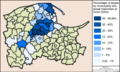 Percentage of people that speak Kashubian at home (2002)
 -

-

-
 Page of Stefan Ramułt Pomeranian (Kashubian language) Dictionary 1893
 -
 Map showing regions in Poland where Kashubian is recognized as a regional language (orange) and where it could qualify in the upcoming years (yellow)
 -
 Church of the Pater Noster, Mount of Olives, Jerusalem. Lord's Prayer in Kashubian


See also
[edit]

- Ł–l merger
- Bilingual communes in Poland
- Gdańsk Pomerania
- Kashubia
- Kashubian alphabet
- Kashubian-Pomeranian Association
- Kashubian studies
- Masurian dialects
- Old Prussian language
- Pomerelia
- Pomeranian language
- Slovincian language
Notes
[edit]- ^ "Wstępne wyniki Narodowego Spisu Powszechnego Ludności i Mieszkań 2021 w zakresie struktury narodowo-etnicznej oraz języka kontaktów domowych" [Report of results: National Census of Population and Housing, 2021.] (PDF). Central Statistical Office of Poland (in Polish). 2023. Archived (PDF) from the original on 2023-06-03. Retrieved 2023-05-21.
- ^ European Charter for Regional or Minority Languages
- ^ "Ustawa z dnia 6 stycznia 2005 r. O mniejszościach narodowych i etnicznych oraz o języku regionalnym" [Act of 6 January 2005 on National and Ethnic Minorities and on the Regional Language]. Internetowy System Aktów Prawnych (in Polish). Archived from the original on 2023-06-11.
- ^ "Lekhitic languages". Britannica. Archived from the original on 2015-06-10. Retrieved 2023-08-08.
- ^ Stephen Barbour, Cathie Carmichael, Language and Nationalism in Europe, Oxford University Press, 2000, p.199, ISBN 0-19-823671-9
- ^ "Archived copy" (PDF). Archived from the original (PDF) on 2015-09-04. Retrieved 2015-01-19.
{{cite web}}: CS1 maint: archived copy as title (link) Ministry of Interior of Poland [dead link] - ^ a b "Narodowy Spis Powszechny Ludności i Mieszkań 2021. Wstępne wyniki. Coraz mnie..." Zawsze Pomorze (in Polish). 2023-04-12. Retrieved 2024-08-24.
- ^ Gerald Stone (1998). "Cassubian". In Glanville Price (ed.). Encyclopedia of the languages of Europe. Oxford: Blackwell. pp. 49–50. ISBN 0-631-19286-7.
- ^ a b Topolinska, Zuzanna (1974). A historical phonology of the Kashubian dialects of Polish. The Hague: Mouton. p. 48.
- ^ Lerski, Jerzy Jan (1996). Historical Dictionary of Poland. Greenwood Publishing Group. p. 62. ISBN 0-313-26007-9.
- ^ Chwalba, Andrzej. Historia Polski 1795-1918. p. 439.
- ^ Barbour, Stephen; Carmichael, Cathie, eds. (2002). Language and nationalism in Europe (Repr. ed.). Oxford University Press. p. 199. ISBN 978-0199250851.
- ^ Biuletin Radzëznë Kaszëbsczégò Jazëka rok 2007, Gduńsk. Archived 2016-01-29 at the Wayback Machine Bibiografiô.
- ^ Anna Gliszczyńska. Germanizmy leksykalne południowej kaszubszczyzny (Na materiale książki Bolesława Jażdżewskiego Wspomnienia kaszubskiego "gbura"). "LingVaria". 1 (3), s. 79–89, 2007. Kraków: Uniwersytet Jagielloński. ISSN 1896-2122.
- ^ "Statistics Poland / National Census / National Population and Housing Census 2021 / Final results of the National Population and Housing Census 2021". stat.gov.pl. Retrieved 2024-08-24.
- ^ "Kaszubi w statystyce (cz. III), Tabela 3. (Table 3.)" (PDF) (in Polish). p. 7/10. Archived from the original (PDF) on 2015-12-31. Retrieved 2016-01-03.
- ^ "Polen-Analysen. Die Kaschuben" (PDF). Länder-Analysen (in German). Polen NR. 95: 10–13. September 2011. Archived (PDF) from the original on 2022-08-29. Retrieved 2018-04-26.
- ^ "The Kashubs Today: Culture-Language-Identity" (PDF). 2007. pp. 8–9. Archived from the original (PDF) on 2016-03-04. Retrieved 2016-01-03.
- ^ "Acta Cassubiana. Vol. XVII (map on p. 122)". Instytut Kaszubski. 2015. Archived from the original on 10 February 2018. Retrieved 9 February 2018.
- ^ Stanulewicz, Danuta (2010). "The Use of the Kashubian Language from the Perspective of Young People Aged 16–19: Settings and Participants". Archived from the original on June 2, 2016. Retrieved April 21, 2016.
- ^ Ramułt, Stefan (1899). Statystyka ludności kaszubskiej. Krakow. p. 243.
{{cite book}}: CS1 maint: location missing publisher (link) - ^ Blank, Joshua C. (2016). Creating Kashubia: History, Memory and Identity in Canada's First Polish Community. McGill-Queen's University Press. ISBN 9780773547209. Archived from the original on 2019-12-12. Retrieved 2019-12-12.
- ^ "Kashubian Capital of America". bambenek.org. Archived from the original on 2017-08-09. Retrieved 2023-08-08.
- ^ Stolpa, James (2005). "A Congregational History of Saint Stan's". Archived from the original on 2017-08-09. Retrieved 2017-08-08.
- ^ Treder, Jerzy. "Piotr Preis, Izmail Sreznevskii, and Kashubia" (PDF). src-h.slav.hokudai.ac.jp. Archived (PDF) from the original on 2023-08-10. Retrieved 2023-08-08.
- ^ "o. prof. dr hab. Adam Sikora OFM - Franciszkanie". Archived from the original on 2011-07-23. Retrieved 2011-03-15.
- ^ Peter Hauptmann, Günther Schulz, Kirche im Osten: Studien zur osteuropäischen Kirchengeschichte und Kirchenkunde, Vandenhoeck & Ruprecht, 2000, pp.44ff, ISBN 3-525-56393-0 [1] Archived 2023-03-26 at the Wayback Machine
- ^ "The Institute for European Studies, Ethnological institute of UW" (PDF). Archived (PDF) from the original on 2003-03-20. Retrieved 2014-10-21.
- ^ "język kaszubski | pl.languagesindanger.eu". pl.languagesindanger.eu. Archived from the original on 2016-06-02. Retrieved 2016-05-02.
- ^ RP, Kancelaria Sejmu. "Internetowy System Aktów Prawnych". Archived from the original on 2012-01-18. Retrieved 2013-12-17.
- ^ G. Stone: Slav outposts in Central European history : the Wends, Sorbs and Kashubs, London, UK : Bloomsbury Academic, an imprint of Bloomsbury Publishing Plc, 2016, p. 348
- ^ Dubisz, Stanisław (1995). Dialekty i gwary polskie. Warszawa: Wiedza Powszechna. pp. 67–70. ISBN 978-8321409894.
- ^ Breza & Treder 1981, pp. 19.
- ^ Breza & Treder 1981, pp. 61.
- ^ a b c Breza & Treder 1981, pp. 20.
- ^ a b Makùrôt 2016, pp. 38.
- ^ Breza & Treder 1981, pp. 20–21.
- ^ Breza & Treder 1981, pp. 21.
- ^ a b c d Breza & Treder 1981, pp. 24.
- ^ a b Breza & Treder 1981, pp. 22.
- ^ Breza & Treder 1981, pp. 23.
- ^ Makùrôt 2016, pp. 37.
- ^ Breza & Treder 1981, pp. 23–24.
- ^ Makùrôt 2016, pp. 30.
- ^ Treder, Jerzy (2010). Małgorzata Klinkosz (ed.). Kaszubienie [Kashubization] (in Polish). ISBN 978-83-62844-10-4. Archived from the original on January 30, 2024.
{{cite book}}:|website=ignored (help) - ^ a b c Breza & Treder 1981, pp. 26.
- ^ Breza & Treder 1981, pp. 29.
- ^ a b c Breza & Treder 1981, pp. 25.
- ^ Breza & Treder 1981, pp. 25–26.
- ^ a b c d Breza & Treder 1981, pp. 27.
- ^ Makùrôt 2016, pp. 34–35.
- ^ a b Breza & Treder 1981, pp. 28.
- ^ Breza & Treder 1981, pp. 30.
- ^ a b Breza & Treder 1981, pp. 31.
- ^ Makùrôt 2016, pp. 31.
- ^ Breza & Treder 1981, pp. 32.
- ^ Makùrôt 2016, pp. 33–34.
- ^ Makùrôt 2016, pp. 34.
- ^ Makùrôt 2016, pp. 35–36.
- ^ Makùrôt 2016, pp. 36.
- ^ Breza & Treder 1981, pp. 33.
- ^ Makùrôt 2016, pp. 18.
- ^ Breza & Treder 1981, pp. 43.
- ^ Breza & Treder 1981, pp. 54–59.
- ^ Breza & Treder 1981, pp. 34.
- ^ a b Breza & Treder 1981, pp. 62.
- ^ Makùrôt 2016, pp. 20–22.
- ^ Breza & Treder 1981, pp. 68.
- ^ Breza & Treder 1981, pp. 67.
- ^ Breza & Treder 1981, pp. 70.
- ^ Breza & Treder 1981, pp. 71.
- ^ Makùrôt 2016, pp. 32–33.
- ^ Breza & Treder 1981, pp. 87.
- ^ Breza & Treder 1981, pp. 88–89.
- ^ "Universal Declaration of Human Rights". un.org. Archived from the original on 2021-03-16. Retrieved 2023-03-01.
Bibliography
[edit]- Breza, Edward; Treder, Jerzy (1981). Maria Kowalewska (ed.). Gramatyka kaszubska: zarys popularny (in Polish). Gdańsk: Zrzeszenie Kaszubsko-Pomorskie (Kaszëbskò-Pòmòrsczé Zrzeszenié). ISBN 83-00-00102-6.
- Makùrôt, Hana (2016). Bożena Ugowska (ed.). Gramatika kaszëbsczégò jãzëka (PDF) (in Kashubian). Gdańsk: Zrzeszenie Kaszubsko-Pomorskie (Kaszëbskò-Pòmòrsczé Zrzeszenié). ISBN 978-83-62137-97-8. Archived (PDF) from the original on 2023-01-25. Retrieved 2024-02-02.
References
[edit]- Comrie, Bernard; Corbett, Greville. G. (2002). The Slavonic Languages. London: Routledge. ISBN 0-415-28078-8
- Blank, Joshua C. Creating Kashubia: History, Memory and Identity in Canada's First Polish Community. Montreal and Kingston: McGill-Queen's University Press, 2016. Archived 2019-12-12 at the Wayback Machine
- Gyula Décsy, Die linguistische Struktur Europas, Vergangenheit — Gegenwart — Zukunft, Otto Harrassowitz, Wiesbaden 1973
- Friedhelm Hinze, Wörterbuch und Lautlehre der deutschen Lehnwörter im Pomoranischen (Kaschubischen), Berlin 1965
- Język kaszubski. Poradnik encyklopedyczny. ed. J. Treder, Rev. 2. corrected and expanded UG, Oficyna Czec, Gdańsk, 2006
- J. Borzyszkowski, J. Mordawski, J. Treder: Historia, geografia, język i piśmiennictwo Kaszubów; J. Bòrzëszkòwsczi, J. Mòrdawsczi, J. Tréder: Historia, geògrafia, jãzëk i pismienizna Kaszëbów, Wëdowizna M. Rôżok przë wespółrobòce z Institutã Kaszëbsczim, Gduńsk 1999, p. 128
- Aleksander Labuda, Słowôrz kaszëbsko-polsczi. Słownik polsko-kaszubski, Gdańsk 1982
- Friedrich Lorentz, Geschichte der Pomoranischen (Kaschubischen) Sprache, Berlin and Leipzig, 1925
- Nestor, N. & Hickey, T. (2009). Out of the Communist frying pan and into the EU fire? Exploring the case of Kashubian [3] Archived 2017-10-11 at the Wayback Machine.
- Nomachi Motoki, On the recipient passive in the Kashubian Language: Annex to Milka Ivić's syntactic inventory for Slavonic dialectology [4] Archived 2014-12-13 at the Wayback Machine
- Stefan Ramułt, Słownik języka pomorskiego, czyli kaszubskiego, Kraków, 1893 i.e. "Dictionary of the Pomeranian (Seacoast) or Kashubian language" (Kraków, 1893)
- Stefan Ramułt, Słownik języka pomorskiego czyli kaszubskiego. Scalił i znormalizował Jerzy Treder, Gdańsk, 2003
- C. F. i F. N. Voegelin, Classification and Index of the World's Languages. Elsevier, New York 1977
Further reading
[edit]- Ager, S. (1998-2016). Kashubian (kaszëbsczi jãzëk). Retrieved February 12, 2016, from http://www.omniglot.com/writing/kashubian.htm Archived 2007-08-05 at the Wayback Machine
- Blank, Joshua C. Creating Kashubia: History, Memory and Identity in Canada's First Polish Community. Montreal and Kingston: McGill-Queen's University Press, 2016. Archived 2019-12-12 at the Wayback Machine
- Grabowska A., Ladykowski P.. "The Change of the Cashubian Identity before Entering the EU Archived 2017-10-11 at the Wayback Machine". In: Baltic Journal of European Studies 2002, no. 1.
- KURCZEWSKI, JACEK (2007). "Self-Identification Structure in Opole Silesia and the Kashubia: A Comparative Analysis". Polish Sociological Review (157): 87–104. JSTOR 41275003.
- MacDonald, Gregory (1939). "The Kashubs on the Baltic". The Slavonic and East European Review. 19 (53/54): 265–275. JSTOR 4203596.
- Perkowski, Jan L (1966). "The Kashubs: Origins and Emigration to the U. S.". Polish American Studies. 23 (1): 1–7. JSTOR 20147702.
- W. (2016). Krótka historia języka kaszubskiego (Short History of the Kashubian Language). Retrieved February 12, 2016, from http://www.kaszubi.pl/o/reda/artykulmenu?id=395 Archived 2017-10-11 at the Wayback Machine
- Stanulewicz, D. (n.d.). The Use of the Kashubian Language from the Perspective of Young People Aged 16–19: Settings and Participants. 191–203. Retrieved February 12, 2016, from www.wilkuer.de/forschung/191-204_stanulewicz_final_js_wk_js.rtf Archived 2016-06-02 at the Wayback Machine.
- Stone, Gerald (1972). "The Language of Cassubian Literature and the Question of a Literary Standard". The Slavonic and East European Review. 50 (121): 521–529. JSTOR 4206617.
- Szulest, David (2012). Kashubian Identity. Kashubs in Canada and Kashubia/Kaszebe Retrieved from http://kaszebsko.com/uploads/KASHUBIAN%20IDENTITY.pdf Archived 2016-12-20 at the Wayback Machine
- Toops, G. H. (2007). [Review of Das Kaschubische: Sprachtod oder Revitalisierung? Empirische Studien zur ethnolinguistischen Vitalität einer Sprachminderheit in Polen. Slavistische Beiträge, 452].Canadian Slavonic Papers, 49(1/2), 160–162.
- Topolinska, Z. (1974). A Historical Phonology of the Kashubian Dialects of Polish. General Information on the Kashubians and Kashubian Dialects. Retrieved from Google Books. ISBN 978-3-11-081338-8
- ZIENIUKOWA, JADWIGA (2015). "THE KASHUBIAN LANGUAGE – A MINORITY LANGUAGE SPOKEN IN BORDERLANDS AS IT WAS AND AS IT IS TODAY". Český Lid. 102 (1): 43–54. JSTOR 24570454.
- Karłowicz, Jan (1898). Gwara kaszubska (in Polish). Warszawa. Archived from the original on 2024-02-02. Retrieved 2024-02-02.
{{cite book}}: CS1 maint: location missing publisher (link) - Lorentz, Friedrich (1927). Gramatyka pomorska (in Polish). Poznań. Archived from the original on 2024-02-02. Retrieved 2024-02-02.
{{cite book}}: CS1 maint: location missing publisher (link) - Lorentz, Friedrich (1927). Kaszube gramatik (in Polish). Gdańsk. Archived from the original on 2024-02-02. Retrieved 2024-02-02.
{{cite book}}: CS1 maint: location missing publisher (link)
External links
[edit] Definitions from Wiktionary
 Media from Commons
 Quotations from Wikiquote
 Kashubian edition of Wikipedia


 The dictionary definition of Appendix:Kashubian Swadesh list at Wiktionary
- The dictionary definition of Kashubian Swadesh list of basic vocabulary words at Wiktionary
- LC Archived 2014-03-04 at the Wayback Machine
- The World Atlas of Language Structures - WALS Archived 2017-08-13 at the Wayback Machine
- BnF Archived 2017-10-11 at the Wayback Machine
- Omniglot Archived 2007-08-05 at the Wayback Machine
- COE 2011 Archived 2015-06-06 at the Wayback Machine
- Kashubian language Archived 2014-03-07 at the Wayback Machine
- UNESCO Archived 2014-12-27 at the Wayback Machine
- Following the trail of manor houses and castles of the Northern Kashubian Region
- Kashubian resources; include phrasebooks
- dictionary Archived 2013-07-19 at the Wayback Machine
- Endangered languages Archived 2016-06-10 at the Wayback Machine
- Kaszëbskô Mowa: Freeing the Kashubian Language Archived 2019-06-21 at the Wayback Machine

| Official language | |||||||
|---|---|---|---|---|---|---|---|
| Minority languages |
| ||||||
| Related | |||||||

