


Xuzhou
 | This article's use of external links may not follow Wikipedia's policies or guidelines. (May 2018) |
Xuzhou
徐州市 Hsü-chou, Süchow | |
|---|---|
Left to right, top to bottom: Xuzhou skyline, Huaihai campaign Memorial Park, Surabaya Pavilion in Sishuiting Park, Yunlong Lake, the Xuzhou TV Tower | |
 | |
 Location of Xuzhou City jurisdiction in Jiangsu | |
  Xuzhou Location of the city center in Jiangsu  Xuzhou Xuzhou (Eastern China)  Xuzhou Xuzhou (China) | |
| Coordinates (Pengcheng Square): 34°15′54″N 117°11′13″E / 34.265°N 117.187°E | |
| Country | People's Republic of China |
| Province | Jiangsu |
| County-level divisions | 10 |
| Township-level divisions | 161 |
| Municipal seat | Yunlong District |
| Government | |
| • Mayor | Zhou Tiegen (周铁根) |
| • CPC Committee Secretary | Zhang Guohua (张国华) |
| Area | |
| 11,259 km2 (4,347 sq mi) | |
| • Urban | 3,037 km2 (1,173 sq mi) |
| • Metro | 2,347 km2 (906 sq mi) |
| Population (2020 census)[1] | |
| 9,083,790 | |
| • Density | 810/km2 (2,100/sq mi) |
| • Urban | 3,589,215 |
| • Urban density | 1,200/km2 (3,100/sq mi) |
| • Metro | 3,135,660 |
| • Metro density | 1,300/km2 (3,500/sq mi) |
| GDP[2] | |
| • Prefecture-level city | CN¥ 732 billion US$ 106 billion |
| • Per capita | CN¥ 80,615 US$ 11,683 |
| Time zone | UTC+8 (China Standard) |
| Postal codes | 221000 (Urban center), 221000, 221000, 221000 (Other areas) |
| Area code | 0516 |
| ISO 3166 code | CN-JS-03 |
| Major Nationalities | Han |
| Licence plate prefixes | 苏C |
| Website | Archived link |


| Xuzhou | |||||||||||
|---|---|---|---|---|---|---|---|---|---|---|---|
 "Xuzhou" in Chinese characters | |||||||||||
| Chinese | 徐州 | ||||||||||
| Postal | Suchow | ||||||||||
| |||||||||||
| Pengcheng | |||||||||||
| Chinese | 彭城 | ||||||||||
| |||||||||||
Xuzhou (Chinese: 徐州), also known as Pengcheng (彭城) in ancient times, is a major city in northwestern Jiangsu province, China. The city, with a recorded population of 9,083,790 at the 2020 census (3,135,660 of which lived in the built-up area made of Quanshan, Gulou, Yunlong and Tongshan urban Districts and Jiawang District not being conurbated), is a national complex transport hub and an important gateway city in East China. Xuzhou is a central city of Huaihai Economic Zone and Xuzhou metropolitan area.[3] Xuzhou is an important node city of the country's Belt and Road Initiative, and an international new energy base. Xuzhou has won titles such as the National City of Civility (全国文明城市) and the United Nations Habitat Scroll of Honour award.
The city is designated as National Famous Historical and Cultural City since 1986 for its relics, especially the terracotta armies, the Mausoleums of the princes and the art of relief of Han dynasty.
Xuzhou is a major city among the top 500 cities in the world by scientific research outputs, as tracked by the Nature Index.[4] The city is also home to China University of Mining and Technology, the only national key university under the Project 211 in Xuzhou and other major public research universities, including Jiangsu Normal University, Xuzhou Medical College, and Xuzhou Institute of Technology.[5]
Romanization
[edit]Before the official adoption of Hanyu Pinyin, the city's name was typically romanized as Suchow[6] or Süchow,[7][8] though it also appeared as Siu Tcheou [Fou],[9] Hsu-chou,[10] Hsuchow,[11] and Hsü-chow.[8][12]
History
[edit]Early history
[edit]The early prehistoric relics around Xuzhou are classified as Dawenkou culture system. Liulin (劉林) site together with Dadunzi (大墩子) site, Huating (花廳) site, and Liangwangcheng (梁王城) site correspond to the initial, middle and late stages of this culture, respectively.[13] While the remains of sacrificial rituals performed to Tudi deity found at Qiuwan (丘灣) site and Gaohuangmiao (高皇廟) site, both of them are in the outskirts of the city, indicate that Shang dynasty affected the area.[14] History relates that Peng or Great Peng, the transitions from a tribe to a chiefdom contained within the boundary of the city. Peng Zu is believed to be the first chief of the ancient Peng state that was centered around Xuzhou, while the state was eventually conquered by King Wu Ding of Shang in around 1208 BC.[15][16]
During the time of Western Zhou, a Huaiyi chiefdom called Xuyi or Xu rose centered around modern Xuzhou and controlled the Lower Yellow River Valley. Xuyi with its Huaiyi people fought against Zhou and its vassals at irregular intervals. Since its declining, Xuyi once moved the capital to the area of Xuzhou and populated it with people who were migrated southwards.
Pengcheng, named after the ancient Peng state that was centered around Xuzhou, a city at the junction of the ancient Bian and Si Rivers, was founded by Lü (annexed by Song later). Chu took the city in the war of 573 BCE, but ceded the city back to Song in the next year, as a coercive measure.[17]
Imperial China
[edit]In 208 BC, Xiang Yu and Liu Bang deployed their troops into Pengcheng, where Emperor Yi of Chu later transferred his capital from Xuyi after rebel leader Xiang Liang's death.[18][19] Xiang Yu then exiled the emperor to southern China in 206 BC, the former proclaiming himself as "Hegemon-King of Western Chu", and also establishing his capital in Pengcheng, until 202 BC.
During the Han dynasty, a new Chu Kingdom was established with its capital at Pengcheng. It was ruled by various imperial princes during the Western Han period (202 BC – 9 AD). Liu Jiao, the younger half-brother of Liu Bang, founder of Western Han, became the first Prince of Chu. In 154 BC, the prince Liu Wu participated in the Rebellion of the Seven Princes. However, he was defeated afterwards and Chu's territories were greatly diminished. By the end of the second century, a prosperous Buddhist community had been settled at Pengcheng.[20]
-
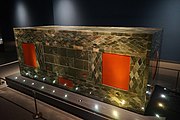 Liu Wu's lacquered wood coffin inlaid with jade
 -
 Liu Wu's jade shroud sewn with gold threads
 -
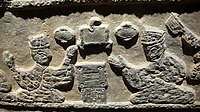 A relief depicting two men gambling


At the turn of the second century, Pengcheng changed hands several times among Cao Cao and his rivals before being annexed to Cao Wei in about 200. In the intervening years, the seat of Xuzhou (Xu province) was transferred from Tancheng to Xiapi, which located in the northwest of Suining. While Pengcheng became the seat later than 220.
With the rebellions of the Five Barbarians, considerable local households migrated to the south, a Liu clan from Pengcheng ascended to the gentry, its most well known descendant is Liu Yu, the Emperor Wu of Liu Song. Pengcheng was taken by the Northern dynasties later. Liu Yu recaptured the lost territory in the north of the Huai River in about 408. Xuzhou was divided into two parts: Beixuzhou (North Xuzhou) and Xuzhou (with Jingkou as its seat) in 411. North Xuzhou whose seat was Pengcheng bounded on the south by the Huai River. Beixuzhou was restored as Xuzhou a decade later, while its south counterpart was renamed Nanxuzhou (South Xuzhou). Since then, Pengcheng remained being the seat of Xuzhou until it was eliminated in the early Ming.
The raging wars inflicted upon Xuzhou until the Emperor Taizong of Tang's enthronement in 626. Keeping the northern rebellions and warfare a distance gave Xuzhou scope for developing during the most period of the Tang dynasty. According to the Old Book of Tang and the New book of Tang, in 639, the total population of Pengcheng County, Fei County and Pei County was only 21,768, versus 205,286 in 742.[21]
In 781, Li Na marched south to besiege Xuzhou. Although his revolt was quell soon, the halt of the transport by the Bian Canal impelled the court to secure the area.[22]
The then prefect of Xuzhou, Zhang Jianfeng was designated as the first military governor of Xuzhou–Sizhou–Haozhou (徐泗濠節度使) which was headquartered in Xuzhou since 788. The title was restored and renamed Wuning (武寧) in 805, after an interval of five years. Wang Zhixing, another military governor of Wuning, established several battalions (the most notorious one among is the Silver Sword) in the Army specifically for select recruits. These soldiers not only defy military discipline but also show defiant towards the successors to Wang. In 832, Li Ting received a threatening letter prior to his induction in there, made him resigned immediately.[23] Then Wuning suffered mutinies in 849, 859 and again in 862.[24] Another two governors were expelled.[25] Wang Shi was appointed, under the circumstances. He put the mutiny down by executing part of the garrison troops and disbanded the rest, which became thugs and loot later. In 864, the court declared an amnesty in the area, and promised that all thugs who willingly re-enrolled would be sent for a tour of duty in the southern, and then, presumably, returned to regular army service in the north.[26]
Three thousand men surrendered and were sent to the south to join the two thousand former Wuning soldiers there. The breached pledge irritated them. Led by Pang Xun, some soldiers mutinied and marched back north.[27] They have unimpeded access to the area by the winter of 868.[28] The local civil governor refused Pang's demand to have the hatred officers removed, and a military confrontation ensued. Thousands of local peasants joined the rebels. They took the prefectural city of Xuzhou, captured the civil governor, and killed those officers. Pang acquired a considerable following. Still, the rebellion was suppressed a year later eventually. Wuning was renamed Ganhua (感化; 'Converting [from insubordination]') with admonishment on lest the garrison to revolt again.[29]
After the Yellow River began to change course during the Song dynasty, heavy silting at the Yellow River estuary forced the river to channel its flow into the lower Huai River tributary. The area became barren thereafter due to persistent flooding, nutrient depletion and salination of the once fertile soil.
In the first month of 1129, Nijuhun took the city after a siege of 27 days, and the then governor Wang Fu (王復) was executed for refusing to submit. Wang's inferior Zhao Li (趙立) rallied the remains and constructed a local militia. They recaptured the city two months later but withdrew from there strategically soon. Henceforth, Xuzhou was ruled by Jurchen over a century.[30]
In 1232, the general Wang You (王佑), Feng Xian (封仙) revolted, they expelled the Jurchen's governor Tuktan. Then the Mongolian army led by Anyong (安用), a Han Chinese general captured Xuzhou soon. Both the general of the state of Su (宿州) Liu Anguo (刘安国) and the general of Pizhou Du Zheng (杜政) yielded their owned city to Anyong. Regarding Anyong's behave as grabbing reputation, the Mongolian general Asuru (Chinese: 阿术鲁/额苏伦) irritated and persisted to kill him. Felt panic, Anyong sought refuge from Jurchen.[31] The Jin dynasty resumed its ruling in Xuzhou, and it was quite transient. The serious disunity made betraying recur. In November 1233, the garrison of Xuzhou welcomed the Mongolian.[32] Meantime, Anyong pledged loyalty to the Song dynasty. He captured the city again after the Mongolian army left. In the spring of the next year, the Mongolian commander Zhang Rong (张荣) attacked Xuzhou,[33] Anyong drowned himself after the final defeat.[31] The Mongolian governor of Xuzhou and Pizhou called Li Gaoge (李杲哥) surrendered to the Song in 1262. Then he failed and was killed after several days.[34]
A rebellion against Yuan rose by Li Er (李二) who was nicknamed Sesame Li in the area around Xuzhou. In the eighth month of 1351, they took the city. Toghon Temür gave an edict that they would be granted amnesty if they surrendered to the authority, in the spring of the next year. The rebels ignored that, so he agreed that Toqto to suppress the unrest. The city fell in the autumn, and the multitudes were killed by Toqto's army afterwards.[35] It may be the symbolically most important victory for Toqto.[36] Thus, Xuzhou was renamed Wu'an (武安; literal meaning: Restoring peace by force") as a favour for him, and a stone slab celebrating his deed was erected by the court in the city.[37]
Zhang Shicheng occupied Xuzhou as the northernmost city of his domain in 1360.[38] The Ming forces under Xu Da, captured Xuzhou in 1366.[39] Soon Köke Temür sent an army under General Li Er to attack Xuzhou. Fu Youde (傅友德) and Lu Ju (陸聚) who held the city raided them outside, most of the enemy were drowned while the remained about 270 soldiers and 500 horses were captured.[40]

Xuzhou had a long period of prosperity during the Ming dynasty. The flourishness largely attributed to the carriage, especially by the Grand Canal,[41] one of seven customs barriers (or customs houses, 鈔關) under the Ministry of Revenue was located in Xuzhou.[42] It was retained until the late Qing.[43] Korean Choe Bu affirmed that the city where he travelled by way of, hardly pale by comparison to the Jiangnan region.[44]
As a hub for both the national courier system and the grain tribute system for several centuries, Xuzhou was of vital importance.[45] Thus, the government of Ming established three garrison areas namely guards in the present-day area: Xuzhou guard (徐州衛), Xuzhou Left guard (徐州左衛) and Pizhou guard (邳州衛) for its security.
Yet, the local navigation was considerably constrained by two Rapids: the Xuzhou Rapids (徐州洪), a kilometer southeast of the city, and the Lüliang Rapids (呂梁洪), another 24 kilometers further south.[46] The remedy provided by the Ministry of Works is constructing the Jia Canal, which paralleled the treacherous stretch of Xuzhou. However, the canal completed in the 1600s ravaged the city. Not only it disrupted the former drainage system, but also depressed the local economy.[47] Prior to the recession, flooding and the famines followed struck Xuzhou frequently.[48] The worst flooding occurred in 1624: it was immersed up to 1 zhang and 3 chi (about 4m) within the city.[49]
After the Hongguang Emperor enthroned in Nanjing, the court designated four defense areas along the southern bank of the Yellow River (江北四鎮) to repulse the Qing armies. While the former bandit general, Gao Jie (高傑) was designated to take the crucial forward position at Xuzhou by Shi Kefa.[50] But the assassination of Gao seriously reduced the court's capacity to deal with challenges from Qing.[51] Gao's successor was Li Chengdong (李成棟). Being aware of forthcoming attack, Li deserted Xuzhou in the early summer of 1645. Then Dodo's army captured the city.
.jpg)
The seismic activity of the Tancheng earthquake in 1688 was also involved Xuzhou. "More than half the houses of the city were ruined" and "led to enormous deaths", according to the gazetteer.[52]
In the 1850s, the Yellow River shifted its course from the southern to the northern side of the Shandong peninsula, the process caused serious floods and famine in Xuzhou, and almost made the waterway system within the prefecture defunct.
Modern China
[edit]Zhang Xun and his remaining army fled to Xuzhou after the Revolution of 1911. They entered the city on 5 December. The Nanking Government sent three armies to attack Xuzhou. In the middle of February 1912, Zhang evacuated the city and moved north after he was defeated.
Since the Second Revolution began, Xuzhou became a front-line city. The Revolutionary Army fared badly as it advanced from there towards the north, and a rout ensued. Then the Beiyang Army captured the city on 24 July. Thereafter, Zhang Xun made Xuzhou his base. he convened four meetings of the Beiyang leadership. Involved the stalemate among Li Yuanhong and Duan Qirui in 1917, he marched on Beijing with a troop in June. His failure spread and caused a terrible wave of theft and arson committed by his garrisons later in Xuzhou in July.
The Zhili clique dominated Xuzhou by 1924. In the autumn of this year, the Second Zhili–Fengtian War broke out, Zhang Zongchang who supported the Fengtian clique seized the city with his thirty thousand soldiers. Sun Chuanfang led a coalition of forces to sortie the Fengtian Army in October 1925. They occupied the city on 8 November. As the leader of the Northern Expedition, Chiang Kai-shek arrived in Xuzhou on 17 June 1927.[53] He conferred with Feng Yuxiang and other Kuomintang officers on 20 June, Feng was courted by Nanjing.[54] Then Sun Chuanfang and Zhang Zongchang began to fight in unison against the Nationalist government. They captured the city on 24 June. The fall of Xuzhou aroused public outrage, Chiang 's first resignation ensued. On 16 December, Nanjing force took the area again.[55]

The area was the main site both of the Battle of Xuzhou in 1938 against the Japanese Army in the Second Sino-Japanese War and of the battle in the Chinese Civil War, the Huaihai Campaign in 1948–49.
On 19 May 1938, Chiang gave the order to abandon Xuzhou, then Japanese military took control of the city.
The Administrative Commission of the Su-Huai Special Region (蘇淮特別區) was established in January 1942, with its seat at Xuzhou. It was replaced by a new puppet province, Huaihai (淮海省). Hao Pengju was appointed as the governor.[56]
After the Second Sino-Japanese War, the troop under He Zhuguo entered Xuzhou on 6 September. The Xuzhou Pacification Commission (徐州綏靖公署) was founded in the end of year, and Gu Zhutong was appointed as the Chief. It was disbanded when the Army Command Headquarters of transferred to Xuzhou on 5 March 1947. Meantime, a military tribunal attached to the commission was organized to sentence 25 Japanese soldiers.[57][58]
Guo Yingqiu as the representative of the CPC went to Xuzhou to negotiate a regional truce, since 10 February 1946. On 2 March, the "Committee of Three", comprising George Marshall, Zhang Zhizhong and Zhou Enlai arrived for the ceasefire in Central China. Still, the KMT and the CPC came into conflict soon. The CPC revealed that Yasuji Okamura assisted the KMT in the local warfare against the PLA.
The Huaihai was the a critical of the trinity of the major campaigns during the Chinese Civil War. Fighting centred around the city of Xuzhou, seat of the Bandit Suppression Headquarters (剿匪總司令部) established on 6 June 1948. It turned into a fiasco, which led to the fall of the Nationalist Chinese capital Nanjing.[59] The CPC controlled the city on 1 December.
-
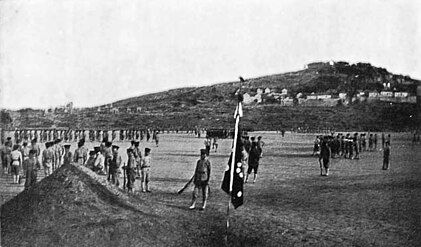 Zhang Xun's troops in Xuzhou, the 1910s
 -
 Chiang Kai-shek conferred with Feng Yuxiang in Xuzhou, 1927
 -
 The "Committee of Three" met in Xuzhou, 1946
 -
 Mao Zedong at the platform of Xuzhou Railway Station in 1953


Then Xuzhou (the old urban area) was made a part of Shandong province temporarily, together with the rest area of the northern Jiangsu along the Longhai Railway. The city was returned to Jiangsu as the province was restored in 1953.
The railways in Xuzhou bore the brunt of the transporting muddle in the 1970s, Beijing was concerned with the issue in 1974. Thus, the then Minister of Railways, Wan Li went to Xuzhou to inspect and rectify in March. It was deemed as a breakthrough on restoring order later.[60]
On April 22, 1993, Xuzhou was ratified as a "Larger Municipality" with legislative power by the State Council.[61]
Administration
[edit]The evolutionary history
[edit]| The table of local administrative changes | |||||||
|---|---|---|---|---|---|---|---|
| Period | Provincial Level | Prefectural Level | County Level | ||||
| Spring and Autumn |
Song (state) 宋國 |
Pengcheng 彭城 Liuyi 留邑 Lüyi 呂邑 | |||||
| Zhongwu (state) 鐘吾國 | |||||||
| Warring States |
Chu (state) 楚國 | Peiyi 沛邑 | |||||
| Qi (state) 齊國 | Changyi 常邑 | ||||||
| Pi (state) 邳國 | |||||||
| Qin dynasty | Sishui Commandery 泗水郡 |
Pei County 沛縣 Pengcheng County 彭城縣 Liu County 留縣 Xiao County 蕭縣 | |||||
| Donghai Commandery 東海郡 | Xiapi County 下邳縣 | ||||||
| Western Han | Xu Province 徐州(古代,刺史部) |
Chu (state) 楚國 | Lü County 呂縣 Wuyuan County 武原縣 | ||||
| Donghai Commandery 東海郡 |
Siwu County 司吾縣 Marquis Jianling's state 建陵侯國 Marquis Liangcheng's state 良成侯國 Marquis Rongqiu's state 容丘侯國 | ||||||
| Yu Province 豫州(古代,刺史部) |
Pei Commandery 沛郡 |
Pei County 沛縣 Feng County 豐縣 Guangqi County 廣戚縣 | |||||
| Eastern Han and Three Kingdoms |
Xu Province 徐州(古代,刺史部) |
Pengcheng (state) 彭城國 |
Pengcheng County 彭城縣 Liu County 留縣 Lü County 呂縣 Wuyuan County 武原縣 Guangqi County 廣戚縣 | ||||
| Xiapi (state) 下邳國 |
Xiapi County 下邳縣 Liangcheng County 良成縣 Siwu County 司吾縣 | ||||||
| Yu Province 豫州(古代,刺史部) |
Pei (state) 沛國 |
Pei County 沛縣 Feng County 豐縣 | |||||
| Jin dynasty, Northern and Southern dynasties |
(North) Xuzhou or (North) Xu Province (北)徐州 South Xuzhou or South Xu Province 南徐州, located in modern Zhenjiang, see Zhenjiang |
Pengcheng Commandery 彭城郡 |
Pengcheng County 彭城縣 Liu County 留縣 Lü County 呂縣 | ||||
| Xiapi Commandery 下邳郡 |
Xiapi County 下邳縣 Liangcheng County 良成縣 Siwu County 司吾縣 | ||||||
| Pei Commandery 沛郡 |
Pei County 沛縣 Feng County 豐縣 | ||||||
| Jiyin Commandery 济阴郡 |
Suiling County 睢陵縣 | ||||||
| Sui dynasty | Pengcheng Commandery 彭城郡 |
Pengcheng County 彭城縣 Liu County 留縣 Pei County 沛縣 Feng County 豐縣 | |||||
| Xiapi Commandery 下邳郡 |
Xiapi County 下邳縣 Liangcheng County 良城縣 | ||||||
| Tang dynasty | Henan Circuit 河南道 |
Xuzhou 徐州 |
Pengcheng County 彭城縣 Pei County 沛縣 Feng County 豐縣 | ||||
| Sizhou 泗州 | Xiapi County 下邳縣 | ||||||
| Northern Song |
West Jingdong Circuit 京東西路 |
Xuzhou 徐州 |
Pengcheng County 彭城縣 Pei County 沛縣 Feng County 豐縣 Baofeng Jian* 寶豐監 Liguo Jian* 利國監 | ||||
| East Jingdong Circuit 京東東路 |
Huaiyang Military 淮陽軍 |
Xiapi County 下邳縣 | |||||
| Jin | West Shandong Circuit 山东西路 |
Xuzhou 徐州 | Pengcheng County 彭城縣 Feng County 豐縣 | ||||
| Huaiyang Military 淮陽軍 | Xiapi County 下邳縣 | ||||||
| Tengzhou 滕州 | Pei County 沛縣 | ||||||
| Yuan dynasty | Henanjiangbei Province 河南江北行中書省 |
Gui’de-fu 歸德府 |
Xuzhou 徐州 | Xiao County 蕭縣 | |||
| Pizhou 邳州 | Xiapi County 下邳縣 Suining County 睢寧縣 | ||||||
| Branch Secretariats 中書省 |
Jining Circuit 濟寧路 |
Jizhou 濟州 | Pei County 沛縣 | ||||
| Feng County 豐縣 | |||||||
| Ming dynasty | Nanquin/South Zhil 南京/南直隸 |
Xuzhou (as an Independent Department) 徐州 |
Pei County 沛縣 Feng County 豐縣 Xiao County 蕭縣 Dangshan County 碭山縣 | ||||
| Huaian-fu 淮安府 | Pizhou 邳州 | ||||||
| Qing dynasty, during 1733–1911 |
Kiangsu/Jiangsu Province 江蘇省 |
Xuzhou-fu (as a Prefecture) 徐州府 |
Tongshan County 銅山縣 Pei County 沛縣 Feng County 豐縣 Xiao County 蕭縣 Dangshan County 碭山縣 Suining County 睢寧縣 Suqian County 宿遷縣 Pizhou 邳州 | ||||
| Republic of China, during 1945–1949 |
Kiangsu/Jiangsu Province 江蘇省 |
Xuzhou City 徐州市 | |||||
| No.9 Administrative Superintendent District 第九督察區 |
Tongshan County 銅山縣 Pei County 沛縣 Feng County 豐縣 Xiao County 蕭縣 Dangshan County 碭山縣 Suining County 睢寧縣 Pi County 邳縣 | ||||||
| People's Republic of China, during 1949–1952 |
Shandong Province 山东省 |
Xuzhou City 徐州市 | Tongshan County 铜山县 | ||||
| Prefecture of Teng County 滕县专区 |
Tongbei County 铜北县 Pei County 沛县 Feng County 丰县 | ||||||
| Prefecture of Linyi 临沂专区 |
Pi County 邳县 | ||||||
| Administrative Region of the Northern Anhui 皖北行署区 |
Prefecture of Su County 宿县专区 |
Xiao County 萧县 Dangshan County 砀山县 | |||||
| People's Republic of China, in 1955 |
Jiangsu Province 江苏省 |
Xuzhou City 徐州市 |
Gulou District 鼓楼区 Yunlong District 云龙区 Zifang District 子房区 Wangling District 王陵区 Jiawang Mining District 贾汪矿区 | ||||
| Prefecture of Xuzhou 徐州专区 |
Xinhailian City 新海连市 Tongshan County 铜山县 Pei County 沛县 Feng County 丰县 Suining County 睢宁县 Pi County 邳县 Xinyi County 新沂县 Donghai County 东海县 Ganyu County 赣榆县 | ||||||
| Anhui Province 安徽省 |
Prefecture of Su County 宿县专区 |
Xiao County 萧县 Dangshan County 砀山县 | |||||
| People's Republic of China, in 1963 |
Jiangsu Province 江苏省 |
Xuzhou City 徐州市 |
Gulou District 鼓楼区 Yunlong District 云龙区 Jiawang Town 贾汪镇 Jiaoqu 郊区(办事处) | ||||
| Prefecture of Xuzhou 徐州专区 |
Tongshan County 铜山县 Pei County 沛县 Feng County 丰县 Suining County 睢宁县 Pi County 邳县 Xinyi County 新沂县 Donghai County 东海县 Ganyu County 赣榆县 | ||||||
| People's Republic of China, in 1983 |
Jiangsu Province 江苏省 |
Xuzhou City 徐州市 |
Gulou District 鼓楼区 Yunlong District 云龙区 Jiaoqu 郊区 Jiawang District 贾汪区 Kuangqu 矿区 Tongshan County 铜山县 Pei County 沛县 Feng County 丰县 Suining County 睢宁县 Pi County 邳县 Xinyi County 新沂县 | ||||
| Lianyungang City 连云港市 |
Donghai County 东海县 Ganyu County 赣榆县 | ||||||
| People's Republic of China, in 1993 |
Jiangsu Province 江苏省 |
Xuzhou City 徐州市 |
Gulou District 鼓楼区 Yunlong District 云龙区 Quanshan District 泉山区 Jiawang District 贾汪区 The Mining District 矿区 Pizhou City 邳州市 Xinyi City 新沂市 Tongshan County 铜山县 Pei County 沛县 Feng County 丰县 Suining County 睢宁县 | ||||
| People's Republic of China, 2010–present |
Jiangsu Province 江苏省 |
Xuzhou City 徐州市 |
Gulou District 鼓楼区 Yunlong District 云龙区 Quanshan District 泉山区 Jiawang District 贾汪区 Tongshan District 铜山区 Pizhou City 邳州市 Xinyi City 新沂市 Pei County 沛县 Feng County 丰县 Suining County 睢宁县 | ||||
The present administrative division
[edit]The prefecture-level city of Xuzhou administers ten county-level divisions, including five districts, two county-level cities and three counties. These are further divided into 161 township-level divisions, including 63 subdistricts and 98 towns.[62]
| Map | |||||
|---|---|---|---|---|---|
| Name | Chinese | Hanyu Pinyin | Population (2020) | Area (km2) | Density (/km2) |
| City Proper | |||||
| Gulou District | 鼓楼区 | Gǔlóu Qū | 806,550 | 222.6 | 3,623 |
| Yunlong District | 云龙区 | Yúnlóng Qū | 471,566 | 120.0 | 3,930 |
| Quanshan District | 泉山区 | Quánshān Qū | 619,784 | 102.4 | 6,053 |
| Suburban | |||||
| Jiawang District | 贾汪区 | Jiǎwāng Qū | 453,555 | 612.4 | 740.6 |
| Tongshan District | 铜山区 | Tóngshān Qū | 1,237,760 | 1,952 | 634.1 |
| Rural | |||||
| Feng County | 丰县 | Fēng Xiàn | 935,200 | 1,447 | 646.3 |
| Pei County | 沛县 | Pèi Xiàn | 1,038,337 | 1,328 | 781.9 |
| Suining County | 睢宁县 | Suīníng Xiàn | 1,088,553 | 1,768 | 615.7 |
| Satellite cities (County-level cities) | |||||
| Xinyi City | 新沂市 | Xīnyí Shì | 969,922 | 1,573 | 616.6 |
| Pizhou City | 邳州市 | Pīzhōu Shì | 1,462,563 | 2,086 | 701.1 |
| Total | 9,083,790 | 11,211 | 810.3 | ||

Geography
[edit]
Xuzhou is of strategic importance for linking South China and North China. The boundaries of its jurisdiction are adjacent to Lianyungang and Suqian in east; Suzhou of Anhui province to the south; Huaibei to the west; Linyi, Zaozhuang, Jining and Heze of Shandong province to the north.
The area can be divided into four sectors from east to west, constitute the Shandong–Jiangsu Traps (鲁苏地盾), the Tancheng–Lujiang Fault Zone (郯庐断裂带), the Xu–Huai Downwarp-fold Belt (徐淮坳褶带) and the Fault-block of West Shandong (鲁西断块) respectively. Most of the area is located in the Xu-Huai Alluvial Plain, the southeast part of the North China Plain.
The confluence of the former Si River and the former Bian Canal was situated northeast of ancient Xuzhou city. The city and its hinterland were areas liable to severe flooding from the Yellow River since the tenth century. In 1194, the Yellow River changed its course to join the Si River, a former tributary of the Huai. From then on, the Yellow River flowed along the north of the walled city until diverting in 1855. The city proper is now bisected by the ancient Yellow River course, while Yunlong Lake is located in the southwest. North of the lake is Yunlong Park.
Climate
[edit]Xuzhou has a monsoon-influenced humid subtropical climate (Köppen Cwa), with cool, dry winters, warm springs, long, hot and humid summers, and crisp autumns. The monthly daily average temperature ranges from 0.7 °C (33.3 °F) in January to 27.3 °C (81.1 °F) in July; the annual mean is 14.9 °C (58.8 °F). Snow may occur during winter, though rarely heavily. Precipitation is light in winter, and a majority of the annual total of 842.8 millimetres (33.2 in) occurs from June thru August. With monthly percent possible sunshine ranging from 44% in July to 54% in three months, the city receives 2,221 hours of bright sunshine annually.
The lowest temperature recorded in Xuzhou was −23.3 °C (−10 °F), on 6 February 1969, while the highest was 43.4 °C (110 °F), on 15 July 1955.[63]
| Climate data for Xuzhou (1991–2020 normals, extremes 1951-present) | |||||||||||||
|---|---|---|---|---|---|---|---|---|---|---|---|---|---|
| Month | Jan | Feb | Mar | Apr | May | Jun | Jul | Aug | Sep | Oct | Nov | Dec | Year |
| Record high °C (°F) | 19.8 (67.6) |
25.9 (78.6) |
30.1 (86.2) |
34.8 (94.6) |
38.2 (100.8) |
40.6 (105.1) |
43.4 (110.1) |
38.2 (100.8) |
36.7 (98.1) |
34.5 (94.1) |
29.0 (84.2) |
22.2 (72.0) |
43.4 (110.1) |
| Mean daily maximum °C (°F) | 5.6 (42.1) |
9.1 (48.4) |
14.8 (58.6) |
21.4 (70.5) |
26.7 (80.1) |
30.7 (87.3) |
31.8 (89.2) |
30.8 (87.4) |
27.2 (81.0) |
21.9 (71.4) |
14.4 (57.9) |
7.7 (45.9) |
20.2 (68.3) |
| Daily mean °C (°F) | 1.0 (33.8) |
4.1 (39.4) |
9.5 (49.1) |
16.0 (60.8) |
21.5 (70.7) |
25.8 (78.4) |
27.7 (81.9) |
26.8 (80.2) |
22.5 (72.5) |
16.5 (61.7) |
9.2 (48.6) |
2.9 (37.2) |
15.3 (59.5) |
| Mean daily minimum °C (°F) | −2.6 (27.3) |
0.1 (32.2) |
4.8 (40.6) |
10.8 (51.4) |
16.4 (61.5) |
21.2 (70.2) |
24.3 (75.7) |
23.5 (74.3) |
18.5 (65.3) |
12.0 (53.6) |
5.0 (41.0) |
−0.8 (30.6) |
11.1 (52.0) |
| Record low °C (°F) | −17.3 (0.9) |
−23.3 (−9.9) |
−7.6 (18.3) |
−1.4 (29.5) |
4.8 (40.6) |
12.4 (54.3) |
15.9 (60.6) |
13.4 (56.1) |
5.0 (41.0) |
−1.0 (30.2) |
−8.3 (17.1) |
−13.5 (7.7) |
−23.3 (−9.9) |
| Average precipitation mm (inches) | 18.4 (0.72) |
20.9 (0.82) |
32.3 (1.27) |
36.8 (1.45) |
64.3 (2.53) |
118.4 (4.66) |
238.3 (9.38) |
152.6 (6.01) |
70.3 (2.77) |
38.5 (1.52) |
35.6 (1.40) |
19.1 (0.75) |
845.5 (33.28) |
| Average precipitation days (≥ 0.1 mm) | 4.3 | 4.9 | 5.7 | 6.7 | 6.7 | 7.4 | 12.8 | 11.2 | 7.4 | 5.7 | 5.9 | 4.2 | 82.9 |
| Average snowy days | 3.4 | 2.6 | 1.1 | 0 | 0 | 0 | 0 | 0 | 0 | 0 | 0.6 | 1.9 | 9.6 |
| Average relative humidity (%) | 66 | 63 | 60 | 61 | 63 | 65 | 78 | 80 | 74 | 69 | 70 | 67 | 68 |
| Mean monthly sunshine hours | 137.3 | 145.9 | 189.8 | 215.1 | 227.0 | 203.4 | 182.4 | 181.2 | 178.2 | 179.4 | 152.6 | 145.7 | 2,138 |
| Percent possible sunshine | 44 | 47 | 51 | 55 | 53 | 47 | 42 | 44 | 48 | 52 | 49 | 48 | 48 |
| Source: China Meteorological Administration[64][65][66] | |||||||||||||
Demographics
[edit]According to the 1% National Population Sample Survey in 2015, the total resident population of Xuzhou reached 8.66 million, and the sex ratio was 101.40 males to 100 females.[67]
| Year | Urban areas | Tongshan | Feng | Pei | Suining | Pizhou | Xinyi | Total |
|---|---|---|---|---|---|---|---|---|
| 1913 | 826,083 | 291,562 | 280,345 | 501,867 | 636,040 | 2,535,897 | ||
| 1918 | 854,213 | 281,696 | 294,604 | 506,975 | 639,064 | 2,576,552 | ||
| 1928 | 954,939 | 308,968 | 329,933 | 508,226 | 568,193 | 2,670,259 | ||
| 1932 | 986,536 | 304,480 | 346,593 | 547,848 | 584,904 | 2,770,361 | ||
| 1935 | 1,099,296 | 364,007 | 391,121 | 645,890 | 642,641 | 3,142,955 | ||
| 1953 | 333,190 | 1,072,430 | 473,815 | 395,094 | 653,854 | 683,113 | 452,203 | 4,063,699 |
| 1964 | 505,417 | 1,001,377 | 587,822 | 575,237 | 729,619 | 861,117 | 518,086 | 4,778,675 |
| 1982 | 779,289 | 1,414,460 | 834,568 | 869,778 | 981,917 | 1,187,526 | 741,600 | 6,809,138 |
| 1990 | 949,267 | 1,741,522 | 952,760 | 1,042,280 | 1,160,772 | 1,431,728 | 883,650 | 8,161,979 |
| 2002 | 1679626 | 1,262,489 | 1,068,404 | 1,183,048 | 1,217,820 | 1,539,922 | 962,656 | 8,913,965 |
| 2010 | 1,911,585 | 1,142,193 | 963,597 | 1,141,935 | 1,042,544 | 1,458,036 | 920,610 | 8,580,500 |
Economy
[edit]Historically, Xuzhou and the surrounding regions were a predominantly agricultural area. Its arable land was severely depleted by the changes in the course of the Yellow River since the mid 11th century, and the drought-resistant crops: wheat, sorghum, soybean, maize and potato, became the local staples. Besides, cotton, peanut, tobacco and sesame also grew in low-yield. The local mining traces it origins to an iron mine, Liguo. It was exploited since Han dynasty, and managed by a particular bureau in Song. And the city had major coal reserves of the province.[68] Local coaling began by the 1070s, according to a lyric of the then governor Su Shi.[69] Copper smelting in this area supposedly started in the Three Kingdoms era.[70]
The city astride the old course of the Grand Canal had been through several transitory periods of prosperity, before the grain tribute system was abolished in 1855. It remained being economically backward in the 1940s for wars, and a few people engaged in industrial sectors.
Later the CPC positioned the city as a region of coal mining and heavy industry. Its dominant sectors are machinery, energy and food production nowadays. The construction machinery manufacturer XCMG is the largest company based in Xuzhou. It was the world's tenth-largest construction equipment maker measured by 2011 revenues, and the third-largest based in China (after Sany and Zoomlion).[71]
Education
[edit]Xuzhou was a regional centre for education, but two defunct institutions once chose their sites within the city: Provincial College of Kiangsu (省立江蘇學院) and North China Theological Seminary. In the 1950s, the then Jiangsu Normal Academy relocated to the city in 1958, and the then Nanjing Medical College, Xuzhou was founded later, both survived the Great Leap Forward. In 1978, the then China Institute of Mining and Technology relocated to Xuzhou.

Schools
[edit]- Xuzhou No.1 Middle School (徐州市第一中学)
- Xuzhou No.2 Middle School (徐州市第二中学)
- Xuzhou No.3 Middle School (徐州市第三中学)
- Xuzhou Senior High School (徐州市高级中学)
- Xuzhou No.5 Middle School
- Xuzhou No.36 Middle School (徐州市第三十六中学)
- Xuzhou No.13 Middle School (徐州市第十三中学)
Universities and colleges
[edit]- China University of Mining and Technology (中国矿业大学)
- Jiangsu Normal University (江苏师范大学)
- Xuzhou Medical University (徐州医科大学)
- Xuzhou Institute of Technology (徐州工程学院暨徐州大学)
- People's Liberation Army Air Force Logistical College (中国人民解放军空军后勤学院)
Religion
[edit]

According to the local administrator's survey in 2014, around 4.76% of the population of Xuzhou, namely 0.46 million people belongs to organised religions. The largest groups being Protestants with 350,000 people, followed by Buddhists with 70,000 people.
Xuzhou is deemed one of earlier Buddhist centres in China supposedly because the Emperor Ming of Han mentioned that the then Prince of Chu Liu Ying built a "temple for Buddha".[72]
The local Catholic activities were dominated by the French-Canadians of the Society of Jesus since the 1880s,[73] and there were 73,932 adherents and seventeen churches in 1940. Cathedral of the Sacred Heart of Jesus, completed in 1910, is still a principal church nowadays. While the initial Protestant mission in Xuzhou was led by Alfred G. Jones of BMS, then American Southern Presbyterian Mission took over it in the 1890s.
Culture
[edit]Arts
[edit]According to Xu Wei's Nanci Xulu (南詞敘錄; [Treatises and Catalogue of Nanqu]), Yuyao Tone (余姚腔), one of then major Southern Operas, was prevalent in Xuzhou during the Mid-Ming period. Shanxi merchants popularized Bangzi in Xuzhou afterwards, since it was introduced in the late Ming along the Great Cannel. Fused the local ballads in dialect, this localized version evolved into a new opera over the following centuries. The opera was designated as Jiangsu Bangzi (江蘇梆子) in 1962.
The new municipal concert hall was opened in 2011, shaped like a myrtle flower. However, the various regular performances are unattainable. While the first local philharmonic orchestra is established in 2015.
Media
[edit]The first local newspaper entitled Hsing-hsü Daily (醒徐日報) was started in 1913. Nowadays, Xuzhou's major newspaper is Xuzhou Daily (徐州日報), which was founded in the end of 1948. It is owned and operated by the Xuzhou Committee of the Chinese Communist Party.[74]
| Station | Chinese name | Frequency |
|---|---|---|
| News Radio | 新闻广播 | 93.0 FM |
| Private Motor Radio | 私家车广播 | 91.6 FM |
| Traffic Radio | 交通广播 | 103.3 FM |
| Joy Radio | 文艺广播 | 89.6 FM |
| Channel | Chinese name | Description |
|---|---|---|
| XZ·1 | 徐州·1 | News & General |
| XZ·2 | 徐州·2 | Economy & Life |
| XZ·3 | 徐州·3 | Arts & Entertainment |
| XZ·4 | 徐州·4 | Public |
The earliest local radio was broadcasting in 1934 for public education. Then Japanese military founded Hsuchow Broadcasting Station (徐州放送局, Joshi Hōsōkyoku) in 1938, after the city was captured. The National Army took over it after World War II. Broadcasting was resumed in 1949, operated by the CPC. In 1980, Xuzhou TV Station was established. A decade later, Xuzhou TV Tower was completed.
Museums
[edit]Dialect
[edit]As a subdialect of Central Plains Mandarin, Xuzhou dialect is spoken in the whole area, especially in the suburb and countryside.
Cuisine
[edit]Xuzhou cuisine is closely related to Shandong cuisine's Jinan-style. Xuzhou's most well known foods include bǎzi ròu (pork belly, and other items stewed in a thick broth), sha tang ( 汤), and various dog meat dishes.
Another one of Xuzhou's famous dishes is dì guō (地锅) style cooking which places ingredients with a spicy sauce in a deep black skillet and cooks little pieces of flatbread on the side or top. Common staples of di guo style cooking include chicken, fish, lamb, pork rib and eggplant.
Fu Yang Festival(伏羊节) is a traditional festival celebrated in the city. It starts on Chufu (初伏) which is around mid-July and lasts for about one month. During the festival, people eat lamb meat and drink lamb soup. This festival is very popular among all the citizens.
Transport
[edit]Roads
[edit]Xuzhou has many urban expressways: Xuzhou 3rd Ring Road expressways (east, north and west), Xuzhou East Ave. expressway (城东大道快速路), Xuzhou-Pantang expressway, Xuzhou-Jiawang expressway and Xuzhou-Suqian expressway etc.
Xuzhou is the sixth city which has a fifth Ring Road (五环路) in China, and is the only city in Jiangsu which has a fifth Ring Road.
Expressways
[edit]- G2 Beijing–Shanghai Expressway
- G2513 Huai'an–Xuzhou Expressway
- G3 Beijing–Taipei Expressway
- G30 Lianyungang–Khorgas Expressway
- S49 Xinyi–Yangzhou Expressway
- S65 Xuzhou–Mingguang Expressway
- S69 Jinan–Xuzhou Expressway
National Highways
[edit]- China National Highway 104
- China National Highway 205
- China National Highway 206
- China National Highway 311
Rail
[edit]Xuzhou is an important railway hub, where two major passenger stations: Xuzhou Railway Station and Xuzhou East Railway Station (Xuzhoudong Railway Station) are situated in. Xuzhou Railway Station is at the intersection of Jinghu Railway and Longhai Railway. While Xuzhou East Railway Station on the eastern outskirts is the junction of the Beijing–Shanghai and Xuzhou–Lanzhou high-speed railways. Xuzhou is the only city which has three huge railway stations (Xuzhou Railway Station, Xuzhoudong Railway Station and Xuzhoubei Railway Station) in Jiangsu Province.
Aviation
[edit]Xuzhou Guanyin International Airport is one of the three biggest international airports in Jiangsu Province, it serves the area with scheduled passenger flights to major airports in China. Xuzhou Guanyin International Airport (徐州观音国际机场) has two terminals until 2019. Domestic Terminal (Terminal 2) and International Terminal (Terminal 1).
Xuzhou Metro System
[edit]Xuzhou Metro is the first subway in North Jiangsu. The project was approved by State Council in 2013. Three subway lines are being built and expected to be completed by 2019-2021 one after another, with total length of 67 km and 3 transfer stations: Pengcheng Square Station (Change for Metro Line 1 and Line 2), Xuzhou Railway Station (Change for Metro Line 1 and Line 3) and Huaita Station (Change for Metro Line 2 and Line 3).
Metro Line 1 (Xuzhoudong Railway Station - Luwo Station via Xuzhou Railway Station and Pengcheng Square Station) (徐州地铁一号线,由徐州东站站开往路窝站,经由徐州火车站和彭城广场站) was opened on 28 September 2019.
Metro Line 2 (Keyunbei Station - Xinchengqudong Station via Pengcheng Square Station and Jiangsu Normal University Yunlong Campus) (由客运北站开往新城区东站,经由彭城广场站和江苏师范大学云龙校区) has been opened for operation on November 29, 2020.
Metro Line 3 (Xiadian Station - Gaoxinqu’nan Station via Xuzhou Railway Station and China University of Mining and Technology Wenchang Campus and Jiangsu Normal University Quanshan Campus)(由下淀站开往高新区南站,经由徐州火车站,中国矿业大学文昌校区和江苏师范大学泉山校区) has been used for service since June 29, 2021. At the same time, Xuzhou Metro Line 3 (Phase 2)
Metro Line 4 (Qiaoshangcun Station - Tuolanshan Road Station), the construction started on July 27, 2022. Xuzhou Metro Line 4 has a total length of 26.2 km, with an average station spacing of 1.456 km, all of which are underground lines. The project has 19 underground stations, including 8 transfer stations.
Metro Line 5 (Olympic Center South Station - Xukuangcheng Station). Xuzhou Metro Line 5 is expected to start construction in 2023. The total length of the line is about 24.9 km, with 20 stations, including 7 transfer stations, all of which are underground lines, with an average distance of 1.28 km.
Metro Line 6 (Xuzhoudong Railway Station - Tongshan Chinese Medical Hospital Station), the construction started on November 28, 2020. Xuzhou Metro Line 6 has a total length of 22.912 km, with an average station spacing of 1.496 km, a maximum station spacing of 3.072 km and a minimum station spacing of 0.809 km, all of which are underground lines. The project has a total of 16 underground stations, including 6 transfer stations.
According to Xuzhou Metro Group, the Xuzhou Metro Line 3 (Phase 2), Line 4, Line 5 and Line 6 will be finished construction before 2026.[75] In the future, Xuzhou Metro System will include at least 11 Subway lines: Xuzhou Metro Line 7, Xuzhou Metro Line S1, Xuzhou Metro Line S2, Xuzhou Metro Line S3, Xuzhou Metro Line S4, Xuzhou Metro Line S5, Xuzhou Metro Line 1 (Phase 2), Xuzhou Metro Line 2 (Phase 2), Xuzhou Metro Line 5 & 6 (Phase 2 & 3) etc.
Others
[edit]The Grand Canal flows through Xuzhou, and the navigation route extends from Jining to Hangzhou.
Luning oil pipeline, which originates from Linyi county of Shandong to Nanjing, passes through Xuzhou.
Military
[edit]Xuzhou is headquarters of the 12th Group Army of the People's Liberation Army, one of the three group armies that compose the Nanjing Military Region responsible for the defense of China's eastern coast and possible military engagement with Taiwan. The People's Liberation Army Navy also has a Type 054A frigate that shares the name of the region.
See also
[edit]- Battle of Xuzhou
- List of cities in the People's Republic of China by population
- List of twin towns and sister cities in China
- Xuzhou dialect
Citations
[edit]- ^ "China: Jiāngsū (Prefectures, Cities, Districts and Counties) - Population Statistics, Charts and Map".
- ^ "存档副本". Archived from the original on 2019-10-07. Retrieved 2019-10-07.
- ^ 国务院关于徐州市城市总体规划的批复(国函〔2017〕78号)_政府信息公开专栏. www.gov.cn. Archived from the original on 2017-08-25. Retrieved 2018-01-15.
- ^ "Nature Index 2018 Science Cities | Nature Index Supplements | Nature Index". www.natureindex.com. Retrieved 2020-11-26.
- ^ "US News Best Global Universities Rankings in Xuzhou". U.S. News & World Report. 2021-10-26. Retrieved 2021-10-26.
- ^ Postal romanization, See, e.g., this 1947 ROC map.
- ^ Rosario Renaud, Süchow. Diocèse de Chine 1882-1931, Montréal, 1955.
- ^ a b Canadian Missionaries, Indigenous Peoples: Representing Religion at Home and Abroad. University of Toronto Press. 2005. p. 208. ISBN 9780802037848.
- ^ Louis Hermand, Les étapes de la Mission du Kiang-nan 1842-1922 et de la Mission de Nanking 1922-1932, Shanghai, 1933.
- ^ See: Wade-Giles.
- ^ Jaques, Tony (2007). Dictionary of Battles and Sieges: P-Z. Greenwood Publishing Group. p. 1116. ISBN 978-0-313-33539-6. Archived from the original on 2016-11-26. Retrieved 2018-02-05.
- ^ Twitchett, Fairbank (2009). The Cambridge History of China, Vol. 5: The Sung Dynasty and Its Precursors, 960-1279 AD, Part I. Cambridge University Press. p. 1042. ISBN 978-0521812481.
- ^ 江苏邳州梁王城遗址大汶口文化遗存发掘简报 [Brief Excavation Report of the Remains of Dawenkou Culture at the Site of Liangwangcheng in Pizhou, Jiangsu] (PDF). Southeast Culture 东南文化. 2013 (4): 21–41. Archived (PDF) from the original on 2017-09-04. Retrieved 2017-04-29.
- ^ Yu, Weichao. 銅山丘湾商代社祀遗迹的推定. 考古 (Archaeology). 1973 (5): 296–298.
- ^ 竹書紀年 [Bamboo Annals].
武丁…四十三年,王師滅大彭
- ^ 國語 Guoyu [Discourses of the States].
彭、豕韋為商伯矣。當週未有…彭姓彭祖、豕韋、諸稽,則商滅之矣
- ^ Ji (2008), p. 8.
- ^ Ji (2008), p. 17.
- ^ Twitchett, Loewe (1987), p. 114.
- ^ Twitchett, Loewe (1987), p. 670.
- ^ a b Jiangsu Provincial Chorographies: Demography Chorography (in Simplified Chinese). Nanjing: Jiangsu Guji Press. 1999. ISBN 7-80122-5260.
- ^ Twitchett (2007), p. 593.
- ^ Twitchett (2007), p. 541.
- ^ Twitchett (2007), p. 687, 697.
- ^ Twitchett (2007), p. 516, 557.
- ^ Twitchett (2007), p. 558, 697.
- ^ Twitchett (2007), p. 696.
- ^ Twitchett (2007), p. 697.
- ^ Twitchett (2007), p. 727.
- ^ History of Song. 25. "三年春正月...丙午,粘罕陷徐州,守臣王復及子倚死之,軍校趙立結鄉兵為興復計...金兵執淮陽守臣李寬,殺轉運副使李跋,以騎兵三千取彭城,間道趣淮甸", "三月...趙立復徐州"; 448. "建炎三年,金人攻徐,王復拒守…城始破,立巷戰…陰結鄉民為收復計。金人北還,立率殘兵邀擊,斷其歸路,奪舟船金帛以千計,軍聲複振。乃盡結鄉民為兵,遂複徐州"; Study of Northern Alliances During the Three Reigns [三朝北盟會編]. 134. "趙立方知徐州,以徐州城孤且乏糧不可守,乃率将兵及民兵約三萬趨行在"
- ^ a b 金史·列传第五十五. Archived from the original on 2016-12-03.
- ^ 金史·列传第五十一. Archived from the original on 2016-12-03.
- ^ 元史·列传第三十七. Archived from the original on 2016-12-20.
- ^ 元史·列传第三十五. Archived from the original on 2016-12-20.
- ^ History of Yuan. 42. "八月...丙戌,蕭縣李二及老彭、趙君用攻陷徐州。李二號芝麻李,與其黨亦以燒香聚眾而反", "二月...戊子,詔:「徐州內外群聚之眾,限二十日,不分首從,並與赦原」", "秋七月...以征西元帥斡羅為章佩添設少監,討徐州。脫脫請親出師討徐州,詔許之", "八月...辛卯,脫脫復徐州,屠其城,芝麻李等遁走"; 138. "十二年,紅巾有號芝麻李者,據徐州。脫脫請自行討之,以逯魯曾為淮南宣慰使,募鹽丁及城邑趫捷,通二萬人,與所統兵俱發。九月,師次徐州,攻其西門。賊出戰,以鐵翎箭射馬首,脫脫不為動,麾軍奮擊之,大破其衆,入其外郛。明日,大兵四集,亟攻之,賊不能支,城破,芝麻李遁去。獲其黃繖旗鼓,燒其積聚,追擒其偽千戶數十人,遂屠其城".
- ^ Franke, Twitchett (2006). The Cambridge History of China, Vol. 6: Alien regimes and border states, 907-1368. Cambridge University Press. p. 577. ISBN 978-0-521-24331-5.
- ^ History of Yuan. Vol. 138.
詔改徐州為武安州,而立碑以著其績
- ^ History of Ming. Vol. 123.
當是時,士誠所據,南抵紹興,北逾徐州
- ^ History of Ming. Vol. 1.
二十六年春...濠、徐、宿三州相繼下
- ^ 明太祖實錄 [Veritable Records of the Hongwu Reign]. Vol. 22.
元將擴廓帖木兒遣左丞李二侵徐州,兵駐陵子村。參政陸聚令指揮傅友德禦之,友德率兵二千餘泛舟至呂梁,伺其出掠,即舍舟登入擊之。李二遣禆將韓乙盛兵迎戰,友德奮槊刺韓乙墜馬,其兵敗去。友德度李二必益兵來鬥,趨還城開門,出兵陳城外,令士皆臥槍以待。有頃,李二果率眾至,友德令鳴鼓,我師奮起,沖其前鋒。李二眾大潰,多溺死,遂生擒李二及其將士二百七十餘人,獲馬五百餘疋。
- ^ Twitchett, Mote (1998), p. 598.
- ^ Twitchett, Mote (1998), p. 603.
- ^ Peterson (2002). The Cambridge History of China, Vol. 9: The Ch'ing Empire to 1800, Part I. Cambridge University Press. p. 647. ISBN 0-521-24334-3.
- ^ 錦南漂海錄 [A Record of Drifting Across the Southern Brocade Sea]. Vol. 3.
江以北,若揚州、淮安,及淮河以北,若徐州、濟寧、臨清,繁華豐阜,無異江南,臨清為尤盛
- ^ Twitchett, Mote (1998), p. 590.
- ^ Twitchett, Mote (1998), p. 599.
- ^ Shen, Defu. 萬曆野獲編 [Unofficial Gleanings from the Wanli Era]. Vol. 12.
徐州卑濕,自堤上視之,如居釜底,與汴梁相似;而堤之堅厚重復,十不得汴二三餘見彼中故老,皆云目中已三見漂溺。須急徒城於高阜,如雲龍、子房等山,皆善地可版築,不然終有其魚之歎。又城下洪河,為古今孔道,自通泇後,軍民二運,俱不復經。商賈散徒,井邑蕭條,全不似一都會
- ^ For instances, in 1453, see History of Ming. 177. "景泰...四年...先是,鳳陽、淮安、徐州大水,道堇相望...至是山東、河南饑民就食者坌至,廩不能給。惟徐州廣運倉有余積..."; in 1465, see History of Ming. 161. "夏寅...成化元年考滿入都,上言:「徐州旱澇,民不聊生...」"; in 1518, see 江南通志 [General Gazetteer of Jiangnan]. 83. "正德...十三年淮徐等處歲饑,截漕運粟數萬石并益以倉儲賑濟"; in 1544, see 明世宗實錄 [Veritable Records of the Jiajin Reign]. 290. "嘉靖二十三年九月…以鳳陽、淮安、揚州、廬州並徐州灾傷重大,命正兌米俱准折色"; in 1576, see History of Ming. 84. "萬曆...四年...未幾,河決韋家樓,又決沛縣縷水堤,豐、曹二縣長堤,豐、沛、徐州、睢甯、金鄉、魚臺、單、曹田廬漂溺無算"
- ^ History of Ming. Vol. 84.
天啟...四年六月,決徐州魁山堤,東北灌州城,城中水深一丈三尺
- ^ Mote, Twitchett (2007), p. 633.
- ^ Mote, Twitchett (2007), p. 656.
- ^ 江苏省志·地震事业志 [Jiangsu Provincial Gazetteer, Volume on Seismic Project] (PDF). 江苏古籍出版社. 1994. pp. 78–9. ISBN 7-80519-550-1. Archived (PDF) from the original on 2018-10-02. Retrieved 2018-10-02.
- ^ Fairbank (2005), p. 651.
- ^ Fairbank (2005), p. 665.
- ^ Fairbank (2005), p. 700.
- ^ Jiangsu Provincial Chorographies: Civil Administration Chorography. Beijing: China Local Records Publishing. 2002.
- ^ 徐州绥靖公署军事法庭审判日本战犯回顾(in Chinese). Archived from the original on 2016-12-26.
- ^ 不能忘却的审判 (in Chinese (China)). Archived from the original on 2016-12-26.
- ^ "Battle of Suchow". Life Magazine, December 6, 1948.
- ^ 万里同志与1975年铁路整顿. China Railway (in Chinese). Archived from the original on 2018-01-26. Retrieved 2018-01-26.
- ^ 国务院关于同意苏州市和徐州市为"较大的市"的批复. Archived from the original on 2016-11-26.
- ^ 徐州市区划简册(2016). Archived from the original on 2016-12-21.
- ^ 沂沭泗流域介绍 (in Chinese (China)). Archived from the original on 2013-09-16.
- ^ 中国气象数据网 – WeatherBk Data (in Simplified Chinese). China Meteorological Administration. Retrieved 25 June 2023.
- ^ "Experience Template" 中国气象数据网 (in Simplified Chinese). China Meteorological Administration. Retrieved 25 June 2023.
- ^ 中国地面国际交换站气候标准值月值数据集(1971-2000年). China Meteorological Administration. Archived from the original on 2013-09-21. Retrieved 2010-05-25.
- ^ "The bulletin of 1% National Population Sample Survey in Xuzhou 2015 's main data". Archived from the original on 2016-11-24.
- ^ "Jiangsu Provincial Geography" (in Chinese). Beijing: Beijing Normal University Publishing Group. 2011. ISBN 9787303131686.
- ^ Feng, Yingliu (2001). 石炭. 蘇軾詩詞合注 [Commentary to an Integrator of Several Versions of the Collection of Su Shi's Poetry and Lyrics]. Shanghai. p. 878. ISBN 9787532526529.
彭城舊無石炭。元豐元年十二月,始遣人訪獲於州之西南白土鎮之北,冶鐵作兵
{{cite book}}: CS1 maint: location missing publisher (link) - ^ A triangle-edge copper mirror with carved divine beasts unearthed at the Kurozuka Kofun (黒塚古墳), Tenri, Japan, bore "銅出徐州;師出洛陽 [Copper from Xuzhou; craftsman from Luoyang]".
- ^ "Analysis: China's budding Caterpillars break new ground overseas". Reuters. 8 March 2012. Archived from the original on 8 March 2012. Retrieved 8 March 2012.
- ^ History of the Later Han. Vol. 42.
詔報曰:「楚王誦黃老之微言,尚浮屠之仁祠,絜齋三月,與神為誓,何嫌何疑,當有悔吝?其還贖,以助伊蒲塞桑門之盛饌。」
- ^ "Le financement canadien-français de la mission chinoise des Jésuites au Xuzhou de 1931 à 1949" (PDF) (in French).
- ^ "Jiangsu Provincial Chorographies: Press Chorography" (in Chinese). Nanjing:Jiangsu Guji Press.
- ^ 徐州地铁1号线一期9月28日10:00正式开通. 2019-09-26. Archived from the original on 2019-09-26. Retrieved 2019-09-28.
General references
[edit]- Ji, Shijia (2008). 江苏省志・大事记(上) [Provincial Gazetteer of Jiangsu, Volume on Chronology, Part I: Prior to 1912] (PDF). Jiangsu Guji Press. ISBN 978-7-806-43321-8.
- Shan, Ma, Shumo, Xiangyong (1999). 江苏省志·地理志 [Provincial Gazetteer of Jiangsu, Volume on Geography] (PDF). Jiangsu Guji Press. ISBN 978-7-806-43266-2.
{{cite book}}: CS1 maint: multiple names: authors list (link) - Twitchett, Loewe, Denis, Michael (1987). The Cambridge History of China, Volume 1: The Ch'in and Han Empires, 221 BC–AD 220. Cambridge University Press. ISBN 978-0-521-24327-8.
{{cite book}}: CS1 maint: multiple names: authors list (link) - Twitchett, Denis (2007). The Cambridge History of China, Volume 3: Sui and T'ang China, 589–906, Part 1. Cambridge University Press. ISBN 978-0-521-21446-9.
- Mote, Twitchett, Frederick W., Denis (2007). The Cambridge History of China, Vol. 7: The Ming Dynasty, 1368-1644, Part 1. Cambridge University Press. ISBN 978-0-521-24332-2.
- Twitchett, Mote, Denis, Frederick W. (1998). The Cambridge History of China, Volume 8: The Ming Dynasty, 1368–1644, Part 2. Cambridge University Press. ISBN 978-0-521-24333-9.
{{cite book}}: CS1 maint: multiple names: authors list (link) - Fairbank (2005). The Cambridge History of China, Vol. 9: Republican China 1912-1949, Part 1. Cambridge University Press. ISBN 978-0-521-23541-9.
- Zhao, Liangyu (2015). 环境·经济·社会——近代徐州城市社会变迁的研究(1882–1948). China Social Sciences Press. ISBN 978-7-516-16418-1.
External links
[edit]

- Government website of Xuzhou (in Simplified Chinese)
- Xuzhou city guide with open directory (Jiangsu.net)
Jiangsu topics | |
|---|---|
| General | |
| Geography | |
| Education | |
| Culture |
|
| Visitor attractions | |


| International | |
|---|---|
| National | |
| Geographic | |
| Other | |

