Aghul language
| Aghul | |
|---|---|
| агъул чӀал / ağul ç̇al | |
| Native to | North Caucasus, also spoken in Azerbaijan |
| Region | Southeastern Dagestan |
| Ethnicity | Aghuls |
Native speakers | 29,300 (2010 census)[1] |
| Cyrillic | |
| Official status | |
Official language in |  Russia Russia |
| Language codes | |
| ISO 639-3 | agx |
| Glottolog | aghu1260 Aghulicaghu1253 |
| ELP | Aghul |

Aghul is a Northeast Caucasian language spoken by the Aghuls in southern Dagestan, Russia and in Azerbaijan. It is spoken by about 29,300[2] people (2010 census).
Classification[edit]
Aghul belongs to the Eastern Samur group of the Lezgic branch of the Northeast Caucasian language family.
Geographic distribution[edit]
In 2002, Aghul was spoken by 28,300 people in Russia, mainly in Southern Dagestan, as well as 32 people in Azerbaijan.[3]
Related languages[edit]
There are nine languages in the Lezgian language family, namely: Aghul, Tabasaran, Rutul, Lezgian, Tsakhur, Budukh, Kryts, Udi and Archi.
Phonology[edit]
Aghul has contrastive epiglottal consonants.[4] Aghul makes, like many Northeast Caucasian languages, a distinction between tense consonants with concomitant length and weak consonants. The tense consonants are characterized by the intensiveness (tension) of articulation, which naturally leads to a lengthening of the consonant so they are traditionally transcribed with the length diacritic. The gemination of the consonant itself does not create its tension, but morphologically tense consonants often derive from adjoining two single weak consonants. Some[which?] Aghul dialects have an especially large number[vague] of permitted initial tense consonants.[4]
Vowels[edit]
| Front | Central | Back | ||
|---|---|---|---|---|
| Close | i | ɯ | u | |
| Mid | e | |||
| Open | a | |||
Consonants[edit]
| Labial | Dental | Alveolar | Palatal | Velar | Uvular | Pharyn- geal |
Glottal | |||||
|---|---|---|---|---|---|---|---|---|---|---|---|---|
| plain | sib. | plain | lab. | |||||||||
| Nasal | m | n | ||||||||||
| Plosive/ Affricate |
voiced | b | d | d͡ʒ | d͡ʒʷ | ɡ | ʔ | |||||
| voiceless | fortis | pː | tː | t͡sː | t͡ʃː | t͡ʃːʷ | kː | qː | ||||
| lenis | p | t | t͡s | t͡ʃ | t͡ʃʷ | k | q | |||||
| ejective | pʼ | tʼ | t͡sʼ | t͡ʃʼ | t͡ʃʷʼ | kʼ | qʼ | |||||
| Fricative | voiceless | fortis | fː | sː | ʃː | ʃːʷ | xː | χː | ||||
| lenis | f | s | ʃ | ʃʷ | x | χ | ||||||
| voiced | v | z | ʒ | ʒʷ | ʁ | ʢ | ɦ | |||||
| Trill | r | ʜ | ||||||||||
| Approximant | l | j | ||||||||||
- The glottal stop transcribed here is named rather ambiguously a "glottalic laryngeal" by the source.
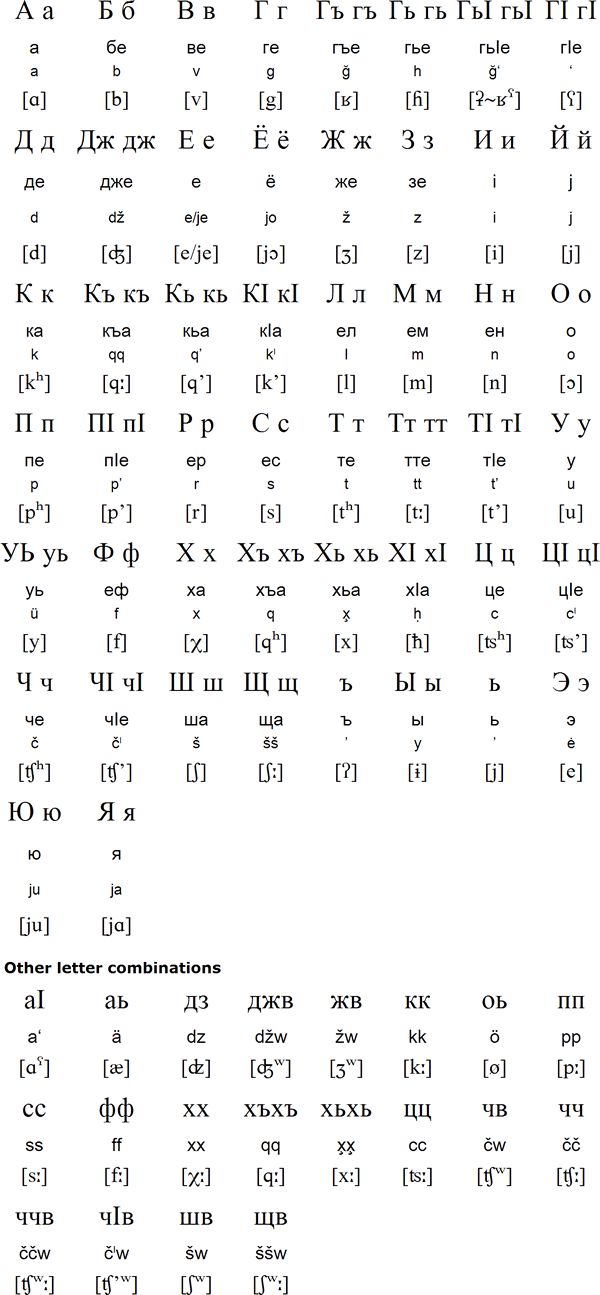
Alphabet[edit]
| А а | Б б | В в | Г г | Гъ гъ | Гь гь | Гӏ гӏ | ||
| Д д | Дж дж | Е е | Ё ё | Ж ж | З з | И и | Й й | |
| К к | Кк кк | Къ къ | Кь кь | Кӏ кӏ | Л л | М м | Н н | |
| О о | П п | Пп пп | Пӏ пӏ | Р р | С с | Т т | Тт тт | |
| Тӏ тӏ | У у | Уь уь | Ф ф | Х х | Хъ хъ | Хь хь | Хӏ хӏ | |
| Ц ц | Цӏ цӏ | Ч ч | Чч чч | Чӏ чӏ | Ш ш | Щ щ | ъ | |
| ӏ | ы | ь | Э э | Ю ю | Я я |
Grammar[edit]
![[icon]](/wiki/File:Wiki_letter_w_cropped.svg) | This section needs expansion. You can help by adding to it. (January 2010) |
Case[edit]
There are four core cases: absolutive, ergative, genitive, and dative, as well as a large series of location cases. All cases other than the absolutive (which is unmarked) and ergative take the ergative suffix before their own suffix.
Adjectives[edit]
Independent and predicative adjectives take number marker and class marker; also case if used as nominal. As attribute they are invariable. Thus idžed "good", ergative, idžedi, etc. -n, -s; pl. idžedar; but Idže insandi hhuč qini "The good man killed the wolf" (subject in ergative case).
Pronouns[edit]
Personal pronouns[edit]
| Singular (Aghul) | Plural (Aghul) | Singular (Tokip) | Plural (Tokip) | |
|---|---|---|---|---|
| 1 | zun | čin (ex), xin (in) | či (ex), xi (in) | či, xi |
| 2 | wun | čun | čun | ču |
Vocabulary[edit]
| This section is empty. You can help by adding to it. (August 2010) |
Writing system[edit]
| This section is empty. You can help by adding to it. (August 2010) |
Examples[edit]
Іисайи
ˡisaji
пуная
punaja
гебурис:
geburis:
–
–
ДуьгІе
Du’gˡe
акье
ak’e
миштти:
mištti:
«Дад,
"Dad,
Ве
Ve
ттур
ttur
гирами
girami
хьурай;
x’uraj;
Ве
Ve
Паччагьвел
Paččag’vel
адирай.
adiraj.
ТІалаб
Tˡalab
аркьая
ark’aja
чин
čin
Вакес
Vakes
гьер
g’er
ягьас
jag’as
гуни.
guni.
Гъил
G″il
гьушен
g’ušen
че
če
гунагьарилас,
gunag’arilas,
чинна
činna
гьил
g’il
гьуршанду
g’uršandu
кІилди
kˡildi
час
čas
Іайвелар
ˡajvelar
аркьаттарилас.
ark’attarilas.
ХІа
Xˡa
темехІера
temexˡera
хьас
x’as
амарта
amarta
час».
čas."
And he said unto them, When ye pray, say, Our Father which art in heaven, Hallowed be thy name. Thy kingdom come. Thy will be done, as in heaven, so in earth. Give us day by day our daily bread. And forgive us our sins; for we also forgive every one that is indebted to us. And lead us not into temptation; but deliver us from evil.[9]
References[edit]
- ^ Aghul at Ethnologue (18th ed., 2015) (subscription required)
- ^ "Aghul".
- ^ "Aghul".
- ^ a b Ladefoged & Maddieson (1996:167–168)
- ^ Magometov, Aleksandr Amarovic. 1970. Agul'skij jazyk: (issledovanie i teksty). Tbilisi: Izdatel'stvo "Mecniereba".
- ^ Gippert, Jost. "Titus Didactica: North-East Caucasian Consonant Systems". titus.fkidg1.uni-frankfurt.de.
- ^ "Aghul lp". Archived from the original on 2011-07-04. Retrieved 2016-07-12.
- ^ "Photo" (GIF). www.omniglot.com.
- ^ "Bible Gateway passage: Luke 11 - King James Version". Bible Gateway.
Bibliography[edit]
- Haspelmath, Martin (1993). A grammar of Lezgian. Mouton grammar library. Vol. 9. Mouton de Gruyter. doi:10.1515/9783110884210. ISBN 3-11-013735-6. LCCN 92-45620.
- Ladefoged, Peter; Maddieson, Ian (1996). The Sounds of the World's Languages. Oxford: Blackwell. ISBN 0-631-19815-6.
- Talibov, Bukar B.; Gadžiev, Magomed M. (1966). Lezginsko-russkij slovar'. Moskva: Izd. Sovetskaja Ėnciklopedija. OCLC 231755759.