


Dagestan
Republic of Dagestan | |||||||||||||||||||||||||||
|---|---|---|---|---|---|---|---|---|---|---|---|---|---|---|---|---|---|---|---|---|---|---|---|---|---|---|---|
| Республика Дагестан 13 other official names
| |||||||||||||||||||||||||||
| Anthem: "State Anthem of the Republic of Dagestan" | |||||||||||||||||||||||||||
.svg) Location of Dagestan (red) within European Russia | |||||||||||||||||||||||||||
| Coordinates: 42°59′2″N 47°30′18″E / 42.98389°N 47.50500°E | |||||||||||||||||||||||||||
| Country | Russia | ||||||||||||||||||||||||||
| Federal district | North Caucasian[1] | ||||||||||||||||||||||||||
| Economic region | North Caucasus[2] | ||||||||||||||||||||||||||
| Capital | Makhachkala | ||||||||||||||||||||||||||
| Government | |||||||||||||||||||||||||||
| • Body | People's Assembly[3] | ||||||||||||||||||||||||||
| • Head[3] | Sergey Melikov | ||||||||||||||||||||||||||
| Area | |||||||||||||||||||||||||||
• Total | 50,270 km2 (19,410 sq mi) | ||||||||||||||||||||||||||
| • Rank | 52nd | ||||||||||||||||||||||||||
| Population | |||||||||||||||||||||||||||
• Total |  3,182,054 3,182,054
| ||||||||||||||||||||||||||
• Estimate (2018)[6] | 3,063,885 | ||||||||||||||||||||||||||
| • Rank | 10th | ||||||||||||||||||||||||||
| • Urban | 45.2% | ||||||||||||||||||||||||||
| • Rural | 54.8% | ||||||||||||||||||||||||||
| Time zone | UTC+3 (MSK  [7]) [7]) | ||||||||||||||||||||||||||
| ISO 3166 code | RU-DA | ||||||||||||||||||||||||||
| License plates | 05 | ||||||||||||||||||||||||||
| OKTMO ID | 82000000 | ||||||||||||||||||||||||||
| Official languages | Russian;[8] [9][10] | ||||||||||||||||||||||||||
| Website | http://www.e-dag.ru/ | ||||||||||||||||||||||||||


Dagestan (/ˌdæɡɪˈstæn, -ˈstɑːn/ DAG-i-STA(H)N; Russian: Дагестан; IPA: [dəɡʲɪˈstan]), officially the Republic of Dagestan,[a] is a republic of Russia situated in the North Caucasus of Eastern Europe, along the Caspian Sea. It is located north of the Greater Caucasus, and is a part of the North Caucasian Federal District. The republic is the southernmost tip of Russia, sharing land borders with the countries of Azerbaijan and Georgia to the south and southwest, the Russian republics of Chechnya and Kalmykia to the west and north, and with Stavropol Krai to the northwest. Makhachkala is the republic's capital and largest city; other major cities are Derbent, Kizlyar, Izberbash, Kaspiysk, and Buynaksk.
Dagestan covers an area of 50,300 square kilometres (19,400 square miles), with a population of over 3.1 million,[12] consisting of over 30 ethnic groups and 81 nationalities.[13] With 14 official languages, and 12 ethnic groups each constituting more than 1% of its total population, the republic is one of Russia's most linguistically and ethnically diverse, and one of the most heterogeneous administrative divisions in the world.[14] Most of the residents speak one of the Northeast Caucasian, or Turkic languages;[13] however, Russian is the primary language and the lingua franca in the republic.[15]
Toponymy
[edit]The word Dagestan is of Turkish and Persian origin, directly translating to "Land of the Mountains". The Turkish word dağ means "mountain", and the Persian suffix -stan means "land".
Some areas of Dagestan were known as Lekia, Avaria and Tarki at various times.[16]
Between 1860 and 1920, Dagestan was referred to as Dagestan Oblast, corresponding to the southeastern part of the present-day republic. The current borders were created with the establishment of the Dagestan Autonomous Soviet Socialist Republic in 1921, with the incorporation of the eastern part of Terek Oblast, which is not mountainous but includes the Terek littoral at the southern end of the Caspian Depression.
Names in its official languages
[edit]- Russian – Республика Дагестан (Respublika Dagestan)
- Avar – Дагъистан Республика (Daġistan Respublika)
- Dargin – Дагъистан Республика (Daġistan Respublika)
- Kumyk – Дагъыстан Жумгьурият (Республика) (Dağıstan Cumhuriyat / Respublika)
- Lezgian – Республика Дагъустан (Respublika Daġustan)
- Lak – Дагъусттаннал Республика (Daġusttannal Respublika)
- Tabasaran – Дагъустан Республика (Daġustan Respublika)
- Rutul – Республика Дагъустан (Respublika Daġustan)
- Aghul – Республика Дагъустан (Respublika Daġustan)
- Tsakhur – Республика Дагъустан (Respublika Daġustan)
- Nogai – Дагыстан Республикасы (Dağıstan Respublikası)
- Chechen – Дегӏестан Республика (Deġestan Respublika)
- Azerbaijani – Дағыстан Республикасы (Dağıstan Respublikası)
- Tat – Республикей Догъисту (Respublikei Doġistu)
Geography
[edit]

stan
- the North Caucasus Federal District's republics: Karachay-Cherkessia, Kabardino-Balkaria, North Ossetia-Alania, Ingushetia, Chechnya and Dagestan
- to the north and west: the Southern Federal District
The republic is situated in the North Caucasus mountains. It is the southernmost part of Russia and is bordered on its eastern side by the Caspian Sea.
- Area: 50,300 square kilometers (19,400 sq mi)
- Borders:
- internal: Kalmykia (N), Chechnya (W), and Stavropol Krai (NW)
- international: Azerbaijan (Balakan District, Khachmaz District, Oghuz District, Qabala District, Qakh District, Qusar District, Shaki District and Zaqatala District) (S), Georgia (Kakheti) (SW)
- water: Caspian Sea (E)
- Highest point: Mount Bazardüzü/Bazardyuzyu: 4,446 metres (14,587 ft)
- Maximum north–south distance: 400 kilometers (250 mi)
- Maximum east–west distance: 200 kilometers (120 mi)
Rivers
[edit]There are over 1,800 rivers in the republic. Major rivers include:
- Sulak River
- Samur River
- Terek River
- Avar Koisu
- Andi Koisu
- Kazi-Kumukh Koisu
Lakes
[edit]Dagestan has about 405 kilometers (252 mi) of coastline on the world's largest lake, the Caspian Sea.
Mountains
[edit]Most of Dagestan is mountainous, with the Greater Caucasus Mountains covering the south of the republic. The highest point is the Bazardüzü/Bazardyuzyu peak at 4,470 meters (14,670 ft), on the border with Azerbaijan. The southernmost point of Russia is located about seven kilometers southwest of the peak. Other important mountains are Diklosmta (4,285 m (14,058 ft)), Gora Addala Shukgelmezr (4,152 m (13,622 ft)) and Gora Dyultydag (4,127 m (13,540 ft)). The town of Kumukh is one of the settlements on the mountains.
Natural resources
[edit]Dagestan is rich in oil, natural gas, coal, and many other minerals.[17]
Climate
[edit]The climate is classified as a continental climate, with a significant lack of precipitation. It is among the warmest places in Russia. In the mountainous regions, it is subarctic.[citation needed]
- Average January temperature: +2 °C (36 °F)
- Average July temperature: +26 °C (79 °F)
- Average annual precipitation: 250 mm (10 in) (northern plains) to 800 mm (31 in) (in the mountains).[18]
Administrative divisions
[edit]Dagestan is divided into forty-one administrative districts (raions) and ten cities/towns. The districts are further subdivided into nineteen urban-type settlements, and 363 rural okrugs and stanitsa okrugs.
History
[edit]
In the first few centuries AD, Caucasian Albania (corresponding to modern Azerbaijan and southern Dagestan) became a vassal and eventually subordinate to the Parthian Empire. With the advent of the Sasanian Empire, it became a satrapy (province) within the vast domains of the empire. In later antiquity, a few wars were fought as the Roman Empire unsuccessfully attempted to contest Sasanid rule over the region. Over the centuries, to a relatively large extent, the peoples within the Dagestan territory converted to Christianity alongside Zoroastrianism.
In the 5th century, the Sassanids gained the upper hand, and by the 6th century had constructed a strong citadel at Derbent, known from then on as the Caspian Gates, while the Huns overran the northern part of Dagestan, followed by the Caucasian Avars. During the Sassanian era, southern Dagestan became a bastion of Persian culture and civilization, with its center at Derbent.[19] A policy of "Persianisation" can be traced over many centuries.[20]
Islamic influence
[edit]During the Islamic conquests, the Dagestani people (region of Derbent) were the first people to become Muslims within current Russian territory, after the Arab conquest of the region in 643.[21] In the 8th century Arabs repeatedly clashed with the Khazars. Although the local population rose against the Arabs of Derbent in 905 and 913, Islam was still adopted in urban centers, such as Samandar and Kubachi (Zerechgeran), from where it steadily diffused into the highlands. By the 15th century, Christianity had died away, leaving a 10th-century Church of Datuna as the sole monument to its existence.
Seljuk Turks
[edit]
In the second half of the 11th century, the Seljuk Turks took part of the region of Dagestan under their control.[22]
Mongol rule
[edit]The Mongols raided the lands in 1221–1222 then conquered Derbent and the surrounding area from 1236 to 1239 during the invasions of Georgia and Durdzuketia.
Timurids
[edit]The Timurids incorporated the region into their realm following the Mongols.[22]
Alternating Persian and Russian rule
[edit].jpg)
As Mongolian authority gradually eroded, new centers of power emerged in Kaitagi and Tarki. In the early 16th century, the Persians (under the Safavids) reconsolidated their rule over the region, which would, intermittently, last till the early 19th century. In the 16th and 17th centuries, legal traditions were codified, and mountainous communities (djamaats) obtained considerable autonomy. In the 1720s, as a result of the disintegration of the Safavids and the Russo-Persian War (1722–23), the Russians briefly annexed maritime Dagestan from the Safavids. The Russians could not hold on to the interior of Dagestan, and could only be stopped in front of Baku with the help of Ottoman forces under the command of Mustafa Pasha. With a treaty signed between Russia and the Ottoman Empire in 1724, aimed at dividing the territories of Safavid Iran between them, Derbend, Baku and some other places in the region were left to Russia. Dagestan briefly came under Ottoman rule between 1578 and 1606.[22]
The territories were however returned to Persia in 1735 per the Treaty of Ganja.
Between 1730 and the early course of the 1740s, following his brother's murder in Dagestan, the new Persian ruler and military genius Nader Shah led a lengthy campaign in swaths of Dagestan in order to fully conquer the region, which was met with considerable success, although eventually he was forced to withdraw due to the extremity of the weather, the outbreak of disease and heavy raids by the various ethnic groups of Dagestan, forcing him to retreat with his army. From 1747 onwards, the Persian-ruled part of Dagestan was administered through the Derbent Khanate, with its center at Derbent. The Persian expedition of 1796 resulted in the Russian capture of Derbent in 1796. However, the Russians were again forced to retreat from the entire Caucasus following internal governmental problems, allowing Persia to capture the territory again.
Russian rule consolidated
[edit]It was not until the aftermath of the Russo-Persian War (1804–1813) that Russian power over Dagestan was confirmed, and that Qajar Persia officially ceded the territory to Russia. In 1813, following Russia's victory in the war, Persia was forced to cede southern Dagestan with its principal city of Derbent, alongside other vast territories in the Caucasus to Russia, conforming with the Treaty of Gulistan.[23] The 1828 Treaty of Turkmenchay indefinitely consolidated Russian control over Dagestan and removed Persia from the military equation.[24]
Uprisings against imperial Russia
[edit]

The Russian administration, however, disappointed and embittered the highlanders. The institution of heavy taxation, coupled with the expropriation of estates and the construction of fortresses (including Makhachkala), electrified highlanders into rising under the aegis of the Muslim Imamate of Dagestan, led by Ghazi Mohammed (1828–1832), Hamzat Bek (1832–1834) and Shamil (1834–1859). This Caucasian War raged until 1864.
Dagestan and Chechnya profited from the Russo-Turkish War (1877–1878), rising together against the Russian Empire. Chechnya rose again at various times throughout the late 19th and 20th centuries.
Soviet era
[edit]On December 21, 1917, Ingushetia, Chechnya, Dagestan and the rest of the North Caucasus declared independence from Russia and formed a single state called the "United Mountain Dwellers of the North Caucasus" (also known as the Mountainous Republic of the Northern Caucasus).[citation needed] The capital of the new state was moved to Temir-Khan-Shura.[25][26] The first prime minister of the state was Tapa Chermoyev, a prominent Chechen statesman. The second prime minister was an Ingush statesman Vassan-Girey Dzhabagiev, who in 1917 also became the author of the constitution of the land, and in 1920 was re-elected for a third term.[27] After the Bolshevik Revolution, Ottoman armies occupied Azerbaijan and Dagestan and the region became part of the short-lived Mountainous Republic of the Northern Caucasus. After more than three years of fighting the White Army and local nationalists, the Bolsheviks achieved victory and the Dagestan Autonomous Soviet Socialist Republic was proclaimed on January 20, 1921. As the newly created Soviet Union was consolidating control in the region, Dagestan declared itself a republic within the Russian Soviet federation but did not follow the other ASSRs in declaring sovereignty.[28]
Post-Soviet era
[edit]On August 7, 1999, the Islamic International Peacekeeping Brigade (IIPB), an Islamist group from Chechnya led by warlords Shamil Basayev, Ibn Al-Khattab and Ramzan Akhmadov, launched a military invasion of Dagestan, in support of the Shura separatist rebels with the aim of creating an "independent Islamic State of Dagestan".
The invaders were supported by part of the local population but were driven back by the Russian military and local paramilitary groups.[29] In response to the invasion, Russian forces subsequently reinvaded Chechnya later that year.[30]
Dagestan has one of the highest unemployment rates in Russia.[31]
Dagestani soldiers participated in the 2022 Russian invasion of Ukraine, many of whom were killed in action.[32][33][34] In September, Dagestan became a center of the 2022 North Caucasian protests against mobilization.[35]
In 2023, during the Hamas-Israel war, there were a wave of antisemitic attacks across the North Caucasus, including Dagestan.[36][37]
Politics
[edit]

The parliament of Dagestan is the People's Assembly, consisting of 72 deputies elected for a four-year term. The People's Assembly is the highest executive and legislative body of the republic.
The Constitution of Dagestan was adopted on July 10, 2003. According to it, the highest executive authority lies with the State Council, comprising representatives of fourteen ethnicities. The Constitutional Assembly of Dagestan appoints the members of the State Council for a term of four years. The State Council appoints the members of the Government.
The ethnicities represented in the State Council are Avars, Dargins, Kumyks, Lezgins, Laks, Azerbaijanis, Tabasarans, Russians, Chechens, Nogais, Aguls, Rutuls, Tsakhurs, and Tats.
Formerly, the Chairman of the State Council was the highest executive post in the republic, held by Magomedali Magomedovich Magomedov until 2006. On February 20, 2006, the People's Assembly passed a resolution terminating this post and disbanding the State Council. Russian president, Vladimir Putin offered the People's Assembly the candidature of Mukhu Aliyev for the newly established post of the president of the Republic of Dagestan. The People's Assembly accepted the nomination, and Mukhu Aliyev became the first president of the republic. On February 20, 2010, Aliyev was replaced by Magomedsalam Magomedov. Ramazan Abdulatipov then became the head (acting 2013–2017, following the resignation of Magomedov).[citation needed] On October 3, 2017, Vladimir Vasilyev was appointed as head.[38]
In the 2024 Russian presidential election, which critics called rigged and fraudulent,[39] President Vladimir Putin won 92.93% of the vote in Dagestan.[40]
Demographics
[edit]Because its mountainous terrain impedes travel and communication, Dagestan is unusually ethnically diverse and still largely tribal. It is Russia's most heterogeneous republic. Dagestan's population is rapidly growing.[41]
| Year | Pop. | ±% |
|---|---|---|
| 1897 | 571,154 | — |
| 1926 | 787,883 | +37.9% |
| 1939 | 1,023,300 | +29.9% |
| 1959 | 1,062,472 | +3.8% |
| 1970 | 1,428,540 | +34.5% |
| 1979 | 1,627,884 | +14.0% |
| 1989 | 1,802,579 | +10.7% |
| 2002 | 2,576,531 | +42.9% |
| 2010 | 2,910,249 | +13.0% |
| 2021 | 3,182,054 | +9.3% |
| Source: Census data | ||
Population
[edit]3,182,054 (2021 Census);[42] 2,910,249 (2010 Census);[43] 2,576,531 (2002 Census);[44] 1,802,579 (1989 Soviet census).[45]
Life expectancy
[edit]Dagestan has the second highest life expectancy in Russia. Higher duration of life is observed only in Ingushetia.[46][47]
| 2019 | 2021 | |
|---|---|---|
| Average: | 79.1 years | 76.6 years |
| Male: | 76.6 years | 74.1 years |
| Female: | 81.4 years | 79.0 years |
-
 Life expectancy at birth in Dagestan
 -
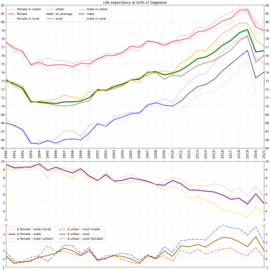 Life expectancy with calculated differences
 -
 Life expectancy in Dagestan in comparison with other regions of the North Caucasus
 -
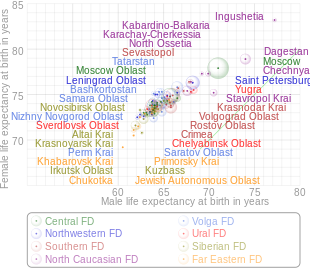 Interactive chart of comparison of male and female life expectancy for 2021. Open the original svg-file in a separate window and hover over a bubble to highlight it.
 -
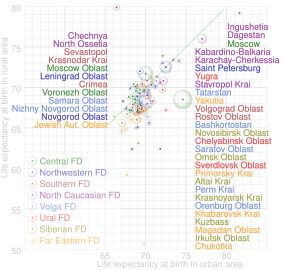 Analogious interactive chart of comparison of urban and rural life expectancy.
Original interactive file.


Settlements
[edit]Largest cities or towns in Dagestan
2021 Russian Census | |||||||||
|---|---|---|---|---|---|---|---|---|---|
| Rank | Administrative Division | Pop. | |||||||
 Makhachkala  Khasavyurt |
1 | Makhachkala | City of republic significance of Makhachkala | 623,254 |  Derbent  Kaspiysk | ||||
| 2 | Khasavyurt | Khasavyurtovsky District | 155,144 | ||||||
| 3 | Derbent | Derbentsky District | 124,953 | ||||||
| 4 | Kaspiysk | City of republic significance of Kaspiysk | 121,140 | ||||||
| 5 | Buynaksk | Buynaksky District | 68,121 | ||||||
| 6 | Izberbash | Town of republic significance of Izberbash | 55,996 | ||||||
| 7 | Kizlyar | Kizlyarsky District | 49,999 | ||||||
| 8 | Kizilyurt | Kizilyurtovsky District | 38,335 | ||||||
| 9 | Dagestanskiye Ogni | Town of republic significance of Dagestanskiye Ogni | 31,412 | ||||||
| 10 | Karabudakhkent | Karabudakhkentsky District | 20,710 | ||||||
Vital statistics
[edit]


Source: Russian Federal State Statistics Service [48]
| Average population (x 1000) | Live births | Deaths | Natural change | Crude birth rate (per 1000) | Crude death rate (per 1000) | Natural change (per 1000) | Fertility rates | |
|---|---|---|---|---|---|---|---|---|
| 1970 | 1,438 | 41,381 | 9,543 | 31,838 | 28.8 | 6.6 | 22.1 | |
| 1975 | 1,544 | 42,098 | 10,292 | 31,806 | 27.3 | 6.7 | 20.6 | |
| 1980 | 1,655 | 44,088 | 11,188 | 32,900 | 26.6 | 6.8 | 19.9 | |
| 1985 | 1,744 | 50,053 | 12,010 | 38,043 | 28.7 | 6.9 | 21.8 | |
| 1990 | 1,848 | 48,209 | 11,482 | 36,727 | 26.1 | 6.2 | 19.9 | 3.07 |
| 1991 | 1,906 | 47,461 | 12,062 | 35,399 | 24.9 | 6.3 | 18.6 | 2.94 |
| 1992 | 1,964 | 44,986 | 12,984 | 32,002 | 22.9 | 6.6 | 16.3 | 2.70 |
| 1993 | 2,012 | 41,863 | 14,777 | 27,086 | 20.8 | 7.3 | 13.5 | 2.46 |
| 1994 | 2,117 | 44,472 | 15,253 | 29,219 | 21.0 | 7.2 | 13.8 | 2.45 |
| 1995 | 2,209 | 45,680 | 15,700 | 29,980 | 20.7 | 7.1 | 13.6 | 2.41 |
| 1996 | 2,251 | 42,282 | 15,565 | 26,717 | 18.8 | 6.9 | 11.9 | 2.19 |
| 1997 | 2,308 | 41,225 | 15,662 | 25,563 | 17.9 | 6.8 | 11.1 | 2.10 |
| 1998 | 2,363 | 41,164 | 15,793 | 25,371 | 17.4 | 6.7 | 10.7 | 2.05 |
| 1999 | 2,417 | 38,281 | 16,020 | 22,261 | 15.8 | 6.6 | 9.2 | 1.87 |
| 2000 | 2,464 | 38,229 | 16,108 | 22,121 | 15.5 | 6.5 | 9.0 | 1.82 |
| 2001 | 2,511 | 38,480 | 15,293 | 23,187 | 15.3 | 6.1 | 9.2 | 1.79 |
| 2002 | 2,563 | 41,204 | 15,887 | 25,317 | 16.1 | 6.2 | 9.9 | 1.85 |
| 2003 | 2,609 | 41,490 | 15,929 | 25,561 | 15.9 | 6.1 | 9.8 | 1.81 |
| 2004 | 2,647 | 41,573 | 15,724 | 25,849 | 15.7 | 5.9 | 9.8 | 1.76 |
| 2005 | 2,684 | 40,814 | 15,585 | 25,229 | 15.2 | 5.8 | 9.4 | 1.69 |
| 2006 | 2,721 | 40,646 | 15,939 | 24,707 | 14.9 | 5.9 | 9.1 | 1.64 |
| 2007 | 2,761 | 45,470 | 15,357 | 30,113 | 16.5 | 5.6 | 10.9 | 1.81 |
| 2008 | 2,804 | 49,465 | 15,794 | 33,671 | 17.6 | 5.6 | 12.0 | 1.94 |
| 2009 | 2,850 | 50,416 | 16,737 | 33,679 | 17.7 | 5.9 | 11.8 | 1.92 |
| 2010 | 2,896 | 52,057 | 17,013 | 35,044 | 18.0 | 5.9 | 12.1 | 1.92 |
| 2011 | 2,914 | 54,646 | 16,872 | 37,774 | 18.1 | 5.8 | 12.3 | 1.98 |
| 2012 | 2,931 | 56,186 | 16,642 | 39,544 | 19.1 | 5.7 | 13.4 | 2.03 |
| 2013 | 2,955 | 55,641 | 16,258 | 39,383 | 18.8 | 5.5 | 13.3 | 2.02 |
| 2014 | 2,982 | 56,888 | 16,491 | 40,397 | 19.1 | 5.5 | 13.6 | 2.08 |
| 2015 | 3,003 | 54,867 | 16,188 | 38,679 | 18.3 | 5.4 | 12.9 | 2.02 |
| 2016 | 3,029 | 52,867 | 15,719 | 37,148 | 17.4 | 5.2 | 12.2 | 1.98 |
| 2017 | 3,041 | 50,174 | 15,473 | 34,701 | 16.4 | 5.1 | 11.3 | 1.91 |
| 2018 | 3,077 | 48,120 | 14,871 | 33,249 | 15.6 | 4.8 | 10.8 | 1.86 |
| 2019 | 3,110 | 45,977 | 14,941 | 31,036 | 14.8 | 4.8 | 10.0 | 1.78 |
| 2020 | 3,138 | 47,051 | 19,750 | 27,301 | 15.1 | 6.3 | 8.8 | 1.87 |
| 2021 | 3,182 | 44,330 | 19,766 | 24,564 | 14.1 | 6.3 | 7.8 | 1.76 |
| 2022 | 3,186 | 42,515 | 16,344 | 26,171 | 13.4 | 5.2 | 8.2 | 1.73 |
| 2023 | 42,075 | 14,605 | 27,470 | 13.1 | 4.5 | 8.6 | 1.75 |
Ethnic groups
[edit]The people of Dagestan include a large variety of ethnicities. According to the 2021 Census,[49] Northeast Caucasians (including Avars, Dargins, Lezgins, Laks, Tabasarans, Rutulians and Chechens) make up almost 75% of the population of Dagestan. Turkic peoples, Kumyks, Azerbaijanis, and Nogais make up 21%, and Russians 3.3%. Other ethnicities (e.g. Tats, who are an Iranian people) each account for less than 0.4% of the total population.
Such groups as the Botlikh, the Andi, the Akhvakhs, the Tsez and about ten other groups were reclassified as Avars between the 1926 and 1939 censuses.[50]
Ethnic groups in Dagestan (2021)
| Ethnic group |
1926 Census | 1939 Census | 1959 Census | 1970 Census | 1979 Census | 1989 Census | 2002 Census | 2010 Census | 2021 Census1 | |||||||||
|---|---|---|---|---|---|---|---|---|---|---|---|---|---|---|---|---|---|---|
| Number | % | Number | % | Number | % | Number | % | Number | % | Number | % | Number | % | Number | % | Number | % | |
| Avars | 177,189 | 22.5% | 230,488 | 24.8% | 239,373 | 22.5% | 349,304 | 24.5% | 418,634 | 25.7% | 496,077 | 27.5% | 758,438 | 29.4% | 850,011 | 29.4% | 956,831 | 30.5% |
| Dargins | 125,707 | 16.0% | 150,421 | 16.2% | 148,194 | 13.9% | 207,776 | 14.5% | 246,854 | 15.2% | 280,431 | 15.6% | 425,526 | 16.5% | 490,384 | 17.0% | 521,381 | 16.6% |
| Kumyks | 87,960 | 11.2% | 100,053 | 10.8% | 120,859 | 11.4% | 169,019 | 11.8% | 202,297 | 12.4% | 231,805 | 12.9% | 365,804 | 14.2% | 431,736 | 14.9% | 496,455 | 15.8% |
| Lezgins | 90,509 | 11.5% | 96,723 | 10.4% | 108,615 | 10.2% | 162,721 | 11.4% | 188,804 | 11.6% | 204,370 | 11.3% | 336,698 | 13.1% | 385,240 | 13.3% | 416,963 | 13.3% |
| Laks | 39,878 | 5.1% | 51,671 | 5.6% | 53,451 | 5.0% | 72,240 | 5.1% | 83,457 | 5.1% | 91,682 | 5.1% | 139,732 | 5.4% | 161,276 | 5.6% | 162,518 | 5.2% |
| Tabasarans | 31,915 | 4.0% | 33,432 | 3.6% | 33,548 | 3.2% | 53,253 | 3.7% | 71,722 | 4.4% | 78,196 | 4.6% | 110,152 | 4.3% | 118,848 | 4.1% | 126,319 | 4.0% |
| Azerbaijanis | 23,428 | 3.0% | 31,141 | 3.3% | 38,224 | 3.6% | 54,403 | 3.8% | 64,514 | 4.0% | 75,463 | 4.2% | 111,656 | 4.3% | 130,919 | 4.5% | 116,907 | 3.7% |
| Russians | 98,197 | 12.5% | 132,952 | 14.3% | 213,754 | 20.1% | 209,570 | 14.7% | 189,474 | 11.6% | 165,940 | 9.2% | 120,875 | 4.7% | 104,020 | 3.6% | 102,243 | 3.3% |
| Chechens | 21,851 | 2.8% | 26,419 | 2.8% | 12,798 | 1.2% | 39,965 | 2.8% | 49,227 | 3.0% | 57,877 | 3.2% | 87,867 | 3.4% | 93,658 | 3.2% | 99,320 | 3.2% |
| Nogais | 26,086 | 3.3% | 4,677 | 0.5% | 14,939 | 1.4% | 21,750 | 1.5% | 24,977 | 1.5% | 28,294 | 1.6% | 38,168 | 1.5% | 40,407 | 1.4% | 36,944 | 1.2% |
| Aghuls | 7,653 | 1.0% | 20,408 | 2.2% | 6,378 | 0.6% | 8,644 | 0.6% | 11,459 | 0.7% | 13,791 | 0.8% | 23,314 | 0.9% | 28,054 | 1.0% | 29,253 | 0.9% |
| Rutuls | 10,333 | 1.3% | 6,566 | 0.6% | 11,799 | 0.8% | 14,288 | 0.9% | 14,955 | 0.8% | 24,298 | 1.0% | 27,849 | 1.0% | 27,043 | 0.9% | ||
| Tsakhurs | 3,531 | 0.4% | 4,278 | 0.4% | 4,309 | 0.3% | 4,560 | 0.3% | 5,194 | 0.3% | 8,168 | 0.3% | 9,771 | 0.3% | 10,320 | 0.3% | ||
| Others | 43,861 | 5.6% | 52,031 | 5.6% | 61,495 | 5.8% | 63,787 | 4.5% | 57,892 | 3.6% | 58,113 | 3.2% | 25,835 | 1.0% | 19,646 | 0.7% | 31,752 | 1.0% |
| 1 47,805 people were registered from administrative databases, and could not declare an ethnicity. It is estimated that the proportion of ethnicities in this group is the same as that of the declared group.[51] | ||||||||||||||||||
Languages
[edit]
More than 30 local languages are commonly spoken, most belonging to the Nakh-Daghestanian language family. Russian became the principal lingua franca in Dagestan during the 20th century;[52] Over 20 of Russia's 131 endangered languages as identified by UNESCO can be found in Dagestan. Most of these endangered languages have speakers in the mountainous region on the Dagestan-Georgia border.[53]
Prior to Soviet rule, the literary lingua-franca status to some extent belonged to Classical Arabic.[54] The northern Avar dialect of Khunzakh has also served as a lingua franca in mountainous Dagestan where Avar-related peoples lived.[55] And throughout centuries the Kumyk language had been the lingua-franca for the bigger part of the Northern Caucasus, from Dagestan to Kabarda, until the 1930s.[56][57][58] Kumyk also had been an official language for communication of the Russian Imperial administration with the local peoples.[59]
The first Russian grammar written about a language from present-day Dagestan was for Kumyk.[60] Author Timofey Makarov wrote:
From the peoples speaking Tatar language I liked the most Kumyks, as for their language's distinction and precision, so for their closeness to the European civilization, but most importantly, I take in account that they live on the Left Flank of the Caucasian Front, where we're conducting military actions, and where all the peoples, apart from their own language, speak also Kumyk.
Religion
[edit]Religion in Dagestan (2012)[61]
According to a 2012 survey which interviewed 56,900 people,[61] 83% of the population of Dagestan adheres to Islam, 2.4% to the Russian Orthodox Church, 2% to Caucasian folk religion and other native faiths, 1% are non-denominational Christians. In addition, 9% of the population identify as "spiritual but not religious", 2% as atheist, and 0.6% as other and no answer.[61]
Islam
[edit]Dagestanis adherents of Islam are largely Sunni Muslims of the Shafii school. On the Caspian coast, particularly in and around the port city of Derbent, the population (primarily made up of Azerbaijanis) is Shia. A Salafi minority is also present, which is sometimes a target of official repression.[62]
The appearance of Sufi mysticism in Dagestan dates back to the 14th century. The two Sufi orders that are widely spread in the North Caucasus were the Naqshbandiya and the Qadiriya. The mystic tariqas preached tolerance and coexistence between the diverse people in the region. The Communist total intolerance for any religion after the Communist Revolution of 1917 also suppressed the Sufi movements. Shaykh Said Afandi al-Chirkawi was a prominent scholar, spiritual leader, and murshid (guide) of Naqshbandi and Shadhili tariqahs in Dagestan until his death.[63]
Since the dissolution of the Soviet Union, there has been an Islamic revival in the region. By 1996, Dagestan had 1,670 registered mosques, nine Islamic universities, 25 madrassas, 670 maktab, and it is estimated that "nearly one in five Dagestanis was involved in Islamic education", while of the 20,000 or so Russian pilgrims for the Hajj more than half were from Dagestan.[64]
Judaism
[edit]A relatively large number of native Tati-speaking Jews – the "Mountain Jews" – were[when?] also present in these same coastal areas. However, since 1991 and the collapse of the Soviet Union, many have migrated to Israel and the United States. These[specify] were an extension of much larger Azerbaijani Jewish community across the border in the Azerbaijani districts of Quba and Shamakhi.[65]
Christianity
[edit]The number of Christians among the non-Slavic indigenous population is very low, with estimates between 2,000 and 2,500. Most of these are Pentecostal Christians from the Lak ethnicity.[66][67] The largest congregation is Osanna Evangelical Christian Church (Pentecostal) in Makhachkala, with more than 1,000 members.[68]
- Cathedral of the Assumption is an Eastern Orthodox cathedral located in the city of Makhachkala, the main cathedral of the Diocese of Makhachkala.
- Church of the Holy Equal-to-the-Apostles Prince Vladimir is a Russian Orthodox cathedral of the Diocese of Makhachkala, located in the city of Makhachkala.
 |
 |
.jpg) |
 |
 |
| Makhachkala Grand Mosque | Cathedral of Our Lady of the Sign in Khasavyurt | Church of the Holy All-Savior of Derbent | Derbent Synagogue | The Juma Mosque of Derbent (built in 733) is the oldest in Russia and one of the oldest in the world. |
Genetics
[edit]In 2006, a genetic study of the Dagestan populations, published in Human Biology, suggested that inhabitants of Dagestan are closely related to Anatolian Turks and Cypriot Turks. Yunusbayev et al. pointed out that these findings support the theory that indigenous groups of Dagestan can trace their roots back to ancient Anatolian farming tribes who introduced early agricultural traditions.[69]
Notable people
[edit]- List of Notable people from Dagestan
Economy
[edit]The major industries in Dagestan include oil production, engineering, chemicals, machine building, textile manufacturing, food processing and timber. Oil deposits are located in the narrow coastal region. Dagestan's natural gas production goes mostly to satisfy local needs. Agriculture is varied and includes grain-farming, viticulture and wine-making, sheep-farming, and dairying. The engineering and metalworking industries own 20% of the republic's industrial production assets and employ 25% of all industrial workers. Dagestan's hydroelectric power industry is developing rapidly. There are five power plants on the Sulak River providing hydroelectric power. It has been estimated that Dagestan's total potential hydroelectric power resources are 4.4 billion kW. Dagestan has a well-developed transportation system. Railways connect the capital Makhachkala to Moscow, Astrakhan, and the Azerbaijani capital, Baku. The Moscow-Baku highway also passes through Dagestan, and there are air links with major cities.[70][71]
Conditions for economic development are favorable in Dagestan, but – as of 2006[update] – the republic's low starting level for a successful transition to market relations, in addition to rampant corruption, has made the region highly dependent on its underground economy and the subsidies coming from the central Russian government.[71][72] Corruption in Dagestan is more severe than in other regions of the former Soviet Union and is coupled with a flourishing black market and clan-based economic system.[73]
In 2011 Rostelecom started the implementation of WDM-based equipment on the backbone network for data transmission in the Republic of Dagestan. Due to WDM introduction, the fiber-optic communication lines bandwidth increased to 2.5 Gbit/s. Rostelecom invested about 48 million rubles in the project.[74]
Culture
[edit]Literature
[edit]Epic-historical songs about the defeat of the armies of Afshar Turk Nadir Shah and various episodes of the nineteenth-century wars are popular among the Avars. Best-known are the ballads "Khochbar" and "Kamalil Bashir". In the second half of the nineteenth century and the beginning of the twentieth, Avar culture and literature grew significantly. Well-known Avar literary figures include the poets Aligaji of Inkho (who died 1875) and Chanka (1866–1909), the lyric poet Makhmud (1873–1919), the satirist Tsadasa Gamzat (1877–1951), and the celebrated poet Rasul Gamzatov (1923–2003). Among his poems was Zhuravli, which became a well-known Russian song.[75]
Music
[edit]There is a Dagestani Philharmonic Orchestra and a State Academic Dance Ensemble. Gotfrid Hasanov, who is said to be the first professional composer from Dagestan, wrote Khochbar, the first Dagestani opera, in 1945. Dagestani folk dances include a fast-paced dance called the lezginka. It derives its names from the Lezgin people; nevertheless, Azerbaijanis, Circassians, Abkhazians, Mountain Jews, Caucasian Avars, the Russian Kuban, and Terek Cossacks and many other tribes have their own versions.[76]
Cuisine
[edit]Khingal-bat is Dagestan's national dish of small dumplings boiled in ram's broth. Depending on the cook's ethnicity, the dumplings can be oval or round, filled with meat or cheese, and served with a garlic or sour cream sauce. Dairy products and meat constitute a large part of the diet in the mountainous regions, while in the valley zones, vegetables and grain flour are eaten in addition to fruits, edible gourds, edible herbs, and wild grasses.[77]
Martial arts
[edit]In recent times the region has been recognized for producing some of the world's best athletes in combat sports and produces the most MMA fighters of any region relative to population. Dagestani born Khabib Nurmagomedov was a UFC lightweight champion who retired undefeated.[78][79] His training partner, Islam Makhachev, who is also Dagestani, is the current UFC lightweight champion. Khabib's cousin, Umar Nurmagomedov, is an undefeated fighter in the UFC's bantamweight division. Umar's younger brother, Usman Nurmagomedov, is the current Bellator lightweight champion. Magomed Ankalaev, who also hails from Dagestan, fought for the UFC light heavyweight championship in 2022. Abubakar Nurmagomedov is also a cousin of Khabib's who is Dagestani, he is also a professional MMA fighter with a professional record of 17-4-1.
Dagestan has also historically produced a disproportionate number of Olympic and world champions in freestyle wrestling. Considered by some as the greatest freestyle wrestlers of all time Buvaisar Saitiev who was a three time Olympic champion and Abdulrashid Sadulaev who won gold at the 2021 Tokyo Olympics are from Dagestan.
In boxing, Artur Beterbiev is a one time World Cup gold medalist, Two time Olympian and the current (October 2024) undisputed IBF, IBO, WBO, and WBC light heavyweight champion, winning 21 fights and 20 by knockout.
See also
[edit]

- Former countries in Europe after 1815
- Insurgency in the North Caucasus
- Islamic Djamaat of Dagestan
- List of clashes in the North Caucasus
- Shariat Jamaat
Notes
[edit]Citations
[edit]- ^ Президент Российской Федерации. Указ №849 от 13 мая 2000 г. «О полномочном представителе Президента Российской Федерации в федеральном округе». Вступил в силу 13 мая 2000 г. Опубликован: "Собрание законодательства РФ", No. 20, ст. 2112, 15 мая 2000 г. (President of the Russian Federation. Decree #849 of May 13, 2000 On the Plenipotentiary Representative of the President of the Russian Federation in a Federal District. Effective as of May 13, 2000.).
- ^ Госстандарт Российской Федерации. №ОК 024-95 27 декабря 1995 г. «Общероссийский классификатор экономических регионов. 2. Экономические районы», в ред. Изменения №5/2001 ОКЭР. (Gosstandart of the Russian Federation. #OK 024-95 December 27, 1995 Russian Classification of Economic Regions. 2. Economic Regions, as amended by the Amendment #5/2001 OKER. ).
- ^ a b Constitution, Article 8
- ^ "Сведения о наличии и распределении земель в Российской Федерации на 01.01.2019 (в разрезе субъектов Российской Федерации)". Federal Service for State Registration, Cadastre and Cartography. Archived from the original on February 9, 2022. Retrieved August 29, 2023.
- ^ "Оценка численности постоянного населения по субъектам Российской Федерации". Federal State Statistics Service. Retrieved September 1, 2022.
- ^ "26. Численность постоянного населения Российской Федерации по муниципальным образованиям на 1 января 2018 года". Federal State Statistics Service. Retrieved January 23, 2019.
- ^ "Об исчислении времени". Официальный интернет-портал правовой информации (in Russian). June 3, 2011. Retrieved January 19, 2019.
- ^ Official throughout the Russian Federation according to Article 68.1 of the Constitution of Russia.
- ^ According to Article 11 of the Constitution of Dagestan, the official languages of the republic include "Russian and the languages of the peoples of Dagestan"
- ^ Solntsev et al., pp. XXXIX–XL
- ^ Всероссийский Центральный Исполнительный Комитет. Декрет от 20 января 1921 г. «Об Автономной Дагестанской Социалистической Советской Республике». (All-Russian Central Executive Committee. Decree of January 20, 1921 On Autonomous Dagestan Socialist Soviet Republic. ).
- ^ "Оценка численности постоянного населения по субъектам Российской Федерации". Главная::Федеральная служба государственной статистики. Archived from the original on January 24, 2020. Retrieved October 24, 2020.
- ^ a b "Dagestan". Encyclopedia Britannica. Retrieved October 24, 2020.
- ^ Heinrich, Hans-Georg; Lobova, Ludmila; Malashenko, Alexei (2011). Will Russia Become a Muslim Society?. Peter Lang. p. 46. ISBN 978-3631609132. Retrieved August 6, 2012.
- ^ Dalby, Andrew (2004). Dictionary of Languages: The Definitive Reference to More Than 400 Languages. Columbia University Press. p. 59. ISBN 0231115695. Retrieved August 6, 2012.
- ^ Zonn, Igor S.; et al. The Caspian Sea Encyclopedia. Berlin: Springer. p. 280.
- ^ "Dagestan Republic". www.investinginrussia.ru. Retrieved May 8, 2019.
- ^ "Climate in Dagestan, Russia". Worlddata.info. Retrieved May 8, 2019.
- ^ Michael Khodarkovsky (2015). "Bitter Choices: Loyalty and Betrayal in the Russian Conquest of the North Caucasus". Cornell University Press. ISBN 0801462908 pp. 47–52
- ^ "Dagestan". Retrieved June 11, 2015.
- ^ "Islam: Islam in the Caucasus and the Middle Volga | Encyclopedia.com". www.encyclopedia.com.
- ^ a b c "DAĞISTAN – TDV İslâm Ansiklopedisi". TDV İslam Ansiklopedisi (in Turkish). Retrieved August 8, 2022.
- ^ Timothy C. Dowling (2014). Russia at War: From the Mongol Conquest to Afghanistan, Chechnya, and Beyond. pp. 728–730. ABC-CLIO. ISBN 1598849484
- ^ Aksan, Virginia (2014). Ottoman Wars, 1700–1870: An Empire Besieged. p. 463. Routledge. ISBN 978-1317884033
- ^ "Republic of the North Caucasus Federation". 1900.ethnia.org. Archived from the original on February 22, 2014. Retrieved January 14, 2022.
- ^ "ISO Brain – Premium Supplement For Your Brain". September 18, 2022. Archived from the original on February 23, 2014.
- ^ Вассан-Гирей Джабагиев Archived February 21, 2014, at the Wayback Machine
- ^ Zamyatin, Konstantin (2013). "Sovereignisation and State Languages: Early Formation of Language Policy of Russia's Finno-Ugric Republics in the Conditions of the USSR Disintegration" (PDF). Finnish-Ugric Communications. 36: 132 – via University of Helsinki.
- ^ "Rebels stage new invasion of Dagestan". The Independent. September 6, 1999.
- ^ "Russia Sends Ground Troops into Chechnya, Raising Fears". The New York Times. October 1, 1999.
- ^ "Занятость и безработица в Российской Федерации в феврале 2020 года (по итогам обследования рабочей силы)". May 27, 2020. Archived from the original on May 27, 2020.
- ^ "Most Russian soldiers killed in action in Ukraine come from Russia's poorest regions". Ukrainska Pravda. April 25, 2022.
- ^ "Дагестан лидирует по числу погибших в Украине"
- ^ "Больше, чем в Афгане. Почему Дагестан лидирует по потерям в Украине?". RFE/RL. May 2022.
- ^ Murphy, Matt; Thomas, Merlyn (September 26, 2022). "Ukraine war: Protests in Russia's Dagestan region against new draft". BBC News. Retrieved September 26, 2022.
- ^ "Hundreds storm airport in Russia in antisemitic riot over arrival of plane from Israel – CBS News". www.cbsnews.com. October 30, 2023. Retrieved October 30, 2023.
- ^ "Anti-Israel mob storms Dagestan airport in Russia". BBC News. October 29, 2023. Retrieved October 30, 2023.
- ^ "Vladimir Vasilyev appointed Acting Head of Dagestan". President of Russia. October 3, 2017. Retrieved May 2, 2019.
- ^ "The extent of fraud in Russia's presidential election begins to emerge". Le Monde. March 20, 2024.
- ^ "Итоги выборов президента России". РИА Новости (in Russian). March 18, 2024. Archived from the original on March 17, 2024.
- ^ Ware, Robert Bruce (March 29, 2008). "Islamic Resistance and Political Hegemony in Dagestan". Archived from the original on October 21, 2014. Retrieved May 28, 2014.
{{cite journal}}: Cite journal requires|journal=(help) - ^ Russian Federal State Statistics Service. Всероссийская перепись населения 2020 года. Том 1 [2020 All-Russian Population Census, vol. 1] (XLS) (in Russian). Federal State Statistics Service.
- ^ Russian Federal State Statistics Service (2011). Всероссийская перепись населения 2010 года. Том 1 [2010 All-Russian Population Census, vol. 1]. Всероссийская перепись населения 2010 года [2010 All-Russia Population Census] (in Russian). Federal State Statistics Service.
- ^ Federal State Statistics Service (May 21, 2004). Численность населения России, субъектов Российской Федерации в составе федеральных округов, районов, городских поселений, сельских населённых пунктов – районных центров и сельских населённых пунктов с населением 3 тысячи и более человек [Population of Russia, Its Federal Districts, Federal Subjects, Districts, Urban Localities, Rural Localities—Administrative Centers, and Rural Localities with Population of Over 3,000] (XLS). Всероссийская перепись населения 2002 года [All-Russia Population Census of 2002] (in Russian).
- ^ Всесоюзная перепись населения 1989 г. Численность наличного населения союзных и автономных республик, автономных областей и округов, краёв, областей, районов, городских поселений и сёл-райцентров [All Union Population Census of 1989: Present Population of Union and Autonomous Republics, Autonomous Oblasts and Okrugs, Krais, Oblasts, Districts, Urban Settlements, and Villages Serving as District Administrative Centers]. Всесоюзная перепись населения 1989 года [All-Union Population Census of 1989] (in Russian). Институт демографии Национального исследовательского университета: Высшая школа экономики [Institute of Demography at the National Research University: Higher School of Economics]. 1989 – via Demoscope Weekly.
- ^ "Демографический ежегодник России" [The Demographic Yearbook of Russia] (in Russian). Federal State Statistics Service of Russia (Rosstat). Retrieved June 1, 2022.
- ^ "Ожидаемая продолжительность жизни при рождении" [Life expectancy at birth]. Unified Interdepartmental Information and Statistical System of Russia (in Russian). Archived from the original on February 20, 2022. Retrieved June 1, 2022.
- ^ "ЕМИСС". fedstat.ru (in Russian). Archived from the original on May 7, 2023.
- ^ "Национальный состав населения". Federal State Statistics Service. Retrieved December 30, 2022.
- ^ Wixman, Ronald (1984). "The Peoples of the USSR: An Ethnographic Handbook". Armonk, New York: M. E. Sharpe, Inc: 11.
{{cite journal}}: Cite journal requires|journal=(help) - ^ Перепись-2010: русских становится больше (in Russian). Perepis-2010.ru. December 19, 2011. Archived from the original on December 25, 2018. Retrieved January 15, 2012.
- ^ Beliaev, Edward; Oksana Buranbaeva (2006). Dagestan. New York: Marshall Cavendish Benchmark. p. 89. ISBN 0761420150. Retrieved April 4, 2013.
- ^ Moseley, Christopher (2010). "UNESCO Interactive Atlas of the World's Languages in Danger". United Nations Education, Scientific, and Cultural Organization. UNESCO. Retrieved October 3, 2016.
- ^ Kemper, Michael (2011). "An Island of Classical Arabic in the Caucasus: Dagestan". In Françoise Companjen; László Károly Marácz; Lia Versteegh (eds.). Exploring the Caucasus in the 21st Century: Essays on Culture, History and Politics in a Dynamic Context. Amsterdam: Pallas Publications. pp. 63–90. ISBN 9789089641830. Retrieved April 4, 2013.
- ^ Comrie, Bernard (1981). The Languages of the Soviet Union. Cambridge, UK: Cambridge University Press. p. 199. ISBN 0521232309. Retrieved April 4, 2013.
Khunzakh.
- ^ Pieter Muysken. (2008). Studies in language companion series. From linguistic areas to areal linguistics. Vol. 90. John Benjamins Publishing Company. p. 74. ISBN 9789027231000.
- ^ Nansen. Gjennem Kaukasus til Volga (Oslo: Jacob Dybwads Forlag, 1929).
- ^ Н.С.Трубецкой (1925). "О народах Кавказа" (статья ed.).
{{cite journal}}: Cite journal requires|journal=(help) - ^ Ярцева В.Н. и др. (ред.) Языки Российской Федерации и соседних государств. Том 2. К-Р, стр. 183
- ^ "Kafkaz Lehçeni Tatar Grammatikası, Makarov 1848". caucasian.space (in Kumyk and Russian). Archived from the original on November 7, 2017. Retrieved June 28, 2017.
- ^ a b c "Arena: Atlas of Religions and Nationalities in Russia". Sreda, 2012.
- ^ "Salafis mustered". The Economist.
- ^ "Biography of Shaykh Said Afandi al-Chirkawi". Islamdag.info. July 22, 2011. Retrieved May 4, 2012.
- ^ Robert Bruce Ware & Enver Kisriev, Dagestan: Russian Hegemony and Islamic Resistance in the North Caucasus, M. E. Sharpe, 2010, p. 90
- ^ Mountain Jews at World Culture Encyclopedia
- ^ "Slavic Center for Law & Justice". SCLJ. Archived from the original on January 17, 2012. Retrieved January 15, 2012.
- ^ Magomed Gasanov (2001). "On Christianity in Dagestan". Iran & the Caucasus. 5: 79–84. doi:10.1163/157338401X00080. JSTOR 4030847.
- ^ [1] Archived August 11, 2010, at the Wayback Machine
- ^ Yunusbayev, Bayazit; Kutuev, Ildus; Khusainova, Rita; Guseinov, Gadzhi; Khusnutdinova, Elza (August 2006). "Genetic structure of Dagestan populations: a study of 11 Alu insertion polymorphisms". Human Biology. 78 (4): 465–476. doi:10.1353/hub.2006.0059. ISSN 0018-7143. PMID 17278621.
- ^ Dagestan Microsoft Encarta Online Encyclopedia 2008. Archived October 31, 2009.
- ^ a b Dagestan Republic Archived September 6, 2009, at the Wayback Machine Kommersant March 10, 2004
- ^ Dagestan's Economic Crisis: Past, Present and Future North Caucasus Weekly December 31, 2006
- ^ Russia's Dagestan: Conflict Causes Archived March 28, 2014, at the Wayback Machine. International Crisis Group Europe Report N°192. June 3, 2008. Access date: April 7, 2014.
- ^ Broadband Russia Newslatter
- ^ "Makhachkala | Russia". Encyclopedia Britannica. Retrieved July 15, 2020.
- ^ "Lezginka | dance". Encyclopedia Britannica. Retrieved July 15, 2020.
- ^ "Подготовка и защита диссертации Казимагомедовой Айшат Абдулгапуровны". www.naukadgpu.ru. Archived from the original on March 26, 2017. Retrieved July 15, 2020.
- ^ Ponomarev, Text by Sergey (March 18, 2018). "A Wrestling Culture That Helps Keep Boys Away From Fighting". The New York Times. Retrieved November 4, 2021.
- ^ "How Dagestan is raising the next generation of MMA champions in the wrestling room". www.mmafighting.com. April 3, 2020. Retrieved November 4, 2021.
General and cited references
[edit]- В. М. Солнцев; et al., eds. (2000). Письменные языки мира: Российская Федерация. Социолингвистическая энциклопедия. (in Russian). Москва: Российская Академия Наук. Институт языкознания. проект №99-04-16158.
- 10 июля 2003 г. «Конституция Республики Дагестан», в ред. Закона №45 от 7 октября 2008 г. (July 10, 2003 Constitution of the Republic of Dagestan, as amended by the Law #45 of October 7, 2008. ).
Further reading
[edit]- Catholic Haidak in the Holy Roman Empire (in Russian)
- Kaziev, Shapi. Imam Shamil. "Molodaya Gvardiya" publishers. Moscow, 2001, 2003, 2006, 2010
- Kaziev, Shapi. Akhoulgo. Caucasian War in the 19th century. The historical novel. Epoch, Publishing house: Makhachkala, 2008. ISBN 978-5-98390-047-9
- Kaziev, Shapi. Caucasian Highlanders. Everyday life of the Caucasian highlanders. 19th century (In the co-authorship with I.Karpeev). "Molodaya Gvardiy" publishers. Moscow, 2003. ISBN 5-235-02585-7
- Kaziev, Shapi. Crash of tyrant. Nader Shah (Крах тирана). The historical novel about Nader Shah. Epoch, Publishing house: Makhachkala, 2009. ISBN 978-5-98390-066-0
- Kropotkin, Peter Alexeivitch; Bealby, John Thomas (1911). . In Chisholm, Hugh (ed.). Encyclopædia Britannica. Vol. 7 (11th ed.). Cambridge University Press. pp. 729–730.
External links
[edit]

- Official governmental website of Dagestan Archived May 12, 2011, at the Wayback Machine (in Russian)
- Egbert Wesselink (1998). "Dagestan (Daghestan): Comprehensive Report". Caspian.net. Archived from the original on October 5, 2001. Retrieved January 15, 2012.
- Dagestan in Iranica Encyclopaedia
- History of Islam in Russia
- "The North Caucasus," Russian Analytical Digest No. 22 (5 June 2007)
- BBC Country Report on Dagestan
- University of Texas maps of the Dagestan region
- Radio Free Europe discusses religious tension in Dagestan
- ISN Case Study: The North Caucasus on the Brink (August 2006) Archived April 17, 2021, at the Wayback Machine
- Articles on Dagestan, reports from research, photos
- Dagestan in Pictures (in Russian)
- Daghestan's Kaitag Embroideries – and Henri Matisse?
- Dagestan Republic News Portal (in Russian)
Countries and regions of the Caucasus | |
|---|---|
1 Partially-recognized states |


| International | |
|---|---|
| National | |
| Geographic | |
| Other | |
- Dagestan
- Countries and territories where Avar is an official language
- Countries and territories where Azerbaijani is an official language
- Countries and territories where Chechen is an official language
- North Caucasian Federal District
- North Caucasus
- Regions of Europe with multiple official languages
- States and territories established in 1921
- Republics of Russia