


Electric car

.jpg)


| Part of a series on |
| Sustainable energy |
|---|
 |


An electric car or electric vehicle (EV) is a passenger automobile that is propelled by an electric traction motor, using only energy stored in on-board batteries. Compared to conventional internal combustion engine (ICE) vehicles, electric cars are quieter, more responsive, have superior energy conversion efficiency and no exhaust emissions and lower overall vehicle emissions[1] (however the power plant supplying the electricity might generate its own emissions). The term "electric car" normally refers to plug-in electric vehicle, typically a battery electric vehicle (BEV), but broadly may also include plug-in hybrid electric vehicle (PHEV), range-extended electric vehicle (REEV) and fuel cell electric vehicle (FCEV).
The electric vehicle battery typically needs to be plugged into a mains electricity power supply for recharging in order to maximize the cruising range. Recharging an electric car can be done at different kinds of charging stations; these charging stations can be installed in private homes, parking garages and public areas.[2] There are also research and development in other technologies such as battery swapping and inductive charging. As the recharging infrastructures (especially those with fast chargers) are still in its relative infancy, range anxiety and time cost are frequent psychological obstacles against electric cars during consumer purchasing decisions.
Worldwide, 10 million plug-in electric cars were sold in 2022, a total of 14% of new car sales,[3] up from 9% in 2021. Many countries have established government incentives for plug-in electric vehicles, tax credits, subsidies, and other non-monetary incentives while several countries have legislated to phase-out sales of fossil fuel cars,[4][5] to reduce air pollution and limit climate change.[6][7] EVs are expected to account for nearly one-fifth of global car sales in 2023, according to the International Energy Agency (IEA).[8]
China currently has the largest stock of electric vehicles in the world, with cumulative sales of 5.5 million units through December 2020,[9] although these figures also include heavy-duty commercial vehicles such as buses, garbage trucks and sanitation vehicles, and only accounts for vehicles manufactured in China.[10][11][12][13][14][15] In the United States and the European Union, as of 2020, the total cost of ownership of recent electric vehicles is cheaper than that of equivalent ICE cars, due to lower fueling and maintenance costs.[16][17]
In 2023 the Tesla Model Y became the world's best selling car.[18] The Tesla Model 3 became the world's all-time best-selling electric car in early 2020,[19] and in June 2021 became the first electric car to pass 1 million global sales.[20] Together with other emerging automotive technologies such as autonomous driving, connected vehicles and shared mobility, electric cars form a future mobility vision called Autonomous, Connected, Electric and Shared (ACES) Mobility.[21]
Terminology[edit]
The term "electric car" typically refers specifically to battery electric vehicles (BEVs) or all-electric cars, a type of electric vehicle (EV) that has an onboard rechargeable battery pack that can be plugged in and charged from the electric grid, and the electricity stored on the vehicle is the only energy source that provide propulsion for the wheels. The term generally refers to highway-capable automobiles, but there are also low-speed electric vehicles with limitations in terms of weight, power and maximum speed that are allowed to travel on public roads. The latter are classified as Neighborhood Electric Vehicles (NEVs) in the United States,[22] and as electric motorised quadricycles in Europe.[23]
History[edit]
Early developments[edit]
Robert Anderson is often credited with inventing the first electric car some time between 1832 and 1839.[24]
The following experimental electric cars appeared during the 1880s:
- In 1881, Gustave Trouvé presented an electric car driven by an improved Siemens motor at the Exposition internationale d'Électricité de Paris.[25]
- In 1884, over 20 years before the Ford Model T, Thomas Parker built an electric car in Wolverhampton using his own specially-designed high-capacity rechargeable batteries, although the only documentation is a photograph from 1895.[26][27][28]
- In 1888, the German Andreas Flocken designed the Flocken Elektrowagen, regarded by some as the first "real" electric car.[29][30][31]
- In 1890, Andrew Morrison introduced the first electric car to the United States.[32]
Electricity was among the preferred methods for automobile propulsion in the late-19th and early-20th centuries, providing a level of comfort and an ease of operation that could not be achieved by the gasoline-driven cars of the time.[33] The electric vehicle fleet peaked at approximately 30,000 vehicles at the turn of the 20th century.[34]
In 1897, electric cars first found commercial use as taxis in Britain and in the United States. In London, Walter Bersey's electric cabs were the first self-propelled vehicles for hire at a time when cabs were horse-drawn.[35] In New York City, a fleet of twelve hansom cabs and one brougham, based on the design of the Electrobat II, formed part of a project funded in part by the Electric Storage Battery Company of Philadelphia.[36] During the 20th century, the main manufacturers of electric vehicles in the United States included Anthony Electric, Baker, Columbia, Anderson, Edison, Riker, Milburn, Bailey Electric, and Detroit Electric. Their electric vehicles were quieter than gasoline-powered ones, and did not require gear changes.[37][38]
Six electric cars held the land speed record in the 19th century.[39] The last of them was the rocket-shaped La Jamais Contente, driven by Camille Jenatzy, which broke the 100 km/h (62 mph) speed barrier by reaching a top speed of 105.88 km/h (65.79 mph) in 1899.
Electric cars remained popular until advances in internal-combustion engine (ICE) cars and mass production of cheaper gasoline- and diesel-powered vehicles, especially the Ford Model T, led to a decline.[32] ICE cars' much quicker refueling times and cheaper production-costs made them more popular. However, a decisive moment came with the introduction in 1912 of the electric starter motor[40] that replaced other, often laborious, methods of starting the ICE, such as hand-cranking.
-
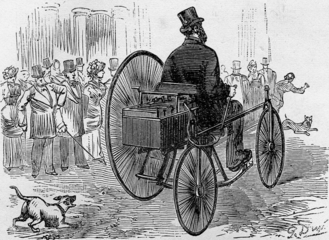 Gustave Trouvé's personal electric vehicle (1881), the world's first publicly presented full-scale electric car powered by an improved Siemens motor
 -
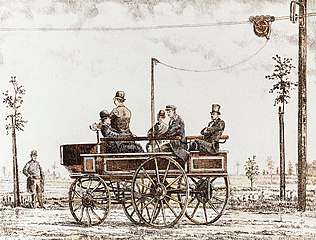 World's first trolleybus by Werner von Siemens, Berlin 1882
 -
![The Flocken Elektrowagen (1888) was the first four-wheeled electric car in the world[41]](//upload.wikimedia.org/wikipedia/commons/thumb/8/8c/1888_Flocken_Elektrowagen.jpg/320px-1888_Flocken_Elektrowagen.jpg) The Flocken Elektrowagen (1888) was the first four-wheeled electric car in the world[41]
The Flocken Elektrowagen (1888) was the first four-wheeled electric car in the world[41] -
![Early electric car built by Thomas Parker - photo from 1895[42]](//upload.wikimedia.org/wikipedia/commons/thumb/e/e7/Thomas_Parker_Electric_car.jpg/349px-Thomas_Parker_Electric_car.jpg) Early electric car built by Thomas Parker - photo from 1895[42]
Early electric car built by Thomas Parker - photo from 1895[42] -
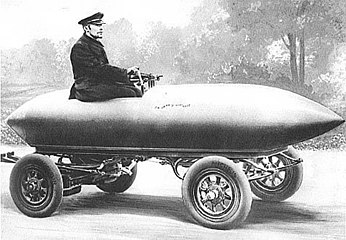 "La Jamais Contente", 1899
 -
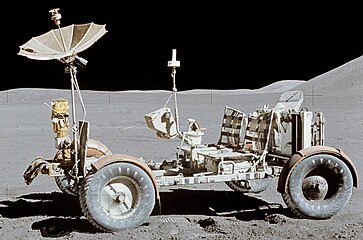 NASA's Lunar Roving Vehicles were battery-driven
 -
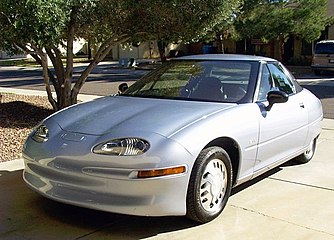 The General Motors EV1, one of the cars introduced due to a California Air Resources Board (CARB) mandate, had a range of 260 km (160 miles) with NiMH batteries in 1999.
 -
 The Tesla Roadster helped inspire the modern generation of electric vehicles.

.jpg)
![The Flocken Elektrowagen (1888) was the first four-wheeled electric car in the world[41]](/wiki/File:1888_Flocken_Elektrowagen.jpg)
![Early electric car built by Thomas Parker - photo from 1895[42]](/wiki/File:Thomas_Parker_Electric_car.jpg)


.jpg)

Modern electric cars[edit]
In the early 1990s the California Air Resources Board (CARB) began a push for more fuel-efficient, lower-emissions vehicles, with the ultimate goal of a move to zero-emissions vehicles such as electric vehicles.[43][44] In response, automakers developed electric models. These early cars were eventually withdrawn from the U.S. market, because of a massive campaign by the US automakers to discredit the idea of electric cars.[45]
California electric-auto maker Tesla Motors began development in 2004 of what would become the Tesla Roadster, first delivered to customers in 2008. The Roadster was the first highway-legal all-electric car to use lithium-ion battery cells, and the first production all-electric car to travel more than 320 km (200 miles) per charge.[46]
Better Place, a venture-backed company based in Palo Alto, California, but steered from Israel, developed and sold battery charging and battery swapping services for electric cars. The company was publicly launched on 29 October 2007 and announced deployment of electric vehicle networks in Israel, Denmark and Hawaii in 2008 and 2009. The company planned to deploy the infrastructure on a country-by-country basis. In January 2008, Better Place announced a memorandum of understanding with Renault-Nissan to build the world's first Electric Recharge Grid Operator (ERGO) model for Israel. Under the agreement, Better Place would build the electric recharge grid and Renault-Nissan would provide the electric vehicles. Better Place filed for bankruptcy in Israel in May 2013. The company's financial difficulties were caused by mismanagement, wasteful efforts to establish toeholds and run pilots in too many countries, the high investment required to develop the charging and swapping infrastructure, and a market penetration far lower than originally predicted.[47]
The Mitsubishi i-MiEV, launched in 2009 in Japan, was the first highway-legal series production electric car,[48] and also the first all-electric car to sell more than 10,000 units. Several months later, the Nissan Leaf, launched in 2010, surpassed the i MiEV as the best selling all-electric car at that time.[49]
Starting in 2008, a renaissance in electric vehicle manufacturing occurred due to advances in batteries, and the desire to reduce greenhouse-gas emissions and to improve urban air quality.[50] During the 2010s, the electric vehicle industry in China expanded rapidly with government support.[51] Several automakers marked up the prices of their electric vehicles in anticipation of the subsidy adjustments, including Tesla, Volkswagen and Guangzhou-based GAC Group, which counts Fiat, Honda, Isuzu, Mitsubishi, and Toyota as foreign partners.[52]
In July 2019 US-based Motor Trend magazine awarded the fully-electric Tesla Model S the title "ultimate car of the year".[53] In March 2020 the Tesla Model 3 passed the Nissan Leaf to become the world's all-time best-selling electric car, with more than 500,000 units delivered;[19] it reached the milestone of 1 million global sales in June 2021.[20]

_annual_sales_-_BloombergNEF.svg)
In the third quarter of 2021, the Alliance for Automotive Innovation reported that sales of electric vehicles had reached six percent of all US light-duty automotive sales, the highest volume of EV sales ever recorded at 187,000 vehicles. This was an 11% sales increase, as opposed to a 1.3% increase in gasoline and diesel-powered units. The report indicated that California was the US leader in EV with nearly 40% of US purchases, followed by Florida – 6%, Texas – 5% and New York 4.4%.[56]
Electric companies from the Middle East have been designing electric cars. Oman's Mays Motors have developed the Mays i E1 which is expected to begin production in 2023. Built from carbon fibre, it has a range of about 560 km (350 miles) and can accelerate from 0–130 km/h (0–80 mph) in about 4 secs.[57] In Turkey, the EV company Togg is starting production of its electric vehicles. Batteries will be created in a joint venture with the Chinese company Farasis Energy.[58]
Economics[edit]
Manufacturing cost[edit]
The most expensive part of an electric car is its battery. The price decreased from €605 per kWh in 2010, to €170 in 2017, to €100 in 2019.[59][60] When designing an electric vehicle, manufacturers may find that for low production, converting existing platforms may be cheaper, as development cost is lower; however, for higher production, a dedicated platform may be preferred to optimize design, and cost.[61]
Total cost of ownership[edit]
In the EU and US, but not yet China, the total cost of ownership of recent electric cars is cheaper than that of equivalent gasoline cars, due to lower fueling and maintenance costs.[16][17][62] A 2024 Consumer Reports analysis of 29 car brands found Tesla was the least expensive to maintain; Tesla was the only all-electric brand included.[63]
The greater the distance driven per year, the more likely the total cost of ownership for an electric car will be less than for an equivalent ICE car.[64] The break-even distance varies by country depending on the taxes, subsidies, and different costs of energy. In some countries the comparison may vary by city, as a type of car may have different charges to enter different cities; for example, in England, London charges ICE cars more than Birmingham does.[65]
Purchase cost[edit]
Several national and local governments have established EV incentives to reduce the purchase price of electric cars and other plug-ins.[66][67][68][69]
As of 2020[update], the electric vehicle battery is more than a quarter of the total cost of the car.[70] Purchase prices are expected to drop below those of new ICE cars when battery costs fall below US$100 per kWh, which is forecast to be in the mid-2020s.[71][72]
Leasing or subscriptions are popular in some countries,[73][74] depending somewhat on national taxes and subsidies,[75] and end of lease cars are expanding the second hand market.[76]
In a June 2022 report by AlixPartners, the cost for raw materials on an average EV rose from $3,381 in March 2020 to $8,255 in May 2022. The cost increase voice is attributed mainly to lithium, nickel, and cobalt.[77]
Running costs[edit]
Electricity almost always costs less than gasoline per kilometer travelled, but the price of electricity often varies depending on where and what time of day the car is charged.[78][79] Cost savings are also affected by the price of gasoline which can vary by location.[80]
Environmental aspects[edit]

Electric cars have several benefits when replacing ICE cars, including a significant reduction of local air pollution, as they do not emit exhaust pollutants such as volatile organic compounds, hydrocarbons, carbon monoxide, ozone, lead, and various oxides of nitrogen.[83] Similar to ICE vehicles, electric cars emit particulates from tyre and brake wear[84] which may damage health,[85] although regenerative braking in electric cars means less brake dust.[86] More research is needed on non-exhaust particulates.[87] The sourcing of fossil fuels (oil well to gasoline tank) causes further damage as well as use of resources during the extraction and refinement processes.
Depending on the production process and the source of the electricity to charge the vehicle, emissions may be partly shifted from cities to the plants that generate electricity and produce the car as well as to the transportation of material.[43] The amount of carbon dioxide emitted depends on the emissions of the electricity source and the efficiency of the vehicle. For electricity from the grid, the life-cycle emissions vary depending on the proportion of coal-fired power, but are always less than ICE cars.[88]
The cost of installing charging infrastructure has been estimated to be repaid by health cost savings in less than three years.[89] According to a 2020 study, balancing lithium supply and demand for the rest of the century will require good recycling systems, vehicle-to-grid integration, and lower lithium intensity of transportation.[90]
Some activists and journalists have raised concerns over the perceived lack of impact of electric cars in solving the climate change crisis[91] compared to other, less popularized methods.[92] These concerns have largely centered around the existence of less carbon-intensive and more efficient forms of transportation such as active mobility,[93] mass transit and e-scooters and the continuation of a system designed for cars first.[94]
Public opinion[edit]

A 2022 survey found that 33% of car buyers in Europe will opt for a petrol or diesel car when purchasing a new vehicle. 67% of the respondents mentioned opting for the hybrid or electric version.[96][97] More specifically, it found that electric cars are only preferred by 28% of Europeans, making them the least preferred type of vehicle. 39% of Europeans tend to prefer hybrid vehicles, while 33% prefer petrol or diesel vehicles.[96][98]
44% Chinese car buyers, on the other hand, are the most likely to buy an electric car, while 38% of Americans would opt for a hybrid car, 33% would prefer petrol or diesel, while only 29% would go for an electric car.[96][99]
Specifically for the EU, 47% of car buyers over 65 years old are likely to purchase a hybrid vehicle, while 31% of younger respondents do not consider hybrid vehicles a good option. 35% would rather opt for a petrol or diesel vehicle, and 24% for an electric car instead of a hybrid.[96][100]
In the EU, only 13% of the total population do not plan on owning a vehicle at all.[96]
Performance[edit]
Acceleration and drivetrain design[edit]

Electric motors can provide high power-to-weight ratios. Batteries can be designed to supply the electrical current needed to support these motors. Electric motors have a flat torque curve down to zero speed. For simplicity and reliability, most electric cars use fixed-ratio gearboxes and have no clutch.
Many electric cars have faster acceleration than average ICE cars, largely due to reduced drivetrain frictional losses and the more quickly-available torque of an electric motor.[101] However, NEVs may have a low acceleration due to their relatively weak motors.
Electric vehicles can also use a motor in each wheel hub or next to the wheels; this is rare but claimed to be safer.[102] Electric vehicles that lack an axle, differential, or transmission can have less drivetrain inertia. Some direct current motor-equipped drag racer EVs have simple two-speed manual transmissions to improve top speed.[103] The concept electric supercar Rimac Concept One claims it can go from 0–97 km/h (0–60 mph) in 2.5 seconds. Tesla claims the upcoming Tesla Roadster will go 0–60 mph (0–97 km/h) in 1.9 seconds.[104]
Energy efficiency[edit]
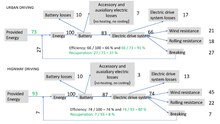
Internal combustion engines have thermodynamic limits on efficiency, expressed as a fraction of energy used to propel the vehicle compared to energy produced by burning fuel. Gasoline engines effectively use only 15% of the fuel energy content to move the vehicle or to power accessories; diesel engines can reach on-board efficiency of 20%; electric vehicles convert over 77% of the electrical energy from the grid to power at the wheels.[105][106][107]
Electric motors are more efficient than internal combustion engines in converting stored energy into driving a vehicle. However, they are not equally efficient at all speeds. To allow for this, some cars with dual electric motors have one electric motor with a gear optimised for city speeds and the second electric motor with a gear optimised for highway speeds. The electronics select the motor that has the best efficiency for the current speed and acceleration.[108] Regenerative braking, which is most common in electric vehicles, can recover as much as one fifth of the energy normally lost during braking.[43][106]
Cabin heating and cooling[edit]
Combustion powered cars harness waste heat from the engine to provide cabin heating, but this option is not available in an electric vehicle. While heating can be provided with an electric resistance heater, higher efficiency and integral cooling can be obtained with a reversible heat pump, such as on the Nissan Leaf.[109] PTC junction cooling[110] is also attractive for its simplicity—this kind of system is used, for example, in the 2008 Tesla Roadster.
To avoid using part of the battery's energy for heating and thus reducing the range, some models allow the cabin to be heated while the car is plugged in. For example, the Nissan Leaf, the Mitsubishi i-MiEV, Renault Zoe and Tesla cars can be pre-heated while the vehicle is plugged in.[111][112][113]
Some electric cars (for example, the Citroën Berlingo Electrique) use an auxiliary heating system (for example gasoline-fueled units manufactured by Webasto or Eberspächer) but sacrifice "green" and "Zero emissions" credentials. Cabin cooling can be augmented with solar power external batteries and USB fans or coolers, or by automatically allowing outside air to flow through the car when parked; two models of the 2010 Toyota Prius include this feature as an option.[114]
Safety[edit]

The safety issues of BEVs are largely dealt with by the international standard ISO 6469. This document is divided into three parts dealing with specific issues:
- On-board electrical energy storage, i.e. the battery[115]
- Functional safety means and protection against failures[116]
- Protection of persons against electrical hazards[117]
Weight[edit]
The weight of the batteries themselves usually makes an EV heavier than a comparable gasoline vehicle. In a collision, the occupants of a heavy vehicle will, on average, suffer fewer and less serious injuries than the occupants of a lighter vehicle; therefore, the additional weight brings safety benefits to the occupant, while increasing harm to others.[118] On average, an accident will cause about 50% more injuries to the occupants of a 2,000 lb (900 kg) vehicle than those in a 3,000 lb (1,400 kg) vehicle.[119] Heavier cars are more dangerous to people outside the car if they hit a pedestrian or another vehicle.[120]
Stability[edit]
The battery in skateboard configuration lowers the center of gravity, increasing driving stability, lowering the risk of an accident through loss of control.[121] If there is a separate motor near or in each wheel, this is claimed to be safer due to better handling.[122]
Risk of fire[edit]
Like their ICE counterparts, electric vehicle batteries can catch fire after a crash or mechanical failure.[123] Plug-in electric vehicle fire incidents have occurred, albeit fewer per distance traveled than ICE vehicles.[124] Some cars' high-voltage systems are designed to shut down automatically in the event of an airbag deployment,[125][126] and in case of failure firefighters may be trained for manual high-voltage system shutdown.[127][128] Much more water may be required than for ICE car fires and a thermal imaging camera is recommended to warn of possible re-ignition of battery fires.[129][130]
Controls[edit]
As of 2018[update], most electric cars have similar driving controls to that of a car with a conventional automatic transmission. Even though the motor may be permanently connected to the wheels through a fixed-ratio gear, and no parking pawl may be present, the modes "P" and "N" are often still provided on the selector. In this case, the motor is disabled in "N" and an electrically actuated hand brake provides the "P" mode.
In some cars, the motor will spin slowly to provide a small amount of creep in "D", similar to a traditional automatic transmission car.[131]
When an internal combustion vehicle's accelerator is released, it may slow by engine braking, depending on the type of transmission and mode. EVs are usually equipped with regenerative braking that slows the vehicle and recharges the battery somewhat.[132] Regenerative braking systems also decrease the use of the conventional brakes (similar to engine braking in an ICE vehicle), reducing brake wear and maintenance costs.
Batteries[edit]

Lithium-ion-based batteries are often used for their high power and energy density.[133] Batteries with different chemical compositions are becoming more widely used, such as lithium iron phosphate which is not dependent on nickel and cobalt so can be used to make cheaper batteries and thus cheaper cars.[134]
Range[edit]

The range of an electric car depends on the number and type of batteries used, and (as with all vehicles), the aerodynamics, weight and type of vehicle, performance requirements, and the weather.[136] Cars marketed for mainly city use are often manufactured with a short range battery to keep them small and light.[137]
Most electric cars are fitted with a display of the expected range. This may take into account how the vehicle is being used and what the battery is powering. However, since factors can vary over the route, the estimate can vary from the actual range. The display allows the driver to make informed choices about driving speed and whether to stop at a charging point en route. Some roadside assistance organizations offer charge trucks to recharge electric cars in case of emergency.[138]
Charging[edit]
Connectors[edit]
Most electric cars use a wired connection to supply electricity for recharging. Electric vehicle charging plugs are not universal throughout the world. However vehicles using one type of plug are generally able to charge at other types of charging stations through the use of plug adapters.[139]
The Type 2 connector is the most common type of plug, but different versions are used in China and Europe.[140][141]
The Type 1 (also called SAE J1772) connector is common in North America[142][143] but rare elsewhere, as it does not support three-phase charging.[144]
Wireless charging, either for stationary cars or as an electric road,[145] is less common as of 2021[update], but is used in some cities for taxis.[146][147]
Home charging[edit]
Electric cars are usually charged overnight from a home charging station; sometimes known as a charging point, wallbox charger, or simply a charger; in a garage or on the outside of a house.[148][149] As of 2021[update] typical home chargers are 7 kW, but not all include smart charging.[148] Compared to fossil fuel vehicles, the need for charging using public infrastructure is diminished because of the opportunities for home charging; vehicles can be plugged in and begin each day with a full charge.[150] Charging from a standard outlet is also possible but very slow.
Public charging[edit]

Public charging stations are almost always faster than home chargers,[151] with many supplying direct current to avoid the bottleneck of going through the car's AC to DC converter,[152] as of 2021[update] the fastest being 350 kW.[153]
Combined Charging System (CCS) is the most widespread charging standard,[141] whereas the GB/T 27930 standard is used in China, and CHAdeMO in Japan. The United States has no de facto standard, with a mix of CCS, Tesla Superchargers, and CHAdeMO charging stations.
Charging an electric vehicle using public charging stations takes longer than refueling a fossil fuel vehicle. The speed at which a vehicle can recharge depends on the charging station's charging speed and the vehicle's own capacity to receive a charge. As of 2021[update] some cars are 400 volt and some 800 volt.[154] Connecting a vehicle that can accommodate very fast charging to a charging station with a very high rate of charge can refill the vehicle's battery to 80% in 15 minutes.[155] Vehicles and charging stations with slower charging speeds may take as long as two hours to refill a battery to 80%. As with a mobile phone, the final 20% takes longer because the systems slow down to fill the battery safely and avoid damaging it.
.jpg)
Some companies are building battery swapping stations, to substantially reduce the effective time to recharge.[156][157] Some electric cars (for example, the BMW i3) have an optional gasoline range extender. The system is intended as an emergency backup to extend range to the next recharging location, and not for long-distance travel.[158]
Electric roads[edit]
Electric road technologies which power and charge electric vehicles while driving were assessed in Sweden from 2013.[159]: 12 The assessment was scheduled to conclude in 2022.[160] The first standard for electrical equipment on board a vehicle powered by a rail electric road system (ERS), CENELEC Technical Standard 50717, has been approved in late 2022.[161] Following standards, encompassing "full interoperability" and a "unified and interoperable solution" for ground-level power supply, are scheduled to be published by the end 2024, detailing complete "specifications for communication and power supply through conductive rails embedded in the road".[162][163] The first permanent electric road in Sweden is planned to be completed by 2026[164] on a section of the E20 route between Hallsberg and Örebro, followed by an expansion of further 3000 kilometers of electric roads by 2045.[165] A working group of the French Ministry of Ecology considers ground-level power supply technologies the most likely candidate for electric roads,[166] and recommended adopting a European electric road standard formulated with Sweden, Germany, Italy, the Netherlands, Spain, Poland, and others.[167] France plans to invest 30 to 40 billion euro by 2035 in an electric road system spanning 8,800 kilometers that recharges electric cars, buses and trucks while driving. Two tenders for assessment of electric road technologies are expected to be announced by 2023.[166]
Vehicle-to-grid: uploading and grid buffering[edit]
During peak load periods, when the cost of generation can be very high, electric vehicles with vehicle-to-grid capabilities could contribute energy to the grid. These vehicles can then be recharged during off-peak hours at cheaper rates while helping to absorb excess night time generation. The batteries in the vehicles serve as a distributed storage system to buffer power.[168]
Lifespan[edit]
As with all lithium-ion batteries, electric vehicle batteries may degrade over long periods of time, especially if they are frequently charged to 100%; however, this may take at least several years before being noticeable.[169] A typical warranty is 8 years or 100,000 mi (160,000 km),[170] but they usually last much longer, perhaps 15 to 20 years in the car and then more years in another use.[171]
Currently available electric cars[edit]
Sales of electric cars[edit]
Tesla became the world's leading electric vehicle manufacturer in December 2019.[172][173] Its Model S was the world's top selling plug-in electric car in 2015 and 2016,[174][175] its Model 3 has been the world's best selling plug-in electric car for four consecutive years, from 2018 to 2021, and the Model Y was the top selling plug-in car in 2022.[176][177][178][179][180] The Tesla Model 3 surpassed the Leaf in early 2020 to become the world's cumulative best selling electric car.[19] Tesla produced its 1 millionth electric car in March 2020, becoming the first auto manufacturer to do so,[181] and in June 2021, the Model 3 became the first electric car to pass 1 million sales.[20] Tesla has been listed as the world's top selling plug-in electric car manufacturer, both as a brand and by automotive group for four years running, from 2018 to 2021.[177][182][183][184][178] At the end of 2021, Tesla's global cumulative sales since 2012 totaled 2.3 million units,[185] with 936,222 of those delivered in 2021.[186]
BYD Auto is another leading electric vehicle manufacturer, with the majority of its sales coming from China. From 2018 to 2023, BYD produced nearly 3.18 million purely plug-in electric car, with 1,574,822 of those were produced in 2023 alone.[187] In the fourth quarter of 2023, BYD surpassed Tesla as the top-selling electric vehicle manufacturer by selling 526,409 battery electric cars, while Tesla delivered 484,507 vehicles.[188][189]
As of December 2021[update], the Renault–Nissan–Mitsubishi Alliance listed as one of major all-electric vehicle manufacturers, with global all-electric vehicle sales totaling over 1 million light-duty electric vehicles, including those manufactured by Mitsubishi Motors since 2009.[190][191] Nissan leads global sales within the Alliance, with 1 million cars and vans sold by July 2023,[192] followed by the Groupe Renault with more than 397,000 electric vehicles sold worldwide through December 2020, including its Twizy heavy quadricycle.[193] As of July 2023[update], global sales totaled over 650,000 units since inception.[192]
Other leading electric vehicles manufacturers are GAC Aion (part of GAC Group, with 962,385 cumulative sales as of December 2023[update]),[194] SAIC Motor with 1,838,000 units (as of July 2023[update]), Geely, and Volkswagen.[195][196][197][198][199]
The following table lists the all-time best-selling highway-capable all-electric cars with cumulative global sales of over 250,000 units:
| Company | Model | Image | Market launch | Lifetime global sales | Total sales through | Annual global sales | Status | Ref |
|---|---|---|---|---|---|---|---|---|
 Tesla, Inc. |
Tesla Model Y |  |
2020-03 | ~2.49 million | 2023-12 | 1,211,601 (2023) | In production | [176][177][200][201][202][203] |
| Tesla, Inc. |
Tesla Model 3 |  |
2017-07 | ~2.06 million | 2023-12 | 529,287 (2023) | In production | [176][177][204][200][203] |
 SAIC-GM-Wuling |
Wuling Hongguang Mini EV | .jpg) |
2020-07 | 1,218,640 | 2023-12 | 118,834 (2023) | In production | [176][177][200][205][206] |
 Nissan |
Nissan Leaf | _(cropped).jpg) |
2010-12 | ~650,000 | 2023-07 | 64,201 (2021) | In production | [177][192] |
 BYD |
BYD Yuan Plus / Atto 3 | 
|
2022-02 | 614,260 | 2023-12 | 412,202 (2023) | In production | [206][207] |
| BYD |
BYD Dolphin | .jpg)
|
2021-08 | 602,434 | 2023-12 | 367,419 (2023) | In production | [176][200][208][209] |
 GAC Group |
Aion S | .jpg)
|
2019-05 | 485,369 | 2023-12 | 222,227 (2023) | In production | [176][177][200][210][211][207] |
| BYD |
BYD Qin EV | .jpg)
|
2016-03 | 454,157 | 2023-12 | 154,774 (2023) | In production | [207][206][212][213][214] |
 Renault |
Renault Zoe | _%E2%80%93_f_22112020.jpg) |
2012-12 | 413,975 | 2023-06 | 15,706 (2023) | In production | [193][215][216][217] |
 Volkswagen |
Volkswagen ID.4 | _front_view.jpg)
|
2020-09 | 493,219 | 2023-12 | 192,686 (2023) | In production | [176][177][218][203] |
GAC Group |
Aion Y | .jpg)
|
2021-04 | 383,350 | 2023-12 | 229,555 (2023) | In production | [207][206][212] |
| BYD |
BYD Han EV | 
|
2020-03 | 367,129 | 2023-12 | 106,502 (2023) | In production | [207][206][212][213] |
Tesla, Inc. |
Tesla Model S | _Motorworld_Munich_1X7A0025.jpg) |
2012-06 | ~363,900 | 2022-12 | ~35,000 (2022) | In production | [219] |
 Chery |
Chery eQ1 | .jpg)
|
2017-03 | 338,051 | 2023-12 | 29,744 (2023) | In production | [220][221][222] |
 Hyundai |
Hyundai Kona Electric | _1X7A1554.jpg)
|
2018-05 | 329,643 | 2023-12 | 70,871 (2023) | In production | [223] |
Volkswagen |
Volkswagen ID.3 | 
|
2019-11 | 325,770 | 2023-12 | 139,268 (2023) | In production | [224][225][226][203] |
| Hyundai |
Hyundai Ioniq 5 | 
|
2021-03 | 280,430 | 2023-12 | 114,988 (2023) | In production | [223] |
| BYD |
BYD Seagull | .jpg)
|
2023-04 | 280,217 | 2023-12 | 280,217 (2023) | In production | [209] |
| Notes: (1) Vehicles are considered highway-capable if able to achieve at least a top speed of 100 km/h (62 mph). | ||||||||
Electric cars by country[edit]
In the year of 2021, the total number of electric cars on the world's roads went to about 16.5 million. The sales of electric cars in the first quarter of 2022 went up to 2 million.[227] China has the largest all-electric car fleet in use, with 2.58 million at the end of 2019, more than half (53.9%) of the world's electric car stock.
All-electric cars have oversold plug-in hybrids since 2012.[228][179][180]


Government policies and incentives[edit]


Several national, provincial, and local governments around the world have introduced policies to support the mass-market adoption of plug-in electric vehicles. A variety of policies have been established to provide: financial support to consumers and manufacturers; non-monetary incentives; subsidies for the deployment of charging infrastructure; electric vehicle charging stations in buildings; and long-term regulations with specific targets.[229][239][240]
| Selected countries | Year |
|---|---|
| Norway (100% ZEV sales) | 2025 |
| Denmark | 2030 |
| Iceland | |
| Ireland | |
| Netherlands (100% ZEV sales) | |
| Sweden | |
| United Kingdom (100% ZEV sales) | 2035 |
| France | 2040 |
| Canada (100% ZEV sales) | |
| Singapore | |
| Germany (100% ZEV sales) | 2050 |
| U.S. (10 ZEV states) | |
| Japan (100% HEV/PHEV/ZEV sales) |
Financial incentives for consumers are aiming to make electric car purchase price competitive with conventional cars due to the higher upfront cost of electric vehicles. Depending on battery size, there are one-time purchase incentives such as grants and tax credits; exemptions from import duties; exemptions from road tolls and congestion charges; and exemption of registration and annual fees.
Among the non-monetary incentives, there are several perks such allowing plug-in vehicles access to bus lanes and high-occupancy vehicle lanes, free parking and free charging.[239] Some countries or cities that restrict private car ownership (for example, a purchase quota system for new vehicles), or have implemented permanent driving restrictions (for example, no-drive days), have these schemes exclude electric vehicles to promote their adoption.[242][243][244][245][246][247] Several countries, including England and India, are introducing regulations that require electric vehicle charging stations in certain buildings.[240][248][249]
Some government have also established long term regulatory signals with specific targets such as zero-emissions vehicle (ZEV) mandates, national or regional CO2 emission regulations, stringent fuel economy standards, and the phase out of internal combustion engine vehicle sales.[229][239] For example, Norway set a national goal that by 2025 all new car sales should be ZEVs (battery electric or hydrogen).[250][251] While these incentives aim to facilitate a quicker transition from internal combustion cars, they have been criticized by some economists for creating excess deadweight loss in the electric car market, which may partially counteract environmental gains.[252][253][254]
EV plans from major manufacturers[edit]
 | This article has multiple issues. Please help improve it or discuss these issues on the talk page. (Learn how and when to remove these template messages)
|


Electric vehicles (EVs) have gained significant traction as an integral component of the global automotive landscape in recent years. Major automakers from around the world have adopted EVs as a critical component of their strategic plans, indicating a paradigm shift toward sustainable transportation.
| As of | Manufacturer | Investment | Investment Timeframe |
# EVs | Year Goal |
Notes |
|---|---|---|---|---|---|---|
| 2020-11 | Volkswagen | $86 billion | 2025 | 27 | 2022 | Plans 27 electric vehicles by 2022, on a dedicated EV platform dubbed "Modular Electric Toolkit" and initialed as MEB.[255] In November 2020 it announced the intention to invest $86 billion in the following five years, aimed at developing EVs and increasing its share in the EV market. Total capital expenditure will include "digital factories", automotive software and self-driving cars.[256] |
| 2020-11 | GM | $27 billion | 30 | 2035 | Announced that it is boosting its EV and self-driving investment from $20 billion to $27 billion, and it currently plans to have 30 EVs on the market by the end of 2025 (including: the Hummer EV; the Cadillac Lyriq SUV; Buick, GMC, and Chevrolet EVs; and a Chevy compact crossover EV).[258] CEO Barra said 40% of the vehicles GM will offer in the United States will be battery electric vehicles by the end of 2025.[259] GM's "BEV3" next-generation electric vehicle platform is designed to be flexible for use in many different vehicle types, such as front, rear and all-wheel drive configurations.[260] | |
| 2019-01 | Mercedes | $23 billion | 2030 | 10 | 2022 | Plans to increase their electric car manufacturing to 50% in global sales by 2030.[261] |
| 2019-07 | Ford | $29 billion | 2025 | Will use Volkswagen's Modular Electric Toolkit ("MEB") to design and build its own fully electric vehicles starting in 2023.[263] The Ford Mustang Mach-E is an electric crossover that will reach up to 480 km (300 miles).[264] Ford is planning to release an electric F-150 in the 2021 time frame.[265][266] | ||
| 2019-03 | BMW | 12 | 2025 | Plans 12 all electric vehicles by 2025, using a fifth-generation electric powertrain architecture, which will save weight and cost and increase capacity.[267] BMW has ordered €10 billion worth of battery cells for the period from 2021 through 2030.[268][269][270] | ||
| 2020-01 | Hyundai | 23 | 2025 | Announced that it plans 23 pure electric cars by 2025.[271] Hyundai will announce its next generation electric vehicle platform, named e-GMP, in 2021.[272] | ||
| 2019-06 | Toyota | Has developed a global EV platform named e-TNGA that can accommodate a three-row SUV, sporty sedan, small crossover or a boxy compact.[273] Toyota and Subaru will release a new EV on a shared platform;[274] it will be about the size of a Toyota RAV4 or a Subaru Forester. | ||||
| 2019-04 | 29 automakers | $300 billion | 2029 | A Reuters analysis of 29 global automakers concluded that automakers are planning on spending $300 billion over the next 5 to 10 years on electric cars, with 45% of that investment projected to occur in China.[275] | ||
| 2020-10 | Fiat | Launched its new electric version of the New 500 for sale in Europe starting in early 2021.[276][277] | ||||
| 2020-11 | Nissan | Announced the intention to sell only electric and hybrid cars in China from 2025, introducing nine new models. Nissan other plans includes manufacturing, by 2035, half zero-emission vehicles and half gasoline-electric hybrid vehicles.[278] In 2018 Infiniti, the luxury brand of Nissan, announced that by 2021 all newly introduced vehicles will be electric or hybrid.[279] | ||||
| 2020-12 | Audi | €35 billion | 2021–2025 | 20 | 2025 | 30 new electrified models by 2025, of which 20 PEV.[280] By 2030–2035, Audi intends to offer just electric vehicles.[281] |
Forecasts[edit]
Total global EV sales in 2030 were predicted to reach 31.1 million by Deloitte.[282] The International Energy Agency predicted that the total global stock of EVs would reach almost 145 million by 2030 under current policies, or 230 million if Sustainable Development policies were adopted.[283]
See also[edit]
- Electric vehicle
- Solar car
- Electric car energy efficiency
- Electric motorcycles and scooters
- Electric vehicle warning sounds - vehicle sounds for pedestrian safety
- Electric motorsport
- Eco Grand Prix
- Formula E
- List of electric cars currently available
- Vehicle-to-everything (V2X)
- Phase-out of fossil fuel vehicles
References[edit]
- ^ "Reducing Pollution with Electric Vehicles". www.energy.gov. Archived from the original on 12 May 2018. Retrieved 12 May 2018.
- ^ "How to charge an electric car". Carbuyer. Archived from the original on 23 April 2018. Retrieved 22 April 2018.
- ^ "Executive summary – Global EV Outlook 2023 – Analysis". IEA. Retrieved 17 June 2023.
- ^ "Governor Newsom Announces California Will Phase Out Gasoline-Powered Cars & Drastically Reduce Demand for Fossil Fuel in California's Fight Against Climate Change". California Governor. 23 September 2020. Retrieved 26 September 2020.
- ^ Groom, David Shepardson, Nichola (29 September 2020). "U.S. EPA chief challenges California effort to mandate zero emission vehicles in 2035". Reuters. Retrieved 29 September 2020.
{{cite news}}: CS1 maint: multiple names: authors list (link) - ^ Thunberg, Greta; Anable, Jillian; Brand, Christian (2022). "Is the Future Electric?". The Climate Book. Penguin. pp. 271–275. ISBN 978-0593492307.
- ^ "EU proposes effective ban for new fossil-fuel cars from 2035". Reuters. 14 July 2021. Retrieved 6 August 2021.
- ^ "IEA: EVs Will Account For 20% Of All Car Sales This Year". OilPrice.com. Retrieved 17 June 2023.
- ^ "How China put nearly 5 million new energy vehicles on the road in one decade | International Council on Clean Transportation". theicct.org. 28 January 2021. Retrieved 30 October 2021.
- ^ Liu Wanxiang (12 January 2017). "中汽协:2016年新能源汽车产销量均超50万辆,同比增速约50%" [China Auto Association: 2016 new energy vehicle production and sales were over 500,000, an increase of about 50%] (in Chinese). D1EV.com. Retrieved 12 January 2017. Chinese sales of new energy vehicles in 2016 totaled 507,000, consisting of 409,000 all-electric vehicles and 98,000 plug-in hybrid vehicles.
- ^ Automotive News China (16 January 2018). "Electrified vehicle sales surge 53% in 2017". Automotive News China. Retrieved 22 May 2020. Chinese sales of domestically-built new energy vehicles in 2017 totaled 777,000, consisting of 652,000 all-electric vehicles and 125,000 plug-in hybrid vehicles. Sales of domestically-produced new energy passenger vehicles totaled 579,000 units, consisting of 468,000 all-electric cars and 111,000 plug-in hybrids. Only domestically built all-electric vehicles, plug-in hybrids and fuel cell vehicles qualify for government subsidies in China.
- ^ "中汽协:2018年新能源汽车产销均超125万辆,同比增长60%" [China Automobile Association: In 2018, the production and sales of new energy vehicles exceeded 1.25 million units, a year-on-year increase of 60%] (in Chinese). D1EV.com. 14 January 2019. Retrieved 15 January 2019. Chinese sales of new energy vehicles in 2018 totaled 1.256 million, consisting of 984,000 all-electric vehicles and 271,000 plug-in hybrid vehicles.
- ^ Kane, Mark (4 February 2020). "Chinese NEVs Market Slightly Declined In 2019: Full Report". InsideEVs.com. Retrieved 30 May 2020. Sales of new energy vehicles totaled 1,206,000 units in 2019, down 4.0% from 2018, and includes 2,737 fuel cell vehicles. Battery electric vehicle sales totaled 972,000 units (down 1.2%) and plug-in hybrid sales totaled 232,000 vehicles (down 14.5%). Sales figures include passenger cars, buses and commercial vehicles..
- ^ China Association of Automobile Manufacturers (CAAM) (14 January 2021). "Sales of New Energy Vehicles in December 2020". CAAM. Retrieved 8 February 2021. NEV sales in China totaled 1.637 million in 2020, consisting of 1.246 million passenger cars and 121,000 commercial vehicles.
- ^ China Association of Automobile Manufacturers (CAAM) (12 January 2022). "Sales of New Energy Vehicles in December 2021". CAAM. Retrieved 13 January 2022. NEV sales in China totaled 3.521 million in 2021 (all classes), consisting of 3.334 million passenger cars and 186,000 commercial vehicles.
- ^ a b Preston, Benjamin (8 October 2020). "EVs Offer Big Savings Over Traditional Gas-Powered Cars". Consumer Reports. Retrieved 22 November 2020.
- ^ a b "Electric Cars: Calculating the Total Cost of Ownership for Consumers" (PDF). BEUC (The European Consumer Organisation). 25 April 2021. Archived (PDF) from the original on 16 May 2021.
- ^ "The Tesla Model Y Is The Best-Selling Car In The World | GreenCars". www.greencars.com. Retrieved 3 September 2023.
- ^ a b c Holland, Maximilian (10 February 2020). "Tesla Passes 1 Million EV Milestone & Model 3 Becomes All Time Best Seller". CleanTechnica. Archived from the original on 12 April 2020. Retrieved 15 May 2020.
- ^ a b c Shahan, Zachary (26 August 2021). "Tesla Model 3 Has Passed 1 Million Sales". CleanTechnica. Retrieved 26 August 2021.
- ^ Hamid, Umar Zakir Abdul (2022). "Autonomous, Connected, Electric and Shared Vehicles: Disrupting the Automotive and Mobility Sectors". US: SAE. Retrieved 11 November 2022.
{{cite journal}}: Cite journal requires|journal=(help) - ^ "US Department of Transportation National Highway Traffic Safety Administration 49 CFR Part 571 Federal Motor Vehicle Safety Standards". Archived from the original on 27 February 2010. Retrieved 6 August 2009.
- ^ "Citizens' summary EU proposal for a Regulation on L-category vehicles (two- or three-wheel vehicles and quadricycles)". European Commission. 4 October 2010. Retrieved 6 April 2023.
- ^ Roth, Hans (March 2011). Das erste vierrädrige Elektroauto der Welt [The first four-wheeled electric car in the world] (in German). pp. 2–3.
- ^ Wakefield, Ernest H (1994). History of the Electric Automobile. Society of Automotive Engineers. pp. 2–3. ISBN 1-5609-1299-5.
- ^ Guarnieri, M. (2012). Looking back to electric cars. Proc. HISTELCON 2012 – 3rd Region-8 IEEE HISTory of Electro – Technology Conference: The Origins of Electrotechnologies. pp. 1–6. doi:10.1109/HISTELCON.2012.6487583. ISBN 978-1-4673-3078-7.
- ^ "Electric Car History". Archived from the original on 5 January 2014. Retrieved 17 December 2012.
- ^ "World's first electric car built by Victorian inventor in 1884". The Daily Telegraph. London. 24 April 2009. Archived from the original on 21 April 2018. Retrieved 14 July 2009.
- ^ Boyle, David (2018). 30-Second Great Inventions. Ivy Press. p. 62. ISBN 9781782406846.
- ^ Denton, Tom (2016). Electric and Hybrid Vehicles. Routledge. p. 6. ISBN 9781317552512.
- ^ "Elektroauto in Coburg erfunden" [Electric car invented in Coburg]. Neue Presse Coburg (in German). Germany. 12 January 2011. Archived from the original on 9 March 2016. Retrieved 30 September 2019.
- ^ a b "The History of the Electric Car". Energy.gov. Retrieved 5 December 2023.
- ^ "Electric automobile". Encyclopædia Britannica (online). Archived from the original on 20 February 2014. Retrieved 2 May 2014.
- ^ Gerdes, Justin (11 May 2012). "The Global Electric Vehicle Movement: Best Practices From 16 Cities". Forbes. Archived from the original on 29 July 2017. Retrieved 20 October 2014.
- ^ Says, Alan Brown (9 July 2012). "The Surprisingly Old Story of London's First Ever Electric Taxi". Science Museum Blog. Archived from the original on 23 October 2019. Retrieved 23 October 2019.
- ^ Handy, Galen (2014). "History of Electric Cars". The Edison Tech Center. Archived from the original on 18 September 2017. Retrieved 7 September 2017.
- ^ "Some Facts about Electric Vehicles". Automobilesreview. 25 February 2012. Archived from the original on 11 August 2017. Retrieved 6 October 2017.
- ^ Gertz, Marisa; Grenier, Melinda (5 January 2019). "171 Years Before Tesla: The Evolution of Electric Vehicles". Bloomberg. Archived from the original on 11 January 2019. Retrieved 30 September 2019.
- ^ Cub Scout Car Show (PDF), January 2008, archived (PDF) from the original on 4 March 2016, retrieved 12 April 2009
- ^ Laukkonen, J.D. (1 October 2013). "History of the Starter Motor". Crank Shift. Archived from the original on 21 September 2019. Retrieved 30 September 2019.
This starter motor first showed up on the 1912 Cadillac, which also had the first complete electrical system, since the starter doubled as a generator once the engine was running. Other automakers were slow to adopt the new technology, but electric starter motors would be ubiquitous within the next decade.
- ^ http://www.np-coburg.de/lokal/coburg/coburg/Elektroauto-in-Coburg-erfunden;art83423,1491254 np-coburg.de
- ^ "Elwell-Parker, Limited". Archived from the original on 4 March 2016. Retrieved 17 February 2016.
- ^ a b c Sperling, Daniel; Gordon, Deborah (2009). Two billion cars: driving toward sustainability. Oxford University Press. pp. 22–26. ISBN 978-0-19-537664-7.
- ^ Boschert, Sherry (2006). Plug-in Hybrids: The Cars that will Recharge America. New Society Publishers. pp. 15–28. ISBN 978-0-86571-571-4.
- ^ See Who Killed the Electric Car? (2006)
- ^ Shahan, Zachary (26 April 2015). "Electric Car Evolution". Clean Technica. Archived from the original on 18 September 2016. Retrieved 8 September 2016. 2008: The Tesla Roadster becomes the first production electric vehicle to use lithium-ion battery cells as well as the first production electric vehicle to have a range of over 200 miles on a single charge.
- ^ Blum, Brian. Totaled : the billion-dollar crash of the startup that took on big auto, big oil and the world. ISBN 978-0-9830428-2-2. OCLC 990318853.
- ^ Kim, Chang-Ran (30 March 2010). "Mitsubishi Motors lowers price of electric i-MiEV". Reuters. Retrieved 22 May 2020.
- ^ "Best-selling electric car". Guinness World Records. 2012. Archived from the original on 16 February 2013. Retrieved 22 May 2020.
- ^ David B. Sandalow, ed. (2009). Plug-In Electric Vehicles: What Role for Washington? (1st. ed.). The Brookings Institution. pp. 1–6. ISBN 978-0-8157-0305-1. Archived from the original on 28 March 2019. Retrieved 6 February 2011.See Introduction
- ^ "DRIVING A GREEN FUTURE: A RETROSPECTIVE REVIEW OF CHINA'S ELECTRIC VEHICLE DEVELOPMENT AND OUTLOOK FOR THE FUTURE" (PDF). Archived (PDF) from the original on 17 January 2021.
- ^ "Automakers raise prices for NEVs in China ahead of subsidy cuts". KrASIA. 3 January 2022. Retrieved 13 January 2022.
- ^ Evans, Scott (10 July 2019). "2013 Tesla Model S Beats Chevy, Toyota, and Cadillac for Ultimate Car of the Year Honors". MotorTrend. Retrieved 17 July 2019.
We are confident that, were we to summon all the judges and staff of the past 70 years, we would come to a rapid consensus: No vehicle we've awarded, be it Car of the Year, Import Car of the Year, SUV of the Year, or Truck of the Year, can equal the impact, performance, and engineering excellence that is our Ultimate Car of the Year winner, the 2013 Tesla Model S.
- ^ "Global EV Outlook 2023 / Trends in electric light-duty vehicles". International Energy Agency. April 2023. Archived from the original on 12 May 2023.
- ^ Data from McKerracher, Colin (12 January 2023). "Electric Vehicles Look Poised for Slower Sales Growth This Year". BloombergNEF. Archived from the original on 12 January 2023.
- ^ Ali, Shirin (23 March 2022). "More Americans are buying electric vehicles, as gas car sales fall, report says". The Hill.
- ^ Kloosterman, Karin (23 March 2022). "Oman makes first electric car in the Middle East". Green Prophet. Canada. Retrieved 22 May 2022.
- ^ Kloosterman, Karin (22 May 2022). "Turkey's all electric Togg EV". Green Prophet. Canada. Retrieved 22 May 2022.
- ^ "Trotz fallender Batteriekosten bleiben E-Mobile teuer" [Despite falling battery costs electric cars remain expensive]. Umwelt Dialog (in German). Germany. 31 July 2018. Archived from the original on 28 December 2019. Retrieved 12 March 2019.
- ^ Hauri, Stephan (8 March 2019). "Wir arbeiten mit Hochdruck an der Brennstoffzelle" [We are working hard on the fuel cell]. Neue Zürcher Zeitung (in German). Switzerland. Archived from the original on 26 March 2019. Retrieved 12 March 2019.
- ^ Ward, Jonathan (28 April 2017). "EV supply chains: Shifting currents". Automotive Logistics. Archived from the original on 3 August 2017. Retrieved 13 May 2017.
- ^ Ouyang, Danhua; Zhou, Shen; Ou, Xunmin (1 February 2021). "The total cost of electric vehicle ownership: A consumer-oriented study of China's post-subsidy era". Energy Policy. 149: 112023. Bibcode:2021EnPol.14912023O. doi:10.1016/j.enpol.2020.112023. ISSN 0301-4215. S2CID 228862530.
- ^ "Four of the Five Least Expensive Car Brands to Maintain Are American". Consumer Reports. 23 April 2024. Retrieved 30 April 2024.
- ^ "Large Auto Leasing Company: Electric Cars Have Mostly Lower Total Cost in Europe". CleanTechnica. 9 May 2020. Archived from the original on 21 May 2020.
- ^ "Birmingham clean air charge: What you need to know". BBC. 13 March 2019. Archived from the original on 23 March 2019. Retrieved 22 March 2019.
- ^ "Fact Sheet – Japanese Government Incentives for the Purchase of Environmentally Friendly Vehicles" (PDF). Japan Automobile Manufacturers Association. Archived from the original (PDF) on 26 December 2010. Retrieved 24 December 2010.
- ^ Motavalli, Jim (2 June 2010). "China to Start Pilot Program, Providing Subsidies for Electric Cars and Hybrids". The New York Times. Archived from the original on 3 June 2010. Retrieved 2 June 2010.
- ^ "Growing Number of EU Countries Levying CO2 Taxes on Cars and Incentivizing Plug-ins". Green Car Congress. 21 April 2010. Archived from the original on 31 December 2010. Retrieved 23 April 2010.
- ^ "Notice 2009–89: New Qualified Plug-in Electric Drive Motor Vehicle Credit". Internal Revenue Service. 30 November 2009. Archived from the original on 28 March 2010. Retrieved 1 April 2010.
- ^ "Batteries For Electric Cars Speed Toward a Tipping Point". Bloomberg.com. 16 December 2020. Retrieved 4 March 2021.
- ^ "EV-internal combustion price parity forecast for 2023 – report". MINING.COM. 13 March 2020. Retrieved 30 October 2020.
- ^ "Why are electric cars expensive? The cost of making and buying an EV explained". Hindustan Times. 23 October 2020. Retrieved 30 October 2020.
- ^ Stock, Kyle (3 January 2018). "Why early EV adopters prefer leasing – by far". Automotive News. Retrieved 5 February 2018.
- ^ Ben (14 December 2019). "Should I Lease An Electric Car? What To Know Before You Do". Steer. Archived from the original on 12 August 2021. Retrieved 30 October 2020.
- ^ "Subsidies slash EV lease costs in Germany, France". Automotive News Europe. 15 July 2020. Retrieved 30 October 2020.
- ^ "To Save the Planet, Get More EVs Into Used Car Lots". Wired. ISSN 1059-1028. Retrieved 30 October 2020.
- ^ Wayland, Michael (22 June 2022). "Raw material costs for electric vehicles have doubled during the pandemic". CNBC. Retrieved 22 June 2022.
- ^ McMahon, Jeff. "Electric Vehicles Cost Less Than Half As Much To Drive". Forbes. Archived from the original on 18 May 2018. Retrieved 18 May 2018.
- ^ "How much does it cost to charge an electric car?". Autocar. Retrieved 1 August 2021.
- ^ Kaminski, Joe (17 August 2021). "The U.S. States Where You'll Save the Most Switching from Gas to Electric Vehicles". www.mroelectric.com. MRO Electric. Retrieved 3 September 2021.
- ^ Romero, Simon (2 February 2009). "In Bolivia, Untapped Bounty Meets Nationalism". The New York Times. Archived from the original on 27 December 2016. Retrieved 28 February 2010.
- ^ "Página sobre el Salar (Spanish)". Evaporiticosbolivia.org. Archived from the original on 23 March 2011. Retrieved 27 November 2010.
- ^ "Vehicle exhaust emissions | What comes out of a car exhaust? | RAC Drive". www.rac.co.uk. Retrieved 6 August 2021.
- ^ "Tyre pollution 1000 times worse than tailpipe emissions". www.fleetnews.co.uk. Retrieved 30 October 2020.
- ^ Baensch-Baltruschat, Beate; Kocher, Birgit; Stock, Friederike; Reifferscheid, Georg (1 September 2020). "Tyre and road wear particles (TRWP) - A review of generation, properties, emissions, human health risk, ecotoxicity, and fate in the environment". Science of the Total Environment. 733: 137823. Bibcode:2020ScTEn.733m7823B. doi:10.1016/j.scitotenv.2020.137823. ISSN 0048-9697. PMID 32422457.
- ^ "EVs: Clean Air and Dirty Brakes". The BRAKE Report. 2 July 2019. Retrieved 13 November 2020.
- ^ "Statement on the evidence for health effects associated with exposure to non-exhaust particulate matter from road transport" (PDF). UK Committee on the Medical Effects of Air Pollutants. Archived (PDF) from the original on 22 October 2020.
- ^ "A global comparison of the life-cycle greenhouse gas emissions of combustion engine and electric passenger cars | International Council on Clean Transportation". theicct.org. Retrieved 6 August 2021.
- ^ "Electric car switch on for health benefits". UK: Inderscience Publishers. 16 May 2019. Archived from the original on 29 May 2019. Retrieved 1 June 2019.
- ^ Greim, Peter; Solomon, A. A.; Breyer, Christian (11 September 2020). "Assessment of lithium criticality in the global energy transition and addressing policy gaps in transportation". Nature Communications. 11 (1): 4570. Bibcode:2020NatCo..11.4570G. doi:10.1038/s41467-020-18402-y. ISSN 2041-1723. PMC 7486911. PMID 32917866.
- ^ Casson, Richard. "We don't just need electric cars, we need fewer cars". Greenpeace International. Greenpeace. Retrieved 13 June 2021.
- ^ "Let's Count the Ways E-Scooters Could Save the City". Wired. 7 December 2018. Retrieved 13 June 2021.
- ^ Brand, Christian (29 March 2021). "Cycling is ten times more important than electric cars for reaching net-zero cities". The Conversation. Retrieved 10 August 2021.
- ^ Laughlin, Jason (29 January 2018). "Why is Philly Stuck in Traffic?". The Philadelphia Inquirer. Retrieved 13 June 2021.
- ^ Bank, European Investment (20 April 2022). The EIB Climate Survey 2021-2022 - Citizens call for green recovery. European Investment Bank. ISBN 978-92-861-5223-8.
- ^ a b c d e "2021-2022 EIB Climate Survey, part 2 of 3: Shopping for a new car? Most Europeans say they will opt for hybrid or electric". EIB.org. Retrieved 4 April 2022.
- ^ fm (2 February 2022). "Cypriots prefer hybrid or electric cars". Financial Mirror. Retrieved 5 April 2022.
- ^ "Germans less enthusiastic about electric cars than other Europeans - survey". Clean Energy Wire. 1 February 2022. Retrieved 5 April 2022.
- ^ Rahmani, Djamel; Loureiro, Maria L. (21 March 2018). "Why is the market for hybrid electric vehicles (HEVs) moving slowly?". PLOS ONE. 13 (3): e0193777. Bibcode:2018PLoSO..1393777R. doi:10.1371/journal.pone.0193777. ISSN 1932-6203. PMC 5862411. PMID 29561860.
- ^ "67% of Europeans will opt for a hybrid or electric vehicle as their next purchase, says EIB survey". Mayors of Europe. 2 February 2022. Retrieved 5 April 2022.
- ^ Threewitt, Cherise (15 January 2019). "Gas-powered vs. Electric Cars: Which Is Faster?". How Stuff Works. Archived from the original on 22 March 2019. Retrieved 5 October 2020.
- ^ "In-wheel motors: The benefits of independent wheel torque control". E-Mobility Technology. 20 May 2020. Retrieved 6 August 2021.
- ^ Hedlund, R. (November 2008). "The Roger Hedlund 100 MPH Club". National Electric Drag Racing Association. Archived from the original on 6 December 2010. Retrieved 25 April 2009.
- ^ DeBord, Matthew (17 November 2017). "The new Tesla Roadster can do 0–60 mph in less than 2 seconds – and that's just the base version". Business Insider. Archived from the original on 7 February 2019. Retrieved 22 April 2019.
- ^ "All-Electric Vehicles". www.fueleconomy.gov. Retrieved 14 October 2023.
- ^ a b Shah, Saurin D. (2009). "2". Plug-In Electric Vehicles: What Role for Washington? (1st ed.). The Brookings Institution. pp. 29, 37 and 43. ISBN 978-0-8157-0305-1.
- ^ "Electric Car Myth Buster – Efficiency". CleanTechnica. 10 March 2018. Archived from the original on 18 April 2019. Retrieved 18 April 2019.
- ^ Sensiba, Jennifer (23 July 2019). "EV Transmissions Are Coming, And It's A Good Thing". CleanTechnica. Archived from the original on 23 July 2019. Retrieved 23 July 2019.
- ^ "Can heat pumps solve cold-weather range loss for EVs?". Green Car Reports. 8 August 2019. Retrieved 13 November 2020.
- ^ US 5889260, Golan, Gad & Galperin, Yuly, "Electrical PTC heating device", published 1999-03-30
- ^ NativeEnergy (7 September 2012). "3 Electric Car Myths That Will Leave You Out in the Cold". Recyclebank. Archived from the original on 11 April 2013. Retrieved 21 July 2013.
- ^ Piotrowski, Ed (3 January 2013). "How i Survived the Cold Weather". The Daily Drive – Consumer Guide Automotive. Archived from the original on 3 June 2013. Retrieved 21 July 2013.
- ^ "Effects of Winter on Tesla Battery Range and Regen". teslarati.com. 24 November 2014. Archived from the original on 21 February 2015. Retrieved 21 February 2015.
- ^ "2010 Options and Packages". Toyota Prius. Toyota. Archived from the original on 7 July 2009. Retrieved 9 July 2009.
- ^ "ISO 6469-1:2019 Electrically propelled road vehicles — Safety specifications — Part 1: Rechargeable energy storage system (RESS)". ISO. April 2019. Archived from the original on 30 December 2019. Retrieved 21 November 2019.
- ^ "ISO 6469-2:2018 Electrically propelled road vehicles — Safety specifications — Part 2: Vehicle operational safety". ISO. February 2018. Archived from the original on 22 December 2019. Retrieved 22 November 2019.
- ^ "ISO 6469-3:2018 Electrically propelled road vehicles — Safety specifications — Part 3: Electrical safety". ISO. October 2018. Archived from the original on 26 December 2019. Retrieved 22 November 2019.
- ^ National Research Council; Transportation Research Board; Division on Engineering and Physical Sciences; Board on Energy and Environmental Systems; Committee on the Effectiveness and Impact of Corporate Average Fuel Economy (CAFE) Standards (2002). Effectiveness and Impact of Corporate Average Fuel Economy (CAFE) Standards. National Academies Press. p. 71. ISBN 978-0-309-07601-2. Archived from the original on 24 December 2019. Retrieved 6 February 2018.
- ^ "Vehicle Weight, Fatality Risk and Crash Compatibility of Model Year 1991–99 Passenger Cars and Light Trucks" (PDF). National Highway Traffic Safety Administration. October 2003. Archived (PDF) from the original on 20 September 2009. Retrieved 25 April 2009.
- ^ Valdes-Dapena, Peter (7 June 2021). "Why electric cars are so much heavier than regular cars". CNN Business. CNN. Retrieved 10 August 2021.
- ^ Wang, Peiling (2020). "Effect of electric battery mass distribution on electric vehicle movement safety". Vibroengineering PROCEDIA. 33: 78–83. doi:10.21595/vp.2020.21569. S2CID 225065995. Retrieved 10 August 2021.
- ^ "Protean Electric's In-Wheel Motors Could Make EVs More Efficient". IEEE Spectrum. 26 June 2018. Retrieved 10 August 2021.
- ^ Spotnitz, R.; Franklin, J. (2003). "Abuse behavior of high-power, lithium-ion cells". Journal of Power Sources. 113 (1): 81–100. Bibcode:2003JPS...113...81S. doi:10.1016/S0378-7753(02)00488-3. ISSN 0378-7753.
- ^ "Roadshow: Electric cars not as likely to catch fire as gasoline powered vehicles". The Mercury News. 29 March 2018. Archived from the original on 12 May 2018. Retrieved 12 May 2018.
- ^ "Detroit First Responders Get Electric Vehicle Safety Training". General Motors News (Press release). 19 January 2011. Archived from the original on 5 June 2011. Retrieved 12 November 2011.
- ^ "General Motors Kicks Off National Electric Vehicle Training Tour For First Responders". Green Car Congress. 27 August 2010. Archived from the original on 31 July 2013. Retrieved 11 November 2011.
- ^ AOL Autos (16 December 2011). "Chevy Volt Unplugged: When To Depower Your EV After a Crash". Translogic. Archived from the original on 17 January 2012. Retrieved 20 December 2011.
- ^ "2011 LEAF First Responder's Guide" (PDF). Nissan North America. 2010. Archived (PDF) from the original on 8 July 2012. Retrieved 20 December 2011.
- ^ "What firefighters need to know about electric car batteries". FireRescue1. 22 February 2017. Retrieved 10 August 2021.
- ^ "04.8 EV fire reignition". EV Fire Safe. Retrieved 6 June 2022.
- ^ "Ford Focus BEV – Road test". Autocar.co.uk. Archived from the original on 3 April 2012. Retrieved 3 January 2011.
- ^ Lampton, Christopher (23 January 2009). "How Regenerative Braking Works". HowStuffWorks.com. Archived from the original on 15 September 2019. Retrieved 21 November 2019.
- ^ "What happens to old electric vehicle batteries?". WhichCar. Retrieved 30 October 2020.
- ^ "What Tesla's bet on iron-based batteries means for manufacturers". TechCrunch. 28 July 2021. Retrieved 11 August 2021.[permanent dead link]
- ^ Fuel Economy Guide, Model Year 2020 (PDF) (Report). United States Environmental Protection Agency. 2019. Retrieved 10 May 2024.
- ^ Liasi, Sahand Ghaseminejad; Golkar, Masoud Aliakbar (2 May 2017). Electric vehicles connection to microgrid effects on peak demand with and without demand response. 2017 Iranian Conference. IEEE. pp. 1272–1277. doi:10.1109/IranianCEE.2017.7985237.
- ^ "Best small electric cars 2021". Auto Express. Retrieved 11 August 2021.
- ^ Lambert, Fred (6 September 2016). "AAA says that its emergency electric vehicle charging trucks served "thousands" of EVs without power". Electrek. Archived from the original on 10 September 2016. Retrieved 6 September 2016.
- ^ "Diginow Super Charger V2 opens up Tesla destination chargers to other EVs". Autoblog. Archived from the original on 3 September 2018. Retrieved 3 September 2018.
- ^ "ELECTRIC VEHICLE CHARGING IN CHINA AND THE UNITED STATES" (PDF). Archived (PDF) from the original on 28 March 2019.
- ^ a b "CCS Combo Charging Standard Map: See Where CCS1 And CCS2 Are Used". InsideEVs. Retrieved 1 September 2021.
- ^ "Rulemaking: 2001-06-26 Updated and Informative Digest ZEV Infrastructure and Standardization" (PDF). title 13, California Code of Regulations. California Air Resources Board. 13 May 2002. Archived (PDF) from the original on 15 June 2010. Retrieved 23 May 2010.
Standardization of Charging Systems
- ^ "ARB Amends ZEV Rule: Standardizes Chargers & Addresses Automaker Mergers" (Press release). California Air Resources Board. 28 June 2001. Archived from the original on 16 June 2010. Retrieved 23 May 2010.
the ARB approved the staff proposal to select the conductive charging system used by Ford, Honda and several other manufacturers
- ^ "ACEA position and recommendations for the standardization of the charging of electrically chargeable vehicles" (PDF). ACEA Brussels. 14 June 2010. Archived from the original (PDF) on 6 July 2011.
- ^ "Magnetised concrete that charges electric vehicles on the move tested in America". Driving.co.uk from The Sunday Times. 29 July 2021. Retrieved 22 August 2021.
- ^ "Nottingham hosts wireless charging trial". www.fleetnews.co.uk. Retrieved 22 August 2021.
- ^ Campbell, Peter (9 September 2020). "Electric vehicles to cut the cord with wireless charging". www.ft.com. Retrieved 22 August 2021.
- ^ a b "How to charge your electric car at home". Autocar. Retrieved 1 September 2021.
- ^ "The Best Home EV Charger Buying Guide For 2020". InsideEVs. Retrieved 1 September 2021.
- ^ "Electric Vehicle Charging: Types, Time, Cost and Savings". Union of Concerned Scientists. 9 March 2018. Archived from the original on 30 November 2018. Retrieved 30 November 2018.
- ^ "Thinking of buying an electric vehicle? Here's what you need to know about charging". USA Today. Archived from the original on 21 May 2018. Retrieved 20 May 2018.
- ^ "DC Fast Charging Explained". EV Safe Charge. Retrieved 1 September 2021.
- ^ "How electric vehicle (EV) charging works". Electrify America. Retrieved 1 September 2021.
- ^ "New, 800V, electric cars, will recharge in half the time". The Economist. 19 August 2021. ISSN 0013-0613. Retrieved 22 August 2021.
- ^ "Electric Cars - everything you need to know". EFTM. 2 April 2019. Archived from the original on 22 December 2019. Retrieved 3 April 2019.
- ^ "EV maker Nio to have 4,000 battery swapping stations globally in 2025". Reuters. 9 July 2021. Retrieved 1 September 2021.
- ^ "EV battery swapping startup Ample charges up operations in Japan, NYC". TechCrunch. 16 June 2021. Retrieved 1 September 2021.[permanent dead link]
- ^ Voelcker, John (12 March 2013). "BMW i3 Electric Car: ReX Range Extender Not For Daily Use?". Green Car Reports. Retrieved 12 March 2013.
- ^ Swedish Transport Administration (29 November 2017), National roadmap for electric road systems (PDF), archived from the original (PDF) on 24 November 2020
- ^ Regler för statliga elvägar SOU 2021:73 (PDF), Regeringskansliet (Government Offices of Sweden), 1 September 2021, pp. 291–297, archived from the original (PDF) on 2 September 2021
- ^ "PD CLC/TS 50717 Technical Requirements for Current Collectors for ground-level feeding system on road vehicles in operation", The British Standards Institution, 2022, archived from the original on 2 January 2023, retrieved 2 January 2023
- ^ Final draft: Standardization request to CEN-CENELEC on 'Alternative fuels infrastructure' (AFI II) (PDF), European Commission, 2 February 2022, archived from the original (PDF) on 8 April 2022, retrieved 2 January 2023
- ^ Matts Andersson (4 July 2022), Regulating Electric Road Systems in Europe - How can a deployment of ERS be facilitated? (PDF), CollERS2 - Swedish German research collaboration on Electric Road Systems
- ^ "Rebecka Johansson, Ministry of Infrastructure - ERS Regulations, policies and strategies in Sweden", Electric Road Systems - PIARC Online Discussion, 4 November 2021, 14 minutes 25 seconds into the video
- ^ Jonas Grönvik (1 September 2021), "Sverige på väg att bli först med elvägar – Rullar ut ganska snabbt", Ny Teknik
- ^ a b Laurent Miguet (28 April 2022), "Sur les routes de la mobilité électrique", Le Moniteur
- ^ Patrick Pélata; et al. (July 2021), Système de route électrique. Groupe de travail n°1 (PDF), archived from the original (PDF) on 21 October 2021
- ^ "Groupe Renault begins large-scale vehicle-to-grid charging pilot". Renewable Energy Magazine. 22 March 2019. Archived from the original on 22 March 2019. Retrieved 22 March 2019.
- ^ "Understanding the life of lithium ion batteries in electric vehicles". Archived from the original on 3 September 2018. Retrieved 3 September 2018.
- ^ "What happens to old electric car batteries? | National Grid Group". www.nationalgrid.com. Retrieved 10 August 2021.
- ^ "Elektroauto: Elektronik-Geeks sind die Oldtimer-Schrauber von morgen" [Elektroauto: Electronics geeks are the classic car screwdrivers of tomorrow]. Zeit Online (in German). Germany. Archived from the original on 22 February 2016. Retrieved 22 February 2016.
- ^ Randall, Chris (4 February 2020). "Newest CAM study shows Tesla as EV sales leader". electricdrive.com. Retrieved 23 May 2020.
- ^ Kane, Mark (4 January 2020). "Within Weeks, Tesla Model 3 Will Be World's Top-Selling EV of All Time". InsideEVs.com. Retrieved 23 May 2020.Cumulatively, Tesla has sold about 900,000 electric cars since 2008.
- ^ Cobb, Jeff (26 January 2017). "Tesla Model S Is World's Best-Selling Plug-in Car For Second Year in a Row". HybridCars.com. Archived from the original on 26 January 2017. Retrieved 26 January 2017. See also detailed 2016 sales and cumulative global sales in the two graphs.
- ^ Cobb, Jeff (12 January 2016). "Tesla Model S Was World's Best-Selling Plug-in Car in 2015". HybridCars.com. Archived from the original on 1 February 2016. Retrieved 23 January 2016.
- ^ a b c d e f g Pontes, José (7 February 2023). "World EV Sales Report — Tesla Model Y Wins 1st Best Seller Title In Record Year". CleanTechnica. Retrieved 10 February 2023. "The top 5 global best selling plug-in electric cars in 2022 were the Tesla Model Y (771,300), the BYD Song (BEV + PHEV) with 477,094, the Tesla Model 3 (476,336), the Wuling Hongguang Mini EV (424,031), and the BYD Qin Plus (BEV + PHEV) with 315,236. BYD Han (BEV + PHEV) sales totaled 273,323 units, BYD Yuan Plus 201,744 and VW ID.4 174,092 units."
- ^ a b c d e f g h Jose, Pontes (30 January 2022). "World EV Sales — Tesla Model 3 Wins 4th Consecutive Best Seller Title In Record Year". CleanTechnica. Retrieved 5 February 2022. "The top 3 global best selling plug-in electric cars in 2021 were the Tesla Model 3 (500,713), the Wuling Hongguang Mini EV (424,138), and the Tesla Model Y (410,517). Nissan Leaf sales totaled 64,201 units and Chery eQ 68,821 units."
- ^ a b Jose, Pontes (2 February 2021). "Global Top 20 - December 2020". EVSales.com. Retrieved 3 February 2021. "Global sales totaled 3,124,793 plug-in passenger cars in 2020, with a BEV to PHEV ratio of 69:31, and a global market share of 4%. The world's top selling plug-in car was the Tesla Model 3 with 365,240 units delivered, and Tesla was the top selling manufacturer of plug-in passenger cars in 2019 with 499,535 units, followed by VW with 220,220."
- ^ a b c Jose, Pontes (31 January 2020). "Global Top 20 - December 2019". EVSales.com. Retrieved 10 May 2020. "Global sales totaled 2,209,831 plug-in passenger cars in 2019, with a BEV to PHEV ratio of 74:26, and a global market share of 2.5%. The world's top selling plug-in car was the Tesla Model 3 with 300,075 units delivered, and Tesla was the top selling manufacturer of plug-in passenger cars in 2019 with 367,820 units, followed by BYD with 229,506."
- ^ a b c Jose, Pontes (31 January 2019). "Global Top 20 - December 2018". EVSales.com. Retrieved 31 January 2019. "Global sales totaled 2,018,247 plug-in passenger cars in 2018, with a BEV:PHEV ratio of 69:31, and a market share of 2.1%. The world's top selling plug-in car was the Tesla Model 3, and Tesla was the top selling manufacturer of plug-in passenger cars in 2018, followed by BYD."
- ^ Lambert, Fred (10 March 2020). "Tesla produces its 1 millionth electric car". Electrek. Retrieved 28 March 2020.
- ^ Jose, Pontes (4 February 2020). "2019 Global Sales by OEM". EVSales.com. Retrieved 23 May 2020. "Tesla led plug-in car sales among automotive groups in 2019, with 367,849 units delivered, followed by BYD with 225,757, and the Renault-Nissan Alliance with 183,299. Accounting just for the all-electric segment (1.6 million electric cars sold in 2019), again Tesla was the leader, followed by BAIC (163,838), BYD (153,085), the Renault-Nissan Alliance (132,762), and SAIC (105,573)."
- ^ Jose, Pontes (3 February 2019). "2018 Global Sales by OEM". EVSales.com. Archived from the original on 4 February 2019. Retrieved 3 February 2019. "Tesla led plug-in car sales among automotive groups in 2018, with 245,240 units delivered, followed by BYD with 229,338, and the Renault-Nissan Alliance with 192,711."
- ^ Kane, Mark (27 January 2022). "Tesla Q4 2021 Final EV Delivery Numbers And Outlook". InsideEVs. Retrieved 27 January 2022.
Cumulatively, Tesla sold over 2.3 million electric cars.
- ^ "Tesla Fourth Quarter & Full Year 2021 Update" (PDF). Palo Alto: Tesla. 26 January 2022. Retrieved 27 January 2022. See table "Operational Summary" pp. 7 and 8 for revised and final production and sales numbers.
- ^ Jin, Qian (1 January 2024). "BYD sold 3.02 million vehicles in 2023, up 61.9%". CarNewsChina.com. Retrieved 1 January 2024.
- ^ Kane, Mark (2 January 2024). "BYD Sales Hit Massive Record In December, Overtaking Tesla". InsideEVs. Retrieved 2 January 2024.
- ^ Opletal, Jiri (2 January 2024). "BYD overtook Tesla as the world's top EV maker". CarNewsChina.com. Retrieved 2 January 2024.
- ^ "RENAULT, NISSAN & MITSUBISHI MOTORS ANNOUNCE COMMON ROADMAP ALLIANCE 2030: BEST OF 3 WORLDS FOR A NEW FUTURE" (Press release). Paris, Tokyo, Yokohama: Media Alliance Website. 27 January 2022. Retrieved 28 January 2022.
In the main markets (Europe, Japan, the US, China) 15 Alliance plants already produce parts, motors, batteries for 10 EV models on the streets, with more than 1 million EV cars sold so far and 30 billion e-kilometers driven.
- ^ "2019 Universal Registration Document" (PDF). 19 March 2020. Retrieved 23 May 2020.
Since 2010, the Renault-Nissan-Mitsubishi alliance has sold over 800,000 100%-electric vehicles
See pp. 24 and 39. Since the launch of the Renault electric program, the Group has sold more than 252,000 electric vehicles in Europe and more than 273,550 electric vehicles worldwide. Since inception, a total of 181,893 Zoe cars, 48,821 Kangoo Z.E. electric vans and 29,118 Twitzy quadricycles have been sold globally through December 2019. Global sales of the Zoe totaled 48,269 units in 2019, and Kangoo ZE totaled 10,349. - ^ a b c Kane, Mark (25 July 2023). "Nissan Global BEV Sales Surpassed One Million". InsideEVs.com. Retrieved 5 August 2023.
- ^ a b "2020 Universal Registration Document" (PDF). 15 March 2021. Retrieved 31 August 2021.
Since it launched its electric program, Renault has sold more than 370,000 electric vehicles in Europe and more than 397,000 worldwide: 284,800 ZOE, 59,150 KANGOO Z.E., 11,400 FLUENCE Z.E./SM3 Z.E., 4,600 K-Z.E., 31,100 TWIZY, 770 MASTER Z.E. and 5,100 TWINGO Electric in 2020.
See pp. 28. - ^ "【图】快讯_汽车之家". www.autohome.com.cn. Retrieved 1 January 2024.
- ^ Zentrum für Sonnenenergieund Wasserstoff-Forschung Baden-Württemberg (ZSW) (26 February 2020). "ZSW analysis shows global number of EVs at 7.9 million". electrive.com. Retrieved 17 May 2020. See table: Global cumulative EV registrations (by models)
- ^ Shahan, Zachary (15 May 2021). "10 European Countries: Volkswagen ID.4 & ID.3 Top EV Sales List In April, Tesla Model 3 & VW ID.4 In January–April". CleanTechnica. Retrieved 11 August 2021.
- ^ "World's Top 5 EV Automotive Groups Ranked By Sales: Q1-Q4 2020". InsideEVs. Retrieved 21 January 2024.
- ^ "World's Top 5 EV Automotive Groups Ranked By Sales: 2021". InsideEVs. Retrieved 21 January 2024.
- ^ "World's Top 5 EV Automotive Groups Ranked By Sales: Q1-Q4 2022". InsideEVs. Retrieved 21 January 2024.
- ^ a b c d e Pontes, José (2 August 2023). "World EV Sales Now 19% Of World Auto Sales!". CleanTechnica. Retrieved 6 August 2023. "The top 5 global best selling plug-in electric cars during the first half of 2023 were the Tesla Model Y (579,552), the Tesla Model 3 (279,320), the BYD Song (BEV + PHEV) with 259,723, the BYD Qin Plus (BEV + PHEV) with 204,529 and the BYD Yuan Plus/Atto 3 (201,505). The Wuling Hongguang Mini EV sold 122,052 units, the BYD Han (BEV + PHEV) 96,437 units and the VW ID.4 86,481 units."
- ^ Jose, Pontes (4 February 2021). "Global Electric Vehicle Top 20 — EV Sales Report". CleanTechnica. Retrieved 5 February 2022. Global sales of the Tesla Model Y totaled 79,734 units in 2020.
- ^ Akhtar, Riz (29 January 2024). "Tesla Model Y confirmed as world's best-selling car in 2023, beating Rav4 and Corolla". The Driven. Retrieved 31 January 2024.
The Model Y first emerged as a best seller in the first quarter of last year, and now data firm Jato Dynamics has confirmed that it maintained this status for the entire year, selling 1.23 million cars.
- ^ a b c d Pontes, José (5 February 2024). "World EV Sales Report — Tesla Model Y is the Best Selling Model in the World!". CleanTechnica. Retrieved 18 February 2024.
- ^ Morris, James (29 May 2021). "Tesla Model 3 Is Now 16th Bestselling Car In The World". Forbes. Retrieved 5 February 2022.
(The Model 3) ... is now the bestselling EV of all time as well, with over 800,000 units sold overall.
- ^ Winton, Neil (4 March 2021). "Europe's Electric Car Sales Will Beat 1 Million In 2021, But Growth Will Slow Later; Report". Forbes. Retrieved 30 August 2021.
Globally, according to Inovev, the biggest selling car in 2020 was the Tesla Model 3 – 365,240 with a 17% market share - followed by the Wuling Hong Guang Mini EV (127,651)
- ^ a b c d e "【易车销量榜】全国2022年纯电动批发量销量榜-易车榜-易车". car.yiche.com. Retrieved 21 January 2024.
- ^ a b c d e "【易车销量榜】全国2023年纯电动批发量销量榜-易车榜-易车". car.yiche.com. Retrieved 21 January 2024.
- ^ Demandt, Bart. "BYD Dolphin EV". Carsalesbase.com. Retrieved 8 August 2023. "Sales of the BYD Dolphin in China totaled 29,598 units in 2021"
- ^ a b Zhang, Phate (1 January 2024). "BYD Dec sales breakdown: Song 84,039 units, Seagull 50,525 units". CnEVPost. Retrieved 1 January 2024.
- ^ Demandt, Bart. "GAC Aion S China Auto Sales Figures". Carsalesbase.com. Retrieved 7 August 2023. "Sales of the Aion S in China totaled 32,125 units in 2019 and 45,626 in 2020"
- ^ "GAC Aion S - Sales in China". www.chinamobil.ru. Retrieved 21 January 2024.
- ^ a b c "【易车销量榜】全国2021年纯电动批发量销量榜-易车榜-易车". car.yiche.com. Retrieved 21 January 2024.
- ^ a b "【易车销量榜】全国2020年纯电动批发量销量榜-易车榜-易车". car.yiche.com. Retrieved 21 January 2024.
- ^ "BYD Qin EV - Sales in China". www.chinamobil.ru. Retrieved 12 December 2023.
- ^ Groupe Renault (January 2022). "Ventes Mensuelles - Statistiques commerciales mensuelles du groupe Renault" [Monthly Sales -Renault Group monthly sales statistics] (in French). Renault.com. Retrieved 10 August 2023. Sales figures includes passenger and light utility variants. Click on the corresponding link to download the file "MONTHLY-SALES-12-2022.XLSX - 588 Ko", and open the tab "Sales by Model (2)" to access sales figures for cumulative sales CYTD 2022 and revised CYTD 2021. Global Zoe sales totaled 40,544 units in 2022 and 77,500 in 2021, including both passenger and LCV variants.
- ^ Groupe Renault (July 2023). "Ventes Mensuelles - Statistiques commerciales mensuelles du groupe Renault" [Monthly Sales -Renault Group monthly sales statistics] (in French). Renault.com. Retrieved 10 August 2023. Sales figures includes passenger and light utility variants. Click on the corresponding link to download the file "MONTHLY-SALES-06-2023.XLSX - 69 Ko", and open the tab "Models" to access sales figures for cumulative sales CYTD 2023 through June. Global Zoe sales totaled 11,131 units in the first half of 2023, including both passenger and LCV variants.
- ^ "Monthly Sales 12-2023". Renault Group. Retrieved 23 February 2024.
- ^ Demandt, Bart. "Volkwagen ID.4 Europe Auto Sales Figures". Carsalesbase.com. Retrieved 8 August 2023. Sales of the VW ID.4 in Europe totaled 4,810 units in 2020
- ^ Zentrum für Sonnenenergieund Wasserstoff-Forschung Baden-Württemberg (ZSW) (2 August 2023). "Sustained boom in market for electric vehicles: worldwide total 10.8 million - ZSW Data service". ZSW. Retrieved 8 August 2023. "See table: Global cumulative EV registrations" by models Cumulative Tesla Model S reached 363,900 units in 2022, up 35,000 from 2021
- ^ "【小蚂蚁销量】小蚂蚁全国销量数据-易车榜-易车". car.yiche.com. Retrieved 21 January 2024.
- ^ "2017年12月微型轿车销量排行榜_平行线车网". m.pxx88.com. Retrieved 21 January 2024.
- ^ "2018年12月微型轿车销量排行榜_平行线车网". m.pxx88.com. Retrieved 21 January 2024.
- ^ a b "Sales Results | IR Resources | IR". Hyundai Worldwide. Retrieved 21 January 2024.
- ^ "Global Plug-In Car Sales: 900k In December, 6.5 Million In 2021". InsideEVs. Retrieved 18 February 2024.
- ^ Pontes, José (3 February 2023). "Open the Gates! 25% BEV Share in Europe!". CleanTechnica. Retrieved 18 February 2024.
- ^ "Global Plug-In Electric Car Sales December 2020: Over 570,000 Sold". InsideEVs. Retrieved 18 February 2024.
- ^ IEA (2022), Global EV Outlook 2022, IEA, Paris https://www.iea.org/reports/global-ev-outlook-2022
- ^ a b Hertzke, Patrick; Müller, Nicolai; Schenk, Stephanie; Wu, Ting (May 2018). "The global electric-vehicle market is amped up and on the rise". McKinsey. Archived from the original on 28 January 2019. Retrieved 27 January 2019. See Exhibit 1: Global electric-vehicle sales, 2010-17.
- ^ a b c d International Energy Agency (IEA), Clean Energy Ministerial, and Electric Vehicles Initiative (EVI) (June 2020). "Global EV Outlook 2020: Enterign the decade of electric drive?". IEA Publications. Retrieved 15 June 2020.
{{cite web}}: CS1 maint: multiple names: authors list (link) See Statistical annex, pp. 247–252 (See Tables A.1 and A.12). The global stock of plug-in electric passenger vehicles totaled 7.2 million cars at the end of 2019, of which, 47% were on the road in China. The stock of plug-in cars consist of 4.8 million battery electric cars (66.6%) and 2.4 million plug-in hybrids (33.3%). In addition, the stock of light commercial plug-in electric vehicles in use totaled 378 thousand units in 2019, and about half a million electric buses were in circulation, most of which are in China. - ^ International Energy Agency (IEA), Clean Energy Ministerial, and Electric Vehicles Initiative (EVI) (May 2019). "Global EV Outlook 2019: Scaling-up the transition to electric mobility". IEA Publications. Archived from the original (PDF) on 13 May 2021. Retrieved 23 May 2020.
{{cite web}}: CS1 maint: multiple names: authors list (link) See Statistical annex, pp. 210–213. The global stock of plug-in electric passenger cars totaled 5,122,460 units at the end of 2018, of which, 3,290,800 (64.2%) were battery electric cars (See Tables A.1 and A.2).. - ^ Argonne National Laboratory, United States Department of Energy (28 March 2016). "Fact #918: March 28, 2016 – Global Plug-in Light Vehicles Sales Increased By About 80% in 2015". Office of Energy Efficiency & Renewable Energy. Archived from the original on 2 April 2016. Retrieved 29 March 2016.
- ^ International Energy Agency (IEA), Clean Energy Ministerial, and Electric Vehicles Initiative (EVI) (May 2018). "Global EV Outlook 2017: 3 million and counting" (PDF). IEA Publications. Archived from the original (PDF) on 16 June 2020. Retrieved 23 October 2018.
{{cite web}}: CS1 maint: multiple names: authors list (link) See pp. 9–10, 19–23, 29–28, and Statistical annex, pp. 107–113. The global stock of plug-in electric passenger cars totaled 3,109,050 units, of which, 1,928,360 were battery electric cars.. - ^ European Automobile Manufacturers Association (ACEA) (1 February 2017). "New Passenger Car Registrations By Alternative Fuel Type In The European Union: Quarter 4 2016" (PDF). ACEA. Archived (PDF) from the original on 1 January 2020. Retrieved 23 October 2018. See table New Passenger Car Registrations By Market in the EU + EFTA - Total Electric Rechargeable Vehicles: Total EU + EFTA in Q1-Q4 2015.
- ^ European Automobile Manufacturers Association (ACEA) (1 February 2018). "New Passenger Car Registrations By Alternative Fuel Type In The European Union: Quarter 4 2017" (PDF). ACEA. Archived (PDF) from the original on 25 February 2018. Retrieved 23 October 2018. See table New Passenger Car Registrations By Market in the EU + EFTA - Total Electric Rechargeable Vehicles: Total EU + EFTA in Q1-Q4 2017 and Q1-Q4 2016.
- ^ European Automobile Manufacturers Association (ACEA) (6 February 2020). "New Passenger Car Registrations By Alternative Fuel Type In The European Union: Quarter 4 2019" (PDF). ACEA. Retrieved 11 May 2020. See table New Passenger Car Registrations By Market in the EU + EFTA - Total Electric Rechargeable Vehicles: Total EU + EFTA in Q1-Q4 2018 and 2019.
- ^ Irle, Roland (19 January 2021). "Global Plug-in Vehicle Sales Reached over 3,2 Million in 2020". EV-volumes.com. Retrieved 20 January 2021. Plug-in sales totaled 3.24 million in 2020, up from 2.26 million in 2019. Europe, with nearly 1.4 million untits surpassed China as the largest EV market for the first time since 2015.
- ^ "Data Center Service News". EV-Volumes. Retrieved 28 January 2022.
- ^ Irle, Roland. "Global EV Sales for 2022". EV-Volumes. Retrieved 12 May 2023.
- ^ a b c Wappelhorst, Sandra; Hall, Dale; Nicholas, Mike; Lutsey, Nic (February 2020). "Analyzing Policies to Grow the Electric Vehicle Market in European Cities" (PDF). International Council on Clean Transportation. Retrieved 18 June 2020.
- ^ a b "Building Envelopes – Analysis". IEA. Retrieved 17 June 2023.
- ^ Tan, Christopher (18 February 2020). "Singapore Budget 2020: Push to promote electric vehicles in move to phase out petrol and diesel vehicles". The Straits Times. Retrieved 19 June 2020.
- ^ Zhuge, Chengxiang; Wei, Binru; Shao, Chunfu; Shan, Yuli; Dong, Chunjiao (April 2020). "The role of the license plate lottery policy in the adoption of Electric Vehicles: A case study of Beijing". Energy Policy. 139: 111328. Bibcode:2020EnPol.13911328Z. doi:10.1016/j.enpol.2020.111328.
- ^ "The great crawl". The Economist. 18 June 2016. Retrieved 18 June 2020.
- ^ Salazar, Camila (6 July 2013). "Carros híbridos y eléctricos se abren paso en Costa Rica" [Hybrid and electric cars make their way in Costa Rica]. La Nación (San José) (in Spanish). Retrieved 6 July 2013.
- ^ "Decreto 575 de 2013 Alcalde Mayor" [Major's Decree 575 of 2013] (in Spanish). Alcaldía de Bogotá. 18 December 2014. Retrieved 18 June 2020.
- ^ Vallejo Uribe, Felipe (13 July 2019). "Sancionada ley que da beneficios a propietarios de vehículos eléctricos en Colombia" [Went into effec law that gives benefits to owners of electric vehicles in Colombia] (in Spanish). Revista Movilidad Eléctrica Sostenible. Archived from the original on 19 June 2020. Retrieved 19 June 2020.
- ^ "Elétricos e híbridos: São Paulo aprova lei de incentivo" [All-electric and hybrids: São Paulo approves incentives law]. Automotive Business (in Portuguese). 28 May 2014. Retrieved 21 September 2014.
- ^ "Approved Document S: Infrastructure for the charging of electric vehicles" (PDF). GOV.UK.
- ^ "Charging Infrastructure for Electric Vehicles (EV)" (PDF). Government of India Ministry of Power.
- ^ "Norwegian EV policy". Norsk Elbilforening (Norwegian Electric Vehicle Association). Retrieved 18 June 2020.
- ^ Cobb, Jeff (8 March 2016). "Norway Aiming For 100-Percent Zero Emission Vehicle Sales By 2025". HybridCars.com. Retrieved 18 June 2020.
- ^ Holland, Stephen; Mansur, Erin; Muller, Nicholas; Yates, Andrew (June 2015). "Environmental Benefits from Driving Electric Vehicles?" (PDF). National Bureau of Economic Research. Cambridge, MA: w21291. doi:10.3386/w21291. S2CID 108921625.
- ^ Fitzgerald, Christopher (27 April 2022). "Learning From Diesel's Failure: Government and Producer Policy Surrounding Hybrid and Electric Vehicles". doi:10.5281/ZENODO.6496339.
{{cite journal}}: Cite journal requires|journal=(help) - ^ IRVINE, IAN (2017). "Electric Vehicle Subsidies in the Era of Attribute-Based Regulations". Canadian Public Policy. 43 (1): 50–60. doi:10.3138/cpp.2016-010. ISSN 0317-0861. JSTOR 90001503. S2CID 157078916.
- ^ "VW plans 27 electric cars by 2022 on new platform". Green Car Reports. 19 September 2018. Archived from the original on 17 June 2019. Retrieved 17 June 2019.
- ^ "Volkswagen Accelerates Investment in Electric Cars as It Races to Overtake Tesla". Bangkok Post.
- ^ "GM plans to exclusively sell electric vehicles by 2035". 28 January 2021.
- ^ Hawkins, Andrew J. (19 November 2020). "General Motors' electric vehicle plan just got bigger, bolder, and more expensive". The Verge.
- ^ LaReau, Jamie L. "GM to bring 30 new electric vehicles to market in next 5 years". Detroit Free Press. Retrieved 20 November 2020.
- ^ "GM aims to make Cadillac lead EV brand". electrive.com. 13 January 2019. Archived from the original on 16 July 2019. Retrieved 16 July 2019.
- ^ Bartlett, Jeff. "Automakers Are Adding Electric Vehicles to Their Lineups. Here's What's Coming". Consumer Reports. © 2023 Consumer Reports, Inc. Retrieved 14 February 2023.
- ^ "Ford commits $29 billion to electric and autonomous vehicle development". 5 February 2021.
- ^ Volkswagen, Ford. "Ford-VW Partnership Expands, Blue Oval Getting MEB Platform For EVs". Motor1.com. Archived from the original on 16 July 2019. Retrieved 16 July 2019.
- ^ Hoffman, Conor (18 November 2019). "2021 Ford Mustang Mach-E Will Please EV Fans, Perplex Mustang Loyalists". Car and Driver. Archived from the original on 18 November 2019. Retrieved 18 November 2019.
- ^ "The era of electrification". Automotive News. 7 October 2019. Archived from the original on 7 October 2019. Retrieved 7 October 2019.
- ^ Capparella, Joey (17 January 2019). "An All-Electric Ford F-150 Pickup Truck Is Happening". Car and Driver. Archived from the original on 7 October 2019. Retrieved 7 October 2019.
- ^ "BMW plans 12 all-electric models by 2025". Green Car Reports. 21 March 2019. Archived from the original on 23 April 2019. Retrieved 17 June 2019.
- ^ "BMW boosts CATL battery order to €7.3B, signs €2.9B battery order with Samsung SDI". Green Car Congress. Archived from the original on 22 November 2019. Retrieved 21 November 2019.
- ^ "BMW places battery cell orders worth more than $11 billion". Automotive News. 21 November 2019. Archived from the original on 21 November 2019. Retrieved 21 November 2019.
- ^ "BMW orders more than 10 billion euros' worth of battery cells". Reuters. 21 November 2019. Archived from the original on 21 November 2019. Retrieved 21 November 2019.
- ^ Genesis, Hyundai Kia. "Hyundai Motor Group To Launch 23 Pure Electric Cars By 2025". InsideEVs. Retrieved 8 June 2020.
- ^ "Hyundai and Kia Expand Presence in Global EV Market". Businesskorea (in Korean). 8 June 2020. Retrieved 8 June 2020.
- ^ "What Toyota's next EVs will look like -- and why". Automotive News. 16 June 2019. Archived from the original on 16 June 2019. Retrieved 17 June 2019.
- ^ "2 EVs on 1 platform: How to tell them apart?". Automotive News. 2 November 2019. Archived from the original on 2 November 2019. Retrieved 2 November 2019.
- ^ "Charged". Reuters. Archived from the original on 14 November 2019. Retrieved 21 October 2019.
- ^ Winton, Neil (26 October 2020). "Fiat Launches New 500 Electric Minicar, Unlikely To Lose $14,000 With Every Sale". Forbes. Retrieved 12 November 2020.
- ^ Tisshaw, Mark (22 October 2020). "New electric Fiat 500: reborn city car gains £19,995 entry model". Autocar (UK). Retrieved 12 November 2020.
- ^ "Nissan to sell only electric and hybrid cars in China by 2025". Nikkei Asia.
- ^ Frost, Laurence; Tajisu, Naomi (16 January 2018). Maler, Sandra; O'Brein, Rosalba (eds.). "Nissan's Infiniti vehicles to go electric". Reuters. Archived from the original on 23 December 2019. Retrieved 8 October 2019.
All new Infiniti models launched from 2021 will be either electric or so-called "e-Power" hybrids, Saikawa told the Automotive News World Congress in Detroit.
- ^ "Audi increases e-mobility budget to €35 billion". 3 December 2020.
- ^ "Audi-Chef Duesmann: "Tempolimit wird kommen"". 8 January 2021.
- ^ Walton, Bryn; Hamilton, Jamie; Alberts, Geneviève (28 July 2020). "Electric vehicles: Setting a course for 2030". Deloitte.com. Deloitte. Retrieved 31 July 2021.
Our global EV forecast is for a compound annual growth rate of 29 per cent achieved over the next ten years: Total EV sales growing from 2.5 million in 2020 to 11.2 million in 2025, then reaching 31.1 million by 2030.
- ^ "Prospects for electric vehicle deployment". IEA.org. International Energy Agency. April 2021. Retrieved 31 July 2021.
External links[edit]


- How an electric car works
- Wikiversity:Can electric cars significantly help humanity get off fossil fuels?
- Electric cars range in 2022: table with 100 different models


| Africa | |||||
|---|---|---|---|---|---|
| Asia | |||||
| Europe |
| ||||
| North America | |||||
| Oceania | |||||
| South America | |||||

| Vehicle |   | ||||||||||
|---|---|---|---|---|---|---|---|---|---|---|---|
| Type | |||||||||||
| Charging |
| ||||||||||
