


Portal:Bangladesh


| Main | Indices | Projects |
 |
 |

| |
Bangladesh, officially the People's Republic of Bangladesh, is a country in South Asia. It is the eighth-most populous country in the world and among the most densely populated with a population of 170 million in an area of 148,460 square kilometres (57,320 sq mi). Bangladesh shares land borders with India to the north, west, and east, and Myanmar to the southeast. To the south, it has a coastline along the Bay of Bengal. To the north, it is separated from Bhutan and Nepal by the Siliguri Corridor, and from China by the mountainous Indian state of Sikkim. Dhaka, the capital and largest city, is the nation's political, financial, and cultural centre. Chittagong is the second-largest city and the busiest port. The official language is Bengali, with Bangladeshi English also used in government.
A middle power in the Indo-Pacific, Bangladesh is home to the fifth-most spoken native language, the third-largest Muslim-majority population, and the second-largest economy in South Asia. It maintains the third-largest military in the region and is the largest contributor to UN peacekeeping operations. Bangladesh is a unitary parliamentary republic based on the Westminster system. Bengalis make up almost 99% of the population. The country consists of eight divisions, 64 districts, and 495 subdistricts, and includes the world's largest mangrove forest. Bangladesh has one of the largest refugee populations in the world due to the Rohingya genocide in neighboring Myanmar. Bangladesh faces challenges like corruption, political instability, overpopulation[citation needed], and the effects of climate change. Bangladesh has twice chaired the Climate Vulnerable Forum and hosts the Bay of Bengal Initiative for Multi-Sectoral Technical and Economic Cooperation (BIMSTEC) headquarters. It is a founding member of the South Asian Association for Regional Cooperation (SAARC) and a member of the Organization of Islamic Cooperation and the Commonwealth of Nations. (Full article...)
Selected articles -
-

Bangladesh National Zoo, (Bengali: বাংলাদেশ জাতীয় চিড়িয়াখানা) is a zoo located in the Mirpur section of Dhaka, the capital city of Bangladesh. The zoo contains many native and non-native animals and wildlife, and attracts about three million visitors each year. On 5 February 2015, the name was changed from Dhaka Zoo to Bangladesh National Zoo.
Established in 1974, the 186-acre (75 ha) Bangladesh National Zoo is the largest zoo in Bangladesh, and is operated by the Ministry of Fisheries and Livestock. The zoo attracts around 10,000 visitors every day with the number increasing during the weekends and holidays. The zoo is also known for its poor conditions for animals and the corruption of its officials. (Full article...) -
The Bangladesh Armed Forces (Bengali: বাংলাদেশ সশস্ত্র বাহিনী, romanized: Bāṅlādēś Sôśôstrô Bāhinī) are the military forces of the People's Republic of Bangladesh. They consist of the three uniformed military services: the Bangladesh Army, the Bangladesh Navy and the Bangladesh Air Force. The Armed Forces are under the jurisdiction of Ministry of Defence of the Government of Bangladesh, and are directly administered by the Armed Forces Division of the Prime Minister's Office. The President of Bangladesh serves as the Commander-in-Chief of the Bangladesh Armed Forces. Bangladesh has the third-largest defence budget in South Asia, The Bangladeshi military is the 37th strongest in the world and the third most powerful military force in South Asia. Border Guard Bangladesh and Bangladesh Coast Guard are under the jurisdiction of the Ministry of Home Affairs. during peacetime, but during wartime they fall under the command of Bangladesh Army and Bangladesh Navy respectively.
Military policy is formulated and executed by the Armed Forces Division (AFD) whereas the Ministry of Defence (MoD) does not exercise any operational or policy authority over the Armed Forces. Since independence, the AFD and MoD has been led by the Prime Minister. To coordinate military policy with foreign and intelligence policy, both the president and the prime minister are advised by a six-member advisory board which consists of the three military services' Chiefs of Staff, the Principal Staff Officer of the Armed Forces Division, and military secretaries to the president and the prime minister. The directors general of the NSI, the DGFI and the BGB also serve in an advisory capacity, when invited. (Full article...) -
The history of Bangladesh dates back over four millennia to the Chalcolithic period. The region's early history was characterized by a succession of Hindu and Buddhist kingdoms and empires that fought for control over the Bengal region. Islam arrived in the 8th century and gradually became dominant from the early 13th century with the conquests led by Bakhtiyar Khalji and the activities of Sunni missionaries like Shah Jalal. Muslim rulers promoted the spread of Islam by building mosques across the region. From the 14th century onward, Bengal was ruled by the Bengal Sultanate, founded by Fakhruddin Mubarak Shah, who established an individual currency. The Bengal Sultanate expanded under rulers like Shamsuddin Ilyas Shah, leading to economic prosperity and military dominance, with Bengal being referred to by Europeans as the richest country to trade with. The region later became a part of the Mughal Empire, and according to historian C. A. Bayly, it was probably the empire's wealthiest province.
Following the decline of the Mughal Empire in the early 1700s, Bengal became a semi-independent state under the Nawabs of Bengal, ultimately led by Siraj ud-Daulah. It was later conquered by the British East India Company after the Battle of Plassey in 1757. Bengal played a crucial role in the Industrial Revolution in Britain, but also faced significant deindustrialization. The Bengal Presidency was established during British rule. (Full article...) -

The Federal Reserve Bank of New York Building
The Bangladesh Bank robbery, also known colloquially as the Bangladesh Bank cyber heist, was a theft that took place in February 2016. Thirty-five fraudulent instructions were issued by security hackers via the SWIFT network to illegally transfer close to US$1 billion from the Federal Reserve Bank of New York account belonging to Bangladesh Bank, the central bank of Bangladesh. Five of the thirty-five fraudulent instructions were successful in transferring US$101 million, with US$81 million traced to the Philippines and US$20 million to Sri Lanka. The Federal Reserve Bank of New York blocked the remaining thirty transactions, amounting to US$850 million, due to suspicions raised by a misspelled instruction. As of 2018, only around US$18 million of the US$81 million transferred to the Philippines has been recovered, and all the money transferred to Sri Lanka has since been recovered. Most of the money transferred to the Philippines went to four personal accounts, held by single individuals, and not to companies or corporations. (Full article...) -
The Nawab of Bengal (Bengali: বাংলার নবাব, bāṅglār nôbāb) was the hereditary ruler of Bengal Subah in Mughal India. In the early 18th-century, the Nawab of Bengal was the de facto independent ruler of the three regions of Bengal, Bihar and Orissa which constitute the modern-day sovereign country of Bangladesh and the Indian states of West Bengal, Bihar and Odisha. The Bengal Subah reached its peak during the reign of Nawab Shuja-ud-Din Muhammad Khan. They are often referred to as the Nawab of Bengal, Bihar and Orissa (Bengali: বাংলা, বিহার ও উড়িষ্যার নবাব). The Nawabs were based in Murshidabad which was centrally located within Bengal, Bihar, and Odisha. Their chief, a former prime minister, became the first Nawab. The Nawabs continued to issue coins in the name of the Mughal Emperor, but for all practical purposes, the Nawabs governed as independent monarchs. Bengal continued to contribute the largest share of funds to the imperial treasury in Delhi. The Nawabs, backed by bankers such as the Jagat Seth, became the financial backbone of the Mughal court.
The Nawabs, especially under the rule of Alivardi Khan of 16 years, were heavily engaged in various wars against the Marathas. Towards the end, he turned his attention to rebuilding and restoring Bengal. (Full article...) -
The Bangladesh Liberation War (Bengali: মুক্তিযুদ্ধ, pronounced [mukt̪iɟud̪d̪ʱo]), also known as the Bangladesh War of Independence and known as the Liberation War in Bangladesh, was an armed conflict sparked by the rise of the Bengali nationalist and self-determination movement in East Pakistan, which resulted in the independence of Bangladesh. The war began when the Pakistani military junta based in West Pakistan—under the orders of Yahya Khan—launched Operation Searchlight against the people of East Pakistan on the night of 25 March 1971, initiating the Bangladesh genocide.
In response to the violence, members of the Mukti Bahini—a guerrilla resistance movement formed by Bengali military, paramilitary and civilians—launched a mass guerrilla war against the Pakistani military, liberating numerous towns and cities in the war's initial months. At first, the Pakistan Army regained momentum during the monsoon, but Bengali guerrillas counterattacked by carrying out widespread sabotage, including through Operation Jackpot against the Pakistan Navy, while the nascent Bangladesh Air Force flew sorties against Pakistani military bases. India joined the war on 3 December 1971, after Pakistan launched preemptive air strikes on northern India. The subsequent Indo-Pakistani War involved fighting on two fronts; with air supremacy achieved in the eastern theatre and the rapid advance of the Allied Forces of Mukti Bahini and the Indian military, Pakistan surrendered in Dhaka on 16 December 1971, in what remains to date the largest surrender of armed personnel since the Second World War. (Full article...) -
The Bangladesh Navy (Bengali: বাংলাদেশ নৌবাহিনী, romanized: Bāṅlādēś Nôubāhinī) is the naval warfare branch of the Bangladesh Armed Forces, responsible for the defence of Bangladesh's 118,813 square kilometres (45,874 sq mi) of maritime territorial area from any external threat, and the security of sea ports and exclusive economic zones of Bangladesh. Bangladesh Navy is a front line disaster management force in Bangladesh. The navy takes part in United Nations peacekeeping. (Full article...) -

The Cinema of Bangladesh, also known as Bangla cinema, is a diverse and vibrant entity, consisting of films produced across various regions in Bangladesh, each contributing its unique linguistic and cultural perspective. Beyond the dominant Dhaka based Bengali-language film industry Dhallywood (Bengali: ঢালিউড), which is a portmanteau of "Dhaka" and "Hollywood", Bangladesh is home to cinema in several other languages and dialects. For instance, Chakma cinema from Bandarban, Garo cinema from Sherpur, Meitei and Sylheti cinema from Sylhet, Chatgaiya cinema from Chattogram. These regional cinemas play a crucial role in preserving and promoting the linguistic and cultural heritage of the country. The dominant style of Bangladeshi cinema is melodramatic cinema, which developed from 1947 to 1990 and characterizes most films to this day. Cinema was introduced in Bangladesh in 1898 by the Bradford Bioscope Company, credited to have arranged the first film release in Bangladesh. Between 1913 and 1914, the first production company, Picture House, was opened. A 1928 short silent film titled Sukumari (lit. 'The Good Girl') was the first Bengali-produced film in the region. The first full-length film, The Last Kiss, was released in 1931.
Following the separation of Bangladesh from Pakistan, Dhaka became the center of the Bangladeshi film industry, and has generated the majority share of revenue, production and audiences for Dhallywood films. Mukh O Mukhosh, the first Bengali-language full-length feature film, was produced in 1956. During the 1970s, many Dhallywood films were inspired by Indian films, with some of the films being unofficial remakes of those films. The industry continued to grow, and many successful Bangladeshi films were produced throughout the 1970s, 1980s and the first half of the 1990s. (Full article...) -
"Bangla Desh" is a song by English musician George Harrison. It was released as a non-album single in July 1971, to raise awareness for the millions of refugees from the country Bangladesh, formerly known as East Pakistan, following the 1970 Bhola cyclone and the outbreak of the Bangladesh Liberation War. Harrison's inspiration for the song came from his friend Ravi Shankar, an Indian-Bengali musician, who approached Harrison for help in trying to alleviate the suffering. "Bangla Desh" has been described as "one of the most cogent social statements in music history" and helped gain international support for Bangladeshi independence by establishing the name of the fledgling nation around the world. In 2005, United Nations Secretary-General Kofi Annan identified the song's success in personalising the Bangladesh crisis, through its emotive description of Shankar's request for help.
"Bangla Desh" appeared at the height of Harrison's popularity as a solo artist, following the break-up of the Beatles and the acclaim afforded his 1970 triple album All Things Must Pass. It was pop music's first charity single, and its release took place three days before the Harrison-sponsored Concert for Bangladesh shows at New York's Madison Square Garden. The single became a top ten hit in the United Kingdom and elsewhere in Europe, and peaked at number 23 on America's Billboard Hot 100. The recording was co-produced by Phil Spector and features contributions from Leon Russell, Jim Horn, Ringo Starr and Jim Keltner. The Los Angeles session for the song marked the start of two enduring musical associations in Harrison's solo career, with Keltner and Horn. (Full article...) -
The COVID-19 pandemic in Bangladesh was a part of the worldwide pandemic of coronavirus disease 2019 (COVID-19) caused by severe acute respiratory syndrome coronavirus 2 (SARS-CoV-2). The virus was confirmed to have spread to Bangladesh in March 2020. The first three known cases were reported on 8 March 2020 by the country's epidemiology institute, IEDCR. Since then, the pandemic has spread day by day over the whole nation and the number of affected people has been increasing. Bangladesh is the second most affected country in South Asia, after India.
In order to protect the population, the government declared "lockdown" throughout the nation from 23 March to 30 May and prepared some necessary steps to spread awareness to keep this syndrome away from them. Infections remained low until the end of March but saw a steep rise in April.
In the week ending on 11 April, new cases in Bangladesh grew by 1,155 percent, the highest in Asia, ahead of Indonesia, with 186 percent.
On 6 May, cases were confirmed in all districts. Rangamati was the last district to report confirmed cases of COVID-19. On 13 June, the number of cases in Bangladesh exceeded the number of cases in China, the country where the outbreak began. Bangladesh reached two grim milestones of 160,000 cases and 2,000 deaths on 5 July and overtook France in terms of the number of cases two days later. The number of recoveries in the country exceeded the number of active cases on 12 July. (Full article...) -
Lesbian, gay, bisexual, and transgender (LGBTQ) people in Bangladesh face widespread social and legal challenges not experienced by non-LGBT people.
Homosexuality is illegal under Bangladeshi law, which is inherited from the colonial British Indian government's Section 377 of 1860. According to the law, the punishment for engaging in same-sex sexual activities is imprisonment. (Full article...) -
The Bengali language movement was a political movement in former East Bengal in 1952, advocating the recognition of the Bengali language as a co-lingua franca of the then-Dominion of Pakistan to allow its use in government affairs, the continuation of its use as a medium of education, its use in media, currency and stamps, and to maintain its writing in the Bengali script.
When the Dominion of Pakistan was formed after the separation of the Indian subcontinent in 1947, when the British left, it was composed of various ethnic and linguistic groups, with the geographically non-contiguous East Bengal province having a mainly ethnic Bengali population. In 1948, the Government of the Dominion of Pakistan ordained as part of Islamization of East Pakistan or East Bengal that Urdu will be the sole federal language, alternately Bengali writing in the Perso-Arabic script or Roman script (Romanisation of Bengali) or Arabic as the state language of the whole of Pakistan was also proposed, sparking extensive protests among the Bengali-speaking majority of East Bengal. Facing rising sectarian tensions and mass discontent with the new law, the government outlawed public meetings and rallies. The students of the University of Dhaka and other political activists defied the law and organised a protest on 21 February 1952. The movement reached its climax when police killed student demonstrators on that day. The deaths provoked widespread civil unrest. After years of conflict, the central government relented and granted official status to the Bengali language in 1956. (Full article...) -
The 1988 Bangladesh cyclone (designated as Tropical Cyclone 04B by the Joint Typhoon Warning Center) was one of the worst tropical cyclones in Bangladesh history. Striking in November 1988, the tropical system exacerbated the catastrophic damage from what was then considered the worst floods in Bangladesh's history. The tropical cyclone originated from a disturbance that developed within the Strait of Malacca on November 21. Tracking slowly westward, the initial tropical depression reached tropical storm status in the Andaman Sea. On November 26, the storm reached an intensity equivalent to that of a modern-day severe cyclonic storm and subsequently turned northward. Gradually intensifying as it had previously, the tropical cyclone reached peak intensity with winds of 125 mph (201 km/h) as it was making landfall near the Bangladesh–India border on November 29. Although the storm retained strong winds well inland, it was last monitored over central Bangladesh as a moderate cyclonic storm-equivalent on November 30.
The brunt of the tropical cyclone's damage was inflicted upon coastal areas of Bangladesh and West Bengal. A total of 6,240 people were killed as a result of the storm, with 5,708 in Bangladesh and 538 in West Bengal. Many of the deaths were a result of the destruction of homes or electrocution after strong winds toppled power poles across the region. Along the coast of Bangladesh, strong storm surge caused heavy infrastructure damage and contributed in wiping out an estimated 70% of all harvestable Bangladeshi crops, with an estimated 200,000 tonnes (220,000 tons) of crops being lost. Widespread power outages cut telecommunications across Bangladesh; in Dhaka, Bangladesh's capital city, debris-laden streets paralyzed traffic while electrical outages caused water shortages. (Full article...) -
The Nawab of Dhaka (Bengali: "ঢাকার নবাব"), originally spelt in English Nawab of Dacca, was the title of the head of one of the largest Muslim zamindar in British Bengal and Assam, based in present-day Dhaka, Bangladesh. The title of nawab, similar to the British peerage, was conferred upon the head of the family by Queen Victoria as a recognition of the first Nawab's loyalty and contribution to the social welfare activities.
Although the Nawabs of Dhaka were not sovereigns, they played an essential role in the politics of South Asia—and the relations with external entities. The family was proprietary of the Dhaka Nawab estate, seated at Ahsan Manzil palace. "Nawab of Dhaka" was the title of the head of the family from 1843. Khwaja Alimullah was the first holder of the title, and Khwaja Abdul Ghani was the first Nawab of Dhaka when the title was made hereditary by Queen Victoria. (Full article...) -

Sixty Dome Mosque
Architecture of Bangladesh is intertwined with the architecture of the Bengal region and the broader Indian subcontinent. The architecture of Bangladesh has a long history and is rooted in Bangladesh's culture, religion and history. It has evolved over centuries and assimilated influences from social, religious and exotic communities. The architecture of Bangladesh bears a remarkable impact on the lifestyle, tradition and cultural life of Bangladeshi people. Bangladesh has many architectural relics and monuments dating back thousands of years. (Full article...)


.svg)


.svg)


Bangladesh News
- 17 October 2024 –
- A court in Bangladesh orders the arrest of former prime minister Sheikh Hasina and 45 others for crimes against humanity. Hasina is in exile in India. (AP)
- 17 September 2024 – 2024 Bangladesh quota reform movement
- Ekattorer Ghatak Dalal Nirmul Committee President Shahriar Kabir is arrested in Dhaka, Bangladesh, on charges of crimes against humanity, mass killing, and murder for his involvement with Sheikh Hasina's government during the quota reform movement. (Dhaka Tribune)
- 5 September 2024 –
- A 15-year-old Hindu boy is killed by a Muslim mob inside a police station in Khulna, Bangladesh, after allegedly insulting the Islamic prophet Muhammad on Facebook. (The Hindustan Times)
- 1 September 2024 – 2024 Bangladesh quota reform movement
- The office of the United Nations High Commissioner for Human Rights announces that it will deploy a fact-finding team to investigate human rights abuses and violations committed by government forces during the quota reform movement, after being requested to do so by the interim government of Muhammad Yunus. (The New York Times)
- 29 August 2024 – 2024 Bangladesh quota reform movement
- Bangladeshi interim health minister Nurjahan Begum says that more than 1,000 people were killed during last month's anti-government protests, making it the bloodiest period in the country's history since the 1971 independence movement. (Al Arabiya)
Where in Bangladesh...
| Evidence of the rise of Mahayana Buddhism in Bengal from the 7th century onwards, Somapura Mahavihara, or the Great Monastery, was a renowned intellectual centre until the 12th century. Ruins of this Buddhist Vihara has been inscribed as a UNESCO World Heritage Site in 1985. Do you know where in Bangladesh is Somapura Mahavihara? | ||
  Somapura Mahavihara
| ||
| Somapura Mahavihara is located in the Paharpur village in Naogaon District under Rajshahi Division in the North-east part of Bangladesh. | ||
Related portals


.svg)

Religions in Bangldesh


Indian Subcontinent


Other countries


Selected images
-
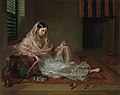 Muslin is a cotton fabric of plain weave made in a wide range of weights from delicate sheers to coarse sheeting. Early muslin was hand woven of uncommonly delicate handspun yarn, especially in the region around Dhaka, Bengal (now Bangladesh). The picture depicts an 18th-century woman in Dhaka clad in fine Bengali muslin.
Photo Credit: Francesco Renaldi
-
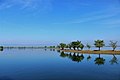 Tanguar haor, located in Sunamganj District, is a unique wetland ecosystem of national importance and has come into international focus. In 2000, the hoar basin was declared a Ramsar site - wetland of international importance.
Photo Credit: Sabirul Islam Biplob
-
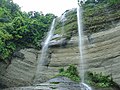 Shuvolong is a place in Barkol sub district, located about 25 kilometres (11 kilometres as the crow flies) away from Rangamati town. There are a few waterfalls in Shuvolong area with the largest one falling from as high as 300 feet. Shuvolong is accessible by speed boat or motor boats from Rangamati. The photo features Shovolong water falls in October (before winter).
Photo Credit: Mirza Salman Hossain Beg, Bangladesh
-
 Pond herons are herons, typically 40–50 cm (16–20 in) long with an 80–100 cm (31–39 in) wingspan, which mostly breed in the tropical Old World. The photo shows a heron at Bangabandhu Sheikh Mujib Safari Park.
Photo Credit: Abdul Momin
-
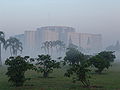 Jatiyo Sangsad Bhaban is the National Assembly Building of Bangladesh, located in the capital Dhaka. It was created by architect Louis I. Kahn and is one of the largest legislative complexes in the world. It houses all parliamentary activities of Bangladesh. This photo offers a view of the parliament building during sunrise.
Photo Credit: Lykantrop
-
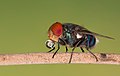 Numerous species of Calliphoridae or blow fly commonly known as Green bottle fly are found in Bangladesh. The pictured specimen was photographed at Baldha Garden, Dhaka.
Photo Credit: Azim Khan Ronnie
-
 Himchari National Park located just south of the Cox's Bazar town consists of lush tropical rain forest, grasslands and trees, and features a number of waterfalls, the biggest of which cascades down toward the sandy, sun-drenched beach. The National Park was established in 1980 as a conservation area for research, education and recreation.
Photo Credit: Shuvra Dutta
-
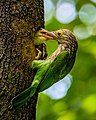 The lineated barbet (Psilopogon lineatus) is an Asian barbet native to the Terai, the Brahmaputra basin to Southeast Asia. It is a frugivore and nests in holes of tree trunks. The pictured specimen was photographed at National Botanical Gardens, Dhaka.
Photo Credit: Nafis Ameen
-
 The Indian pitta (Pitta brachyura) is a passerine bird native to the Indian subcontinent. It inhabits scrub jungle, deciduous and dense evergreen forest. The pictured specimen was photographed at Bhawal National Park.
Photo Credit: Md shahanshah bappy
-
 The river Buriganga is economically very important to Dhaka. Even during the Mughal rules the banks of the Buriganga were already a prime location for trade. Today the river provides vital connectivity between the capital city and many districts. The photograph features a launch sailing from Sadarghat on the Buriganga during sunset.
Photo Credit: Jubair1985
-
 The chestnut-capped babbler (Timalia pileata) is a passerine bird of the Timaliidae. It is monotypic within the genus Timalia. The pictured specimen of this native bird of Bangladesh was photographed at Himchari National Garden, Cox's Bazar.
Photo Credit: Syedabbas321
-
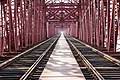 Hardinge Bridge is a steel railway bridge over the river Padma located at Paksey, Ishwardi, Pabna in western Bangladesh. It is named after Lord Hardinge, who was the Viceroy of India from 1910 to 1916. The bridge is 1.8 kilometres (1.1 mi) long.
Photo Credit: Azim Khan Ronnie
-
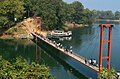 The District of Rangamati is a part of the Chittagong Hill Tracts and is one of the most beautiful districts of the country. Its beauty lies in the people, culture, landscape and lifestyle. The Hanging Bridge at Rangamti district, pictured here, is a famous landmark and tourist attraction of the district.
Photo Credit: Shakhawat Hossen Shafat
-
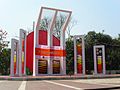 Shaheed Minar, or the Martyr's monument, located near Dhaka Medical College was established to pay the tribute to the martyrs of the Bengali language movement of 1952 and as such has become the center of commemoration of Language Movement Day, in Bangladesh on February 21 every year.
Photo Credit: Karl Ernst Roehl
-
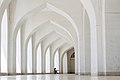 Baitul Mukarram is the National Mosque of Bangladesh. Located at the center of Dhaka, capital of Bangladesh, the mosque was completed in 1968.
Photo Credit: Jubair1985
-
 Chomchom is a traditional Bengali sweet originated from Porabari, Tangail, Bangladesh. It is a very popular dessert in Bangladesh and India. The cuisine comes in a variety of colors, mainly light pink, light yellow, and white. It is coated with coconut or mawa flakes as a garnish. The sweet is oval and brownish.
Photo Credit: P.K.Niyogi
-
 Somapura Mahavihara in Paharpur, Badalgachhi Upazila, Naogaon District, Bangladesh is among the best known Buddhist viharas in the Indian subcontinent and is one of the most important archeological sites in the country. It was designated as a UNESCO World Heritage Site in 1985.
Photo Credit: Kazi Rashed Abdallah
-
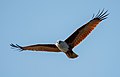 The Brahminy kite (Haliastur indus) is a medium-sized bird of prey in the family Accipitridae found in the Indian subcontinent, Southeast Asia and Australia. They are found mainly on the coast and in inland wetlands, where they feed on dead fish and other prey. Adults have a reddish-brown body plumage contrasting with their white head and breast which make them easy to distinguish from other birds of prey. The pictured specimen was photographed at Kuakata Eco-Park.
Photo Credit: Md. Tareq Aziz Touhid
-
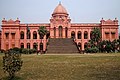 Ahsan Manzil, the official residential palace and seat of the Dhaka Nawab Family, situated on the banks of the Buriganga River. The palace is now a museum.
Photo Credit: Mahbub Hossain Shaheed (mahosha)
-
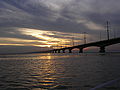 Jamuna Multi-purpose Bridge, opened in June 1998 connects Bhuapur on the Jamuna River's east bank to Sirajganj on its west bank. The 5th longest bridge in South Asia established a strategic link between the eastern and western parts of Bangladesh.
Photo Credit: Arman Aziz
-
 Magpie Robin, a very common bird in Bangladesh - locally known as Doyel or Doel (Bengali: দোয়েল), is designated as the National Bird of the country.
Photo Credit: J.M.Garg
-
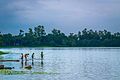 Ramsagar National Park is a national park in Bangladesh located at Tejpur, near Dinajpur District in the northwest of the country. The Park is 27.76 hectare, in size, and is built around a large water reservoir known as "Ramsagar reservoir" built in the 18th century by Raja Ram Nath. The photograph shows young children from the locality fishin in the reservoir.
Photo Credit: Jubair1985
-
 The Asian pied starling (Sturnus contra) is one of the 12 bird species of family Sturnidae resident in Bangladesh. Locally known as myna or shalik, these birds build their nests in holes or cavities in trees or buildings, or large globular structures of straw, twigs, etc. in trees.
Photo Credit: J.M.Garg
-
 Jatiyo Sangsad Bhaban is the National Assembly Building of Bangladesh, located in the capital Dhaka. It was created by architect Louis I. Kahn and is one of the largest legislative complexes in the world. It houses all parliamentary activities of Bangladesh. This photo offers a close view of a section of the parliament building.
Photo Credit: justinstravels
-
 Although rice is the staple food of Bangladesh, wheat holds an important position is a summplementary staple corp. The image was captured in a wheat field in the Natore District.
Photo Credit: Jubair1985
-
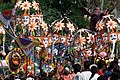 Pohela Baishakh, is the first day of the Bengali calendar, celebrated in both Bangladesh and Bengali communities across India. The most colourful New Year's Day festival takes place in Dhaka, as the students and teachers of Institute of Fine Arts, University of Dhaka take out a colourful procession and parade round the campus. This image shows a glimpse of the parade.
Photo Credit: Niloy
-
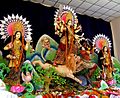 Durga Puja is the biggest festival of Hindus in Assam, Bihar, West Bengal, Jharkhand, and Bangladesh, and of Bengali Hindus all over the world. It is also called Akalbodhan, Vijaya Dashami, Dashain, and Dussehra. The image shows celebration of the festival at Dhakeshwari Temple, the national temple of Bangladesh.
Photo Credit: Rajiv Ashrafi
-
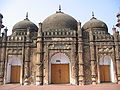 The Khan Mohammad Mridha Mosque on Lalbagh road is situated less than half a kilometre west of the Lalbagh Fort, in an area called Atish Khana in old Dhaka. Two Persian inscriptions, one over the central archway and the other over the central Mihrab, speak of its construction during 1704–05 AD.
Photo Credit: Ragib Hasan
-
 Ratargul Swamp Forest is a freshwater swamp forest located in Gowain River, Fatehpur Union, Gowainghat, Sylhet, Bangladesh. It is the only swamp forest located in Bangladesh and one of the few freshwater swamp forest in the world. The forest is naturally conserved under the Department of Forestry, Govt. of Bangladesh.
Photo Credit: Sumon Mallick
-
 Patenga, a sea beach and popular tourist spot, is located 14 kilometres south of the port city of Chittagong, Bangladesh, near the mouth of the Karnaphuli River. The beach is very close to BNS Isha Khan Naval Base of Bangladesh Navy, and Shah Amanat International Airport.
Photo Credit: Ziaul Hoque
-
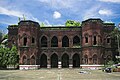 Chandanpura Nachghar is an ancient building located adjacent to Chandanpura Fire Service Station, along Nawab Siraj-ud-Daulah road in Chittagong, Bangladesh. It is known as the dance hall of the Zamindar house of Sajjalela. The building, once used as the Chittagong Divisional Fire Service Office, is currently preserved as the proposed Fire Service and Civil Defense Museum.
Photo Credit: Intakhab
-
 Bandarban, one of the remotest districts of Bangladesh, is famous for the beauty of its hilly terrain. The numerous Buddhist temples and bihars in the town, Prantik Lake, Jibannagar and Kyachlong Lake are some more places of interest. This image shows the skyline of the district from the pouplar Nilachol resort managed by Bangladesh Parjatan Corporation.
Photo Credit: Fahad Faisal
-
 Sripur is a tourist spot in Bangladesh's Sylhet district. It is well known for its waterfalls, which span across the Bangladesh-India border. This picture features a tea garden in Sripur, Sylhet, Bangladesh
Photo Credit: Moheen Reeyad
-
 The Rhesus Macaque (Macaca mulatta) is one of the best-known species of Old World monkeys native in Bangladesh. The pictured macaque is seen eating from a jackfruit at Lawachara National Park, Moulvibazar.
Photo Credit: Syedabbas321
-
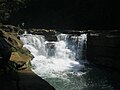 NgafaKhong (native Marma term) or Nafa-khum waterfall is situated on the Remaikree River, a tributory of Sangu river. The wild hilly Remaikree river suddenly falls down here about 25–30 feet. The falls are located in a remote area two hours' walking distance from Remakree bazar, Thanchi Upazila, Bandarban District.
Photo Credit: Abu Md. Jakaria
-
 The Pancha Ratna Govinda Temple in is located at Puthia village in Rajshahi district in Bangladesh. The temple is a striking monument built in the 19th century. It has the architectural feature of five ratnas or spires. It is located within the inner precincts of the Puthia Rajbari or palace.
Photo Credit: RockyMasum
-
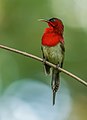 The crimson sunbird (Aethopyga siparaja) is a species of bird native in Bangladesh. The pictured specimen was photographed at Modhutila Eco-Park in Sherpur District.
Photo Credit: Masud Rana
-
 Jatiyo Sangsad Bhaban is the National Assembly Building of Bangladesh, located in the capital Dhaka. It was created by architect Louis I. Kahn and is one of the largest legislative complexes in the world. It houses all parliamentary activities of Bangladesh. This photo offers a close view of a section of the parliament building.
Photo Credit: Nahid Sultan & Saiful Aopu
-
 Jatiyo Sangsad Bhaban is the National Assembly Building of Bangladesh, located in the capital Dhaka. It was created by architect Louis I. Kahn and is one of the largest legislative complexes in the world. It houses all parliamentary activities of Bangladesh. This photo offers a close view of a section of the parliament building.
Photo Credit: Nahid Sultan & Saiful Aopu
-
 Madhabkunda waterfall is one of the highest waterfalls in Bangladesh. It is situated in Barlekha Upazila in Moulvibazar District, Sylhet Division. The waterfall is a popular tourist spot in Bangladesh. Big boulders, surrounding forest, and the adjoining streams attracts many tourists for picnic parties and day trips.
Photo Credit: Jubair1985
-
 Natore Rajbari (also known as Pagla Raja's Palace, Natore Palace) was a prominent royal palace in Natore, Bangladesh. It was the residence and seat of the Rajshahi Raj family of zamindars. The famous queen Rani Bhabani lived here and after the death of her husband, expanded both the estate and the palace.
Photo Credit: Nur-E-Saud
-
 Dinajpur Railway Bridge on Punorvoba River is an important landmark facilitating rail connectivity between Dinajpur District and rest of the country.
Photo Credit: Jubair1985
-
 Numerous species of Dragonflies are native in Bangladesh. The pictured specimen was photographed at Baldha Garden, Dhaka.
Photo Credit: Azim Khan Ronnie
-
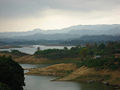 The District of Rangamati is a part of the Chittagong Hill Tracts and is one of the most beautiful districts of the country. Its beauty lies in the people, culture, landscape and lifestyle. This picture featuring the skyline of Rangamati has been taken at Tabalchhori at BDR Rangamati.
Photo Credit: Sakib
-
 St. Martin's Island is a small island in the northeastern part of the Bay of Bengal, about 9 km south of the tip of the Cox's Bazar-Teknaf peninsula, and forming the southernmost part of Bangladesh. There is a small adjoining island that is separated at high tide, called Chera Dwip. It is about 8 kilometres (5 miles) west of the northwest coast of Myanmar, at the mouth of the Naf River.
Photo Credit: Niaz morshed Shovon
-
 Chittagong War Cemetery is a Commonwealth War Graves Commission cemetery located at Dampara 22 kilometers north of the airport and 8 kilometers from the port. The burial area is surrounded by a large plantation. A tarmac lane leads from the entrance gate to the burial area which is entered through a metal gate flanked by two small brick chapels.
Photo Credit: Hossain Toufique Iftekher
-
 Bagakain Lake, also called Boga Lake is located in Ruma Upazila in Bandarban. It is a natural sweet and deep water lake situated nearly 1,246 feet (380 m) above sea level. The irregularly shaped lake is bounded on three sides by mountain peaks covered with thick bamboo bushes.
Photo Credit: Masum Ibn Musa
-
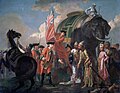 This is a photographic reproduction of an original two-dimensional work of art by Francis Hayman (1708–1776) created in 1762. The artwork is showing Lord Clive meeting with Mir Jafar after the Battle of Plassey (1757). The painting was displayed in Vauxhall soon after completion.
Photo Credit:www.sterlingtimes.org
-
 Fantails are small insectivorous birds of Australasia, Southeast Asia and the Indian subcontinent of the genus Rhipidura in the family Rhipiduridae. The pictured specimen was photographed at Bhawal National Park.
Photo Credit: Md shahanshah bappy
-
 Egrets are herons which have white or buff plumage, and develop fine plumes (usually milky white) during the breeding season.. The pictured specimens were photographed at Sundarbans East Wildlife Sanctuary, Bagerhat.
Photo Credit: Md shahanshah bappy
-
 In Bangladesh there are many tribal people live in Sylhet, Dinajpur, Cox's Bazar, Mymensingh, Rajshahi etc. But majority of tribal people live in the Chittagong Hill Tracts. This picture features a tribal kid with her little sister tied in her back at Farukpara, Bandarban, Bangladesh.
Photo Credit: Mohammad Rakibul Hasan
-
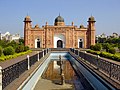 Pari Bibi's mazar at the Lalbagh Fort, the center of Mughal military power in Dhaka and an intrinsic part of the history of the city, founded by Muhammad Azam Shah in 1678.
Photo Credit: Md. Shahed Faisal
-
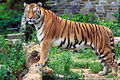 Bengal Tiger, the national animal of Bangladesh, is a subspecies of tiger primarily found in Indian subcontinent. In the Sunderbans, a 2004 census found the presence of about 280 Tigers on the India side & 500 tigers on the Bangladesh side.
Photo Credit: Hollingsworth, John and Karen, retouched by Zwoenitzer
-
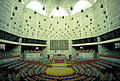 Jatiyo Sangsad Bhaban is the National Assembly Building of Bangladesh, located in the capital Dhaka. It was created by architect Louis I. Kahn and is one of the largest legislative complexes in the world. It houses all parliamentary activities of Bangladesh. This photo offers a view of the assembly hall inside the parliament building
Photo Credit: Rossi101
-
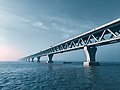 The Padma Multipurpose Bridge is a multipurpose road-rail bridge across the Padma River, the main distributary of Ganges, under construction in Bangladesh. The image features a beautiful morning view of Padma Bridge under construction (November 2021).
Photo Credit: Nahian Bin Shafiq
-
 Cox's Bazar in Bangladesh known for its wide sandy beach, is believed to be the world's longest (120 km) natural sandy sea beach. It is located 152 km south of Chittagong. The photo features a beach restaurant at Cox's Bazar.
Photo Credit: Xalan mustafa
-
 An old man carrying two baskets on a stick through a field of tea plants in Jaflong, Sylhet, Bangladesh, with misty hills in the background.
Photo Credit: Abdul Momin
-
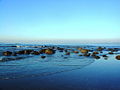 St. Martin's Island is a small island in the northeast part of the Bay of Bengal, about 9 km south of the tip of the Cox's Bazar-Teknaf peninsula, and forming the southernmost part of Bangladesh. It is the only coral island in Bangladesh. This picture features the dead corals of The Saint Martin's Island.
Photo Credit: Mirza Salman Hossain Beg
-
 Kaptai Lake is the largest man made lake in Bangladesh. It is located in the Kaptai Upazila under Rangamati District of Chittagong Division. The lake was created as a result of building the Kaptai Dam on the Karnaphuli River, as part of the Karnaphuli Hydro-electric project. The Kaptai Lake's average depth is 100 feet (30 m) and maximum depth is 490 feet (150 m).
Photo Credit: Fahad Faisal
-
 Dhakeshwari Temple is a famous state-owned Hindu temple in Dhaka, Bangladesh built in the 12th century. The temple is located southwest of the Salimullah Hall of Dhaka University. This image shows Shiva temple structures inside the Dhakeshwari Temple complex.
Photo Credit: Ragib Hasan
-
 The blue peafowl (Pavo cristatus), a large and brightly coloured bird, is a species of peafowl native to the Indian subcontinent, but introduced in many other parts of the world. The photo shows a peacock displaying its train at Bangabandhu Sheikh Mujib Safari Park.
Photo Credit: Azim Khan Ronnie
-
 Jatiyo Sangsad Bhaban is the National Assembly Building of Bangladesh, located in the capital Dhaka. It was created by architect Louis I. Kahn and is one of the largest legislative complexes in the world. It houses all parliamentary activities of Bangladesh.
Photo Credit: Karl Ernst Roehl
-
 The image features a Rosette Bearing the Names and Titles of Shah Jahan; Folio from the Shah Jahan Album. It depicts a shamsa (literally, sun) traditionally opened imperial Mughal albums. Worked in bright colors and several tones of gold, the meticulously designed and painted arabesques are enriched by fantastic flowers, birds, and animals. The inscription in the center reads: "His Majesty Shihabuddin Muhammad Shahjahan, the King, Warrior of the Faith, may God perpetuate his kingdom and sovereignty.".
Photo Credit: Metropolitan Museum of Art
-
 The Uttara Ganabhaban (meaning Northern People's House) is an 18th-century (1734) royal palace also known as Dighapatia Rajbari as it was formerly the seat of the Dighapatia Raj, an aristocratic landed estate in the Bengal Presidency of the British Raj. It is located near Natore town and serves as the principal residence of the Bangladeshi Prime Minister in the northern part of the country.
Photo Credit: Rohan Uddin Fahad
-
 The oriental garden lizard, eastern garden lizard or changeable lizard (Calotes versicolor) is an agamid lizard found widely distributed in Asia. The pictured specimen was photographed at National Botanical Gardens, Dhaka.
Photo Credit: Azim Khan Ronnie
-
 Lawachara National Park is a major national park and nature reserve in Bangladesh. The park is located at Kamalganj Upazila, Maulvi Bazar District in the northeastern region of the country. The park covers approximately 1,250 ha (12.5 km2) of semi-evergreen forest Biome and mixed deciduous forest Biome.
Photo Credit: Pallabkabir
-
 The pictured Shiva Temple is situated in Puthia Bazar of Rajshahi District. It was built on a hing plinth on the southern bank of a large tank. The temple is a 19.81 meter square building and total height is 35.03 meter. It is a Pancha Ratna type building consists of a Garbhagriha and a surrounding verandah. Rani Bhubanmoye Debi built this temple in 1823 AD.
Photo Credit: Nasir Khan Saikat
-
 Cox's Bazar in Bangladesh known for its wide sandy beach, is believed to be the world's longest (120 km) natural sandy sea beach. It is located 152 km south of Chittagong.
Photo Credit: ed g2s


_2.jpg)


-_Male_at_Kolkata_I_IMG_3003.jpg)

_on_Kapok_(Ceiba_pentandra)_in_Kolkata_W_IMG_4513.jpg)


.jpg)


.jpg)

.jpg)
.jpg)


.jpg)


.jpg)


.jpg)

Did you know (auto-generated) -

- ... that Sheikh Mujibur Rahman, the founder and first president of Bangladesh, experienced his birthday in jail eight times?
- ... that Alatchakra: Circle of Desire was the first three-dimensional Bangladeshi film?
- ... that Sheikh Mujibur Rahman proclaimed the independence of Bangladesh from his residence in Dhaka before his arrest by the Pakistan Army?
- ... that many fans of Ayub Bachchu's Bangladeshi rock watched the film Loot Toraj in theaters just to hear the love song "Ananta Prem Tumi Dao Aamake"?
- ... that Mohammad Saifullah Ozaki, an academic in Japan born to a Hindu family in Bangladesh, became a leader in the Islamic State?
- ... that a Bangladeshi government agency collected ৳6.5 billion (equivalent to US$150 million in 2023) from corruption suspects, but a court ruled it was illegal?
Selected biography

Sher-e-Bangla (Urdu phrase meaning 'The Tiger of Bengal') Abul Kashem Fazlul Huq (Bengali: আবুল কাশেম ফজলুল হক) (26 October 1873—27 April 1962) was a well-known Bengali statesman in the first half of the 20th century. He held different political posts including those of the Mayor of Calcutta (1935), Chief Minister of undivided Bengal (1937-1943) and East Bengal (1954), Home Minister of Pakistan (1955) and Governor of East Pakistan (1956-58).
Huq entered the Bengal Legislative Council in 1913 as an elected member from the Dhaka (Dacca) Division. For 1913-1916 Huq served as the Secretary of the Bengal Provincial Muslim League and Joint Secretary of the All India Muslim League. Then he served as the President of the All India Muslim League from 1916 to 1921. He played an instrumental role in formulating the Lucknow Pact of 1916 between the Congress and the Muslim League. In 1917 Huq became Joint Secretary of the Indian National Congress and in 1918-1919 he served this organisation as its General Secretary.
In 1935, with the Congress' support, Fazlul Huq was chosen and elected first Muslim mayor of Calcutta. Prior to 1937 election, Fazlul Huq reorganized the defunct Proja-Shamiti and renamed it as Krishak Praja Party (KPP). Later that year Sher-e-Bangla joined Muslim League and subsequently become the chairman of the Bengal headquarter of the party. Afterwards he acted as the Chief Minister (also called Premier) of undivided Bengal between 1937 to 1943. Fazlul Huq drafted and moved the Lahore Resolution on 23 March, 1940. According to this resolution, North-eastern and Eastern parts of India happened to be formed as sovereign states.[clarification needed] It established Muslim League's demand for a homeland for Muslims, that ultimately resulted in the nation of Pakistan. However after 1942 Huq actually opposed the Two-Nation Theory and tried to mobilise non-Muslim League Muslim leaders against Partition of India. (more...)
General images -
-
 Bangladeshi artists performing in a dance show. (from Culture of Bangladesh)
 -
 Rabindranath Tagore is Asia's first Nobel laureate and composer of the national anthem of Bangladesh. (from History of Bangladesh)
 -

-
 Durga Puja in Bangladesh (from Culture of Bangladesh)
 -
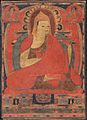 Atisha was one of the most influential Buddhist priest during the Pala dynasty in Bengal. He was believed to have been born in Bikrampur (from History of Bangladesh)
 -
 Sandesh, created with milk and sugar (from Culture of Bangladesh)
 -
 An ancient inscription from the site of Mahasthangarh (from History of Bangladesh)
 -
 A cricket match between Bangladesh & India at the Sher-e-Bangla Cricket Stadium in Dhaka. (from Culture of Bangladesh)
 -
 Relatives decorating the bride with traditional wedding turmeric in a Bangladeshi Gaye Holud ceremony in Dhaka. (from Culture of Bangladesh)
 -
 Pala Empire and its neighbouring kingdoms. (from History of Bangladesh)
 -
 Rohingya refugees in Bangladesh in October 2017 (from History of Bangladesh)
 -
 Map of India under the Mughal Empire in 1700 CE. (from History of Bangladesh)
 -
 Sheikh Mujibur Rahman (from History of Bangladesh)
 -
 Chief Advisor Fakhruddin Ahmed with presidents Hamid Karzai of Afghanistan and Pervez Musharraf of Pakistan, at the World Economic Forum (from History of Bangladesh)
 -
 Jatiyo Sangsad Bhaban, the house of the Parliament of Bangladesh. (from Culture of Bangladesh)
 -
 alt=Boat on a river in a densely forested plain. (from Culture of Bangladesh)
 -
 The Cabinet of East Bengal, 1954 (from History of Bangladesh)
 -
 Painting by artist Firoz Mahmud on Battle of Plassey titled 'The Start of the End of the Reign of the Subcontinent: during the time of my forefathers' (from History of Bangladesh)
 -
 alt=Building of red bricks with a roof consisting of many white domes. There are small round towers on the corners of the building each crowned by a white cupola. (from Culture of Bangladesh)
 -
 A sun motif in Mangal Shobhajatra, a parade takes place in Bangladesh in the occasion of Pohela Boishakh (from Culture of Bangladesh)
 -

-
 Tamak' (r.) and Tumdak' (l.) - typical drums of the Santhal people, photographed in a village in Dinajpur district, Bangladesh. (from Culture of Bangladesh)
 -
 President Ziaur Rahman with Queen Juliana and Princess Beatrix of the Netherlands in 1979 (from History of Bangladesh)
 -
 Noor Hossain, a pro-democracy demonstrator, "স্বৈরাচার নীপাত যাক//" The words, in bright white paint written on the bare chest on 10 November 1987 protest for democracy in Dhaka, photographed by Dinu Alam just before he was shot dead by President Ershad's security forces (from History of Bangladesh)
 -

-
 A rural congregation for Eid-al-Fitr prayers (from Culture of Bangladesh)
 -
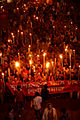 2013 Shahbag protests demanding the death penalty for the war criminals of the 1971 Bangladesh Liberation War (from History of Bangladesh)
 -
 The Muazzampur Shahi Mosque in Sonargaon, built in Shamsuddin Ahmad Shah's reign. (from History of Bangladesh)
 -
Sixty Dome Mosque in Mosque city of Bagerhat was built in the 15th century and is the largest historical mosque in Bangladesh, as well as a World Heritage Site. (from History of Bangladesh)
-
 An urban congregation for Eid-ul-Azha prayers in Dhaka. (from Culture of Bangladesh)
 -
 Khaleda Zia, Bangladesh's first woman prime minister, with President Lula of Brazil, during her second term (from History of Bangladesh)
 -
 alt=Ruins of a structure of red stone now resembling a small hill or mound. (from Culture of Bangladesh)
 -
 The Surrender of Pakistan took place on 16 December 1971 at the Ramna Race Course in Dhaka, marking the liberation of Bangladesh. (from History of Bangladesh)
 -
-
 Siraj ud-Daulah the last independent Nawab of Bengal. (from History of Bangladesh)
 -
 1752 Kantajew Temple, prominent Hindu architecture of Bangladesh. (from Culture of Bangladesh)
 -
 Alivardi Khan (Mughal Empire's viceroy of Bangal) captures two prisoners. (from History of Bangladesh)
 -
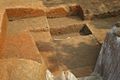 The ruins of Wari-Bateshwar in Narsingdi is believed to be from the Copper Age. Suggesting a thriving culture in ancient Bengal (from History of Bangladesh)
 -
 Victory march by protesters after the resignation of Sheikh Hasina in 2024 (from History of Bangladesh)
 -
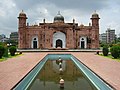 Lalbagh Fort, a Mughal architecture of Bangladesh (from Culture of Bangladesh)
 -
 President Hussain Muhammad Ershad (from History of Bangladesh)
 -
Pohela Boishakh celebration in Dhaka, Bangladesh (from Culture of Bangladesh)
-
 Shaheed Minar (Martyr Monument) People commemorates those who were killed in the 21 February 1952 Bengali Language Movement demonstration (from Culture of Bangladesh)
 -
 Portion of a sari woven at Sonargaon, Bangladesh (from Culture of Bangladesh)
 -
Ahsan Manzil in Dhaka, Indo-Saracenic Revival architecture of Bangladesh (from Culture of Bangladesh)

_Dhaka_Bangladesh_2011_18.JPG)


.JPG)


_002.jpg)


.jpg)


Did you know from old articles

- ...that the Bara Katra palace in Dhaka, now dilapidated and half-destroyed, was built originally to be the residence of Mughal prince Shah Shuja?
- ... that Bangladesh Games, the national multi-sport event of Bangladesh, was previously known as Bangladesh Olympic Championships?
- ... that the Mymensingh Museum in Bangladesh contains Saraswati and Vishnu statues from a Muktagacha zamindar palace, and a huge shade used during hunting from a Gouripur zamindar palace?
- ... that the German architect Anna Heringer has contributed to sustainable architecture building hand-made schools in Bangladesh and Morocco with local craftsmen and materials?
- ... that Mukti Bahini guerrillas were absorbed into the ranks of regular military officers and personnel upon the formation of Bangladesh's armed forces?
- ... that the arrest of Basanti Devi during the non-cooperation movement in 1921 proved to be a major impetus for widespread agitation?
- ... that a University of Michigan gymnast dubbed the "Golden Syque" won the first gold medal in international competition for Bangladesh and was chosen to compete in the 2012 Summer Olympics in London?
- ... that the Bangladesh Police inherits much of its structure from the police of British India and contributes to U.N. peace-keeping missions?
Recognized content


New articles
Rules | Match log | Results page (for watching) | Last updated: 2024-10-31 19:40 (UTC)
Note: The list display can now be customized by each user. See List display personalization for details.
- Atharia School and College (edit | talk | history | links | watch | logs | tools) by Therealbey (talk · contribs · new pages (4)) started on 2024-10-31, score: 16
- Molla Waheeduzzaman (edit | talk | history | links | watch | logs | tools) by Vinegarymass911 (talk · contribs · new pages (36)) started on 2024-10-31, score: 34
- Dinajpur Medical College (edit | talk | history | links | watch | logs | tools) by Nahian (talk · contribs · new pages (6)) started on 2024-10-31, score: 36
- Kaya Chakrabortty (edit | talk | history | links | watch | logs | tools) by Sunuraju (talk · contribs · new pages (19)) started on 2024-10-31, score: 32
- Kabadi (web series) (edit | talk | history | links | watch | logs | tools) by Mr Bangladesh71 (talk · contribs · new pages (5)) started on 2024-10-30, score: 16
- Ispahani Mirzapore Banglabid (edit | talk | history | links | watch | logs | tools) by Niloy Nasif (talk · contribs · new pages (1)) started on 2024-10-22, score: 38
- Syed Borhan Kabir (edit | talk | history | links | watch | logs | tools) by Vinegarymass911 (talk · contribs · new pages (36)) started on 2024-10-30, score: 46
- Bangladesh Jatiotabadi Ainjibi Forum (edit | talk | history | links | watch | logs | tools) by Vinegarymass911 (talk · contribs · new pages (36)) started on 2024-10-26, score: 60
- Batisha Union (edit | talk | history | links | watch | logs | tools) by GreenRedFlag (talk · contribs · new pages (4)) started on 2024-10-29, score: 20
- Operation Searchlight order of battle: Pakistan (edit | talk | history | links | watch | logs | tools) by Hey man im josh (talk · contribs · new pages (450)) started on 2024-10-29, score: 20
- List of Bangladeshi people (edit | talk | history | links | watch | logs | tools) by Hey man im josh (talk · contribs · new pages (450)) started on 2024-10-29, score: 30
- Sheikh Mohammad Wahid Uz Zaman (edit | talk | history | links | watch | logs | tools) by Vinegarymass911 (talk · contribs · new pages (36)) started on 2024-10-29, score: 34
- Abdus Sobhan Sikder (edit | talk | history | links | watch | logs | tools) by Vinegarymass911 (talk · contribs · new pages (36)) started on 2024-10-29, score: 38
- Five-Point Demand (edit | talk | history | links | watch | logs | tools) by St.teresa (talk · contribs · new pages (1)) started on 2024-10-29, score: 42
- Vice-Chancellor of Bangladesh University of Engineering and Technology (edit | talk | history | links | watch | logs | tools) by Bruno pnm ars (talk · contribs · new pages (16)) started on 2024-10-28, score: 44
- Md. Akther Hossain (edit | talk | history | links | watch | logs | tools) by Vinegarymass911 (talk · contribs · new pages (36)) started on 2024-10-28, score: 42
- Electoral history of Sheikh Mujibur Rahman (edit | talk | history | links | watch | logs | tools) by Mehedi Abedin (talk · contribs · new pages (15)) started on 2024-10-28, score: 28
- University of Brahmanbaria (edit | talk | history | links | watch | logs | tools) by UzbukUdash (talk · contribs · new pages (25)) started on 2024-10-28, score: 40
- Pabitra Sarkar (edit | talk | history | links | watch | logs | tools) by CharlesWain (talk · contribs · new pages (1)) started on 2024-10-28, score: 20
- International Islami University of Science and Technology Bangladesh (edit | talk | history | links | watch | logs | tools) by UzbukUdash (talk · contribs · new pages (25)) started on 2024-10-28, score: 44
- Microland University of Science and Technology (edit | talk | history | links | watch | logs | tools) by UzbukUdash (talk · contribs · new pages (25)) started on 2024-10-28, score: 40
- Sheikh Hasina University of Science and Technology (edit | talk | history | links | watch | logs | tools) by UzbukUdash (talk · contribs · new pages (25)) started on 2024-10-28, score: 36
- Abdus Salam (businessman) (edit | talk | history | links | watch | logs | tools) by Vinegarymass911 (talk · contribs · new pages (36)) started on 2024-10-28, score: 40
- A. S. Mahmud (edit | talk | history | links | watch | logs | tools) by Vinegarymass911 (talk · contribs · new pages (36)) started on 2024-10-28, score: 36
- Farhana Khorshed (edit | talk | history | links | watch | logs | tools) by Wikiwookie543 (talk · contribs · new pages (4)) started on 2024-10-27, score: 16
- Jatir Pita Bangabandhu Sheikh Mujibur Rahman Science and Technology University, Narayanganj (edit | talk | history | links | watch | logs | tools) by UzbukUdash (talk · contribs · new pages (25)) started on 2024-10-27, score: 24
- Bangabandhu Sheikh Mujib Shariatpur Agriculture University (edit | talk | history | links | watch | logs | tools) by UzbukUdash (talk · contribs · new pages (25)) started on 2024-10-27, score: 40
- Kazi Rafiqul Alam (edit | talk | history | links | watch | logs | tools) by Rafiqul01 (talk · contribs · new pages (1)) started on 2024-10-27, score: 20
- Kasem Bin Abu Bakar (edit | talk | history | links | watch | logs | tools) by UzbukUdash (talk · contribs · new pages (25)) started on 2024-10-27, score: 32
- Tahmid Bhuiyan Tamim (edit | talk | history | links | watch | logs | tools) by Rayhan Ahmed Tamim (talk · contribs · new pages (4)) started on 2024-10-27, score: 24
- Days celebrated in Bangladesh (edit | talk | history | links | watch | logs | tools) by UzbukUdash (talk · contribs · new pages (25)) started on 2024-10-27, score: 38
- Gonotantrik Chhatra Shakti (edit | talk | history | links | watch | logs | tools) by UzbukUdash (talk · contribs · new pages (25)) started on 2024-10-27, score: 50
- Md, Akram Hossain (edit | talk | history | links | watch | logs | tools) by Rayhan Ahmed Tamim (talk · contribs · new pages (4)) started on 2024-10-27, score: 32
- Daily Kalbela (edit | talk | history | links | watch | logs | tools) by UzbukUdash (talk · contribs · new pages (25)) started on 2024-10-27, score: 36
- Mövenpick Khulna (edit | talk | history | links | watch | logs | tools) by Asm sultan (talk · contribs · new pages (1)) started on 2024-10-27, score: 16
- Shahid Syed Nazrul Islam Muktamanch (edit | talk | history | links | watch | logs | tools) by Nahian (talk · contribs · new pages (6)) started on 2024-10-27, score: 44
- IslamPidia (edit | talk | history | links | watch | logs | tools) by Rayhanpopi (talk · contribs · new pages (1)) started on 2024-10-27, score: 36
- Bangladesh Jatiyatabadi Ainjibi Forum (edit | talk | history | links | watch | logs | tools) by Vinegarymass911 (talk · contribs · new pages (36)) started on 2024-10-26, score: 58
- Tabith Awal (edit | talk | history | links | watch | logs | tools) by Niasoh (talk · contribs · new pages (2)) started on 2024-10-26, score: 44
- Student Federation of Bangladesh (edit | talk | history | links | watch | logs | tools) by UzbukUdash (talk · contribs · new pages (25)) started on 2024-10-26, score: 56
- Criticism of the Constitution of Bangladesh (edit | talk | history | links | watch | logs | tools) by পেতনীপিসি (talk · contribs · new pages (2)) started on 2024-10-26, score: 32
- 2022 Bangladesh anti-Hindu violence (edit | talk | history | links | watch | logs | tools) by CosmLearner (talk · contribs · new pages (5)) started on 2024-10-22, score: 26
- Aung Rakhine (edit | talk | history | links | watch | logs | tools) by UzbukUdash (talk · contribs · new pages (25)) started on 2024-10-25, score: 50
- Litton Das (edit | talk | history | links | watch | logs | tools) by Samin Yasar KZS (talk · contribs · new pages (1)) started on 2024-10-25, score: 44
- Shadhinata Complex (edit | talk | history | links | watch | logs | tools) by Bruno pnm ars (talk · contribs · new pages (16)) started on 2024-10-25, score: 28
- Md Abdul Hannan (edit | talk | history | links | watch | logs | tools) by Vinegarymass911 (talk · contribs · new pages (36)) started on 2024-10-24, score: 38
- Tareq Md Ariful Islam (edit | talk | history | links | watch | logs | tools) by Vinegarymass911 (talk · contribs · new pages (36)) started on 2024-10-24, score: 36
- Cyclone Dana (edit | talk | history | links | watch | logs | tools) by VNC200 (talk · contribs · new pages (2)) started on 2024-10-24, score: 24
- Farhan Faiyaaz Ratul (edit | talk | history | links | watch | logs | tools) by Rayhan Ahmed Tamim (talk · contribs · new pages (4)) started on 2024-10-24, score: 20
- Fazle Hasan Shishir (edit | talk | history | links | watch | logs | tools) by UzbukUdash (talk · contribs · new pages (25)) started on 2024-10-24, score: 40
- Fifth inauguration of Sheikh Hasina (edit | talk | history | links | watch | logs | tools) by ToadetteEdit (talk · contribs · new pages (13)) started on 2024-10-24, score: 24
- Muhammad Mahfuzur Rahman (diplomat) (edit | talk | history | links | watch | logs | tools) by Vinegarymass911 (talk · contribs · new pages (36)) started on 2024-10-24, score: 34
- 2024 Bangladesh internet blackouts (edit | talk | history | links | watch | logs | tools) by Stranger43286 (talk · contribs · new pages (2)) started on 2024-10-20, score: 40
- Murder of Sony (edit | talk | history | links | watch | logs | tools) by Marjan Rahman Rabby (talk · contribs · new pages (1)) started on 2024-10-23, score: 44
- DC Hill, Chattogram (edit | talk | history | links | watch | logs | tools) by GreenRedFlag (talk · contribs · new pages (4)) started on 2024-10-23, score: 40
- Topkhana Road (edit | talk | history | links | watch | logs | tools) by Stud.asif (talk · contribs · new pages (9)) started on 2024-10-23, score: 36
- Ayesha Mousumi (edit | talk | history | links | watch | logs | tools) by EngrShakamal (talk · contribs · new pages (1)) started on 2024-10-23, score: 38
- Poet Vijay Gupta's Mansa Devi Temple (edit | talk | history | links | watch | logs | tools) by ToadetteEdit (talk · contribs · new pages (13)) started on 2024-10-23, score: 16
- Tahir Zaman Priyo (edit | talk | history | links | watch | logs | tools) by CycloneYoris (talk · contribs · new pages (27)) started on 2024-10-23, score: 48
- 2024 Bangladesh Presidential resignation protests (edit | talk | history | links | watch | logs | tools) by Bruno pnm ars (talk · contribs · new pages (16)) started on 2024-10-22, score: 40
- Selim Al Deen Muktamanch (edit | talk | history | links | watch | logs | tools) by FaysaLBinDaruL (talk · contribs · new pages (4)) started on 2024-10-22, score: 24
- Liberation Docfest Bangladesh (edit | talk | history | links | watch | logs | tools) by UzbukUdash (talk · contribs · new pages (25)) started on 2024-10-22, score: 52
- Pathshala South Asian Media Institute (edit | talk | history | links | watch | logs | tools) by UzbukUdash (talk · contribs · new pages (25)) started on 2024-10-22, score: 28
- Hill Film Festival (edit | talk | history | links | watch | logs | tools) by UzbukUdash (talk · contribs · new pages (25)) started on 2024-10-22, score: 30
- Overseas Employment Services (edit | talk | history | links | watch | logs | tools) by MPGuy2824 (talk · contribs · new pages (57)) started on 2024-10-22, score: 16
- Mohammad Zoynal Abedin (edit | talk | history | links | watch | logs | tools) by Shuvomzr (talk · contribs · new pages (1)) started on 2024-10-22, score: 36
- Bangladesh Khelafat Majlis (edit | talk | history | links | watch | logs | tools) by Owais Al Qarni (talk · contribs · new pages (8)) started on 2024-10-22, score: 44
- Duncan Brothers (Bangladesh) Limited (edit | talk | history | links | watch | logs | tools) by Vinegarymass911 (talk · contribs · new pages (36)) started on 2024-10-22, score: 64
- Harun Ahmed Chowdhury (edit | talk | history | links | watch | logs | tools) by Vinegarymass911 (talk · contribs · new pages (36)) started on 2024-10-22, score: 32
- 2024 Bangladesh HSC results protests (edit | talk | history | links | watch | logs | tools) by Zkabirkhan (talk · contribs · new pages (1)) started on 2024-10-21, score: 32
- 2025 in Bangladesh (edit | talk | history | links | watch | logs | tools) by Fixer88 (talk · contribs · new pages (55)) started on 2024-10-21, score: 40
- Shawkat Ali (freedom fighter) (edit | talk | history | links | watch | logs | tools) by GreenRedFlag (talk · contribs · new pages (4)) started on 2024-10-21, score: 46
- Madhupur pineapple (edit | talk | history | links | watch | logs | tools) by Tanvir Rahat (talk · contribs · new pages (3)) started on 2024-10-21, score: 28
- HSC Results Protest 2024 (edit | talk | history | links | watch | logs | tools) by Zkabirkhan (talk · contribs · new pages (1)) started on 2024-10-21, score: 28
- Syed Rezaul Karim (edit | talk | history | links | watch | logs | tools) by Rosguill (talk · contribs · new pages (5)) started on 2024-10-21, score: 40
- Laage Ura Dhura (edit | talk | history | links | watch | logs | tools) by ApurboWiki2024 (talk · contribs · new pages (3)) started on 2024-10-21, score: 48
- Joydebpur Thana (edit | talk | history | links | watch | logs | tools) by Stud.asif (talk · contribs · new pages (9)) started on 2024-10-21, score: 36
- Kotwali Thana (Rangpur) (edit | talk | history | links | watch | logs | tools) by Stud.asif (talk · contribs · new pages (9)) started on 2024-10-21, score: 32
- 48th Bangladesh National Film Awards (edit | talk | history | links | watch | logs | tools) by Dead.rabbit (talk · contribs · new pages (1)) started on 2024-10-21, score: 42
- Sector 10, Uttara (edit | talk | history | links | watch | logs | tools) by Mehedi Abedin (talk · contribs · new pages (15)) started on 2024-10-20, score: 52
- Tulshimala rice (edit | talk | history | links | watch | logs | tools) by Tanvir Rahat (talk · contribs · new pages (3)) started on 2024-10-20, score: 32
- Sannyasir Dhap (edit | talk | history | links | watch | logs | tools) by Sajid Ahmed Nijhu (talk · contribs · new pages (2)) started on 2024-10-20, score: 28
- Fuller Road (edit | talk | history | links | watch | logs | tools) by Stud.asif (talk · contribs · new pages (9)) started on 2024-10-20, score: 36
- Khandaker Abu Bakr (edit | talk | history | links | watch | logs | tools) by Thomas Khan 45678 (talk · contribs · new pages (1)) started on 2024-10-20, score: 40
- Mugdho Mancha (edit | talk | history | links | watch | logs | tools) by Mehedi Abedin (talk · contribs · new pages (15)) started on 2024-10-19, score: 68
- Manik Mia Avenue (edit | talk | history | links | watch | logs | tools) by Stud.asif (talk · contribs · new pages (9)) started on 2024-10-19, score: 36
- Mahbubur (edit | talk | history | links | watch | logs | tools) by ShelfSkewed (talk · contribs · new pages (150)) started on 2024-10-19, score: 40
- Ahasan (edit | talk | history | links | watch | logs | tools) by Tutwakhamoe (talk · contribs · new pages (3)) started on 2024-10-19, score: 16
- Tajhat Thana (edit | talk | history | links | watch | logs | tools) by Stud.asif (talk · contribs · new pages (9)) started on 2024-10-19, score: 16
- Minto Road (edit | talk | history | links | watch | logs | tools) by Stud.asif (talk · contribs · new pages (9)) started on 2024-10-19, score: 44
- Kutila Mura (edit | talk | history | links | watch | logs | tools) by Sajid Ahmed Nijhu (talk · contribs · new pages (2)) started on 2024-10-19, score: 36
- BGMEA Complex (edit | talk | history | links | watch | logs | tools) by Mehedi Abedin (talk · contribs · new pages (15)) started on 2024-10-18, score: 56
- Afroza Abbas (edit | talk | history | links | watch | logs | tools) by Ahammed Saad (talk · contribs · new pages (10)) started on 2024-10-18, score: 34
- Bangladesh Jatiotabadi Chatradal (edit | talk | history | links | watch | logs | tools) by Ahammed Saad (talk · contribs · new pages (10)) started on 2024-10-18, score: 52
- Muhammad Abdul Malek (edit | talk | history | links | watch | logs | tools) by Owais Al Qarni (talk · contribs · new pages (8)) started on 2024-10-18, score: 32
- Kushtia Central Jame Masjid (edit | talk | history | links | watch | logs | tools) by মোঃ সাকিবুল হাসান (talk · contribs · new pages (7)) started on 2024-10-18, score: 20
- An Open Letter from Shah Ahmad Shafi to the Government and the Public (edit | talk | history | links | watch | logs | tools) by Owais Al Qarni (talk · contribs · new pages (8)) started on 2024-10-18, score: 46
- Daudkandi (edit | talk | history | links | watch | logs | tools) by CosmLearner (talk · contribs · new pages (5)) started on 2024-10-17, score: 36
- Yunus Ministry (edit | talk | history | links | watch | logs | tools) by HelloCommando (talk · contribs · new pages (0)) started on 2024-10-17, score: 30
- Mahfuzul Mamun Babu (edit | talk | history | links | watch | logs | tools) by FNH004 (talk · contribs · new pages (1)) started on 2024-10-17, score: 64
Associated Wikimedia
The following Wikimedia Foundation sister projects provide more on this subject:
-
 Commons
Free media repository -
 Wikibooks
Free textbooks and manuals -
 Wikidata
Free knowledge base -
 Wikinews
Free-content news -
 Wikiquote
Collection of quotations -
 Wikisource
Free-content library -
 Wikiversity
Free learning tools -
 Wikivoyage
Free travel guide -
 Wiktionary
Dictionary and thesaurus


