


Syrian Turkmen
| Regions with significant populations | |
|---|---|
| See areas of settlement | |
| Languages | |
| Turkish · Arabic | |
| Religion | |
| Predominantly Sunni Islam, minority Alevism | |
| Related ethnic groups | |
| Turkish people · Iraqi Turkmen · Turks in Egypt · Lebanese Turkmen · Israeli Turkmen · Azerbaijanis |
Syrian Turkmen (Arabic: تركمان سوريا, romanized: Turkumān Sūriyā; Turkish: Suriye Türkmenleri)[a] are Syrian citizens of Turkish origin who mainly trace their roots to Anatolia (i.e. modern Turkey). Turkish-speaking Syrian Turkmen make up the third largest ethnic group in the country, after the Arabs and Kurds respectively.[1][2][3][4][5]
The majority of Syrian Turkmen are the descendants of migrants who arrived in Syria during Ottoman rule (1516–1918);[6][7] however, there are also many Syrian Turkmen who are the descendants of earlier Turkish settlers that arrived during the Seljuk (1037–1194) and Mamluk (1250–1517) periods. Some estimates indicate that if Arabized Turkmen (those who no longer speak Turkish as their main language) are taken into account, they form the second-largest group in the country.[5] The majority of Syrian Turkmen are Sunni Muslims.[5]
Syrian Turkmen share common genealogical and linguistic ties with the Turkish people in Turkey and Iraqi Turkmen, but do not identify themselves with the Turkmen of Turkmenistan and Central Asia.[7][8] Most live near the Syrian-Turkish border, in an area that runs from the northwestern governorates of Idlib and Aleppo to the Raqqa Governorate. Others reside in the Turkmen Mountain near Latakia, the city of Homs and its vicinity until Hama, Damascus, and the southwestern governorates of Daraa (bordering Jordan) and Quneitra (bordering Israel).[9]
During the ongoing Syrian Civil War, many Syrian Turkmen have been involved in military actions against both the Syrian Armed Forces and the Syrian Democratic Forces (SDF), and have looked to the Turkish Armed Forces for support and protection. Many united under an official governing body, the Syrian Turkmen Assembly, and established the military wing of the assembly, the Syrian Turkmen Brigades.[10] However, not all Turkmen support the Turkish occupation of northern Syria, and some have sided with the SDF, forming the Seljuk Brigade.
History
[edit]
Turkic migration to Syria began in the 11th century during the rule of the Seljuk Empire.[9][6] However, most Turkmen settled in the region after the Ottoman sultan Selim I conquered Syria in 1516.[11][12] The Ottoman administration encouraged Turcoman families from Anatolia[7] to establish villages throughout the rural hinterlands of several cities in Ottoman Syria (and later the Syria Vilayet).[9] Migration from Anatolia to Syria was continuous for over 400 years of Ottoman rule, until the dissolution of the Ottoman Empire in 1918; nonetheless, Syrian Turkmen community continued to reside in the region during the French Mandate and the formation of Syrian Republics.[9]
Seljuk era
[edit]Syrian Turkmen have had a presence in Syria since the 11th century.[13] The first recorded entry of free Turkmen troops into Syria was in 1064 when the Turkmen prince Ibn Khan and 1,000 of his archers entered Aleppo.[14][15] He came at the request of the Arab Mirdasid emir Atiyya ibn Salih to assist him against his own Banu Kilab tribesmen who backed a rival Mirdasid emir, Mahmud ibn Nasr.[14][15] Turkmen rule in the region began with the Seljuk conquests in the Middle East. The Seljuk Turks opened the way for mass migration of Turkish nomads once they entered northern Syria in 1071, and took Damascus in 1078 and Aleppo in 1086.[16] By the 12tn century the Turkic Zengid dynasty (a vassal of the Seljuk Empire) continued to settle Turkmes in the wilayah of Aleppo to confront attacks from the Crusaders. In return for their military service, the Turkic rulers distributed fiefs in the area to the Turkmen.[13]
Mamluk era
[edit]
In 1260, the Mamluk Sultanate – ruled by a line of Turkish and Circassian sultans – entered Syria in response to the Mongol invasions. Whilst Cairo remained the seat of the Mamluk Sultanate, Damascus became their second capital.[17] Hence, by the thirteenth century, the Turkmen formed a part of the armies of Damascus and Aleppo, and permanently settled in these regions.[18] After the Bahri sultan of the Mamluks, Baibars, destroyed Qara he settled Turkmen in the town in 1265. Two years later, he settled more Turkmen in the Syrian coast to protect the region. The Turkmen were called on to assist in the capture of Margat by the Muslim commander of the Krak des Chevaliers in 1280.[18] The late Mamluk-era writer Ahmad al-Qalqashandi noted that Turkmen formed contingents in the regular armies of greater Syria. By the 15th century, the Muslim writer Khalil az-Zahiri recorded 180,000 Turkmen soldiers and 20,000 Kurdish soldiers in Syria.[18] The Turkmen mainly lived in the provinces of Aleppo and were settled in suburbs such as al-Hadir al-Sulaymani; they also live near the coast and the Jawlan (i.e. Golan Heights).[18]
Ottoman era
[edit]
Mamluk rule of Syria ended once the Ottoman Sultan Selim I conquered the region in 1516–17.[19] Thereafter, the Ottoman administration encouraged Turkish nomads from Anatolia to settle in strategic areas of the region. By the sixteenth century the Ottomans continued to settle Turkmen in the rural areas around Homs and Hama to keep the Bedouin in check and serve as mütesellim.[20]

Turkish migration from Anatolia to Ottoman Syria was continuous for almost 400 years, until Ottoman rule ended in 1918.[12] The Turkish settlement throughout the rural hinterlands of several Syrian cities was a state-organized population transfer which was used to counter the demographic weight and influence of other ethnic groups in the region. Furthermore, the Turkmen served as the local gendarmes to help assert Ottoman authority.[9]
By the late nineteenth century, many Turkish refugees who lost their lands to Russia in the European regions of the Ottoman Empire (particularly in the Balkans) settled in Ottoman Syria between 1878 and 1906 and were provided with new lands by the Ottoman state.[21] According to Dawn Chatty, these Turkmen settlers (alongside Circassian and Chechen refugees) became loyal subjects to the sultan and were "driven to succeed in agriculture and ready to defend themselves against any Bedouin claims to the land on which they had built their villages".[21]
Vilayet of Aleppo
[edit]According to the French geographer Vital Cuinet (1833–96), the Ottoman Turks (excluding Turkmen nomads) formed the second largest ethnic group, after the Syrian Arabs, in the Aleppo Sanjak. In his best known work La Turquie d'Asie, géographie administrative: statistique, descriptive et raisonnée de chaque province de l'Asie Mineure he stated that the demographic structure of the Sanjak was as follows:
| Ethnic and religious groups | Estimated population in the Aleppo Sanjak (ca.1890-95)[22][page needed] | Percentage |
|---|---|---|
| Syrian Arab | 300,541 | 38.41% |
| Ottoman Turk | 159,787 | 20.43% |
| Kurdish and Turkmen nomads | 103,744 | 13.26% |
| Greek Catholic | 23,315 | 2.98% |
| Syrian Catholic | 20,913 | 2.67% |
| Syrian Jacobite | 20,594 | 2.63% |
| Jew | 19,633 | 2.51% |
| Greek Orthodox | 18,665 | 2.39% |
| Armenian Apostolic | 17,999 | 2.30% |
| Chaldean Catholic | 17,027 | 2.18% |
| Armenian Catholic | 15,563 | 1.96% |
| Chaldean non-Uniate | 15,300 | 1.96% |
| Protestant | 9,033 | 1.15% |
| Circassian | 9,000 | 1.15% |
| Other Muslims (Fellah, Ansarieh, Tahtaji, Nusairi) | 26,713 | 3.41% |
| Other Catholic (Latin and Maronite) | 4,447 | 0.57% |
| Total | 782,274 | 100% |
French Mandate
[edit]The Alexandretta/Hatay Question
[edit]


In 1921, the Treaty of Ankara established Alexandretta (present-day Hatay) under an autonomous regime under French Mandate of Syria. The Turks were initially satisfied with this agreement, because Article 7 declared that "The Turkish inhabitants of this district shall enjoy every facility for their cultural development. The Turkish language shall have official recognition." Moreover, Article 9 stated that the tomb of Suleyman Shah, grandfather of the first Ottoman ruler Osman I, "shall remain, with its appurtenances, the property of Turkey."[23]
| Population of Hatay State in 1936 according to the French census[24] | ||||||
| Ethnic group | Inhabitants | % | ||||
|---|---|---|---|---|---|---|
| Turks | 85,800 | 39% | ||||
| Alawites | 61,600 | 28% | ||||
| Armenians | 24,200 | 11% | ||||
| Sunni Arabs | 22,000 | 10% | ||||
| other Christians | 17,600 | 8% | ||||
| Circassians, Jews, Kurds | 8,800 | 4% | ||||
| Total | 220,000 | 100% | ||||
In September 1936, France announced that it would grant full independence to Syria, which would also include Alexandretta. The President of the Republic of Turkey, Mustafa Kemal Atatürk, responded with a demand that Alexandretta be given its own independence.[25] The issue was brought before the League of Nations, which sent a mission to the district in January 1937. The mission concluded that the Turks constituted a majority and by July 1938 elections were held in the province; the Turks formed a majority of 22 seats in a 40-seat parliament of the newly established Hatay State, which remained a joint Franco-Turkish protectorate.[26] The Hatay State began using Turkish flags, and petitioned Ankara to unify Hatay to the Republic of Turkey. France finally agreed to the Turkish annexation on 23 July 1939.[25] Today, the Bayırbucak region, the coastal and rural section covering the northern Latakia area, has a considerable Turkmen presence and is considered by some Turks as a "stretch of the modern Turkish Hatay Province".[27]
Syrian Republican era
[edit]

.svg)
After the Sanjak of Alexandretta became the province of Hatay in the Republic of Turkey, in 1939, some Turkish families immigrated into the new borders of Syria, settling in the provinces of Aleppo and Damascus.[30] Hence, new "Turkish streets" began to emerge, such as in the al-Salihia district in Damascus. Family unifications of Turkmen families living on both sides of the Syrian-Turkish border continued for more than 70 years until the outbreak of the Syrian revolution.[30]
By 1950, Latakia showed great economic potential as the largest port city in Syria, and many Syrian Turkmen living in rural villages joined the Turkmen community already established there. Consequently, there is now a total of 265 Turkish villages in and around Latakia center.[31]
In addition to urban migrations, under the name of "land reform", lands owned by the Turkmen were nationalized and Arabs were resettled in areas near the Turkish border. Arabization policies also saw the names of Turkish villages renamed with Arabic names.[31] Thus, a mass exodus of Syrian Turkmen migration to Turkey took place between 1945 and 1953, many of which settled in Kirikhan, Alexandretta and Adana, in southern Turkey.[30]
The cultural and political rights of the Turkish-speaking minority remaining in Syrian territories was not guaranteed under any legal constitution.[31] Those living in large groups managed to protect their cultural identity, however, Turkmen living in smaller groups were significantly Arabized. In any case, the minority had no rights to open Turkish schools or associations.[31]
By the late 20th century, Dr. Larry Clark stated there was "more than 200,000" Turkmen in Syria[32] whilst the German Orient-Institute stated that estimates ranged between 800,000 and 1 million.[33] Numerous academics placed the Turkish-speaking Sunni Muslim population (i.e. not including Arabized or Alevi/Shia Turkmen) at approximately 3% of Syria's population, including Professor Daniel Pipes[34] Professor Itamar Rabinovich,[35] Professor Moshe Ma'oz,[36] Dr. Nikolaos van Dam,[37] Dr Henry Munson,[38] Professor Alasdair Drysdale and Professor Raymond Hinnebusch.[39]
Syrian Civil War (2011–present)
[edit]Since the beginning of the Syrian civil war in 2011, large numbers of Syrian Turkmen have been displaced from their homes and many have been killed due to attacks by President Bashar al-Assad's government, as well as the terrorist attacks carried out by "Islamic State of Iraq and the Levant" (ISIL). Whilst Turkmen villages in Hama, Homs, and Latakia have been destroyed by the Syrian government, Turkmen villages in Aleppo were occupied by ISIL.[40]


Syrian Turkmen, with the support of the Republic of Turkey, have taken up arms against the Syrian government.[11] Several Syrian Turkmen parties united under the Syrian Turkmen Assembly, which is affiliated with the National Coalition opposition group.[11] A Second Coastal Division was formed in 2015 and along with another extensive Turkmen militia group Sultan Murad Division, the Turkmen brigades are closely affiliated with the Free Syrian Army (FSA). Another Syrian Turkmen unit – the Seljuk Brigade and the Manbij Turkmen Brigade – have sided with the Kurdish-led People's Protection Units (YPG) and joined the US-backed Kurdish-led opposition coalition called the Syrian Democratic Forces (SDF).[11]
Displacement
[edit]Since the beginning of the Syrian civil war many Syrian refugees (including Syrian Turkmen) have sought asylum in Turkey, Jordan, Lebanon and northern Iraq,[41] as well as several Western European countries[42] and Australia.[43] Moreover, many Syrian Turkmen have also been internally displaced from their homes, forcing them to settle in other parts of Syria.[citation needed]

In 2012 the UN Refugee Agency had stated that Syrian Turkmen formed a significant number of the first wave of refugees who entered Turkey.[44]
An article published by Reuters in 2015, reporting the Russian raids hitting Syrian Turkmen areas (after a Russian plane was shot down on the Turkey-Syria border), said that "Officials estimate 300,000 Turkmen used to live in northern Latakia" before the Russians "heavily targeted ethnic Turkmen areas."[45] Al Jazeera English has also reported that the "Russian escalation of attacks on Turkmen areas" displaced "300,000 Turkmen from northern Latakia alone."[46]
By the Syrian Government
[edit]The Syrian Government of president Bashar al-Assad, backed by Russia since 2015, have targeted several areas populated by Syrian Turkmen, as they were largely involved in anti-government attacks. On 2 February 2016, at least seven women and children were killed by Russian air strikes in a Syrian Turkmen village in the northern countryside of Homs.[47] In the same month Russian warplanes had staged 600 strikes on Syrian Turkmen villages, displacing approximately 10,000 people.[48]
By the YPG
[edit]There have also been reports that there had been forced displacement of Arabs, Syrian Turkmen and Kurdish civilians at the hands of the YPG from their homes in areas in the Democratic Federation of Northern Syria.[49][50] In June 2015 there was concern expressed by the UN Human Rights Council regarding displacement of Syrian Turkmen from their homes in villages south of Hasakah and Tal Abyad during fighting with ISIL.[51] Approximately 200 Syrian Turkmen refugees fled to Urfa, in southern Turkey, while 700 more fled to the eastern areas of Tal Abyad, once the YPG seized the town of Tell Hammam al-Turkman from ISIL, and there were claims that the YPG had accused the locals of collaborating with ISIL.[52]
Current population
[edit]There are no reliable estimates on the total number of ethnic minorities living in Syria because official censuses have only asked citizens about their religion, therefore, Syrian citizens have not been allowed to declare their ethnic origin or mother tongue.[1] Dr Abdelwahed Mekki-Berrada, et al., in a report published by the UNHCR, points out that the majority of Syrians are considered "Arab", however, this is a term based on spoken language (Arabic) not ethnic affiliation.[1] Consequently, this has created difficulties in estimating the total Syrian Turkmen population (i.e. including the Turkish-speaking and the Arabized Turkmen).[31]
According to Professor Taef El-Azhari, the Syrian Turkmen have "always been the forgotten minority in the area despite their large population".[53] Dr Abdelwahed Mekki-Berrada, et al.,[1] as well as Professor Pierre Beckouche,[54] Professor John Shoup,[2] Professor Pierre Piccinin,[3] and Dr Peter Behnstedt,[4] have all placed the Turkish-speaking Syrian Turkmen as the third largest ethnic group in the country (after Arabs and Kurds respectively). Yet, a report published by the Arab Reform Initiative suggests that they may form the second largest ethnic group if Arabized Turkmen are also taken into account:
"Turkmen are the third largest ethnic group in Syria, making up around 4-5% of the population. Some estimations indicate that they are the second biggest group, outnumbering Kurds, drawing on the fact that Turkmen are divided into two groups: the rural Turkmen who make up 30% of the Turkmen in Syria and who have kept their mother tongue, and the urban Turkmen who have become Arabised and no longer speak their mother language. Turkmen are mostly found in the urban centres and countryside of six governorates of Syria: Aleppo, Damascus, Homs, Hama, Latakia and Quneitra." – Mustafa Khalifa (2013, published by the Arab Reform Initiative)[5]
Estimates since the Syrian Civil War
[edit]Assistant Professor Sebastian Maisel, focusing on the Yezidis, claimed that Syrian Turkmen numbered 250,000 (or approx 1% of the population).[55] However, Professor Pierre Beckouche stated that Sunni Muslim Turkmen alone formed 4% of the country's population before 2011 (i.e. approximately 1 million).[54] Professor John Shoup has said that in 2018 the Turkish-speaking Syrian Turkmen formed around 4-5% of the population.[2] Professor Taef El-Azhari,[53] Dr. Sebastien Peyrouse,[8] and Dr. Paul Antonopoulos[56] have all stated that there is around 1 million Turkish-speaking Syrian Turkmen. In addition, Dr. Eldad J. Pardo and Maya Jacobi have cited an estimate of 750,000 to 1.5 million.[57] Professor David Aikman has said that there is "about 1.7 million Turks in Syria".[58] Dr. Jonathan Spyer, as well as a report published in cooperation between the Norwegian Church Aid and the World Council of Churches (compiled by various academics), stated that the Turkmen number anywhere from 500,000 to 3 million.[59][60] Professor Pierre Piccinin claims that whilst 1.5 million Syrian Turkmen are Turkish-speaking, the total population of the minority is between 3.5 and 6 million (or 15% to 20% of the population), including those who have adopted Arabic as their mother tongue.[3]
Diaspora
[edit]

Middle East
[edit]Turkey
[edit]In December 2016 the Turkish Foreign Ministry Undersecretary Ümit Yalçın stated that Turkey opened its borders to 500,000 Syrian Turkmen.[62] Most Syrian Turkmen settled in Istanbul, Gaziantep, Osmaniye, Hatay, Izmir, Malatya, and Konya.
In 2020 the Voice of America reported that 1,000,000 Syrian Turkmen (including descendants) who are living in Turkey are requesting to become Turkish citizens.[63]
Lebanon
[edit]In October 2015, the Syrian independent newspaper Zaman Al Wasl reported that 120,000 to 150,000 Syrian Turkmen refugees arrived in Lebanon, and hence they now outnumber the Turkish minority of Lebanon.[64][65] By 2018 the number of Syrian Turkmen in Lebanon had increased to approximately 200,000.[66]
Jordan
[edit]A substantial number of Syrian Turkmen refugees also fled to Jordan.[41]
Europe
[edit]Outside the Middle East, Syrian Turkmen refugees have mainly fled to Western Europe (particularly Germany), but some have also been given refuge in countries as far as Australia.[43]
Germany
[edit]Established in Germany, the "Suriye Türkmen Kültür ve Yardımlaşma Derneği – Avrupa",or "STKYDA", ("Syrian Turkmen Culture and Solidarity Association – Europe") was the first Syrian Turkmen association to be launched in Europe.[67] It was established in order to help the growing Syrian Turkmen community which arrived in the country since the European migrant crisis which started in 2014 and saw its peak in 2015. The association includes Syrian Turkmen youth activists originating from all Syrian cities and who are now living across Western European cities.[68]
Areas of settlement
[edit]


Most Syrian Turkmen live in the area around the northern Euphrates, near the Syrian-Turkish border; however, they are also scattered throughout several governorates, stretching towards central Syria and the southern region near the Golan Heights. In particular, the Turkmen are concentrated in the urban centers and countryside of six governorates of Syria: in the Aleppo Governorate, the Damascus Governorate, the Homs Governorate, the Hama Governorate, the Latakia Governorate and the Quneitra Governorate.[5][70] There are also smaller Turkmen communities living in the Daraa Governorate;[70] as well as in Tartous, Raqqa, and Idlib governorates.[40]
In the Aleppo governorate, the main locales in which the Turkmen live include the city of Aleppo (with Bustan al-Basha, Haydariyah, Hllok, Sheikh Hizir, Sheikh Feriz, Saladdin, Owaijah being neighborhoods with ethnic Turkmen populations) and the countryside in the northern part of the governorate. They also live in the villages next to the cities of Azaz, Al-Bab, and Jarabulus.[5][71][72] Al-Rai is also a Turkmen-dominated town. There are 16 Turkmen-dominated villages south of Mount Simeon, 17 Turkmen villages in the district of Azaz, 29 villages to the east of that region, 3 villages connected to Aleppo, 69 villages around Al-Rai, 26 villages in the vicinity of Jarabulus, and 23 villages south of Sajur River.[73]
In the Latakia governorate the Turkmen live mostly in the Turkmen Mountains (Jabal al-Turkman), Al-Badrusiyah, Umm al-Tuyour, and in various villages near the Syrian-Turkish border.[5] There is also a number of Turkmen districts, including Bayırbucak and Jimmel Harresi where there are many Turkmen villages.[70]
In the Damascus governorate the Turkmen live in the city of Damascus, and Harret Al Turkman is a Turkmen district where Turkish is predominantly spoken.[70] In the Homs governorate the Turkmen mostly live in the city of Homs and the surrounding villages, such as Kara Avshar, Inallu, and Kapushak.[70] They also live in Gharnatah, Al-Krad, Burj Qa'i, al-Sam'lil, and in villages in the Houla plain.[5] In the Hama governorate the Turkmen live in the city of Hama and are also scattered in numerous villages around the district.[5] For example, Baba Amir Haras is a prominent Turkmen district.[70] There are also Turkmen living in Aqrab and Talaf.[74] In the Quneitra governorate the Turkmen are scattered in numerous villages in the districts of Quneitra.[5] They predominantly reside in the villages of Dababiye, Rezaniye, Sindiyane, Aynul Kara, Aynul Simsim, Ulayka, Aynul Alak, Ahmediye, Kafer Nafah, Mugir, Hafir, Hüseyniye, and Ayn Ayse.[70]
Culture
[edit]Language
[edit]

According to The Encyclopedia of Arabic Language and Linguistics, the Turkish language is the third most widely used language in Syria (after Arabic and Kurdish).[4] It is spoken by the Turkmen minority mostly in villages east of the Euphrates, north of Aleppo, and on the northern coast of the country, along the Syrian-Turkish border.[4][77][78][79] In addition, there are Turkish language islands in the Qalamun area and the Homs area.[4] Moreover, Syrian Arabic dialects have also borrowed many loanwords from Turkish.[4] Mustafa Khalifa claims that, Turkmen are divided into two groups: Rural Turkish-speaking Turkmen, constituting 30% of Syrian Turkmen, and Urban Arabic-speaking Turkmen.[5]
Various dialects of Turkish are spoken throughout Syria: in Aleppo they speak a Kilis and Antep dialect; in Tell Abyad and Raqqa they speak an Urfa dialect; and in Bayırbucak they speak a Hatay/Yayladağı dialect of the Turkish language.[80] Some Syrian Turkmen living far from the Turkish border, such as in Homs, have managed to preserve their national identity but are more competent in speaking the Arabic language. In Damascus Syrian Turkmen speak the Turkish language of a Yörük dialect.[80]
In 2018 Dr. Eldad J. Pardo and Maya Jacobi reported that they did not identify any Turkish (nor Kurdish or Aramaic) teaching, either as a first or second language, in the Syrian national curriculum.[57]
-
 Bilingual sign (Arabic and Turkish) of Al-Rai Council.
 -
 Bilingual sign (Arabic and Turkish) of Al-Bab police station.
_Council.jpg)

Religion
[edit]The majority of Syrian Turkmen are Sunni Muslims,[5][37][60][81] but there is also a small minority of Turkmen who are Shia Muslims (particularly Alevis and Bektashis). Ali Öztürkmen claims that the Turkmen community is 99% Sunni whilst the remainder (1%) practice Shia Islam.[82]
-
-

-
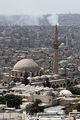
 The Murad Pasha Mosque (Turkish: Şam Murat Paşa Camii) in Damascus was built by the Ottomans in 1568.
 -

-
 The Sulaymaniyya Takiyya (known in Turkish as Şam Süleymaniye Külliyesi) in Damascus was built by the Ottomans in the sixteenth century.


There are also some Syrian "Nawar people" (a derogatory term for people who live a mobile lifestyle – often described as "gypsies"[83]) who speak Turkish, some of whom self-identify as Turkmen;[84] those practicing Islam belong to the Sunni, Shiite, and Alevi/Bektashi religious groups.[84][85] There are also some who practice Christianity.[84]
Discrimination
[edit]
.jpg)
From the French mandate era to the Assad regime, the Turkish culture and language have perished for a section of the Syrian Turkmen community.[87] Many Syrian Turkmen have become Arabized and indistinguishable from the Arabs in areas where they form a minority. Consequently, Arabization is mainly an exception in areas where the Syrian Turkmen live in areas where they form a significant population, where they have continued to maintain their Turkish identity and language despite discriminative state policies.[87]
Under the rule of Hafez al-Assad, there has been a ban on Syrian Turkmen communities from publishing works in Turkish.[11][88]
Syrian Turkmen occupied a low rung on the societal ladder, as reported by Al Bawaba, it was stated that Assad always sought to benefit his politically dominant Alawite religious minority. The report quoted Bayırbucak Turkmen as highlighting, "They would take Alawites first no matter what, even if they had degrees, Turkmen couldn't find jobs".[89]
Notable people
[edit]


Several Turkish families, such as the al-Atassi's (Atasi's), Bey Kanj Pasha Zadeh (Genç Yussef Pasha 1807–1811), Al-Azm, Qawuqji's, Quwwatli's (Kuvvetli's) and Shishakli's (Çiçekçi's), continued to rule Syria as Prime Ministers or Presidents.[90] However, by the 1960s the pan-Arab Baathist movement of the Al-Assad family sidelined non-Arabs from politics.[96]
- Armande Altaï, French singer[97]
- Akshamsaddin, Ottoman religious scholar
- Kanj Yousef Pasha Zadeh, Genç Pasha-Zadeh, Ottoman governor of Damascus state 1807–1811.
- Al-Azm family[90][86]
- Abdullah Pasha al-Azm, Ottoman governor of Damascus
- As'ad Pasha al-Azm, Ottoman governor of Hama and Damascus
- Haqqi al-Azm, former prime minister of Syria
- Ibrahim bin Taher bin Ahmed Al-Azem (ar), poet and human rights activist
- Ismail Pasha al-Azm, Ottoman governor of Hama, Homs Tripoli and Damascus
- Khalid al-Azm, six-time former prime minister of Syria[86]
- Muhammad Fawzi Pasha al-Azm (ar), first president of the first parliament in Syria
- Muhammad Pasha al-Azm, Ottoman governor of Sidon and Damascus
- Rafīq Bey al-ʿAzm, intellectual, author, and politician
- Sa'deddin Pasha al-Azm, Ottoman governor of Aleppo and Egypt (among others)
- Sadiq al-Azm (ar), traveler and Ottoman military commander
- Sadiq Jalal al-Azm, professor emeritus of Modern European Philosophy at the University of Damascus[86]
- Sulayman Pasha al-Azm, Ottoman governor of Tripoli, Sidon and Damascus
- Adel al-Azma, Politician
- Bashir al-Azma, Prime Minister of Syria (1962)
- Nabih Al-Azma, Minister of Interior in Jordan (1925)[91]
- Yasser al-Azma, Actor
- Yusuf al-'Azma, Minister of War in Syria (1920)[91]
- Aziz al-Azmeh
- Subhi Barakat, first President of Syria (1922–1925)[28]
- Burhan Asaf Belge, Turkish politician[98]
- Mardam Bey family:[99][29][95]
- Adnan Mardam Bey, lawyer, playwright and poet
- Farouk Mardam-Bey, French librarian, historian and publisher
- Ghada Mardam Bey, First program director on Syrian TV
- Haydar Mardam Bey, diplomat
- Jamil Mardam Bey, Prime Minister of Syria (1936–1939)[95]
- Khaled Mardam-Bey, British software developer and creator of mIRC
- Khalil Mardam Bey, Composer of the Syrian National Anthem
- Rashid Pasha Mardam Bey, judge
- Salma Mardam Bey, Writer[95]
- Sami Mardam-Bey, politician who was elected deputy and vice-president of the Syrian federation
- Mohammed al-Bezm (ar), Poet
- Cemil Bilsel, Turkish politician and academic[100]
- Emin Bozoğlan, Second President of the Syrian Turkmen Assembly (2016–present)
- Mehmed Fuad Carim, Turkish politician[101]
- Thanaa Debsi, Actress
- Tharaa Debsi, Actress
- Mohammad Emadi, Minister of Economy and Foreign Trade[87]
- Nadia al-Ghazzi, Lawyer, writer, TV presenter[92]
- Said al-Ghazzi, Prime Minister of Syria (in 1954 and 1955–56)[92]
- Sati' al-Husri, writer[94]
- Mennel Ibtissem, singer (contestant on The Voice France)[102]
- Sami Sabit Karaman, General of the Turkish army
- Khaled Khoja, President of the Syrian National Coalition (2015–2016)[11]
- Mehmet Muhittin Kurtiş, Turkish soldier
- Sanharib Malki, football player
- Taqi ad-Din Muhammad ibn Ma'ruf, Polymath[103]
- Ghaith Mofeed, artist[104]
- Abdurrahman Mustafa, First President of the Syrian Turkmen Assembly (2012–2016)[105]
- Huda Naamani, Feminist writer[92]
- Mustafa Naima, Ottoman historian
- Ahmad Nami, second President of Syria (1926–1928)[76] and Ottoman damat
- Mahmud Kâmil Pasha, General of the Ottoman army
- Zeki Pasha, Ottoman Turkish field marshal
- Abu Khalil Qabbani, playwright and composer[106][75]
- Nizar Qabbani, diplomat, poet and publisher[75]
- Sabah Qabbani, Ambassador of Syria to the United States (1974–1981)[75]
- children:
- Rana Kabbani, Syrian cultural historian
- Shukri al-Quwatli, First president of post-independence Syria (1943–1949) and (1955–1958).
- Aliye Rona, Turkish actress[107]
- Reşit Ronabar, Ottoman governor and Turkish politician[108]
- Suleyman Shah
- Hala Shawkat, Actress.[109]
- Adib Shishakli, Prime Minister and President of Syria (1953–1954)
- Talal Silo, former Syrian Democratic Forces spokesperson.[110]
- Adil Şan, Singer[111]
- Mehmet Şandır (tr), Turkish politician[27]
- Pakize Tarzi, Turkey's first female gynaecologist[112]
- Mustafa Tlass, Syrian Minister of Defense in (1972–2004)[113]
- children:
- Manaf Tlass, former Brigadier General
- Firas Tlass, business tycoon
- Hasan Turkmani. Minister of Defense (2004–2009)[114]
- children:
- Bilal Turkmani, owner of the Syrian weekly Abyad wa Aswad
- Rim Turkmani, astrophysicist
- Refi Cevat Ulunay (tr), Turkish writer
- Suat Hayri Ürgüplü, Prime Minister of Turkey (1965)[93]
- Necdet Yılmaz (tr), Turkish politician
- Husni al-Za'im, President of Syria (1949)[115]
- Muhammed Habes, Jarabulus Civilian Council President (since August 2016)
- Ahmed Othman, Old SAA colonel, leader of Sultan Murad Division since 2013[116]
- Nur ad-Din Zengi, a member of the Turkish Zengid dynasty which ruled the Syrian province of the Seljuk Empire.
- Imad ad-Din Zengi, a Turkish atabeg who ruled Mosul, Aleppo, Hama, and Edessa. He was the namesake of the Zengid dynasty.
- Tutush I, Seljuk Emir of Damascus.
- Aq Sunqur al-Hajib, Seljuk governor of Aleppo.
See also
[edit].svg)

Notes
[edit]- ^ Also referred to as Syrian Turkomans, Turkish Syrians, or simply Syrian Turks or Turks of Syria (Suriye Türkleri).
References
[edit]- ^ a b c d UNHCR 2015, p. 10.
- ^ a b c Shoup, John A. (2018), "Syria", The History of Syria, ABC-CLIO, p. 6, ISBN 978-1-4408-5835-2,
The third largest ethnic group in Syria is the Turkish speakers...They comprise around 4-5 percent of the total population
- ^ a b c Piccinin, Piere (2011), Après avoir été sur le terrain, La Libre Belgique,
Les Turcomans pratiquant exclusivement leur dialecte turc sont 1 500 000. L'ensemble des Turcomans de Syrie (y compris ceux qui ont adopté l'arabe comme langue usuelle), sont estimés entre 3,5 et 6 millions, soit de 15 à 20 % de la population. C'est le troisième groupe de population en importance.
- ^ a b c d e f Behnstedt 2008, p. 402.
- ^ a b c d e f g h i j k l Khalifa 2013, pp. 3–5.
- ^ a b Özkaya 2007, p. 112.
- ^ a b c The New York Times (2015). "Who Are the Turkmens of Syria?". The New York Times. Archived from the original on 14 January 2017. Retrieved 3 March 2017.
In the context of Syria, though, the term ["Turkmen"] is used somewhat differently, to refer mainly to people of Turkish heritage whose families migrated to Syria from Anatolia during the centuries of the Ottoman period — and thus would be closer kin to the Turks of Turkey than to the Turkmens of Central Asia...Q. How many are there? A. No reliable figures are available, and estimates on the number of Turkmens in Syria and nearby countries vary widely, from the hundreds of thousands up to 3 million or more.
- ^ a b Peyrouse 2015, p. 62.
- ^ a b c d e Heras, Nicholas A. (2013), "Syrian Turkmen Join Opposition Forces in Pursuit of a New Syrian Identity", Terrorism Monitor, 11 (11), Jamestown Foundation, archived from the original on 12 June 2018, retrieved 4 June 2018,
Syria's Turkmen communities are descendants of Oghuz Turkish tribal migrants who began moving from Central Asia into the area of modern-day Syria during the 10th century, when the Turkic Seljuk dynasty ruled much of the region. Under the Ottomans, Turkmen were encouraged to establish villages throughout the rural hinterlands of several Syrian cities in order to counter the demographic weight and influence of the settled and nomadic and semi-nomadic Arab tribesmen that populated the region. Syrian Turkmen were also settled to serve as local gendarmes to help assert Ottoman authority over roads and mountain passes in diverse regions such as the Alawite-majority, northwestern coastal governorate of Latakia. After the dissolution of the Ottoman Empire in 1918, communities of Turkmen continued to reside in the country.
- ^ Dispossessed Turkomans in Syria wait for Turkey's support Archived 25 December 2012 at the Wayback Machine
- ^ a b c d e f BBC (2015). "Profile: Khaled Khoja, Syria opposition chief". BBC News. Archived from the original on 29 November 2016. Retrieved 9 October 2016.
- ^ a b Öztürkmen, Duman & Orhan 2015, p. 5.
- ^ a b Ziadeh 1953, p. 45.
- ^ a b Zakkar 1971, p. 206.
- ^ a b Bianquis 1993, p. 120.
- ^ Commins 2004, p. 231.
- ^ Commins 2004, p. 184.
- ^ a b c d Ziadeh 1953, p. 46.
- ^ Commins 2004, p. 185.
- ^ Commins 2004, p. 330.
- ^ a b Chatty 2018, p. 150
- ^ Cuinet 1890–1895.
- ^ Franco-Turkish Agreement signed at Angora on October 20, 1921 (PDF), The Stationery Office, 1921, pp. 6–7, archived (PDF) from the original on 16 January 2013, retrieved 16 October 2016
- ^ Brandell, Inga (2006). State Frontiers: Borders and Boundaries in the Middle East. I.B.Tauris. p. 144. ISBN 978-1-84511-076-5. Retrieved 30 July 2013.
- ^ a b Shaw & Shaw 1977, p. 377.
- ^ Zürcher 2007, p. 203.
- ^ a b "The Turkmens of Bayırbucak". Hürriyet Daily News. 24 November 2015. Archived from the original on 26 December 2015. Retrieved 13 December 2015.
- ^ a b Bidwell, Robin (1998), "Barakat, Subhi (c.1886-)", Dictionary Of Modern Arab History, Routledge, p. 68, ISBN 978-1-136-16291-6,
BARAKAT, Subhi (c. 1886-) Syrian Head of State. He was born into a Turkish family in Antioch and was educated in the local secondary school.
- ^ a b Al Azmenah. "خليل مردم بك". Archived from the original on 4 January 2017. Retrieved 3 January 2007.
ولد خليل بن أحمد مختار مردم بك في دمشق عام 1895، من أصل تركي.
- ^ a b c Complex nationalities: the stories of Syria's Turkmen, Enab Baladi, 2019
- ^ a b c d e Yılmaz, Meşküre (2015), Suriye Türkleri, 21. Yüzyıl Türkiye Enstitüsü
- ^ Clark, Larry (1998), Turkmen Reference Grammar, Otto Harrassowitz Verlag, p. 11, ISBN 978-3-447-04019-8
- ^ Deutsches Orient–Institut 1996, p. 33.
- ^ Pipes 1992, p. 151.
- ^ Rabinovich 1972, p. 3.
- ^ Ma'oz 1973, p. 89.
- ^ a b Van Dam 1979, p. 1.
- ^ Munson 1988, p. 85.
- ^ Drysdale, Alasdair; Hinnebusch, Raymond A. (1991). Syria and the Middle East Peace Process. Council on Foreign Relations. p. 222. ISBN 978-0-87609-105-0.
- ^ a b Mustafa 2015, p. 4.
- ^ a b Wahby et al. 2014.
- ^ Hatahet & Aldassouky 2017, online.
- ^ a b Crowe, David (2015). "First Syrian refugees here for Christmas: Tony Abbott". The Australian. Retrieved 15 July 2018.
- ^ UN Refugee Agency (2012). "Exodus continues from Syria, including some 10,000 Iraqis". Archived from the original on 11 October 2016. Retrieved 10 October 2016.
- ^ Stubbs, Jack; Pamuk, Humeyra (2015). "Russian raids repeatedly hit Syrian Turkmen areas, Moscow's data shows". Reuters. Archived from the original on 22 July 2018. Retrieved 22 July 2018.
- ^ Al Jazeera English (2017). "Syrian Turkmen: Fighting to Survive". Archived from the original on 1 June 2018. Retrieved 2 June 2018.
But the result was a Russian escalation of attacks on Turkmen areas, displacing 300,000 Turkmen from northern Latakia alone. Since then, Syrian government forces have taken control of many villages and hilltops on the Turkmen Mountain.
- ^ Zaman al-Wasl (2016). "In Homs, Russian Strikes on Turkmen Village Kill Seven Women, Children". The Syrian Observer. Archived from the original on 4 November 2016. Retrieved 10 October 2016.
- ^ Zaman al-Wasl (2016). "Russian Warplanes Staged 600 Strikes on Turkmen Villages in a Month: FSA". The Syrian Observer. Archived from the original on 11 October 2016. Retrieved 10 October 2016.
- ^ Amnesty International 2015, online.
- ^ Foreign and Commonwealth Office (2016). "Syria – in-year update December 2015". Archived from the original on 11 October 2016. Retrieved 10 October 2016.
- ^ Human Rights Council (2016). "Report of the Independent International Commission of Inquiry on the Syrian Arab Republic" (PDF). p. 14. Archived (PDF) from the original on 15 February 2017. Retrieved 10 October 2016.
- ^ The Syrian Observer (2015). "YPG Displaces Hundreds of Syrian Turkmen Near Tal Abyad: Activists". Archived from the original on 11 October 2016. Retrieved 10 October 2016.
- ^ a b Taef 2005, p. 97.
- ^ a b Pierre 2017, pp. 178–180.
- ^ Maisel, Sebastian (2016), Yezidis in Syria: Identity Building among a Double Minority, Lexington Books, p. 15, ISBN 978-0-7391-7775-4
- ^ Antonopoulos, Paul (2018), "Turkey's interests in the Syrian war: from neo-Ottomanism to counterinsurgency", Global Affairs, Taylor & Francis: 8
- ^ a b Pardo, Eldad J.; Jacobi, Maya (2018), Syrian National Identity: Reformulating School Textbooks During the Civil War, Institute for Monitoring Peace and Cultural Tolerance in School Education, p. 42,
We did not identify any Syrian Kurdish (Kurmanji), Turkish or Aramaic teaching, either as a first or second language, although the ethno-linguistic Kurdish minority is large—forming about 10 percent of the population. The numbers of Turkmen and Assyrians is also significant.
- ^ Aikman, David (2014), The Mirage of Peace: Understand The Never-Ending Conflict in the Middle East, Baker Publishing Group, ISBN 9781441223555,
There is also about 1.7 million Turks in Syria, and about 800,000 Druze,...
- ^ Spyer, Jonathan (2015). "Strings pulled from Ankara, Moscow tangled in a Sukhoi". The Australian.
The Turkmens of Syria are ethnic Turks, numbering anywhere from 500,000 to three million.
- ^ a b The Protection Needs of Minorities from Syria and Iraq (PDF), Norwegian Church Aid and the World Council of Churches, 2016, p. 18, archived (PDF) from the original on 26 November 2018, retrieved 25 July 2018
- ^ Hurriyet (2004). "İlk kadın doğumcu Dr Pakize Tarzi öldü". Retrieved 29 December 2016.
- ^ Ünal, Ali (2016). "Turkey stands united with Turkmens, says Foreign Ministry Undersecretary Yalçın". Daily Sabah. Retrieved 11 September 2018.
Yalçın explained how Turkey opened its borders to 100,000 Turkmens from Iraq and 500,000 from Syria, sharing their pain and trying to mend their wounds as much as they could with economic, social and humanitarian aid.
- ^ Erkılıç, Orhan (2020). "Türkiye'deki Suriyeli Türkmenler de Vatandaşlık İstiyor". Amerika'nin Sesi | Voice of America - Turkish. Voice of America. Retrieved 17 December 2020.
1 Milyon Suriyeli Türkmen Vatandaşlık Hakkından Yararlanmak İstiyor.
- ^ Ahmed, Yusra (2015), Syrian Turkmen refugees face double suffering in Lebanon, Zaman Al Wasl, archived from the original on 23 August 2017, retrieved 11 October 2016,
There are about 5,000 Turkmen families in Lebanon, making between 125,000 and 150,000 people
- ^ Syrian Observer (2015). "Syria's Turkmen Refugees Face Cruel Reality in Lebanon". Archived from the original on 11 October 2016. Retrieved 10 October 2016.
Around 5,000 Syrian Turkmen families have fled to Lebanon, totaling between 125,000 and 150,000 people from all regions of Syria
- ^ "Suriye Türkmenlerinin sorunlarına ilişkin gündem dışı konuşması". Grand National Assembly of Turkey. 2018. Retrieved 17 December 2020.
Yaklaşık olarak 200 bin Türkmen'in Lübnan'da yaşadığı tahmin edilmektedir.
- ^ Avrupa'da Suriyeli Türkmenler İlk Dernek Kurdular Suriye Türkmen kültür ve yardımlaşma Derneği- Avrupa STKYDA, Suriye Türkmenleri, retrieved 10 November 2020
- ^ SYRISCH TURKMENICHER KULTURVEREIN E.V. EUROPA, Suriye Türkmenleri, retrieved 10 November 2020
- ^ "Latakia is Assad's Achilles Heel".
- ^ a b c d e f g Hürmüzlü 2015, pp. 89–90.
- ^ Bozoğlan 2016.
- ^ "Aleppo struggles with war, all parts of city devastated". Daily Sabah. 20 July 2015. Archived from the original on 23 March 2017. Retrieved 16 October 2016.
- ^ Hürmüzlü, Erşat. "THE TURKMENS OF THE MIDDLE EAST" (PDF). turkishpolicy.com. Retrieved 29 May 2022.
- ^ Hartmann 2012, p. 54.
- ^ a b c d e Sadgrove, Philip (2010), "Ahmad Abu Khalil al-Qabbani (1833–1902)", in Allen, Roger M. A.; Lowry, Joseph Edmund; Stewart, Devin J. (eds.), Essays in Arabic Literary Biography: 1850–1950, Otto Harrassowitz Verlag, p. 267, ISBN 978-3-447-06141-4,
The Qabbani family was of Turkish origin and came from Konya; their original family name was Ak Bıyık, meaning "white moustache" in Turkish.
- ^ a b Mardam Bey, Salma (1997). Syria's Quest for Independence. Ithaca Press. p. 31. ISBN 978-0-86372-175-5.
Al-Damand was a man of Turkish origin, who could hardly speak Arabic...
- ^ Watson 1999, p. 98.
- ^ Palva 1999, p. 200.
- ^ Etheredge 2012, p. 9.
- ^ a b Abdurrahman Mustafa: Turkmens' Survival Can Be Ensured by Syria's Territorial Integrity (PDF), ORSAM, 2015, p. 3, archived (PDF) from the original on 10 October 2016, retrieved 10 October 2016
- ^ Shora 2008, p. 236.
- ^ Orhan, Oytun (2013), Syrian Turkmens: Political Movements and Military Structure, ORSAM, p. 20, archived from the original on 21 January 2019, retrieved 6 November 2018
- ^ Meyer 2004, p. 71.
- ^ a b c Meyer, Frank (2004), "Biography and identity in Damascus, a Syrian Nawar Chief", in Berland, Joseph C.; Rao, Aparna (eds.), Customary Strangers: New Perspectives on Peripatetic Peoples in the Middle East, Africa, and Asia, Greenwood Publishing Group, pp. 74–75, ISBN 978-0-89789-771-6
- ^ Tarlan, Kemal Vural, ed. (2017), The Dom, The "Other" Asylum Seekers From Syria: Discrimination, Isolation and Social Exclusion: Syrian Dom Asylum Seekers in the Crossfire (PDF), Kırkayak Kültür Sanat ve Doğa Derneği, p. 21, archived (PDF) from the original on 18 June 2018, retrieved 17 June 2018
- ^ a b c d al-Azm, Sadik J. (2008), "Science and Religion, an Uneasy Relationship in the History of Judeo-Christian-Muslim Heritage", in Abicht, Ludo (ed.), Islam & Europe: Challenges and Opportunities, Leuven University Press, p. 129, ISBN 978-9058676726,
At this point, a rough sketch of Sadik al-Azm's cultural and social background might be in place... Syrian by birth and educated in Lebanon, he is in fact of "Ottoman" and Turkish descent. His family belonged to the Ottoman ruling class in Damascus; its power dates back to the 17th and 18th centuries...The Turkish family al-Azm continued to stay in Damascus, now the capital of the new Syrian state under French mandate. A member of the family, Khalid bey al-Azm, even became prime minister.
- ^ a b c "Turkmen: A Minority Influential in Syrian Culture", Enab Baladi, 2019
- ^ Hayek, Caroline; Roumi, Ahmad (2020), The Turkmen: their heart in Syria, their mind in Turkey, L'Orient-Le Jour
- ^ "Syria's Turkmen exception". Al Bawaba (English). 25 February 2016. Archived from the original on 15 November 2016. Retrieved 14 November 2016.
- ^ a b c McHugo 2014, p. 44.
- ^ a b c Roded 1986, p. 159.
- ^ a b c d Cooke 2007, p. 40.
- ^ a b İrfan, Neziroğlu; Yılmaz, Tuncer (2014), Başbakanlarımız ve Genel Kurul Konuşmaları: Cilt 5, Türkiye Büyük Millet Meclisi, p. 34,
Suat Hayri Ürgüplü. 13 Ağustos 1903 tarihinde Şam'da doğdu.
- ^ a b Ness, Immanuel; Cope, Zak (2016), "Pan-Arabism and Iran", The Palgrave Encyclopedia of Imperialism and Anti-Imperialism, Palgrave Macmillan, p. 917, ISBN 978-0-230-39278-6,
The Pan-Arabist origins of anti-Iranism were mainly constructed in Iraq especially from 1921 when King Faisal I (1885–1935) bought Satia al-Husri (1882–1968; of Syrian-Turkish descent) to Iraq...
- ^ a b c d Moubayed 2000, p. xxiv.
- ^ Yılmaz, Hüseyin Raşit; Koru, Selim (2014), Turkmen: The Missing Piece in the Syria-Iraq Debate, Fair Observer, archived from the original on 12 July 2017, retrieved 9 October 2016
- ^ Armande Altaï : » L'occident maintient l'Afrique dans la pauvreté, Je suis la fille d'un officier français et d'une mère turque., 2013, retrieved 19 December 2020
- ^ T.C. Başbakanlık Basın – Yayın ve Enformasyon Genel Müdürlüğü, Genel Müdürlerimiz: Burhan Belge, archived from the original on 20 December 2016, retrieved 19 December 2016,
1898 senesinde babasının memuren bulunduğu sırada Şam'da doğmuştur. Babası Eski mutasarrıflardan ve İstanbul avukatlarından Mehmet Asaf. Ailesi aslen Çorluludur. Orta ve yüksek tahsilini Almanya'da yapmıştır.
- ^ Shoup, John A. (2018), The History of Syria, Greenwood Publishing Group, p. 174, ISBN 9781440858352,
Mardam Bey... a prominent Sunni family of Turkish origin.
- ^ Yücel, M. Serhan (2016), "Ankara Adliye Hukuk Mektebi'nin İlk Yılı" (PDF), Akademik Sosyal Araştırmalar Dergisi, 4 (26): 371, archived (PDF) from the original on 1 January 2017, retrieved 31 December 2016,
1- Prof. Cemil Bey (Prof. Cemil Bilsel, Reis Vekili-Devletler Umumi Hukuku, 1925–1934): 1879 yılında Suriye'nin Şam şehrinde doğan Cemil Bey,...
- ^ Reisman, Arnold (2010), An Ambassador and a Mensch: The Story of a Turkish Diplomat in Vichy France, Createspace, p. 152, ISBN 978-1-4505-5812-9
- ^ "Mennel Ibtissem moves 'Voice France' judges with Arabic take of Leonard Cohen's 'Hallelujah'", The National, 2018, archived from the original on 19 June 2018, retrieved 19 June 2018,
Born to a Syrian-Turkish father and Moroccan-Algerian mother,
- ^ Blake, Stephen P. (2013), Time in Early Modern Islam: Calendar, Ceremony, and Chronology in the Safavid, Mughal and Ottoman Empires, Cambridge University Press, p. 66, ISBN 978-1-107-03023-7,
Taqi al-Din b. Muhammad b. Maruf. Born in Damascus in 1525 to a family of Turkish descent,...
- ^ Meet the artist: Ghaith Mofeed, The Atassi Foundation,
The Journey of a Cell was all about me exploring my Turkish ancestry.
- ^ Bilgen, Yılmaz (2015), "Suriye Türkmenleri kendi ordusunu kuruyor", Al Jazeera Turk - Ortadoğu, Kafkasya, Balkanlar, Türkiye Ve Çevresindeki Bölgeden Son Dakika Haberleri Ve Analizler, Al Jazeera, archived from the original on 26 February 2016, retrieved 9 October 2016
- ^ Moosa, Matti (1997), The Origins of Modern Arabic Fiction, Lynne Rienner Publishers, p. 35, ISBN 978-0-89410-684-2
- ^ Türk Sineması Araştırmaları, Aliye Rona, archived from the original on 10 October 2016, retrieved 9 October 2016
- ^ Gemici, Filiz; Şahin, Enis (2007). "Millî Mücadele'de Bir Vali: Sivas Valisi Mehmet Reşit Paşa (1868–1924)". Sakarya Üniversitesi. Archived from the original on 3 January 2017. Retrieved 2 January 2017.
- ^ Al-Akhbar (2007). "رحيل "الأم الطيّبة"". Archived from the original on 30 December 2016. Retrieved 29 December 2016.
- ^ Amberin Zaman (2017). "SDF commander's claims of Turkish allegiance rises eyebrows". al-Monitor. Archived from the original on 5 December 2017. Retrieved 4 December 2017.
- ^ Hurriyet (2015). "Türkmenler 'Geliş' Dedi". Hurriyet. Archived from the original on 17 September 2016. Retrieved 2 January 2016.
- ^ Hurriyet (2004). "İlk kadın doğumcu Dr Pakize Tarzi öldü". Archived from the original on 10 October 2017. Retrieved 29 December 2016.
- ^ Batatu, Hanna (1999), Syria's Peasantry, the Descendants of Its Lesser Rural Notables, and Their Politics, Princeton University Press, p. 218 (Table 18–1), ISBN 978-1-4008-4584-2,
Mustafa Tlas... Sunni (paternal grandmother of Circassian and mother of Turkish origin)
- ^ Al-Akhbar (2012). "Damascus Bombing: The Assassinated Generals". Archived from the original on 10 October 2016. Retrieved 9 October 2016.
He was born in Aleppo, the capital of northern Syria, in 1935 to parents of Turkish origins. He studied in the city until he enrolled in the Military Academy, graduating as an expert in field artillery.
- ^ Rejwan, Nissim (2008), Arabs in the Mirror: Images and Self-Images from Pre-Islamic to Modern Times, University of Texas Press, p. 152, ISBN 978-0-292-77445-2
- ^ "Turkish Forces and Rebels Storm Into Syria, Taking IS Stronghold of Jarablus". VOA. 24 August 2016. Archived from the original on 4 January 2017. Retrieved 1 December 2016.
Bibliography
[edit]- Amnesty International (October 2015). "Syria: 'We Had Nowhere to Go' – Forced Displacement and Demolitions in Northern Syria" (PDF). Peter Benenson House. Archived from the original on 13 October 2015. Retrieved 10 October 2016.
- Behnstedt, Peter (2008). "Syria". In Versteegh, Kees; Eid, Mushira; Elgibali, Alaa; Woidich, Manfred; Zaborski, Andrzej (eds.). Encyclopedia of Arabic Language and Linguistics. Vol. 4. Brill Publishers. ISBN 978-90-04-14476-7.
- Bianquis, Thierry (1993). "Mirdās, Banū or Mirdāsids". In Bosworth, C. E.; van Donzel, E.; Heinrichs, W. P. & Pellat, Ch. (eds.). The Encyclopaedia of Islam, Second Edition. Volume VII: Mif–Naz. Leiden: E. J. Brill. pp. 115–123. doi:10.1163/1573-3912_islam_SIM_5220. ISBN 978-90-04-09419-2.
- Bozoğlan, Emin (October 2016). "Cerablus'taki Uygulamalar Suriye'nin Geleceğine Dair Başarılı Bir Yönetim Modeli Ortaya Koymaktadır" (PDF). ORSAM Bölgesel Gelişmeler Söyleşileri. 36. Archived (PDF) from the original on 18 October 2016. Retrieved 16 October 2016.
- Chatty, Dawn (2018). Syria: The Making and Unmaking of a Refuge State. Oxford University Press. ISBN 978-0-19-091134-8.
- Commins, David Dean (2004). Historical Dictionary of Syria. Scarecrow Press. ISBN 978-0-8108-4934-1.
- Cooke, Miriam (2007). Dissident Syria: Making Oppositional Arts Ffficial. Duke University Press. ISBN 978-0-8223-4035-5.
- Cuinet, Vital (1890–1895). La Turquie d'Asie: Géographie Administrative, Statistique, Descriptive et Raisonnée de Chaque Province de l'Asie-Mineure. Paris: Ernest Leroux.
- Deutsches Orient–Institut (1996), Nahost-Informationsdienst : Presseausschnitte zu Politik, Wirtschaft und Gesellschaft in Nordafrika und dem Nahen und Mittleren Osten, Deutsches Orient Institut, ISSN 0949-1856
- Etheredge, Laura (2012). Middle East Region in Transition: Syria, Lebanon, and Jordan. Britannica Educational Publishing. ISBN 978-1-61530-329-8.
- Hartmann, Martin (2012). Reisebriefe aus Syrien (in German). Books on Demand. ISBN 978-3-86444-801-0.
- Hatahet, Sinan; Aldassouky, Ayman (2017). "Forced Demographic Changes in Syria". Al Sharq Forum. Archived from the original on 12 June 2018. Retrieved 7 June 2018.
- Hürmüzlü, Erşat (2015). "The Turkmens of the Middle East" (PDF). Turkish Policy Quarterly. 14 (1). Archived (PDF) from the original on 12 June 2018. Retrieved 11 June 2018.
- Khalifa, Mustafa (2013). "The Impossible Partition of Syria". Arab Reform Initiative.
- Ma'oz, Moshe (1973). "Syria". In Milson, Menahem (ed.). Society and Political Structure in the Arab World. Humanities Press. ISBN 978-0-391-00258-6.
- McHugo, John (2014). Syria: A Recent History. Saqi Books. ISBN 978-0-86356-763-6.
- Moubayed, Sami M. (2000). Damascus Between Democracy and Dictatorship. University Press of America. ISBN 978-0-7618-1744-4.
- Munson, Henry (1988). Islam and Revolution in the Middle East. Yale University Press. ISBN 978-0-300-04604-5.
- Mustafa, Abdurrahman (June 2015). "The Turkmens Reality in Syria" (PDF). ORSAM Review of Regional Affairs (27). Ortadoğu Stratejik Araştırmalar Merkezi (ORSAM): 4. Archived (PDF) from the original on 9 October 2016. Retrieved 6 October 2016.
- Özkaya, Abdi Noyan (2007). "Suriye Kürtleri: Siyasi Etkisizlik ve Suriye Devleti'nin Politikaları" (PDF). Review of International Law and Politics (in Turkish). 2 (8). Archived from the original (PDF) on 24 January 2011.
- Öztürkmen, Ali; Duman, Bilgay; Orhan, Oytun (2015), "Suriye'de Değişimin Ortaya Çıkardığı Toplum: Suriye Türkmenleri" (PDF), Ortadoğu Stratejik Araştırmalar Merkezi (ORSAM), 83, archived from the original (PDF) on 16 June 2016, retrieved 6 October 2016
- Palva, Heikki (1999). "Reviewed Work: Sprachatlas von Syrien by Peter Behnstedt". Mediterranean Language Review. 11: 200.
- Peyrouse, Sebastien (2015). Turkmenistan: Strategies of Power, Dilemmas of Development. Routledge. ISBN 978-0-230-11552-1.
- Pierre, Beckouche (2017). "The Country Reports: Syria". Europe's Mediterranean Neighbourhood. Edward Elgar Publishing. ISBN 978-1-78643-149-3.
- Pipes, Daniel (1992). Greater Syria: The History of an Ambition. Oxford University Press. ISBN 978-0-19-506022-5.
- Rabinovich, Itamar (1972). Syria Under the Ba'th, 1963–66: The Army-Party Symbiosis. Transaction Publishers. ISBN 978-0-7065-1266-3.
- Roded, Ruth (1986), "Social Patterns Among the Urban Elite of Syria During the Late Ottoman Period", in Kusher, David (ed.), Palestine in the Late Ottoman Period: Political, Social, and Economic Transformation, Brill Publishers, ISBN 978-9004077928
- Shaw, Stanford J.; Shaw, Ezel Kural (1977). History of the Ottoman Empire and Modern Turkey: Volume 2, Reform, Revolution, and Republic: The Rise of Modern Turkey 1808–1975. Cambridge University Press. ISBN 978-0-521-29166-8.
- Shora, Nawar (2008). The Arab-American Handbook: A Guide to the Arab, Arab-American & Muslim Worlds. Cune Press. p. 236. ISBN 978-1-885942-47-0.
- Taef, El-Azhari (2005). "The Turkmen Identity Crisis in the fifteenth-century Middle East: The Turkmen-Turkish Struggle for Supremacy" (PDF). Chronica. 5. Archived (PDF) from the original on 12 June 2018. Retrieved 9 June 2018.
- Mekki-Berrada, Abdelwahed; Quosh, Constanze; el Chammay, Rabih; Deville-Stoetzel, JeanBenoit; Youssef, Ahmed; Jefee-Bahloul, Hussam; Barkeel-Oteo, Andres; Coutts, Adam; Song, Suzan (2015). Hassan, Ghayda; J.Kirmayer, Laurence; Ventevogel, Peter (eds.). Culture, Context and the Mental Health and Psychosocial Wellbeing of Syrians (PDF) (Report). United Nations High Commissioner for Refugees. Archived (PDF) from the original on 26 March 2016. Retrieved 9 June 2018.
- Van Dam, Nikolaos (1979). The Struggle for Power in Syria. Taylor & Francis. ISBN 978-0-85664-703-1.
- Wahby, Sarah; Ahmadzadeh, Hashem; Çorabatır, Metin; Hashem, Leen; Al Husseini, Jalal (2014), Ensuring quality education for you refugees from Syria (12-25 year): a mapping exercise, Refugee Studies Centre, University of Oxford, archived from the original on 25 April 2018, retrieved 25 April 2018
- Watson, J (1999), "Sbahtû! A Course in Sancânî Arabic (A. Zaborski)", Journal of Arabic Linguistics, 36: 98
- Zakkar, Suhayl (1971). The Emirate of Aleppo: 1004–1094. Aleppo: Dar al-Amanah. OCLC 759803726.
- Ziadeh, Nicola A. (1953). Urban life in Syria under the early Mamlūks. American University of Beirut. ISBN 978-0-8371-3162-7.
- Zürcher, Erik J. (2007). Turkey: A Modern History. I.B.Tauris. ISBN 978-1-86064-958-5.