


Balinese script
| Balinese script Aksara Bali ᬅᬓ᭄ᬱᬭᬩᬮᬶ | |
|---|---|
 | |
| Script type | |
Time period | 914 CE – present |
| Direction | Left-to-right  |
| Languages | Balinese Sasakese Loloanese |
| Related scripts | |
Parent systems | |
Sister systems | Batak Baybayin scripts Javanese Lontara Makasar Old Sundanese Rencong Rejang |
| ISO 15924 | |
| ISO 15924 | Bali (360), Balinese |
| Unicode | |
Unicode alias | Balinese |
| U+1B00–U+1B7F | |

The Balinese script, natively known as Aksara Bali and Hanacaraka, (Balinese: ᬅᬓ᭄ᬱᬭᬩᬮᬶ) is an abugida used in the island of Bali, Indonesia, commonly for writing the Austronesian Balinese language, Old Javanese, and the liturgical language Sanskrit. With some modifications, the script is also used to write the Sasak language, used in the neighboring island of Lombok.[1] The script is a descendant of the Brahmi script, and so has many similarities with the modern scripts of South and Southeast Asia. The Balinese script, along with the Javanese script, is considered the most elaborate and ornate among Brahmic scripts of Southeast Asia.[2]
Though everyday use of the script has largely been supplanted by the Latin alphabet, the Balinese script has a significant prevalence in many of the island's traditional ceremonies and is strongly associated with the Hindu religion. The script is mainly used today for copying lontar or palm leaf manuscripts containing religious texts.[2][3]
| Brahmic scripts |
|---|
| The Brahmi script and its descendants |
Earliest record
[edit]Belanjong pillar
[edit]The Belanjong pillar, also Blanjong pillar or Blanjong inscription (Indonesian: Prasasti Blanjong, Balinese: ᬧ᭄ᬭᬲᬲ᭄ᬢᬶᬩ᭄ᬮᬜ᭄ᬚ᭄ᬭᭀᬂ), is a pillar established in 914 CE in the harbour of Belanjong, in the southern area of Sanur in Bali. This is the earliest evidence of Balinese literary script and language.[4]
Language-script and Date
[edit]
The inscription is written in both the Indian Sanskrit language and Old Balinese language, using two scripts, the Nagari script and the Old Balinese script (which is used to write both Balinese and Sanskrit).[5] The Old Balinese in pre-Nagari script is on one side of the pillar, while the Sanskrit inscription in Pallava-derived old Javanese script (also called Kawi script)[6] is on the other side.[7]
The pillar is dated according to the Indian Shaka era, on the seventh day of the waxing half ('saptāmyāṁ sita') of the month Phalguna of the Śaka year 835, which corresponds to 4 February 914 CE as calculated by Louis-Charles Damais.[8][9]
Characteristics
[edit]There are 47 letters in the Balinese script, each representing a syllable with inherent vowel /a/ or /ə/ at the end of a sentence, which changes depending on the diacritics around the letter. Pure Balinese can be written with 18 consonant letters and 9 vowel letters, while Sanskrit transliteration or loan words from Sanskrit and Old Javanese utilizes the full set. A set of modified letters are also used for writing the Sasak language. Each consonant has a conjunct form called gantungan which nullifies the inherent vowel of the previous syllable.[10][11]
Punctuation includes a comma, period, colon, as well as marks to introduce and end section of a text. Musical notation uses letter-like symbols and diacritical marks in order to indicate pitch information. Text are written left to right without word boundaries (Scriptio continua).[1]
There is also a set of "holy letters" called aksara modre which appears in religious texts and protective talismans. Most of them are constructed using diacritic ulu candra with corresponding characters. A number of additional characters, known to be used inline in text (as opposed to decoratively on drawings), remains under study and those characters are expected to be proposed as Balinese extensions in due course.[1]
Letters
[edit]A basic letter in Balinese is called aksara (ᬅᬓ᭄ᬱᬭ), and each letter stands for a syllable with inherent vowel /a/.
Consonants
[edit]Consonants are called wianjana (ᬯ᭄ᬬᬜ᭄ᬚᬦ) or aksara wianjana (ᬅᬓ᭄ᬱᬭᬯ᭄ᬬᬜ᭄ᬚᬦ). Balinese script has 33 consonants, of which only 18 called wreṣāstra (ᬯᬺᬱᬵᬲ᭄ᬢ᭄ᬭ) are used for writing basic vocabulary in Balinese language. The other 15, known as sualalita (ᬰ᭄ᬯᬮᬮᬶᬢ), are mainly used for writing Sanskrit and Kawi loanwords in Balinese language. The consonants can be arranged into Sanskrit order and hanacaraka traditional order.
| Unvoiced | Voiced | Nasal | Semivowel | Sibilant | Fricative | |||
|---|---|---|---|---|---|---|---|---|
| Unaspirated | Aspirated | Unaspirated | Aspirated | |||||
| Velar | ka ᬓ IPA: [ka] ka
|
kha ᬔ IPA: [kʰa] ka
mahaprana |
ga ᬕ IPA: [ɡa] ha
|
gha ᬖ IPA: [ɡʱa] ga gora
|
nga ᬗ IPA: [ŋa] nga
|
ha ᬳ IPA: [ha]
| ||
| Palatal | ca ᬘ IPA: [tʃa] ca murca
|
cha ᬙ IPA: [tʃʰa] ca laca
|
ja ᬚ IPA: [dʒa]
|
jha ᬛ IPA: [dʒʱa] ja jera
|
nya ᬜ IPA: [ɲa]
|
ya ᬬ IPA: [ja]
|
śa ᬰ IPA: [ɕa] sa saga
|
|
| Retroflex | ṭa ᬝ IPA: [ʈa] ta latik
|
ṭha ᬞ IPA: [ʈʰa] ta latik
mahaprana |
ḍa ᬟ IPA: [ɖa] da dadu
|
ḍha ᬠ IPA: [ɖʱa] da dadu
mahaprana |
ṇa ᬡ IPA: [ɳa] na rambat
|
ra ᬭ IPA: [ra]
|
ṣa ᬱ IPA: [ʂa]
|
|
| Dental | ta ᬢ IPA: [t̪a]
|
tha ᬣ IPA: [t̪ʰa] ta tawa
|
da ᬤ IPA: [d̪a]
|
dha ᬥ IPA: [d̪ʱa] da lindung
|
na ᬦ IPA: [n̪a] na kojong
|
la ᬮ IPA: [l̪a]
|
sa ᬲ IPA: [sa] sa danti
|
|
| Labial | pa ᬧ IPA: [pa]
|
pha ᬨ IPA: [pʰa] pa kapal
|
ba ᬩ IPA: [ba]
|
bha ᬪ IPA: [bʱa] ba kembang
|
ma ᬫ IPA: [ma]
|
wa ᬯ IPA: [wa]
|
||
Hanacaraka traditional order
[edit]The modern Balinese languages does not make use of the whole inventory of consonants inherited from Sanskrit. The 18 consonants used in Balinese (Balinese: ᬅᬓ᭄ᬱᬭᬯᬺᬱᬵᬲ᭄ᬢ᭄ᬭ, romanized: aksara wreṣāstra) are traditionally arranged following the Javanese hanacaraka sequence, in which 20 letters form a four-line pangram narrating the myth of Aji Saka. The remaining consonants (Balinese: ᬅᬓ᭄ᬱᬭᬰ᭄ᬯᬮᬮᬶᬢ, romanized: aksara sualalita) are used in sanskrit transcription.
ha ᬳ
|
na ᬦ
|
ca ᬘ
|
ra ᬭ
|
ka ᬓ
|
Javanese: ꦲꦤꦕꦫꦏ, romanized: hana caraka, lit. 'There were (two) emissaries.' |
da ᬤ
|
ta ᬢ
|
sa ᬲ
|
wa ᬯ
|
la ᬮ
|
Javanese: ꦢꦠꦱꦮꦭ, romanized: data sawala, lit. 'They began to fight.' |
pa ᬧ
|
dha ᬥ
|
ja ᬚ
|
ya ᬬ
|
nya ᬜ
|
Javanese: ꦥꦝꦗꦪꦚ, romanized: padha jayanya, lit. 'Their valor was equal' |
ma ᬫ
|
ga ᬕ
|
ba ᬩ
|
tha ᬣ
|
ṅa ᬗ
|
Javanese: ꦩꦒꦧꦛꦔ, romanized: maga bathanga, lit. 'They both fell dead.' |
Consonant clusters
[edit]ᬓ ◌᭄ᬓ ka
|
ᬔ ◌᭄ᬔ kha
|
ᬕ ◌᭄ᬕ ga
|
ᬖ ◌᭄ᬖ gha
|
ᬗ ◌᭄ᬗ nga
|
ᬳ ◌᭄ᬳ ha
| ||
ᬘ ◌᭄ᬘ ca
|
ᬙ ◌᭄ᬙ cha
|
ᬚ ◌᭄ᬚ ja
|
ᬛ ◌᭄ᬛ jha
|
ᬜ ◌᭄ᬜ nya
|
ᬬ ◌᭄ᬬ ya
|
ᬰ ◌᭄ᬰ śa
|
|
ᬝ ◌᭄ᬝ ṭa
|
ᬞ ◌᭄ᬞ ṭha
|
ᬟ ◌᭄ᬟ ḍa
|
ᬠ ◌᭄ᬠ ḍha
|
ᬡ ◌᭄ᬡ ṇa
|
ᬭ ◌᭄ᬭ ra
|
ᬱ ◌᭄ᬱ ṣa
| |
ᬢ ◌᭄ᬢ ta
|
ᬣ ◌᭄ᬣ tha
|
ᬤ ◌᭄ᬤ da
|
ᬥ ◌᭄ᬥ dha
|
ᬦ ◌᭄ᬦ na
|
ᬮ ◌᭄ᬮ la
|
ᬲ ◌᭄ᬲ sa
| |
ᬧ ◌᭄ᬧ pa
|
ᬨ ◌᭄ᬨ pha
|
ᬩ ◌᭄ᬩ ba
|
ᬪ ◌᭄ᬪ bha
|
ᬫ ◌᭄ᬫ ma
|
ᬯ ◌᭄ᬯ wa
|
As in other members of the Brahmic family, consonant clusters are written cursively, by combining a consonant an appended letter (Balinese: ᬕᬦ᭄ᬢᬸᬗᬦ᭄, romanized: gantungan) or attached letter (ᬕᬾᬫ᭄ᬧᬾᬮᬦ᭄, gempelan). For example, ⟨ᬦ᭄ᬤ⟩, a ⟨ᬦ, na⟩ appended with ⟨◌᭄ᬤ, da⟩ is pronounced [nda]. Each consonant letter has a corresponding gantungan or gempelan.
A consonant may be marked with both a gantungan or gempelan and a vowel diacritic (pangangge), but attaching two or more gantungan to one letter is forbidden. When three consonants occur together, vowel-killer (adeg-adeg) may be used in the middle of a word. For example, in the word ᬢᬫ᭄ᬩ᭄ᬮᬂ, temblang, the consonant cluster mbl is spelled ⟨ᬫ + ◌᭄ + ᬩ + ◌᭄ᬮ⟩.[13]
For a few letters, ⟨ᬧ, pa⟩, ⟨ᬨ, pha⟩, ⟨ᬲ, sa⟩ and ⟨ᬰ, ṣa⟩ adding a gantungan or gempelan also eliminates the letter's inherent vowel [a].
Vowels
[edit]Vowels, called suara (ᬲ᭄ᬯᬭ) or aksara suara (ᬅᬓ᭄ᬱᬭᬲ᭄ᬯᬭ), can be written as independent letters when vowels appear in initial position.
a kara ᬅ a IPA: [a]
|
i kara ᬇ i IPA: [i]
|
ra repa ᬋ ṛ IPA: [ɹ̩]
|
la lenga ᬍ ḷ IPA: [l̩]
|
u kara ᬉ u IPA: [u]
|
e kara ᬏ e
|
o kara ᬑ o
|
a kara ᬆ ā IPA: [ɑː]
|
i kara ᬈ ī IPA: [iː]
|
ra repa ᬌ ṝ IPA: [ɹ̩ː]
|
la lenga ᬎ ḹ IPA: [l̩ː]
|
u kara ᬊ ū IPA: [uː]
|
airsanya ᬐ ai IPA: [aːi]
|
o kara ᬒ au IPA: [aːu]
|
Diacritics
[edit]Diacritics (Balinese: ᬧᬗ᭢ᬗ᭄ᬕpangangge (ᬧᬗ᭢ᬗ᭄ᬕ) are symbols that cannot stand by themselves. When they are attached to the independent letters, they affect the pronunciation. The three types of diacritics are pangangge suara, pangangge tengenan, and pangangge aksara.
Vowel diacritics
[edit]Vowel diacritics (Balinese: ᬧᬗ᭢ᬗ᭄ᬕᬲ᭄ᬯᬭ, romanized: pangangge suara) change the inherent vowel of a consonant letter. For example, the letter ⟨ᬦ, na⟩ plus ⟨◌ᬶ, ulu⟩ becomes ⟨, ni⟩.
pepet ◌ᭂ e, ê, ě IPA: [ə]
|
tedung ◌ᬵ ā IPA: [ɑː]
|
ulu ◌ᬶ i IPA: [i]
|
ulu sari ◌ᬷ ī IPA: [iː]
|
suku ◌ᬸ u IPA: [u]
|
suku ilut ◌ᬹ ū IPA: [uː]
|
taling ◌ᬾ e, é
|
taling detya ◌ᬿ ai IPA: [aːi]
|
taling tedung ◌ᭀ o
|
taling detya matedun ◌ᭁ au IPA: [aːu]
|
ᬓᭂ ke, kê, kě
|
ᬓᬵ kā
|
ᬓᬶ ki
|
ᬓᬷ kī
|
ᬓᬸ ku
|
ᬓᬹ kū
|
ᬓᬾ ke, ké
|
ᬓᬿ kai
|
ᬓᭀ ko
|
ᬓᭁ kau
|
- ^ a b In the romanization of Balinese, developed during Dutch Colonial Era, the e represents [ə] and é represents the sounds [e] and [ɛ] as they do in the Van Ophuijsen Indonesian. Since 1957, the sounds [ə], [e] and [ɛ] have all been represented bye, as in the modern Malay alphabet, except dictionaries and materials for new learners.[14][15]
Pangangge tengenan
[edit]Pangangge tengenan (ᬧᬗ᭢ᬗ᭄ᬕᬢᭂᬗᭂᬦᬦ᭄), except adeg-adeg, adds a final consonant to a syllable. It can be used together with pangangge suara. For example, the letter ᬦ (na) with bisah (◌ᬄ) becomes ᬦᬄ (nah); ᬓ (ka) with suku (◌ᬸ) and surang (◌ᬃ) becomes ᬓᬸᬃ (kur). Compared to Devanagari, bisah is analogous to visarga, cecek to anusvara, and adeg-adeg to virama.
Adeg-adeg is zero vowel diacritics as in other Brahmic scripts in Balinese script. Adeg-adeg, as virama in Devanagari, suppress the inherent vowel /a/ in the consonant letter. Adeg-adeg is used on impossibility of gantungan and gempelan usage such as succeeded by punctuation marks, attachment of two or more gantungan to one letter (tumpuk telu, lit. three layers), preservation of combination (watek ksatriya, ᬯᬢᭂᬓ᭄ᬓ᭄ᬱᬢ᭄ᬭᬶᬬ rather than ᬯᬢᭂᬓ᭄ᬓ᭄ᬱᬢ᭄ᬭᬶᬬ) and disambiguation.[14]
| Pangangge tengenan ᬧᬗ᭢ᬗ᭄ᬕᬢᭂᬗᭂᬦᬦ᭄ | ||||
| Balinese script | IPA | Translit. | Name | |
|---|---|---|---|---|
 |
◌ᬄ | [h] | h | Bisah |
 |
◌ᬃ | [r] | r | Surang |
 |
◌ᬂ | [ŋ] | ng | Cecek |
 |
◌᭄ | [∅] | Adeg-adeg | |
Pangangge aksara
[edit]Pangangge aksara (ᬧᬗ᭢ᬗ᭄ᬕᬅᬓ᭄ᬱᬭ) is appended below consonant letters. Pangangge aksara are the appended (gantungan) forms of the ardhasuara (semivowel) consonants. Guwung macelek is the appended form of the vowel ra repa (ᬋ).
| Pangangge aksara ᬧᬗ᭢ᬗ᭄ᬕᬅᬓ᭄ᬱᬭ | ||||
| Balinese script | IPA | Translit. | Name | |
|---|---|---|---|---|
 |
◌᭄ᬭ | [ra] | ra | Cakra Guwung |
 |
◌ᬺ | [rə] | rě | Guwung macelek |
 |
◌᭄ᬯ | [ʋa] | ua | Suku kembung |
 |
◌᭄ᬬ | [ja] | ia | Nania |
Numerals
[edit]Balinese numerals are written in the same manner as Arabic numerals. For example, 25 is written with the Balinese numbers 2 and 5.
0 ᭐ bindu,
windu |
1 ᭑ siki,
besik |
2 ᭒ kalih,
dua |
3 ᭓ tiki,
telu |
4 ᭔ papat
|
5 ᭕ lima
|
6 ᭖ nem
|
7 ᭗ pitu
|
8 ᭘ kutus
|
9 ᭙ sanga,
sia |
If the number is written in the middle of a text, carik has to be written before and after the number to differentiate it from the text. Below is an example of how a date is written using Balinese numerals (date: 1 July 1982, location: Bali):
| Balinese script | Transliteration |
|---|---|
 ᬩᬮᬶ᭞᭑᭞ᬚᬸᬮᬶ᭞᭑᭙᭘᭒᭟ |
Bali, 1 Juli 1982. |
Other symbols
[edit]There are some special symbols in the Balinese script. Some of them are punctuation marks, and the others are religious symbols. The symbols are described in the following list:
| Symbol | Symbol | Name | Remarks |
|---|---|---|---|
 |
᭞ | Carik Carik Siki |
Written in the middle of a sentence, like a comma (,). Also, written surrounding numerals to differentiate them from the text. |
 |
᭟ | Carik Kalih Carik Pareren |
Written at the end of a sentence, like a full stop (.). |
 |
᭝ | Carik pamungkah | Functions like a colon (:). |

|
᭟᭜᭟ | Pasalinan | Used at the end of a prose, letter, or verse. |
 |
᭚ | Panten or Panti | Used at the beginning of a prose, letter, or verse. |
 |
᭛ | Pamada | Used at the beginning of religious texts. This symbol is a ligature of the letters ma, nga, ja, and pa, forming the word mangajapa, which roughly means "praying for safety". |
 |
ᬒᬁ | Ongkara | Sacred symbol of Hinduism. This symbol is pronounced "Ong" or "Om". |
Orthography
[edit]Balinese language
[edit]Loanword from Sanskrit and Old Javanese
[edit]Balinese have many loanwords from Sanskrit and Old Javanese. In general, the Balinese orthography in Balinese script preserve the original orthography. The preservation of original orthography result on several rules:
- assimilation rule, which based on articulation rule (Kalvi / Shiksha),
- ᬧᬲᬂᬧᬕᭂᬄ (pasang pageh) rule, which the word is spelled based on the source,
- ᬫᬤ᭄ᬯᬶᬢ (maduita) rule, which several words has doubled consonant.
Assimilation
[edit]Assimilation in Balinese occurs within the conjuncts/consonant clusters. Balinese script represents assimilation occurred, however Latin script sometimes may not represent this. In general, alveolar consonants are assimilated into palatal, retroflex or labial. There are more specific descriptions in assimilation combination:[15]
- ᬦ [n] assimilated into ᬜ [ɲ] if succeeded by palatal consonants, such as consonant cluster nc ᬜ᭄ᬘ and nj ᬜ᭄ᬚ. For example, word wianjana is written as ᬯ᭄ᬬᬜ᭄ᬚᬦ ([wjaɲdʒana]), not written as ᬯ᭄ᬬᬦ᭄ᬚᬦ (*[wjandʒana]).
- ᬲ [s] assimilated into ᬰ [ɕ] if succeeded by palatal consonants, such as consonant cluster sc ᬰ᭄ᬘ. For example, word pascad is written as ᬧᬰ᭄ᬘᬤ᭄ ([paɕcad]), not written as ᬧᬲ᭄ᬘᬤ᭄ (*[pascad]).
- ᬤ [d] assimilated into ᬚ [dʒ] if succeeded by palatal consonants, such as consonant cluster dny ᬚ᭄ᬜ. For example, word yadnya is written as ᬬᬚ᭄ᬜ ([jadʒɲa]), not written as ᬬᬤ᭄ᬜ (*[jadɲa]).
- ᬦ [n] assimilated into ᬡ [ɳ] if preceded by retroflex consonants, such as consonant cluster rn ᬭ᭄ᬡ. For example, word karna is written as ᬓᬭ᭄ᬡ ([karɳa]), not written as ᬓᬭ᭄ᬦ (*[karna]).
- ᬲ [s] assimilated into ᬱ [ʂ] if succeeded by retroflex consonants, such as consonant cluster st (ṣṭ) ᬱ᭄ᬝ and sn (ṣṇ) ᬱ᭄ᬡ. For example, word dusta (duṣṭa, lie) is written as ᬤᬸᬱ᭄ᬝ ([duʂʈa]), not written as ᬤᬸᬲ᭄ᬝ (*[dusʈa]).
- ᬦ [n] assimilated into ᬫ [m] if succeeded by labial consonants. For example, word tanbara is written as ᬢᬫ᭄ᬪᬭ ([tambʰara]), not written as ᬢᬦ᭄ᬪᬭ (*[tanbʰara]).
Liquid Consonant-Schwa Combination
[edit]Liquid consonant, ᬭ [r] and ᬮ [l], may not be combined with ◌ᭂ (pepet, schwa) [ə] as ᬭᭂ and ᬮᭂ. These combination, rě [rə] and lě [lə], should be written as ᬋ (re repa) and ᬍ (le lenga). Word kěrěng (lit. eat a lot) and lekad are written as ᬓᭂᬋᬂ and ᬍᬓᬤ᭄. While combination of ◌᭄ᬮ (gantungan [l]) and ◌ᭂ (pepet) is possible as in ᬩᬼᬕᬜ᭄ᬚᬸᬃ (bleganjur), combination of ◌᭄ᬭ (cakra or gantungan [r]) and ◌ᭂ pepet is not allowed. If the combination follows a word which ends in a consonant, ◌᭄ᬋ (gempelan re repa) may be used as in ᬧᬓ᭄ᬋᬋᬄ (Pak Rěrěh, Mr. Rěrěh). If the combination is in a word, ◌ᬺ (guwung macelek) may be used instead as in ᬓᬺᬱ᭄ᬡ (Krěsna, Krishna).[15][16]
Latin Script Transliteration
[edit]Latin script transliteration into Balinese script is based on phonetics. As vocabulary expands, foreign sounds are introduced and have no equivalent on Balinese script. In general, transliteration of foreign sounds is shown as below.[17]
| Foreign Sound Transliteration | |||||||
| IPA | Foreign Sound Latin Script |
Balinese Language | Example | ||||
| Latin Script | Balinese Script | Foreign Word | Balinese Language | Meaning | |||
|---|---|---|---|---|---|---|---|
| Latin Script | Balinese Script | ||||||
| [f] | f | p | ᬧ | telefon | telepon | ᬢᬾᬮᬾᬧᭀᬦ᭄ | telephone |
| [v] | v | p | ᬧ | vitamin | pitamin | ᬧᬶᬢᬫᬶᬦ᭄ | vitamine |
| [kw], [k], [q] | q | k | ᬓ | quantum | kuantum | ᬓ᭄ᬯᬦ᭄ᬢᬸᬫ᭄ | quantum |
| [z] | z | j | ᬚ | ||||
| [z] | z | s | ᬲ | ijazah | ijasah | ᬳᬶᬚᬲᬄ | ijaza |
Sasak language
[edit]The Sasak language, spoken in Lombok Island east of Bali, is related to Balinese, is written in a version of the Balinese script known as Aksara Sasak, which is influenced by the Javanese script[18] and is given additional characters for loanwords of foreign origin.
| Sasak letter |
Name[18] | IPA[18] | Derived from |
Javanese equivalent |
Arabic equivalent |
|---|---|---|---|---|---|
| ᭅ | qaf | [q~k~ʔ] | ᬓ | ꦐ | ق |
| ᭆ | xot | [x] | ᬓ+ᬳ | ꦏ꦳ | خ |
| ᭇ | tsir | [ts] | ᬢ | ? | ث |
| ᭈ | ef | [f] | ᬧ | ꦥ꦳ | ف |
| ᭉ | ve | [v] | ᬯ | ꦮ꦳ | ۏ |
| ᭊ | zal | [z] | ᬲ | ꦗ꦳ | ز |
| ᭋ | asyura | [ʃ] | ᬲ+ᬬ | ꦱ꦳ | ش |
Fonts
[edit]There are some fonts for Balinese script as of 2016. Bali Simbar, Bali Galang, JG Aksara Bali, Aksara Bali, Tantular Bali, Lilitan, Geguratan and Noto Sans Balinese are some fonts that included Balinese script. The fonts have different degree of compatibility each other, and most contain critical flaws.[19]
Bali Simbar is first font for Balinese script by I Made Suatjana Dipl Ing at 1999.[20] Bali Simbar is not compatible for Mac-OS and Unicode.[20][19] JG Aksara Bali, was designed by Jason Glavy, has over 1400 Balinese glyphs, including a huge selection of precomposed glyph clusters.[19] The latest version of JG Aksara Bali was released on 2003, thus has no compatibility with Unicode.[19] Bali Simbar and JG Aksara Bali, in particular, may cause conflicts with other writing systems, as the font uses code points from other writing systems to complement Balinese's extensive repertoire as Balinese script was not included in Unicode at the creation time.[20][19]
Aksara Bali by Khoi Nguyen Viet is the first hacked Unicode Balinese font with a brute-force OpenType implementation. The results depend on how well other OpenType features are implemented in the renderer. The font has about 370 Balinese glyphs, but does not display the vowel ⟨é⟩ correctly.[19] The team of Aditya Bayu Perdana, Ida Bagus Komang Sudarma, and Arif Budiarto has created a small series of Balinese fonts: Tantular Bali, Lilitan, and Geguratan, all using hacked Unicode and a brute-force OpenType implementation. Tantular has about 400 Balinese glyphs.[19] These all have serious flaws.[19]
Another Unicode font is Noto Sans Balinese from Google.[21] However, Noto Sans Balinese exhibits several critical flaws, such as an inability to correctly display more than one diacritic per consonant.[19]
The free font Bali Galang, maintained by Bemby Bantara Narendra, displays correctly apart from the consonant-spanning vowels ⟨o⟩ and ⟨au⟩. However, those vowels can be manually substituted by their graphic components, ⟨é⟩ and ⟨ai⟩ followed by the length sign (tedung), which together display as ⟨o⟩ and ⟨au⟩. It also automatically assimilates some consonants within words. It displays corresponding Balinese glyphs instead of Latin letters.
Unicode
[edit]Balinese script was added to the Unicode Standard in July, 2006 with the release of version 5.0.
The Unicode block for Balinese is U+1B00–U+1B7F:
| Balinese[1][2] Official Unicode Consortium code chart (PDF) | ||||||||||||||||
| 0 | 1 | 2 | 3 | 4 | 5 | 6 | 7 | 8 | 9 | A | B | C | D | E | F | |
| U+1B0x | ᬀ | ᬁ | ᬂ | ᬃ | ᬄ | ᬅ | ᬆ | ᬇ | ᬈ | ᬉ | ᬊ | ᬋ | ᬌ | ᬍ | ᬎ | ᬏ |
| U+1B1x | ᬐ | ᬑ | ᬒ | ᬓ | ᬔ | ᬕ | ᬖ | ᬗ | ᬘ | ᬙ | ᬚ | ᬛ | ᬜ | ᬝ | ᬞ | ᬟ |
| U+1B2x | ᬠ | ᬡ | ᬢ | ᬣ | ᬤ | ᬥ | ᬦ | ᬧ | ᬨ | ᬩ | ᬪ | ᬫ | ᬬ | ᬭ | ᬮ | ᬯ |
| U+1B3x | ᬰ | ᬱ | ᬲ | ᬳ | ᬴ | ᬵ | ᬶ | ᬷ | ᬸ | ᬹ | ᬺ | ᬻ | ᬼ | ᬽ | ᬾ | ᬿ |
| U+1B4x | ᭀ | ᭁ | ᭂ | ᭃ | ᭄ | ᭅ | ᭆ | ᭇ | ᭈ | ᭉ | ᭊ | ᭋ | ᭌ | | | |
| U+1B5x | ᭐ | ᭑ | ᭒ | ᭓ | ᭔ | ᭕ | ᭖ | ᭗ | ᭘ | ᭙ | ᭚ | ᭛ | ᭜ | ᭝ | ᭞ | ᭟ |
| U+1B6x | ᭠ | ᭡ | ᭢ | ᭣ | ᭤ | ᭥ | ᭦ | ᭧ | ᭨ | ᭩ | ᭪ | ᭫ | ᭬ | ᭭ | ᭮ | ᭯ |
| U+1B7x | ᭰ | ᭱ | ᭲ | ᭳ | ᭴ | ᭵ | ᭶ | ᭷ | ᭸ | ᭹ | ᭺ | ᭻ | ᭼ | ᭽ | ᭾ | |
| Notes | ||||||||||||||||
Sample texts
[edit]Article 1 of the Universal Declaration of Human Rights
[edit]- Balinese script
ᬲᬫᬶᬫᬦᬸᬲᬦᬾᬲᬦᬾᬜ᭄ᬭᬸᬯᬤᬶᬯᬦ᭄ᬢᬄᬫᬭ᭄ᬤᬾᬓᬢᬸᬃᬫᬤᬸᬯᬾᬓᬳᬸᬢ᭄ᬢᬫᬳᬦ᭄ᬮᬦ᭄ᬳᬓ᭄ᬳᬓ᭄ᬲᬦᬾᬧᬢᭂᬄ᭟ᬲᬫᬶᬓᬮᬸᬕ᭄ᬭᬵᬳᬶᬦ᭄ᬧᬧᬶᬦᭂᬄᬮᬦ᭄ᬳᬶᬤᭂᬧ᭄ᬢᬸᬃᬫᬗ᭄ᬤᬦᬾᬧᬟᬫᬲᬯᬶᬢ᭄ᬭᬫᭂᬮᬭᬧᬦ᭄ᬲᭂᬫᬗᬢ᭄ᬧᬓᬸᬮᬯᬭ᭄ᬕᬳᬦ᭄᭞
- Romanised
Sami manusané sané nyruwadi wantah mardéka tur maduwé kautamaan lan hak-hak sané pateh. Sami kalugrähin papineh lan idep tur mangdané paḍa masawitra melarapan semangat pakulawargaan.
- English
All human beings are born free and equal in dignity and rights. They are endowed with reason and conscience and should act towards one another in a spirit of brotherhood.[22]
Gallery
[edit]-
 Page from a Bible printed with Balinese script
 -
 Balinese palm-leaf manuscript
 -
 Sign at Pura Puseh Temple, Batuan, Bali
 -
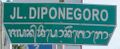 Street sign in Singaraja, written in Latin and Balinese script
 -
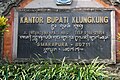 Klungkung Regent's Office sign
 -
 A date in Latin and Balinese script


References
[edit]- ^ a b c Everson, Michael; Suatjana, I Made (2005-01-23). "N2908: Proposal for encoding the Balinese script in the UCS" (PDF). Retrieved 2016-09-09.
- ^ a b Kuipers, Joel (2003). Indic Scripts of Insular Southeast Asia: Changing Structures and Functions Archived 2014-05-14 at the Wayback Machine. Tokyo: Tokyo University of Foreign Studies.
- ^ Fox, Richard (2013). Rival Styles of Writing, Rival Styles of Practical Reasoning. Heidelberg: Institut für Ehtnologie.
- ^ Damais, Louis-Charles (1960). "I. Études sino-indonésiennes". Bulletin de l'École Française d'Extrême-Orient. 50 (1): 1–35. doi:10.3406/befeo.1960.1515. ISSN 0336-1519.
- ^ Haer, p. 275
- ^ A short history of Bali by Robert Pringle p. 46
- ^ The people of Bali Angela Hobart p. 141
- ^ Louis-Charles Damais (1947) Études balinaises: I. La colonnette de Sanur p. 127
- ^ Louis-Charles Damais (1959) "Ouvrages d'Études Indonésiennes", Bulletin de l'École Française d'Extrême-Orient, 49, 2, pp. 685-686.
- ^ Ida Bagus Adi Sudewa (14 May 2003). "The Balinese Alphabet, v0.6". Yayasan Bali Galang. Archived from the original on 10 June 2015. Retrieved 9 November 2013.
- ^ Richard Ishida (2012). "Balinese Script Notes". Archived from the original on May 22, 2014. Retrieved 22 May 2014.
- ^ Tinggen, p. 16
- ^ Tinggen, p. 27
- ^ a b Tinggen, I Nengah (1994). Pedoman Perubahan Ejaan Bahasa Bali dengan Huruf Latin dan Huruf Bali. Singaraja: Rikha.
- ^ a b c Pedoman Pasang Aksara Bali. Denpasar: Dinas Kebudayaan Provinsi Bali. 1997.
- ^ Ishida, Richard. "Balinese script notes". Archived from the original on May 22, 2014. Retrieved 24 March 2016.
- ^ Tinggen, I Nengah (1994). Celah-Celah Kunci Aksara Bali (1 ed.). Singaraja: Rhika.
- ^ a b c "Sasak language, alphabet and pronunciation". Omniglot. Retrieved 2020-11-25.
- ^ a b c d e f g h i "Bringing Balinese to iOS". Norbert's Corner. Retrieved 24 March 2016.
- ^ a b c "Aksara Bali". Bali Galang Foundation. Retrieved 24 March 2016.
- ^ "Noto Sans Balinese". Google Noto Font. Retrieved 24 March 2016.
- ^ "OHCHR |". www.ohchr.org. Retrieved 2020-03-21.
Further reading
[edit]- Surada, I Made (2007). Kamus Sanskerta-Indonesia. Surabaya: Penerbit Paramitha.
- Simpen, I Wayan. Pasang Aksara Bali. Bali: Dinas Pendidikan dan Kebudayaan Provinsi Daerah Tingkat I.
External links
[edit]
- Outline of Balines script Archived 2020-07-28 at the Wayback Machine at BASAbali.org
- Entry on Balinese at Omniglot.com -- A guide to writing systems
- Computerization of Balinese Script
- Balinese character picker
- Balinese script converter