


Notting Hill Gate tube station
Notting Hill Gate  | |
|---|---|
 Entrance through a subway | |
  Notting Hill Gate Location of Notting Hill Gate in Central London | |
| Location | Notting Hill |
| Local authority | Royal Borough of Kensington and Chelsea |
| Managed by | London Underground |
| Owner | Transport for London |
| Station code | NHG[1] |
| Number of platforms | 4 |
| Fare zone | 1 and 2 |
| London Underground annual entry and exit | |
| 2018 |  14.95 million[2] 14.95 million[2] |
| 2019 |  15.07 million[3] 15.07 million[3] |
| 2020 | 5.68 million[4] |
| 2021 | 6.40 million[5] |
| 2022 | 11.69 million[6] |
| Key dates | |
| 1 October 1868 | Opened (MR) |
| 30 July 1900 | Opened (CLR) |
| 1 March 1959 | Combined Station Opened |
| Other information | |
| External links |
|
| Coordinates | 51°30′32″N 0°11′49″W / 51.509°N 0.197°W |
 London transport portal London transport portal | |
Notting Hill Gate is a London Underground station near Notting Hill, London, located on the street called Notting Hill Gate. On the Central line, it is between Holland Park to the west and Queensway to the east. On the District line and Circle line, it is between High Street Kensington and Bayswater stations. It is on the boundary of Travelcard Zone 1 and Zone 2.
History[edit]
The sub-surface Circle and District line platforms were opened on 1 October 1868 by the Metropolitan Railway (MR) as part of its extension from Paddington to Gloucester Road. The Central line platforms were opened on 30 July 1900 by the Central London Railway (CLR). Entrances to the two sets of platforms were originally via separate station buildings on opposite sides of the road; access to the CLR platforms was originally via lifts.
The station name Notting Hill Gate had potential for confusion with the MR station to the north in Ladbroke Grove which was known as "Notting Hill" when opened in 1864, and renamed "Notting Hill & Ladbroke Grove" in 1880. This latter station eventually, in 1919, dropped its reference to Notting Hill, becoming "Ladbroke Grove (North Kensington)" in 1919 and, simply, "Ladbroke Grove" in 1938 (see Ladbroke Grove Underground station).
On the Circle and District lines Notting Hill Gate is a cut and cover station still covered with a glass roof, despite many other similar stations having lost theirs.[7]
Redevelopment[edit]
The station was rebuilt in the late 1950s and reopened on 1 March 1959, now linking the two 'Notting Hill Gate stations' on the Circle and District and Central lines, which had previously been accessed on either side of the street, with a shared sub-surface ticket hall and escalators down to the deeper Central line, replacing the aged and now sealed-off lifts. The escalators were the first on the Underground to have metal side panels rather than wooden. The new entrance also acts as a pedestrian subway under the widened Notting Hill Gate. The mosaic columns at the southern entrance were created in 2006 by local public art organisation Urban Eye.
Refurbishment[edit]
The station was refurbished from 2010 to 2011, with new ceramic tiling throughout the subway entrances, deep-level passageways and Central line tube platforms as well as a modified ticket hall layout.
During the refurbishment works an abandoned lift passageway from the original 1900 CLR station, closed to the public after Notting Hill Gate was last upgraded in 1959, was rediscovered and found to contain a series of original posters dating from the late 1950s. Images have been posted online.[8]
A scheme was developed by the architects Weston Williamson to provide canopies over the entrances from the street,[9] but this has not been implemented.
.jpg)
Nearby places[edit]
Media appearances[edit]
In the 1968 film Otley, one of the Central line platforms at Notting Hill Gate (or a station pretending to be it) is where the assassin and coach driver Johnston, played by Leonard Rossiter, blows himself up opening a booby-trapped suitcase full of money.
The station and its staff featured prominently in the third episode of BBC Two documentary series The Tube, which first aired on 5 March 2012.
Layout[edit]
The westbound Central line platform is located above the eastbound platform because when the CLR was built it did not want to tunnel under buildings, and the street above was not wide enough for the two platforms to be side by side.
Connections[edit]
London Buses day and night routes serve the station, as well as Oxford Tube coaches.
Gallery[edit]

-
 District & Circle line platforms (September 2006)
 -
 Roof over District & Circle line platforms
 -
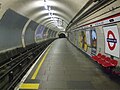 Eastbound Central line platform looking west before refurbishment
 -
 Historical picture of Central line platform (1902)


References[edit]
- ^ "Station Codes" (PDF). Transport for London. Retrieved 25 April 2021.
- ^ "Station Usage Data" (CSV). Usage Statistics for London Stations, 2018. Transport for London. 23 September 2020. Archived from the original on 14 January 2023. Retrieved 11 October 2023.
- ^ "Station Usage Data" (XLSX). Usage Statistics for London Stations, 2019. Transport for London. 23 September 2020. Archived from the original on 9 November 2020. Retrieved 9 November 2020.
- ^ "Station Usage Data" (XLSX). Usage Statistics for London Stations, 2020. Transport for London. 16 April 2021. Retrieved 1 January 2022.
- ^ "Station Usage Data" (XLSX). Usage Statistics for London Stations, 2021. Transport for London. 12 July 2022. Retrieved 7 September 2022.
- ^ "Station Usage Data" (XLSX). Usage Statistics for London Stations, 2022. Transport for London. 4 October 2023. Retrieved 10 October 2023.
- ^ Martin, Andrew (2013). Underground Overground: A Passenger's History of the Tube. London: Profile Books. p. 31. ISBN 978-1846684784.
- ^ "Urban Ghosts Media is coming soon".
- ^ "London Underground Entrance Canopies". Weston Williamson Architects. Archived from the original on 9 September 2011. Retrieved 28 April 2011.
External links[edit]
| Preceding station |  London Underground London Underground
|
Following station | ||
|---|---|---|---|---|
| Holland Park towards Ealing Broadway or West Ruislip
|
Central line | Queensway | ||
| High Street Kensington towards Hammersmith via Tower Hill
|
Circle line | Bayswater towards Edgware Road
| ||
| High Street Kensington towards Wimbledon
|
District line Edgware Road branch
|
|||
| Stations |
| ||||||||||||||
|---|---|---|---|---|---|---|---|---|---|---|---|---|---|---|---|
| Rolling stock | |||||||||||||||
| History |
| ||||||||||||||
| Proposed stations | |||||||||||||||
| Depots | |||||||||||||||


| Stations |
| ||||||
|---|---|---|---|---|---|---|---|
| Rolling stock | |||||||
| History |
| ||||||
| See also | |||||||

- Rail transport stations in London fare zone 1
- Rail transport stations in London fare zone 2
- Circle line (London Underground) stations
- District line stations
- Central line (London Underground) stations
- London Underground Night Tube stations
- Tube stations in the Royal Borough of Kensington and Chelsea
- Former Metropolitan Railway stations
- Railway stations in Great Britain opened in 1868
- Former Central London Railway stations
- Railway stations in Great Britain opened in 1900
- Buildings and structures in Notting Hill