


Royal Thai Police
| Royal Thai Police สำนักงานตำรวจแห่งชาติ | |
|---|---|
 Official Seal | |
.svg) Coat of Arms (cap badge) | |
 Flag of the Royal Thai Police | |
| Abbreviation | RTP |
| Agency overview | |
| Formed | 1860 (164 years) |
| Jurisdictional structure | |
| National agency | Thailand |
| Operations jurisdiction | Thailand |
| General nature | |
| Operational structure | |
| Headquarters | Pathum Wan, Bangkok, Thailand |
| Police officers | 230,000[1][2] |
| Minister responsible |
|
| Agency executive |
|
| Bureaus | 12
|
| Regional Bureaus | 9
|
| Website | |
| www | |
The Royal Thai Police (RTP) (Thai: สำนักงานตำรวจแห่งชาติ; RTGS: samnakngan tamruat haeng chat) is the national police force of Thailand. The RTP employs between 210,700 and 230,000 officers, roughly 17 percent of all civil servants (excluding the military and the employees of state-owned enterprises).[2][3] The RTP is frequently recognized as the fourth armed force of Thailand since their tradition, concept, culture, skill, and training are relatively similar to the army and most of their officer cadets need to graduate from the Armed Forces Academies Preparatory School before entering the Royal Thai Police Cadet Academy. Officers also undergo paramilitary training similar to the army but with an additional focus on law enforcement.
On 20 March 2024, Kitrat Panphet became acting police chief; however, Torsak Sukvimol is still the police chief while having been transferred to an inactive post at the primeminister's office; on the day of the transfer, Torsak Sukvimol was in a meeting with the prime minister.[4] As of 21 March, Police General Winai Thongsong "said [...] that he still could not confirm if the investigation would finish within the assigned 60 days or before the retirement of" Torsak Sukvimol in September.[5]
History[edit]


Until the 19th century Royal Thai Armed Forces personnel, aside from their duties of national defence, also performed law enforcement duties alongside dedicated civil servants. Responsibility for law and order was divided into the six ministries led by chancellors of state (during the Ayutthaya and Thonburi eras); in time of war, police units were under royal command as part of the army. Only during the reigns of King Mongkut (Rama IV) and King Chulalongkorn (Rama V) did the nation see a huge reform and the Westernization of Thai law enforcement forces to adapt to the changing situation and needs of the country. By 1902, the Royal Police Cadet Academy (RPCA)[6] was founded to train future police officers. In the same year, King Chulalongkorn granted the Police its own symbol using the Phra Saeng sword (พระแสงดาบ) and the all evil-warding Chaturmuk (จตุรมุข) shield.[7] In 1915 the provincial and urban police forces were united as one national organization under the Ministry of Interior (established 1894).[8]
Primary responsibility for the maintenance of public order through enforcement of the kingdom's laws was exercised by the Thailand National Police Department (TNPD), a subdivision of the Interior Ministry. Charged with performing police functions throughout the entire country, the TNPD was a unitary agency whose power and influence in Thai national life had at times rivaled that of the armed forces itself.
The formal functions of the TNPD included more than the enforcement of laws and apprehension of offenders. The department also played an important role in the government's efforts to suppress the remnants of the communist insurgency. In the event of an invasion by external forces, much of the police force would come under the control of the Ministry of Defense to serve with, but not be incorporated into, the military forces.[citation needed]
Originally modeled on the pre–World War II national police force of Japan, the TNPD was reorganized several times to meet changing public order and internal security needs. American advice, training, and equipment, which were provided from 1951 through the early 1970s, did much to introduce new law enforcement concepts and practices and to aid in the modernization of the TNPD. During this era the strength and effectiveness of the police grew steadily.
All components of the police system were administered by the TNPD headquarters in Bangkok, which also provided technical support for law enforcement activities throughout the kingdom. The major operational units of the force were the Provincial Police, the Border Patrol Police (BPP), the Metropolitan Police, and smaller specialized units supervised by the Central Investigation Bureau.
In mid-1987 the total strength of the TNPD, including administrative and support personnel, was estimated at roughly 110,000. Of this number, over one-half were assigned to the Provincial Police and some 40,000 to the BPP. More than 10,000 served in the Metropolitan Police. Quasi-military in character, the TNPD was headed by a director general, who held the rank of police general. He was assisted by three deputy directors general and five assistant directors general, all of whom held the rank of police lieutenant general. Throughout the TNPD system, all ranks except the lowest (constable) corresponded to those of the army. The proliferation of high ranks in the TNPD organizational structure, as in the military, indicated the political impact of the police on national life.[citation needed]
In 1998, TNPD was transferred from the Ministry of Interior of Thailand to be directly under the Office of the Prime Minister. It acquired a new name, in English, the "Royal Thai Police" (RTP). The title of its commander was changed from "Director-General of the TNPD" to "Commissioner-General of the Royal Thai Police".[9][10]
Personnel[edit]

Thailand's police forces number about 230,000 officers. About eight percent (18,400) are female.[11] For comparison, in the Philippines the percentage of female police officers is 20 percent, 18 percent in Malaysia, and 30 percent in Sweden which hold the world's highest percentage of female police officers. [12] Of 8,000 investigators with the RTP, 400 are women.[13]
Females were first admitted to the Royal Police Cadet Academy (RPCA), founded in 1901, in 2009. It has since graduated about 700 female officers.[11] Starting with the class to be admitted for the 2019 academic year, the 280 places formerly reserved for females will be scrapped.[12][14][15] Earlier in 2018, the RTP prohibited women from "inquiry official" roles. The rationale given was that women are hindered by domestic responsibilities, therefore less effective than male officers.[11] Women will still be able to become police officers via other avenues. For example, women with law degrees will continue to be recruited.[11]
National police chief Chakthip Chaijinda attributed the barring of women from the RPCA to a new Ministry of Defence ruling that all RPCA cadets must undergo an initial period of training at the male-only Armed Forces Academies Preparatory School (AFAPS).[11] Critics say the new policy violates the 2015 Gender Equality Act,[16] the constitution, Thailand's 20 year national strategy, as well as international conventions that prohibit gender discrimination.[11][17]
Organization[edit]
The Thai police are subdivided into several regions and services, each wielding their own powers.
Metropolitan Police Bureau[edit]


Responsible for providing all law enforcement services for the capital city of Bangkok and its suburbs, the Metropolitan Police Bureau is probably the most visible and publicly recognizable of all Thai police components. This largely uniformed urban force operates under the command of a chief who holds the rank of police lieutenant general assisted by six deputy chiefs. Organizationally, the force consists of three divisions, each responsible for police services in one of the three urban areas: northern Bangkok, southern Bangkok, and Thonburi. As of 2019[update], there are 88 police stations across the capital, each with 30-200 police officers attached to it.[18] In addition to covering the city with foot patrols, the Metropolitan Police maintains motorized units, a canine corps, building guards, traffic-control specialists, and law enforcement personnel trained to deal with juveniles. The Traffic Police Division also provides escorts and guards of honor for the king and visiting dignitaries and served as a riot-control force to prevent demonstrations and to disperse unruly crowds in Bangkok.[citation needed]
- Traffic Police Division, The Traffic Police Division (TPD) got its start in 1927 as the "Registration Division". TPD officers now are responsible for patrolling the roads throughout their areas of responsibility. In addition to their general road policing duties, they work to improve road safety, and deal with vehicle crimes and the criminal use of the road network. They back up other units as they are constantly roaming as part of their patrolling duties.[19]
- Patrol and Special operation Division (191 Special Branch police), Patrol and Special operation Division is a direct commander of Arintharat 26 Special Operations Unit.
- Protection and Crowds Control Division (PCCD) got its start in 2009. PCCD has a mission to offer protection and security to the King, the Queen, the royal family, royal representative visitor's and with a crowd control mission.
Border Patrol Police Bureau[edit]

A 40,000 person paramilitary force. The BPP and the PARU were largely creations of the US CIA. In the late-1950s and 1960s, "The BPP and PARU were integral in U.S. and Thai counterinsurgency efforts." The BPP, other than protecting the borders, countered "infiltration and subversion..." and operated "as guerrilla forces in enemy held areas" such as northeast and southern Thailand. The PARU was a small unit used on clandestine missions outside Thailand.[20]: 51
Central Investigation Bureau[edit]

The national coordinating headquarters has jurisdiction over the entire country. The CIB was organized to assist both provincial and metropolitan components of the Royal Thai Police in preventing and suppressing criminal activity and in minimizing threats to national security.
Divisions under Central Investigation Bureau[edit]
- Specialized units of the bureau, including the railroad, marine, highway, technology police, economic police and forestry police, who employ up-to-date technical equipment, law enforcement techniques, and training.[21]
- Five other divisions and offices employed modern procedures to assist in investigating and preventing crime.
- The Crime Suppression Division (CSD) (Thai: กองบังคับการปราบปราม; RTGS: kong bang khap kan prappram ), one of the bureau's largest components, is responsible for conducting most of the technical investigations of criminal offenses throughout the kingdom. Its emergency unit copes with riots and other public disorders, sabotage, counterfeiting, fraud, illegal gambling operations, narcotics trafficking, and the activities of secret societies, and organized criminal associations. It is responsible for cases involving politics, notably elections.[22]
- Special Service Division (SSD) (Thai: กองบังคับการปฏิบัติการพิเศษ; RTGS: kong bang khap kan patibutkan piset ), In October 2018, a new police unit, whose job it is to protect the monarchy, the "Special Service Division", was formed. The 1,600 man unit is to provide security to the royal family and to collect information on "individuals or groups whose behaviors pose a threat to the national security and His Majesty the King." The unit is also charged with carrying out the king's "royal wishes".[23] On 28 January 2019, the unit's name was changed to "Ratchawallop Police Retainers, King's Guard 904". Its jurisdiction will extend to the entire country.[24] On July 2020, the unit's change the name back to the "Special Service Division" and increase the authority to Counter-Terrorism, Resisting sabotage, riot control and bomb disposal in the area around the royal court.[25][26]
- The Criminal Records Office collects and maintains records required in the conduct of police work, including dossiers and fingerprints of known criminals and persons suspected of wrongdoing.
- The Scientific Crime Detection Laboratory, where technicians perform the requisite chemical and physical analyses.
- Licenses Division: registered and licensed firearms, vehicles, gambling establishments, and various other items and enterprises as required by law.
Immigration Bureau[edit]
The Immigration Bureau is responsible for issuing travel visas and managing entry and departure in Thailand. The Immigration Police are a frequent target of criticism from expatriates who decry slow service, inconsistent application of regulations, and excessive filing of paper forms.[27] Referring to just one of scores of immigration forms, the TM6 Arrival-Departure Card, Kobsak Pootrakool, deputy secretary-general to the prime minister, admitted that, "The immigration police have to have a huge warehouse to store these papers," Kobsak said, adding that the police rarely look at the information in the forms, which are only stored "just in case". The government expects a 20 million visitors to Thailand this year, each required to complete a TM6 form. The form will be replaced by mobile phone app in 2019.[28]
Narcotics Suppression Bureau[edit]
Narcotics Suppression Bureau is the lead agency for counter-narcotics investigations in Thailand.
Office of Logistics[edit]
Thai Police Aviation division[edit]

.jpg)
The RTP operates 9 fixed wing and 54 rotary-wing aircraft:[29]
|
Office of the Surgeon General[edit]
Responsible for medical and healthcare-related services for the police, including forensic science and autopsies. It is headquartered at Police General Hospital in Pathum Wan District, Bangkok and operates Dara Rasmi Hospital in Chiang Mai, Nawutti Somdet Ya Hospital in Bangkok and Yala Sirirattanarak Hospital in Yala. It also operates the Institute of Forensic Science which trains a number of residents in forensic science each year.
Provincial Police division[edit]

The Provincial Police form the largest of the Royal Thai Police operational components in both personnel and geographic responsibility. It is headed by a commander who reported to the police commissioner-general, and administered through four police regions—geographic areas of responsibility similar to those of the army regional commands. This force provides police services to every town and village throughout the kingdom except metropolitan Bangkok and border areas. The Provincial Police thus handled law enforcement activities and in many cases was the principal representative of the central government's authority in much of the country.
During the 1960s and early-1970s, as the police assumed an increasing role in counterinsurgency operations, a lack of coordination among security forces operating in the rural areas became apparent. Observers noted that the overall police effort suffered because of conflicting organizational patterns and the highly centralized control system that required decisions on most matters to emanate from the various police bureaus of the (then) TNPD headquarters in Bangkok.
A reorganization of the TNPD in 1978 and 1979 gave more command authority to the four police lieutenant generals who served as regional commissioners of the Provincial Police. Thereafter, the senior officers of each region not only controlled all provincial police assigned to their respective geographic areas but also directed the railroad, highway, marine, and forestry police units operating there, without going through the chain of command to the Central Investigation Bureau in Bangkok. Although this change increased the workload of the regional headquarters, it resulted in greater efficiency and improved law enforcement.
The Provincial Police Division is divided into 10 regions covering the 76 provinces of Thailand except metropolitan Bangkok and the border areas:
|
|
Police Education Bureau[edit]
The RTP Education Bureau is responsible for training police personnel in the latest methods of law enforcement and the use of modern weapons. It operates the Royal Police Cadet Academy in Sam Phran District, Nakhon Pathom Province, for the officer corps, the detective training school at Bang Kaen, the Metropolitan Police Training School at Bang Kaen, and the Provincial Police training centers at Nakhon Pathom, Lampang, Nakhon Ratchasima, and Yala. The bureau also supervises a number of sites established and staffed by the BPP to train its field platoons in counterinsurgency operations. These sites include a large national facility near Hua Hin and smaller facilities in Udon Thani, Ubon Ratchathani, Chiang Mai, and Songkhla.
Special Branch Bureau[edit]
Special Branch Bureau is a Special Branch — sometimes referred to by critics as the "political police", is responsible for controlling subversive activities and serves as the Thai Police's major intelligence organization, as well as the unit responsible for VIP protection.
Tourist Police Bureau[edit]

Tourist Police Bureau was elevated from the Tourist Police Division under Central Investigation Bureau in 2017. The creation of the Tourist Police is due to the fact that the tourism and entertainment industry in Thailand is growing every year, and the number of people arriving in the country is constantly increasing. The priorities of the Tourist Police include cooperation with foreign nationals and the promotion of their security.[32]
According to Reuters correspondent, Andrew Marshall, "The country has a special force of Tourist Police, set up specifically so that foreigners have as little contact as possible with the ordinary police—the effect on the crucial tourism industry would be chilling."[33]
According to one source, in 2017 there were 1,700 enlisted tourist police on the force.[34] As of 2019[update] the agency has 2,000 officers and 70 tourist police cars for use nationwide.[35]
Transportation[edit]
As of 2023[update], the RTP has a fleet of some 62 aircraft including a six passenger, 1.14 billion baht (US$37 million) police jet, a Dassault Falcon 2000S.[36]
The Royal Thai Police, especially the provincial forces, extensively uses pickup trucks and SUVs. For traffic regulation and patrolling in cities, sedans and motorcycles are also used. Highway police vehicles generally also have equipment like speed radars, breath analyzers, and emergency first aid kits. They also use tuk-tuks, minivans, bicycles, all-terrain vehicles, boats, and helicopters.[citation needed] As of April 2020[update], the RTP operate seven leased[37] electric patrol cars used to protect "VVIPs". "They will replace the Mercedes-Benz A Class and will be used in the government's VVIP's motorcade", a spokesman explained.[38]
Royal Thai Police vehicle colors vary widely according to grade, region, and kind of duty performed. Bangkok metropolitan police vehicles are black and white. Provincial police vehicles are maroon and white while highway police are maroon and yellow.
Firearms[edit]
There are no standard-issue pistols carried by the Royal Thai Police. Policemen must buy their own pistol and he/she must buy what is available in Thailand and what he/she can afford. If the police officer cannot afford a pistol, he may purchase one by paying in installments through his police co-operative.
One of the most popular police pistols is the M1911A1 .45 ACP pistol which can be found readily and relatively cheaply in Thailand. The 9 mm Glock 19 9mm parabellum is another popular, albeit more expensive, choice.
In mid-2015, Pol Gen Somyot Phumphanmuang, Royal Thai Police Commissioner, initiated a program to allow officers to purchase US-made, 9 mm SIG Sauer P320 pistols[39] for 18,000 baht each. The Thai market price for this gun is several times higher. The affordable price is made possible by a special police exemption from import quotas and import duties.[40][41] In December 2017, 150,000 SIG Sauer P320SP pistols became available for purchase by police for 23,890 baht each. The RTP will, in addition, distribute 55,000 of the new pistols to police stations nationwide, each station receiving 60.[42]
Although the RTP does not issue pistols, long guns are made available by the government. Common are the Heckler & Koch MP5 and FN P90 sub-machine guns, Remington 870 shotguns, the M4 carbine, and M16 rifles.
| Photo | Model | Type | Caliber | Origin | Notes | |
|---|---|---|---|---|---|---|
| Pistols | ||||||
 |
M1911 | Semi-automatic pistol | .45 ACP |  US US Thailand Thailand |
Thai M1911A1 pistols produced under license; locally known as the Type 86 pistol (ปพ.86). | |
_modified.png) |
Heckler & Koch USP | Semi-automatic pistol | .45 ACP |  Germany Germany |
Used by Arintharat 26 Special Operation Unit and Naresuan 261 Special Operation Unit | |
| HS2000 | Semi-automatic pistol | 9×19 mm Parabellum |  Croatia Croatia |
Used by Arintharat 26 Special Operation Unit and Naresuan 261 Special Operation Unit[43] | ||
 |
CZ 75 | Semi-automatic pistol | 9×19 mm Parabellum |  Czech Republic Czech Republic |
||
 |
Beretta 92 | Semi-automatic pistol | 9×19 mm Parabellum |  Italy Italy |
Mostly use by metropolitan police and police traffic | |
 |
Beretta M1951 | Semi-automatic pistol | 9×19 mm Parabellum | Italy |
||
 |
Beretta Px4 Storm | Semi-automatic pistol | 9×19 mm Parabellum | Italy |
Used by Arintharat 26 Special Operation Unit and Naresuan 261 Special Operation Unit | |
.jpg) |
Browning Hi-Power[44] | Semi-automatic pistol | 9×19 mm Parabellum |  Belgium Belgium |
||
 |
SIG Sauer P226[44] | Semi-automatic pistol | 9×19 mm Parabellum | Germany |
Used by Arintharat 26 Special Operation Unit and Naresuan 261 Special Operation Unit | |
 |
SIG Sauer P320SP | Semi-automatic pistol | 9×19 mm Parabellum | United States |
Standard service pistol | |
 |
Smith & Wesson Model 60 | Revolver | .38 Special | United States |
||
 |
Colt Python | Revolver | .357 Magnum | United States |
||
 |
Smith & Wesson Model 15 | Revolver | .38 Special | United States |
||
 |
Smith & Wesson Model 19 | Revolver | .357 Magnum | United States |
||
.jpg) |
Glock 17/Glock 19[44] | Semi-automatic pistol | 9×19 mm Parabellum |  Austria Austria |
At least 2,238 G19
Used by Arintharat 26 Special Operation Unit and Naresuan 261 Special Operation Unit The Glock 19MS and the SIG P320SP are the standard service pistols. | |
 |
FN Five-seven | Semi-automatic pistol | FN 5.7×28 mm | Belgium |
||
| Shotguns | ||||||
 |
Remington Model 870 | Shotgun | 12 gauge | USA |
Used by Arintharat 26 Special Operation Unit and Naresuan 261 Special Operation Unit | |
 |
Mossberg 500 | Shotgun | 12 gauge | USA |
||
 |
Franchi SPAS-12 | Shotgun | 12 gauge | Italy |
Used by Arintharat 26 Special Operation Unit and Naresuan 261 Special Operation Unit | |
| Submachine guns | ||||||
 |
Heckler & Koch MP5 | Submachine gun | 9×19 mm Parabellum | Germany |
Used by Arintharat 26 Special Operation Unit and Naresuan 261 Special Operation Unit | |
 |
Heckler & Koch UMP | Submachine gun | 9×19 mm Parabellum | Germany |
Used by Arintharat 26 Special Operation Unit and Naresuan 261 Special Operation Unit | |
 |
Heckler & Koch MP7 | Submachine gun | HK 4.6×30 mm | Germany |
Used by Arintharat 26 Special Operation Unit and Naresuan 261 Special Operation Unit | |
 |
SIG Sauer MPX | Submachine gun | 9×19 mm Parabellum | United States |
Used by Arintharat 26 Special Operation Unit and Naresuan 261 Special Operation Unit | |
 |
FN P90 | Submachine gun | 5.7x28 mm | Belgium |
Used by Arintharat 26 Special Operation Unit and Naresuan 261 Special Operation Unit | |
 |
UZI | Submachine gun | 9×19 mm Parabellum |  Israel Israel |
Used by Arintharat 26 Special Operation Unit and Naresuan 261 Special Operation Unit | |
 |
KRISS Vector | Submachine gun | 9×19 mm Parabellum | US |
Used by Arintharat 26 Special Operation Unit and Naresuan 261 Special Operation Unit | |
 |
CZ Scorpion Evo 3 | Submachine gun | 9×19 mm Parabellum | Czech Republic |
Used by police units | |
| Assault rifles | ||||||
 |
M16 | Assault rifle | 5.56×45 mm NATO | US |
To be replaced by M4 carbines | |
 |
M4 Carbine | Assault rifle | 5.56×45 mm NATO | US |
M4, M4A1, M4A3 | |
 |
FN FAL | Battle Rifle | 7.62×51 mm NATO | Belgium |
To be replaced by M4 carbines | |
Uniforms[edit]
Royal Thai Police uniforms vary widely according to rank, region, and kind of duty performed. Among the police, uniforms tend to resemble army dress rather than conventional police uniforms.
Considered part of the police "uniform", all male officers are required to shave the sides and back of their heads, leaving a short crop of hair on the top, hence its common name, (Thai: ขาวสามด้าน; RTGS: khao sam dan), or 'three white sides'. The models for the haircut are the royal guards who protect King Vajiralongkorn. They are known for their short haircuts, required by the monarch. "It's a royal practice," a retired police general said. "...we are all serving His Majesty the King...It looks beautiful...It doesn't hurt anyone."[45]
-
 A helmet for traffic police in Bangkok, Thailand August 31, 2010.
 -
 Police peaked caps of Royal Thai Police.
 -
 Royal Thai Police white normal dress uniform
 -
 Royal Thai Police grey full dress uniform
 -
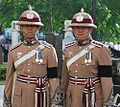 Thai Commissioned Officer kraki full dress uniform
 -
 Royal Thai Police officer uniform
 -
 Border Patrol Police field uniform
 -
 Police EOD uniform
 -
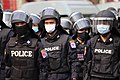 PCCD Riot Control uniform

.JPG)
.jpg)


.JPG)
.jpg)

Rank structure[edit]
Officers[edit]
| NATO Code | OF-10 | OF-9 | OF-8 | OF-7 | OF-6 | OF-5 | OF-4 | OF-3 | OF-2 | OF-1 | Student Officer | ||
|---|---|---|---|---|---|---|---|---|---|---|---|---|---|
.svg)
|
.svg)
|
.svg)
|
.svg)
|
.svg)
|
.svg)
|
.svg)
|
.svg)
|
.svg)
|
.svg)
|
ร ๑ or ๒ or ๓ or ๔ | |||
| Thai title | พลตำรวจเอก | พลตำรวจโท | พลตำรวจตรี | พลตำรวจจัตวา | พันตำรวจเอก | พันตำรวจโท | พันตำรวจตรี | ร้อยตำรวจเอก | ร้อยตำรวจโท | ร้อยตำรวจตรี | นักเรียนนายร้อยตำรวจ | ||
| RTGS | Phon Tam Ruad Ek | Phon Tam Ruad Tho | Phon Tam Ruad Tri | Phon Tam Ruad Jattawa | Phan Tam Ruad Ek | Phan Tam Ruad Tho | Phan Tam Ruad Tri | Roi Tam Ruad Ek | Roi Tam Ruad Tho | Roi Tam Ruad Tri | Nak Rian Nai Roi Tam Ruad | ||
| Abbreviation[46] | พล.ต.อ. | พล.ต.ท. | พล.ต.ต. | พล.ต.จ. | พ.ต.อ. | พ.ต.ท. | พ.ต.ต. | ร.ต.อ. | ร.ต.ท. | ร.ต.ต. | นรต. | ||
| Anglicised version | Police General | Police Lieutenant General | Police Major General | Police Brigadier General (no longer used) (replaced by police senior colonel) |
Police Colonel | Police Lieutenant Colonel | Police Major | Police Captain | Police Lieutenant | Police Sub Lieutenant | Police Cadet Officer | ||
| UK equivalent (Military/Police) | General Commissioner |
Lieutenant General Deputy Commissioner |
Major General Assistant Commissioner |
Brigadier Commander |
Colonel Chief Superintendent |
Lieutenant Colonel Divisional Superintendent |
Major Superintendent |
Captain Chief Inspector |
Lieutenant Inspector |
Second Lieutenant Subdivisional Inspector |
Officer Cadet | ||
Non-commissioned officers[edit]
| Constable ranks | .svg)
|
.svg)
|
.svg)
|
.svg)
|
.svg)
|
No Insignia |
| ดาบตำรวจ | จ่าสิบตำรวจ | สิบตำรวจเอก | สิบตำรวจโท | สิบตำรวจตรี | พลตำรวจ | |
| Dahb Tam Ruad | Cha Sip Tam Ruad | Sip Tam Ruad Ek | Sip Tam Ruad Tho | Sip Tam Ruad Tri | Phon Tam Ruad | |
| Police Sergeant Major | Police Staff Sergeant | Police Sergeant | Police Corporal | Police Lance Corporal | Police Constable | |
| NATO Code | OR-9 or OR-8 | OR-7 or OR-6 | OR-5 | OR-4 | OR-3 | OR-1 |
Notable police chiefs[edit]
- Phao Sriyanond (also "Pao Sriyanond") was Director General of Thailand's national police from 1951 to 1957.
- Sarit Thanarat was Director General of Thailand's national police from 1959 to 1963.
- Praphas Charusathien was Director General of Thailand's national police from 1963 to 1973.
- Pao Sarasin was Director General of Thailand's national police from 1987 to 1989.
- Pratin Santiprapop was Director General of the Royal Thai Police from 1994 to 1994.
- Isarapong Noonpakdee was Director General of the Royal Thai Police in 1992.
- Poj Boonyajinda was Director General of the Royal Thai Police from 1994 to 1997.
- Pracha Promnok was the last Director General of the Royal Thai Police from 1997 to 1998 and the first Commissioner-General of the Royal Thai Police from 1998 to 2000.
- Sant Prabhawat was Commissioner-General of the Royal Thai Police from 2001 to 2004.
- Kowit Wattana was Commissioner-General of the Royal Thai Police from 2004 to 2007 and was reinstated as Commissioner-General of the Royal Thai Police from September 10, 2007 to September 30, 2007 (his mandatory retirement). He was the first commissioner who came from Border Patrol Police.[47]
- Sereepisuth Temeeyaves was Commissioner-General of the Royal Thai Police starting from October 1, 2007 to April 2008.[48][49] Appointed Police Commissioner of Thailand by a military junta government. As a police officer he gained a reputation for targeting mafia leaders.[50] He was removed from office in April 2008 by the elected government of Samak Sundaravej under charges of corruption.[49] His supporters, however, claim that these charges are put-up jobs to punish him for prosecuting many cases against the militarily deposed former premier Thaksin Shinawatra.
- Somyot Poompanmoung was Commissioner-General of the Royal Thai Police from 2014 to 2015.
- Chakthip Chaijinda was the longest-serving Commissioner-General of the Royal Thai Police from 2015 to 2020.
- Suwat Jangyodsuk was Commissioner-General of the Royal Thai Police from 2020 until his retirement in 2022.
Controversies[edit]
Police-Army rivalry[edit]
Clashes between the police and army bureaucracies date back at least as far as 1936 and continue to the present day.[51] The intensity of the infighting has waxed and waned over the years. Since 1947, according to academic Paul Chambers, "...the army has time and again attempted to rein in the police. In many cases, it has resorted to coups."[51] In the 1950s, the rivalry took a comical turn as an arms race developed between the army—supplied by the US military—and the RTP—supplied by the US Central Intelligence Agency (CIA).[52] The vitriol intensified in 2016 when, following the 2014 Thai coup d'état, the junta moved to impose army control over the police for once and for all by giving soldiers power over police.[51]
On 29 March 2016, in a move that the Bangkok Post said will "...will inflict serious and long-term damage...", the NCPO, under a Section 44 order (NCPO Order 13/2559) signed by junta chief Prayut Chan-o-cha, granted to commissioned officers of the Royal Thai Armed Forces broad police powers to suppress and arrest anyone they suspect of criminal activity without a warrant and detain them secretly at almost any location without charge for up to seven days. Bank accounts can be frozen, and documents and property can be seized. Travel can be banned. Automatic immunity for military personnel has been built into the order, and there is no independent oversight or recourse in the event of abuse.[53] The decree basically deputises soldiers as police, but gives greater legal impunity to soldiers than to police.[51] The order came into immediate effect and is still in force as of 2020. The net result is that the military will have more power than the police and less oversight.[54]
The government has stated that the purpose of this order is to enable military officers to render their assistance in an effort to "...suppress organized crimes such as extortion, human trafficking, child and labor abuses, gambling, prostitution, illegal tour guide services, price collusion, and firearms. It neither aims to stifle nor intimidate dissenting voices. Defendants in such cases will go through normal judicial process, with police as the main investigator...trial[s] will be conducted in civilian courts, not military ones. Moreover, this order does not deprive the right of the defendants to file complaints against military officers who have abused their power."[55]
The NCPO said that the reason for its latest order is that there are simply not enough police, in spite of the fact that there are about 230,000 officers in the Royal Thai Police force. They make up about 17 percent of all non-military public servants. This amounts to 344 cops for every 100,000 persons in Thailand, more than twice the ratio in Myanmar and the Philippines, one and a half times that of Japan and Indonesia, and roughly the same proportion as the United States.[56]
In a joint statement released on 5 April 2016, six groups, including Human Rights Watch (HRW), Amnesty International, and the International Commission of Jurists (ICJ), condemned the move.[57]
Police corruption[edit]
On the occasion of the festivities surrounding its 12th anniversary, the Office of the Ombudsman, Thailand reported on its activities since its inception. Chief Ombudsman Panit Nitithanprapas noted that her office had handled nearly 25,000 cases during the period and observed that the Royal Thai Police had been found to be "the most corrupt agency in Thailand".[58] Curiously, Ms Panit's photo does not appear among those of other former ombudsmen on the organisation's website, nor is there any other mention of her.[59]
In the words of Jomdet Trimek, a former police officer, now an academician, "In-depth studies of the causes of...corruption tend to be avoided."[60] Jomdet attributes police corruption to two factors: a centralized police bureaucracy which gives too much power to a few; and very low police salaries. He divides police corruption into three main forms: embezzlement of government funds, coercing bribes from the public, and collection of protection money from illegal business operators and gives examples of each. At the level of constable, this petty thievery is driven by low wages: entry level salaries for police with no university education was 6,800 baht (2012). In June 2015, the Bangkok Post reported that, "Thai police officers are paid around 14,760 baht per month (6,800–8,340 baht for entry level) and have to buy their own guns and even office supplies."[61] He posits that one reason salaries are so low is that the sheer number of officers is staggering, roughly 250,000. This means that an increase of 5,000 baht in every cop's monthly salary would cost the government a politically untenable 15 billion baht annually.[60]: 51
Prime Minister Prayut Chan-o-cha appointed no-nonsense Police-General Somyot Poompanmoung head of the RTP following the coup of May 2014. Somyot, whose declared assets exceed US$11.5 million, has vowed to transfer, arrest, or prosecute all corrupt officers. But, according to Chuwit Kamolvisit, a former massage parlour magnate turned legislator, "police reform" is a never-ending mantra which never produces results. The "cash-for-jobs" culture within the police is too deep to uproot, he says, alleging that low-ranking officers earning just US$460 a month tap the public for bribes, or solicit protection money from dodgy businesses to top up their salaries and buy promotions. "Rank and status is everything in Thailand... when you are a small policeman to go up [sic], you need to have the right boss, and preferably one at a 'golden police station'– near a casino or entertainment venue", he explained.[62]
In a 2008 article, The Economist summed up their assessment succinctly: "In Thailand's most sensational crimes, the prime suspects are often the police."[63]
In August 2015, a post was made on the Sakon Nakhon Police Facebook page, allegedly from a junior officer. Among other observations the post asked, "...Are our meagre salaries enough to support our families? The answer is no. We have to borrow money and get trapped in debt. "So what about the phuyai [bigwigs]? Are they in debt too? Definitely not. They are rich. Why? Because at the end of every month, money from gambling dens, entertainment venues, the sex trade, human trafficking, drugs and whatnot are routinely sent to them." The post was immediately deleted. Then the Facebook page was deleted altogether. The supervisor of the junior policeman in charge of the page said it was all a technical mistake. Someone had hacked into the page to write the message to taint the image of the police force.[64]
In the view of Rangsit University's Associate Professor Police Lieutenant Colonel Krisanaphong Poothakool, "We hear that police reform is ongoing, but in practice, nothing is happening". He added that the country has had a couple of police reform committees, which did not amount to much when their recommendations were ignored.[65]

On 5 August 2021, the police assaulted Jeerapong Thanapat, a 24-year-old drug suspect, during an interrogation to force him to reveal hidden methamphetamines and to pay a two million baht or US$60,000 bribe for his release. The video appears to show the director of the Muang Nakhon Sawan Province police station, Thitisan Utthanaphon widely known by the nickname "Jo Ferrari", and other police officers suffocating Thanapat with plastic bags until he collapsed and died. The police reportedly ordered doctors at Sawanpracharak Hospital to write in a medical report that the cause of Jeerapong’s death was methamphetamine overdose.[66]
In 1976, Thai police, military personnel and others, were seen shooting at protesters at Thammasat University. Many were killed and many survivors were abused.[67]
Incidents[edit]
- More than 50 vendors in Ko Samui protested at their local police station on 2 April 2015 to protest rampant bribery among island police officers. The rally was sparked by the arrest of a 42-year-old woman who sold counterfeit purses near Chaweng Beach. According to her, police arrested her employee several hours after they demanded 50,000 baht to overlook the store's violation of trademark laws. The owner, Patcharee Chimthaprasert, 49, said she initially agreed to pay the bribe, but that officers later raised the price to 190,000 baht, which she was unable to afford. Four officers returned several hours later and arrested her employee, Nampueng Moongraiklang, and confiscated 28 bags as evidence, she said. After news of the arrest spread, around 50 vendors from 20 shops near Chaweng beach closed down their stores and staged a rally in front of Bo Phut Police Station. The group filed a complaint that the four police officers extorted bribes from Nampueng and other vendors in the area.[68]
- In 2009, the Thai Police and justice system on the holiday island of Phuket were accused of corruption and over-reaction by tourists visiting the island.[69] In one case an Australian woman was arrested and accused of stealing a bar mat. She spent four nights in jail and had her passport confiscated. Then she faced a wait of another 14 weeks on bail until the next phase of her prosecution. This was despite friends of hers confessing to the police that they had placed the bar mat in the woman's bag as a joke.[70] Eventually the case was resolved after the intervention of the governor of Phuket, Wichai Praisa-nob, after being contacted by Thailand's Ministry of Tourism and the Foreign Ministry. A deal was done under which she would plead guilty, be fined, and then governor Wichai Praisa-nob would pay the fine and give an apology. After this her passport was returned and she was allowed to return to Australia.[71]
- In another case an American couple was arrested upon returning to Thailand and accused of being responsible for burning down a house in which they resided on a previous stay in Phuket. The fire had previously been investigated and found to have been caused by an electrical fault. In order to recover their passports and be allowed to depart Thailand, they had to compensate the house owner and make under the table payments to the judges, the public prosecutor, and everyone down to the bailiffs in the court. This cost them around 45,000 US dollars.[72]
- In 2007 a 15-year-old Danish boy was involved in an insurance fraud when a Chinese couple threw themselves under his Jetboat killing one of them. While the court ruled the incident as an accident, the police detained the boy and held his passport until an amount of DKK300,000 had been paid so the case could be settled within weeks.[73][74]
- As a condition of being appointed to the National Legislative Council (NLC), prospective members were required to reveal their assets and liabilities. The disclosures by would-be NLC members of their assets shocked many Thais. "Police Chief Somyos Poompanmuang and his wife's net worth was revealed to about 355.8 million baht (roughly $11 million) [sic], raising questions about how a lifelong career in the public service could have made him a millionaire many times over."[75]
- It has been alleged that Thai police profit greatly from "enforcing" music copyright infringement laws. Bars and restaurants in Thailand that play recorded music are required to obtain a licence from a local copyright agency. This is supposed to protect the interests of international artists and record companies. Thailand has more music licensing companies than any other country in the world, making it confusing for business operators to figure out whom to go to if they want to obtain a licence. In cases where fees have not been paid, licensing companies work with the police to collect royalties and sometimes a bit more.[76]
- The discovery in early-May 2015 of two dozen bodies from shallow graves in the mountains of southern Thailand, a discovery that has exposed a network of jungle camps run by traffickers who allegedly held migrants captive while they extorted ransoms from their families, has seemingly galvanized Thailand into action. A total of 33 bodies, believed to be migrants from Myanmar and Bangladesh, have now been exhumed from various jungle camps. The discoveries have embarrassed Thailand, which is already under pressure from the United States and the European Union to crack down on human trafficking both on land and in its fishing fleets. Thai Police chief Gen. Somyot Poompanmoung has moved quickly, arresting the mayor of the district town and relieving 50 police officers of their duties. "If you are...neglecting, or involved with, or supporting or benefiting from human-trafficking networks — your heads will roll," Somyot said.[77]
- Bangkok police chief, Police Lt Gen Sriwarah Rangsipramkul, off-duty, in civilian clothes, and driving a private vehicle, was stopped by police at a drunk driving checkpoint in Bangkok in July 2015. He was asked to take a breathalyzer test. "I rolled down my window and told them I hadn't drunk any alcohol, but the [police] volunteers said, 'you have to take the breathalyzer test,'" Sriwarah recounted. "I told them no five times, but the volunteers wouldn't give in." This enraged the police chief who observed that, "If those volunteers were quality people, and had some wits, they would have realized that I didn't smell of any alcohol. Eventually, I had to tell them who I was and get out of my car and criticize them." Sriwarah said he later encountered a second checkpoint in front of the Criminal Court where a second group of police volunteers again insisted he take a breathalyzer test. He said the incident prompted him to order police officers "to only select quality volunteers for traffic works, so that the people won't be affected." In Thailand, refusing to take breathalyzer test carries a maximum penalty of one year imprisonment.[78] The day following the incidents, Pol Maj Gen Thanapon Techatanon, a senior officer at Traffic Police Division, said he has ordered all traffic officers to familiarize themselves with their superiors to avoid similar incidents in the future. "I have instructed all volunteers and police officers to memorize faces, names, and license plates of their commanders well, so that this mistake will not happen again," Thanapon said.[79]
- In response to the Erawan Shrine bombing on 17 August 2015 which killed 20 and wounded 125 persons, the Thai police on 21 August, initiated "Operation Lock Down the City, Raid the Bandits' Nests," with the objective of "X-raying" potential residences that might hold clues leading to the bomber and his network. On Sunday 23 August, the police held a parade and formal ceremony inaugurating the operation that had begun on 21 August and was due to end the next day. A parade of soldiers and police, complete with mounted cavalry and motorized convoys, marched out of Royal Plaza in the Dusit district. Police reports of the operation claimed a total of 139 people were arrested, three detained, and 4,615 properties searched by the time the operation ended Monday. The majority of suspects were charged with unrelated drug offenses, with a small number taken into custody on weapons charges. Police reports did not indicate how many of those arrested were foreigners. Another three people were arrested for using social media to "spread panic" in connection to the deadly bombing. The operation failed to net any suspects related to the bomb attack.[80]
- Following the arrest of one suspect in the bombing, the national police chief, Somyot Poompanmoung, said that he would award the three million baht reward (US$84,000) for tips leading to the arrest of bombing suspects to the Royal Thai Police. "This money should be given to officials who did their job," he said at a news conference as aides brought out stacks of 1,000 baht notes. How the money would be distributed to the police was not made clear.[81] Also unclear was whether the landlady who owned the apartment where the suspect was captured and phoned in her suspicions will receive any money.[82] At a press conference on 28 September 2015 Somyot announced that the police consider the Erewan bombing case solved: the bomb attack was revenge by a gang that was smuggling ethnic Uighurs out of China and had been damaged by a police crackdown. Somyot took the occasion to award police working the case a second tranche of reward money donated by private citizens and was photographed with bundles of 1,000 baht notes.[83]
- The Thai national police chief, Pol Gen Somyot Poompanmuang, at a meeting with 259 immigration police officers at the National Police Office on 7 September 2015, accused the Immigration Bureau of taking millions of baht in bribes daily. The Immigration Bureau falls under the aegis of the RTP. The meeting followed the news last week that a key suspect in the bombing at Erawan Shrine in Bangkok was able to bribe his way past Thai Immigration officials at a border crossing from Thailand to Cambodia and was only arrested when Cambodian officials stopped him. General Somyot, who is retiring at the end of the month, is reported to have said that Immigration officials at Bangkok's two major airports took bribes amounting to at least 1.8 million baht a day. The immigration bureau police commander, Pol Lt-Gen Sakda Choenpakdee,[84] was warned by the national police chief that he would be removed from his post if he fails to rein in unlawful activities.[85][86][87]
- Police Lt Col Prakarn Korpsiripat was fired from the RTP and charged with assault after he punched a cashier at a restaurant in Korat where he had been demanding free meals. At the Sor Sunthorn Restaurant on 31 August 2015, Prakarn attacked the cashier who had reported Prakarn's refusal to pay bills totaling 1,400 baht on 29 and 30 August. "Do you know who I am? Why did you report me to my boss? I got reprimanded because of you", restaurant owner Pongpat Bamrungkul described Prakarn as saying to the cashier. The cashier's nose was broken in the assault. "Prakarn's swift sacking was a departure from the usual punishment—transfer to an inactive post—handed down to police officers and other officials implicated in wrongdoing in Thailand." said one news report.[88]
- Laura Witheridge, sister of one of the Ko Tao murder victims, Hannah Witheridge, murdered on Ko Tao, posted a message on her Facebook profile saying that the Thai police are corrupt and that their investigation leading to the conviction of the two Burmese migrants was "bungled". After the message was posted, Pol Gen Chakthip Chaijinda, the Royal Thai Police Chief, threatened to file lawsuits against Laura for defaming the Thai police.[89]
- Police arrested a British tourist in Chiang Mai on the first day of the 2016 Songkran holiday, 13 April, for violating the junta's ban on indecent dress. In a water fight the culprit was topless, wearing only short pants, but no shirt. He was taken into custody, fined 100 baht, then released. Temperatures in Chiang Mai reached 41 °C that day.[90]
- Police captain 1 gave 700,000 baht to his colleague, police captain 2, in order for captain 2 to exercise his influence with a high-ranking police official who could assure captain 1 of a promotion to inspector. When no promotion was forthcoming, captain 1 filed a complaint. When questioned, captain 2 admitted lying to his colleague. He denied knowing any high-ranking police officer with influence. Prime Minister Prayut Chan-o-cha ordered the Royal Thai Police to take action against two officers involved in the scandal.[91]
- The owner of a karaoke bar in the Bang Lamung District of Chonburi Province, filed a complaint with Muang Pattaya police accusing six policemen of illegally detaining her and her employees, attempting to extort money from her and misconduct causing damage to others. The six cops allegedly enticed a server into accepting 2,000 baht for saying she was selling sex to him. The owner and the server were then handcuffed and placed in a police van. Inside the van, the police allegedly asked for a bribe of 30,000 baht in exchange for their freedom. Unfortunately for the cops, the owner telephoned a close relative who knew the national police chief, Chakthip Chaijinda, to seek help. The six officers have been charged with false imprisonment, malfeasance causing injury, and attempted extortion.[92]
- Five senior police officers at the Lat Krabang police station in Bangkok were transferred to inactive posts after soldiers rounded them up in a major gambling den in the district on 18 November 2016. The five arrested included a colonel and four lieutenant colonels. They were the Lat Krabang police superintendent; the deputy superintendent for crime suppression; the deputy superintendent for investigation; the station investigation chief; and the station crime suppression chief.[93]
- In November 2016 Police Lance Corporal Withoon Phetpankan and two accomplices were arrested for stealing five million baht at gunpoint from bank employees reloading an ATM with cash. Under interrogation Withoon confessed to the crime.[94]
- When the National Anti-Corruption Commission (NACC) revealed the asset declarations of new NLA members, it was disclosed that Bangkok police chief Pol Lt Gen Sanit Mahathavorn has received monthly payments of 50,000 baht from alcohol conglomerate Thai Beverage PLC as an adviser to the firm since 2015. Sanit also serves as a member of the city's alcohol control committee, raising conflict of interest issues. Calls for him to step down from his police post were immediate.[95] In January 2017 a Royal Thai Police investigation confirmed that Sanit is not violating police rules by holding an advisory role with a major alcohol conglomerate.[96]
- Thailand's Anti-Money Laundering Office (AMLO) seized assets worth 100 million baht from the ex-police chief of Loei Province and his accomplices. The former police major general allegedly embezzled 229 million baht from 192 police officers he commanded. He is accused of inducing his officers to invest in a "Ponzi-like scheme" and "misappropriating" the money.[97][98]
- Thai police are keen on crime reenactments. Police say re-enactments help investigators visualize the crime. Legal experts say they violate suspects' rights and should be abolished.[99][100][101]
See also[edit]
- Department of Special Investigation
- Narcotics Control Board
- Border Patrol Police
- Corruption in Thailand
- Crime in Thailand
- March of Public Peace Preservation
- Controversy over Police Conduct in Pai
References[edit]
 This article incorporates text from this source, which is in the public domain. Country Studies. Federal Research Division.
- ^ "Thailand / Asia & South Pacific / Member countries / Internet / Home - INTERPOL". www.interpol.int. Archived from the original on 5 February 2016. Retrieved 16 April 2018.
- ^ a b Saelawong, Tippatrai; Chatinakrob, Thanapat (24 February 2016). "How to boost confidence in the police". Bangkok Post. Retrieved 24 February 2016.
- ^ "Thailand Royal Thai Police". Interpol. Retrieved 3 Apr 2015.
- ^ Police chief Torsak, deputy Surachate transferred to inactive posts. Bangkok Post. Retrieved 2024-03-20
- ^ PM transfers police chief, deputy for "justice". Bangkok Post. 2024-03-21. Retrieved 2024-03-21
- ^ "RPCA: Royal Police Cadet Academy". RPCA. Archived from the original on 4 August 2019. Retrieved 4 August 2019.
- ^ หญิงนุจรีย์ จารุศิวัตม์. "เกร็ดความรู้สีกากีกับ 3 ตราสัญลักษณ์ตำรวจไทย" (in Thai). pp. 6–7. Retrieved 2 August 2023.
- ^ Haanstad, Eric (2013). "Chapter 3: A Brief History of the Thai Police". In Chambers, Paul (ed.). Knights of the Realm: Thailand's Military and Police, Then and Now (PDF). White Lotus Press. p. 461. ISBN 978-9744801982. Retrieved 15 February 2017.
- ^ "วันตํารวจแห่งชาติ". 12 October 2010.
- ^ "ประวัติกรมตำรวจ หรือสำนักงานตำรวจแห่งชาติ (คืออะไร หมายถึง ความหมาย) - Sanook! พีเดีย".
- ^ a b c d e f "Arrest sexism in police force" (Opinion). Bangkok Post. 6 September 2018. Retrieved 6 September 2018.
- ^ a b Ngamkham, Wassayos; Laohong, King-Oua (10 September 2018). "Police stand their ground on female ban". Bangkok Post. Retrieved 10 September 2018.
- ^ Panyasuppakun, Kornrawee (3 September 2018). "Men-only Police Academy will 'hamper' probes into sex crime". The Nation. Retrieved 3 September 2018.
- ^ "RTP extends 'males-only' policy to cadets". Bangkok Post. 3 September 2018. Retrieved 3 September 2018.
- ^ Fullerton, Jamie (5 September 2018). "Thai police academy bans women from enrolling". The Guardian. Retrieved 6 September 2018.
- ^ "Thailand Gender Equality Act" (PDF). Human Rights Watch. 2015-09-21. Retrieved 6 September 2018.
- ^ "Police force takes blundering step backwards" (Opinion). The Nation. 6 September 2018. Retrieved 6 September 2018.
- ^ Ngamkham, Wassayos (28 October 2019). "Top cop champions 'back to basics'". Bangkok Post. Retrieved 28 October 2019.
- ^ "History". Traffic Police Division (in Thai). Retrieved 6 October 2018.
- ^ Rattanasengchanh, Phimmasone Michael (2012). Thailand's Second Triumvirate: Sarit Thanarat and the military, King Bhumibol Adulyadej and the monarchy and the United States. 1957-1963 (MA Thesis). Seattle: University of Washington. Retrieved 26 April 2017.
- ^ "CENTRAL INVESTIGATION BUREAU". Central Investigation Bureau (CIB). Retrieved 15 October 2018.
- ^ Ngamkham, Wassayos (15 October 2018). "New CSD boss braced for poll drama". Bangkok Post. Retrieved 15 October 2018.
- ^ Charuvastra, Teeranai (2018-10-03). "New Commando Unit to Monitor 'Threats' to Monarchy". Khaosod English. Retrieved 2019-01-30.
- ^ Charuvastra, Teeranai (2019-01-29). "Special Police Unit Rebranded as King's Guard". Khaosod English. Retrieved 2019-01-30.
- ^ "ครม.เห็นชอบ เปลี่ยนชื่อ "กองบังคับการตำรวจมหาดเล็กราชวัลลภฯ" เป็น "กองบังคับการปฏิบัติการพิเศษ"". 14 July 2020.
- ^ "ผู้จัดการออนไลน์ Lite version ข่าวอัพเดท ข่าวยอดนิยม ทันเหตุการณ์".
- ^ "POLICE SPOKESMAN: INCOMPETENT IMMIGRATION COPS WILL BE PUNISHED". Khaosod English. 16 August 2019. Retrieved 19 September 2019.
- ^ Rojanaphruk, Pravit (18 September 2019). "GOV'T TO SCRAP ARRIVAL CARDS FOR FOREIGNERS, INTRODUCE TM30 APP". Khaosod English. Retrieved 19 September 2019.
- ^ "Thai Police Aircraft list" (PDF). Retrieved 15 March 2023.
- ^ "Royal Thai Police becomes first H175 operator in Asia Pacific" (Press release). Airbus S.A.S. London. 17 October 2017. Retrieved 17 October 2017.
- ^ "AgustaWestland AW189 in Royal Thai Police". Retrieved 15 March 2023.
- ^ "เกี่ยวกับเรา". Tourist Police TH (in Thai). Retrieved 2022-08-03.
- ^ Marshall, Andrew (2010-10-04). "The curse of Thailand's Queenly blue diamond-Reuters". FACT – Freedom Against Censorship Thailand. Reuters. Retrieved 22 November 2015.
- ^ Charuvastra, Teeranai (10 October 2017). "Foreign Volunteer Cops Accused of Extorting Phuket Businesses". Khaosod English. Retrieved 11 October 2017.
- ^ Ngamkham, Wassayaos; Wancharoen, Supoj (5 August 2019). "Cops crack down on Khao San crime". Bangkok Post. Retrieved 5 August 2019.
- ^ Thongnoi, Jitsiree (10 July 2019). "Thailand's deputy PM Prawit Wongsuwon flies 100km in US$37 million police jet, reigniting backlash against extravagant spending". South China Morning Post. Retrieved 28 December 2019.
- ^ "Lease Agreement" (PDF). Royal Thai Police. Retrieved 24 April 2020.
- ^ "Thai cops roll out fleet of Tesla Model 3s for 'VVIPs'". Coconuts Bangkok. 23 April 2020. Retrieved 24 April 2020.
- ^ "Police chief to seek approval from ministry to make direct order of 150,000 Sig Sauer pistols". Thai PBS. 2015-08-21. Retrieved 2015-08-21.
- ^ "Additional purchase of affordable 9 mm pistols now permitted for police". ThaiPBS. Retrieved 21 June 2015.
- ^ "Large scale handgun purchase under police welfare scheme approved by PM". Thai PBS. Retrieved 19 September 2015.
- ^ "Claims of gangsters buying police pistols are false, says RTP spokesman". The Nation. 24 December 2017. Retrieved 24 December 2017.
- ^ "HS Produkt" (PDF). Hrvatski vojnik (in Croatian) (337/338): 20. 28 March 2011. Archived from the original (PDF) on 7 October 2012. Retrieved 11 May 2013.
- ^ a b c "อาวุธประจำกาย และอาวุธธประจำกายทหารราบ - Thai Army". sites.google.com.
- ^ Charuvastra, Teeranai (6 February 2018). "40 COPS SUSPENDED FOR NOT ADOPTING NEW HAIRCUT". Khaosod English. Retrieved 7 February 2018.
- ^ [1], กรมการกงสุล กระทรวงการต่างประเทศ
- ^ "เกียรติประวัติ"พล.ต.อ.โกวิท วัฒนะ"บนตำแหน่งผบ.ตร.!?!". 11 January 2007.
- ^ "New national police chief criticizes Bangkok police chief". People's Daily Online. Xinhua. 2007-02-08. Retrieved 1 June 2015.
- ^ a b [2] PM to look into allegations of corruption of Gen Seripisut Archived February 16, 2012, at the Wayback Machine
- ^ [3] Demolish gambling den, says senior police officer
- ^ a b c d Chambers, Paul (2 March 2020). "The partisan history of police power in Thailand". New Mandala. Retrieved 20 April 2020.
- ^ Baker, Chris; Phongpaichit, Pasuk (2009). A History of Thailand (2nd, paper ed.). Cambridge University Press. p. 146. ISBN 9780521759151.
- ^ Quinley, Caleb. "Drug suspect's killing in Thailand sparks calls for police reform". Al Jazeera. Retrieved 2 September 2021.
- ^ "Affront to justice system" (Editorial). Bangkok Post. 2016-04-01. Retrieved 4 April 2016.
- ^ "The Dissemination of the Final Constitution Draft and the issuance of the Head of the NCPO's Order No. 13/2559" (Press release). Ministry of Foreign Affairs of the Kingdom of Thailand. 2016-04-03. Retrieved 4 April 2016.
- ^ "In the dark on army's shadowy powers" (Editorial). Bangkok Post. 2016-04-03. Retrieved 4 April 2016.
- ^ "Giving soldiers police powers 'wrong': human rights groups". The Nation. Agence France Presse. 2016-04-05. Retrieved 5 April 2016.
- ^ "Ombudsman: Royal Thai Police found to be most corrupt". Pattaya Mail. 2012-03-30. Retrieved 6 Apr 2015.
- ^ "Previous". Office of the Ombudsman, Thailand. Retrieved 6 Apr 2015.
- ^ a b Trimek, Jomdet (2014-05-28). "Embezzlement, Bribery and Protection Money in the Royal Thai Police Force" (PDF). Rangsit Journal of Social Sciences and Humanities (RJSH). 1 (2): 50. Retrieved 4 Apr 2015.
- ^ Kamnuansilpa, Peerasit (2015-06-01). "PM must seize chance to shake up police". Bangkok Post. Retrieved 1 June 2015.
- ^ "Thailand's top cop: graft-buster or junta hatchet man?". AsiaOne. Agence France Presse. 2015-04-19. Archived from the original on 2015-04-19. Retrieved 19 Apr 2015.
- ^ "The Thai police; A law unto themselves". The Economist. 2008-04-17. Retrieved 26 August 2015.
- ^ Ekakchai, Sanitsuda (2015-08-19). "Minnows cop it hard as big fish prosper". Bangkok Post. Retrieved 23 August 2015.
- ^ Bohwongprasert, Yvonne (14 October 2019). "Reforming the police". Bangkok Post. Retrieved 14 October 2019.
- ^ "Thailand: Drug Suspect Tortured to Death". Human Rights Watch. 26 August 2021.
- ^ "6ตุลา".
- ^ "Koh Samui vendors protest police 'extortion'". Khaosod English. 2015-04-03. Retrieved 3 Apr 2015.
- ^ Sonti, Chalpat (2009-05-22). "$3000 the price of Thai justice". Traveller. Retrieved 17 Mar 2015.
- ^ Gregory, Peter (2009-05-20). "Stranded in Thailand: mat prank backfires". Traveller. Retrieved 4 Apr 2015.
- ^ [4] Thai bar mat mum back home Archived May 27, 2009, at the Wayback Machine
- ^ Strong, Geoff (2009-05-20). "Return to Phuket turns into holiday from hell". Traveller. Retrieved 1 June 2015.
- ^ Låner 500.000 kr: Nu kan Kristian komme hjem, by Michael Jensen, BT, January 16, 2007
- ^ Example 4: A 15-year-old boy extorted in Thailand, Danish Xenophobia Victims Archived March 8, 2012, at the Wayback Machine
- ^ Chachavalpongpun, Pavin (2014-10-12). "Thai Junta Beset By Corruption Scandals". The Diplomat. Retrieved 21 Apr 2015.
- ^ Wongsamuth, Nanchanok (2015-04-26). "Facing the music on dirty copyright deeds". Bangkok Post. Retrieved 26 Apr 2015.
- ^ Doksone, Thanyarat (2015-05-08). "Thailand cracks down on human trafficking syndicates, targeting corrupt police, officials". U.S. News & World Report. Associated Press. Retrieved 9 May 2015.
- ^ "BKK Police Chief Angered by Breathalyzer Test Requests". Khaosod English. 2015-07-15. Archived from the original on 19 July 2015. Retrieved 15 July 2015.
- ^ "BKK Traffic Cops Told to Respect Bosses' Privilege". Khaosod English. 2015-07-16. Retrieved 16 July 2015.
- ^ "Bangkok Bombing Dragnet Yields 142 Unrelated Arrests". Khaosod English. 2015-08-25. Retrieved 25 August 2015.
- ^ Anusondisai, Nattasuda; Gecker, Jocelyn (2015-08-31). "Thai police seek 2 new suspects in Bangkok blasts after raid finds bomb components". U.S. News & World Report. Associated Press. Retrieved 31 August 2015.
- ^ "Police give themselves the Bt3-million reward". The Nation. Deutsche Presse Agentur. 2015-08-31. Retrieved 1 September 2015.
- ^ "Bangkok blast: Thailand's police say they consider case solved, receive cash awards again". The Straits Times. 2015-09-28. Retrieved 29 September 2015.
- ^ "About us; Commander". Immigration Bureau (Thailand). Retrieved 8 September 2015.
- ^ "Immigration chief warned he might face the chop". ThaiPBS. 2015-09-08. Retrieved 8 September 2015.
- ^ "Retiring Police Chief Says Corruption by Immigration Threatens Thailand's Reputation and Security". Phuketwan. 2015-09-07. Retrieved 8 September 2015.
- ^ "First shot fired in battle against border corruption". The Nation. 2015-09-10. Retrieved 10 September 2015.
- ^ "Korat Cop Fired for Demanding Free Food, Beating Cashier". Khaosod English. 2015-09-07. Archived from the original on 24 September 2015. Retrieved 8 September 2015.
- ^ "Thai court to sue anonymous hackers who shut down government websites". Pratchathai. 2016-01-14. Retrieved 18 January 2016.
- ^ Rojanaphruk, Pravit (2016-04-13). "Topless Farang Fined 100 Baht in Chiang Mai". Khaosod English. Retrieved 13 April 2016.
- ^ "Officers' promotion scandal riles up PM". Bangkok Post. 13 July 2016. Retrieved 13 July 2016.
- ^ "Six policemen staged 'karaoke shakedown'". Bangkok Post. 19 July 2016. Retrieved 19 July 2016.
- ^ "Five officers transferred after Lat Krabang gambling bust". Bangkok Post. 19 November 2016. Retrieved 23 November 2016.
- ^ "Cop and 'lookout' arrested for Bt5m robbery of bank truck". The Nation. 26 November 2016. Retrieved 26 November 2016.
- ^ "City police chief urged to quit over ThaiBev link". Bangkok Post. 14 December 2016. Retrieved 14 December 2016.
- ^ "Police rule Sanit payment 'within the rules'". Bangkok Post. 26 January 2017. Retrieved 26 January 2017.
- ^ Natanri, Chakkrapan (22 August 2018). "B100m seized from ex-Loei police chief". Bangkok Post. Retrieved 22 August 2018.
- ^ "Top cop's Ponzi network sites busted". Bangkok Post. 5 September 2018. Retrieved 5 September 2018.
- ^ "Drama Mixes with Crime in Thailand's Public Re-enactments". VOA News. 11 September 2015. Retrieved 23 April 2020.
- ^ "Not fooling around: Dedicated Thai cops who re-enacted campus sex romp just doing their jobs". Coconuts Bangkok. 21 January 2020. Retrieved 23 April 2020.
- ^ Wongyala, Pongpat (11 December 2018). "'Drunk' gunman reenacts road rage killing". Bangkok Post. Retrieved 23 April 2020.
Further reading[edit]
External links[edit]

- Official Royal Thai Police website (in Thai)
- English Information on the Royal Thai Police
- Catalogue of Torture and Corruption by The Royal Thai Police
- Cops 'still buying top positions' (28 February 2021)
| Monarchy |  | |
|---|---|---|
| Executive | ||
| Legislative | ||
| Judicial | ||
| Ministries |
| |
| Constitutional organizations | ||
| Independent departments | ||
| Independent organisations | ||


