The Philippine National Police (Filipino: Pambansang Pulisya ng Pilipinas, PNP) is the armed national police force in the Philippines. Its national headquarters is located at Camp Crame in Bagong Lipunan ng Crame, Quezon City. Currently, it has approximately 228,000 personnel to police a population in excess of 100 million.[4]
The agency is administered and controlled by the National Police Commission and is part of the Department of the Interior and Local Government (DILG). Local police officers are operationally controlled by city or municipal mayors.[5] DILG, on the other hand, organizes, trains and equips the PNP for the performance of police functions as a police force that is national in scope and civilian in character.
The need to assert civilian control of the military was a reform agenda which began being addressed almost as soon as Ferdinand Marcos was deposed by the 1986 People Power Revolution; within a year of Marcos' ouster, the 1987 Constitution of the Philippines enshrined the principle of civilian supremacy over the military.[6] This was because of broad local[7][8][9] and international consensus[10] that "human rights abuses became rampant"[9][11] during the dictatorship, with Philippine Constabulary units[12] such as the Metrocom Intelligence and Security Group (MISG),[13] and the 5th Constabulary Security Unit (5CSU),[14] identified with many particular cases. These units had also been associated with acts of intimidation and violence media entities,[15][16] corporate management,[17] and opposition groups.[18]
Regional Police Offices manage and administer Police Stations within the various regions of the Philippines, each of which include several provinces and independent cities. Each unit exercises independent control over all police units within their areas of operation and attached units of the PNP National Headquarters are ordered to assist these Regional Offices. The National Capital Region Police Office is one such regional office.
The PNP created a national Internal Affairs Service (IAS) in June 1999. It is an organization within the structure of the PNP and one of its tasks is to help the Chief PNP institute reforms to improve the image of the police force through assessment, analysis and evaluation of the character and behavior of the PNP personnel. It is headed by the Inspector General.
The National Operations Center (NOC) is at Camp Crame. Chief Superintendent Constante Azares Jr., chief of the PNP-NOC, explained that "the NOC is the hub and nerve of this facility."[25]
The following operational units exist within the PNP.[26]
Anti-Cybercrime Group (ACG) – responsible for the investigation of cybercrime, conducting forensic analyses on seized computers and digital evidence, and for assessing vulnerabilities in public and private IT infrastructure.[27]
Anti-Kidnapping Group (AKG) – responsible in addressing kidnapping menace in the country and in handling hostage situations.
AIRBUS H125 Helicopter of the Philippine National PoliceAviation Security Group (AVSEGROUP) – responsible for the security of Philippine airports against threats to civil aviation.[28]
Civil Security Group (CSG) – responsible for the regulation of all organized private detectives, watchmen, security agencies, and company guard forces. It also supervises the licensing and registration of firearms and explosives.[29]
Criminal Investigation and Detection Group (CIDG) – responsible for monitoring, investigating, and prosecuting all crimes involving economic sabotage, and other crimes of such magnitude and extent as to indicate their commission by highly placed or professional criminal syndicates and organizations. It also conducts organized crime control and handles all major cases involving violations of the penal code or other laws assigned.
Drug Enforcement Group (DEG) – responsible for the prevention and control of illegal drugs in support of the Philippine Drug Enforcement Agency.[30] It is formerly known as the PNP Anti Illegal Drugs Group.
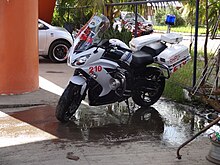
Highway Patrol Group's Kawasaki Ninja 650R No. 210 of PNPThe Highway Patrol Group (HPG) – responsible for enforcing traffic laws and motor vehicle registration and regulation and assisting the Land Transportation Office and is also part of the LTFRB#I-ACT!.[31] This group is rarely seen outside of highly urbanized areas or in any provincial areas however.[citation needed]
Integrity Monitoring and Enforcement Group (IMEG) – responsible for conducting intelligence build-up and law enforcement operations against PNP personnel who are involved in any illegal activities such as drug trafficking, human trafficking, financial crimes, cybercrime, malversation, graft and corrupt practices, security violations, and others. It replaced the Counter-Intelligence Task Force (CITF).[32]
Intelligence Group (IG) – responsible for intelligence and counter-intelligence.[33]
Forensic Group (FG) – responsible for carrying out different forensic services and scientific investigations.[34] Known previously as the Crime Laboratory (CL),[35] it includes the Scene of the Crime Operations (SOCO) division.[36]
Philippine National Police boat on the Iloilo River, Iloilo CityMaritime Group (MG) – responsible for performing all police functions over Philippine territorial waters, lakes, and rivers and along coastal areas, including ports, harbors, and small islands for the security and the safety of the maritime environment.[37]
Police Security and Protection Group (PSPG) – responsible for the security of vital government installations, government officials, visiting dignitaries and private individuals authorized to be given protection. It also supports the Presidential Security Group in protecting the president and their family.[38]
Special Action Force (SAF) – a mobile strike force or a reaction unit to augment regional, provincial, municipal and city police force for civil disturbance control, internal security operations, hostage-taking rescue operations, search and rescue in times of natural calamities, disasters and national emergencies and other special police operations such as anti-hijacking, anti-terrorism, and explosives and ordnance disposal.
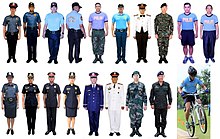
Isuzu D-Max Special weapons and Tactics Vehicle of PNPPNP Air Unit (AU) – a highly specialized police unit specializing in providing air support to the entire PNP. It is staffed by a pool of professional, licensed and experienced pilots and aircraft mechanics. Once a part of Special Action Force.[39]Uniforms of the Philippine National Police.
Per the current (2019) rank system, the National Police has no rank holders of Second Lieutenant, Technical Sergeant, Sergeant and Patrolman First Class.
Two members of the PNP rappel down a tower during a joint U.S.-AFP-PNP Subject Matter Expert Exchange (SMEE).
The PNP conducts regular recruitment programs, depending on the annual budget. The entry level for non-commissioned officers is the rank of Police Patrolman (for male recruits) or Police Patrolwoman (for female recruits). The new recruits will undergo Public Safety Basic Recruit Course for six months, and a Field Training Program for another six months. Prior to their actual duty, they are required to undergo the mandatory special training of PNP BISOC or PNP Basic Internal Security Operations Course for 45 days to 5 months to enhance them in militaristic/tactics for future assignment in the field whether in the Striking Force or in the Police Station.
Commissioned officers for the Philippine National Police are from the Philippine National Police Academy as well as through "lateral entry" for specialized disciplines and requirements such as criminologists in line-officers, lawyers, doctors, engineers, chaplain and other technical positions and also the rose-from-the-rank personnel who have reached the qualifications to be a commissioned officer.
A police officer has to two ways for retirement i.e. Optional and Mandatory Retirement. Optional Retirement is an option of an uniformed personnel to retire who rendered at least 20 years retire from the service, while the latter is when they reach the mandatory retirement age of 56. Any officer may opt to go on non-duty status at most three months before the date when they reach the mandatory retirement age so they could prepare the pertinent documents for their retirement (some called it Terminal Leave). While on this status they are still considered as part of the police force and retain their ranking.[41]
This section may be too long to read and navigate comfortably. Consider splitting content into sub-articles, condensing it, or adding subheadings. Please discuss this issue on the article's talk page.(August 2023)
A blackmail case occurred in Binondo, Manila when police officers abducted and blackmailed seven Chinese citizens suspected of drug trafficking on December 30, 1998.[48] After many months of detainment and torture, two Hong Kong residents were killed when the ransom money was not paid.[49] One police superintendent who knew of the operation was also killed.[48]
The Euro Generals scandal involves Eliseo de la Paz and several Philippine National Police officials who went to Russia in October 2008 to attend an Interpol conference. De la Paz was detained for carrying a large sum of undeclared money. A House panel investigating the scandal concluded that the six police officials who attended the conference had made the trip without authorization.[50] In 2010, the Office of the Ombudsman filed graft charges against twelve former and active ranking PNP officials for their alleged involvement in the incident.[51][52]
On December 5, 2008, ten suspected criminals, one policeman, and five civilians, a total of 16 people, including a seven-year-old girl, were killed in a shootout in Parañaque. Several others were wounded, including a ranking officer of the Highway Patrol Group, two members of the Special Action Force, a village watchman, and a security guard, said Director Leopoldo Bataoil, head of the Metro Manila regional police. The criminals belonged to a Waray-Waray gang and were armed with high-caliber M16 rifles fitted with grenade launchers.[53]
The head of the Internal Affairs Service of the PNP said, "We failed in our mission to protect the civilians."[54] On July 29, 2009, the Department of Justice (DOJ) filed multiple murder charges against 29 policemen, including three generals, in connection with the shootout following the filing of a complaint-affidavit by Lilian de Vera, who lost her husband and seven-year-old daughter in the incident.[55] On January 11, 2010, the Commission on Human Rights recommended the filing of criminal and administrative charges against 26 policemen[56] In March, it was reported that after two witnesses had said De Vera and his daughter were not killed in the shootout, that policemen already had complete control of the area where the two were killed.[57]
Inspector Joselito Binayug, chief of the Asuncion police community precinct in Tondo arrested Darius Evangelista on March 5, 2009, for alleged robbery. A torture video was leaked to the media and shown on television showing a police officer whipping and cursing the suspect and pulling on a rope that was tied to the victim's genitals. The incident allegedly happened inside the Asuncion police precinct in Tondo. Binayug was arrested for violating the Anti-Torture act of 2009. Separate charges were filed for Evangelista being tortured to death.[58][59]
On November 24, 2009, Senior Superintendent Abusana Maguid, the police chief of Maguindanao province, was reported to have been relieved of his duties after witnesses reported seeing three of his officers at the scene of the Maguindanao massacre in which 57 people, including journalists, lawyers, aides, and motorists who were witnesses were killed.[60] On November 25 Maguid and Chief Inspector Sukarno Dikay were reported to have been relieved from post and placed under restrictive custody.[61] On November 26, Department of the Interior and Local Government (DILG) Secretary Ronaldo Puno announced that Maguid, Dikay, and others were suspected of involvement in the massacre.[62] On December 19, Maguid, Dikay, and others were reported to have been recommended for summary dismissal by the PNP high command.[63] On April 16, 2010, the National Police Commission ordered a 90-day suspension against Maguid, Dikay, and 60 other police personnel for their possible involvement in the killings.[64] On July 10, it was reported that Dikay had applied to become state witness, saying that he is confident that his testimony will pin down the masterminds of the killing.[65]
The Philippine National Police conceded that in the 2010 Manila hostage crisis they made blunders in ending a bus hijacking, as outrage grew over the bloody assault played out on live television that left eight Hong Kong tourists dead. The Hong Kong Economic Journal was reported to have accused the PNP of having "appalling professional standards" and "...[a] lack of strategic planning".[66]
"Wheel of Torture" secret detention facility[edit]
The Philippine Commission on Human Rights filed charges against ten police officers after it was discovered that they routinely tortured detainees inside a secret detention facility in Biñan, Laguna. It was alleged that some "were tortured for the police officers’ amusement" when they're intoxicated. The facility is notorious for utilizing a roulette called the "Wheel of Torture", a play on the Wheel of Fortune, where various torture methods were printed. The wheel is rotated and wherever the pin stops, the indicated torture method is perpetrated on the detainee.[67]
The torture methods included a 20-second Manny Pacman punch, named after the famous boxer Manny Pacquiao, where the detainee is beaten for 20 seconds; "Paniki" which means being hung like a bat; "Tusok ulo ka" which means being pierced through the head; "Zombies" which means being electrocuted; and other degrading tasks like "duck walk" and "Ferris wheel".[68]
Sometime in January 2017, a Korean was killed inside Camp Crame.[69][70] The Philippine National Police Anti-Kidnapping Group (PNP-AKG) charged former NBI officials Roel Boliv, Ricardo Diaz, and Jose Yap in relation to the case.[71]
In 2013, an anti-illegal drug unit led by Police Chief Inspector (now Police Major) Rodney Baloyo launched an operation against a certain Chinese national inside a subdivision in Mexico, Pampanga. However, an alleged recycling of Methamphetamine Hydrocloride locally known as "Shabu" worth 648 million Philippine Pesos confiscated dubbed as "Agaw-Bato" by the media and setting drug lord Johnson Lee free were discovered by then Criminal Investigation and Detection Group (CIDG) Chief (now Baguio Mayor) Benjamin Magalong resulting to a dismissal of the 13 Policemen dubbed as "Ninja Cops" (including Baloyo) involved in the said operation. In 2019, Magalong revealed that PNP Chief Oscar Albayalde who was then the Pampanga Provincial Director when the incident happened, asked not to implement the dismissal of the cops involved in the recycling of drugs and often profited along with the cops involved.[72] The revelations caused Magalong receiving death threats and the resignation of Albayalde on October 14, 2019.[73][74]
In 2019, German news outlets reported that the Philippine National Police received training from Uniter Association (German: Verein Uniter), a non-government organization suspected to be a neo-Nazi paramilitary due to its alleged affiliation with a far-right network called "Hannibal".[75][76] Kontraste, a news magazine of Germany's public broadcasting network ARD reported that Uniter members held a training seminar at the Seda Hotel with high-ranking officers of the PNP, and other government officials, including E.R. Ejercito who posted photos of the seminar on his Facebook page two days after he was convicted for graft.[77][78] Uniter denied claims of training Filipino police forces in an attempt to establish right-wing extremist networks overseas, but insisted that they were there for "humanitarian" support for the PNP, which they claimed it as "unfortunate" timing given the ongoing war on drugs. Despite being reported across Germany amidst a neo-Nazi scandal that hit the Bundeswehr (which revolves around an alleged terror plot called "Day X"), it was not reported by Philippine media.[79][80] The PNP refused to comment on its involvement with Uniter.
The holding of a mañanita for NCRPO's chief (later PNP Chief) Debold Sinas amidst the COVID-19 pandemic in Metro Manila was criticized for breaching quarantine regulations. A mañanita is a customary celebration in the PNP where senior officers are greeted by their personnel early in the morning of their birthdays. The national police has filed charges against Sinas over the event for violation of existing regulations on social distancing and mass gatherings. However, Sinas was still able to keep his post due to the "emergency situation" posed by the pandemic, as self-proclaimed by him.[81][82]
Indignation rally in response to Tarlac shooting incident, December 21, 2020, Boy Scout Circle, Quezon City.
Police Senior Master Sergeant Jonel Nuezca shot to death his two unarmed neighbors, Sonya Gregorio and her son Frank, in Paniqui, Tarlac, on December 20, 2020, at 5:10 pm (PST).[83] The incident was reported to the police 20 minutes later and, at 6:19 pm, Nuezca surrendered at the police station in Pangasinan.[83]
The incident started when Nuezca went to investigate the Gregorios who were shooting a boga–an improvised bamboo cannon used as a noisemaker every December. Nuezca tried to arrest Frank, who appeared to be drunk. This led to a heated argument with Sonya, which culminated in Nuezca killing the two by shooting them at close range.[83][84] According to Police Colonel Renante Cabico, director of the Tarlac Provincial Police Office, Nuezca was "off duty" at the time of the incident.[83] The police called the incident an "isolated case."[84]
The incident was captured on video and spread online. Several netizens and celebrities condemned the killings on social media with the hashtags #StopTheKillingsPH, #EndPoliceBrutality, #PulisAngTerorista, and #JusticeForSonyaGregorio dominating on Twitter in the Philippines, as well as in Singapore and Dubai.[85][86] Some critics also pointed at the government over the acts of impunity and human rights abuses in recent years.[87]
An indignation rally was done by numerous groups on December 21, 2020, at the Boy Scout Circle, Quezon City.[88]
The disgraced former PNP officer Jonel Nuezca was found guilty of murder in August 2021 and sentenced to "reclusion perpetua", which is 40 years imprisonment with parole possible after 30 years. He was also ordered to pay PHP 476,000 (US$9,377) to the heirs of each of the people he brutally murdered.[89]
On February 24, 2021, personnel of the Philippines National Police (PNP) and the Philippine Drug Enforcement Agency (PDEA) was involved in a friendly fire incident. Personnel from both sides engaged in a gunfight with both sides saying they were conducting an anti-drug operation. The shootout resulted 2 deaths and 1 injured in the side of the PNP and 2 deaths and 3 injured in the PDEA Side.[90]
Quezon City 52-year-old woman shooting (2021)[edit]
On May 31, 2021, a police officer Police Master Sergeant Hensie Zinampan, who appeared to be drunk, was filmed with a cell phone when he shot a 52-year-old woman named Lilybeth Valdez dead in close range outside the store in Fairview, Quezon City at around 9:30pm, following the heated argument between the two.[91] The incident was caught on video.[92] PNP Chief Guillermo Eleazar confronts Zinampan for his crime.[93] The police filed an "administrative and criminal charges" against the police officer.[94] The incident sparked outrage on social media, trending the hashtag #PulisAngTerorista on June 1, 2021, with the netizen rejected the claims that the incident was "isolated case."[95] The incident was likened to the case of Tarlac shooting in December 2020.[95] There has been no further news on the status of the disgraced officer.
^Hurley, Vic (2011). Jungle Patrol, the Story of the Philippine Constabulary (1901–1936). Cerberus Books. p. 60. ISBN9780983475620 – via Google Books. Section 1. An Insular Constabulary is hereby established under the general supervision of the Civil Governor for the purpose of better maintaining peace, law, and order in the various provinces of the Philippine Islands, organized, officered and governed as hereinafter set forth, which shall be known as the Philippines Constabulary.
^"I. PHILIPPINE NATIONAL POLICE"(PDF). Republic of the Philippines Department of Budget and Management. Archived(PDF) from the original on May 27, 2023. Retrieved June 29, 2023.
^N., Abinales, P. (2005). State and society in the Philippines. Lanham, MD: Rowman & Littlefield Publishers. ISBN978-0742510234. OCLC57452454.{{cite book}}: CS1 maint: multiple names: authors list (link)
^W., McCoy, Alfred (2009). Policing America's empire : the United States, the Philippines, and the rise of the surveillance state. Madison, Wis.: University of Wisconsin Press. ISBN9780299234133. OCLC550642875.{{cite book}}: CS1 maint: multiple names: authors list (link)
^Rosenberg, David A. (1974). "Civil Liberties and the Mass Media under Martial Law in the Philippines". Pacific Affairs. 47 (4): 472–484. doi:10.2307/2755948. JSTOR2755948.
^"Republic Act No. 6975". Official Gazette of the Republic of the Philippines. December 13, 1990. Archived from the original on February 12, 2020. Retrieved June 13, 2020. This article incorporates text from this source, which is in the public domain.
^ ab"Republic Act 8551". Philippine Commission on Women. February 25, 1998. Archived from the original on May 3, 2020. Retrieved June 13, 2020. This article incorporates text from this source, which is in the public domain.
^"Republic Act No. 9708". Official Gazette of the Republic of the Philippines. August 12, 2009. Archived from the original on October 16, 2021. Retrieved June 13, 2020.
^ abUnson, John (March 25, 2019). "Cotabato City cops can join BARMM or transfer to PRO-12". The Philippine Star. Archived from the original on March 27, 2019. Retrieved March 26, 2019. The PRO-BARMM, originally PRO-ARMM, covers Maguindanao and Lanao del Sur, both in mainland Mindanao, and the island provinces of Basilan, Sulu and Tawi-Tawi.
^Felipe, Cecille Suerte; Tupas, Emmanuel (October 14, 2019). "Albayalde goes on 'non-duty' leave". The Philippine Star. Archived from the original on October 21, 2019. Retrieved October 21, 2019.
^ abNewsinfo.inquirer.net. "Newsinfo.inquirer.netArchived 2010-08-30 at the Wayback Machine." Acting MPD chief facing raps over abduction of HK residents. Retrieved on August 28, 2010.
^ abcd"Cop shoots unarmed mother, son over 'boga' in Tarlac". Rappler. Archived from the original on December 21, 2020. Retrieved December 21, 2020. The shooting happened at 5:10 pm then was reported to the Paniqui police station at 5:30 pm. Nearly an hour later, at 6:19 pm, Nuezca surrendered to the Rosales police station in Pangasinan province. Paniqui police picked up Nuezca and now have him in their custody.
^Gutierrez, Jason. "A Brazen Police Shooting Caught on Video Sparks Anger in the Philippines". The New York Times. Archived from the original on December 22, 2020. Retrieved December 22, 2020. MANILA — A video of a police officer shooting a woman and her adult son at close range on Sunday has spread rapidly across social media in the Philippines, provoking a wave of outrage directed at the government and a police force that many say acts with impunity.








.jpg)


_soldiers_descend_a_repel_tower_during_a_joint_U.S.-AFP-Philippine_National_Police_(PNP)_Subject_Matter_Expert_Exchange_(SMEE).jpg)
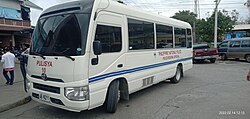 Police bus used by Regional Office's of the Philippine National Police
 PNP Toyota Corolla Altis Police Unit
 Honda XR 150L of the Philippine National Police
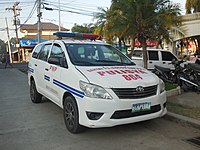 Toyota Innova Police Unit of the Philippine National Police
 Cabanatuan City Police Office's Toyota Hilux Police Vehicle Unit
 MAN CLA 18.300 Police Truck of 13TH Regional Public Safety Battalion
 Kawasaki Versys 1000 PSPG Police Unit
 PNP Maritime Group's 33' patrol boat
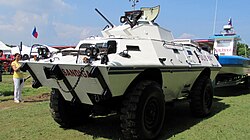 V-150 of the Philippine National Police Special Action Force (PNP-SAF)
 H125 Helicopter of the Philippine National Police Air Unit PNP-SAF
.jpg)


_2.jpg)


 This article incorporates text from this source, which is in the public domain.


