


Russia–United States relations
.svg) | |
 Russia |
 United States |
|---|---|
| Diplomatic mission | |
| Embassy of Russia, Washington, D.C. | Embassy of the United States, Moscow |
| Envoy | |
| Ambassador Anatoly Antonov | Ambassador Lynne M. Tracy |

Russia and the United States maintain one of the most important, critical and strategic foreign relations in the world. Both nations have shared interests in nuclear safety and security, nonproliferation, counterterrorism, and space exploration.[1] Due to the Russian invasion of Ukraine, relations became very tense after the United States imposed sanctions against Russia. Russia placed the United States on a list of "unfriendly countries",[2] along with Taiwan, South Korea, Japan, Singapore, European Union members, NATO members (except Turkey), Australia, New Zealand, Switzerland, Micronesia, and Ukraine.
After the dissolution of the Soviet Union in 1991, the relationship was generally warm under the Russian President Boris Yeltsin (1991–99). In the early years of Yeltsin's presidency, the U.S. and Russia established a cooperative relationship and worked closely together to address global issues such as arms control, counterterrorism, and the conflict in Bosnia. During Yeltsin's second term, U.S.-Russia relations became more strained. The NATO intervention in Yugoslavia, in particular, the 1999 NATO intervention in Kosovo, was strongly opposed by Yeltsin.[3][4][5][6] Although the Soviet Union had been strongly opposed by the Titovian flavour of independence, Yeltsin saw it as an infringement on Russia's latter-day sphere of influence.[citation needed] Yeltsin also criticized NATO's expansion into Eastern Europe, which he saw as a threat to Russia's security.[citation needed]
After Vladimir Putin became President of Russia in 2000, he initially sought to improve relations with the United States. The two countries cooperated on issues such as counterterrorism and arms control. Putin worked closely with U.S. President George W. Bush on the war in Afghanistan following the 9/11 attacks. Tensions began to rise as Putin became more authoritarian, and the U.S. pursued policies that Russia viewed as threatening to its security. The U.S. supported the pro-Western government in Georgia, which led to the Russo-Georgian War.
The U.S. missile defense system created another source of tension. Following Putin regaining control of the Russian government in 2012, relations between the two countries were significantly strained due to Russia's annexation of Crimea and the Russian military intervention in Ukraine. Deterioration continued with the Russian military intervention in the Syrian Civil War, and over Russia's interference in the 2016 and 2020 U.S. elections.
Following the Russian invasion of Ukraine in 2022, relations reached the lowest point since the Cuban Missile Crisis.[7] International sanctions imposed since 2014 were significantly expanded by the U.S. and its allies following the invasion, including several state-owned banks and oligarchs.[8]
Background[edit]
 | |
Russia |
 United States |
|---|---|
United States and the Russian Empire[edit]
.jpg)
Official contacts between the Russian Empire and the new United States of America began in 1776. Russia, while formally neutral during the American Revolution (1765–1783), favored the U.S.[9]
There was little trade or migration before the late 19th century. Formal diplomatic ties were established in 1809.[10] During the American Civil War, Russia supported the Union, largely because it believed that the U.S. served as a counterbalance to its geopolitical rival, the United Kingdom. In 1863, the Russian Navy's Baltic and Pacific fleets wintered in the American ports of New York and San Francisco, respectively.[11]
Russia operated a small fur-trade operations in Alaska, coupled with missionaries to the natives. By 1861, the project had lost money, threatened to antagonize the Americans, and could not be defended from Britain. It proved practically impossible to entice Russians to permanently migrate to Alaska; only a few hundred were there in 1867. In the Alaska Purchase of 1867, the land was sold to the United States for $7.2 million.[12][13]
The Russian administrators and military left Alaska, but some missionaries stayed on to minister to the many natives who converted to the Russian Orthodox faith.[14]
After 1880, repeated anti-Jewish pogroms in Russia alienated American elite and public opinion. In 1903, the Kishinev pogrom killed 47 Jews, injured 400, and left 10,000 homeless and dependent on relief. American Jews began large-scale organized financial help and assisted in emigration.[15]
The Treaty of Portsmouth (1905), brokered by American President Theodore Roosevelt ended the Russo-Japanese War.[16]
During World War I, the United States declaration of war on Germany (1917) came after Nicholas II had abdicated as a result of the February Revolution. When the tsar was still in power, many Americans deplored fighting a war with him as an ally. With him gone, the Wilson administration used the new provisional government to describe how the democratic nations were fighting against autocratic old empires of Germany and Austria-Hungary. During the war, the American Expeditionary Forces were just starting to see battle when the October Revolution happened in which the Bolsheviks overthrew the provisional government and removed Russia from the war.
Before the armistice in November 1918, the Americans had helped the Allied intervention in the Russian Civil War with the Polar Bear Expedition and the American Expeditionary Force Siberia. The Americans' goal was not necessarily ideological but rather to prevent the German enemy from gaining access to war supplies controlled by the Bolsheviks, though the United States also tacitly supported the White movement against the Bolsheviks.[17]
From 1820 until 1917, about 3.3 million immigrants arrived in the U.S. from the Russian Empire. Most were Jews, Poles or Lithuanians; only 100,000 were ethnic Russians.[18][19]
United States and the Soviet Union[edit]
 | |
 Soviet Union |
 United States |
|---|---|


By 1921, after the Bolsheviks gained the upper hand in the Russian Civil War, executed the Romanov imperial family, repudiated the tsarist debt, and called for a world revolution by the working class, it was regarded as a pariah nation by most of the world.[20] Beyond the Russian Civil War, relations were also dogged by claims of American companies for compensation for the nationalized industries they had invested in.[21] The U.S., while starting to develop trade and economic ties, was the last major world power that continued to refuse to formally recognize the Soviet government.[22] The United States and Soviet Russia established diplomatic relations in November 1933.[23]
The United States and the Soviet Union, along with Britain, were the leaders of the Allies against the Axis powers during World War II. Following the onset of the Cold War in 1947, the North Atlantic Treaty was signed by the U.S., Canada, and several Western European nations, on April 4, 1949, a treaty that established the North Atlantic Treaty Organization (NATO) designed to provide collective security against the Soviet Union.[24]
The first bilateral treaty between the U.S. and Soviet Russia/USSR was a consular convention signed in Moscow in June 1964.[25][26] In 1975, the Helsinki Final Act was signed by a multitude of countries, including the USSR and the US, and, while not having a binding legal power of a treaty, it effectively signified the U.S.-led West's recognition of the Soviet Union's dominance in Eastern Europe and acceptance of the Soviet annexation of Estonia, Latvia and Lithuania that had been effected in 1940. The Act came to play a role in subsequently ending the Cold War.[27]
In the 1970s—1980s, the USSR and the U.S. signed a series of arms control treaties such as the Anti-Ballistic Missile Treaty (1972), two Strategic Arms Limitation treaties (SALT), the Intermediate-Range Nuclear Forces Treaty (1987); in July 1991 the Strategic Arms Reduction Treaty was concluded.
In the late 1980s, Eastern Europe nations took advantage of the relaxation of Soviet control under General Secretary Mikhail Gorbachev and began to break away from communist rule. The relationship greatly improved in the final years of the USSR.
On December 3, 1989, Soviet general secretary Gorbachev and the U.S. president George H. W. Bush declared the Cold War over at the Malta Summit.[28]
Both countries agreed to cut their strategic nuclear weapons by 30 percent, and the Soviet Union promised to reduce its intercontinental ballistic missile force by 50 percent.[29] In August 1991, hard-line Communists launched a coup against Gorbachev; while the coup quickly fell apart, it broke the remaining power of Gorbachev and the central Soviet government.[30] Later that month, Gorbachev resigned as general secretary of the Communist party, and Russian president Boris Yeltsin ordered the seizure of Soviet property. Gorbachev clung to power as the President of the Soviet Union until 25 December 1991, when the Soviet Union dissolved.[31] Fifteen states emerged from the Soviet Union, with the largest and most populous one, Russia, taking full responsibility for all the rights and obligations of the USSR under the Charter of the United Nations, including the financial obligations. As such, Russia assumed the Soviet Union's UN membership and permanent membership on the Security Council, nuclear stockpile and the control over the armed forces; Soviet embassies abroad became Russian embassies.[32] Bush and Yeltsin met in February 1992, declaring a new era of "friendship and partnership".[33] In January 1993, Bush and Yeltsin agreed to START II, which provided for further nuclear arms reductions on top of the original START treaty.[34]
History[edit]
The dissolution of the Soviet Union through Yeltsin's terms (1991–99)[edit]
With Communism defunct, on December 25, 1991, the Soviet Union dissolved, and the Commonwealth of Independent States, a loose association was formed by 12 of the 15 former Soviet constituent republics, leaving out the three Baltic states. The Russian Soviet Federative Socialist Republic became the Russian Federation. It was now an independent state that inherited the USSR's UN Security Council permanent membership and became the successor state to the USSR.
Strobe Talbott, who was Washington's chief expert on Russia, has argued that Clinton hit it off with Russian Boris Yeltsin, the president of Russia 1991-1999:
- The personal diplomacy between Clinton and Yeltsin, augmented by the channel that Gore developed with Yeltsin's longest-serving prime minister, Victor Chernomyrdin, yielded half a dozen major understandings that either resolved or alleviated disputes over Russia's role in the post–cold war world. The two presidents were the negotiators in chief of agreements to halt the sale of Russian rocket parts to India; remove Soviet-era nuclear missiles from Ukraine in exchange for Russian assurances of Ukraine's sovereignty and security; withdraw Russian troops from the Baltic states; institutionalize cooperation between Russia and an expanding NATO; lay the ground for the Baltic states to join the alliance; and ensure the participation of the Russian military in Balkan peacekeeping and of Russian diplomacy in the settlement of NATO's air war against Serbia.[35]
As the collapse of the Soviet Union appeared imminent, the United States and their NATO allies grew concerned of the risk of nuclear weapons held in the Soviet republics falling into enemy hands. The Cooperative Threat Reduction (CTR) program was initiated by the Nunn–Lugar Act (really the Soviet Nuclear Threat Reduction Act of 1991), which was authored and cosponsored by Sens. Sam Nunn (D-GA) and Richard Lugar (R-IN). According to the CTR website, the purpose of the CTR Program was originally "to secure and dismantle weapons of mass destruction and their associated infrastructure in former Soviet Union states."
Relations between Yeltsin and the administrations of George H. W. Bush (1989–1993) and Bill Clinton (1993–2001) started off well, but deteriorated after 1997. Yeltsin and his foreign minister Andrey Kozyrev made a high priority Russia's full membership into the family of democratic nations. They wanted to be a partner of the United States. At home they tried to create democratic institutions and a free-market capitalist system.
In 1993, both nations signed the START II arms control treaty that was designed to ban the use of multiple independently targetable reentry vehicles (MIRVs) on intercontinental ballistic missiles (ICBMs). The treaty was eventually ratified by both countries, yet it was never implemented and was formally abandoned in 2002, following the U.S.'s withdrawal from the 1972 Anti-Ballistic Missile Treaty.
Clinton and Yeltsin were personally friendly. Washington encouraged the rapid transition to a liberal capitalist system in Russia.[36] Clinton provided rich talking points but provided less than $3 billion, and much was paid to American contractors. The Russians—aware of the Marshall Plan in the 1940s—had counted on far larger sums.[37] A 1995 NATO study on enlarging the alliance, and the 1999 admission of the Czech Republic, Hungary, and Poland into NATO, alarmed Russia.[38] With the Cold War over, Russians felt NATO's original role was no longer needed. It feared its dramatic move eastward meant an escalation of NATO's historic role in containment of Russian goals.[39][40] Fears over NATO enlargement contributed to the rise of Vladimir Putin and his emphasis on Russian nationalism and security issues.[38]

Russia stridently opposed the U.S.-led NATO military operation against Serbia and Montenegro over Kosovo that began in March 1999.[41][42][43] In December 1999, while on a visit to China, president Yeltsin verbally assailed Clinton for criticizing Russia's tactics in Chechnya (at the start of the Second Chechen War) emphatically stating that Russia remained a nuclear power.[44]
Putin and George W. Bush (2001–2009)[edit]
In 2001, in response to the terrorist attacks on September 11, the new Russian president Vladimir Putin quickly announced strong support. Terrorism against Russia was already high on Putin's agenda and he found common ground by supporting the American/NATO invasion of Afghanistan to destroy the Taliban that had harbored the Al-Qaeda terrorists.[45] By 2002, however, the two countries were escalating their disagreements. Russia became more assertive in international affairs; George W. Bush took an increasingly unilateral course in foreign policy.[46]
In 2002, the United States withdrew from the Anti-Ballistic Missile Treaty in order to move forward with plans for a missile defense system. Putin called the decision a mistake. Russia strongly opposed the 2003 invasion of Iraq, though without exercising its veto in the United Nations Security Council. Russia has regarded the expansion of NATO into the old Eastern Bloc, and U.S. efforts to gain access to Central Asian oil and natural gas as a potentially hostile encroachment on Russia's sphere of influence. The Russian leadership blamed U.S. officials for encouraging anti-Russian revolts during the Rose Revolution in Georgia in 2003 and the Orange Revolution in Ukraine in 2004. Putin saw intrusions into Russia's historic sphere of interest.[47][48]


Russia condemned the unilateral declaration of independence of Kosovo from Serbia in February 2008,[49] stating they "expect the UN mission and NATO-led forces in Kosovo to take immediate action to carry out their mandate [...] including the annulling of the decisions of Pristina's self-governing organs and the taking of tough administrative measures against them."[50] Russian President Putin described the recognition of Kosovo's independence by the United States and other Western countries as "a terrible precedent, which will de facto blow apart the whole system of international relations, developed not over decades, but over centuries", and that "they have not thought through the results of what they are doing. At the end of the day it is a two-ended stick and the second end will come back and hit them in the face".[51] In March 2014, Russia used Kosovo's declaration of independence as a justification for recognizing the independence of Crimea, citing the so-called "Kosovo independence precedent".[52][53]
In early 2008, President George W. Bush vowed full support for admitting Ukraine and Georgia into NATO,[54] despite Russia's opposition to the further eastward expansion of NATO.[55] Russia's Deputy Foreign Minister Grigory Karasin warned that any incorporation of Ukraine into NATO would cause a "deep crisis" in Russia–Ukraine relations and also negatively affect Russia's relations with the West.[56]
Controversy over U.S. plan to station missiles in Poland (2007–2008)[edit]
In March 2007, the U.S. announced plans to build an anti-ballistic missile defense installation in Poland along with a radar station in the Czech Republic. Both nations were former Warsaw Pact members and both had repudiated Communism and Russian interference. U.S. officials said that the system was intended to protect the United States and Europe from possible nuclear missile attacks by Iran or North Korea. Russia, however, viewed the new system as a potential threat and, in response, tested a long-range intercontinental ballistic missile, the RS-24, which it claimed could defeat any defense system. Putin warned the U.S. that these new tensions could turn Europe into a powder keg. On June 3, 2007, Putin warned that if the United States built the missile defense system, Russia would consider targeting missiles at Poland and the Czech Republic.[57]
In October 2007, Vladimir Putin visited Iran to discuss Russia's aid to Iran's nuclear power program and "insisted that the use of force was unacceptable."[58] On October 17, Bush stated "if you're interested in avoiding World War III, it seems like you ought to be interested in preventing them from having the knowledge necessary to make a nuclear weapon," understood as a message to Putin.[59] A week later, Putin compared U.S. plans to put up a missile defense system near Russia's border as analogous to when the Soviet Union deployed missiles in Cuba, prompting the Cuban Missile Crisis.[60]
In July 2008, Russia announced that if a U.S. anti-missile shield was deployed near the Russian border, it would have to react militarily. The statement from the Russian foreign ministry said, "If an American strategic anti-missile shield starts to be deployed near our borders, we will be forced to react not in a diplomatic fashion but with military-technical means." Later, Russia's ambassador to the United Nations Vitaly Churkin said that "military-technical means" did not mean military action, but more likely a change in Russia's strategic posture, perhaps by redeploying its own missiles.[61]
On August 14, 2008, the U.S. and Poland agreed to have 10 two-stage missile interceptors – made by Orbital Sciences Corporation – placed in Poland, as part of a missile shield to defend Europe and the U.S. from a possible missile attack by Iran. In return, the U.S. agreed to move a battery of MIM-104 Patriot missiles to Poland. The missile battery was to be staffed – at least temporarily – by U.S. Military personnel. The U.S. also pledged to defend Poland, a NATO member, quicker than NATO would in the event of an attack. Additionally, the Czech Republic recently agreed to allow the placement of a radar-tracking station in their country, despite public opinion polls showing that the majority of Czechs were against the plans and only 18% supported it.[62] The radar-tracking station in the Czech Republic would also be part of the missile defense shield. After the agreement was announced, Russian officials said defences on Russia's borders would be increased and that they foresaw harm in bilateral relations with the United States.[63]
Russian-Georgian clash (August 2008)[edit]
In August 2008, United States-Russia bilateral relations became further strained, when Russia and Georgia fought a five-day war over the Russian-backed self-proclaimed republics of South Ossetia and Abkhazia. President Bush said to Russia, "Bullying and intimidation are not acceptable ways to conduct foreign policy in the 21st century."[64]
Obama administration (2009–2017)[edit]
"Reset" under Obama and Medvedev (2009–11)[edit]

Despite U.S.–Russia relations becoming strained during the Bush administration, Russian president Dmitry Medvedev (president from May 2008 until May 2012, with Vladimir Putin as head of government) and U.S. president Barack Obama struck a warm tone at the 2009 G20 summit in London and released a joint statement that promised a "fresh start" in Russia–United States relations. The statement also called on Iran to abandon its nuclear program and to permit foreign inspectors into the country.[65]
In March 2009, U.S. secretary of state Hillary Clinton and her Russian counterpart Sergey Lavrov symbolically pressed a "reset" button. The gag fell short as the Russian translation on the button was misspelt by the State Department and actually meant "overload" instead of "reset". After making a few jokes and laughs, they decided to press the button anyway to symbolise friendship.[66]
In early July 2009, Obama visited Moscow where he had meetings with president Medvedev and prime minister Putin. Speaking at the New Economic School Obama told a large gathering, "America wants a strong, peaceful and prosperous Russia. This belief is rooted in our respect for the Russian people, and a shared history between our nations that goes beyond competition."[67] Days after president Obama's visit to Moscow, U.S. vice president Joe Biden, noting that the U.S. was "vastly underestimat[ing] the hand that [it] h[e]ld", told a U.S. newspaper that Russia, with its population base shrinking and the economy "withering", would have to make accommodations to the West on a wide range of national-security issues.[68]

In March 2010, the United States and Russia reached an agreement to reduce their stockpiles of nuclear weapons. The new nuclear arms reduction treaty (called New START) was signed by President Obama and President Medvedev on April 8, 2010. The agreement cut the number of long-range nuclear weapons held by each side to about 1,500, down from the current 1,700 to 2,200 set by the Moscow Treaty of 2002. The New START replaced the 1991 Strategic Arms Reduction Treaty, which expired in December 2009.[69]

On a visit to Moscow in March 2011, U.S. vice president Joe Biden reiterated Washington's support for Russia's accession to the World Trade Organization;[70] he also had a meeting with Russia's leading human rights and opposition leaders where he reportedly told the gathering at the U.S. ambassador's Spaso House residence that it would be better for Russia if Putin did not run for re-election in 2012.[71]
Through 2020, this was the only time Biden and Putin had met. After an official group meeting Biden characterized in his memoir as "argumentative," he and Putin met privately, with Biden saying "Mr. Prime Minister, I'm looking into your eyes," (a reference to a 2001 meeting between Putin and President Bush, who later said "I looked the man in the eye...I was able to get a sense of his soul"). Biden continued, "I don't think you have a soul." Putin replied, "We understand each other." Biden was elected president in 2020.[72]

The 2011 military intervention in Libya prompted a widespread wave of criticism from several world leaders, including Russian President Medvedev[73] and Russian Prime Minister Putin, who said that "[UNSC Resolution 1973] is defective and flawed...It allows everything. It resembles medieval calls for crusades."[74]
At the start of the mass protests that began in Russia after the legislative election in early December 2011, prime minister Vladimir Putin accused the United States of interference and inciting unrest, specifically saying that secretary of state Hillary Clinton had sent "a signal" to "some actors in our country"; his comments were seen as indication of a breakdown in the Obama administration's effort to "reset" the relationship.[75]
By 2012, it was clear that a genuine reset never happened and relations remained sour. Factors in the West included traditional mistrust and fear, an increasing drift away from democracy by Russia, and a demand in Eastern Europe for closer political, economic and military integration with the West. From Russia factors included a move away from democracy by Putin, expectations of regaining superpower status and the tactic of manipulating trade policies and encouraging divisions within NATO.[76][77]
Increasing tensions during Putin's third term (2012–2015)[edit]
In mid-September 2013, the United States and Russia made a deal whereby Syria's chemical weapons would be placed under international control and eventually destroyed; President Obama welcomed the agreement[78] that was shortly after enshrined in the UNSC Resolution 2118. The Obama administration was criticised for having used the chemical weapons deal as an ineffectual substitute for military action that Obama had promised in the event of use of chemical weapons by the Syrian government.[79] In George Robertson's view, as well as many others', the failure of Obama to follow through on his 2013 "red line" and take promised military action badly hurt his credibility and that of the United States with Putin and other world leaders.[80][81]
Obama acknowledged Russia's role in securing the deal to limit Iran's nuclear program that was reached in July 2015, and personally thanked Putin for Russia's role in the relevant negotiations.[82]

In May 2012, Russian general Nikolay Yegorovich Makarov said that there was a possibility of a preemptive strike on missile defense sites in Eastern Europe, to apply pressure to the United States regarding Russia's demands.[83] Later in August 2012, it was revealed that an Akula-class submarine had conducted a patrol within the Gulf of Mexico without being detected, raising alarms of the U.S. Navy's anti-submarine warfare capabilities.[84]
On December 14, 2012, U.S. President Barack Obama signed the Magnitsky Act, which "[imposed] U.S. travel and financial restrictions on human rights abusers in Russia". On December 28, 2012, Russian President Vladimir Putin signed a bill, widely seen as retaliatory, that banned any United States citizen from adopting children from Russia.[85]
On February 12, 2013, hours before the 2013 State of the Union Address by U.S. president Obama, two Russian Tu-95 Bear strategic bombers, reportedly equipped with nuclear-tipped cruise missiles, circled the U.S. territory of Guam.[86] Air Force F-15 jets based on Andersen Air Force Base were scrambled to intercept the aircraft.[86] The Russian aircraft reportedly "were intercepted and left the area in a northbound direction."[86]
At the end of 2013, Russia announced that a rearmament of the Kozelsk, Novosibirsk, Tagil Rocket divisions with advanced RS-24 Yars intercontinental ballistic missiles was going ahead.[87]
In July 2014, the U.S. government formally accused Russia of having violated the 1987 Intermediate-Range Nuclear Forces (INF) Treaty by testing a prohibited medium-range ground-launched cruise missile (presumably R-500,[88] a modification of Iskander)[89] and threatened to retaliate accordingly.[89][90] Concern in the U.S. was also caused by the test-firing in 2014 of the Russian RS-26 Rubezh Intercontinental Ballistic Missile capable of evading the existing anti-ballistic missile defenses.[91][92]
In early June 2015, the U.S. State Department reported that Russia had failed to correct the violation of the I.N.F. Treaty; the U.S. government was said to have made no discernible headway in making Russia so much as acknowledge the compliance problem.[93]
Edward Snowden affair (2013)[edit]
.jpg)
Edward Snowden, a contractor for the United States government, copied and released hundreds of thousands of pages of secret U.S. government documents. He fled to Hong Kong, and then to Russia where in July 2013 he was granted political asylum. He was wanted on a criminal warrant by U.S. prosecutors for theft of government property and espionage.[94]
The granting of asylum further aggravated relations between the two countries and led to the cancellation of a meeting between Obama and Putin that was scheduled for early September 2013 in Moscow.[95] Snowden remains in Russia as of October 2023.
Russian Annexation of Crimea (2014)[edit]
Following the collapse of the Viktor Yanukovych government in Ukraine in February 2014, Russia annexed Crimea on the basis of a controversial referendum held on March 16, 2014. The U.S. had submitted a UN Security Council resolution declaring the referendum illegal; it was vetoed by Russia on March 15 with China abstaining and the other 13 Security Council members voting for the resolution.[96] In 2016, in a court in Moscow, former top Ukrainian officials of the Yanukovich administration testified that the collapse of the government was, in their opinion, a coup d'état organized and sponsored by the U.S. government.[97][98] Russian newspaper Kommersant alleges George Friedman (chairman of Stratfor) had agreed this was the "most blatant coup in history', which George Friedman says was taken out of context.[99][100]

U.S. secretary of state John Kerry in early March 2014 answering the press questions about Russia's moves in Crimea said, "This is an act of aggression that is completely trumped up in terms of its pretext. It's really 19th century behavior in the 21st century, and there is no way, to start with, that if Russia persists in this, that the G8 countries are going to assemble in Sochi. That's a starter."[81] On March 24, 2014, the U.S. and its allies in the G8 political forum suspended Russia's membership thereof.[101] The decision was dismissed by Russia as inconsequential.[102][103]
At the end of March 2014, U.S. president Obama ruled out any Western military intervention in Ukraine[102] and admitted that Russia's annexation of Crimea would be hard to reverse; however, he dismissed Russia as a "regional power" that did not pose a major security threat to the U.S.[104] In January 2016, when asked for his opinion of Obama's statement, Putin said, "I think that speculations about other countries, an attempt to speak disrespectfully about other countries is an attempt to prove one's exceptionalism by contrast. In my view, that is a misguided position."[105][106]
In November 2016, the president of the European Commission Jean-Claude Juncker said this of the statement of Obama: "We have a lot to learn about the depths of Russia, we are very ignorant about it at the moment. I would like to have discussions on a level footing with Russia. Russia is not, as President Obama said, 'a regional power'. This was a big error in assessment."[107]
As unrest spread into eastern Ukraine in the spring of 2014, relations between the U.S. and Russia further worsened. The U.S. government imposed punitive sanctions for Russia's activity in Ukraine. After one bout of sanctions announced by President Obama in July 2014 targeting Russia's major energy, financial and defence companies, Russia said the sanctions would seriously harm the bilateral ties relegating them to the 1980s Cold War era.[108]
_02.jpg)
From March 2014 to 2016, six rounds of sanctions were imposed by the U.S., as well as by the EU, and some other countries allied to the U.S. The first three rounds targeted individuals close to Putin by freezing their assets and denying leave to enter. Russia responded by banning import of certain food products as well as by banning entry for certain government officials from the countries that imposed sanctions against Russia.
The end of 2014 saw the passage by the U.S. of the Ukraine Freedom Support Act of 2014,[109][110] aimed at depriving certain Russian state firms of Western financing and technology while also providing $350 million in arms and military equipment to Ukraine, and the imposition by the U.S. president's executive order of yet another round of sanctions.[111]
Due to the situation concerning Ukraine, relations between Russia and the U.S. that denounced Russia's actions were in 2014 said to be at their worst since the end of the Cold War.[112]
As vice president, Joe Biden urged the Ukrainian government to reduce the nation's reliance on imports of Russian natural gas, and to eliminate pro-Russia middlemen such as Dmitry Firtash from the country's natural gas industry.[113]
Russian military intervention in the Syrian Civil War (from September 30, 2015)[edit]
_04.jpg)
Shortly after the start of the Syrian Civil War in the spring of 2011, the U.S. imposed sanctions on Syria's government and urged president Bashar al-Assad to resign; meanwhile, Russia, a long-standing ally of Syria, continued and increased its support for the Syrian government against rebels backed up by the U.S. and its regional allies.
On September 30, 2015, Russia began the air campaign in Syria on the side of the Syrian government headed by president Bashar al-Assad of Syria. According to Russian foreign minister Sergey Lavrov's statement made in mid-October 2015, Russia had invited the U.S. to join the Baghdad-based information center set up by Iran, Iraq, Syria and Russia to coordinate their military efforts, but received what he called an "unconstructive" response; Putin's proposal that the U.S. receive a high-level Russian delegation and that a U.S. delegation arrive in Moscow to discuss co-operation in Syria was likewise declined by the U.S.[114][115]
In early October 2015, U.S. president Obama called the way Russia was conducting its military campaign in Syria a "recipe for disaster";[116] top U.S. military officials ruled out military cooperation with Russia in Syria.[117][118] Secretary of Defense Ashton Carter and other senior U.S. officials said Russia's campaign was primarily aimed at propping up Assad, whom U.S. president Barack Obama had repeatedly called upon to leave power.[119]
Three weeks into the Russian campaign in Syria, on October 20, 2015, Russian president Vladimir Putin met Bashar Assad in Moscow to discuss their joint military campaign and a future political settlement in Syria, according to the Kremlin report of the event.[120][121] The meeting provoked a sharp condemnation from the White House.[122]
While one of the original aims of the Russian leadership may have been to normalize relations with the U.S. and the West at large, the resultant situation in Syria was said in October 2015 to be a proxy war between Russia and the U.S.[123][124][125][126][127] The two rounds of the Syria peace talks held in Vienna in October and November 2015, with Iran participating for the first time, highlighted yet again the deep disagreement over the Syrian settlement between the U.S. and Russia, primarily on the issue of Bashar Assad's political future.[128] The talks in Vienna were followed by a bilateral meeting of Obama and Putin on the sidelines of the G-20 Summit in Turkey, during which a certain consensus between the two leaders on Syria was reported to have been reached.[129]
.jpg)
Bilateral negotiations over Syria were unilaterally suspended by the U.S. on October 3, 2016, which was presented as the U.S. government's reaction to a re-newed offensive on Aleppo by Syrian and Russian troops.[130] On the same day Putin signed a decree[131] that suspended the 2000 Plutonium Management and Disposition Agreement with the U.S. (the relevant law was signed on October 31, 2016[132]), citing the failure by the U.S. to comply with the provisions thereof as well as the U.S.' unfriendly actions that posed a "threat to strategic stability."[133][134]
In mid-October 2016, Russia's U.N. ambassador Vitaly Churkin, referring to the international situation during the 1973 Arab–Israeli War, said that tensions with the U.S. are "probably the worst since 1973".[135] After two rounds of fruitless talks on Syria in Lausanne and London, the foreign ministers of the U.S. and the UK said that additional sanctions against both Russia and Syria were imminent unless Russia and the "Assad regime" stopped their air campaign in Aleppo.[136][137]

Trump administration (2017–2021)[edit]
Election of Donald Trump and Russian interference[edit]
.jpg)
In mid-November 2016, shortly after the election of Trump as the U.S. president, the Kremlin accused president Barack Obama's administration of trying to damage the U.S.' relationship with Russia to a degree that would render normalization thereof impossible for Trump's incoming administration.[138]
In his address to the Russian parliament delivered on December 1, 2016, Russian president Putin said this of U.S.—Russia relations: "We are prepared to cooperate with the new American administration. It's important to normalize and begin to develop bilateral relations on an equal and mutually beneficial basis. Mutual efforts by Russia and the United States in solving global and regional problems are in the interest of the entire world."[139]
In early December 2016, the White House said that President Obama had ordered the intelligence agencies to review evidence of Russian interference in the 2016 presidential campaign; Eric Schultz, the deputy White House press secretary, denied the review to be led by Director of National Intelligence James R. Clapper was meant to be "an effort to challenge the outcome of the election".[140] Simultaneously, the U.S. press published reports, with reference to senior administration officials, that U.S. intelligence agencies, specifically the CIA,[141] had concluded with "high confidence" that Russia acted covertly in the latter stages of the presidential campaign to harm Hillary Clinton's chances and promote Donald Trump.[142] President-elect Donald Trump rejected the CIA assessment that Russia was behind the hackers' efforts to sway the campaign in his favour as "ridiculous".[143][144]
In mid-December 2016, Hillary Clinton suggested that Putin had a personal grudge against her due to her criticism of the 2011 Russian legislative election and his opinion that she was responsible for fomenting the anti-Putin protests in Russia that began in December 2011.[145] She partially attributed her loss in the 2016 election to Russian meddling organized by Putin.[146][147] Among her presidential campaign's Russia policy advisors was Richard Lourie.[148][who?][citation needed]
Also in mid-December, President Obama publicly pledged to retaliate for Russian cyberattacks during the U.S. presidential election in order to "send a clear message to Russia" as both a punishment and a deterrent;[149] however, the press reported that his actionable options were limited, with many of those having been rejected as either ineffective or too risky. The New York Times, citing a catalogue of U.S.-engineered coups in foreign countries, opined, "There is not much new in tampering with elections, except for the technical sophistication of the tools. For all the outrage voiced by Democrats and Republicans in the past week about the Russian action — with the notable exception of Mr. Trump, who has dismissed the intelligence findings as politically motivated — it is worth remembering that trying to manipulate elections is a well-honed American art form."[150]
The National Defense Authorization Act for Fiscal Year 2017 signed into law by president Obama on December 23, 2016, was criticised by the Russian foreign ministry as yet another attempt to "create problems for the incoming Trump administration and complicate its relations on the international stage, as well as to force it to adopt an anti-Russia policy."[151]
At the end of 2016, U.S. president-elect Donald Trump praised Putin for not expelling U.S. diplomats in response to Washington's expulsion of 35 Russian diplomats as well as other punitive measures taken by the Obama administration in retaliation for what U.S. officials had characterized as interference in the U.S. presidential election.[152][153]
On January 6, 2017, the Office of the Director of National Intelligence (ODNI), in an assessment of "Russian Activities and Intentions in Recent U.S. Elections", asserted that Russian leadership favored presidential candidate Trump over Clinton, and that Putin personally ordered an "influence campaign" to harm Clinton's chances and "undermine public faith in the US democratic process".[154]: 7 Trump campaign manager Paul Manafort admitted he was in contact with Russian operatives and sharing information through the campaign.[155]
2017[edit]
.jpg)
A week after Trump's inauguration on January 20, 2017, Trump had a 52-minute telephone conversation with Russian president Vladimir Putin that was hailed by both governments as a step towards improvement of relations between the U.S. and Russia; the presidents agreed to arrange a face-to-face meeting for a later date.[156][157]
In early March 2017, the U.S. military for the first time publicly accused Russia of having deployed a land-based cruise missile (SSC-8[158]) that they said violated the "spirit and intent" of the 1987 Intermediate-range Nuclear Forces (INF) treaty and posed a threat to NATO.[159]
On March 25, 2017, the U.S. imposed new sanctions against eight Russian companies in connection with the Iran, North Korea, Syria Nonproliferation Act (INKSNA).[citation needed]
The cruise-missile strikes on the Syrian Shayrat Airbase, conducted by the U.S. on April 7, 2017, as a response to the Khan Shaykhun chemical attack,[160][161][162] were condemned by Russia as an "act of aggression" that was based on a "trumped-up pretext", which substantially impaired Russia–United States relations.[163] Russian prime minister Dmitry Medvedev said the attack had placed the U.S. on the cusp of warfare with Russia.[164][165][166] Both Donald Trump in April and the Russian government in May characterised the relationship between the countries as frozen and lacking any progress;[167][168] in early June, Vladimir Putin said relations were at an all-time low since the end of the Cold War.[169] In mid-June 2017, the Russian foreign ministry confirmed that, for the first time ever, Russia had failed to receive a formal greeting from the U.S. government on occasion of Russia's national day celebrated on June 12.[170][171][172][173]
.jpg)
In April 2017, Trump's administration denied a request from ExxonMobil to allow it to resume oil drilling in Russia.[174] In July 2017, ExxonMobil filed a lawsuit against the U.S. government challenging the finding that the company violated sanctions imposed on Russia.[175]
On May 10, 2017, Trump had an unannounced meeting in the Oval Office with Russian Foreign Minister Sergey Lavrov and Russian Ambassador to the United States Sergey Kislyak.[176] During the meeting he disclosed highly classified information, providing details that could have been used to deduce the source of the information and the manner in which it was collected, according to current and former government officials.[177][178] Although the disclosure was not illegal, it was widely criticized because of the possible danger to the source.[179][180]
On July 6, 2017, during a speech in Warsaw, Poland, Trump urged Russia to cease its support for "hostile regimes" in Syria and Iran.[181] On July 7, 2017, in what appeared to be a sign of good relations between the leaders of both countries,[182] Trump met with Putin at the G20 Hamburg summit in Germany and described the meeting as "an honour."[183]
In mid-July 2017, the Russian foreign ministry noted that the staff of the U.S. Embassy in Moscow, following expulsion of diplomats by the Obama administration in December 2016, far exceeded the number of Russian embassy employees in Washington and indicated that the Russian government was considering retaliatory expulsion of more than thirty-five U.S. diplomats, thus evening out the number of the countries' diplomats posted.[184] On July 28, Russia announced punitive measures that were cast as Russia's response to the additional, codified, sanctions against Moscow passed by Congress days prior, but also referenced the specific measures imposed against the Russian diplomatic mission in the U.S. by the Obama administration.[185] Russia demanded that the U.S. reduce its diplomatic and technical personnel in the Moscow embassy and its consulates in St Petersburg, Ekaterinburg and Vladivostok to four hundred fifty-five persons — the same as the number of Russian diplomats posted in the U.S. — by September 1; Russia's government would also suspend the use of a retreat compound and a storage facility in Moscow used by the U.S. by August 1.[185][186][187] Two days later, Vladimir Putin said that the decision on the curtailment of the U.S. diplomatic mission personnel had been taken by him personally and that 755 staff must terminate their work in Russia.[188][189][190] After the sanction bill was on August 2 signed by Donald Trump, Russian prime minister Dmitry Medvedev wrote that the law had ended hope for improving U.S.–Russia relations and meant "an all-out trade war with Russia."[191][192] The law was also criticised by Donald Trump, whose signing statement indicated that he might choose not to enforce certain provisions of the legislation that he deemed unconstitutional.[193][194]
Russia protested on September 2, 2017, against a search it said U.S. officials were planning of a Russian trade mission building in Washington D.C., shortly after the U.S., ″in the spirit of parity invoked by the Russians″, demanded that Russia shut two of its diplomatic annexes (buildings) in Washington D.C. and New York City as well as its Consulate General in San Francisco.[195] The Russian foreign ministry said the inspection would be "illegal" and an "unprecedented aggressive action"; it also demanded that the U.S. ″immediately return the Russian diplomatic facilities″.[196][197]
In November 2017, Trump and Putin both attended the Asia-Pacific Economic Cooperation meeting in Danang. Although they had no formal meeting they spoke informally several times during the event.[198]
At the end of 2017, CNN concluded that a series of steps undertaken by the Trump administration within a mere week before Christmas such as naming Russia a "rival power" and ″revisionist power″ (along with China), imposing sanctions on Ramzan Kadyrov, a close Putin ally, the decision to provide Ukraine with anti-tank weapons, coupled with tougher line from the State Department about Moscow's activities in eastern Ukraine, and accusations from the Pentagon that Russia was intentionally violating de-confliction agreements in Syria, highlighted "a decided turn away from the warmer, more cooperative relationship with Russia that President Donald Trump called for during his campaign and early in his presidency".[199][200][201] In February 2018, echoing Donald Trump's own statement, White House press secretary Sarah Huckabee Sanders said: "[President Donald Trump] has been tougher on Russia in the first year than Obama was in eight years combined."[202][203]
Beginning of Putin's fourth term (2018–2020)[edit]

A highly unusual[204] unannounced visit to Washington, D.C., at the end of January 2018 by the directors of Russia's three main intelligence and security agencies (FSB, SVR, and GRU), two of whom (Sergey Naryshkin and Igor Korobov) were on the U.S. sanctions list,[205] and their reported meetings with top U.S. security officials caused political controversy in the U.S. and elicited no official comment in Russia, while it occurred days before the Trump administration chose not to impose immediately new sanctions on Russia at the deadline mandated by the Countering America's Adversaries Through Sanctions Act.[206][207][208][209]
The U.S. air and artillery strike on a pro-government formation in eastern Syria on February 7, 2018, which caused massive death toll among Russian nationals and a political scandal in Russia, was billed by media as "the first deadly clash between citizens of Russia and the United States since the Cold War" and "an episode that threatens to deepen tensions with Moscow".[210][211]
Public statements read out by Vladimir Putin on March 1, 2018, days before the presidential election, about missile technology breakthroughs made by Russia, were referred to by the Trump administration officials as largely boastful untruths, as well as confirmation that "Russia ha[d] been developing destabilizing weapons systems for over a decade, in direct violation of its treaty obligations".[212] U.S. Defense Secretary James Mattis remarked that the systems Putin had talked about "[were] still years away" and he did not see them changing the military balance.[213] Nevertheless, White House insiders were later quoted as saying that Putin's claims "really got under the president [Trump]'s skin" and caused Trump to take a sharper tone behind the scenes vis-à-vis Vladimir Putin.[214]
On March 26, 2018, following the United States National Security Council's recommendation,[215] to demonstrate the U.S.'s support for the UK's position on the Salisbury poisoning incident, president Donald Trump ordered the expulsion of sixty Russian diplomats and closure of Russian consulate in Seattle.[216][217] Russian foreign minister Sergei Lavrov responded to the simultaneous expulsion of the total of 140 Russian diplomats by 25 countries by accusing the U.S. government of "blackmailing" other nations.[218][219]
.jpg)
In April 2018, U.S.-Russian relations were further exacerbated by missile strikes against the Syrian government targets following the suspected chemical attack in Douma on April 7.[220] The countries clashed diplomatically, with Russia's top military officials threatening to hit U.S. military targets in the event of a massive U.S.-led strike against Syria.[221][222][223][224] In late May, during an interview with RT, Syria's president Bashar al-Assad said that direct military conflict between the Russian forces and the U.S. forces in Syria had been averted in April "by the wisdom of the Russian leadership" and that the U.S.-led missile attack against Syria would have been far more extensive had it not been for Russia's intervention.[225][226]
On June 8, 2018, Trump called for Russia to be readmitted to the G-7, from which it was expelled after the Russian annexation of Crimea in 2014.[227]
Trump's public statements during his first formal meeting with Putin in Helsinki on July 16, 2018, drew criticism from the Democratic members of the U.S. Congress and a number of former senior intelligence officials as well as some ranking members of the Republican party for appearing to have sided with Putin rather than accepting the findings of Russian interference in the 2016 presidential election issued by the United States Intelligence Community.[228][229][230] Republican senator John McCain called the press conference "one of the most disgraceful performances by an American president in memory."[231] The press around the world ran publications that tended to assess the news conference following the presidents′ two-hour meeting as an event at which Trump had "projected weakness".[232]
.jpg)
In December 2019, the Trump administration imposed sanctions on businesses involved in the construction of Nord Stream 2 natural gas pipeline from Russia to Germany,[233] as the U.S. sought to sell more of its own liquefied natural gas (LNG) to European states.[234] German Finance Minister Olaf Scholz called the sanctions "a severe intervention in German and European internal affairs", while the EU spokesman criticized "the imposition of sanctions against EU companies conducting legitimate business."[235] Russian Foreign Minister Sergey Lavrov also criticized sanctions, saying that U.S. Congress "is literally overwhelmed with the desire to do everything to destroy" the U.S.–Russia relations.[236]
A June 2020 New York Times report, citing unnamed sources, stated that American intelligence officials assessed with medium confidence that Russian military intelligence unit 29155 had supervised a bounty program paying Taliban-linked militants to kill foreign servicemembers, including Americans, in Afghanistan in 2019.[237][238] The bounty program reportedly resulted in the deaths of "several" U.S. soldiers,[239] but The Pentagon's top leaders said that Russian bounty program has not been corroborated.[240] The Taliban and Russia have both denied that the bounty program exists.[239] President Donald Trump and his aides denied that he was briefed on the intelligence. Director of National Intelligence John Ratcliffe said that Trump had not received a briefing on the bounty program. White House press secretary Kayleigh McEnany said the same.[239] Secretary of Defense Mark Esper said that General Kenneth McKenzie, the commander of U.S. Central Command, and General Scott Miller, the top U.S. military commander in Afghanistan, did not think "the reports were credible as they dug into them."[240] McKenzie said that he found no "causative link" between reported bounties to actual U.S. military deaths, but said a lack of proof is "often true in battlefield intelligence."[240]
On July 1, 2020, following media reports of Taliban participation in an alleged Russian bounty program, the U.S. House Armed Services Committee overwhelmingly voted in favor of an amendment to restrict President Trump's ability to withdraw U.S. troops from Afghanistan.[241]
On September 25, 2020, U.S. Air Force B-52 bombers staged a mock attack run on Kaliningrad, a Russian exclave locked between NATO countries. The simulated raid on the Kaliningrad region was a test case of destroying Russian air defense systems located in the region.[242]
Influence on the Trump administration[edit]
.jpg)
Shortly before the inauguration of President Trump, the Steele dossier was leaked to the public. Written by a private intelligence firm claiming to unearth a relationship between his presidential campaign and the Russian government, the report alleged that the Russians possessed kompromat on Trump which could be used to blackmail him. It suggested the Kremlin had promised the campaign that compromising information would not be released if the Administration cooperated.[243][244] Though the report was met with skepticism, the relationship between Russian leadership and the incoming Trump Administration became highly salient. Days later, Ynet, an Israeli online news site, reported that U.S. intelligence had advised Israeli intelligence officers to be cautious about sharing information with the incoming Trump administration until the possibility of Russian influence over Trump had been fully investigated.[245] Allegations of collusion between Trump associations and the Russian government continued to emerge well into his presidency.
Various links between Trump associates and Russian officials and spies have been documented and heavily scrutinized, most notably former National Security Advisor Michael Flynn's contacts with the Russian ambassador. Throughout his presidential tenure, Trump expressed both support and criticism of Russia's actions in Crimea,[246] Syria,[247] Ukraine,[248] North Korea,[249] Venezuela,[250] election meddling,[251] Skripal poisoning,[252] and oil drilling in Russia.[253]
Despite extensive investigation into the dossier's claims, they remain unverified, and many consider the allegations to be a conspiracy theory.[254][255][256][257][258][259][260] Trump's actions at the Helsinki summit in 2018 led some to conclude that Steele's report was more accurate than not. Politico reported, "Trump sided with the Russians over the U.S. intelligence community's assessment that Moscow had waged an all-out attack on the 2016 election...The joint news conference cemented fears among some that Trump was in Putin's pocket and prompted bipartisan backlash."[261] At the joint news conference, when asked directly about the subject, Putin denied that he had any kompromat on Trump. Trump was reportedly given a gift from Putin the weekend of the pageant, though Putin argued "that he did not even know Trump was in Russia for the Miss Universe pageant in 2013 when, according to the Steele dossier, video of Trump was secretly recorded to blackmail him."[262]
In reaction to Trump's actions at the summit, Senator Chuck Schumer (D-N.Y.) spoke in the Senate:
Millions of Americans will continue to wonder if the only possible explanation for this dangerous and inexplicable behavior is the possibility — the very real possibility — that President Putin holds damaging information over President Trump.[263]

Several operatives and lawyers in the U.S. intelligence community reacted strongly to Trump's performance at the summit, describing it as "subservien[ce] to Putin" and "a fervent defense of Russia's military and cyber aggression around the world, and its violation of international law in Ukraine". Some framed Trump's conduct as harmful to U.S. interests and an asset to Russian interests, suggesting that he was a "useful idiot" to Putin,[265] and that he looked like "Putin's puppet".[266] Former Director of National Intelligence James Clapper wondered "if Russians have something on Trump",[267] and former CIA director John O. Brennan accused Trump of treason, tweeting: "He is wholly in the pocket of Putin."[268] In January 2019, former acting CIA director Michael Morell called Trump "an unwitting agent of the Russian federation", echoing the sentiments of former CIA director Michael V. Hayden.[269] House Speaker Nancy Pelosi suggested then-President Trump's behavior was part of a pattern: "All roads lead to Putin."[270]
Biden administration (2021–present)[edit]
Following the arrest of Russian opposition leader Alexei Navalny on January 17, 2021, Jake Sullivan, Biden's national security advisor, stated: "Mr. Navalny should be immediately released, and the perpetrators of the outrageous attack on his life must be held accountable. The Kremlin's attacks on Mr. Navalny are not just a violation of human rights, but an affront to the Russian people who want their voices heard."[271]
On the day of Biden's inauguration, Russia urged the new administration to take a "more constructive" approach in talks over the extension of the 2010 New START treaty, accusing the Trump administration of "deliberately and intentionally" dismantling international arms control agreements and attacking its "counterproductive and openly aggressive" approach in talks.[272] On January 26, Biden and Putin agreed that they would extend by five years the New START treaty, which would otherwise have expired in February 2021.[273]
On 17 March 2021, the Russian foreign ministry announced that Russia had recalled its ambassador to the U.S., Anatoly Antonov, for "consultations" in a move that was characterized by the ministry's spokesperson as being without precedent for a Russia ambassador to the U.S.[274] The recall came after Biden said he thought that Putin was "a killer" and said he would "pay the price" for the interference in the 2020 U.S. election, which had been confirmed by a declassified DNI report released the previous day.[275] The State Department commented on the recall by saying that while the U.S. would work with Russia to advance U.S. interests, they would "be able to hold Russia accountable for any of their malign actions".[276]
On April 15, the U.S. announced the expulsion of 10 Russian diplomats and imposed sanctions on six Russian technology companies as well as 32 other individuals and entities. The new sanctions also targeted ruble-denominated sovereign debt. Nevertheless, the economic punishments were assessed by observers as "more bark than bite" and likely to be "largely symbolic", with the ruble even rebounding against the dollar on the news. Biden commented the United States "could have gone further" with the sanctions, but that he had opted for a milder form of sovereign-debt sanctions for now because he wanted to avoid a "cycle of escalation and conflict."[277] Russia retaliated the following day, expelling 10 U.S. diplomats and suggesting the U.S. ambassador return home for consultations.[278]
On May 19, the Biden administration lifted sanctions on the Nord Stream 2 gas pipeline that was being built between Russia and Germany. While President Biden believed the project was bad, the U.S. State Department explained it had concluded that it was in the "U.S. national interest" to waive the sanctions.[279]
In May 2021, Biden and Putin agreed to meet as the relationship between the countries was being assessed to be at the lowest point since the 1980s.[280] At the meeting in Geneva in mid-June, the countries′ leaders reached an agreement to return their ambassadors to their posts in each other's capitals, no progress was made in overcoming the major points of contention.[281]
On August 21, the Department of State imposed increased sanctions on Russia for alleged poisoning of Alexei Navalny. These sanctions include a ban on ammunition imports into the United States, as well as restrictions of small arm sales.[282]
On 1 December 2021, Russia's Foreign Ministry told U.S. diplomats who have been working in Moscow for more than three years, to leave the country by 31 January 2022.[283] The move came in response to news on 28 November 2021 that the US would be expelling 27 Russian diplomatic staff by the end of January 2022.[284]
On 21 February 2023, Russian President Vladimir Putin suspended the New START agreement.[285]
2021–2022 Russo-Ukrainian crisis[edit]
.jpg)

In late 2021 and early 2022, Russian troops build up along the Russo-Ukrainian border, resulted in renewed tensions between Russia and NATO. Senior officials of the Biden administration reported that Russia had only withdrawn a few thousand troops since the previous military buildup in early 2021. The New York Times estimated over 80,000 Russian troops still remain at the Russo-Ukrainian border by September 2021.[286] The Kremlin has repeatedly denied that it has any plans to invade Ukraine.[287][288]
On 30 November 2021, Putin stated that an expansion of NATO's presence in Ukraine, especially the deployment of any long-range missiles capable of striking Russian cities or missile defence systems similar to those in Romania and Poland, would be a "red line" issue for the Kremlin.[289][290][291] Putin asked President Joe Biden for legal guarantees that NATO wouldn't expand eastward or put "weapons systems that threaten us in close vicinity to Russian territory."[292] The U.S. rejected Putin's demands.[293][294]
Biden and Putin discussed the crisis over the course of a 50-minute phone call on December 30, 2021.[295] Bilateral talks began in Geneva on 10 January 2022, to discuss the crisis in Ukraine as well as longstanding Russians concerns regarding NATO postering in Eastern Europe.[296] The talks were led by Russian Deputy Foreign Minister Sergei Ryabkov and U.S. Deputy Secretary of State Wendy Sherman.[297] On January 31, 2022, both the United States and Russia discussed the crisis at an emergency meeting of the UN Security Council.[298] The discussion was tense, with both sides accusing the other of stoking tensions.
The United States government increased military support to Ukraine through a $650 million arms deal.[299] U.S. Secretary of Defense Lloyd Austin and Chairman of the Joint Chiefs of Staff Mark Milley threatened U.S. support for an anti-Russian insurgency within Ukraine.[300] The Biden administration approved deliveries of American-made FIM-92 Stinger surface-to-air missiles to Ukraine.[301] The government threatened severe sanctions against Russia as well as personal sanctions against Putin and his allies.[302] The United States also threatened to halt the opening of the Nord Stream 2 pipeline that would send Russian natural gas to Germany, "if Russia invades Ukraine one way or another."[303]
In January 2022, the United States accused Russia of sending saboteurs into Ukraine to stage "a false-flag operation" that would create a pretext for Russia to invade Ukraine. Russian Foreign Minister Sergey Lavrov dismissed the U.S. claim as "total disinformation."[288] On 4 February 2022, Lavrov dismissed as "nonsense" and "craziness" allegations by the United States that Russia was preparing a fake video of the Ukrainian forces attacking the separatist-held Donbas as a pretext for starting a war in Ukraine.[304]
On 19 January 2022, President Biden said that he believed Russia would invade Ukraine.[305] Biden said a full-scale invasion of Ukraine would be "the most consequential thing that's happened in the world in terms of war and peace" since World War II.[306] Biden and Ukrainian President Volodymyr Zelenskyy disagreed on how imminent the threat was.[307][308] On 10 February 2022, Biden urged all American citizens in Ukraine to leave immediately.[309] On 11 February 2022, Biden's national security advisor Jake Sullivan publicly warned about the likelihood of a Russian invasion of Ukraine prior to the end the 2022 Winter Olympics.[310]
The Chicago Council on Global Affairs poll, conducted on 7–26 July 2021, found that 50% of Americans supported the use of U.S. troops to defend Ukraine if Russia invaded the rest of the country.[311]
In December 2021, a Levada Center poll found that about 50% of Russians believed that the U.S. and NATO were responsible for the Russo-Ukrainian crisis, while 16% blamed Ukraine and just 4% blamed Russia.[312][313]
In February 2022, according to the White House, U.S. President Joe Biden stated in a video conference with Russian President Vladimir Putin that if Russia invades Ukraine, Washington and its allies will respond "decisively and impose fast and severe penalties."[314]

On February 16, 2022, the US State Department stated that Russia is seeking to establish a "pretext" for invading Ukraine by making unsubstantiated claims of "genocide" and mass graves in Ukraine's eastern Donbas region.[316]
On February 20, 2022, the US secretary of state showed his concern about the continuation of Russian military drills in Belarus. According to Antony Blinken, Moscow's decision to keep roughly 30,000 troops in Belarus, near to Ukraine, amid increased tensions in the east justifies US's concerns.[317]
On February 22, 2022, US President Joe Biden criticized Russia's recognition of the Donetsk People's Republic and the Luhansk People's Republic as "the beginning of the Russian invasion of Ukraine" and announced sanctions against on banks VEB and Promsvyazbank and comprehensive sanctions on Russia's sovereign debt in response.[318]
Russian invasion of Ukraine and significantly increased tensions[edit]
.jpg)
On February 24, 2022, Russia launched an invasion of Ukraine opening fire with explosive ordinance and hitting several residential buildings, by the 25th the invading army had taken all of the Chernobyl exclusion zone and began to attack the Ukrainian capital with high resistance from both the Ukrainian military and a makeshift militia. On February 26, President Joe Biden authorized the US State Department to deliver up to $350 million in weapons from US stockpiles to Ukraine.[319]
President Joe Biden rejected the idea of a NATO-enforced no-fly zone over Ukraine, in order to avoid a direct war with Russia.[320]
On February 26, 2022, the deputy head of Russia's Security Council chaired by President Vladimir Putin, warned that Moscow may retaliate to international sanctions by withdrawing from the most recent nuclear arms treaty with the US, severing diplomatic ties with Western nations, and freezing their assets.[321]
On February 28, 2022, the U.S., during a meeting with the U.N., asked the Russian ambassador, Vasily Nebenzya, to remove 12 Russian diplomats from the U.S. under claims of abuse of power.
On March 4, 2022, the United States and its allies strongly denounced Russia at the United Nations on Friday for shelling and seizing Europe's largest nuclear power facility overnight in Ukraine, and some insisted that Moscow not allow such an action to happen again.[322]
On March 13, 2022, President Biden's National Security Adviser Jake Sullivan warned of a full-fledged NATO response if Russia were to hit any part of NATO territory.[323]

The poll, conducted by NPR/Ipsos between 18 and 21 March 2022, found that only 36% of Americans approved the Biden administration's response to the invasion.[325]
On April 28, 2022, President Biden asked Congress for an additional $33 billion to assist Ukraine, including $20 billion to provide weapons to Ukraine.[326]
On July 6, 2022, the speaker of the Russian Parliament threatened the US about the possible "return" of Alaska to Russia.[327]
On September 21, 2022, President Putin warned the US and NATO during his partial mobilization speech regarding Russia's ability to use nuclear weapons, stating that if Russia's "territorial integrity" was threatened, Russia would "certainly make use of all weapon systems available" to them.[328]
On 27 September 2022, White House press secretary Karine Jean-Pierre encouraged Russian men fleeing their home country to avoid being drafted to apply for asylum in the United States.[329] In early 2023, the Biden administration resumed deportations of Russians who had fled Russia due to mobilization and political persecution. Texas-based attorney Jennifer Scarborough said that "In March of 2022, the US said they were stopping deportations to Russia because of the political situation – so I don’t understand why they restarted it and they did it so quietly."[330]
On January 25, 2023, the Biden administration decided to supply 31 M1 Abrams tanks to Ukraine.[331]
In February 2023, the United States stepped up efforts to pressure the countries, including Turkey and the United Arab Emirates, to stop the commercial activities that had been benefiting Russia and helping them to evade international sanctions. Turkey, a NATO member, and the United Arab Emirates, a close ally of the US, agreed to Western pressure and imposed sanctions on Russia.[332]
A Gallup poll conducted in June 2023 found that 62% of respondents in the United States wanted to support Ukraine in regaining territory that Russia had captured, even if it meant prolonging the war between Russia and Ukraine, while 32% wanted to end the war as quickly as possible, even if it meant allowing Russia to keep the territory it captured and annexed in southeastern Ukraine.[333] According to a 2023 CNN poll, 55% of American respondents said the US Congress should not approve additional funding to support Ukraine, while 45% would support additional funding.[334]
In 2022, Congress approved more than $112 billion to help Ukraine in its war with Russia. At the end of 2023, the White House requested $61.4 billion more for Ukraine for the year ahead.[335]
On 13 April 2024, the London Metal Exchange set out measures following US and UK imposed sanctions that banned delivery of new Russian metal including aluminum, copper and nickel. Aim of this decision is to agitate Russian export revenue as Moscow continues it war against Ukraine.[336]
Russian and U.S. intelligence operations[edit]

The Soviet Union's systemic espionage efforts in the U.S. began in the 1920s.[337]
In April 2015, CNN reported that "Russian hackers" had "penetrated sensitive parts of the White House" computers in "recent months." It was said that the FBI, the Secret Service, and other U.S. intelligence agencies categorized the attacks "among the most sophisticated attacks ever launched against U.S. government systems."[338]
In 2017, a cybersecurity specialist working in the Federal Security Service was arrested by Russian authorities on suspicion of passing information to U.S. intelligence.[339]
In June 2019, Russia said that its electrical grid has been under cyber-attack by the United States. The New York Times reported that American hackers from the United States Cyber Command planted malware potentially capable of disrupting the Russian electrical grid.[340]
Mutual perceptions by the countries' populations[edit]

A poll by the University of Maryland, College Park, released early July 2009 found that only 2 percent of Russians had "a lot of confidence" that U.S. president Barack Obama would do the right thing in world affairs.[341] Russian media has criticized the United States over the past years for pursuing an anti-missile system in Europe, for favoring NATO expansion and for supporting Georgia in its armed conflict with Russia in 2008.[342]

Prior to 2014, the Russian press expressed varying opinions of Russia–United States relations.[344] Russian media treatment of America ranged from doctrinaire[345] and nationalistic[346] to very positive toward the United States and the West.[347][348][349][350] In 2013, 51 percent of Russians had a favorable view of the U.S., down from 57 percent in 2010.[351]
The opinion polls taken by the independent Levada Center in January 2015,[352] showed 81 percent of Russians tended to hold negative views of the U.S., a number that had nearly doubled over the previous 12 months and that was by far the highest negative rating since the center started tracking those views in 1988, as well as surpassing any time since the Stalin era, according to observers.[353] This contrasts with only 7 percent of Russians in April 1990 who said they had bad or somewhat bad attitudes towards the U.S.[354] Likewise, the figures published by Gallup in February 2015 showed a significant rise in anti-Russian sentiment in the U.S.: the proportion of Americans who considered Russia as a "critical military threat" had over the 12 months increased from 32 to 49 percent, and, for the first time in many years, Russia topped the list of America's perceived external enemies, ahead of North Korea, China and Iran, with 18 percent of U.S. residents putting Russia at the top of the list of the "United States' greatest enemy today".[355] Public opinion polls taken by the Pew Research Center showed that favorable U.S. public opinion of Russia was at 22 percent in 2015. The most negative view of Russia was at 19 percent in 2014, and the most positive view at 49 percent in 2010 and 2011.[356] The most negative view of the United States was at 15 percent in 2015, while the most positive view was at 61 percent in 2002.[357]
US public opinion regarding Russia has changed substantially over the past 25 years. A Gallup poll from 1992 to 2017 shows 62% of American respondents having a favorable view of Russia in 1992, and 29% having an unfavorable view. In 2017, 70% of American respondents had an unfavorable view of Russia, and 28% had a favorable view.[358] A February 2023 Gallup poll found that 9% of Americans have a favorable view of Russia, and 51% view the military power of Russia as a critical threat, though this is down significantly from 59% a year prior.[359] A poll conducted by YouGov in 2015 found that only 11% of Americans believed that the Soviet Union contributed most to the defeat of Nazi Germany in World War II.[360]
A 2017 survey conducted by the Pew Research Center showed 41% of Russians had a positive view of the US, only one of two countries surveyed where positive perception for the US increased; 52% expressed a negative view.[361] The same study also showed 53% of Russians had confidence in the U.S. president Donald Trump, compared to just 11% for former president Barack Obama.[362]

There has also been a change in whether Americans view Russia as an ally or a threat. In 1992, 44% of American respondents saw Russia to be friendly but not an ally, and 5% see them as a threat. In 2014, the Gallup poll reports that 21% of Americans see Russia as friendly but not an ally, and 24% of American respondents seeing them as a threat.[358] This difference in how Americans view Russia has been attributed to the increasing lack of cooperation in the scientific field between the US and Russia, by some.[363] Another perspective is the shift from ally to threat is due to the US being critical of Russia's aggression, especially with their aggression towards geographic neighbors,[364] the United States being one of those neighbors, as it shares a common sea border with the Russian Federation and the US State of Alaska.
The 2016 surveys independently conducted by the Chicago Council and Russia's Levada Center showed that mutual perceptions between Russians and Americans were at levels not seen since the Cold War, indicating considerable mutual distrust.[365]
U.S.–Russian relations have further deteriorated since 2016.[366] A December 2017 survey conducted by the Chicago Council and its Russian partner, the Levada Center, showed that:
Seventy-eight percent of Russians polled said the United States meddles "a great deal" or "a fair amount" in Russian politics, compared to 69 percent of Americans who say the same about Russian interference in U.S. politics. ... The poll found that 31 percent of Russians said Moscow tried to influence U.S. domestic affairs in a significant way, compared to 55 percent of Americans who felt that their own government tried to do the same thing in Russia. ... Only 31 percent of Americans say they hold a positive view of Russia, and 24 percent of Russians say the same of the United States. ... Eighty-one percent of Russians said they felt the United States was working to undermine Russia on the world stage; 77 percent of Americans said the same of Russia.[367]
A Levada poll released in August 2018 found that 68% of Russian respondents believe that Russia needs to dramatically improve relations with the United States and other Western countries.[368] According to The Moscow Times, "Russians increasingly view the United States in a positive light following a presidential" summit in Helsinki in July 2018. "For the first time since 2014, the number of Russians who said they had "positive" feelings towards the United States (42 percent) outweighed those who reported "negative" feelings (40 percent)."[369]
The 2019 poll independently conducted by the Chicago Council and Levada Center found that 85% of Russians and 78% of Americans say the United States and Russia are "more rivals than partners."[370] The president of the Center for Citizen Initiatives, Sharon Tennison, stated in 2019, "In my 35 years of traveling throughout Russia, I've never before witnessed such a vast gap between what average Americans 'believe' about Russia and Russia's reality on ground today."[370]
A Levada poll released in February 2020 found that 80% of Russian respondents believe that Russia and the West should become friends and partners.[371] However, only 42% of Russians polled said they had a positive view of the United States.[371] Only 18% of Americans polled by Pew Research Center said they had a positive view of Russia.[372] According to the Pew Research Center, "57% of Russians ages 18 to 29 see the U.S. favorably, compared with only 15% of Russians ages 50 and older."[373] In 2019, only 20% of Russians viewed U.S. President Donald Trump positively.[374] Only 14% of Russians expressed net approval of Donald Trump's foreign policies and actions.[375]
Propaganda[edit]
- The U.S. government funds Radio Free Europe/Radio Liberty that broadcasts in 26 languages to many countries.[376] The radio's broadcasting is viewed by Russian researchers as an instrument of American propaganda targeting Russia as a state.[377] According to The Intercept, some American media have been accused of spreading anti-Russian propaganda."[378][379][380]
- Russia funds Russia Today and Sputnik News which have been accused of pushing pro-Kremlin narratives internationally. In 2021, the Russian state media budget was 211 billion rubles (about $2.8 billion USD), an increase of 34 billion-ruble ($460 million USD) over previous years.[381] According to a University of Oxford report, Moscow uses RT "to sow conspiracy theories to cast doubt on traditional media outlets" and "skewing news output to promote narratives that showed the West as corrupt, divided and out of touch."[382] The influence operation also extends to US allies. RT and Sputnik were cited by the European Parliament's resolution of November 23, 2016 as the Russian government's tools of "propaganda against the EU and its North American partners" such as pushing narratives against democratic values and portraying eastern countries as failed states.[383] The RT America network has employed Americans, including TV hosts and political commentators such as Larry King and Ed Schultz, to help them appear more like a legitimate outlet. Jim Rutenberg described them "wittingly or not... playing the equestrians to Russia's trojan horse."[384][385]
Timeline of relations between the United States and Russia[edit]
The timeline covers key events, 1991 to present.[386][387]
Yeltsin era, 1991–99[edit]
- 1991: U.S. president George H. W. Bush and USSR president Mikhail Gorbachev sign START I treaty, July 31.
- 1991: August: Soviet hardliners stage a coup against Gorbachev; they fail because of defiance by Russian president Boris Yeltsin. Communism collapses overnight in the USSR.
- 1991: Gorbachev announces the dissolution of the USSR into 15 independent republics; Russia is the successor state to the USSR.
- 1992: Russian president Yeltsin visits the U.S. on January 26. He and Bush set up the United States–Russia Joint Commission on P.O.W./M.I.A.'s. Its mission is to discover what happened to POWs and those missing in action during the Cold War, as well as planes shot down, missing submarines. The committee had access to classified archives from the FBI and the KGB.[388]
- 1992: The Lisbon Protocol calls for the denuclearization of Ukraine, Belarus, Kazakhstan. May 23.[389]
- 1992: Russia attends the Washington Summit on June 16.
- 1992: The United States and Russia sign an Agreement Concerning Cooperation in the Exploration and Use of Outer Space for Peaceful Purposes on June 17.[390]
- 1993: Bush and Yeltsin sign the START II treaty in Moscow on January 3.[391]
- 1993: First summit meeting between U.S. president Bill Clinton and Yeltsin on April 4 in Vancouver, Canada, to discuss a new and expanded $1 billion aid package intended to support Russian democrats and to fund medical supplies, food and grain assistance as well as loans to Russian entrepreneurs.[392]
- 1993: The U.S. announces a bilateral aid program of $1.8 billion for Russia and the former Soviet republics on July 9 to 10.
- 1993: The U.S.–Russian Commission on technical cooperation in energy and space has its first meeting in Washington, D.C., on August 31 to September 2.
- 1994: Presidents Clinton and Yeltsin sign the Kremlin accords on January 14 in Moscow.
- 1994: First joint U.S.–Russia Space Shuttle mission on February 3.
- 1994: The United States and Russia move to end the practice of aiming their strategic nuclear missiles at each other on May 30.
- 1994: Russia joins the Partnership for Peace program on June 22.
- 1995: Presidents Clinton and Yeltsin hold a summit on European Security in Moscow on May 9 to May 10.
- 1995: Russia joins the NATO-led IFOR in the aftermath of the Bosnian War on December 20.
- 1996: Ratification of START II treaty on January 26.
- 1996: Clinton and Yeltsin attend the Summit of the Peacemakers in Sharm al-Sheikh, Egypt to condemn the terrorist attacks in Israel and to declare their support for the Middle East peace process on March 14.
- 1996: Clinton attends a Summit on Nuclear Safety and Security with Yeltsin in Moscow on April 20.
- 1997: Russia joins the NATO-led Euro-Atlantic Partnership Council to cooperate on political and security issues on January 1.
- 1997: Clinton and Yeltsin hold another summit on European Security in Helsinki, Finland, on March 21. They reach some economic agreements, but there is continued disagreement on NATO expansion.
- 1997: April. Moscow summit with Chinese president Jiang Zemin disapproves of American world domination; agree to reduce troops along Russia-China border.[393]
- 1997: Russia attends the NATO summit in Paris, France, on May 27.
- 1997: The NATO-Russia Founding Act provides the formal basis of bilateral cooperation between the U.S., Russia and NATO is signed on May 27. Allows participation in NATO decision making; Russia agrees to drop opposition to NATO expansion in Central Europe.[394]
- 1997: Russia joins the G8 at the 23rd G8 summit in Denver, Colorado, on June 20 to June 22.[395]
- 1998: Clinton and Yeltsin agree to exchange information on missile launchings and to remove 50 metric tons of plutonium from their countries' nuclear weapons stocks in a summit in Moscow on September 1 to 2.
- 1999: Russia joins the NATO-led KFOR in the aftermath of the Kosovo War on June 12.
- 1999: March: Operation Allied Force: NATO bombing of Yugoslavia to force it out of Kosovo. Moscow attacked it as a breach of international law and a challenge to Russia's status in the Balkans.[396]
- 1999: Clinton and Yeltsin meet at an Organization for Security Cooperation in Europe Summit Meeting in Istanbul, Turkey, from November 18–19, to discuss arms control, Chechnya and events in Europe. Clinton remarks that the international community does not dispute Russia's right to defend its territorial integrity and to fight terrorism.[397]

Putin era, 2000–present[edit]
- 2000: Clinton visits Moscow to meet with new Russian president Vladimir Putin on June 3 to 5.
- 2000: Clinton and Putin meet at the United Nations Millennium Summit in New York City to call a plea for world peace on September 6.
- 2001: President George W. Bush has a very friendly meeting with Putin at the Slovenia summit on June 16. At the closing press conference, Bush said: "I looked the man in the eye. I found him very straightforward and trustworthy – I was able to get a sense of his soul." Bush's top security aide Condoleezza Rice realized that Bush's phrasing had been a serious mistake. "We were never able to escape the perception that the president had naïvely trusted Putin and then been betrayed."[398]
- 2001: Russia supports the U.S. in the aftermath of the September 11 attacks on September 12.[399]
- 2001: Russia opens a military hospital in Kabul, Afghanistan, to help the NATO military forces and Afghan civilians on December 2.
- 2002: Bush and Putin meet in Moscow and sign the Strategic Offensive Reductions Treaty and declaration on a new strategic relationship between the U.S. and Russia on May 24.[400]
- 2002: NATO and Russia create the NATO-Russia Council during Rome summit on May 28.[401]
- 2003: The "Roadmap for Peace" proposal developed by the U.S. in cooperation with Russia, the European Union, and the United Nations (the Quartet), was presented to Israel and the Palestinian Authority on April 30.[402]
- 2003: Russia strongly condemns the United States in the lead-up to the 2003 invasion of Iraq, and calls for a peaceful solution to the crisis.[403]

Donald Rumsfeld with Russian Minister of Defense Sergei Ivanov on March 13, 2002 - 2004: Bush gives condolences to Putin in the aftermath of the Beslan school hostage crisis on September 21.
- 2006: Bush and Putin jointly announced the organization of the Global Initiative to Combat Nuclear Terrorism on July 16.[404]
- 2006: The U.S. and Russia condemn North Korea's first nuclear launch test on October 6.
- 2008: Russian president Dmitry Medvedev visits the U.S. for the first time at the 2008 G-20 summit in Washington, D.C., from November 14 to November 15.
- 2009: February: US vice president Joe Biden suggests the new Obama administration would like to "reset" America's relationship with Russia, which had deteriorated to its lowest point since the Cold War after Russia's war with Georgia in 2008.[405]
- 2009: Newly elected president Barack Obama and Medvedev meet for the first time at the G-20 Summit in London on April 1; they pledge to "deepen cooperation" on issues like nuclear terrorism.[406]
- 2009: The U.S. and Russia disapprove the nuclear test by North Korea on May 25.[407]
- 2009: Obama and Medvedev announce the Obama–Medvedev Commission to improve communication and cooperation between the U.S. and Russia in Moscow on July 6.
- 2009: U.S. chairman of the Joint Chiefs of Staff Admiral Michael Mullen and Russian chief of the general staff Nikolay Makarov sign a new strategic framework for military-to-military engagement between the U.S. and Russia on July 7.
- 2009: Obama administration cancels the eastern European missile defense program denounced by Russian.[408]
- 2009: Russia agrees to allow U.S. and NATO troops and supplies to pass through Russia en route to Afghanistan on December 16.
- 2010: Obama and Medvedev sign New START treaty in Prague, Czech Republic, to replace the START I and it will eventually see the reduction of both nations' nuclear arsenals to 1,500 warheads for both the U.S. and Russia on April 8.
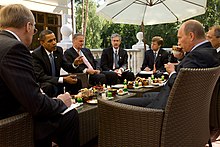
Barack Obama meets with Prime Minister Putin outside Moscow, July 7, 2009 - 2010: The U.S. and Russia call for Iran to give up on its nuclear weapons program along with the United Kingdom, France and China on June 9.
- 2010: Obama and Medvedev sign the "New START" (New Strategic Arms Reduction Treaty). Goal is to reduce the deployed nuclear warheads on both sides by roughly 30 percent, down to 1,550. The treaty also limits the number of nuclear-armed submarines and bombers. New START went into force in February 2011.[406]
- 2010: The U.S. and Russia conduct a joint anti-hijacking exercise called Vigilant Eagle-2010 on August 14.
- 2010: Foreign ministers from the U.S., Russia and NATO meet in New York to discuss areas of cooperation like Afghanistan, fighting piracy and combatting terrorism as well as ways of enhancing security within Europe on September 22.
- 2010: Medvedev attends the 2010 NATO summit in Portugal, from November 19 to November 20. The U.S., Russia and NATO agree to cooperate on missile defense and other security issues as well as allowing more supplies for the U.S. and NATO to pass through Russia en route to Afghanistan as well as supplying Afghan armed forces with helicopters.
- 2011: The New START treaty is ratified in Munich, Germany, by U.S. secretary of state Hillary Clinton and Russian foreign minister Sergey Lavrov on February 5.
- 2011: Ministers from the U.S., Russia and NATO meet in Berlin, Germany to discuss the situation in Libya and Afghanistan, as well as ongoing work on outlining the future framework for missile defence cooperation between the U.S., Russia and NATO on April 15.
- 2011: Russia congratulates the U.S. on the killing of Osama bin Laden on May 2.
- 2011–present: Syrian Civil War; the government receives technical, financial, military and political support from Russia, while the U.S. favors some of the rebels. Russia provides diplomatic support in the United Nations as well. Russia has an interest in a military presence in the region, and in suppressing its own Muslim militants. It also rejects regime change imposed by the West.[409]
- 2011: American, Russian and NATO ambassadors meet in Sochi, Russia, to restate their commitment to pursuing cooperation on missile defense as well as cooperation in other security areas of common interest on July 4.

U.S. Secretary of State Hillary Clinton and Russian Foreign Minister Sergey Lavrov shake hands after signing the New START Treaty, Munich, Germany, on February 5, 2011 - 2011: American, Russian and NATO diplomats meet in New York to announce they have made progress in combating terrorism and enhancing Afghan transit on September 22.
- 2012: Russia agrees to host a U.S. and NATO transit hub at Ulyanovsk airport to help the U.S. and NATO withdrawal from Afghanistan in 2014 on March 21.
- 2012: Obama and Medvedev meet at the 2012 Nuclear Security Summit in Seoul to discuss the increase economic trade on March 26.
- 2012: The U.S., Russia and NATO hold missile defense exercises in Germany, from March 26 to March 30.
- 2012: American, Russian and NATO military forces agree to strengthen cooperation to counter piracy in the Horn of Africa on March 27.
- 2012: Russian prime minister Dmitry Medvedev attends the 38th G8 summit in Maryland, from May 18 to May 19.
- 2012: Russia joins the U.S. and NATO at the Chicago Summit on May 20.
- 2012: Obama and Putin meet at the 7th G-20 meeting in Los Cabos, Mexico, and call for an end to the Syrian civil war on June 18 to 19.
- 2012: American and Russian navies participate in the RIMPAC 2012 naval exercises from June 29 to August 3.
- 2012: Russia joins the WTO and begins trade with the U.S. on August 22.[410]
- 2013: Russia supports the U.S. against North Korea for North Korea building up tensions in the Korean peninsula and for threatening the U.S. during the crisis with North Korea on April 8.
- 2013: The U.S. and Russia agree to intensify their cooperation in countering terrorism, including information exchange between intelligence organizations and conduct joint counter-terrorist operations as well as signing a cyber security pact to reduce the risk of conflict in cyberspace and signing the New Anti-Proliferation Deal in order to protect, control and account for nuclear materials on June 17 during the 39th G8 summit.

Obama at a bilateral meeting with Putin during the G8 summit in Ireland, June 17, 2013.


- 2013 August 7. President Obama cancels an upcoming summit with Putin; journalists call it "a rare, deliberate snub that reflects the fresh damage done by the Edward Snowden case to an important relationship already in decline."[405]
- 2013: Obama and Putin make progress on the discussion of Syria at the end of the 2013 G-20 summit in Saint Petersburg, Russia, on September 6.
- 2013: U.S. secretary of state John Kerry and Russian foreign minister Sergey Lavrov meet in Geneva, Switzerland, and agree to secure and destroy Syria's chemical weapons on September 14.
- 2013: The U.S. and Russia along with the United Kingdom, France, China and Germany sign a deal with Iran about their nuclear program in Geneva, Switzerland, on November 27.
- 2014: The Geneva II Conference
- 2014: The U.S. Olympics team arrives in Sochi, Russia, to participate in the 2014 Winter Olympics on January 30.
- 2014 - Continuing. see Russian military intervention in Ukraine (2014–present)
- 2014: The U.S. and Russia along with the European Union and Ukraine talk in Geneva about the crisis in Ukraine and reach an agreement to end the crisis on April 17.
- 2014: The U.S. and Russia start sending aid to Iraq to help fight ISIS on June 5.
- 2015: The U.S. and Russia along with members of the European Union and Ukraine welcome the new Minsk agreement to stop the war in Donbas in Donbas on February 12.
- 2015: The U.S. and Russia agree to build a new space station to replace the International Space Station and to make a joint project to travel to Mars on March 28.
- 2015: The U.S. and Russia along with the United Kingdom, France, China, Germany, the European Union and Iran sign the Joint Comprehensive Plan of Action to regulate Iran's nuclear program in Vienna, Austria on July 14.
- 2015: The U.S. and Russia reach an agreement on a UN resolution that would designate accountability for use of chemical weapons in Syria on August 6.
- 2015: The U.S. and Russia resume military relations to increase fighting against the Islamic State on September 18.
- 2015: Obama and Putin meet in New York to discuss ways to combat the Islamic State on September 28–29.
- 2015: The U.S. and Russia sign a deal to avoid air incidents over Syria on October 20.
- 2015: Obama and Putin have an informal bilateral meeting on the sidelines of the G-20 Summit in Turkey to discuss the situation in Syria and the ramifications of the Paris attacks on November 15.
- 2015: The U.S., Russia and the United Nations hold three way talks on Syria in Geneva, Switzerland on December 11.
- 2015: The U.S. and Russia, along with the United Nations approve a resolution that supports international efforts to seek a solution to end the Syrian Civil War and provide a new government in Syria in Vienna, Austria on December 18.
- 2016 June: A debate opens inside the Republican Party on future American policy toward Russia. The presumptive presidential nominee Donald Trump has suggested that US and Russia might work together in areas such as Syria. Meanwhile, on June 9, Republican leaders in Congress urged confronting Putin, alleging that he is exhibiting "burgeoning militarism" and calling for "standing up to Russian aggression and bolstering countries such as Ukraine."[411]
- 2016 November: Donald Trump wins the US presidential election.
- 2017 April: According to Trump, US ties with Russia may be at all-time low following US missile strike on Syria.[412]
- 2017 July: During a speech in Warsaw, Poland, Trump warned Russia to stop its "destabilizing" actions in Ukraine and elsewhere, and its support for "hostile regimes" such as those in Syria and Iran. He also urged Russia to "join the community of responsible nations".[413]

U.S. President Donald Trump, Russian President Vladimir Putin, Rex Tillerson, and Sergey Lavrov at the G20 Hamburg summit, July 7, 2017 - 2017 July: Trump and Putin held a meeting for more than a two-hour period at the G20 Summit in Hamburg. Secretary of State Rex Tillerson said that Trump brought up discussion about Russia's alleged interference in the 2016 US presidential election.[414]
- 2018 July 16, Russia–United States summit between Trump and Putin took place in Helsinki, Finland. Topics of discussion included the situation in Syria, the Ukrainian crisis and nuclear arms control.[415]
- 2021 June 16, Russia–United States summit between Biden and Putin took place in Geneva, Switzerland.
- 2021 Nov 19, the congressmen calling on the U.S. not to recognize Vladimir Putin as president of Russia beyond 2024. Kremlin denounced it as an attempt to meddle in its domestic affairs.[416]
- 2022 January, the U.S. sent 5000-8500 troops to Eastern Europe, to assist Ukraine against a potential renewed invasion by Russia.[417]
- 2022 Feb 24, Russia invades Ukraine.
.jpg)
![[icon]](/wiki/File:Wiki_letter_w_cropped.svg) | This section needs expansion. You can help by adding to it. (June 2012) |

The Planetary Society is known to have collaborated with Russia, especially Cosmos 1 and LIFE.
In 2014, NASA renewed a contract to ferry U.S. astronauts to the International Space Station on Soyuz rockets and spacecraft. Including additional support at the Russian launch site, this contract is costing the United States $457.9 million. Along with the renewal, NASA also announced that they would be cutting some contacts with Russia after the annexation of Crimea.[418]
In June 2021, NASA Administrator Bill Nelson told CNN Business' Rachel Crane about the future of U.S.-Russian cooperation in the International Space Station (ISS): "For decades, upwards now of 45 plus years [we've cooperated with] Russians in space, and I want that cooperation to continue. Your politics can be hitting heads on Earth, while you are cooperating" in space.[419]
In December 2022, Russia and the United States agreed to do a prisoner exchange. Russian arms dealer Viktor Bout and American basketball player Brittney Griner were swapped.[420]
In April 2023, US imposed sanctions on Russia & Iran for wrongful detention and hostage-taking of U.S. citizens abroad.[421]
Nuclear arms race[edit]
| This section needs expansion. You can help by adding to it. (July 2019) |
In 1995, a Black Brant sounding rocket launched from the Andøya Space Center caused a high alert in Russia, known as the Norwegian rocket incident.[422] The Russians thought it might be a nuclear missile launched from an American submarine. The incident occurred in the post-Cold War era, where many Russians were still very suspicious of the United States and NATO.[423][424] The Norwegian rocket incident was the first and thus far only known incident where any nuclear-weapons state had its nuclear briefcase activated and prepared for launching an attack.[425]
President Donald Trump announced on October 20, 2018, that the U.S. would no longer consider itself bound by the 1987 INF Treaty's provisions, raising nuclear tensions between the two powers.[426][427][428] Two days later, Russian military analyst Pavel Felgenhauer told Deutsche Welle that the new Cold War would make this treaty and other Cold War-era treaties "irrelevant because they correspond to a totally different world situation."[429] In early 2019, more than 90% of world's 13,865 nuclear weapons were owned by Russia and the United States.[430]
President Putin oversaw Russia's large-scale nuclear war exercises on October 17, 2019, where the Russian army integrated land, sea and air components of the nation's nuclear triad, nearly one year after Trump announced that the US was pulling-out of the nuclear treaty it had signed with Russia.[431]
According to a peer-reviewed study published in the journal Nature Food in August 2022,[432] a full-scale nuclear war between the U.S. and Russia, which together hold more than 90% of the world's nuclear weapons, would kill 360 million people directly and more than 5 billion indirectly from starvation during a nuclear winter.[433][434]
Economic ties[edit]
| This section needs expansion. You can help by adding to it. (November 2012) |
The U.S. Congress repealed the Jackson–Vanik amendment on November 16, 2012.[435]
"Last year [2015] was not particularly favorable for trade between Russia and the U.S. Our overall 2015 turnover was $21 billion, a decline of 27.9 percent," said a senior Russian official in April 2016.[436]
Reuters reported that U.S. companies "generated more than $90 billion in revenue from Russia in 2017."[437] According to the AALEP, "there are almost 3,000 American companies in Russia, and the U.S. is also the leader in terms of foreign companies in Special Economic Zones, with 11 projects."[438]
The U.S. goods and services trade deficit with Russia was $11.2 billion in 2022.[439]
The following chart shows dollar figures from the US Census Bureau's Trade in Goods with Russia page:
- Imports from Russia to the US
- Exports from the US to Russia
Imports from Russia to the US[edit]
One major import is enriched uranium. As of 2023, 24% of enriched uranium in the US is imported from Russia.[440]
Another major import is gasoline, of which Russia the top provider in 2021.[441] During the period 2003-2023 (inclusive), the low-point was December 2003.[442]
Exports from the US to Russia[edit]
In 2023, the Congressional Research Service reported that the US was the third largest source of goods imports to Russia in 2021.[443]
In March 2022, following the Russian invasion of Ukraine, exports from the US to Russia fell dramatically.[444]
Military ties[edit]


Following the demise of the Soviet Union, the United States and Russia signed a bilateral treaty called the Strategic Arms Reduction Treaty (START II), signed by George H. W. Bush and Boris Yeltsin.
The United States and Russia have conducted joint military maneuvers, training and counter-terrorist exercises in Germany. This was done in hopes to strengthen relations with the United States and Russia.[445] The Russian president has also proposed that the United States and Russia put a joint missile defense system in Azerbaijan, a proposal being considered by the United States.[446] In 2008, in response to tensions over Georgia, the United States had cancelled its most recent joint NATO-Russia military exercises.[citation needed]
As of August 2013, the U.S. and Russia continue to hold joint military exercises like Northern Eagle (held since 2004, together with Norway)[447] and Vigilant/Watchful Eagle (with Canada)[citation needed] among others, with the aim of improving joint cooperation against terrorism and piracy.
NATO–Russia relations[edit]
Russia-U.S. relations are significantly influenced by the United States' leading role in NATO and policies thereof. NATO and Russia agreed to cooperate on security issues at the 2002 Rome summit and had been gradually improving relations. However, due to the expansion of the alliance, the Russian intervention in Georgia, Russia's war campaign against Ukraine and other controversies, relations have since deteriorated significantly.[448]
In May 2015, following increased tensions with NATO, Russia closed a key military transport corridor (the Northern Distribution Network), which had allowed NATO to deliver military supplies to Afghanistan through the Russian territory.[449] The Northern Distribution Network was established in 2010 in response to the increased risk of sending supplies through Pakistan.[450]
A June 2016 Levada poll found that 69% of Russians think that deploying NATO troops in the Baltic states and Poland – former Eastern bloc countries bordering Russia – is a threat to Russia.[451]
Joint operations and mutual support[edit]
Russia has expressed support for the United States' War on Terror. Russia has also agreed to provide logistic support for the United States forces in Afghanistan to aid in anti-terrorist operations. Russia has allowed U.S. and NATO forces to pass through its territory to go to Afghanistan.[449] In 2017, the former Deputy Secretary of State Antony Blinken said: "We cooperated with regard to Afghanistan, where Russia played a positive role, particularly in letting our forces and our equipment transit into and out of Afghanistan."[452]
See also[edit]


- Russian Americans
- Foreign relations of Russia
- Foreign relations of the United States
- Embassy of Russia, Washington, D.C.
- Embassy of the United States, Moscow
- Ambassadors of Russia to the United States (including Imperial and Soviet times)
- Ambassadors of the United States to Russia (Including Imperial and Soviet times)
- Russian Empire–United States relations
- Soviet Union–United States relations
- NATO–Russia relations
- Russia–Ukraine relations
- Ukraine–Commonwealth of Independent States relations
- Ukraine–NATO relations
- Ukraine–United States relations
- New Cold War
Notes[edit]
References[edit]
- ^ "U.S.-Russian Relations". Center for Strategic and International Studies. Retrieved August 16, 2021.
- ^ "Russia adds Japan to "unfriendly" countries, regions list in sanctions countermeasure", Mainichi Daily News, March 8, 2022, retrieved September 23, 2023
- ^ "Yeltsin: Russia will not use force against Nato". The Guardian. March 25, 1999.
- ^ "Yeltsin Warns of European War Over Kosovo". Reuters. April 9, 1999.
- ^ "Yeltsin warns of possible world war over Kosovo". CNN. April 9, 1999. Retrieved April 23, 2007.
- ^ "Russia Condemns NATO's Airstrikes". Associated Press. June 8, 1999.
- ^ "Russia says United States is directly involved in Ukraine war". Reuters. August 2, 2022. Retrieved October 1, 2022.
- ^ "With Over 300 Sanctions, U.S. Targets Russia's Circumvention and Evasion, Military-Industrial Supply Chains, and Future Energy Revenues". U.S. Department of the Treasury. June 9, 2023. Retrieved June 22, 2023.
- ^ Hans Rogger, "The influence of the American Revolution in Russia." in Jack P. Greene and J. R. Pole, eds. A Companion to the American Revolution (2000): 554-555.
- ^ "Россия установила дипломатические отношения с США".
- ^ Norman E. Saul, Richard D. McKinzie. Russian-American Dialogue on Cultural Relations, 1776–1914 p 95. ISBN 0-8262-1097-X, 9780826210975.
- ^ James R. Gibson, "Why the Russians Sold Alaska." Wilson Quarterly 3.3 (1979): 179-188 online.
- ^ Thomas A. Bailey, "Why the United States Purchased Alaska." Pacific Historical Review 3.1 (1934): 39-49. online
- ^ Ronald Jensen, The Alaska Purchase and Russian-American Relations (1975)
- ^ Philip Ernest Schoenberg, "The American Reaction to the Kishinev Pogrom of 1903." American Jewish Historical Quarterly 63.3 (1974): 262-283.
- ^ See "Treaty of Portsmouth"
- ^ John W. Long, "American Intervention in Russia: The North Russian Expedition, 1918–19." Diplomatic History 6.1 (1982): 45-68. online
- ^ John Powell (2009). Encyclopedia of North American Immigration. Infobase. pp. 257–59. ISBN 978-1-4381-1012-7.
- ^ Русские трудовые эмигранты в США (конец XIX века – 1917 год)
- ^ MacMillan, Margaret, 1943- (2003). Paris 1919: six months that changed the world. Holbrooke, Richard (First U.S. ed.). New York: Random House. pp. 63–82. ISBN 0-375-50826-0. OCLC 49260285.
{{cite book}}: CS1 maint: multiple names: authors list (link) CS1 maint: numeric names: authors list (link) - ^ Donald E. Davis and Eugene P. Trani (2009). Distorted Mirrors: Americans and Their Relations with Russia and China in the Twentieth Century. University of Missouri Press. p. 48. ISBN 978-0-8262-7189-1.
- ^ Признание Америки Radio Liberty, April 30, 2018.
- ^ "Nov. 16, 1933 | U.S. Establishes Diplomatic Relations With the Soviet Union". The New York Times. November 16, 2011.
- ^ North Atlantic Treaty Organization (NATO), 1949 U.S. Department of State.
- ^ Luman H. Long. 1968 Centennial Edition. The World Almanac and Book of Facts. Newspaper Enterprise Association, Inc., N.Y., N.Y., p. 532.
- ^ Консульская конвенция между Правительством Союза Советских Социалистических Республик и Правительством Соединенных Штатов Америки
- ^ "Milestones: 1969–76 - Office of the Historian". history.state.gov. Retrieved February 9, 2018.
- ^ Malta summit ends Cold War, BBC News, December 3, 1989. Retrieved June 11, 2008.
- ^ Greene, p. 204
- ^ Naftali, George H. W. Bush (2007), pp 137-138
- ^ Greene, pp. 205–206
- ^ Letter to the Secretary-General of the United Nations from the President of the Russian Federation
- ^ Jussi Hanhimäki; Georges-Henri Soutou; Basil Germond (2010). The Routledge Handbook of Transatlantic Security. Routledge. p. 501. ISBN 978-1-136-93607-4.
- ^ Ruud van Dijk; et al. (2013). Encyclopedia of the Cold War. Routledge. pp. 860–51. ISBN 978-1-135-92311-2.
- ^ Strobe Talbott, The Russia Hand (2002) p. 9
- ^ Strobe Talbott, The Russia hand: A memoir of presidential diplomacy (2007) pp 189–213.
- ^ Svetlana Savranskaya, "Yeltsin and Clinton." Diplomatic History (2018) 42#4 pp 564–567.
- ^ a b Lampton, David M. (2024). Living U.S.-China Relations: From Cold War to Cold War. Lanham, MD: Rowman & Littlefield. p. 253. ISBN 978-1-5381-8725-8.
- ^ Ronald D. Asmus, Opening NATO's Door: How the Alliance Remade Itself for a New Era (2002).
- ^ Talbott, The Russia Hand pp 218–250.
- ^ "Russia condemns Nato at UN". BBC News. March 25, 1999.
- ^ "Fighting for a foreign land". BBC News. May 20, 1999.
- ^ Talbott, The Russia Hand pp 298–349.
- ^ Michael Laris (December 10, 1999). "In China, Yeltsin Lashes Out at Clinton: Criticisms of Chechen War Are Met With Blunt Reminder of Russian Nuclear Power". The Washington Post. p. A35.
- ^ Ian Bremmer, and Alexander Zaslavsky, "Bush and Putin's tentative embrace." World Policy Journal 18.4 (2001): 11-17 online.
- ^ Angela E. Stent, The Limits of Partnership: US-Russian Relations in the Twenty-First Century (2014) pp 62–81.
- ^ Stent, The Limits of Partnership (2014) pp 82–134.
- ^ Mazzetti, Mark; Eric Lichtblau (December 11, 2016). "C.I.A. Judgment on Russia Built on Swell of Evidence". The New York Times. Retrieved December 14, 2016.
- ^ "Russia warns of resorting to 'force' over Kosovo". France 24. February 22, 2008.
- ^ In quotes: Kosovo reaction, BBC News Online, 17 February 2008.
- ^ "Putin calls Kosovo independence 'terrible precedent'". The Sydney Morning Herald. February 23, 2008.
- ^ "Address by President of the Russian Federation". March 18, 2014.
- ^ "Why the Kosovo "precedent" does not justify Russia's annexation of Crimea". Washington Post.
- ^ "Ukraine: NATO's original sin". Politico. November 23, 2021.
- ^ "Bush-Putin row grows as pact pushes east". The Guardian. April 2, 2008.
- ^ "Bush stirs controversy over NATO membership". CNN. April 1, 2008.
- ^ Gottemoeller, Rose (June 5, 2007). "Strained Russian Relations Greet Bush in Europe". NPR (Interview). Interviewed by Robert Siegel. Retrieved July 26, 2016.
- ^ Halpin, Tony (October 17, 2007). "Vladimir Putin pledges to complete Iranian nuclear reactor". The Times. Archived from the original on July 6, 2008. Retrieved April 2, 2010.
- ^ "White House Transcript of 17 October 2007 Press Conference". whitehouse.gov. October 17, 2007 – via National Archives.
- ^ "Putin compares US shield to Cuba". BBC News. October 26, 2007. Retrieved April 2, 2010.
- ^ "Russia warns over US-Czech shield". BBC News. July 8, 2008. Retrieved April 2, 2010.
- ^ "No permanent foreign inspectors in US-Czech radar talks: minister". spacedaily.com. May 11, 2008. Retrieved August 8, 2008.
- ^ Andrusz, Katya (August 15, 2008). "Poland Gets U.S. Military Aid in Missile-Shield Deal". Bloomberg.com. Archived from the original on October 22, 2012. Retrieved April 3, 2010.
- ^ "Bush hits Russia on 'bullying and intimidation'". USA Today. August 15, 2008. Archived from the original on October 22, 2012.
- ^ Cooper, Helene (April 1, 2009). "Promises of 'Fresh Start' for U.S.-Russia Relations". The New York Times. Retrieved July 28, 2016.
- ^ "U.S.-Russia Relations: In Need of a New Reset". Time. March 16, 2010. Archived from the original on March 21, 2014. Retrieved May 23, 2010.
- ^ "Obama: U.S. wants strong, peaceful Russia". CNN. July 7, 2009. Retrieved October 28, 2016.
- ^ Spiegel, Peter (July 25, 2009). "Biden Says Weakened Russia Will Bend to U.S." The Wall Street Journal. Retrieved October 28, 2016.
- ^ Baker, Peter; Ellen Barry (March 24, 2010). "Russia and U.S. Report Breakthrough on Arms". The New York Times. Retrieved July 28, 2016.
- ^ U.S. Vice President Meets Putin, Russian Opposition March 10, 2011.
- ^ Biden 'Opposes' 3rd Putin Term The Moscow Times, March 11, 2011.
- ^ Steinhauer, Jennifer (December 15, 2020). "Biden to Face a Confrontational Russia in a World Changed From His Time in Office". The New York Times.
- ^ "Nato rejects Russian claims of Libya mission creep". The Guardian. April 15, 2011.
- ^ "West in "medieval crusade" on Gaddafi: Putin Archived 23 March 2011 at the Wayback Machine." The Times (Reuters). 21 March 2011.
- ^ Herszenhorn, David M.; Ellen Barry (December 8, 2011). "Putin Contends Clinton Incited Unrest Over Vote". The New York Times. Retrieved December 14, 2016.
- ^ Braun, Aurel (2012). "Resetting Russian–Eastern European relations for the 21st century". Communist and Post-Communist Studies. 45 (3–4): 389–400. doi:10.1016/j.postcomstud.2012.07.009. ISSN 0967-067X.
- ^ Ratti, Luca (2013). "'Resetting' NATO–Russia Relations: A Realist Appraisal Two Decades after the USSR". The Journal of Slavic Military Studies. 26 (2): 141–161. doi:10.1080/13518046.2013.779845. ISSN 1351-8046. S2CID 145351757.
- ^ Obama welcomes Syria chemical weapons deal but retains strikes option The Guardian, September 14, 2013.
- ^ Obama's biggest achievement in Syria fell short — and Assad is rubbing it in his face Business Insider, August 28, 2016.
- ^ "Europeans View Obama's Exit With a Mix of Admiration and Regret". The New York Times. November 6, 2016.
- ^ a b Interview With David Gregory of NBC's Meet the Press March 2, 2014.
- ^ Russia's Stake in Iran Nuclear Deal VOA, July 18, 2015.
- ^ Heintz, Jim; Liudas Dapkus (May 3, 2012). "Russia's military threatens pre-emptive strike if NATO goes ahead with missile plan". Fox News. Associated Press. Archived from the original on May 4, 2012. Retrieved August 27, 2012.
- ^ Richard Dunham (August 16, 2012). "Red October redux? John Cornyn demands answers from Pentagon on Russian sub in Gulf of Mexico (UPDATED)". Houston Chronicle. Hearst Communications Inc. Retrieved August 27, 2012.
- ^ "Russia's Putin signs anti-U.S. adoption bill". CNN News Network.
- ^ a b c "Air Force confirms Russian jets circled US territory of Guam". Fox News. February 16, 2013. Retrieved February 20, 2013.
- ^ Bayanihan. Science and Technology. December 27, 2013. Putin: Russia begins deployment of new silo-based missile system December 27, 2013.
- ^ Schwartz, Paul N. (October 16, 2014). "Russian INF Treaty Violations: Assessment and Response". Retrieved April 22, 2016.
- ^ a b Gordon, Michael R. (July 28, 2014). "U.S. Says Russia Tested Cruise Missile, Violating Treaty". The New York Times. USA. Retrieved January 4, 2015.
- ^ "US and Russia in danger of returning to era of nuclear rivalry". The Guardian. UK. January 4, 2015. Retrieved January 4, 2015.
- ^ Испытания новой МБР завершатся в декабре Rossiyskaya Gazeta, December 27, 2014.
- ^ Убийца ПРО «Рубеж» выходит на позиции: последнее предупреждение США TV Zvezda, April 27, 2015.
- ^ Gordon, Michael R. (June 5, 2015). "U.S. Says Russia Failed to Correct Violation of Landmark 1987 Arms Control Deal". The New York Times. US. Retrieved June 7, 2015.
- ^ Suné von Solms and Renier van Heerden. "The Consequences of Edward Snowden NSA Related Information Disclosures." Iccws 2015–The Proceedings of the 10th International Conference on Cyber Warfare and Security (2015) online.
- ^ Sanchez, Raf (August 7, 2013). "Barack Obama cancels meeting with Vladimir Putin over Edward Snowden". The Daily Telegraph. London. Archived from the original on January 12, 2022.
- ^ UN Security Council action on Crimea referendum blocked UN web site.
- ^ Экс-премьер Украины Азаров назвал "кураторов" переворота на Украине RIA Novosti, December 16, 2016.
- ^ новостей, Независимое бюро. "Независимое бюро новостей - Суд в РФ по "перевороту" в Украине допросил Азарова, Клюева, Захарченко и Якименко". Archived from the original on December 17, 2016. Retrieved March 5, 2022.
- ^ ""Интересы РФ и США в отношении Украины несовместимы друг с другом": Глава Stratfor Джордж Фридман о первопричинах украинского кризиса". Kommersant. December 19, 2014.
- ^ "George Friedman: Russia is winning the internet". Business Insider. April 21, 2016.
- ^ Smale, Alison; Shear, Michael D. (March 24, 2014). "Russia Is Ousted From Group of 8 by U.S. and Allies". The New York Times. Retrieved March 25, 2014.
- ^ a b "U.S., other powers kick Russia out of G8". CNN. March 24, 2014. Retrieved March 25, 2014.
- ^ "Russia Suspended From G8 Club Of Rich Countries". Business Insider. March 24, 2014.
- ^ "Barack Obama: Russia is a regional power showing weakness over Ukraine". The Guardian. March 25, 2014. Retrieved November 1, 2014.
- ^ Интервью немецкому изданию Bild. Часть 2 Kremlin.Ru, January 12, 2016.
- ^ Interfax (January 12, 2016). "Putin disagrees with Obama over Russia's regional status, US exceptionalism".
- ^ "Exclusive Interview with European Commission President Jean-Claude Juncker". Euronews. Retrieved November 26, 2016.
- ^ "Russia warns new US sanctions will return ties to Cold War era". Russia News.Net. Archived from the original on July 29, 2014. Retrieved July 18, 2014.
- ^ Statement by the President on the Ukraine Freedom Support Act, December 18, 2014.
- ^ Baker, Peter (December 16, 2014). "Obama Signals Support for New U.S. Sanctions to Pressure Russian Economy". The New York Times. Retrieved December 25, 2014.
- ^ "Ukraine crisis: Russia defies fresh Western sanctions". BBC. December 20, 2014. Retrieved December 25, 2014.
- ^ Koren, Marina (December 31, 2014). "How 2014 Became the Worst Year in U.S.-Russia Relations Since the Cold War". National Journal. Archived from the original on January 1, 2015. Retrieved February 25, 2015.
- ^ Becker, Jo; Bogdanich, Walt; Haberman, Maggie; Protess, Ben (November 25, 2019). "Why Giuliani Singled Out 2 Ukrainian Oligarchs to Help Look for Dirt". The New York Times.
- ^ "Russia's Lavrov says Washington declines deeper military talks on Syria". NEWSru. October 14, 2015. Retrieved October 17, 2015.
- ^ ""Это обидно": Лавров сообщил, что США отказались принять делегацию РФ для обсуждения сирийского кризиса". NEWSru. October 14, 2015. Retrieved October 16, 2015.
- ^ "US president's comments follow coalition's expression of deep concerns over targeting in Russian bombing campaign". The Guardian. October 2, 2015. Retrieved October 23, 2015.
- ^ "As Russia escalates, U.S. rules out military cooperation in Syria". Reuters. October 7, 2015. Archived from the original on October 9, 2015. Retrieved October 9, 2015.
- ^ "Russia will pay price for Syrian airstrikes, says US defence secretary". The Guardian. October 8, 2015.
- ^ "Russians Strike Targets in Syria, but Not ISIS Areas". The New York Times. September 30, 2015. Retrieved October 9, 2015.
- ^ "Meeting with President of Syria Bashar Assad". The Kremlin, Moscow. October 21, 2015. Retrieved July 26, 2016.
- ^ "Assad Makes Unannounced Trip to Moscow to Discuss Syria With Putin". The New York Times. October 21, 2015.
- ^ "Syria crisis: US attacks Moscow welcome for Assad". BBC. October 22, 2015. Retrieved October 23, 2015.
- ^ "U.S. Weaponry Is Turning Syria Into Proxy War With Russia". The New York Times. October 12, 2015. Retrieved October 14, 2015.
- ^ Pengelly, Martin (October 4, 2015). "John McCain says US is engaged in proxy war with Russia in Syria". The Guardian. Archived from the original on October 12, 2015. Retrieved October 17, 2015.
- ^ "U.S., Russia escalate involvement in Syria". CNN. October 13, 2015. Retrieved October 17, 2015.
- ^ ""The Russians have made a serious mistake": how Putin's Syria gambit will backfire". The VOA. October 1, 2015. Retrieved October 17, 2015.
- ^ Simon Shuster (October 12, 2015). "Putin's Syria Gamble". Time. Retrieved October 23, 2015.
- ^ "Сирийское урегулирование продвинулось не дальше Башара Асада". Kommersant. November 16, 2015. Retrieved November 16, 2015.
- ^ "G20: Barack Obama and Vladimir Putin agree to Syrian-led transition", The Guardian, November 16, 2015.
- ^ Gordon, Michael R.; Kramer, Andrew E. (October 3, 2016). "Tension With Russia Rises as U.S. Halts Syria Negotiations". The New York Times. ISSN 0362-4331. Retrieved October 4, 2016.
- ^ "Официальный интернет-портал правовой информации". Retrieved December 14, 2016.
- ^ "Путин подписал закон о приостановлении действия соглашения с США об утилизации плутония". October 31, 2016. Retrieved December 14, 2016.
- ^ "Putin Halts Plutonium Pact, Demands End to Sanctions by U.S." Bloomberg. October 3, 2016. Retrieved October 15, 2016.
- ^ Kramer, Andrew E. (October 3, 2016). "Vladimir Putin Exits Nuclear Security Pact, Citing 'Hostile Actions' by U.S." The New York Times. ISSN 0362-4331. Retrieved October 4, 2016.
- ^ "Russia's United Nations Ambassador: Tensions with US are probably worst since 1973". The Independent. October 15, 2016. Retrieved October 15, 2016.
- ^ "Syria conflict: West considers new sanctions over Aleppo". BBC. October 16, 2016. Retrieved October 16, 2016.
- ^ Cockburn, Harry (October 17, 2016). "UK and US propose economic sanctions against Russia over 'barbaric siege' of Aleppo". The Independent. Retrieved December 12, 2016.
- ^ "Kremlin: Obama team trying to damage ties with Russia". The Washington Post. November 17, 2016. Archived from the original on February 28, 2019. Retrieved June 25, 2021.
- ^ "Послание Президента Федеральному Собранию". December 2016. Retrieved December 14, 2016.
- ^ "Barack Obama orders 'full review' of possible Russian hacking in US election". The Guardian. December 9, 2016.
- ^ "Trump, CIA on collision course over Russia's role in U.S. election". The Washington Post. December 10, 2016.
- ^ "Russia 'intervened to promote Trump' - US intelligence". BBC. December 10, 2016.
- ^ "Donald Trump rejects CIA Russia hacking report". BBC. December 11, 2016.
- ^ "Donald Trump's transition team dismisses CIA findings Russia attempted to influence US election in his favour". The Independent. December 10, 2016.
- ^ Chozick, Amy (December 17, 2016), "Clinton Says 'Personal Beef' by Putin Led to Hacking Attacks", The New York Times, p. A12, retrieved December 17, 2016
- ^ Abdullah, Halimah (December 16, 2016), "Hillary Clinton Singles Out Putin, Comey in Election Loss", NBC News, retrieved December 17, 2016
- ^ Keith, Tamara (December 16, 2016), "In Leaked Remarks, Hillary Clinton Explains Putin's 'Beef' With Her", National Public Radio, retrieved December 17, 2016
- ^ Lourie 2017, back flap.
- ^ "Barack Obama promises retaliation against Russia over hacking during US election". The Guardian. December 16, 2016.
- ^ "Obama Confronts Complexity of Using a Mighty Cyberarsenal Against Russia". The New York Times. December 17, 2016.
- ^ Comment by Foreign Ministry Spokesperson Maria Zakharova on new US National Defence Authorisation Act December 27, 2016.
- ^ Russia-US row: Trump praises Putin amid hacking expulsions BBC, December 31, 2016.
- ^ Obama administration announces measures to punish Russia for 2016 election interference The Washington Post, December 29, 2016.
- ^ Feldman, Brian (January 6, 2017). "DNI Report: High Confidence Russia Interfered With U.S. Election". nymag.com. Retrieved October 6, 2017.
- ^ Boggioni, Tom (August 8, 2022). "Paul Manafort admits sharing info with the Russians during 2016 Trump campaign". Retrieved August 8, 2022.
- ^ "Donald Trump and Vladimir Putin ready to hold summit following historic phone call". The Telegraph. January 28, 2017. Archived from the original on January 12, 2022.
- ^ "Trump and Putin make counter-terror top priority in first call". BBC. January 28, 2017.
- ^ Majumdar, Dave (February 15, 2017). "Russia's Dangerous Nuclear Forces are Back". The National Interest.
- ^ U.S. general says Russia deploys cruise missile, threatens NATO Reuters, March 8, 2017.
- ^ "Statement from Pentagon Spokesman Capt. Jeff Davis on U.S. strike in S" (Press release). U.S. Department of Defense. Retrieved April 7, 2017.
- ^ Starr, Barbara; Diamond, Jeremy (April 6, 2017). "Trump launches military strike against Syria". CNN. Archived from the original on April 7, 2017. Retrieved April 7, 2017.
- ^ "Syria war: US launches missile strikes following chemical 'attack'". BBC News. April 7, 2017. Archived from the original on April 7, 2017. Retrieved April 7, 2017.
- ^ Robinson, Julian. "Putin calls US strikes against Syria 'aggression against sovereign country'". TASS. Retrieved April 7, 2017.
- ^ Morello and Filipov (April 11, 2017). "Tillerson brings tough line to Moscow over Russia's backing for Syrian regime". Washington Post. Retrieved April 11, 2017.
- ^ Медведев объявил, что разгромом военной базы в Сирии США поставили себя "на грань боевых столкновений с Россией" NEWSru, April 7, 2017.
- ^ "Russia says US air strikes in Syria came 'within an inch' of military clash with their forces". The Independent. Retrieved April 7, 2017.
- ^ Moscow, Julian Borger Alec Luhn in (April 13, 2017). "Donald Trump says US relations with Russia 'may be at all-time low'". The Guardian.
- ^ Отношения России и США застыли не только в сфере политики, считает Ушаков RIA Novosti, May 31, 2017.
- ^ Путин назвал отношения России и США худшими со времен холодной войны RIA Novosti, June 2, 2017.
- ^ США впервые не направили в посольство РФ поздравление с Днем России Rossiyskaya Gazeta, June 13, 2017.
- ^ Захарова: США не передавали официального поздравления с Днем России Vedomosti, June 15, 2017.
- ^ Захарова: Москва так и не получила от Вашингтона поздравление с Днем России TASS, June 15, 2017.
- ^ "Spineless Trump First POTUS Not to Congratulate Russian Holiday in 25 Years". June 14, 2017.
- ^ "The Trump administration has denied ExxonMobil permission to bypass sanctions to drill for oil in Russia". CNN. April 21, 2017.
- ^ "Exxon Mobil Sues U.S. Over Penalty For Post-Sanctions Russian Deal". Radio Free Europe/Radio Liberty (RFE/RL). July 20, 2017.
- ^ Hirschfeld Davis, Julie (May 10, 2017). "Trump Bars U.S. Press, but Not Russia's, at Meeting With Russian Officials". New York Times.
- ^ Rosenberg, Matthew; Schmitt, Eric (May 15, 2017). "Trump Revealed Highly Classified Intelligence to Russia, in Break With Ally, Officials Say". The New York Times. p. A1. Archived from the original on May 15, 2017. Retrieved June 17, 2018.
- ^ Miller, Greg; Jaffe, Greg. "Trump revealed highly classified information to Russian foreign minister and ambassador". The Washington Post. Retrieved May 15, 2017.
- ^ Pegues, Jeff (May 16, 2017). "Former officials call Trump's disclosure 'serious'". CBS News. Retrieved May 16, 2017.
- ^ Dalrymple, Jim II; Leopold, Jason (May 15, 2017). "Trump Revealed Highly Classified Information To Russians During White House Visit". BuzzFeed. Retrieved May 16, 2017.
- ^ Wilner, Michael (July 6, 2017). "Trump Calls on Putin to Distance Russia from Syria and Iran". The Jerusalem Post. Retrieved July 26, 2017.
- ^ Cassidy, John (July 7, 2017). "The Trump-Putin Bromance is Back On". The New Yorker. Retrieved July 26, 2017.
- ^ Sampathkumar, Mythili (July 7, 2017). "Donald Trump's meeting with Vladimir Putin lasts more than 2 hours after being scheduled for 30 minutes". The Independent. Retrieved July 26, 2017.
- ^ Nechepurenko, Ivan (July 14, 2017). "Russia Warns U.S. It Could Expel Americans Over Diplomatic Dispute". The New York Times. Retrieved July 18, 2017.
- ^ a b Заявление Министерства иностранных дел Российской Федерации Russian Foreign Ministry, July 28, 2017.
- ^ Russia expels US diplomats in tit-for-tat over sanctions FT, July 28, 2017.
- ^ Американским дипломатам закрыли дачный сезон Kommersant, July 28, 2017.
- ^ "Putin asks US to cut its embassy and consulate staff in Russia by 755". Delhi NYOOOZ. Retrieved July 31, 2017.
- ^ Putin confirms 755 US diplomatic staff must leave BBC, July 30, 2017.
- ^ Эксклюзивное интервью Владимира Путина: почему ответ России чувствителен для США Vesti.ru, July 30, 2017.
- ^ Eckel, Mike (August 3, 2017). "Russia's Medvedev Says U.S. Sanctions Bill Ends Hope For Better Ties". Radio Free Europe/Radio Liberty.
- ^ Медведев: ужесточением санкций США объявили России полноценную торговую войну TASS, August 2, 2017.
- ^ Trump Signs Russian Sanctions Into Law, With Caveats The New York Times, August 2, 2017.
- ^ Statement by President Donald J. Trump on the Signing of H.R. 3364 The White House, August 2, 2017.
- ^ "Achieving Parity in Diplomatic Missions". state.gov. U.S. Department of State. August 31, 2017. Retrieved September 2, 2017.
- ^ Russia condemns US 'plans' to search Washington trade mission BBC, September 2, 2017.
- ^ Statement of the Ministry of Foreign Affairs of the Russian Federation mid.ru, September 3, 2017.
- ^ Merica, Dan (November 11, 2018). "Trump, Putin shake hands, chat multiple times at Asia-Pacific summit". CNN. Retrieved June 17, 2018.
- ^ Despite Trump's hopes, US-Russia relations are getting chilly CNN, December 24, 2017.
- ^ Treasury adds five to Russian sanctions list that has infuriated the Kremlin CNBC, December 20, 2017.
- ^ Trump: Russia and China 'rival powers' in new security plan BBC, December 18, 2017.
- ^ Sarah Sanders cryptically hints at action against Russia CNN, February 20, 2018.
- ^ Trump's 'tougher on Russia' claim fits a pattern of striving to one-up Obama The Washington Post, February 20, 2018.
- ^ Chiefs Of Three Russian Intelligence Agencies Travel To Washington Radio Liberty, February 1, 2018.
- ^ US suspends sanctions against Russian security chiefs during their visit to Washington TASS, February 2, 2018.
- ^ Russian spy chiefs met in Washington with CIA director to discuss counterterrorism The Washington Post, January 31, 2018.
- ^ «Визит Нарышкина касается национальных интересов США» Gazeta.ru, February 2, 2018.
- ^ Why the Directors of Russia's Intelligence Agencies Visited Washington (Op-ed): Secret meetings between the U.S. and Russia are the best hope for restoring relations The Moscow Times, February 8, 2018.
- ^ CIA defends meeting with Russian spy officials, in letter to Schumer Fox News, February 1, 2018.
- ^ White House Considers Citing Russian Deaths in Syria as Sign of U.S. Resolve Bloomberg, February 21, 2018.
- ^ Russian mercenary boss spoke with Kremlin before attacking US forces in Syria, intel claims The Telegraph, February 23, 2018.
- ^ Putin claims new 'invincible' missile can pierce US defenses CNN, March 1, 2018.
- ^ Mattis Sees No Change in Russian Military Capability in Light of Putin's Speech U.S. Department of Defense, March 11, 2018.
- ^ Trump tells aides not to talk publicly about Russia policy moves: But Trump, irked by Putin's nuclear buildup, told him last week: "If you want to have an arms race we can do that, but I'll win." NBC News, March 29, 2018.
- ^ Kosinski, Michelle. "Trump's National Security Council recommends expelling Russian diplomats". CNN. Retrieved March 24, 2018.
- ^ Rucker, Philip; Nakashima, Ellen (March 26, 2018). "Trump administration expels 60 Russian officers, shuts Seattle consulate in response to attack on former spy in Britain". Washington Post. ISSN 0190-8286. Retrieved March 26, 2018.
- ^ США высылают из страны 60 российских дипломатов TASS, March 26, 2018.
- ^ Lavrov: 'Rest assured, Russia won't tolerate' West's obnoxious conduct TASS, March 27, 2018.
- ^ Лавров обвинил США в колоссальном шантаже европейских стран Rossiyskaya Gazeta, March 27, 2018.
- ^ Majumdar, David (April 11, 2018). "Tensions Are Flaring between Washington and Moscow". The National Interest. Retrieved April 11, 2018.
- ^ U.S., Russia clash at U.N. over chemical weapons attacks in Syria Reuters, April 9, 2018.
- ^ Russian officials warn of possible military clash with US over Syria The Guardian, April 10, 2018.
- ^ Россия нацелила "Калибры" на базы США в Сирии: Вооруженные силы РФ скрытно приведены в полную боеготовность Nezavisimaya Gazeta, April 11, 2018.
- ^ "America vows to respond to a suspected chemical attack in Syria". The Economist. April 9, 2018. Retrieved April 10, 2018.
- ^ Assad tells US to leave Syria CNN, May 31, 2018.
- ^ Assad raises prospect of clashes with U.S. forces in Syria Reuters, May 31, 2018.
- ^ DeYoung, Karen (June 9, 2018). "In Trump, some fear the end of the world order". The Washington Post. Retrieved June 9, 2018.
- ^ Zurcher, Anthony (July 16, 2018). "Trump-Putin summit: After Helsinki, the fallout at home". BBC News. BBC News Services. Retrieved July 18, 2018.
- ^ Calamur, Krishnadev (July 16, 2018). "Trump Sides With the Kremlin, Against the U.S. Government". The Atlantic. Retrieved July 18, 2018.
- ^ Trump Hails Summit With Putin, Stirs Anger In Congress Radio Liberty, July 16, 2018.
- ^ "John McCain: Trump gave 'one of the most disgraceful performances by an American president in memory'". CNN. July 16, 2018.
- ^ 'Putin's poodle:' Newspapers around the world react to Trump-Putin meeting CNN, July 17, 2018.
- ^ "Trump approves sanctions on builders of Russia-to-Europe gas pipelines". France24. December 20, 2019.
- ^ "Nord Stream 2: Trump approves sanctions on Russia gas pipeline". BBC News. December 21, 2019.
- ^ "Germany, EU decry US Nord Stream sanctions". Deutsche Welle. December 21, 2019.
- ^ "Ukraine and Russia look to strike new gas deal amid US sanctions threa". CNBC. December 16, 2019.
- ^ "Outrage mounts over report Russia offered bounties to Afghanistan militants for killing US soldiers". The Guardian. June 27, 2020. Retrieved June 27, 2020.
- ^ "Why we need a little skepticism, and more evidence, on Russian bounties". The Hill. July 7, 2020.
- ^ a b c Nakashima, Ellen; DeYoung, Karen; Ryan, Missy; Hudson, John (June 28, 2020). "Russian bounties to Taliban-linked militants resulted in deaths of U.S. troops, according to intelligence assessments". The Washington Post.
- ^ a b c "Top Pentagon officials say Russian bounty program not corroborated". ABC News. July 10, 2020.
- ^ "House panel votes to constrain Afghan drawdown, ask for assessment on 'incentives' to attack US troops". The Hill. July 1, 2020.
- ^ Axe, David (September 25, 2020). "U.S. Air Force B-52s Just Flew A Mock Bombing Run On Russia's Baltic Fortress". Forbes.
- ^ Withnall, Adam; Sengupta, Kim (January 12, 2017). "The 10 key Donald Trump allegations from the classified Russia memos". The Independent. Retrieved December 29, 2017.
- ^ Bertrand, Natasha (January 10, 2017). "Trump briefed on unverified claims that Russian operatives have compromising information on him". Business Insider. Retrieved February 26, 2018.
- ^ Bergman, Ronen (January 12, 2017). "US intel sources warn Israel against sharing secrets with Trump administration". Ynetnews. Retrieved April 1, 2018.
- ^ "Trump expects Russia to return Crimea to Ukraine: White House". Reuters. February 14, 2017.
- ^ "Trump blames Putin for backing 'Animal Assad'". Politico. April 8, 2018.
- ^ Rampton, Roberta; Sobczak, Pawel (July 6, 2017). "Trump criticizes Russia, calls for defense of Western civilization". Reuters.
- ^ "Exclusive: Trump accuses Russia of helping North Korea evade sanctions; says U.S. needs more missile defense". Reuters. January 17, 2018.
- ^ "Venezuela crisis: Russia hits out at 'boorish' Trump". BBC News. March 28, 2019.
- ^ "Trump vows to 'counteract' any Russia election meddling". Daily Nation. March 7, 2018.
- ^ "Trump expelling 60 Russian diplomats in wake of UK nerve agent attack". CNN. March 26, 2018.
- ^ Borak, Donna; Egan, Matt (April 21, 2017). "Trump denies Exxon permission to drill for oil in Russia". CNN.
- ^ Bunch, Sonny (March 15, 2017). "Rachel Maddow takes conspiracy theorizing mainstream with Trump tax 'scoop'". The Washington Post.
- ^ "Trump, Russia, and the collapse of the collusion narrative". Al-Jazeera. March 30, 2019. Archived from the original on May 4, 2019. Retrieved December 25, 2019.
- ^ Greenwald, Glenn (April 18, 2019). "Robert Mueller Did Not Merely Reject the Trump-Russia Conspiracy Theories. He Obliterated Them". The Intercept.
- ^ Bershidsky, Leonid (March 31, 2019). "The U.S. Needs a Post-Mueller Reality Check". Bloomberg News.
- ^ Paskin, Willa (March 29, 2019). "Rachel Maddow's Conspiracy Brain". Slate.
- ^ Reynolds, Glenn (April 22, 2019). "Mueller report: Donald Trump collusion conspiracy theories are now exposed. Will they end?". USA Today.
- ^ Barkan, Ross (March 28, 2019). "Will Rachel Maddow face a reckoning over her Trump-Russia coverage?". The Guardian.
- ^ Bertrand, Natasha (September 30, 2019). "The Russia Hawk in the White House". Politico. Retrieved November 11, 2019.
- ^ Mackey, Robert (July 16, 2018). "Trump and Putin Met in Helsinki's Hall of Mirrors. Here Are the Highlights". The Intercept. Retrieved November 11, 2019.
- ^ Blake, Aaron (July 17, 2018). "The growing Trump-Putin kompromat question". The Washington Post. Retrieved November 11, 2019.
- ^ "James Clapper on Trump-Russia Ties: 'My Dashboard Warning Light Was Clearly On". NBC News. May 28, 2017.
- ^ Sheth, Sonam (August 30, 2019). "US spies say Trump's G7 performance suggests he's either a 'Russian asset' or a 'useful idiot' for Putin". Business Insider. Retrieved November 12, 2019.
- ^ Sheth, Sonam (August 27, 2019). "Russia came out the winner of this year's G7 summit, and Trump looked like 'Putin's puppet'". Business Insider. Retrieved November 12, 2019.
- ^ "Clapper: I wonder if Russians have something on Trump". CNN. July 19, 2018. Retrieved November 12, 2019.
- ^ Sevastopulo, Demetri; Hille, Kathrin (July 20, 2018). "Trump-Putin: Will Helsinki prove a turning point for the Republicans?". Financial Times. Archived from the original on December 11, 2022. Retrieved November 12, 2019.
- ^ Boot, Max (January 13, 2019). "Here are 18 reasons Trump could be a Russian asset". The Washington Post. Retrieved November 12, 2019.
- ^ DeBonis, Mike; Kim, Seung Min (October 17, 2019). "'All roads lead to Putin': Pelosi questions Trump's loyalty in White House clash". The Washington Post. Retrieved November 12, 2019.
- ^ "In A Response To Navalny's Arrest, Clues To Biden's Russia Policy". Radio Free Europe/Radio Liberty. January 19, 2021. Retrieved January 25, 2021.
- ^ "Russia Urges Biden to Be 'More Constructive' Over Arms Treaty". The Moscow Times. January 20, 2021. Retrieved January 25, 2021.
- ^ "Renewed US-Russia nuke pact won't fix emerging arms threats". Associated Press. January 27, 2021. Retrieved January 28, 2021.
- ^ "Захарова "не припомнит", чтобы посла РФ в США раньше приглашали в Москву на консультации". TASS (in Russian). March 17, 2021. Retrieved March 18, 2021.
- ^ "Russia recalls envoy after Biden remarks about Putin". BBC. March 17, 2021. Retrieved March 18, 2021.
- ^ "Department Press Briefing – March 17, 2021". state.gov. March 17, 2021. Retrieved March 18, 2021.
- ^ "U.S. Sanctions On Russian Debt Still 'More Bark Than Bite,' Analysts Say". Radio Free Europe/Radio Liberty. March 16, 2021. Retrieved April 18, 2021.
- ^ "Russia, retaliating against Washington, asks 10 U.S. diplomats to leave". Reuters. March 17, 2021. Retrieved April 18, 2021.
- ^ "Nord Stream 2: Biden waives US sanctions on Russian pipeline". BBC News. May 20, 2021. Retrieved May 20, 2021.
- ^ Sanger, David (May 25, 2021). "Biden and Putin to meet in mid-June in a summit fraught with tensions". The New York Times.
- ^ Madhani, Aamer; Lemire, Johnathan; Isachenkov, Vladimir (June 17, 2021). "'Practical work' summit for Biden, Putin: No punches or hugs". Associated Press.
- ^ "Fact Sheet: United States Imposes Additional Costs on Russia for the Poisoning of Aleksey Navalny". United States Department of State. Retrieved August 24, 2021.
- ^ Teslova, Elena (December 1, 2021). "Russia orders longtime US Embassy staff to leave country by Jan. 31". Anadolu Agency.
- ^ "Moscow says 27 more Russian diplomats due to leave U.S. in January". Reuters. November 28, 2021. Retrieved December 1, 2021.
- ^ "Russia suspends New START - Google Search". www.google.com. Retrieved February 22, 2023.
- ^ Cooper, Helene; Barnes, Julian E. (May 5, 2021). "80,000 Russian Troops Remain at Ukraine Border as U.S. and NATO Hold Exercises". The New York Times. Archived from the original on January 14, 2022.
- ^ "Kremlin denies plans to invade Ukraine, alleges NATO threats". Politico. November 12, 2021. Archived from the original on December 19, 2021.
- ^ a b Isachenkov, Vladimir; Karmanau, Yuras (January 17, 2022). "Russia denies looking for pretext to invade Ukraine". ABC News. Archived from the original on January 22, 2022.
- ^ "Russia will act if Nato countries cross Ukraine 'red lines', Putin says". The Guardian. November 30, 2021.
- ^ "NATO Pushes Back Against Russian President Putin's 'Red Lines' Over Ukraine". The Drive. December 1, 2021.
- ^ "Putin warns Russia will act if NATO crosses its red lines in Ukraine". Reuters. November 30, 2021.
- ^ "Putin Demands NATO Guarantees Not to Expand Eastward". U.S. News & World Report. December 1, 2021.
- ^ "US will help to end Ukraine conflict with Russia, Biden tells Kyiv". Euronews. December 10, 2021.
- ^ "Is Russia preparing to invade Ukraine? And other questions". BBC News. December 10, 2021.
- ^ "Biden and Putin exchange warnings during phone call amid rising Ukraine tensions". The Guardian. December 30, 2021. Retrieved January 10, 2022.
- ^ "EXPLAINER: Main issues at Russia-US security talks". AP NEWS. January 10, 2022. Retrieved January 10, 2022.
- ^ "Senior officials to lead Russia-U.S. security talks in Geneva on Jan. 10". Reuters. December 30, 2021. Retrieved January 2, 2022.
- ^ "UN security council meets to discuss Ukraine crisis". The Guardian. Agence France-Presse. January 31, 2022. Retrieved January 31, 2022.
- ^ "U.S. approves allied weapons shipments to Ukraine as worries mount". Politico. January 19, 2022. Archived from the original on January 23, 2022. Retrieved January 24, 2022.
- ^ Cooper, Helene (January 15, 2022). "US considers backing an insurgency if Russia invades Ukraine". The New York Times. Archived from the original on January 23, 2022. Retrieved January 23, 2022.
- ^ Charap, Samuel; Scott, Boston (January 21, 2022). "U.S. Military Aid to Ukraine: A Silver Bullet?". RAND Corporation. Archived from the original on January 22, 2022. Retrieved January 24, 2022.
- ^ Michael Crowley; Edward Wong (January 29, 2022). "U.S. Sanctions Aimed at Russia Could Take a Wide Toll". The New York Times.
- ^ "Nord Stream 2 will not move forward if Russia invades Ukraine -State Dept". Reuters. January 27, 2022.
- ^ "Russia slams US' words about plans to justify alleged invasion of Ukraine as nonsense". TASS. February 4, 2022.
- ^ "Biden predicts Russia will invade Ukraine". NBC News. January 19, 2022. Archived from the original on January 21, 2022. Retrieved January 22, 2022.
- ^ "Joe Biden thinks Russia will attack Ukraine – but will face a 'stiff price'". The Guardian. January 20, 2022. Archived from the original on January 22, 2022. Retrieved January 22, 2022.
- ^ "Ukraine crisis: US president Joe Biden tells Zelensky to 'prepare' for Russian invasion". The New Zealand Herald. January 28, 2022.
- ^ "Ukraine's president told Biden to 'calm down' Russian invasion warnings, saying he was creating unwanted panic: report". Yahoo News. January 28, 2022.
- ^ "Biden warns Americans in Ukraine to leave, says sending troops to evacuate would be 'world war'". NBC. February 10, 2022.
- ^ Desk, NPR Washington (February 11, 2022). "Russia could begin an invasion before the Olympics end, Biden adviser says". NPR. Retrieved February 11, 2022.
- ^ "Half of Americans Support Use of US Troops in Defense of Ukraine". Chicago Council on Global Affairs. September 14, 2021.
- ^ "Ukraine crisis: Russians hope for peace as the world talks of war". Al Jazeera. January 27, 2022.
- ^ "Russian public doesn't want war, but is anyone listening?". The Monitor. February 4, 2022.
- ^ Alsaafin, Linah; Uras, Umut (February 12, 2022). "Biden warns Putin of 'severe costs' of Ukraine invasion". Al Jazeera. Al Jazeera. AL Jazeera. Retrieved February 12, 2022.
- ^ "AP-NORC poll: More support for Ukraine, concern about Russia". Associated Press. March 23, 2022.
- ^ "US accuses Moscow of creating Ukraine invasion pretext with 'genocide' claims". France 24. France 24. France 24. February 16, 2022. Retrieved February 16, 2022.
- ^ "Ukraine tensions: US sounds fresh alarm over Russia invasion fears". BBC News. BBC News. BBC News. February 20, 2022. Retrieved February 20, 2022.
- ^ "What to know about new U.S. sanctions targeting Russia over Ukraine". CBS News. Retrieved February 23, 2022.
- ^ Holland, Steve; Stone, Mike (February 26, 2022). "Biden approves $350 million in military aid for Ukraine". Reuters.
- ^ Wilkinson, Tracy (March 8, 2022). "Ukraine wants a no-fly zone. Why do the U.S. and NATO reject the idea?". Los Angeles Times.
- ^ "Senior Russian security official issues stark threats to the West". Al Jazeera. Al Jazeera. AP. February 26, 2022. Retrieved February 26, 2022.
- ^ Pamuk, Humeyra; Chiacu, Doina (March 5, 2022). "U.S., allies slam Russia at U.N. over its seizure of Ukraine nuclear plant". Reuters.
- ^ Khaled, Fatma (March 13, 2022). "Russia Hitting NATO Even Accidentally Will Spur 'Full' Response: Sullivan". Newsweek.
- ^ "Russia outlines plan for 'unfriendly' investors to sell up at half-price". Reuters. December 30, 2022.
- ^ "Most Americans don't like Biden's Ukraine response and worry about inflation". NPR. March 24, 2022.
- ^ "War in Ukraine: U.S. dramatically upgrades its aid package to Kyiv". Le Monde. April 29, 2022.
- ^ "Russian politician threatens to retaliate against US sanctions by reclaiming Alaska". Anchorage Daily News. July 6, 2022. Retrieved July 6, 2022.
- ^ "Read Putin's national address on a partial military mobilization". Washington Post. ISSN 0190-8286. Retrieved September 23, 2022.
- ^ "The White House told Russians to flee here instead of fighting Ukraine. Then the U.S. tried to deport them". Los Angeles Times. August 17, 2023.
- ^ "Biden administration quietly resumes deportations to Russia". The Guardian. March 18, 2023.
- ^ Berlin, Michael R. Gordon and Gordon Lubold in Washington and Bojan Pancevski in (January 25, 2023). "U.S., Germany Approve Sending Tanks to Ukraine". The Wall Street Journal. Retrieved February 9, 2023.
- ^ Hubbard, Ben (February 4, 2023). "U.S. Presses Partners to Weed Out Illicit Trade With Russia". The New York Times. Retrieved February 4, 2023.
- ^ "Most Americans Still Support Ukraine War Effort". Gallup. June 29, 2023.
- ^ "CNN Poll: Majority of Americans oppose more US aid for Ukraine in war with Russia". CNN. August 4, 2023.
- ^ "Senate fails to advance Ukraine aid despite dire warnings from Biden". NPR. December 6, 2023.
- ^ Timsina, Nilutpal (April 13, 2024). "LME releases notice after UK and US take action targeting Russian metals". Reuters. Retrieved April 14, 2024.
- ^ Andrew, Christopher; Mitrokhin, Vasili (1999). The Sword and the Shield: The Mitrokhin Archive and the Secret History of the KGB. New York: Basic Books. p. 15. ISBN 0-465-00312-5.
- ^ Evan Perez; Shimon Prokupecz (April 8, 2015). "How the U.S. thinks Russians hacked the White House". CNN. Retrieved December 17, 2016.
Russian hackers behind the damaging cyber intrusion of the State Department in recent months used that perch to penetrate sensitive parts of the White House computer system, according to U.S. officials briefed on the investigation.
- ^ "Police Arrest Alleged U.S. Spy Working in Heart of Russian Cybersecurity". Moscow Times. January 26, 2017.
- ^ "How Not To Prevent a Cyberwar With Russia". Wired. June 18, 2019.
- ^ "Obama agrees arms cuts, Afghan transit with Russia". Reuters. July 6, 2009. Archived from the original on March 5, 2016. Retrieved April 2, 2010.
- ^ Stott, Michael (July 6, 2009). "Chilly welcome awaits Obama in Russia". Reuters. Archived from the original on December 10, 2013. Retrieved April 2, 2010.
- ^ Pushkov, Alexei K. (Spring 1997). "Don't Isolate Us: A Russian View of NATO Expansion". The National Interest. Vol. 47, no. 47. pp. 58–63. JSTOR 42896937.
- ^ Gavrov, Sergei (April 30, 2013). "US Still Has a Chance". Vzglyad, Russia. Retrieved April 30, 2013.
- ^ Orlov, Dmitriy (July 31, 2009). "Truman and Churchill No Better Than Stalin". Izvestia. Retrieved April 2, 2010.
- ^ Trostnikov, Victor (January 21, 2009). "Obama Presidency Marks End of Western Civilization". Argumenty i Fakty. Retrieved April 2, 2010.
- ^ Novoprudski, Semen (October 17, 2009). "Russia's Elite Must Embrace New Era with U.S." Gazeta.ru. Retrieved April 2, 2010.
- ^ Golz, Alexander (September 18, 2009). "Shall Russians Praise or Curse 'Those Treacherous Yankees'?". Yezhednevniy Zhurnal, Russia. Retrieved April 2, 2010.
- ^ Markedonov, Sergey (October 19, 2009). "Russians Shouldn't Be Happy About America's Afghan Misfortune". Kommersant. Retrieved April 2, 2010.
- ^ "Obama: The Color of Change for Both Russia and Europe". Vedomosti. November 6, 2008. Retrieved April 2, 2010.
- ^ "Opinion of the United States". Pew Research Center.
- ^ "Opinions in Russia". Washington Post. March 8, 2015. Archived from the original on July 9, 2016. Retrieved July 26, 2016.
- ^ Birnbaum, Michael (March 8, 2015). "Russia's anti-American fever goes beyond the Soviet era's". The Washington Post. Retrieved July 27, 2016.
- ^ "Anti-American Sentiment on the Rise in Russia". The Wall Street Journal. June 5, 2014.
- ^ "Americans Increasingly See Russia as Threat, Top U.S. Enemy". Gallup. February 16, 2015.
- ^ "Global Indicators Database: Opinion of Russia". Pew Research Center. 2015. Retrieved July 26, 2016.
- ^ "Global Indicators Database: Opinion of the United States". Pew Research Center. 2015. Retrieved July 26, 2016.
- ^ a b "Russia". Gallup.com. Retrieved November 2, 2017.
- ^ Reyes, G. (2023, March 21). Our greatest threat: China, Russia or climate change? Americans weigh in. Fox News. Retrieved May 2, 2023; Jones, J. (2023, March 13). Americans' favorable rating of Russia sinks to new low of 9%. Gallup. Retrieved May 2, 2023.
- ^ "People in Britain and the U.S. disagree on who did more to beat the Nazis". YouGov. May 1, 2015.
- ^ Wike, Richard; Stokes, Bruce; Poushter, Jacob; Fetterolf, Janell (June 26, 2017). "1. The tarnished American brand".
- ^ U.S. Image Suffers as Publics Around World Question Trump's Leadership Pew Research Center, June 26, 2017.
- ^ Campbell, Cathleen A. (June 20, 2014). "Warming U.S.-Russia relations". Science. 344 (6190): 1323. Bibcode:2014Sci...344.1323C. doi:10.1126/science.1257373. ISSN 0036-8075. PMID 24948710.
- ^ Rice, Condoleezza (October 2008). "US-Russia Relations". Hampton Roads International Security Quarterly – via Proquest.
- ^ Affairs, Chicago Council on Global (November 4, 2016). "US and Russia: Insecurity and Mistrust Shape Mutual Perceptions | Chicago Council on Global Affairs". www.thechicagocouncil.org. Archived from the original on December 10, 2017. Retrieved November 17, 2017.
- ^ "US-Russia relations fail to improve in Trump's first year and they are likely to get worse". The Independent. January 19, 2018.
- ^ "More Russians are sure of the U.S. meddling in their politics than the other way around, poll finds". The Washington Post. February 7, 2018.
- ^ "Favorable Attitudes Toward U.S., EU Rising In Russia, Poll Finds". Radio Free Europe/Radio Liberty. August 2, 2018.
- ^ "Anti-Americanism Wanes in Russia After Putin-Trump Summit, Survey Says". The Moscow Times. August 2, 2018.
- ^ a b "How 'Russiagate' Has Reshaped American and Russian Public Opinion". The Nation. April 11, 2019. Archived from the original on April 18, 2019. Retrieved July 31, 2019.
- ^ a b "4 in 5 Russians View West as a Friend – Poll". The Moscow Times. February 18, 2020.
- ^ "Russia and Putin receive low ratings globally". Pew Research Center. February 7, 2020.
- ^ "How people around the world see the U.S. and Donald Trump in 10 charts". Pew Research Center. January 8, 2020.
- ^ "1. Little trust in Trump's handling of international affairs". Pew Research Center. January 8, 2020.
- ^ "Few in other countries approve of Trump's major foreign policies, but Israelis are an exception". Pew Research Center. February 3, 2020.
- ^ Lopatka, Jan (February 7, 2017). "Radio Free Europe launches new Russian-language TV channel". Reuters. Retrieved March 28, 2021.
- ^ Якунин В. И.; Багдасарян В. Э. [in Russian]; Сулакшин С. С. [in Russian] (2013). Новые технологии борьбы с российской государственностью: монография (PDF). М.: Научный эксперт. Archived from the original (PDF) on July 6, 2014. Retrieved December 13, 2016., pp. 282–283.
- ^ "Russia Hysteria Infects WashPost Again: False Story About Hacking U.S. Electric Grid". The Intercept. December 31, 2016.
- ^ "The New Yorker's Big Cover Story Reveals Five Uncomfortable Truths About U.S. and Russia". The Intercept. February 28, 2017.
- ^ "Beyond BuzzFeed: The 10 Worst, Most Embarrassing U.S. Media Failures on the Trump-Russia Story". The Intercept. January 20, 2019.
- ^ Nemtsova, Anna (March 5, 2021). "Putin Ramps Up RT's Propaganda Budget as Poll Rating Slumps". The Daily Beast. Retrieved March 28, 2021.
- ^ "Inside Russia's state-media propaganda machine". Politico. September 28, 2020. Retrieved March 28, 2021.
- ^ "MEPs sound alarm on anti-EU propaganda from Russia and Islamist terrorist groups - News - European Parliament". November 23, 2016. Retrieved December 14, 2016.
- ^ Rutenberg, Jim (September 18, 2016). "Larry King, the Russian Media and a Partisan Landscape". The New York Times.
- ^ Kramer, Andrew E (August 22, 2010). "Russian Cable Station Plays to U.S." The New York Times.
- ^ Angela E. Stent, The Limits of Partnership: U.S. Russian Relations in the Twenty-First Century (2014), pp 282–93.
- ^ "Chronology of Important Events" online from U. S. government
- ^ James Brooke, "Decades Later, Tales of Americans in Soviet Jails," New York Times July 19, 1996
- ^ Marco De Andreis; Francesco Calogero (1995). The Soviet Nuclear Weapon Legacy. Oxford University Press. p. 12. ISBN 978-0-19-829197-8.
- ^ Jinyuan Su, "Use of Outer Space for Peaceful Purposes: Non-Militarization, Non-Aggression and Prevention of Weaponization." Journal of Space Law 36 (2010): 253+.
- ^ American President: A Reference Resource. Foreign Affairs. George H.W.Bush Front Page. Miller Center. University of Virginia. History. Policy. Impact. Retrieved February 6, 2014.
- ^ T. L. Friedman (April 1993) SUMMIT IN VANCOUVER; CLINTON PRESENTS BILLION TO YELTSIN IN U.S. AID PACKAGE The New York Times Archives. Retrieved February 6, 2014.
- ^ "China, Russia sign pact: Yeltsin and Jiang Oppose any single world power," CNN April 23, 1997
- ^ J. L. Black, Russia faces NATO expansion: bearing gifts or bearing arms? (2000).
- ^ Kovatch, William J. Jr. (Winter 1998). "Comments: Joining the Club: Assessing Russia's Application for Accession to the World Trade Organization" (PDF). Temple Law Review. 71: 3. Archived from the original (PDF) on August 16, 2016. Retrieved July 26, 2016.
- ^ Averre, Derek (2009). "From Pristina to Tskhinvali: the legacy of Operation Allied Force in Russia's relations with the West". International Affairs. 85 (3): 575–591. doi:10.1111/j.1468-2346.2009.00815.x. ISSN 0020-5850. JSTOR 27695032.
- ^ Bill Clinton, Boris Yeltsin, and U.S.-Russian Relations Milestones: 1993–2000. U.S. Department of State. Office of the Historian. Retrieved February 6, 2014.
- ^ Condoleezza Rice (2011). No Higher Honour. Simon and Schuster. p. xxx. ISBN 978-0-85720-809-5.
- ^ Anatole Lieven, "The secret policemen's ball: the United States, Russia and the international order after 11 September." International Affairs 78#2 (2002): 245–259.
- ^ George W. Bush, "Letter of transmittal and article-by-article analysis of the treaty on strategic offensive reductions." Arms Control Today 32#6 (2002): 28.
- ^ Julianne Smith, The NATO-Russia relationship: defining moment or déjà vu? (CSIS, 2008).
- ^ Daniel Mandel, "Four-Part Disharmony: The Quartet Maps Peace." Middle East Quarterly (Summer 2003), pp. 15–27 online
- ^ "Russia's Putin Calls Iraq War A 'Mistake'". The Washington Post.
- ^ Alcaro, Riccardo (2009). "The Global Initiative to Combat Nuclear Terrorism: Big Potential, Limited Impact?". The International Spectator. 44: 99–112. doi:10.1080/03932720802693002. S2CID 155077525.
- ^ a b Brad Plumer, "A short timeline of deteriorating U.S.-Russia relations," Washington Post August 8, 2013
- ^ a b Plumer, "A short timeline of deteriorating U.S.-Russia relations," Washington Post August 8, 2013.
- ^ Seung‐Ho Joo, "Moscow–Pyongyang Relations under Kim Jong‐il: High Hopes and Sober Reality" Pacific Focus 24.1 (2009): 107–130.
- ^ Mankoff, Jeffrey (2012). "The politics of US missile defence cooperation with Europe and Russia". International Affairs. 88 (2): 329–347. doi:10.1111/j.1468-2346.2012.01074.x. ISSN 0020-5850.
- ^ Roy Allison, "Russia and Syria: explaining alignment with a regime in crisis." International Affairs 89.4 (2013): 795–823.
- ^ Stephen K. Wegren, "The Impact of WTO Accession on Russia's Agriculture." Post-Soviet Affairs 28.3 (2012): 296–318.
- ^ Damian Paletta, "House GOP Plan Differs From Donald Trump on Foreign Policy: One notable departure is the lawmakers' hard line on Vladimir Putin, whom Trump has praised" The Wall Street Journal June 9, 2016
- ^ "Donald Trump says US relations with Russia 'may be at all-time low'". The Guardian. April 12, 2017.
- ^ "Trump tells Russia to stop 'destabilising' Ukraine". BBC News. July 6, 2017.
- ^ Merica, Dan; Liptak, Kevin (July 7, 2017). "US, Russia disagree over what Trump and Putin actually said to each other". CNN.
- ^ "Trump sides with Russia against FBI at Helsinki summit". BBC News. July 16, 2018.
- ^ "Kremlin Slams U.S. Bid Not to Recognize 'Autocrat' Vladimir Putin as President after 2024". Newsweek. November 19, 2021.
- ^ "US places up to 8,500 troops on alert for possible deployment to Eastern Europe amid Russia tensions". CNN. January 24, 2022.
- ^ Zezima, Katie (April 18, 2014). "Despite sanctions, Russia is getting a $457.9M check from NASA". Washington Post. Retrieved July 26, 2016.
- ^ "NASA chief says Russia leaving ISS could kick off a space race". CNN. June 4, 2021.
- ^ Ganguli, Tania; Abrams, Jonathan; Bubola, Emma (December 17, 2022). "What We Know About Brittney Griner's Release from Russia". The New York Times.
- ^ "U.S. imposes sanctions on Russia and Iran for wrongful detention and hostage-taking of American citizens". CNBC. April 27, 2023.
- ^ "The World Was Never Closer To Nuclear War Than On Jan. 25, 1995". Business Insider. August 7, 2012.
- ^ Forden, Dr. Geoffrey (November 6, 2001). "False Alarms in the Nuclear Age". NOVA. Public Broadcasting System.
- ^ Pry, Peter (1999). "Black Brant XII". War scare: Russia and America on the nuclear brink. New York: Praeger. pp. 214–227. ISBN 0-275-96643-7.
- ^ Andreas Budalen; Dan Henrik Klausen (February 26, 2012). "Verden har aldri vært nærmere atomkrig" [The world has never been closer to nuclear war]. www.nrk.no (in Norwegian).
- ^ Hurlbert, Heather (October 26, 2018). "Russia Violated an Arms Treaty. Trump Ditched It, Making the Nuclear Threat Even Worse". New York Magazine. USA.
- ^ "Russia may have violated the INF Treaty. Here's how the United States appears to have done the same". Bulletin of the Atomic Scientists. February 7, 2019.
- ^ Kramer, Andrew E. (May 12, 2016). "Russia Calls New U.S. Missile Defense System a 'Direct Threat'". The New York Times. NYT.
- ^ Felgenhauer, Pavel (October 22, 2018). "Prepare for a 'new Cold War' without INF, Russia analyst says". DW (Interview). Retrieved July 25, 2019.
- ^ "Global Nuclear Arsenal Declines, But Future Cuts Uncertain Amid U.S.-Russia Tensions". Radio Free Europe/Radio Liberty. June 17, 2019.
- ^ Isachenkov, Vladimir (October 17, 2019). "Putin directs exercise of Russian nuclear forces". Associated Press. Retrieved October 17, 2019.
- ^ Xia, Lili; Robock, Alan; Scherrer, Kim; Harrison, Cheryl S.; Bodirsky, Benjamin Leon; Weindl, Isabelle; Jägermeyr, Jonas; Bardeen, Charles G.; Toon, Owen B.; Heneghan, Ryan (August 15, 2022). "Global food insecurity and famine from reduced crop, marine fishery and livestock production due to climate disruption from nuclear war soot injection". Nature Food. 3 (8): 586–596. doi:10.1038/s43016-022-00573-0. hdl:11250/3039288. PMID 37118594. S2CID 251601831.
- ^ Diaz-Maurin, François (October 20, 2022). "Nowhere to hide: How a nuclear war would kill you — and almost everyone else". Bulletin of the Atomic Scientists.
- ^ "World Nuclear war between the U.S. and Russia would kill more than 5 billion people – just from starvation, study finds". CBS News. August 16, 2022.
- ^ Englund, Will (November 17, 2012). "Russia chafes as House passes Magnitsky Act". The Washington Post. Retrieved July 27, 2016.
- ^ Lydia Tomkiw, "Russia Economy 2016: No GDP Growth Expected Amid Low Oil Prices, Sanctions, Government Officials Admit" IBT April 21, 2016
- ^ "Factbox: U.S. companies with exposure to Russia". Reuters. August 9, 2018.
- ^ "AMERICAN COMPANIES OPERATING IN RUSSIA". Association of Accredited Public Policy Advocates to the European Union.
- ^ "U.S.-Russia Trade Facts". United States Trade Representative. Archived from the original on March 16, 2022. A deficit means that imports exceed exports.
- ^ "Why the US and Europe Still Buy Russian Nuclear Fuel". Bloomberg News. August 27, 2023. Archived from the original on August 27, 2023. Retrieved December 3, 2023.
- ^ Ken Roberts. "Russia Is United States' Top Source Of Imported Gas, Refined Petroleum". Forbes.
- ^ "US Imports of Crude Oil and other Petroleum Products". Energy Information Administration.
- ^ Andres B. Schwarzenberg. "Russia's Trade and Investment Role in the Global Economy". Congressional Research Service.
- ^ "Trade in Goods with Russia". US Census Bureau.
- ^ "Russia, US to Hold Joint Military Exercises in Germany". Moscow News. July 20, 2007. Archived from the original on October 15, 2007. Retrieved April 2, 2010.
- ^ "U.S./Russia: Missile Expert Assesses Azerbaijan Radar Proposal". Radio Free Europe/Radio Liberty. June 8, 2007. Archived from the original on June 10, 2007. Retrieved April 2, 2010.
- ^ "U.S. participates in joint naval drills". United Press International. August 22, 2012. Retrieved August 26, 2012.
- ^ Forsberg, Tuomas; Herd, Graeme (2015). "Russia and NATO: From Windows of Opportunities to Closed Doors". Journal of Contemporary European Studies. 23 (1): 41–57. doi:10.1080/14782804.2014.1001824. ISSN 1478-2804. S2CID 153379927.
- ^ a b "Russia closes NATO supply corridor to Afghanistan". The Washington Times. May 19, 2015.
- ^ "Northern Distribution Network Delivers". EurasiaNet. March 18, 2009.
- ^ Levada-Center and Chicago Council on Global Affairs about Russian-American relations. Levada-Center. November 4, 2016.
- ^ "The Frontline Interview: Antony Blinken". PBS. July 24, 2017.
Further reading[edit]
- Gaddis, John Lewis, ed. Russia, Soviet Union & the United States: an Interpretive History (1978)
- Weiner, Tim. The Folly and the Glory: America, Russia, and Political Warfare 1945–2020 (2020); Pulitzer Prize excerpt
- Ziegler, Charles E. "Russian–American relations: From Tsarism to Putin." International Politics (2014) 51#6 pp: 671–692. online
To 1945[edit]
- Bailey, Thomas A. America Faces Russia: Russian-American Relations from Early Times to Our Day (1950).
- Bailey, Thomas A. A Diplomatic History of the American People (10th edition 1980) online
- Bolkhovitinov, Nikolai N. The Beginnings of Russian-American Relations, 1775–1815 (Harvard University Press, 1975) https://doi.org/10.4159/harvard.9780674733305
- Feis, Herbert. Churchill, Roosevelt, Stalin: the war they waged and the peace they sought (Princeton University Press, 1957), World War II; online
- Kennan, George F. Soviet-American Relations, 1917–1920: Volume I, Russia Leaves the War (Princeton University Press, 1956)
- Kennan, George Frost. Soviet foreign policy, 1917–1941 (Van Nostrand, 1960), Brief summary with documents
- Kinsella, William E. "Relations with the Soviet Union" in William D. Pederson, ed. A Companion to Franklin D. Roosevelt (2011) pp 564–589 https://doi.org/10.1002/9781444395181.ch29
- Laserson, Max M. The American Impact on Russia: Diplomatic and Ideological, 1784–1917 (1950)
- McNeill, William Hardy. America, Britain, & Russia: their co-operation and conflict, 1941–1946 (1953)
- Sainsbury, Keith. The Turning Point: Roosevelt, Stalin, Churchill, and Chiang-Kai-Shek, 1943: the Moscow, Cairo, and Teheran Conferences (Oxford UP, 1986) online
- Sogrin, Vladimir V. "Franklin D. Roosevelt and the USSR, 1933–1945: An Interpretation." in New Perspectives on Russian-American Relations (Routledge, 2015) pp. 212–228.
- Stalin, Joseph. Correspondence Between the Chairman of the Council of Ministers of the USSR and the Presidents of the USA and the Prime Ministers of Great Britain During the Great Patriotic War of 1941-1945: Correspondence with Franklin D. Roosevelt and Harry S. Truman (August 1941-December 1945) (Documentary Publications, 1978) online.
- Zabriskie, Edward H. American-Russian rivalry in the Far East. A study in diplomacy and power politics, 1895–1914 (1946) online
Cold War[edit]
- English, Robert D. Russia and the Idea of the West: Gorbachev, Intellectuals, and the End of the Cold War (Columbia University Press, 2000)
- Fenby, Jonathan. Alliance: the inside story of how Roosevelt, Stalin and Churchill won one war and began another (2015) online
- Gaddis, John Lewis. The Cold War: a new history (Penguin, 2006)
- Gleason, Abbott. Totalitarianism: The inner history of the Cold War (Oxford University Press, 1995)
- Graebner, Norman A., Richard Dean Burns, and Joseph M. Siracusa. Reagan, Bush, Gorbachev: Revisiting the end of the cold war (Greenwood, 2008)
- Levering, Ralph B. et al. eds. Debating the Origins of the Cold War: American and Russian Perspectives (2013) online
- Mann, Jim. The Rebellion of Ronald Reagan: A History of the End of the Cold War (Penguin, 2009)
- Matlock Jr, Jack F. Reagan and Gorbachev: How the cold war ended (2005), Analysis by the American ambassador to Moscow
- Service, Robert. The End of the Cold War: 1985–1991 (2015) excerpt, a standard scholarly history
- Zubok, Vladislav. Inside the Kremlin's Cold War: from Stalin to Krushchev (Harvard University Press, 1997) online
Since 1991[edit]
- Aggarwal, Vinod K., and Kristi Govella, eds. Responding to a Resurgent Russia: Russian Policy and Responses from the European Union and the United States (Springer Science & Business Media, 2011).
- Ambrosio, Thomas, and Geoffrey Vandrovec. "Mapping the Geopolitics of the Russian Federation: The Federal Assembly Addresses of Putin and Medvedev." Geopolitics (2013) 18#2 pp 435–466.
- Goldgeier, James, and Joshua R. Itzkowitz Shifrinson. "Evaluating NATO enlargement: scholarly debates, policy implications, and roads not taken." International Politics 57 (2020): 291–321.
- Gvosdev, Nikolas K., and Christopher Marsh. Russian Foreign Policy: Interests, Vectors, and Sectors (Washington: CQ Press, 2013) excerpt and text search
- Hopf, Ted, ed. Understandings of Russian Foreign Policy (1999)
- Kanet, Roger E. Russian foreign policy in the 21st century (Palgrave Macmillan, 2010)
- Larson, Deborah Welch, and Alexei Shevchenko. "Status seekers: Chinese and Russian responses to US primacy." International Security (2010) 34#4 pp 63–95.
- Legvold, Robert, ed. Russian Foreign Policy in the 21st Century and the Shadow of the Past (2007).
- Mankoff, Jeffrey. Russian Foreign Policy: The Return of Great Power Politics (2nd ed. 2011).
- McFaul, Michael (2018). From Cold War To Hot Peace: An American Ambassador in Putin's Russia. Mariner Books. ISBN 978-0-544-71624-7.
- Moniz, Ernest J., and Sam Nunn, "The Return of Doomsday: The New Nuclear Arms Race – and How Washington and Moscow Can Stop It", Foreign Affairs, 98#5 (September / October 2019), pp. 150–61. Argues "the old [strategic] equilibrium" has been "destabilized" by "clashing national interests, insufficient dialogue, eroding arms control structures, advanced missile systems, and new cyberweapons. (p. 161.)
- Oberdorfer, Don. The Turn: From the Cold War to a New Era: the United States and the Soviet Union, 1983–1990 (1991).
- Orlova, Victoria V. "US–Russia Relations in the Last 30 Years: From a Rapprochement to a Meltdown." in 30 Years since the Fall of the Berlin Wall (Palgrave Macmillan, Singapore, 2020) pp. 117–138.
- Parker, David. US Foreign Policy Towards Russia in the Post-Cold War Era: Ideational Legacies and Institutionalised Conflict and Co-operation (Routledge, 2019).
- Reif, Kingston, and Shannon Bugos. "Putin invites US to extend New START." Arms Control Today 50.1 (2020): 25–27. online
- Peterson, James W. Russian-American relations in the post-Cold War world (Oxford UP, 2017).
- Sakwa, Richard. The Putin Paradox (I. B. Tauris Bloomsbury, 2020) online
- Sakwa, Richard. Russia against the Rest: The Post-Cold War Crisis of World Order (Cambridge UP, 2017) 362pp online review
- Sakwa, Richard. Putin: Russia's Choice (2nd ed. 2008) excerpt
- Lourie, Richard (2017). Putin: His Downfall and Russia's Coming Crash. St. Martin's Press. ISBN 978-0-312-53808-8.
- Schoen, Douglas E. and Melik Kaylan. Return to Winter: Russia, China, and the New Cold War Against America (2015)
- Stent, Angela E. The Limits of Partnership: U.S. Russian Relations in the Twenty-First Century (Princeton UP, 2014) 355 pages; excerpt and text search
- Talbott, Strobe. The Russia hand: A memoir of presidential diplomacy (2007); memoir by key U.S. diplomat; a primary source
- Tsygankov, Andrei P. "The Russia-NATO mistrust: Ethnophobia and the double expansion to contain "the Russian Bear"." Communist and Post-Communist Studies (2013).
External links[edit]


- A Guide to the United States' History of Recognition, Diplomatic, and Consular Relations, by Country, since 1776: Russia
- Report from the Commission on U.S. Policy Toward Russia Archived January 17, 2010, at Archive-It Harvard Kennedy School's Belfer Center
- link to PDF slideshow, 'The "Reset": Theory, Results, Future' released by Michael McFaul U.S. Ambassador to the Russian Federation during the Twitter War of May 28, 2012
- U.S.-Russia Bilateral Presidential Commission: Spring 2012 Joint Report


| |||||||||||||||||||||||||||||||||||||||||||||||||||||||||||||
| |||||||||||||||||||||||||||||||||||||||||||||||||||||||||||||
| |||||||||||||||||||||||||||||||||||||||||||||||||||||||||||||
Part of the Russo-Ukrainian War | |||||||||||||||||||||||||||||||||||
| |||||||||||||||||||||||||||||||||||
| |||||||||||||||||||||||||||||||||||
| |||||||||||||||||||||||||||||||||||
| |||||||||||||||||||||||||||||||||||
| |||||||||||||||||||||||||||||||||||
| |||||||||||||||||||||||||||||||||||
| |||||||||||||||||||||||||||||||||||


