


Gonzales, Texas
Gonzales, Texas | |
|---|---|
 Gonzales' Municipal Building on St. Joseph St. was built in 1959 from plans by Emil Niggli and Barton Riley. | |
 Flag  Seal | |
| Motto: "Where the fight for Texas liberty began"[2] | |
 Location of Gonzales, Texas | |
| Coordinates: 29°30′32″N 97°26′52″W / 29.50889°N 97.44778°W | |
| Subregion | Eagle Ford Shale[1] |
| Region | Austin Chalk[1] |
| County | Gonzales |
| State | Texas |
| Country | United States |
| Government | |
| • Mayor | S.H. "Steve" Sucher |
| • City manager | Tim Crow |
| Area | |
| • Total | 6.08 sq mi (15.75 km2) |
| • Land | 6.08 sq mi (15.75 km2) |
| • Water | 0.00 sq mi (0.00 km2) |
| Elevation | 285 ft (87 m) |
| Population (2020) | |
| • Total | 7,165 |
| • Density | 1,238.98/sq mi (478.34/km2) |
| Time zone | UTC-6 (Central (CST)) |
| • Summer (DST) | UTC-5 (CDT) |
| ZIP code | 78629 |
| Area code | 830 |
| FIPS code | 48-30116[4] |
| GNIS feature ID | 1336672[5] |
| Website | www |
Gonzales is a city in the U.S. state of Texas, with a population of 7,165 at the 2020 census.[6] It is the county seat of Gonzales County.[7] The "Come and Take It" incident, the ride of the Immortal 32 into the Alamo, and the Runaway Scrape after the fall of the Alamo, all integral events in the War for Texas Independence from Mexico, originated in Gonzales.
Its cattle and poultry economy is enhanced by oilfield services and light manufacturing enterprises, a short rail connection to a major Union-Pacific rail line, and lodging oil field workers from the nearby Eagle Ford Shale.[8] It is the site of the Battle of Gonzales, the first battle of the Texas Revolution.
History[edit]
Gonzales is one of the earliest Anglo-American settlements in Texas, the first west of the Colorado River. It was established by Empresario Green DeWitt as the capital of his colony in August 1825. DeWitt named the community for Rafael Gonzáles, governor of Coahuila y Tejas.[9] Informally, the community was known as the DeWitt Colony.
The original settlement (located where Highway 90-A crosses Kerr Creek) was abandoned in 1826 after two Indian attacks. It was rebuilt nearby in 1827. The town remains today as it was originally surveyed.
Gonzales is referred to as the "Lexington of Texas" because it was the site of the first skirmish of the Texas Revolution. In 1831, the Mexican government had granted Green DeWitt's request for a small cannon for protection against Indian attacks. At the outbreak of disputes between the Anglo settlers and the Mexican authorities in 1835, a contingent of more than 100 Mexican soldiers was sent from San Antonio to retrieve the cannon.
When the soldiers arrived, only 18 men were in Gonzales, but they refused to return the cannon, and men from the surrounding area soon joined them. Texians under the command of John Henry Moore confronted them. Sarah DeWitt and her daughter sewed a flag bearing the likeness of the cannon and the words "Come and Take It", which was flown when the first shots of Texian independence were fired on October 2, 1835. The Texians successfully resisted the Mexican troops in what became known as the Battle of Gonzales.[10][11]
Gonzales later contributed 32 men from the Gonzales Ranging Company to the defense of the Alamo.[12] It was the only city to send aid to the Alamo, and all 32 men lost their lives defending the site. Susanna Dickinson, widow of one of the Alamo defenders, and Joe, the slave of William B. Travis, fled to Gonzales with news of the Alamo massacre. General Sam Houston was there organizing the Texas forces. He anticipated the town would be the next target of General Antonio López de Santa Anna's Mexican army. Gathering the Texians at Peach Creek east of town, under the Sam Houston Oak, Houston ordered Gonzales burned, to deny it to the enemy. He began a retreat toward the U.S. border. The widows and orphans of Gonzales and their neighbors were forced to flee, thus precipitating the Runaway Scrape.
The town was derelict immediately after the Texas Revolution, but was eventually rebuilt on the original site in the early 1840s. By 1850, the town had a population of 300. The population rose to 1,703 by time of the 1860 census, 2,900 by the mid-1880s, and 4,297 in 1900. Part of the growth of the late 19th century can be attributed to the arrival of various immigrants, among them Jews, many of whom became peddlers and merchants.[13]
Geography[edit]
Gonzales is located in central Gonzales County, on the northeastern side of the Guadalupe River, just east of the mouth of the San Marcos River. U.S. Route 183 passes through the western side of the city, and U.S. Route 90 Alternate passes through the north of the city.
According to the United States Census Bureau, Gonzales has a total area of 6.1 square miles (15.7 km2), all land.[6]
Climate[edit]
The climate in this area is characterized by hot, humid summers and generally mild to cool winters. According to the Köppen Climate Classification system, Gonzales has a humid subtropical climate, abbreviated "Cfa" on climate maps.[14]
| Climate data for Gonzales, Texas (2 miles south) (1991–2020 normals, extremes 1965–2023) | |||||||||||||
|---|---|---|---|---|---|---|---|---|---|---|---|---|---|
| Month | Jan | Feb | Mar | Apr | May | Jun | Jul | Aug | Sep | Oct | Nov | Dec | Year |
| Record high °F (°C) | 89 (32) |
96 (36) |
100 (38) |
98 (37) |
102 (39) |
109 (43) |
106 (41) |
111 (44) |
111 (44) |
98 (37) |
93 (34) |
87 (31) |
111 (44) |
| Mean daily maximum °F (°C) | 62.1 (16.7) |
65.9 (18.8) |
72.5 (22.5) |
79.3 (26.3) |
85.6 (29.8) |
91.8 (33.2) |
94.3 (34.6) |
95.7 (35.4) |
89.9 (32.2) |
82.1 (27.8) |
71.9 (22.2) |
64.0 (17.8) |
79.6 (26.4) |
| Daily mean °F (°C) | 51.1 (10.6) |
54.8 (12.7) |
61.7 (16.5) |
68.3 (20.2) |
75.8 (24.3) |
81.9 (27.7) |
84.2 (29.0) |
84.7 (29.3) |
79.4 (26.3) |
70.6 (21.4) |
60.4 (15.8) |
52.8 (11.6) |
68.8 (20.4) |
| Mean daily minimum °F (°C) | 40.1 (4.5) |
43.7 (6.5) |
51.0 (10.6) |
57.3 (14.1) |
66.0 (18.9) |
72.1 (22.3) |
74.0 (23.3) |
73.7 (23.2) |
68.8 (20.4) |
59.0 (15.0) |
49.0 (9.4) |
41.6 (5.3) |
58.0 (14.4) |
| Record low °F (°C) | 12 (−11) |
8 (−13) |
18 (−8) |
31 (−1) |
43 (6) |
50 (10) |
59 (15) |
58 (14) |
47 (8) |
28 (−2) |
21 (−6) |
4 (−16) |
4 (−16) |
| Average precipitation inches (mm) | 2.37 (60) |
2.07 (53) |
2.80 (71) |
2.82 (72) |
4.68 (119) |
3.41 (87) |
1.95 (50) |
2.92 (74) |
3.58 (91) |
3.94 (100) |
2.73 (69) |
2.66 (68) |
35.93 (913) |
| Average snowfall inches (cm) | 0.0 (0.0) |
0.0 (0.0) |
0.0 (0.0) |
0.0 (0.0) |
0.0 (0.0) |
0.0 (0.0) |
0.0 (0.0) |
0.0 (0.0) |
0.0 (0.0) |
0.0 (0.0) |
0.0 (0.0) |
0.0 (0.0) |
0.0 (0.0) |
| Average precipitation days (≥ 0.01 in) | 7.3 | 7.1 | 6.5 | 4.9 | 5.6 | 6.2 | 4.6 | 4.9 | 6.7 | 4.8 | 5.8 | 6.4 | 70.8 |
| Average snowy days (≥ 0.1 in) | 0.0 | 0.0 | 0.0 | 0.0 | 0.0 | 0.0 | 0.0 | 0.0 | 0.0 | 0.0 | 0.0 | 0.0 | 0.0 |
| Source: NOAA[15][16] | |||||||||||||
Demographics[edit]
| Census | Pop. | Note | %± |
|---|---|---|---|
| 1850 | 307 | — | |
| 1860 | 1,103 | 259.3% | |
| 1870 | 1,255 | 13.8% | |
| 1880 | 1,581 | 26.0% | |
| 1890 | 1,641 | 3.8% | |
| 1900 | 4,297 | 161.9% | |
| 1910 | 3,139 | −26.9% | |
| 1920 | 3,128 | −0.4% | |
| 1930 | 3,859 | 23.4% | |
| 1940 | 4,722 | 22.4% | |
| 1950 | 5,659 | 19.8% | |
| 1960 | 5,829 | 3.0% | |
| 1970 | 5,854 | 0.4% | |
| 1980 | 7,152 | 22.2% | |
| 1990 | 6,527 | −8.7% | |
| 2000 | 7,202 | 10.3% | |
| 2010 | 7,237 | 0.5% | |
| 2020 | 7,165 | −1.0% | |
| U.S. Decennial Census[17] | |||

| Race | Number | Percentage |
|---|---|---|
| White (NH) | 2,134 | 29.78% |
| Black or African American (NH) | 654 | 9.13% |
| Native American or Alaska Native (NH) | 23 | 0.32% |
| Asian (NH) | 38 | 0.53% |
| Some Other Race (NH) | 15 | 0.21% |
| Mixed/Multi-Racial (NH) | 123 | 1.72% |
| Hispanic or Latino | 4,178 | 58.31% |
| Total | 7,165 |
As of the 2020 United States census, there were 7,165 people, 2,711 households, and 1,834 families residing in the city.
As of the census[4] of 2010, there were 7,237 people and 2,243 households in the city. The population density was 1,412.8 inhabitants per square mile (545.5/km2). There were 2,869 housing units at an average density of 562.8 per square mile (217.3/km2). The racial makeup of the city was 71.5% White, 7.40% African American, 1.00% Native American, 0.40% Asian, 0.00% Pacific Islander, 21.15% from other races, and 2.20% from two or more races. Hispanic or Latino of any race were 47.2% of the population.
There were 2,571 households, out of which 36.0% had children under the age of 18 living with them, 47.0% were married couples living together, 15.7% had a female householder with no husband present, and 31.4% were non-families. 28.2% of all households were made up of individuals, and 16.5% had someone living alone who was 65 years of age or older. The average household size was 2.73 and the average family size was 3.35.
In the city, the population was spread out, with 29.7% under the age of 18, 9.6% from 18 to 24, 24.9% from 25 to 44, 18.7% from 45 to 64, and 17.0% who were 65 years of age or older. The median age was 34 years. For every 100 females, there were 91.4 males. For every 100 females age 18 and over, there were 86.5 males.
The median income for a household in the city was $27,226, and the median income for a family was $34,663. Males had a median income of $22,804 versus $18,217 for females. The per capita income for the city was $12,866. About 14.8% of families and 20.9% of the population were below the poverty line, including 25.5% of those under age 18 and 23.0% of those age 65 or over.
Arts and culture[edit]
Historic monuments and buildings[edit]
The site of the Battle of Gonzales, in the village of Cost, off Highway 97, is marked by a handsome stone and bronze monument commissioned by the State of Texas in 1910. The Gonzales Memorial Museum, built and dedicated by the State of Texas as part of the state's 1936 Centennial celebrations, houses the Come and Take It cannon and memorializes Gonzales's Old Eighteen and the Immortal 32. The monument at Texas Heroes Square is the work of the Italian-born San Antonio artist Pompeo Coppini, Texas' leading sculptor in his day.
The Gonzales County Courthouse (1896), on the National Register of Historic Places, is by the master of Texas courthouses, James Riely Gordon. Winning a country-wide competition for the Bexar County Courthouse in San Antonio launched Gordon's career, as the first of 72 courthouses, 18 of them in Texas (with 12 remaining in this state). J. Riely Gordon was also a master of the Romanesque Revival style, hugely popular in the 1890s, and seen here with good effect.
Historic houses[edit]
Gonzales has an exceptionally high concentration of historic houses and buildings.
In 2012, This Old House named Gonzales as one of the Best Old House Neighborhoods,[21] noting its well-preserved downtown, its large stock of affordable and fixer-upper fine houses in Queen Anne, Tudor Revival, Italianate, and Greek Revival styles, as well as the town's low cost of living and convenience to the big cities of Austin, San Antonio, and Houston.
The oldest dwellings in Gonzales date to the mid-19th century, but most of the architecturally notable houses were constructed beginning in the late Victorian period, from about 1880 to about 1915. Queen Anne style houses are the most common, with Colonial Revival and Classical Revival houses as well. J. Riely Gordon and Atlee B. Ayers were among the renowned architects active here. Many of the most notable homes, built for the important families of Gonzales, were erected along St. Louis St. and St. Lawrence St. Those two roads edge, to the south and north, a long stretch of public land one block wide running from the historic downtown commercial center and courthouse all the way to Kerr Creek to the east.
Education[edit]

During the 19th century, the town was a center for higher education in Texas. Construction of Gonzales College began in 1851, and it opened in 1853, with 50 students. An 1855 addition for the men's program was torn down during the Civil War; the materials were used to build Fort Waul, just to the north of the town. By 1857, the school granted bachelor of arts degrees to females, making it one of the earliest colleges in Texas to do so. The college was purchased in 1891, and its building converted into a private residence by W.M. Atkinson.
The city of Gonzales is served by the Gonzales Independent School District and is home to the Gonzales High School Apaches.[22] According to the University Interscholastic League of Texas, the Gonzales Apaches football team is in the 4A-1 Region IV District 15; Division: 4A-1.[23]
The city of Gonzales also is home to the Gonzales Center, a branch of the Victoria College which is located in Victoria, Texas.[24]
Media[edit]
The Gonzales Inquirer was established in 1853. It is one of the six oldest county newspapers still operating in Texas.[25][26] Radio station KCTI was established in Gonzales in 1947.
Notable people[edit]
- Phil Coe (1839–1871), well-known saloon owner and Old West gambler, killed in the last known gunfight of "Wild Bill" Hickok
- John Joel Glanton (1819–1850) early settler of Mexican Texas, and later a Texas Ranger. After the Mexican-American War, he became a terrorist and sadistic murderer and led the notorious Glanton Gang of scalp hunters in the American Southwest
- Jerry Hall (born 1956), American supermodel, actress, and Mick Jagger's long-time companion and former common-law wife[27]
- Myra Hemmings (1895–1968) was a founder and first president of Delta Sigma Theta sorority, Inc., in 1913 on the campus of Howard University, Washington D.C.
- George W. Littlefield (1842–1920), Confederate army officer, Texas cattleman, banker, and regent of the University of Texas at Austin, lived in Gonzales during the 1870s
- William Stubbs, award-winning American interior designer, author, and television show host, born in Gonzales
- Tom Sestak (1936–1987) defensive tackle for Buffalo Bills; 1962–1968 Member of the All-Time AFL Team
References[edit]
- ^ a b "Austin Chalk". United States Geological Survey. U.S. Department of the Interior. Retrieved October 24, 2020.
- ^ "City of Gonzales Texas". City of Gonzales Texas. Retrieved October 19, 2012.
- ^ "2019 U.S. Gazetteer Files". United States Census Bureau. Retrieved August 7, 2020.
- ^ a b "U.S. Census website". United States Census Bureau. Retrieved January 31, 2008.
- ^ "US Board on Geographic Names". United States Geological Survey. October 25, 2007. Retrieved January 31, 2008.
- ^ a b "Geographic Identifiers: 2010 Demographic Profile Data (G001): Gonzales city, Texas". American Factfinder. U.S. Census Bureau. Retrieved March 14, 2017.[dead link]
- ^ Hardin, Stephen L. (May 6, 2016) [June 15, 2010]. "Gonzales, TX". Handbook of Texas (online ed.). Texas State Historical Association.
- ^ Diamond, Randy (October 16, 2020). "Gonzales' Alcalde Hotel, a onetime Bonnie and Clyde hideout and Elvis nap spot, is banking on tourists". Laredo Morning Times. Hearst. Retrieved October 16, 2020.
- ^ "Come and Take It". Gonzales Texas Chamber of Commerce. Archived from the original on October 12, 2012. Retrieved October 19, 2012.
- ^ Davis (2006), p. 142.
- ^ Sonny Long (April 20, 2006). "Gonzales named top historical community in Texas". The Victoria Advocate. p. 2A. Retrieved December 29, 2012.
- ^ Edmondson (2000), p. 340.
- ^ Gonzales, Texas; "Encyclopedia of Southern Jewish Communities" online; accessed May 2018
- ^ "Gonzales, Texas Köppen Climate Classification (Weatherbase)". Weatherbase.
- ^ "NOWData - NOAA Online Weather Data". National Oceanic and Atmospheric Administration. Retrieved November 6, 2023.
- ^ "Summary of Monthly Normals 1991-2020". National Oceanic and Atmospheric Administration. Retrieved November 6, 2023.
- ^ "Census of Population and Housing". Census.gov. Retrieved June 4, 2015.
- ^ "Explore Census Data". data.census.gov. Retrieved May 25, 2022.
- ^ https://www.census.gov/ [not specific enough to verify]
- ^ "About the Hispanic Population and its Origin". www.census.gov. Retrieved May 18, 2022.
- ^ "Best Old House Neighborhoods 2012: The South". February 9, 2012.
- ^ "Gonzales Independent School District". Gonzales Independent School District. Archived from the original on June 26, 2012. Retrieved October 19, 2012.
- ^ "University Interscholastic League Football District Alignment" (PDF). University Interscholastic League. Archived from the original on June 30, 2014. Retrieved February 19, 2014.
- ^ "Victoria College". Victoria College. Archived from the original on December 2, 2010. Retrieved February 13, 2015.
- ^ "Gonzales Inquirer". Gonzales Inquirer. Retrieved October 19, 2012.
- ^ Baumgartner, Dorcas Huff; Vollentine, Genevieve B. (February 2, 2016) [June 15, 2010]. "Gonzales County". Handbook of Texas (online ed.). Texas State Historical Association.
- ^ "Jerry Hall". IMDb. Retrieved October 19, 2012.
Further reading[edit]
- Davis, William C. (2004), Lone Star Rising: The Revolutionary Birth of the Texas Republic, Free Press, ISBN 0-684-86510-6
- Edmondson, J.R. (2000), The Alamo Story-From History to Current Conflicts, Plano, TX: Republic of Texas Press, ISBN 1-55622-678-0
- Frenzel, Paul (1999), Historic Homes of Gonzales, Gonzales, TX: Reese's Printing
External links[edit]


Municipalities and communities of Gonzales County, Texas, United States | ||
|---|---|---|
| Cities | 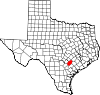 | |
| Unincorporated areas | ||
| Ghost towns | ||
| Footnotes | ‡This populated place also has portions in an adjacent county or counties | |
| International | |
|---|---|
| National | |
| Geographic | |
| Other | |
