


Kazakh alphabets
.jpg)
In modern orthography: «Бұрыңғы өткен заманда, бір данышпан кісі, Бағдат шаһарының бір үлкен қазысының үйіне келіп қоныпты. Қазыменен сөйлесіп, қазыны сөзге жеңе беріпті. Сонда қазы қорқып, — „Бұл маған келген бала — менің қазылығымды тартып алса керек! Не де болса, бұған жалынып, сый беріп, орнымда қалайын!“ — деп, қатынына ақылдасыпты.»
Transliteration: «Būryñğy ötken zamanda, bır danyşpan kısı, Bağdat şaharynyñ bır ülken qazysynyñ üiıne kelıp qonypty. Qazymenen söilesıp, qazyny sözge jeñe berıptı. Sonda qazy qorqyp, — „Būl mağan kelgen bala - menıñ qazylyğymdy tartyp alsa kerek! Ne de bolsa, būğan jalynyp, syi berıp, ornymda qalaiyn!“ — dep, qatynyna aqyldasypty.»
Note the differences between the older Cyrillic here and the current Cyrillic alphabet.
.JPG)
Three alphabets are used to write Kazakh: the Cyrillic, Latin and Arabic scripts. The Cyrillic script is used in Kazakhstan, Russia, and Mongolia. An October 2017 Presidential Decree in Kazakhstan ordered that the transition from Cyrillic to a Latin script be completed by 2031.[1] The Arabic script is used in Saudi Arabia, Iran, Afghanistan, and parts of China.
| А а | Ә ә | Б б | В в | Г г | Ғ ғ | Д д |
| Е е | Ё ё | Ж ж | З з | И и | Й й | К к |
| Қ қ | Л л | М м | Н н | Ң ң | О о | Ө ө |
| П п | Р р | С с | Т т | У у | Ұ ұ | Ү ү |
| Ф ф | Х х | Һ һ | Ц ц | Ч ч | Ш ш | Щ щ |
| Ъ ъ | Ы ы | І і | Ь ь | Э э | Ю ю | Я я |
The Kazakh Cyrillic alphabet is used in Kazakhstan, the Altai Republic in Russia, and the Bayan-Ölgiy Province in Mongolia. It is also used by Kazakh populations in Kyrgyzstan, Russia, Turkmenistan and Uzbekistan, as well as diasporas in other countries of the former USSR. It was introduced during the Russian Empire period in the 1800s, and then adapted by the Soviet Union in 1940.[2]
In the nineteenth century, Ibrahim Altynsarin, a prominent Kazakh educator, first introduced a Cyrillic alphabet for transcribing Kazakh. Russian missionary activity, as well as Russian-sponsored schools, further encouraged the use of Cyrillic in the nineteenth and early twentieth centuries. The alphabet was reworked by Sarsen Amanzholov and accepted in its current form in 1940. It contains 42 letters: 33 from the Russian alphabet with 9 additional letters for sounds of the Kazakh language: Ә, Ғ, Қ, Ң, Ө, Ұ, Ү, Һ, І (until 1951 Ӯ was used instead of Ұ). Initially, Kazakh letters came after letters from the Russian alphabet, but now they are placed after Russian letters similar in sound or shape.
The letters В, Ё (since 1957), Ф, Ц, Ч, Ъ, Ь and Э are not used in native Kazakh words. Of these, Ё, Ц, Ч, Ъ, Ь, Э, are used only in words borrowed from Russian or through the Russian language which are written according to Russian orthographic rules. The letter E in Kazakh makes a sound similar to Э in Russian (ex. Kazakh: Екібастуз - Russian: Экибастуз). The letter Ж is pronounced similarly to ДЖ in Russian (approximately like J in English). The letter Х is pronounced like a wheezing h (hard h). The letter Һ is frequently used in Arabic-Persian borrowings and is often pronounced like an unvoiced Х (as /h/, soft h, or a voiceless glottal fricative). In rapid conversation, the letter Қ (Q) can be pronounced like X (if Қ is in the middle of a word and before a consonant) or like Ғ. The letter Щ is used for the long Ш sound in three native words (ащы 'bitter', тұщы 'saltless', кеще 'stupid') and their derivatives, as well as in loanwords.
The letter И represents the tense vowel [i] obtained from the combinations ЫЙ /əj/ and ІЙ /ɪj/. The letter У represents /w/ and the tense vowel [u] obtained from the combinations ҰУ /ʊw/, ҮУ /ʉw/, ЫУ /əw/ and ІУ /ɪw/. Additionally, И and У are retained in words borrowed from Russian, where they represent the simple vowels [i] and [u] respectively.
History
[edit]The switch from a Latin alphabet to a Cyrillic one was likely in an attempt to distance the then-Soviet Kazakhstan from Turkey.[3] This was likely in part due to weakening Turkish–Soviet relations and the Turkish Straits crisis.[citation needed]
In effort to consolidate its national identity, Kazakhstan started a phased transition from the Cyrillic alphabet to the Latin alphabet in 2017. The Kazakh government drafted a seven-year process until the full implementation of the new alphabet, sub-divided into various phases.[4]
Romanization
[edit]Kazakh Cyrillic is romanized for accessibility to readers familiar with the Latin alphabet. Commonly used systems include:
- ALA-LC romanization (American Library Association and Library of Congress), 1940 system, commonly used in English-language bibliographic cataloguing and in academic publishing[5]
- BGN/PCGN romanization (US Board on Geographic Names and Permanent Committee on Geographical Names for British Official Use), 1979 system, commonly used in place names and mapping[6]
- ISO 9:1995 (International Organization for Standardization), 1995, an international system based on central European orthography that uses a single unique character for each letter.[7][8]
| Cyrillic letter |
ALA-LC | BGN/PCGN | ISO 9:1995 | English approximation |
|---|---|---|---|---|
| А а | A a | A a | A a | Gulag |
| Ә ә | Ă ă | Ä ä | A̋ a̋ | Apple |
| Б б | B b | B b | B b | Boredom |
| В в | V v | V v | V v | Driveway |
| Г г | G g | G g | G g | Goal |
| Ғ ғ | Gh gh | Gh gh | Ġ ġ | Knight |
| Д д | D d | D d | D d | Doorway |
| Е е | E e | E e | E e | End |
| Ё ё | Ë ë | Yo yo | Ë ë | Yolk |
| Ж ж | Zh zh | Zh zh | Ž ž | Vision |
| З з | Z z | Z z | Z z | Zinc |
| И и | I i | Ī ī | I i | Inner |
| Й й | Ĭ ĭ | Y y | J j | Yes |
| К к | K k | K k | K k | King |
| Қ қ | Q q | Q q | K̦ k̦ | Queen |
| Л л | L l | L l | L l | Luster |
| М м | M m | M m | M m | Millenia |
| Н н | N n | N n | N n | No |
| Ң ң | N͡g n͡g | Ng ng | N̦ n̦ | Bring |
| О о | O o | O o | O o | Olden |
| Ө ө | Ȯ ȯ | Ö ö | Ô ô | Orc |
| П п | P p | P p | P p | Protect |
| Р р | R r | R r | R r | Ring but with rolled r's |
| С с | S s | S s | S s | Stall |
| Т т | T t | T t | T t | At |
| У у | U u | Ū ū | U u | Uber |
| Ұ ұ | Ū ū | U u | U̇ u̇ | Suit |
| Ү ү | U̇ u̇ | Ü ü | Ù ù | Cook |
| Ф ф | F f | F f | F f | Fall |
| Х х | Kh kh | Kh kh | H h | Loch ness in scottish english |
| Һ һ | Ḣ ḣ | H h | Ḥ ḥ | Hinder |
| Ц ц | T͡s t͡s | Ts ts | C c | Artsy |
| Ч ч | Ch ch | Ch ch | Č č | Cheat |
| Ш ш | Sh sh | Sh sh | Š š | Share |
| Щ щ | Shch shch | Shch shch | Ŝ ŝ | Shall |
| Ъ ъ | ʺ | ” | ʺ | " silent |
| Ы ы | Y y | Y y | Y y | Yell |
| І і | Ī ī | I i | Ì ì | Illness |
| Ь ь | ʹ | ’ | ʹ | ' silent |
| Э э | Ė ė | Ė ė | È è | Cafe |
| Ю ю | I͡u i͡u | Yu yu | Û û | You |
| Я я | I͡a i͡a | Ya ya | Â â | Yard |
Notes to the BGN/PCGN system
- Character sequences гһ, зһ, кһ, нг, сһ and цһ may be romanized g·h, z·h, k·h, n·g, s·h and ts·h to differentiate from gh, zh, kh, ng, sh, and tsh, which are used to render ғ, ж, х, ң, ш, and тш.
- The character ы may be romanized i̵ instead of у.
Encoding
[edit]Before the spread of operating systems and text editors with support for Unicode, Cyrillic Kazakh often failed to fit on a keyboard because of both the problem with 8-bit encoding, which was not supported at the system level, and the absence of standard computer fonts. More than 20 variations of 8-bit encoding for Kazakh Cyrillic have been suggested, including the following government standards (note that the following are historical code pages and that modern systems use Unicode Encoding, such as UTF-8):
- СТ РК 920-91 for MS-DOS (a modification of code page 866)
- СТ РК 1048—2002 for Windows (a modification of code page 1251)
СТ РК 1048—2002 was confirmed in 2002, well after the introduction of different Windows character sets. Some Internet resources in part used the government information agency QazAqparat before the encoding of this standard. Today the encoding UTF-8 is being accepted.
Keyboard
[edit]The standard Windows keyboard layout used for Cyrillic Kazakh in Kazakhstan is a modification of the standard Russian keyboard, with characters found in Kazakh but not in Russian located on the number keys.

Latin script
[edit]

A number of Latin alphabets are in use to write the Kazakh language. A variant based on the Turkish alphabet is unofficially used by the Kazakh diaspora in Turkey and in Western countries, as well as in Kazakhstan. As with other Central Asian Turkic languages, a Latin alphabet, the Yañalif, was introduced by the Soviets and used from 1929 to 1940 when it was replaced with Cyrillic.[2][9] Moreover, a Latin alphabet was used for the Kazakh language for Kazakhs in China during 1964–84. Later, the use of the Kazakh Arabic alphabet was restored in China.[10]
| A a | B ʙ | C c | Ç ç | D d | E e | Ə ə | G g | Ƣ ƣ | H h |
| I i | J j | K k | L l | M m | N n | Ꞑ ꞑ | O o | Ɵ ɵ | P p |
| Q q | R r | S s | T t | U u | V v | Y y | Z z | Ь ь |
| A a | B ʙ | V v | G g | D d | E e | Ç ç | Z z | I i | J j | K k |
| L l | M m | N n | O o | P p | R r | S s | T t | U u | F f | X x |
| Ƣ ƣ | Q q | C c | Ə ə | H h | Ꞑ ꞑ | Ɵ ɵ | Ū ū | Y y | Ь ь |
As part of a modernization program, the presidential decree No. 569 signed by Kazakh President Nursultan Nazarbayev ordered the replacement of the Cyrillic script with a Latin script by 2025.[2][11][12] In 2007, Nazarbayev said the transformation of the Kazakh alphabet from Cyrillic to Latin should not be rushed, as he noted: "For 70 years, the Kazakhstanis read and wrote in Cyrillic. More than 100 nationalities live in our state. Thus we need stability and peace. We should be in no hurry in the issue of alphabet transformation".[13]
In 2015, the Minister of Culture and Sports Arystanbek Muhamediuly announced that a transition plan was underway, with specialists working on the orthography to accommodate the phonological aspects of the language.[14] On April 12, 2017, President Nazarbayev published an article in state newspaper Egemen Qazaqstan announcing a switchover to the Latin alphabet by 2025,[9][14] a decision implemented by decree.[11]
Nazarbayev argued that the "Kazakh language and culture have been devastated" during the period of Soviet rule, and that ending the use of Cyrillic is useful in re-asserting national identity.[9] The new Latin alphabet is also a step to weaken the traditional Russian influence on the country, as the Russian language is the country's second official language.[15] The initial proposed Latin alphabet tried to avoid digraphs (such as "sh", "ch") and diacritics (such as "ä" or "ç"). In fact, President Nazarbayev had expressly stated that the new alphabet should contain "no hooks or superfluous dots".[16] Instead, the new alphabet, which is based on a transliteration of Cyrillic into Latin letters, would have used apostrophes to denote those Kazakh letters where there was no direct Latin equivalent. It is similar to the Karakalpak Latin alphabet and the Uzbek alphabet.
A revised version of the 2017 Latin alphabet was announced in February 2018. Presidential Decree 637 of 19 February 2018 amends the 2017 decree and the use of apostrophes was discontinued and replaced with diacritics and digraphs.[17][18] Notably, the new alphabet uses the acute accent. A few web applications and sites were launched to facilitate the switch to the Latin-based alphabet. One of them is a new web-based portal, Qazlatyn.kz, that uses the new Latin alphabet to report news and other information about Kazakhstan.[19]
Latest developments
[edit]| A a (А а) |
Ä ä (Ә ә) |
B b (Б б) |
D d (Д д) |
E e (Е е) |
F f (Ф ф) |
G g (Г г) |
Ğ ğ (Ғ ғ) |
| H h (Х х, Һ һ) |
I ı (І і) |
İ i (Й й, И и) |
J j (Ж ж) |
K k (К к) |
L l (Л л) |
M m (М м) |
N n (Н н) |
| Ñ ñ (Ң ң) |
O o (О о) |
Ö ö (Ө ө) |
P p (П п) |
Q q (Қ қ) |
R r (Р р) |
S s (С с) |
Ş ş (Ш ш) |
| T t (Т т) |
U u (У у) |
Ū ū (Ұ ұ) |
Ü ü (Ү ү) |
V v (В в) |
Y y (Ы ы) |
Z z (З з) |
In 2020, the President of Kazakhstan Kassym-Jomart Tokayev called for another revision of the Latin alphabet with a focus on preserving the original sounds and pronunciation of the Kazakh language.[22][23] This revision, presented to the public in November 2019 by academics from the Baitursynov Institute of Linguistics, and specialists belonging to the official working group on script transition, uses umlauts, breves and cedillas instead of digraphs and acute accents, and introduces spelling changes in order to reflect more accurately the phonology of Kazakh.[24] This revision deviated only slightly from the Common Turkic Alphabet (CTA), introducing the letter Ŋ in place of Ñ. As this version was awaiting approval, linguists had been in discussion as to which Latin-based letters were to be used in place of the specific Cyrillic-based letters Ә ə, Ғ ғ, И и, Й й, Ң ң, Ө ɵ, У у, Ұ ұ, Ү ү, Ы ы, Ч ч, Ш ш, and І i; a suggested alternative to the introduction of accented characters was to make greater use of digraphs, with ч being written as "tş", for example.[25][better source needed]
In January 2021, a new revision of the Kazakh Latin alphabet was presented, introducing the letters Ä ä (Ə ə), Ö ö (Ө ө), Ü ü (Ү ү), Ğ ğ (Ғ ғ), Ū ū (Ұ ұ), Ŋ ŋ (Ң ң), and Ş ş (Ш ш),[26] bringing it even closer to the CTA.
A subsequent revision on 22 April further narrowed this gap by changing Ŋ ŋ to Ñ ñ.[27] Its presentation to the public was well received. This current Latin script has similarities especially with Turkish, Azerbaijani and Turkmen alphabets. The transition is expected to be completed by 2031.[28]
-
 Initial proposed Latin alphabet for the Kazakh language, implemented by Presidential Decree 569 (26 October 2017),[11] later revised by Presidential Decree 637 of 19 February 2018, replacing the apostrophe with diacritics and digraphs
 -
![2018 revision of the Kazakh Latin alphabet, used from 2018 to 2022[29]](//upload.wikimedia.org/wikipedia/commons/thumb/8/8f/2018_Kazakh_Latin_alphabet_table_-_RU.svg/180px-2018_Kazakh_Latin_alphabet_table_-_RU.svg.png) 2018 revision of the Kazakh Latin alphabet, used from 2018 to 2022[29]
2018 revision of the Kazakh Latin alphabet, used from 2018 to 2022[29] -
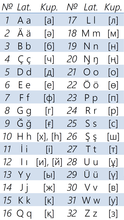 Proposed new version of the Kazakh Latin alphabet presented in 2019
 -
![2021 revision of the Kazakh Latin alphabet, officially used starting 2023[30]](//upload.wikimedia.org/wikipedia/commons/thumb/c/c1/2021.4_Kazakh_Latin_alphabet_table_-_RU.svg/180px-2021.4_Kazakh_Latin_alphabet_table_-_RU.svg.png) 2021 revision of the Kazakh Latin alphabet, officially used starting 2023[30]
2021 revision of the Kazakh Latin alphabet, officially used starting 2023[30]

![2018 revision of the Kazakh Latin alphabet, used from 2018 to 2022[29]](/wiki/File:2018_Kazakh_Latin_alphabet_table_-_RU.svg)

![2021 revision of the Kazakh Latin alphabet, officially used starting 2023[30]](/wiki/File:2021.4_Kazakh_Latin_alphabet_table_-_RU.svg)
Arabic script
[edit]
The Arabic script is the official alphabet for Kazakhs in the Ili Kazakh Autonomous Prefecture of the Xinjiang Uyghur Autonomous Region[10] of China. It was first introduced to the territory of Kazakhstan in the eleventh century and was traditionally used to write Kazakh until the introduction of a Latin alphabet in 1929. In 1924, Kazakh intellectual Akhmet Baitursynov attempted to reform the Arabic script to better suit Kazakh. The letters ۆ, گ, ڭ, پ and چ are used to represent sounds not found in the Arabic language.
A modified Arabic script is also used in Iran and Afghanistan, based on the alphabet used for Kazakh before 1929.
The Kazakh Arabic alphabet contains 29 letters and one digit, the 'upper hamza' used at the beginnings of words to create front vowels throughout the word. The direction the alphabet is written in is right to left. Unlike the original Arabic script, which is an abjad, the Kazakh Arabic script functions more like a true alphabet, as each sound has its own letter and every sound in each word is spelt out in the written form of the language. The reform of the Arabic script from an abjad to an alphabet was carried out by the early 20th-century linguist Akhmet Baitursynov.
Kazakhs living now in China, Pakistan, Afghanistan, Iran and other countries of the Middle East use the Arabic script.
Vowels
[edit]In Kazakh Arabic alphabet, 9 vowels are defined.[31] Important to note that a few of the vowels in Kazakh Latin and Cyrillic scripts (such as U u [У у]) are classified as consonants in the Arabic Script.
| Rounded | Unrounded | |||||||
|---|---|---|---|---|---|---|---|---|
| Close | Open | Close | Open | |||||
| Back جۋان داۋىستى دىبىستار Жуан дауысты дыбыстар |
Arabic | ـۇ / ۇ | ـو / و | ىـ / ـى / ى | ا / ـا | |||
| Cyrillic (Latin) |
Ұ ұ (Ū ū) |
О о (O o) |
Ы ы (Y y) |
А а (A a) | ||||
| IPA | [ʊ] | [wʊ~o̞] | [ə] | [ɑ] | ||||
| Front جىڭىشكە داۋىستى دىبىستار Жіңішке дауысты дыбыстар |
Arabic | ٴـۇ / ٴۇ | ٴـو/ ٴو | ٴىـ / ٴـى / ٴى | ە / ـە | ٴا / ٴـا | ||
| Cyrillic (Latin) |
Ү ү (Ü ü) |
Ө ө (Ö ö) |
І і (I ı) |
Е е / Э э (E e) |
Ә ә (Ä ä) | |||
| IPA | [ʏ] | [wʏ~ɵ] | [ɪ] | [jɪ] | [æ] | |||
Use of Hamza
[edit]Hamza has a unique role in Kazakh, a role not seen in other Arabic scripts. Kazakh Arabic script makes use of U+0674 ٴ ARABIC LETTER HIGH HAMZA, and it can only ever come at the beginning of words. It never comes in the middle or end of words. Hamza doesn't represent any sound in Kazakh. Instead, Hamza indicates that the vowels in the word will be the following front vowels:
- Ә ә / Ä ä
- І і / I ı
- Ө ө / Ö ö
- Ү ү / Ü ü
Dagger alif played a similar but inverse role in Tatar Yaña imlâ alphabet, marking that vowels in a word will be back vowels.
There are exceptions in Kazakh orthography, meaning words that will have front vowels, but won't have Hamza written for them. First are words that contain the vowel Э э / Е е (shown in Arabic Script as ە / ـە). This vowel itself is classified as a front vowel, which means that as per Kazakh rules on vowel harmony, the rest of the vowels in the word will be front vowel too. Thus there won't be a need for Hamza. For example, the word tüyis 'knot', is written with Hamza, as ٴتۇيىس. But in its plural form, tüyister is written as تۇيىستەر.[31]
The second exception, is words that contain the following consonants:
- Г г / G g (گ)
- Ғ ғ / Ğ ğ (ع)
- К к / K k (ك)
- Қ қ / Q q (ق)
As per Kazakh phonology, the letters Ғ ғ / Ğ ğ (ع) and Қ қ / Q q (ق) can only be accompanied by back vowels. Thus there won't be any words containing these consonants that would need Hamza. In contrast, the letters Г г / G g (گ) and К к / K k (ك) can only be accompanied by front vowels. This means that they themselves act as indicators that vowels in a word are front vowels, thus eliminating a need for Hamza. For example, the word Tüyir 'a tiny grain' is written as ٴتۇيىر, whereas, a derived word, such as tüyirşik 'granular', is written as تۇيىرشىك.[31]
Pursuant to these rules, suffixes are formed in pairs too. For example words with back vowels take suffixes -лық (‑لىق) / -дық (‑دىق) / -тық (‑تىق), and words with front vowels, take suffixes -лік (‑لىك) / -дік (‑دىك) / -тік (‑تىك).[31]
Forms of the Kazakh Arabic alphabet
[edit]| Transliteration | Name in Kazakh | IPA | Isolated | Final | Medial | Initial |
|---|---|---|---|---|---|---|
| Аа | älıf ٴالىپ |
[ɑ] | ا | ـا | ا | |
| Әә | hämzä-älıp ٴحامزا-ٴالىپ |
[æ] | ٴا | ٴـا | ٴا | |
| Бб | ba با |
[b] | ب | ـب | ـبـ | بـ |
| Пп | pa پا |
[p] | پ | ـپ | ـپـ | پـ |
| Тт | ta تا |
[t] | ت | ـت | ـتـ | تـ |
| Жж | jim جيم |
[ʑ] | ج | ـج | ـجـ | جـ |
| Чч | ha üş noqat حا ٴۇش نوقات |
[t͡ɕ] | چ | ـچ | ـچـ | چـ |
| Хх | xa حا |
[χ~q] | ح | ـح | ـحـ | حـ |
| Дд | däl ٴدال |
[d] | د | ـد | د | |
| Рр | ra را |
[r] | ر | ـر | ر | |
| Зз | zain زاين |
[z] | ز | ـز | ز | |
| Сс | sin سين |
[s] | س | ـس | ـسـ | سـ |
| Шш | şin شين |
[ɕ] | ش | ـش | ـشـ | شـ |
| Ғғ | ain اين |
[ɢ~ʁ] | ع | ـع | ـعـ | عـ |
| Фф | fa فا |
[f] | ف | ـف | ـفـ | فـ |
| Ққ | qaf قاف |
[q] | ق | ـق | ـقـ | قـ |
| Кк | käf کاف |
[k] | ك | ـك | ـكـ | كـ |
| Гг | gäf گاف |
[ɡ] | گ | ـگ | ـگـ | گـ |
| Ңң | käf üş noqat كاف ٴۇش نوقات |
[ŋ~ɴ] | ڭ | ـڭ | ـڭـ | ڭـ |
| Лл | läm ٴلام |
[l~ɫ] | ل | ـل | ـلـ | لـ |
| Мм | mim ميم |
[m] | م | ـم | ـمـ | مـ |
| Нн | nun نۋن |
[n] | ن | ـن | ـنـ | نـ |
| Ее | hä ٴحا |
[jɪ] | ە | ـە | ە | |
| Һһ | hä ekı köz ٴحا ەكى كوز |
[h] | ھ | ـھ | ـھـ | ھـ |
| Оо | uau ۋاۋ |
[wʊ~o̞] | و | ـو | و | |
| Өө | hämzä-uau ٴحامزا-ۋاۋ |
[wʏ~ɵ] | ٴو | ٴـو | ٴو | |
| Ұұ | uau damma ۋاۋ دامما |
[ʊ] | ۇ | ـۇ | ۇ | |
| Үү | hämzä-uau damma ٴحامزا-ۋاۋ دامما |
[ʏ] | ٴۇ | ٴـۇ | ٴۇ | |
| Уу | uau üş noqat ۋاۋ ٴۇش نوقات |
[w], [ʊw], [ʏw] | ۋ | ـۋ | ۋ | |
| Вв | uau qūsbelgı ۋاۋ قۇسبەلگى |
[v] | ۆ | ـۆ | ۆ | |
| Ыы | ia يا |
[ə] | ى | ـى | ـىـ | ىـ |
| Іі | hämzä-ia ٴحامزا-يا |
[ɪ] | ٴى | ٴـى | ٴـىـ | ٴىـ |
| Йй, Ии | ia ekı noqat يا ەكى نوقات |
[j], [ɪj], [əj] | ي | ـي | ـيـ | يـ |
| Ъъ, Ьь | hämzä ٴحامزا |
ء | ||||
Correspondence chart
[edit]Here is the correspondence chart of the official writing scripts:
| IPA[32][33] | Cyrillic | Latin | Arabic | Braille | |||
|---|---|---|---|---|---|---|---|
| 2021[27] | 2018[34][35] | 2017 | Letter | Name | |||
| [ɑ] | А а | A a | ا | Alif | ⠁ | ||
| [æ] | Ә ә | Ä ä | Á á | Aʼ aʼ | ٵ | Hamza + Alif | ⠜ |
| [b] | Б б | B b | ب | Ba | ⠃ | ||
| [v] | В в | V v | ۆ | Waw with Haček | ⠺ | ||
| [g] | Г г | G g | گ | Gaf | ⠛ | ||
| [ʁ] | Ғ ғ | Ğ ğ | Ǵ ǵ | Gʼ gʼ | غ | Ghain | ⠻ |
| [d] | Д д | D d | د | Dal | ⠙ | ||
| [jɪ] | Е е | E e | ە | Ha | ⠑ | ||
| [jo] | Ё ё | İo io | Io ıo | — | يو | Ya + Waw | ⠡ |
| [ʑ] | Ж ж | J j | ج | Jeem | ⠚ | ||
| [z] | З з | Z z | ز | Za | ⠵ | ||
| [ɪj ~ əj] | И и | İ i | I ı | Iʼ iʼ | ٸ | Hamza + Ya | ⠊ |
| [j] | Й й | ي | Ya | ⠯ | |||
| [k] | К к | K k | ك | Kaf | ⠅ | ||
| [q ~ ʁ ~ χ] | Қ қ | Q q | ق | Qaf | ⠹ | ||
| [l] | Л л | L l | ل | Lam | ⠇ | ||
| [m] | М м | M m | م | Meem | ⠍ | ||
| [n] | Н н | N n | ن | Noon | ⠝ | ||
| [ŋ] | Ң ң | Ñ ñ | Ń ń | Nʼ nʼ | ڭ | Ng | ⠩ |
| [o] | О о | O o | و | Waw | ⠕ | ||
| [ø] | Ө ө | Ö ö | Ó ó | Oʼ oʼ | ٶ | Hamza + Waw | ⠣ |
| [p] | П п | P p | پ | Pa | ⠏ | ||
| [ɾ] | Р р | R r | ر | Ra | ⠗ | ||
| [s] | С с | S s | س | Seen | ⠎ | ||
| [t] | Т т | T t | ت | Ta | ⠞ | ||
| [w ~ ʊw ~ ʏw] | У у | U u | Ý ý | Yʼ yʼ | ۋ | Waw with 3 dots | ⠥ |
| [ʊ] | Ұ ұ | Ū ū | U u | ۇ | Waw with damma | ⠌ | |
| [ʏ] | Ү ү | Ü ü | Ú ú | Uʼ uʼ | ٷ | Hamza + Waw with damma | ⠬ |
| [f] | Ф ф | F f | ف | Fa | ⠋ | ||
| [h] | Х х | H h | هـ | Ḥa | ⠓ | ||
| [χ] | Һ һ | خ | Initial Ha | ⠧ | |||
| [ts] | Ц ц | Ts ts | S s | — | تس | Ta + Seen | ⠉ |
| [tʃ] | Ч ч | Tş tş | Ch ch | Cʼ cʼ | چ | Cheem/Che | ⠟ |
| [ʃ] | Ш ш | Ş ş | Sh sh | Sʼ sʼ | ش | Sheen | ⠱ |
| [ʃtʃ] | Щ щ | Ştş ştş | Shch shch | — | شش | Sheen + Sheen | ⠭ |
| — | Ъ ъ | — | ⠷ | ||||
| [ə] | Ы ы | Y y | ى | Alif maqṣūrah | ⠮ | ||
| [ɪ] | І і | I ı | I i | ٸ | Hamza + Alif maqṣūrah | ⠽ | |
| — | Ь ь | — | ⠾ | ||||
| [e] | Э э | E e | — | ە | Ha | ⠪ | |
| [jʏw ~ jʊw] | Ю ю | İu iu | Iý ıý | يۋ | Ya + Waw with 3 dots | ⠳ | |
| [jɑ ~ jæ] | Я я | İa ia | Ia ıa | يا | Ya + Alif | ⠫ | |
Symbols in parentheses are for bi-directional transliteration only. See Menıñ Qazaqstanym.
Text sample
[edit]Article 1 of the Universal Declaration of Human Rights:[36]
| Kazakh in Cyrillic script | Kazakh in Arabic script | English |
|---|---|---|
| Барлық адамдар тумысынан азат және қадір-қасиеті мен құқықтары тең болып дүниеге келеді. Адамдарға ақыл-парасат, ар-ождан берілген, сондықтан олар бір-бірімен туыстық, бауырмалдық қарым-қатынас жасаулары тиіс. | بارلىق ادامدار تۋمىسىنان ازات جانە ٴقادىر-قاسيەتى مەن قۇقىقتارى تەڭ بولىپ دۇنيەگە كەلەدى. ادامدارعا اقىل-پاراسات، ار-وجدان بەرىلگەن، سوندىقتان ولار ٴبىر-بىرىمەن تۋىستىق، باۋىرمالدىق قارىم-قاتىناس جاساۋلارى تيىس. | All human beings are born free and equal in dignity and rights. They are endowed with reason and conscience and should act towards one another in a spirit of brotherhood. |
| Kazakh in Latin script (approved by Nazarbayev in 2017, revised 2018) |
Kazakh in Latin script (version by Kazinform, used by Kazakh Wikipedia) |
The 2017 Kazakh alphabet, also known as the “apostrophe alphabet” |
| Barlyq adamdar týmysynan azat jáne qadir-qasıeti men quqyqtary teń bolyp dúnıege keledi. Adamdarǵa aqyl-parasat, ar-ojdan berilgen, sondyqtan olar bir-birimen týystyq, baýyrmaldyq qarym-qatynas jasaýlary tıis. | Barlıq adamdar twmısınan azat jäne qadir-qasïeti men quqıqtarı teñ bolıp dünïege keledi. Adamdarğa aqıl-parasat, ar-ojdan berilgen, sondıqtan olar bir-birimen twıstıq, bawırmaldıq qarım-qatınas jasawları tïis. | Barlyq adamdar tyʼmysynan azat jaʼne qadir-qasiʼeti men quqyqtary tenʼ bolyp duʼniʼege keledi. Adamdargʼa aqyl-parasat, ar-ojdan berilgen, sondyqtan olar bir-birimen tyʼystyq, bayʼyrmaldyq qarym-qatynas jasayʼlary tiʼis. |
| Kazakh in Yañalif (1929 variant) |
Kazakh in Yañalif (1938 variant) |
Kazakh in Pinyin (1964–1984) |
| Barlьq adamdar tuvmьsьnan azat çəne qadir-qasijeti men quqьqtarь teꞑ ʙolьp dynijege keledi. Adamdarƣa aqьl-parasat, ar-oçdan ʙerilgen, sondьqtan olar ʙir-ʙirimen tuvьstьq, ʙavьrmaldьq qarьm-qatьnas çasavlarь tijis. | Barlьq adamdar tumьsьnan azat çəne qadjr-qasietj men qūqьqtarь teꞑ ʙolьp dyniege keledj. Adamdarƣa aqьl-parasat, ar-oçdan ʙerjlgen, sondьqtan olar ʙjr-ʙjrjmen tuьstьq, ʙauьrmaldьq qarьm-qatьnas çasaularь tijs. | Barleⱪ adamdar tuwmesenan azat jənê ⱪadir-ⱪasiyêti mên ⱪuⱪeⱪtare têng bolep düniyêgê kêlêdi. Adamdarƣa aⱪel-parasat, ar-ojdan bêrilgên, sondeⱪtan olar bir-birimên tuwesteⱪ, bawermaldeⱪ ⱪarem-ⱪatenas jasawlare tiyis. |
| Kazakh in Latin (January 2021 variant) |
Kazakh in Latin (April 2021 variant) |
Kazakh in the International Phonetic Alphabet |
| Barlyq adamdar tumysynan azat jäne qadır-qasietı men qūqyqtary teŋ bolyp düniege keledı. Adamdarğa aqyl-parasat, ar-ojdan berılgen, sondyqtan olar bır-bırımen tuystyq, bauyrmaldyq qarym-qatynas jasaulary tiıs. | Barlyq adamdar tumysynan azat jäne qadır-qasietı men qūqyqtary teñ bolyp düniege keledı. Adamdarğa aqyl-parasat, ar-ojdan berılgen, sondyqtan olar bır-bırımen tuystyq, bauyrmaldyq qarym-qatynas jasaulary tiıs. | [bɑrˈɫəq ɑdɑmˈdɑr tʰʊwməsəˈnɑn ɑˈzɑt dʒæˈɲe qɑˈdɘr qɑsɘjeˈtɘ mʲeɴ qʊqəqtɑˈrə tʲem boˈɫəp dʉnɘjeˈɟe cʰeʎeˈdɘ ‖ ɑdɑmdɑrˈʁɑ‿qəɫ pɑrɑˈsɑt ɑr‿wʊdʒˈdɑm bʲerɘʎˈɟen | sondəqˈtɑn wʊˈɫɑr bɘr bɘrɘˈmʲen tʰʊwəsˈtəq | bɑwərmɑɫˈdəq qɑˈrəm qɑtəˈnɑs dʒɑsɑwɫɑˈrə tʰɘˈjɘs] |
References
[edit]- ^ "Kazakhstan to change from Cyrillic to Latin alphabet". Deutsche Welle. 27 October 2017. Retrieved 2020-09-16.
- ^ a b c "Kazakh President Orders Shift Away From Cyrillic Alphabet". Radio Free Europe/Radio Liberty. April 12, 2017. Archived from the original on July 6, 2017. Retrieved October 30, 2017.
- ^ Aslan, Betül (2010-03-01). "SOVYET RUSYA HAKİMİYETİNDE YAŞAYAN TÜRKLERİN ORTAK "BİRLEŞTİRİLMİŞ TÜRK ALFABESİ"NDEN "RUS KİRİL" ALFABESİNE GEÇİRİLMESİ". Atatürk Üniversitesi Türkiyat Araştırmaları Enstitüsü Dergisi. 16 (40): 357–374. ISSN 1300-9052.
- ^ "Switching to Latin alphabet further opens Kazakhstan to the world". astanatimes.com. 13 March 2018.
- ^ "Non-Slavic Languages (in Cyrillic Script)" (PDF). Library of Congress. 2017.
- ^ "Romanization of Kazakh: BGN/PCGN 1979 System" (PDF). February 2022.
- ^ "Romanization of Kazakh for Geographical Names". www.eki.ee. March 2016. Retrieved 2022-12-13.
- ^ Pedersen, Thomas T. (2004-03-30). "Transliteration of Non-Roman Scripts" (PDF).
- ^ a b c Назарбаев, Нұрсұлтан (April 26, 2017). "Болашаққа бағдар: рухани жаңғыру" [Orientation for the future: spiritual revival]. Egemen Qazaqstan (in Kazakh). Archived from the original on June 28, 2017. Retrieved October 30, 2017.
- ^ a b Minglang Zhou (2003). Multilingualism in China: The Politics of Writing Reforms for Minority Languages, 1949-2002. Mouton de Gruyter. p. 149. ISBN 3-11-017896-6 – via Google Books.
- ^ a b c "О переводе алфавита казахского языка с кириллицы на латинскую графику" [On the change of the alphabet of the Kazakh language from the Cyrillic to the Latin script] (in Russian). President of the Republic of Kazakhstan. October 26, 2017. Retrieved October 26, 2017.
- ^ "Alphabet soup as Kazakh leader orders switch from Cyrillic to Latin letters". The Guardian. 26 October 2017. Archived from the original on October 28, 2017. Retrieved 30 October 2017 – via Reuters.
- ^ "Kazakhstan should be in no hurry in Kazakh alphabet transformation to Latin: Nazarbayev". Kazinform. December 13, 2007, cited in "Kazakhstan backtracks on move from Cyrillic to Roman alphabet?". Pinyin News. December 14, 2007. Archived from the original on September 29, 2014. Retrieved October 30, 2017.
- ^ a b "Kazakh language to be converted to Latin alphabet – MCS RK". Kazinform. January 30, 2015. Archived from the original on February 19, 2017. Retrieved September 17, 2015.
- ^ "Kazakhstan to Qazaqstan: Why would a country switch its alphabet?". BBC News. 31 October 2017.
- ^ Smailova, Damira (September 14, 2017). "Назарбаев обсудил с журналистами девальвацию, "saebiz", ЭКСПО и Головкина" [Nazarbayev discussed devaluation, "saebiz", Expo and Golovkin with journalists] (in Russian). KTK. Archived from the original on October 27, 2017. Retrieved October 25, 2017.
- ^ "Kazakhstan adopts new version of Latin-based Kazakh alphabet". The Astana Times. 26 February 2018.
- ^ "О внесении изменения в Указ Президента Республики Казахстан от 26 октября 2017 года № 569 «О переводе алфавита казахского языка с кириллицы на латинскую графику» — Официальный сайт Президента Республики Казахстан". Akorda.kz (in Russian). Retrieved 2023-01-22.
- ^ "Kazakhstan Launches Easy-To-Use Apps For New Latin Alphabet". caspiannews.com. Retrieved 2022-03-08.
- ^ Satubaldina, Assel (2021-02-01). "Kazakhstan Presents New Latin Alphabet, Plans Gradual Transition Through 2031". Kazakhstan's Independence: 30 Years, Nation. The Astana Times. Retrieved 2022-03-08.
- ^ On some issues of translating the alphabet of the Kazakh language from Cyrillic to Latin script.
- ^ "Kazakh President Tokaev introduces reforms". Modern Diplomacy Europe. 7 January 2020.
- ^ "Kazakhstanis Awaiting For New Latin-Based Alphabet". Caspian News. 14 January 2020.
- ^ Yergaliyeva, Aidana (2019-11-18). "Fourth version of Kazakh Latin script will preserve language purity, linguists say". The Astana Times. Retrieved 2020-04-03.
- ^ "A Proposal for the Reprioritisation of the Principles for Kazakh Alphabet Latinisation". Linkedin. Retrieved 2020-05-22.
- ^ "Kazakhstan Presents New Latin Alphabet, Plans Gradual Transition Through 2031". Astana Times. February 2021. Retrieved 2021-02-02.
- ^ a b "New kazakh latin alphabet was shown". Retrieved 2021-02-02.
- ^ Altynbayev, Kanat. "Kazakhs express approval of new Latin-based alphabet". Caravanserai. Retrieved 2022-03-08.
- ^ "Gradual transition of the Kazakh alphabet to the Latin alphabet". Electronic government of the Republic of Kazakhstan. Retrieved 2020-05-04.
- ^ "Kazakhstan Presents New Latin Alphabet, Plans Gradual Transition Through 2031". Astana Times. February 2021. Retrieved 2021-02-02.
- ^ a b c d e Nayman, S (1985), Kazakh-Chinese Consice Dictionary (哈汉辞典. قازاقشا - حانزۋشا سوزدىك) (in Chinese and Kazakh), Ūlttar Baspasy (ۇلتتار باسپاسى), ISBN 9787105053520
- ^ Vajda, Edward (1994), "Kazakh phonology", in Kaplan, E.; Whisenhunt, D. (eds.), Essays presented in honor of Henry Schwarz, Washington: Western Washington, pp. 603–650
- ^ McCollum, Adam (2015), "Labial Harmonic Shift in Kazakh: Mapping the Pathways and Motivations for Decay", Proceedings of the Forty-First Annual Meeting of the Berkeley Linguistics Society, vol. 41, Berkeley: Berkeley Linguistics Society, pp. 329–351
- ^ "Qazaq álipbıi".
- ^ "Mátindik konverter".
- ^ Universal Declaration of Human Rights (Kazakh ed.) – via Wikisource.
External links
[edit]- Kazakh alphabet (in Russian)
- Kazakh language, alphabet and pronunciation
- Kazakh Cyrillic–Arabic–Latin converter
- ALASH Cyrillic–Latin–Arabic–Runic online converter
- Cyrillic–Latin 2018 online converter
- Official Kazakh version (in Arabic script) of the People's Daily Online
- Kazakh: extended Latin and Cyrillic
| Europe | |
|---|---|
| Asia | |
| Africa | |

| History |
|  | ||||||||
|---|---|---|---|---|---|---|---|---|---|---|
| Geography |
| |||||||||
| Politics | ||||||||||
| Economy | ||||||||||
| Culture |
| |||||||||