


Aurangzeb

| Muhi ad-Din Muhammad Bahadur Alamgir Aurangzeb | |
|---|---|
 Aurangzeb holding a hawk, c. 1660 | |
| 6th Mughal Emperor | |
| Reign | 31 July 1658 – 3 March 1707 |
| Predecessor | Shah Jahan |
| Successor | Azam Shah |
| Born | Muhi al-Din Muhammad c. 1618 Dahod, Gujarat Subah, Mughal Empire (modern-day Gujrat, India) |
| Died | 3 March 1707 (aged 88) Ahmednagar, Ahmadnagar Subah, Mughal Empire (modern-day Maharashtra, India) |
| Burial | |
| Spouse |
|
| Issue | |
| House |  House of Babur House of Babur |
| Dynasty |  Timurid dynasty Timurid dynasty |
| Father | Shah Jahan |
| Mother | Mumtaz Mahal |
| Religion | Sunni Islam[c] |
| Imperial Seal | .jpg) |
Muhi al-Din Muhammad (c. 1618 – 3 March 1707), commonly known as Aurangzeb (Persian pronunciation: [ʔaw.ɾaŋɡ.ˈzeːb] lit. 'Ornament of the Throne'), was the sixth Mughal emperor, reigning from 1658 until his death in 1707. His regnal name is Alamgir I (Persian pronunciation: [ʔɑː.ˈlam.ˈɡiːɾ] lit. 'Conqueror of the World'), which derived from his title, Abu al-Muzaffar Muhi-ad-Din Muhammad Bahadur Alamgir Aurangzeb Badshah al-Ghazi.[2][3][4] Under his emperorship, the Mughal Empire reached its greatest extent with territory spanning nearly the entirety of the Indian subcontinent.[5][6][7][8]
Aurangzeb and the Mughals belonged to a branch of the Timurid dynasty. He held administrative and military posts under his father Shah Jahan (r. 1628–1658) and gained recognition as an accomplished military commander. Aurangzeb served as the viceroy of the Deccan in 1636–1637 and the governor of Gujarat in 1645–1647. He jointly administered the provinces of Multan and Sindh in 1648–1652 and continued expeditions into the neighboring Safavid territories. In September 1657, Shah Jahan nominated his eldest and liberalist son Dara Shikoh as his successor, a move repudiated by Aurangzeb, who proclaimed himself emperor in February 1658. In April 1658, Aurangzeb defeated the allied army of Shikoh and the Kingdom of Marwar at the battle of Dharmat. Aurangzeb's decisive victory at the battle of Samugarh in May 1658 cemented his sovereignty and his suzerainty was acknowledged throughout the Empire. After Shah Jahan recovered from illness in July 1658, Aurangzeb declared him incompetent to rule and imprisoned his father in the Agra Fort.
Under Aurangzeb's emperorship, the Mughals reached its greatest extent with their territory spanning nearly the entire Indian subcontinent. His reign is characterized by a period of rapid military expansion, with several dynasties and states being overthrown by the Mughals. His conquests acquired him the regnal title Alamgir ('Conqueror'). The Mughals also surpassed Qing China as the world's largest economy and biggest manufacturing power. The Mughal military gradually improved and became one of the strongest armies in the world. A staunch Muslim, Aurangzeb is credited with the construction of numerous mosques and patronizing works of Arabic calligraphy. He successfully imposed the Fatawa 'Alamgiri as the principal regulating body of the empire and prohibited religiously forbidden activities in Islam. Although Aurangzeb suppressed several local revolts, he maintained cordial relations with foreign governments.
Arangzeb was the longest reigning Mughal Emperor. His empire was also one of the largest in Indian history. However, his emperorship has a complicated legacy.[9] His critics, citing his actions against the non-Muslims and his conservative view of Islam, argue that he abandoned the legacy of pluralism and tolerance of the earlier Mughal emperors. Others, however, reject these assertions, arguing that he opposed bigotry against Hindus, Sikhs and Shia Muslims and that he employed significantly more Hindus in his imperial bureaucracy than his predecessors.
Early life
Aurangzeb was born in Dahod in c. 1618.[10][11][12] His father was Emperor Shah Jahan (r. 1628–1658), who hailed from the Mughal house of the Timurid dynasty.[13] The latter was descended from Emir Timur (r. 1370–1405), the founder of the Timurid Empire.[14][15] Aurangzeb's mother Mumtaz Mahal was the daughter of the Persian nobleman Asaf Khan, who was the youngest son of vizier Mirza Ghiyas.[16] Aurangzeb was born during the reign of his patrilineal grandfather Jahangir (r. 1605–1627), the fourth emperor of the Mughal Empire.
In June 1626, after an unsuccessful rebellion by his father, eight-year-old Aurangzeb and his brother Dara Shikoh were sent to the Mughal court in Lahore as hostages of their grandfather Jahangir and his wife, Nur Jahan, as part of their father's pardon deal.[17][18] After Jahangir died in 1627, Shah Jahan emerged victorious in the ensuing war of succession to the Mughal throne. Aurangzeb and his brother were consequently reunited with Shah Jahan in Agra.[19]
Aurangzeb received a Mughal princely education covering subjects like combat, military strategy, and administration. His curriculum also included scholarly areas like Islamic studies and Turkic and Persian literature. Aurangzeb grew up fluent in the Hindi of his time.[20]
On 28 May 1633, a powerful war elephant stampeded through the Mughal imperial encampment. Aurangzeb rode against the elephant and threw his spear at its head. He was unhorsed, but escaped death. Aurangzeb's valour was appreciated by his father who conferred on him the title of Bahadur (Brave) and presented him with gifts. When gently chided for his recklessness, Aurangzeb replied:[21]
If the fight had ended fatally for me it would not have been a matter of shame. Death drops the curtain even on emperors; it is no dishonor. The shame lay in what my brothers did!
Historians have interpreted this as an unjust slur against his brothers. Shuja had also faced the elephant and wounded it with his spear. Dara had been too far away to come to their assistance.[22][23]
Three days later Aurangzeb turned fifteen. Shah Jahan weighed him and presented him with his weight in gold along with other presents worth Rs. 200,000. His heroism against the elephant was celebrated in Persian and Urdu verses.[24]
Career as prince
.jpg)
Aurangzeb was nominally in charge of the force sent to Bundelkhand with the intent of subduing the rebellious ruler of Orchha, Jhujhar Singh, who had attacked another territory in defiance of Shah Jahan's policy and was refusing to atone for his actions. By arrangement, Aurangzeb stayed in the rear, away from the fighting, and took the advice of his generals as the Mughal Army gathered and commenced the siege of Orchha in 1635. The campaign was successful and Singh was removed from power.[25]
_facing_a_maddened_elephant_named_Sudhakar_(7_June_1633).jpg)
Aurangzeb was appointed viceroy of the Deccan in 1636.[27] After Shah Jahan's vassals had been devastated by the alarming expansion of Ahmednagar during the reign of the Nizam Shahi boy-prince Murtaza Shah III, the emperor dispatched Aurangzeb, who in 1636 brought the Nizam Shahi dynasty to an end.[28] In 1637, Aurangzeb married the Safavid princess Dilras Banu, posthumously known as Rabia-ud-Daurani.[14][15] She was his first wife and chief consort as well as his favourite.[29][30][31] He also had an infatuation with a slave girl, Hira Bai, whose death at a young age greatly affected him. In his old age, he was under the charms of his concubine, Udaipuri Mahal.[32][33] The latter had formerly been a companion to Dara Shukoh.[34]

In the same year, 1637, Aurangzeb was placed in charge of annexing the small Rajput kingdom of Baglana, which he did with ease.[35] In 1638, Aurangzeb married Nawab Bai, later known as Rahmat al-Nisa.[15][14] That same year, Aurangzeb dispatched an army to subdue the Portuguese coastal fortress of Daman, however his forces met stubborn resistance and were eventually repulsed at the end of a long siege.[36][37][38] At some point, Aurangzeb married Aurangabadi Mahal, who was a Circassian or Georgian.[39][14]
In 1644, Aurangzeb's sister, Jahanara, was burned when the chemicals in her perfume were ignited by a nearby lamp while in Agra. This event precipitated a family crisis with political consequences. Aurangzeb suffered his father's displeasure by not returning to Agra immediately but rather three weeks later. Shah Jahan had been nursing Jahanara back to health in that time and thousands of vassals had arrived in Agra to pay their respects.[citation needed] Shah Jahan was outraged to see Aurangzeb enter the interior palace compound in military attire and immediately dismissed him from his position of viceroy of the Deccan; Aurangzeb was also no longer allowed to use red tents or to associate himself with the official military standard of the Mughal emperor.[citation needed] Other sources tell us that Aurangzeb was dismissed from his position because Aurangzeb left the life of luxury and became a faqir.[40]
Governor of Gujarat
In 1645, he was barred from the court for seven months and mentioned his grief to fellow Mughal commanders. Thereafter, Shah Jahan appointed him governor of Gujarat. His rule in Gujarat was marked with religious disputes but he was rewarded for bringing stability.[41][42]
Governor of Balkh
In 1647, Shah Jahan moved Aurangzeb from Gujarat to be governor of Balkh, replacing a younger son, Murad Baksh, who had proved ineffective there. The area was under attack from Uzbek and Turkmen tribes. While the Mughal artillery and muskets were a formidable force, so too were the skirmishing skills of their opponents. The two sides were in stalemate and Aurangzeb discovered that his army could not live off the land, which was devastated by war.[citation needed] It is recorded that at the height of the battle against the Uzbeks during this campaign, Aurangzeb dismounted from his elephant ride to recite prayer, which amazed the opposing force commander.[43] With the onset of winter, he and his father had to make a largely unsatisfactory deal with the Uzbeks, giving away territory in exchange for nominal recognition of Mughal sovereignty.[44] The Mughal force suffered still further with attacks by Uzbeks and other tribesmen as it retreated through the snow to Kabul. By the end of this two-year campaign, into which Aurangzeb had been plunged at a late stage, a vast sum of money had been expended for little gain.[45]
Further inauspicious military involvements followed, as Aurangzeb was appointed governor of Multan and Sindh. His efforts in 1649 and 1652 to dislodge the Safavids at Kandahar, which they had recently retaken after a decade of Mughal control, both ended in failure as winter approached. The logistical problems of supplying an army at the extremity of the empire, combined with the poor quality of armaments and the intransigence of the opposition have been cited by John Richards as the reasons for failure, and a third attempt in 1653, led by Dara Shikoh, met with the same outcome.[46]
Second Deccan governorate
Aurangzeb became viceroy of the Deccan again after he was replaced by Dara Shukoh in the attempt to recapture Kandahar. Aurangzeb regretted this and harboured feelings that Shikoh had manipulated the situation to serve his own ends. Aurangbad's two jagirs (land grants) were moved there as a consequence of his return and, because the Deccan was a relatively impoverished area, this caused him to lose out financially. So poor was the area that grants were required from Malwa and Gujarat in order to maintain the administration and the situation caused ill-feeling between father and son. Shah Jahan insisted that things could be improved if Aurangzeb made efforts to develop cultivation.[47] Aurangzeb appointed Murshid Quli Khan[citation needed] to extend to the Deccan the zabt revenue system used in northern India. Murshid Quli Khan organised a survey of agricultural land and a tax assessment on what it produced. To increase revenue, Murshid Quli Khan granted loans for seed, livestock, and irrigation infrastructure. The Deccan returned to prosperity,[27][48]
Aurangzeb proposed to resolve the situation by attacking the dynastic occupants of Golconda (the Qutb Shahis) and Bijapur (the Adil Shahis). As an adjunct to resolving the financial difficulties, the proposal would also extend Mughal influence by accruing more lands.[47] Aurangzeb advanced against the Sultan of Bijapur and besieged Bidar. The Kiladar (governor or captain) of the fortified city, Sidi Marjan, was mortally wounded when a gunpowder magazine exploded. After twenty-seven days of hard fighting, Bidar was captured by the Mughals and Aurangzeb continued his advance.[49] Again, he was to feel that Dara had exerted influence on his father: believing that he was on the verge of victory in both instances, Aurangzeb was frustrated that Shah Jahan chose then to settle for negotiations with the opposing forces rather than pushing for complete victory.[47]
War of succession

The four sons of Shah Jahan all held governorships during their father's reign. The emperor favoured the eldest, Dara Shikoh.[50] This had caused resentment among the younger three, who sought at various times to strengthen alliances between themselves and against Dara. There was no Mughal tradition of primogeniture, the systematic passing of rule, upon an emperor's death, to his eldest son.[47] Instead it was customary for sons to overthrow their father and for brothers to war to the death among themselves.[51] Historian Satish Chandra says that "In the ultimate resort, connections among the powerful military leaders, and military strength and capacity [were] the real arbiters".[47] The contest for power was primarily between Dara Shikoh and Aurangzeb because, although all four sons had demonstrated competence in their official roles, it was around these two that the supporting cast of officials and other influential people mostly circulated.[52] There were ideological differences – Dara was an intellectual and a religious liberal in the mould of Akbar, while Aurangzeb was much more conservative – but, as historians Barbara D. Metcalf and Thomas R. Metcalf say, "To focus on divergent philosophies neglects the fact that Dara was a poor general and leader. It also ignores the fact that factional lines in the succession dispute were not, by and large, shaped by ideology."[53] Marc Gaborieau, professor of Indian studies at l'École des Hautes Études en Sciences Sociales,[54] explains that "The loyalties of [officials and their armed contingents] seem to have been motivated more by their own interests, the closeness of the family relation and above all the charisma of the pretenders than by ideological divides."[51] Muslims and Hindus did not divide along religious lines in their support for one pretender or the other nor, according to Chandra, is there much evidence to support the belief that Jahanara and other members of the royal family were split in their support. Jahanara, certainly, interceded at various times on behalf of all of the princes and was well-regarded by Aurangzeb even though she shared the religious outlook of Dara.[55]
In 1656, a general under Qutb Shahi dynasty named Musa Khan led an army of 12,000 musketeers to attack Aurangzeb, who was besieging Golconda Fort. Later in the same campaign, Aurangzeb, in turn, rode against an army consisting of 8,000 horsemen and 20,000 Karnataki musketeers.[56][57]
Having made clear that he wanted Dara to succeed him, Shah Jahan became ill with stranguary in 1657 and was closeted under the care of his favourite son in the newly built city of Shahjahanabad (Old Delhi). Rumours of the death of Shah Jahan abounded and the younger sons were concerned that Dara might be hiding it for Machiavellian reasons. Thus, they took action: Shah Shuja In Bengal, where he had been governor since 1637, Prince Muhammad Shuja crowned himself King at RajMahal, and brought his cavalry, artillery and river flotilla upriver towards Agra. Near Varanasi his forces confronted a defending army sent from Delhi under the command of Prince Sulaiman Shukoh, son of Dara Shukoh, and Raja Jai Singh[58] while Murad did the same in his governorship of Gujarat and Aurangzeb did so in the Deccan. It is not known whether these preparations were made in the mistaken belief that the rumours of death were true or whether the challengers were just taking advantage of the situation.[47]
.jpg)
After regaining some of his health, Shah Jahan moved to Agra and Dara urged him to send forces to challenge Shah Shuja and Murad, who had declared themselves rulers in their respective territories. While Shah Shuja was defeated at Banares in February 1658, the army sent to deal with Murad discovered to their surprise that he and Aurangzeb had combined their forces,[55] the two brothers having agreed to partition the empire once they had gained control of it.[59] The two armies clashed at Dharmat in April 1658, with Aurangzeb being the victor. Shuja was being chased through Bihar and the victory of Aurangzeb proved this to be a poor decision by Dara Shikoh, who now had a defeated force on one front and a successful force unnecessarily pre-occupied on another. Realising that his recalled Bihar forces would not arrive at Agra in time to resist the emboldened Aurangzeb's advance, Dara scrambled to form alliances in order but found that Aurangzeb had already courted key potential candidates. When Dara's disparate, hastily concocted army clashed with Aurangzeb's well-disciplined, battle-hardened force at the battle of Samugarh in late May, neither Dara's men nor his generalship were any match for Aurangzeb. Dara had also become over-confident in his own abilities and, by ignoring advice not to lead in battle while his father was alive, he cemented the idea that he had usurped the throne.[55] "After the defeat of Dara, Shah Jahan was imprisoned in the fort of Agra where he spent eight long years under the care of his favourite daughter Jahanara."[60]
Aurangzeb then broke his arrangement with Murad Baksh, which probably had been his intention all along.[59] Instead of looking to partition the empire between himself and Murad, he had his brother arrested and imprisoned at Gwalior Fort. Murad was executed on 4 December 1661, ostensibly for the murder of the diwan of Gujarat sometime earlier. The allegation was encouraged by Aurangzeb, who caused the diwan's son to seek retribution for the death under the principles of Sharia law.[61] Meanwhile, Dara gathered his forces, and moved to the Punjab. The army sent against Shuja was trapped in the east, its generals Jai Singh and Dilir Khan submitted to Aurangzeb, but Dara's son, Suleiman Shikoh, escaped. Aurangzeb offered Shah Shuja the governorship of Bengal. This move had the effect of isolating Dara Shikoh and causing more troops to defect to Aurangzeb. Shah Shuja, who had declared himself emperor in Bengal began to annex more territory and this prompted Aurangzeb to march from Punjab with a new and large army that fought during the battle of Khajwa, where Shah Shuja and his chain-mail armoured war elephants were routed by the forces loyal to Aurangzeb. Shah Shuja then fled to Arakan (in present-day Burma), where he was executed by the local rulers.[62]
With Shuja and Murad disposed of, and with his father immured in Agra, Aurangzeb pursued Dara Shikoh, chasing him across the north-western bounds of the empire. Aurangzeb claimed that Dara was no longer a Muslim [citation needed] and accused him of poisoning the Mughal Grand Vizier Saadullah Khan. After a series of battles, defeats and retreats, Dara was betrayed by one of his generals, who arrested and bound him. In 1658, Aurangzeb arranged his formal coronation in Delhi.
On 10 August 1659, Dara was executed on grounds of apostasy and his head was sent to Shahjahan.[60] The first prominent execution of Aurangzeb was that of his brother Prince Dara Shikoh, who was accused of being influenced by Hinduism although some sources argue it was done for political reasons.[63] Aurangzeb had his allied brother Prince Murad Baksh held for murder, judged and then executed.[64] Aurangzeb is accused of poisoning his imprisoned nephew Sulaiman Shikoh.[65] Having secured his position, Aurangzeb confined his frail father at the Agra Fort but did not mistreat him. Shah Jahan was cared for by Jahanara and died in 1666.[59]
Reign
Bureaucracy

Aurangzeb's imperial bureaucracy employed significantly more Hindus than that of his predecessors.
Between 1679 and 1707, the number of Hindu officials in the Mughal administration rose by half, to represent 31.6% of Mughal nobility, the highest in the Mughal era.[66][67] Many of them were Marathas and Rajputs, who were his political allies.[66] However, Aurangzeb encouraged high ranking Hindu officials to convert to Islam.[68]
Economy
Under his reign, the Mughal Empire contributed to the world's GDP by nearly 25%, surpassing Qing China, making it the world's largest economy and biggest manufacturing power, more than the entirety of Western Europe, and signaled proto-industrialization.[69][70]
Religious policy

Aurangzeb was an orthodox Muslim ruler. Subsequent to the policies of his three predecessors, he endeavored to make Islam a dominant force in his reign. However these efforts brought him into conflict with the forces that were opposed to this revival.[71] Aurangzeb was a follower of the Mujaddidi Order and a disciple of the son of the Punjabi saint, Ahmad Sirhindi. He sought to establish Islamic rule as instructed and inspired by him.[72]
Sheikh Muhammad Ikram stated that after returning from Kashmir, Aurangzeb issued order in 1663, to ban the practice of Sati, a Hindu practice to burn a widow whenever her husband passed away.[73] Ikram recorded that Aurangzeb issued decree:
"in all lands under Mughal control, never again should the officials allow a woman to be burnt".[73]
Although Aurangzeb's orders could be evaded with payment of bribes to officials, adds Ikram, later European travellers record that sati was not much practised in Mughal empire, and that Sati was "very rare, except it be some Rajah's wives, that the Indian women burn at all" by the end of Aurangzeb's reign.[73]
Historian Katherine Brown has noted that "The very name of Aurangzeb seems to act in the popular imagination as a signifier of politico-religious bigotry and repression, regardless of historical accuracy." The subject has also resonated in modern times with popularly accepted claims that he intended to destroy the Bamiyan Buddhas.[74] As a political and religious conservative, Aurangzeb chose not to follow the secular-religious viewpoints of his predecessors after his ascension. He made no mention of the Persian concept of kinship, the Farr-i-Aizadi, and based his rule on the Quranic concept of kingship.[75] Shah Jahan had already moved away from the liberalism of Akbar, although in a token manner rather than with the intent of suppressing Hinduism,[76][d] and Aurangzeb took the change still further.[77] Though the approach to faith of Akbar, Jahangir and Shah Jahan was more syncretic than Babur, the founder of the empire, Aurangzeb's position is not so obvious.
His emphasis on sharia competed, or was directly in conflict, with his insistence that zawabit or secular decrees could supersede sharia.[78] The chief qazi refusing to crown him in 1659, Aurangzeb had a political need to present himself as a "defender of the sharia" due to popular opposition to his actions against his father and brothers.[79] Despite claims of sweeping edicts and policies, contradictory accounts exist. Historian Katherine Brown has argued that Aurangzeb never imposed a complete ban on music.[80] He sought to codify Hanafi law by the work of several hundred jurists, called Fatawa 'Alamgiri.[80] It is possible the War of Succession and continued incursions combined with Shah Jahan's spending made cultural expenditure impossible.[81]
He learnt that at Multan, Thatta, and particularly at Varanasi, the teachings of Hindu Brahmins attracted numerous Muslims. He ordered the subahdars of these provinces to demolish the schools and the temples of non-Muslims.[82] Aurangzeb also ordered subahdars to punish Muslims who dressed like non-Muslims. The executions of the antinomian Sufi mystic Sarmad Kashani and the ninth Sikh Guru Tegh Bahadur bear testimony to Aurangzeb's religious policy; the former was beheaded on multiple accounts of heresy,[e] the latter, according to Sikhs, because he objected to Aurangzeb's forced conversions.[83][84][85] Aurangzeb had also banned the celebration of the Zoroastrian festival of Nauroz along with other un-Islamic ceremonies, and encouraged conversions to Islam; instances of persecution against particular Muslim factions were also reported.[86][87]
Yohanan Friedmann has reported that according to many modern historians and thinkers, the puritanical thought of Ahmad Sirhindi inspired the religious orthodoxy policy of Aurangzeb.[88][89]
Taxation policy
Shortly after coming to power, Aurangzeb remitted more than 80 long-standing taxes affecting all of his subjects.[90][91]
_(cropped).jpg)
In 1679, Aurangzeb chose to re-impose jizya, a military tax on non-Muslim subjects in lieu of military service, after an abatement for a span of hundred years, in what was critiqued by many Hindu rulers, family-members of Aurangzeb, and Mughal court-officials.[92][93][94] The specific amount varied with the socioeconomic status of a subject and tax-collection were often waived for regions hit by calamities; also, Brahmins, women, children, elders, the handicapped, the unemployed, the ill, and the insane were all perpetually exempted.[93][95] The collectors were mandated to be Muslims.[92] A majority of modern scholars reject that religious bigotry influenced the imposition; rather, realpolitik – economic constraints as a result of multiple ongoing battles and establishment of credence with the orthodox Ulemas – are held to be primary agents.[96][97][98][99][100]
Aurangzeb also enforced a higher tax burden on Hindu merchants at the rate of 5% (as against 2.5% on Muslim merchants), which led to considerable dislike of Aurangzeb's economic policies; a sharp turn from Akbar's uniform tax code.[citation needed] According to Marc Jason Gilbert, Aurangzeb ordered the jizya fees to be paid in person, in front of a tax collector, where the non Muslims were to recite a verse in the Quran which referred to their inferior status as non Muslims. This decision led to protests and lamentations among the masses as well as Hindu court officials. In order to meet state expenditures, Aurangzeb had ordered increases in land taxes; the burden of which fell heavily upon the Hindu Jats.[90][101] The reimposition of the jizya encouraged Hindus to flee to areas under East India Company jurisdiction, under which policies of religious sufferance and pretermissions of religious taxes prevailed.[102]
Aurangzeb issued land grants and provided funds for the maintenance of shrines of worship but also (often) ordered their destruction.[103][104] Modern historians reject the thought-school of colonial and nationalist historians about these destruction being guided by religious zealotry; rather, the association of temples with sovereignty, power and authority is emphasized upon.[105][106]
Whilst constructing mosques were considered an act of royal duty to subjects, there are also several firmans in Aurangzeb's name, supporting temples, maths, chishti shrines, and gurudwaras, including Mahakaleshwar temple of Ujjain, a gurudwara at Dehradun, Balaji temple of Chitrakoot, Umananda Temple of Guwahati and the Shatrunjaya Jain temples, among others.[103][104][107][108][105] Numerous new temples were built, as well.[107]
Contemporary court-chronicles mention hundreds of temple which were demolished by Aurangzab or his chieftains, upon his order.[104] In September 1669, he ordered the destruction of Vishvanath Temple at Varanasi, which was established by Raja Man Singh, whose grandson Jai Singh was believed to have facilitated Shivaji's escape.[107] After the Jat rebellion in Mathura (early 1670), which killed the patron of the town-mosque, Aurangzeb suppressed the rebels and ordered for the city's Kesava Deo temple to be demolished, and replaced with an Eidgah.[107] In 1672–73, Aurangzeb ordered the resumption of all grants held by Hindus throughout the empire, though this was not followed absolutely in regions such as Gujarat, where lands granted in in'am to Charans were not affected.[109] In around 1679, he ordered destruction of several prominent temples, including those of Khandela, Udaipur, Chittor and Jodhpur, which were patronaged by rebels.[107] The Jama Masjid at Golkunda was similarly treated, after it was found that its ruler had built it to hide revenues from the state; however desecration of mosques are rare due to their complete lack of political capital contra temples.[107]
In an order specific to Benaras, Aurangzeb invokes Sharia to declare that Hindus will be granted state-protection and temples won't be razed (but prohibits construction of any new temple); other orders to similar effect can be located.[107][110] Richard Eaton, upon a critical evaluation of primary sources, counts 15 temples to have been destroyed during Aurangzeb's reign.[111][104] Ian Copland and others reiterate Iqtidar Alam Khan who notes that, overall, Aurangzeb built more temples than he destroyed.[112]
Administrative reforms
Aurangzeb received tribute from all over the Indian subcontinent, using this wealth to establish bases and fortifications in India, particularly in the Carnatic, Deccan, Bengal and Lahore.
Revenue

Aurangzeb's exchequer raised a record[citation needed] £100 million in annual revenue through various sources like taxes, customs and land revenue, et al. from 24 provinces.[114] He had an annual yearly revenue of $450 million, more than ten times that of his contemporary Louis XIV of France.[115]
Coins
-
 Half rupee
 -
 Rupee coin showing full name
 -
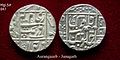 Rupee with square area
 -
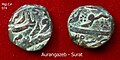 A copper dam of Aurangzeb


Aurangzeb felt that verses from the Quran should not be stamped on coins, as done in former times, because they were constantly touched by the hands and feet of people. His coins had the name of the mint city and the year of issue on one face, and, the following couplet on other:[116]
King Aurangzib 'Ālamgir
Stamped coins, in the world, like the bright full moon.[116]
Law
In 1689, the second Maratha Chhatrapati (King) Sambhaji was executed by Aurangzeb. In a sham trial, he was found guilty of murder and violence, atrocities[117] against the Muslims of Burhanpur and Bahadurpur in Berar by Marathas under his command.[118]
In 1675 the Sikh leader Guru Tegh Bahadur was arrested on orders by Aurangzeb, found guilty of blasphemy by a Qadi's court and executed.[119]
The 32nd Da'i al-Mutlaq (Absolute Missionary) of the Dawoodi Bohra sect of Musta'lī Islam Syedna Qutubkhan Qutubuddin was executed by Aurangzeb, then governor of Gujarat, for heresy; on 27 Jumadil Akhir 1056 AH (1648 AD), Ahmedabad, India.[120]
-
![In the year 1689, according to Mughal accounts, Sambhaji was put on trial, found guilty of atrocities[117] and executed.[121][122]](//upload.wikimedia.org/wikipedia/commons/thumb/d/de/Tulapur_arch.jpg/120px-Tulapur_arch.jpg)
-
![Guru Tegh Bahadur was publicly executed in 1675 on the orders of Aurangzeb in Delhi[123]](//upload.wikimedia.org/wikipedia/commons/thumb/d/d4/Gurdwara_Rakabganj_Sahib%2C_Delhi.jpg/120px-Gurdwara_Rakabganj_Sahib%2C_Delhi.jpg) Guru Tegh Bahadur was publicly executed in 1675 on the orders of Aurangzeb in Delhi[123]
Guru Tegh Bahadur was publicly executed in 1675 on the orders of Aurangzeb in Delhi[123] -
![Sarmad Kashani, a Jewish convert to Islam and Sufi mystic was accused of heresy and executed.[124]](//upload.wikimedia.org/wikipedia/commons/thumb/8/8a/Indian_-_Single_Leaf_of_Shah_Sarmad_and_Prince_Dara_Shikoh_-_Walters_W912.jpg/58px-Indian_-_Single_Leaf_of_Shah_Sarmad_and_Prince_Dara_Shikoh_-_Walters_W912.jpg)
![In the year 1689, according to Mughal accounts, Sambhaji was put on trial, found guilty of atrocities[117] and executed.[121][122]](/wiki/File:Tulapur_arch.jpg)
![Guru Tegh Bahadur was publicly executed in 1675 on the orders of Aurangzeb in Delhi[123]](/wiki/File:Gurdwara_Rakabganj_Sahib,_Delhi.jpg)
![Sarmad Kashani, a Jewish convert to Islam and Sufi mystic was accused of heresy and executed.[124]](/wiki/File:Indian_-_Single_Leaf_of_Shah_Sarmad_and_Prince_Dara_Shikoh_-_Walters_W912.jpg)
Military
_of_Emperor_Aurangzeb_(reigned_1658-1707)_and_sheath_LACMA_M.76.2.7a-b_(3_of_9).jpg)

It is reported that Aurangzeb always inspected his cavalry contingents every day, while testing his cutlasses sheep carcass, brought before him without the entrails and neatly bound up, in one strike.[125]
In 1663, during his visit to Ladakh, Aurangzeb established direct control over that part of the empire and loyal subjects such as Deldan Namgyal agreed to pledge tribute and loyalty. Deldan Namgyal is also known to have constructed a Grand Mosque in Leh, which he dedicated to Mughal rule.[126]
.jpg)
In 1664, Aurangzeb appointed Shaista Khan subedar (governor) of Bengal. Shaista Khan eliminated Portuguese and Arakanese pirates from the region, and in 1666 recaptured the port of Chittagong from the Arakanese king, Sanda Thudhamma. Chittagong remained a key port throughout Mughal rule.[127]
In 1685, Aurangzeb dispatched his son, Muhammad Azam Shah, with a force of nearly 50,000 men to capture Bijapur Fort and defeat Sikandar Adil Shah (the ruler of Bijapur) who refused to be a vassal. The Mughals could not make any advancements upon Bijapur Fort,[128] mainly because of the superior usage of cannon batteries on both sides. Outraged by the stalemate Aurangzeb himself arrived on 4 September 1686 and commanded the siege of Bijapur; after eight days of fighting, the Mughals were victorious.[129]
Only one remaining ruler, Abul Hasan Qutb Shah (the Qutbshahi ruler of Golconda), refused to surrender. He and his servicemen fortified themselves at Golconda and fiercely protected the Kollur Mine, which was then probably the world's most productive diamond mine, and an important economic asset. In 1687, Aurangzeb led his grand Mughal army against the Deccan Qutbshahi fortress during the siege of Golconda. The Qutbshahis had constructed massive fortifications throughout successive generations on a granite hill over 400 ft high with an enormous eight-mile long wall enclosing the city. The main gates of Golconda had the ability to repulse any war elephant attack. Although the Qutbshahis maintained the impregnability of their walls, at night Aurangzeb and his infantry erected complex scaffolding that allowed them to scale the high walls. During the eight-month siege the Mughals faced many hardships including the death of their experienced commander Kilich Khan Bahadur. Eventually, Aurangzeb and his forces managed to penetrate the walls by capturing a gate, and their entry into the fort led Abul Hasan Qutb Shah to surrender; he died after twelve years of Mughal imprisonment.[130]
Mughal cannon making skills advanced during the 17th century.[131] One of the most impressive Mughal cannons is known as the Zafarbaksh, which is a very rare composite cannon, that required skills in both wrought-iron forge welding and bronze-casting technologies and the in-depth knowledge of the qualities of both metals.[132] The Ibrahim Rauza was a famed cannon, which was well known for its multi-barrels.[133] François Bernier, the personal physician to Aurangzeb, observed Mughal gun-carriages each drawn by two horses, an improvement over the bullock-drawn gun-carriages used elsewhere in India.[134]
During the rule of Aurangzeb, In 1703, the Mughal commander at Coromandel, Daud Khan Panni spent 10,500 coins to purchase 30 to 50 war elephants from Ceylon.[135]
Art and culture
Aurangzeb was noted for his religious piety; he memorized the entire Quran, studied hadiths and stringently observed the rituals of Islam,[35][136] and "transcribe[d] copies of the Quran."[137][138]
Aurangzeb had a more austere nature than his predecessors, and greatly reduced imperial patronage of the figurative Mughal miniature.[139] This had the effect of dispersing the court atelier to other regional courts. Being religious he encouraged Islamic calligraphy. His reign also saw the building of the Lahore Badshahi Masjid and Bibi Ka Maqbara in Aurangabad for his wife Rabia-ud-Daurani. Aurangzeb was considered a Mujaddid by contemporary Muslims considered Aurangzeb.[140]
Calligraphy

The Mughal Emperor Aurangzeb is known to have patronised works of Islamic calligraphy;[142] the demand for Quran manuscripts in the naskh style peaked during his reign. Having been instructed by Syed Ali Tabrizi, Aurangzeb was himself a talented calligrapher in naskh, evidenced by Quran manuscripts that he created.[143][144]
Architecture
Aurangzeb was not as involved in architecture as his father. Under Aurangzeb's rule, the position of the Mughal Emperor as chief architectural patron began to diminish. However, Aurangzeb did endow some significant structures. Catherine Asher terms his architectural period as an "Islamization" of Mughal architecture.[145] One of the earliest constructions after his accession was a small marble mosque known as the Moti Masjid (Pearl Mosque), built for his personal use in the Red Fort complex of Delhi. He later ordered the construction of the Badshahi Mosque in Lahore, which is today one of the largest mosques in the Indian subcontinent.[146] The mosque he constructed in Srinagar is still the largest in Kashmir.[147] Aurangzeb had a palace constructed for himself in Aurangabad, which was extant till a few years ago.[148]
Most of Aurangzeb's building activity revolved around mosques, but secular structures were not neglected. The Bibi Ka Maqbara in Aurangabad, the mausoleum of Rabia-ud-Daurani, was constructed by his eldest son Azam Shah upon Aurangzeb's decree. Its architecture displays clear inspiration from the Taj Mahal.[149][150] Aurangzeb also provided and repaired urban structures like fortifications (for example a wall around Aurangabad, many of whose gates still survive), bridges, caravanserais, and gardens.[151]
Aurangzeb was more heavily involved in the repair and maintenance of previously existing structures. The most important of these were mosques, both Mughal and pre-Mughal, which he repaired more of than any of his predecessors.[152] He patronised the dargahs of Sufi saints such as Bakhtiyar Kaki, and strived to maintain royal tombs.[151]
-
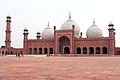 Seventeenth-century Badshahi Masjid built by Aurangzeb in Lahore.
 -
 Bibi ka Maqbara.
.jpg)

Textiles
The textile industry in the Mughal Empire emerged very firmly during the reign of the Mughal Emperor Aurangzeb and was particularly well noted by Francois Bernier, a French physician of the Mughal Emperor. Francois Bernier writes how Karkanahs, or workshops for the artisans, particularly in textiles flourished by "employing hundreds of embroiderers, who were superintended by a master". He further writes how "Artisans manufacture of silk, fine brocade, and other fine muslins, of which are made turbans, robes of gold flowers, and tunics worn by females, so delicately fine as to wear out in one night, and cost even more if they were well embroidered with fine needlework".[153]
He also explains the different techniques employed to produce such complicated textiles such as Himru (whose name is Persian for "brocade"), Paithani (whose pattern is identical on both sides), Mushru (satin weave) and how Kalamkari, in which fabrics are painted or block-printed, was a technique that originally came from Persia. Francois Bernier provided some of the first, impressive descriptions of the designs and the soft, delicate texture of Pashmina shawls also known as Kani, which were very valued for their warmth and comfort among the Mughals, and how these textiles and shawls eventually began to find their way to France and England.[154]
-
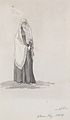 Shawls manufactured in the Mughal Empire had highly influenced other cultures around the world.
 -
 Shawl makers in the Mughal Empire.
 -
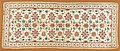 Mughal imperial carpet
.jpg)
.jpg)
.jpg)
Foreign relations

Aurangzeb sent diplomatic missions to Mecca in 1659 and 1662, with money and gifts for the Sharif. He also sent alms in 1666 and 1672 to be distributed in Mecca and Medina. Historian Naimur Rahman Farooqi writes that, "By 1694, Aurangzeb's ardour for the Sharifs of Mecca had begun to wane; their greed and rapacity had thoroughly disillusioned the Emperor ... Aurangzeb expressed his disgust at the unethical behavior of the Sharif who appropriated all the money sent to the Hijaz for his own use, thus depriving the needy and the poor."[156]</ref> According to english traveller named John Fryar, Aurangzeb also consider that despite his enormous power on land, it is cheaper to establish reciprocal relation with the naval forces of Portuguese empire to secure the sea interest of ships in Mughal territory, so he did not built an overtly massive naval forces.[157]
Relations with Aceh
For decades, the Malabari Mappila Muslims which representing the Mughal empire are already patronized Aceh Sultanate.[158] Aurangzeb, and his brother, Dara Shikoh, participated with Aceh trade and Aurangzeb himself also exchanging presents with the Sultan of Aceh in 1641.[158] In that year, it is recorded the daughter of Iskandar Muda, Sultanah Safiatuddin, has presented Aurangzeb with eight elephants.[159]
When the VOC, or Dutch East India Company trying to disrupt the trade in Aceh to make their own Malaka trade lucrative, Aurangzeb threatened the Dutch with retaliation against any losses in Gujarat due to Dutch intervention.[158] This effort were caused due to VOC realization that Muslim tradings were damaging to the VOC.[160] The Firman issued by Aurangzeb caused the VOC to back down and allowed Indian sailors to pass into Aceh, Perak, and Kedah, without any restrictions.[158][160][161]
Relations with the Uzbek
Subhan Quli Khan, Balkh's Uzbek ruler was the first to recognise him in 1658 and requested for a general alliance, he worked alongside the new Mughal Emperor since 1647, when Aurangzeb was the Subedar of Balkh.[citation needed]
Relations with the Safavid dynasty
Safavid Iran and the Mughal Empire had long clashed over Kandahar, an outpost on the distant frontier of their two empires. Control of the city swung back and forth.[162] Aurangzeb led two unsuccessful campaigns to recapture it 1649 and 1652. Mughal attempts died down after 1653 amidst internal rivalries.[163][164]
Upon ascending the throne, Aurangzeb was eager to obtain diplomatic recognition from the Safavids to bolster the legitimacy of his rule. Abbas II of Persia sent an embassy in 1661. Aurangzeb received the ambassador warmly and they exchanged gifts.[165] A return embassy sent by Aurangzeb to Persia in 1664 was poorly treated. Tensions over Kandahar rose again. There were cross border raids, but hostilities subsided after Abbas II's death in 1666.[166]
Aurangzeb's rebellious son, Prince Akbar, sought refuge with Suleiman I of Persia. Suleiman rescued him from the Imam of Musqat, but refused to assist him in any military adventures against Aurangzeb.[167]
Relations with the French
In 1667, the French East India Company ambassadors Le Gouz and Bebert presented Louis XIV of France's letter which urged the protection of French merchants from various rebels in the Deccan. In response to the letter, Aurangzeb issued a firman allowing the French to open a factory in Surat.[citation needed]
-
 March of the Great Moghul (Aurangzeb)
 -
 François Bernier, was a French physician and traveller, who for 12 years was the personal physician of Aurangzeb. He described his experiences in Travels in the Mughal Empire.
 -
 Map of the Mughal Empire by Vincenzo Coronelli (1650–1718) of Venice, who served as Royal Geographer to Louis XIV of France.
 -
 French map of the Deccan.


Relations with the Sultanate of Maldives
In the 1660s, the Sultan of the Maldives, Ibrahim Iskandar I, requested help from Aurangzeb's representative, the Faujdar of Balasore. The Sultan wished to gain his support in possible future expulsions of Dutch and English trading ships, as he was concerned with how they might impact the economy of the Maldives. However, as Aurangzeb did not possess a powerful navy and had no interest in providing support to Ibrahim in a possible future war with the Dutch or English, the request came to nothing.[168]
Relations with the Ottoman Empire
Like his father, Aurangzeb was not willing to acknowledge the Ottoman claim to the caliphate. He often supported the Ottoman Empire's enemies, extending cordial welcome to two rebel Governors of Basra, and granting them and their families a high status in the imperial service. Sultan Suleiman II's friendly postures were ignored by Aurangzeb.[169]</ref> The Sultan urged Aurangzeb to wage holy war against Christians.[170]</ref> However, Aurangzeb were granted as patron of Sharif of Mecca, and sending the Sherif at that time with richly laden mission, which at that time were under the jurisdiction of Ottoman.[171]
Relations with the English and the Anglo-Mughal War

In 1686, the East India Company, which had unsuccessfully tried to obtain a firman that would grant them regular trading privileges throughout the Mughal Empire, initiated the Anglo-Mughal War.[172] This war ended in disaster for the English after Aurangzeb in 1689 dispatched a large fleet from Janjira that blockaded Bombay. The ships, commanded by Sidi Yaqub, were manned by Indians and Mappilas.[173] In 1690, realising the war was not going favourably for them, the Company sent envoys to Aurangzeb's camp to plead for a pardon. The company's envoys prostrated themselves before the emperor, agreed pay a large indemnity, and promise to refrain from such actions in the future.[citation needed]
In September 1695, English pirate Henry Every conducted one of the most profitable pirate raids in history with his capture of a Grand Mughal grab convoy near Surat. The Indian ships had been returning home from their annual pilgrimage to Mecca when the pirate struck, capturing the Ganj-i-Sawai, reportedly the largest ship in the Muslim fleet, and its escorts in the process. When news of the capture reached the mainland, a livid Aurangzeb nearly ordered an armed attack against the English-governed city of Bombay, though he finally agreed to compromise after the Company promised to pay financial reparations, estimated at £600,000 by the Mughal authorities.[174] Meanwhile, Aurangzeb shut down four of the English East India Company's factories, imprisoned the workers and captains (who were nearly lynched by a rioting mob), and threatened to put an end to all English trading in India until Every was captured.[174] The Lords Justices of England offered a bounty for Every's apprehension, leading to the first worldwide manhunt in recorded history. However, Every successfully eluded capture.[175]
In 1702, Aurangzeb sent Daud Khan Panni, the Mughal Empire's Subhedar of the Carnatic region, to besiege and blockade Fort St. George for more than three months.[176] The governor of the fort Thomas Pitt was instructed by the East India Company to sue for peace.
Relations with the Ethiopian Empire
Ethiopian Emperor Fasilides dispatched an embassy to India in 1664–65 to congratulate Aurangzeb upon his accession to the throne of the Mughal Empire.[177]
Relations with the Tibetans, Uyghurs, and Dzungars
After 1679, the Tibetans invaded Ladakh, which was in the Mughal sphere of influence. Aurangzeb intervened on Ladakh's behalf in 1683, but his troops retreated before Dzungar reinforcements arrived to bolster the Tibetan position. At the same time, however, a letter was sent from the governor of Kashmir claiming the Mughals had defeated the Dalai Lama and conquered all of Tibet, a cause for celebration in Aurangzeb's court.[178]
Aurangzeb received an embassy from Muhammad Amin Khan of Chagatai Moghulistan in 1690, seeking assistance in driving out "Qirkhiz infidels" (meaning the Buddhist Dzungars), who "had acquired dominance over the country".
Relations with the Czardom of Russia
Russian Czar Peter the Great requested Aurangzeb to open Russo-Mughal trade relations in the late 17th century. In 1696 Aurangzeb received his envoy, Semyon Malenkiy, and allowed him to conduct free trade. After staying for six years in India, and visiting Surat, Burhanpur, Agra, Delhi and other cities, Russian merchants returned to Moscow with valuable Indian goods.[179]
Rebellions

Traditional and newly coherent social groups in northern and western India, such as the Marathas, Rajputs, Hindu Jats, Pashtuns, and Sikhs, gained military and governing ambitions during Mughal rule, which, through collaboration or opposition, gave them both recognition and military experience.[180]
- In 1669, the Hindu Jat peasants of Bharatpur around Mathura rebelled and created Bharatpur State but were defeated.
- In 1659, Maratha Emperor Shivaji, launched a surprise attack on the Mughal Viceroy Shaista Khan and, while waging war against Aurangzeb. Shivaji and his forces attacked the Deccan, Janjira and Surat and tried to gain control of vast territories.[citation needed] In 1689, Aurangzeb's armies captured Shivaji's son Sambhaji and executed him. But the Marathas continued the fight.[181]
- In 1679, the Rathore clan under the command of Durgadas Rathore of Marwar rebelled when Aurangzeb did not give permission to make the young Rathore prince the king and took direct command of Jodhpur. This incident caused great unrest among the Hindu Rajput rulers under Aurangzeb and led to many rebellions in Rajputana, resulting in the loss of Mughal power in the region and religious bitterness over the destruction of temples.[182][183]
- In 1672, the Satnami, a sect concentrated in an area near Delhi, under the leadership of Bhirbhan, took over the administration of Narnaul, but they were eventually crushed upon Aurangzeb's personal intervention with very few escaping alive.[184]
- In 1671, the battle of Saraighat was fought in the easternmost regions of the Mughal Empire against the Ahom Kingdom. The Mughals led by Mir Jumla II and Shaista Khan attacked and were defeated by the Ahoms.
- Maharaja Chhatrasal was the warrior from Bundela Rajput clan, who fought against the Mughal Emperor Aurangzeb, and established his own kingdom in Bundelkhand, becoming a Maharaja of Panna.[185]
Jat rebellion

In 1669, Hindu Jats began to organise a rebellion that is believed to have been caused by the re-imposition of jizya and destruction of Hindu temples in Mathura.[186][187] The Jats were led by Gokula, a rebel landholder from Tilpat. By the year 1670 20,000 Jat rebels were quelled and the Mughal Army took control of Tilpat, Gokula's personal fortune amounted to 93,000 gold coins and hundreds of thousands of silver coins.[188]
Gokula was caught and executed. But the Jats once again attempted rebellion. Raja Ram Jat, in order to avenge his father Gokula's death, plundered Akbar's tomb of its gold, silver and fine carpets, opened Akbar's grave and dragged his bones and burned them in retaliation.[189][190][191][192][193] Jats also shot off the tops of the minarets on the gateway to Akbar's Tomb and melted down two silver doors from the Taj Mahal.[194][195][196][197] Aurangzeb appointed Mohammad Bidar Bakht as commander to crush the Jat rebellion. On 4 July 1688, Raja Ram Jat was captured and beheaded. His head was sent to Aurangzeb as proof.[198]
However, after Aurangeb's death, Jats under Badan Singh later established their independent state of Bharatpur.
Due to the Jat rebellion, the temples of Pushtimarg, Gaudiya, and Radha vallabh Vaishnavs in Braj were abandoned and their icons were taken to different regions or into hiding.[199]
Mughal–Maratha Wars

In 1657, while Aurangzeb attacked Golconda and Bijapur in the Deccan, the Hindu Maratha warrior, Shivaji, used guerrilla tactics to take control of three Adil Shahi forts formerly under his father's command. With these victories, Shivaji assumed de facto leadership of many independent Maratha clans. The Marathas harried the flanks of the warring Adil Shahis, gaining weapons, forts, and territory.[200] Shivaji's small and ill-equipped army survived an all out Adil Shahi attack, and Shivaji personally killed the Adil Shahi general, Afzal Khan.[201] With this event, the Marathas transformed into a powerful military force, capturing more and more Adil Shahi territories.[202] Shivaji went on to neutralise Mughal power in the region.[203]
In 1659, Aurangzeb sent his trusted general and maternal uncle Shaista Khan, the Wali in Golconda to recover forts lost to the Maratha rebels. Shaista Khan drove into Maratha territory and took up residence in Pune. But in a daring raid on the governor's palace in Pune during a midnight wedding celebration, led by Shivaji himself, the Marathas killed Shaista Khan's son and Shivaji maimed Shaista Khan by cutting off three fingers of his hand. Shaista Khan, however, survived and was re-appointed the administrator of Bengal going on to become a key commander in the war against the Ahoms.[citation needed]

Aurangzeb next sent general Raja Jai Singh to vanquish the Marathas. Jai Singh besieged the fort of Purandar and fought off all attempts to relieve it. Foreseeing defeat, Shivaji agreed to terms.[204] Jai Singh persuaded Shivaji to visit Aurangzeb at Agra, giving him a personal guarantee of safety. Their meeting at the Mughal court did not go well, however. Shivaji felt slighted at the way he was received, and insulted Aurangzeb by refusing imperial service. For this affront he was detained, but managed to effect a daring escape.[205]
Shivaji returned to the Deccan, and crowned himself Chhatrapati or the ruler of the Maratha Kingdom in 1674.[206] Shivaji expanded Maratha control throughout the Deccan until his death in 1680. Shivaji was succeeded by his son, Sambhaji.[207] Militarily and politically, Mughal efforts to control the Deccan continued to fail.
On the other hand, Aurangzeb's third son Akbar left the Mughal court along with a few Muslim Mansabdar supporters and joined Muslim rebels in the Deccan. Aurangzeb in response moved his court to Aurangabad and took over command of the Deccan campaign. The rebels were defeated and Akbar fled south to seek refuge with Sambhaji, Shivaji's successor. More battles ensued, and Akbar fled to Persia and never returned.[208]
In 1689, Aurangzeb's forces captured and executed Sambhaji. His successor Rajaram, later Rajaram's widow Tarabai and their Maratha forces fought individual battles against the forces of the Mughal Empire. Territory changed hands repeatedly during the years (1689–1707) of interminable warfare. As there was no central authority among the Marathas, Aurangzeb was forced to contest every inch of territory, at great cost in lives and money. Even as Aurangzeb drove west, deep into Maratha territory – notably conquering Satara – the Marathas expanded eastwards into Mughal lands – Malwa and Hyderabad. The Marathas also expanded further South into Southern India defeating the independent local rulers there capturing Jinji in Tamil Nadu. Aurangzeb waged continuous war in the Deccan for more than two decades with no resolution.[209][page range too broad] He thus lost about a fifth of his army fighting rebellions led by the Marathas in Deccan India. He travelled a long distance to the Deccan to conquer the Marathas and eventually died at the age of 88, still fighting the Marathas.[210]
Aurangzeb's shift from conventional warfare to anti-insurgency in the Deccan region shifted the paradigm of Mughal military thought. There were conflicts between Marathas and Mughals in Pune, Jinji, Malwa and Vadodara. The Mughal Empire's port city of Surat was sacked twice by the Marathas during the reign of Aurangzeb and the valuable port was in ruins.[211] Matthew White estimates that about 2.5 million of Aurangzeb's army were killed during the Mughal–Maratha Wars (100,000 annually during a quarter-century), while 2 million civilians in war-torn lands died due to drought, plague and famine.[212]
-
 A Mughal trooper in the Deccan.
 -
 Aurangzeb leads his final expedition (1705), leading an army of 500,000 troops.
 -
 Mughal-era aristocrat armed with a matchlock musket.
 -
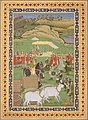 Aurangzeb, in later life, hunting with hounds and falconers


Ahom campaign

While Aurangzeb and his brother Shah Shuja had been fighting against each other, the Hindu rulers of Kuch Behar and Assam took advantage of the disturbed conditions in the Mughal Empire, had invaded imperial dominions. For three years they were not attacked,[citation needed] but in 1660 Mir Jumla II, the viceroy of Bengal, was ordered to recover the lost territories.[213]
The Mughals set out in November 1661. Within weeks they occupied the capital of Kuch Behar, which they annexed. Leaving a detachment to garrison it, the Mughal army began to retake their territories in Assam. Mir Jumla II advanced on Garhgaon, the capital of the Ahom kingdom, and reached it on 17 March 1662. The ruler, Raja Sutamla, had fled before his approach. The Mughals captured 82 elephants, 300,000 rupees in cash, 1000 ships, and 173 stores of rice.[214]
On his way back to Dacca, in March 1663, Mir Jumla II died of natural causes.[215] Skirmishes continued between the Mughals and Ahoms after the rise of Chakradhwaj Singha, who refused to pay further indemnity to the Mughals and during the wars that continued the Mughals suffered great hardships. Munnawar Khan emerged as a leading figure and is known to have supplied food to vulnerable Mughal forces in the region near Mathurapur. Although the Mughals under the command of Syed Firoz Khan the Faujdar at Guwahati were overrun by two Ahom armies in 1667, but they continued to hold and maintain presence in their eastern territories even after the battle of Saraighat in 1671.[citation needed]
The battle of Saraighat was fought in 1671 between the Mughal empire (led by the Kachwaha king, Raja Ramsingh I), and the Ahom Kingdom (led by Lachit Borphukan) on the Brahmaputra river at Saraighat, now in Guwahati. Although much weaker, the Ahom Army defeated the Mughal Army by brilliant uses of the terrain, clever diplomatic negotiations to buy time, guerrilla tactics, psychological warfare, military intelligence and by exploiting the sole weakness of the Mughal forces – its navy.[citation needed]
The battle of Saraighat was the last battle in the last major attempt by the Mughals to extend their empire into Assam. Though the Mughals managed to regain Guwahati briefly after a later Borphukan deserted it, the Ahoms wrested control in the battle of Itakhuli in 1682 and maintained it till the end of their rule.[216]
Satnami opposition

In May 1672, the Satnami sect, obeying the commands of an old toothless woman (according to Mughal accounts), organised a revolt in the agricultural heartlands of the Mughal Empire. The Satnamis were known to have shaved off their heads and even eyebrows and had temples in many regions of Northern India. They began a large-scale rebellion 75 miles southwest of Delhi.[217]
The Satnamis believed they were invulnerable to Mughal bullets and believed they could multiply in any region they entered. The Satnamis initiated their march upon Delhi and overran small-scale Mughal infantry units.[184]
Aurangzeb responded by organising a Mughal army of 10,000 troops, artillery, and a detachment of his imperial guards. Aurangzeb wrote Islamic prayers and drew designs that were sewn into the army's flags. His army crushed the Satnami rebellion.[217]
Sikh opposition

The ninth Sikh Guru, Guru Tegh Bahadur, like his predecessors was opposed to forced conversion of the local population as he considered it wrong. Approached by Kashmiri Pandits to help them retain their faith and avoid forced religious conversions, Guru Tegh Bahadur sent a message to the emperor that if he could convert Teg Bagadur to Islam, every Hindu will become a Muslim.[219] In response, Aurangzeb ordered arrest of the Guru. He was then brought to Delhi and tortured so as to convert him. On his refusal to convert, he was beheaded in 1675.[219][220]

In response, Guru Tegh Bahadur's son and successor, Guru Gobind Singh, further militarised his followers, starting with the establishment of Khalsa in 1699, eight years before Aurangzeb's death.[221][222][223] In 1705, Guru Gobind Singh sent a letter entitled Zafarnamah, which accused Aurangzeb of cruelty and betraying Islam.[224][225] The letter caused him much distress and remorse.[226] Guru Gobind Singh's formation of Khalsa in 1699 led to the establishment of the Sikh Confederacy and later Sikh Empire.
Pashtun opposition
.jpg)
The Pashtun revolt in 1672 under the leadership of the warrior poet Khushal Khan Khattak of Kabul,[227][228] was triggered when soldiers under the orders of the Mughal Governor Amir Khan allegedly molested women of the Pashtun tribes in modern-day Kunar Province of Afghanistan. The Safi tribes retaliated against the soldiers. This attack provoked a reprisal, which triggered a general revolt of most of tribes. Attempting to reassert his authority, Amir Khan led a large Mughal Army to the Khyber Pass, where the army was surrounded by tribesmen and routed, with only four men, including the Governor, managing to escape.[citation needed]
Aurangzeb's incursions into the Pashtun areas were described by Khushal Khan Khattak as "Black is the Mughal's heart towards all of us Pathans".[229] Aurangzeb employed the scorched earth policy, sending soldiers who massacred, looted and burnt many villages. Aurangzeb also proceeded to use bribery to turn the Pashtun tribes against each other, with the aim that they would distract a unified Pashtun challenge to Mughal authority, and the impact of this was to leave a lasting legacy of mistrust among the tribes.[230]
After that the revolt spread, with the Mughals suffering a near total collapse of their authority in the Pashtun belt. The closure of the important Attock-Kabul trade route along the Grand Trunk road was particularly disastrous. By 1674, the situation had deteriorated to a point where Aurangzeb camped at Attock to personally take charge. Switching to diplomacy and bribery along with force of arms, the Mughals eventually split the rebels and partially suppressed the revolt, although they never managed to wield effective authority outside the main trade route.[citation needed]
Death


By 1689, the conquest of Golconda, Mughal victories in the south expanded the Mughal Empire to 4 million square kilometres,[231] with a population estimated to be over 158 million.[8] But this supremacy was short-lived.[232] Jos Gommans, Professor of Colonial and Global History at the University of Leiden,[233] says that "... the highpoint of imperial centralisation under emperor Aurangzeb coincided with the start of the imperial downfall."[234]
Aurangzeb constructed a small marble mosque known as the Moti Masjid (Pearl Mosque) in the Red Fort complex in Delhi.[235] However, his constant warfare, especially with the Marathas, drove his empire to the brink of bankruptcy just as much as the wasteful personal spending and opulence of his predecessors.[236]

The Indologist Stanley Wolpert, emeritus professor at UCLA,[237] says that:
The conquest of the Deccan, to which Aurangzeb devoted the last twenty-six years of his life, was in many ways a Pyrrhic victory, costing an estimated hundred thousand lives a year during its last decade of fruitless, chess-game warfare ... The expense in gold and rupees can hardly be imagined or accurately estimated. Alamgir's moving capital alone-a city of tents thirty miles in circumference, two hundred and fifty bazaars, with half a million camp followers, fifty thousand camels, and thirty thousand elephants, all of whom had to be fed, stripped peninsular India of any and all of its surplus grain and wealth ... Not only famine, but bubonic plague arose ... Even Alamgir had ceased to understand the purpose for it all by ... 1705. The emperor was nearing ninety by then ... "I came alone and I go as a stranger. I do not know who I am, nor what I have been doing," the dying old man confessed to his son in February 1707.[238]

Even when ill and dying, Aurangzeb made sure that the populace knew he was still alive, for if they had thought otherwise then the turmoil of another war of succession was likely.[239] He died at his military camp in Bhingar near Ahmednagar on 3 March 1707 at the age of 88, having outlived many of his children. He had only 300 rupees with him which were later given to charity as per his instructions and he prior to his death requested not to spend extravagantly on his funeral but to keep it simple.[138][240] His modest open-air grave in Khuldabad, Aurangabad, Maharashtra expresses his deep devotion to his Islamic beliefs. It is sited in the courtyard of the shrine of the Sufi saint Shaikh Burhan-u'd-din Gharib, who was a disciple of Nizamuddin Auliya of Delhi.
Brown writes that after his death, "a string of weak emperors, wars of succession, and coups by noblemen heralded the irrevocable weakening of Mughal power". She notes that the populist but "fairly old-fashioned" explanation for the decline is that there was a reaction to Aurangzeb's oppression.[241] Although Aurangzeb died without appointing a successor, he instructed his three sons to divide the empire among themselves. His sons failed to reach a satisfactory agreement and fought against each other in a war of succession. Aurangzeb's immediate successor was his third son Azam Shah, who was defeated and killed in June 1707 at the battle of Jajau by the army of Bahadur Shah I, the second son of Aurangzeb.[242] Both because of Aurangzeb's over-extension and because of Bahadur Shah's weak military and leadership qualities, entered a period of terminal decline. Immediately after Bahadur Shah occupied the throne, the Maratha Empire – which Aurangzeb had held at bay, inflicting high human and monetary costs even on his own empire – consolidated and launched effective invasions of Mughal territory, seizing power from the weak emperor. Within decades of Aurangzeb's death, the Mughal Emperor had little power beyond the walls of Delhi.[243]
Assessments and legacy
Aurangzeb's rule has been the subject of both praise and controversy.[244][245] During his lifetime, victories in the south expanded the Mughal Empire to 4 million square kilometres,[231] and he ruled over a population estimated to be over 158 million subjects.[8] His critics argue that his ruthlessness and religious bigotry made him unsuitable to rule the mixed population of his empire. Some critics assert that the persecution of Shias, Sufis and non-Muslims to impose practices of orthodox Islamic state, such as imposition of sharia and jizya religious tax on non-Muslims, doubling of custom duties on Hindus while abolishing it for Muslims, executions of Muslims and non-Muslims alike, and destruction of temples eventually led to numerous rebellions.[246][247][248][249][250][251] G. N. Moin Shakir and Sarma Festschrift argue that he often used political opposition as pretext for religious persecution,[249] and that, as a result, groups of Jats, Marathas, Sikhs, Satnamis and Pashtuns rose against him.[184][249][252]
Multiple interpretations of Aurangzeb's life and reign over the years by critics have led to a very complicated legacy. Some argue that his policies abandoned his predecessors' legacy of pluralism and religious tolerance, citing his introduction of the jizya tax and other policies based on Islamic ethics; his demolition of Hindu temples; the executions of his elder brother Dara Shikoh, King Sambhaji of Maratha[253][254] and Sikh Guru Tegh Bahadur[255][256][f] and the prohibition and supervision of behaviour and activities that are forbidden in Islam such as gambling, fornication, and consumption of alcohol and narcotics.[257][258] At the same time, some historians question the historical authenticity of the claims of his critics, arguing that his destruction of temples has been exaggerated,[259][260] and noting that he built more temples than he destroyed,[112] paid for their maintenance, employed significantly more Hindus in his imperial bureaucracy than his predecessors, and opposed bigotry against Hindus and Shia Muslims.[66]
Muhammad Al-Munajjid has compilled that the opinions from Islamic scholarly community towards Aurangzeb were positive for the emperor general attitude such as abolished Bid'ah celebrations, musics, and also abolished the customs of bowing and kissing the ground which were done by his predecessors, practically adhering practice of Salafi while still held to Hanafite creed.[Notes 1] Apparently this view of Aurangzeb were influenced by Muhammad Saleh Kamboh,[264] who acted as his teacher.[265]
In Pakistan, author Haroon Khalid writes that, "Aurangzeb is presented as a hero who fought and expanded the frontiers of the Islamic empire" and "is imagined to be a true believer who removed corrupt practices from religion and the court, and once again purified the empire."[266] The academic Munis Faruqui also opines that the "Pakistani state and its allies in the religious and political establishments include him in the pantheon of premodern Muslim heroes, especially lauding him for his militarism, personal piety, and seeming willingness to accommodate Islamic morality within state goals."[267]
Muhammad Iqbal, considered the spiritual founder of Pakistan, admired Aurangzeb. Iqbal Singh Sevea, in his book on the political philosophy of the thinker, says that "Iqbal considered that the life and activities of Aurangzeb constituted the starting point of Muslim nationality in India".[268] Maulana Shabbir Ahmad Usmani, in his funeral oration, hailed M.A. Jinnah, the founder of Pakistan, to be the greatest Muslim since Aurangzeb.[269] Pakistani-American academic Akbar Ahmed described President Zia-ul-Haq, known for his Islamization drive, as "conceptually ... a spiritual descendent of Aurangzeb" because Zia had an orthodox, legalistic view of Islam.[270][271]
Muhammad Sayyid Tantawy, a grand mufti of Egypt, once called Aurangzeb as "A remnant of the Rightly-Guided Rashidun Caliphs", as appreciation of Aurangzeb commitment to Islam teaching.[272]
Beyond the individual appreciations, Aurangzeb is seminal to Pakistan's national self-consciousness, as historian Ayesha Jalal, while referring to the Pakistani textbooks controversy, mentions M. D. Zafar's A Text Book of Pakistan Studies where we can read that, under Aurangzeb, "Pakistan spirit gathered in strength", while his death "weakened the Pakistan spirit."[273] Another historian from Pakistan, Mubarak Ali, also looking at the textbooks, and while noting that Akbar "is conveniently ignored and not mentioned in any school textbook from class one to matriculation", contrasts him with Aurangzeb, who "appears in different textbooks of Social Studies and Urdu language as an orthodox and pious Muslim copying the Holy Quran and sewing caps for his livelihood."[274] This image of Aurangzeb is not limited to Pakistan's official historiography.
As of 2015, about 177 towns and villages of India have been named after Aurangzeb.[275] Historian Audrey Truschke points out that Bharatiya Janta Party (BJP), Hindutva proponents and some others outside Hindutva ideology regard Aurangzeb as Muslim zealot in India. Jawaharlal Nehru wrote that, due to his reversal of the cultural and religious syncretism of the previous Mughal emperors, Aurangzeb acted "more as a Moslem than an Indian ruler",[276] while Mahatma Gandhi was of the view that there was greater degree of freedom under Mughal rule than the British rule and asks that "in Aurangzeb's time a Shivaji could flourish. Has one hundred and fifty years of the British rule produced any Pratap and Shivaji?"[277] Other historians also noting that there are Hindu temples built during Aurangzeb reign,[[112] while he also employed significantly more Hindus in his imperial bureaucracy than his predecessors did, opposed bigotry against Hindus and Shia Muslims.[278]
Literatures
Aurangzeb has prominently featured in the following books
- 1675 – Aureng-zebe, play by John Dryden, written and performed on the London stage during the Emperor's lifetime.
- 1688 - Alamgirnama by Mirza Mohammed Qasim official biographer at Aurangzeb's court [279]
- 19?? – Hindi fiction novel by Acharya Chatursen Shastri[280]
- 1970 – Shahenshah (Marathi: शहेनशहा), the Marathi fictional biography by N S Inamdar; translated into English in 2017 by Vikrant Pande as Shahenshah – The Life of Aurangzeb
- 2017 – 1636: Mission to the Mughals, by Eric Flint and Griffin Barber
- 2018 – Aurangzeb: The Man and the Myth, by Audrey Truschke
Personal Life
Ancestry
| Ancestors of Aurangzeb | |||||||||||||||||||||||||||||||||||||||||||||||||||||||||||||||||||||||||||||||||||||||||||||||||||||||||||||||||||||||||||||||||||||||||||||||||||||||||||||||||||||||||||||||||||||||||||||||||||||||||||||||||||||||||||||||||||||||||||||||||||||||||||||||||||||||||
|---|---|---|---|---|---|---|---|---|---|---|---|---|---|---|---|---|---|---|---|---|---|---|---|---|---|---|---|---|---|---|---|---|---|---|---|---|---|---|---|---|---|---|---|---|---|---|---|---|---|---|---|---|---|---|---|---|---|---|---|---|---|---|---|---|---|---|---|---|---|---|---|---|---|---|---|---|---|---|---|---|---|---|---|---|---|---|---|---|---|---|---|---|---|---|---|---|---|---|---|---|---|---|---|---|---|---|---|---|---|---|---|---|---|---|---|---|---|---|---|---|---|---|---|---|---|---|---|---|---|---|---|---|---|---|---|---|---|---|---|---|---|---|---|---|---|---|---|---|---|---|---|---|---|---|---|---|---|---|---|---|---|---|---|---|---|---|---|---|---|---|---|---|---|---|---|---|---|---|---|---|---|---|---|---|---|---|---|---|---|---|---|---|---|---|---|---|---|---|---|---|---|---|---|---|---|---|---|---|---|---|---|---|---|---|---|---|---|---|---|---|---|---|---|---|---|---|---|---|---|---|---|---|---|---|---|---|---|---|---|---|---|---|---|---|---|---|---|---|---|---|---|---|---|---|---|---|---|---|---|---|---|---|---|---|---|
| |||||||||||||||||||||||||||||||||||||||||||||||||||||||||||||||||||||||||||||||||||||||||||||||||||||||||||||||||||||||||||||||||||||||||||||||||||||||||||||||||||||||||||||||||||||||||||||||||||||||||||||||||||||||||||||||||||||||||||||||||||||||||||||||||||||||||
Full title
_(36012492090).jpg)
The epithet Aurangzeb means 'Ornament of the Throne'.[12] His chosen title Alamgir translates to Conqueror of the World.[289]
Aurangzeb's full imperial title was:
Al-Sultan al-Azam wal Khaqan al-Mukarram Hazrat Abul Muzaffar Muhy-ud-Din Muhammad Aurangzeb Bahadur Alamgir I, Badshah Ghazi, Shahanshah-e-Sultanat-ul-Hindiya Wal Mughaliya.[290]
Aurangzeb had also been attributed various other titles including Caliph of The Merciful, Monarch of Islam, and Living Custodian of God.[291][292]
See also
Notes
- ^ English: The Honorable, Generous
- ^ English: Commander of the Faithful
- ^ School of Thought: Hanafi
- ^ Regarding the tokenistic aspect of Shah Jahan's actions to strengthen Islam in his empire, Satish Chandra says, "We may conclude that Shah Jahan tried to effect a compromise. While formally declaring the state to be an Islamic one, showing respect to the sharia, and observing its injunctions in his personal life, he did not reject any of the liberal measures of Akbar. ... Shah Jahan's compromise was based not on principle but on expediency."[76]
- ^ It has however been argued that the Mughal emperor had political motives for this particular execution. See the article on Sarmad Kashani for references.
- ^ See also "Aurangzeb, as he was according to Mughal Records"; more links at the bottom of that page. For Muslim historian's record on major Hindu temple destruction campaigns, from 1193 to 1729 AD, see Richard Eaton (2000), "Temple Desecration and Indo-Muslim States", Journal of Islamic Studies, Vol. 11, Issue 3, pp. 283–319
- ^ through IslamQA.info,[261] Professor Muhammad al-Munajjid on his online correspondence has answered that he based his opinion Silk ad-Durar fi A'yaan al-Qarn ath-Thaani 'Ashar (4/113)[262] and Aurangzeb biography by Professor 'Abd al-Mun'im an-Nimr in his book Tareekh al-Islam fi'l-Hind.[263]
Citations
- ^ "Tomb of Aurangzeb" (PDF). ASI Aurangabad. Archived from the original (PDF) on 23 September 2015. Retrieved 21 March 2015.
- ^ Khomdan Singh Lisam (2011). Encyclopaedia Of Manipur (3 Vol.). Gyan Publishing House. p. 706. ISBN 9788178358642. Retrieved 20 March 2024.
... Aurangzeb Bahadur Alamgir I ( Conqueror of the Universe ) , more commonly known as Aurangzeb , the 6th Mughal Emperor ruled from 1658 to
- ^ Gul Rahim Khan (2021). "Silver Coins Hoard of the Late Mughals from Kohat". Ancient Pakistan. 18. Department of Archaeology, University of Peshawar: 16. ISSN 2708-4590.
In gold there is no more type. In silver some other types like Abu al Muzaffar Muhiuddin/ Muhammad (and date) / Bahadur Alamgir/ Aurangzeb/ Badshah Ghazi or ...
- ^ Proceedings of the Royal Irish Academy Volume 3. Harvard University; Royal Irish Academy. 1893. p. 398. Retrieved 20 March 2024.
The Emperor's name and title were proclaimed in the pulpit as Abu al-Muzaffar Bahadur ' Alamgir Badshah i Ghazi
- ^ Chapra, Muhammad Umer (2014). Morality and Justice in Islamic Economics and Finance. Edward Elgar Publishing. pp. 62–63. ISBN 978-1-78347-572-8.
Aurangzeb (1658–1707). Aurangzeb's rule, spanning a period of 49 years
- ^ Bayly, C.A. (1990). Indian society and the making of the British Empire (1st pbk. ed.). Cambridge [England]: Cambridge University Press. p. 7. ISBN 978-0-521-38650-0.
- ^ Turchin, Peter; Adams, Jonathan M.; Hall, Thomas D (December 2006). "East-West Orientation of Historical Empires". Journal of World-Systems Research. 12 (2): 223. ISSN 1076-156X. Retrieved 12 September 2016.
- ^ a b c József Böröcz (2009). The European Union and Global Social Change. Routledge. p. 21. ISBN 978-1-135-25580-0. Retrieved 26 June 2017.
- ^ Ali, A.; Thiam, I.D.; Talib, Y.A. (2016). The Different aspects of Islamic culture: Islam in the World today; Retrospective of the evolution of Islam and the Muslim world. UNESCO Publishing. p. 51. ISBN 978-92-3-100132-1.
- ^ Bibb, Sheila C.; Simon-López, Alexandra (2019). Framing the Apocalypse: Visions of the End-of-Times. Brill. ISBN 978-90-04-39944-0.
- ^ Spear, Percival. "Aurangzeb". Encyclopædia Britannica. Retrieved 6 April 2016.
- ^ a b Thackeray, Frank W.; Findling, John E., eds. (2012). Events that formed the modern world: from the European Renaissance through the War on Terror. Santa Barbara, Calif.: ABC-CLIO. p. 248. ISBN 978-1-59884-901-1.
- ^ Waseem, M., ed. (2003). On Becoming an Indian Muslim: French Essays on Aspects of Syncretism. New Delhi: Oxford University Press. p. 103. ISBN 978-0-19-565807-1.
- ^ a b c d Mukerjee 2001, p. 23.
- ^ a b c Sarkar 1912, p. 61.
- ^ Tillotson 2008, p. 194.
- ^ Eaton, Richard M. (2019). India in the Persianate Age: 1000–1765. University of California Press. p. 251. ISBN 978-0-520-97423-4. OCLC 1243310832.
- ^ Gandhi, Supriya (2020). The emperor who never was: Dara Shukoh in Mughal India. Cambridge, Massachusetts: Belknap Press. pp. 52–53. ISBN 978-0-674-98729-6. OCLC 1112130290.
- ^ Gandhi, Supriya (2020). The emperor who never was: Dara Shukoh in Mughal India. Cambridge, Massachusetts: Belknap Press. pp. 59–62. ISBN 978-0-674-98729-6. OCLC 1112130290.
- ^ Truschke, Audrey (2017). Aurangzeb: the life and legacy of India's most controversial king. Stanford, California: Stanford University Press. pp. 17–18. ISBN 978-1-5036-0259-5. OCLC 962025936.
- ^ Sarkar 1912, pp. 10–12.
- ^ Sarkar 1912, pp. 11–12.
- ^ Hansen, Waldemar (1996) [1972]. The Peacock Throne: The Drama of Mogul India. Motilal Banarsidass. pp. 122–124. ISBN 978-81-208-0225-4. Retrieved 23 November 2012.
- ^ Sarkar 1912, p. 12.
- ^ Richards (1996, p. 130)
- ^ Abdul Hamid Lahori (1636). "Prince Awrangzeb (Aurangzeb) facing a maddened elephant named Sudhakar". Padshahnama. Archived from the original on 6 January 2014.
- ^ a b Markovits, Claude, ed. (2004) [First published 1994 as Histoire de l'Inde Moderne]. A History of Modern India, 1480–1950 (2nd ed.). London: Anthem Press. p. 103. ISBN 978-1-84331-004-4.
- ^ George Michell and Mark Zebrowski, Architecture and Art of the Deccan Sultanates, (Cambridge University Press, 1999), 12.
- ^ Eraly, Abraham (2007). The Mughal World: Life in India's Last Golden Age. Penguin Books India. p. 147. ISBN 978-0-14-310262-5.
- ^ Chandra, Satish (2002) [1959]. Parties and politics at the Mughal Court, 1707–1740 (4th ed.). Oxford University Press. p. 50. ISBN 978-0-19-565444-8.
- ^ Krieger-Krynicki, Annie (2005). Captive princess: Zebunissa, daughter of Emperor Aurangzeb. Translated by Hamid, Enjum. Oxford University Press. p. 92. ISBN 978-0-19-579837-1.
- ^ Mukerjee 2001, p. 53.
- ^ Sarkar 1912, pp. 64–66.
- ^ Brown, Katherine Butler (January 2007). "Did Aurangzeb Ban Music? Questions for the Historiography of his Reign". Modern Asian Studies. 41 (1): 82–84. doi:10.1017/S0026749X05002313. S2CID 145371208.
- ^ a b Richards (1996, p. 128)
- ^ The Calcutta Review, Volume 75, 1882, p. 87.
- ^ Sir Charles Fawcett: The Travels of the Abbarrn India and the Near East, 1672 to 1674 Hakluyt Society, London, 1947, p. 167.
- ^ M. S. Commissariat: Mandelslo's Travels In Western India, Asian Educational Services, 1995, p. 57.
- ^ Krieger-Krynicki, Annie (2005). Captive Princess: Zebunissa, Daughter of Emperor Aurangzeb. Oxford University Press. pp. 3, 41. ISBN 978-0-195-79837-1.
- ^ Ahmad, Fazl. Heroes of Islam. Lahore: Sh. Muhammad Ashraff, 1993. Print.
- ^ Campbell, James McNabb (1896). History of Gujarát. Bombay: Government Central Press. p. 280. Retrieved 29 April 2022.
- ^ Subramanian, Archana (30 July 2015). "Way to the throne". The Hindu. ISSN 0971-751X. Retrieved 26 February 2022.
- ^ Munis D. Faruqui (2012). The Princes of the Mughal Empire, 1504-1719 (Hardcover). Cambridge University Press. p. 175. ISBN 978-1-107-02217-1. Retrieved 15 March 2024.
- ^ Richards (1996, pp. 132–133)
- ^ Richards (1996, pp. 132–133)
- ^ Richards (1996, pp. 134–135)
- ^ a b c d e f Chandra, Satish (2005). Medieval India: From Sultanat to the Mughals. Vol. 2. Har-Anand Publications. pp. 267–269. ISBN 978-81-241-1066-9. Retrieved 29 September 2012.
- ^ Richards (1996, pp. 140, 188)
- ^ Prasad, Ishwari (1974). The Mughal Empire. Allahabad: Chugh Publications. pp. 524–525. OCLC 1532660.
[Aurangzeb] marched in the direction of Bijapur and on reaching Bidar laid siege to it ... The Qiladar of the fort was Sidi Marjan ... [The Mughals] were helped by an explosion of powder magazine in the fortress ... Sidi Marjan and two of his sons were badly burnt ... Thus was the fort of Bidar taken after a siege of 27 days ... Sidi Marjan died of his wounds soon afterwards ... Aurangzeb arrived at Kalyani.
- ^ Mukhoty, Ira (17 May 2018). "Aurangzeb and Dara Shikoh's fight for the throne was entwined with the rivalry of their two sisters". Scroll.in.
- ^ a b Markovits, Claude, ed. (2004) [First published 1994 as Histoire de l'Inde Moderne]. A History of Modern India, 1480–1950 (2nd ed.). London: Anthem Press. p. 96. ISBN 978-1-84331-004-4.
- ^ Richards (1996, pp. 151–152)
- ^ Metcalf, Barbara D.; Metcalf, Thomas R. (2006). A Concise History of Modern India (2nd ed.). Cambridge: Cambridge University Press. pp. 20–21. ISBN 978-0-521-86362-9.
- ^ "Marc Gaborieau" (in French). Centre d'Études de l'Inde et de l'Asie du Sud. 6 July 2016. Retrieved 2 May 2016.
- ^ a b c Chandra, Satish (2005). Medieval India: From Sultanat to the Mughals. Vol. 2. Har-Anand Publications. pp. 270–271. ISBN 978-81-241-1066-9. Retrieved 29 September 2012.
- ^ Syed, Anees Jahan (1977). Aurangzeb in Muntakhab-al Lubab. Somaiya Publications. pp. 64–65. OCLC 5240812.
- ^ Kolff, Dirk H. A. (2002) [1990]. Naukar, Rajput, and Sepoy: The Ethnohistory of the Military Labour Market of Hindustan, 1450–1850 (illustrated, revised ed.). Cambridge University Press. p. 22. ISBN 978-0-521-52305-9.
- ^ Richards (1996, p. 159)
- ^ a b c Chandra, Satish (2005). Medieval India: From Sultanat to the Mughals. Vol. 2. Har-Anand Publications. p. 272. ISBN 978-81-241-1066-9. Retrieved 29 September 2012.
- ^ a b Sen, Sailendra (2013). A Textbook of Medieval Indian History. Primus Books. p. 183. ISBN 978-9-38060-734-4.
- ^ Richards (1996, p. 162)
- ^ The Cambridge History of India (1922), vol. IV, p. 481.
- ^ Larson, Gerald James (1995). India's Agony Over Religion. State University of New York Press. p. 111. ISBN 978-0-7914-2411-7.
- ^ Allan, J.; Haig, Sir T. Wolseley (1934). Dodwell, H. H. (ed.). The Cambridge Shorter History of India. Cambridge University Press. p. 416.
- ^ Smith, Vincent Arthur (1920). The Oxford History of India: From the Earliest Times to the End of 1911. Clarendon Press. p. 412.
- ^ a b c Truschke, Audrey (2017). Aurangzeb: The Life and Legacy of India's Most Controversial King. Stanford University Press. p. 58. ISBN 978-1-5036-0259-5.
- ^ Malik, Jamal (2008). Islam in South Asia: A Short History. Brill. p. 190. ISBN 978-90-04-16859-6.
- ^ Laine, James W. (2015). Meta-Religion: Religion and Power in World History. Univ of California Press. p. 153. ISBN 978-0-520-95999-6.
- ^ Maddison, Angus (2003): Development Centre Studies The World Economy Historical Statistics: Historical Statistics, OECD Publishing, ISBN 92-64-10414-3, pp. 259–261
- ^ Ahmed Sayeed (2020). Negate Fighting Faith. Oxford University Press. p. 201. ISBN 978-93-88660-79-2.
- ^ Holt, P. M.; Lambton, Ann K. S.; Lewis, Bernard, eds. (1977). The Cambridge History of Islam. Vol. 2a. p. 52. doi:10.1017/chol9780521219488. ISBN 978-1-139-05504-8.
- ^ History of Indian Nation: Medieval India. K. K. Publications. 2022. p. 155.
- ^ a b c S. M. Ikram; Ainslie T. Embree (1964). "17". Muslim Civilization in India (Ebook). Columbia University Press. Retrieved 25 November 2023.
Aurangzeb was most forthright in his efforts to stop sati. According to Manucci, on his return from Kashmir in December, 1663, he "issued an order that in all lands under Mughal control, never again should the officials allow a woman to be burnt." Manucci adds that "This order endures to this day."/26/ This order, though not mentioned in the formal histories, is recorded in the official guidebooks of the reign./27/ Although the possibility of an evasion of government orders through payment of bribes existed, later European travelers record that sati was not much practiced by the end of Aurangzeb's reign. As Ovington says in his Voyage to Surat: "Since the Mahometans became Masters of the Indies, this execrable custom is much abated, and almost laid aside, by the orders which nabobs receive for suppressing and extinguishing it in all their provinces. And now it is 237 very rare, except it be some Rajah's wives, that the Indian women burn at all; /27/ Jadunath Sarkar, History of Aurangzib (Calcutta, 1916), III, 92. /28/ John Ovington, A Voyage to Surat (London, 1929), p. 201.
- ^ Brown, Katherine Butler (January 2007). "Did Aurangzeb Ban Music? Questions for the Historiography of his Reign". Modern Asian Studies. 41 (1): 78. doi:10.1017/S0026749X05002313. S2CID 145371208.
- ^ Indian Archives: Volume 50. National Archives of India. 2001. p. 141.
- ^ a b Chandra, Satish (2005). Medieval India: From Sultanat to the Mughals. Vol. 2. Har-Anand Publications. pp. 255–256. ISBN 978-81-241-1066-9. Retrieved 29 September 2012.
- ^ Richards (1996, p. 171)
- ^ Chandra, Satish (2006) [1999]. Medieval India: From Sultanate To The Mughals: Mughal Empire (1526–1748) (Second Reprint ed.). Har-Anand Publications Pvt Ltd. p. 350. ISBN 978-81-241-1066-9. Retrieved 24 October 2014.
- ^ Satish Chandra (2005). Medieval India: From Sultanat to the Mughals Part – II. Har-Anand Publications. pp. 280–. ISBN 978-81-241-1066-9.
Although Aurangzeb had not raised the slogan of defending Islam before the battle of Samugarh with Dara, and had tried to befriend the Rajput rajas as we have seen, there were a number of factors which make it necessary for Aurangzeb to present himself as the defender of the sharia, and to try and win over the theologians. A principal factor was the popular revulsion against his treatment of his brothers, Murad and Dara, both of whom had the reputation of being liberal patrons of the poor and needy. Aurangzeb was shocked when as the time of his second coronation in 1659, the chief qazi refused to crown him since his father was still alive.
- ^ a b Brown, Katherine Butler (January 2007). "Did Aurangzeb Ban Music? Questions for the Historiography of his Reign". Modern Asian Studies. 41 (1): 77. doi:10.1017/S0026749X05002313. S2CID 145371208.
More importantly, though, the fact that Aurangzeb did not order a universal ban on music lends support to the idea that his regime was less intolerant and repressive than has been widely believed in the past...Thus, the overwhelming evidence against a ban on musical practice in Aurangzeb's reign suggests that the nature of his state was less orthodox, tyrannical and centralised than
- ^ Zaman, Taymiya R. (2007). Inscribing Empire: Sovereignty and Subjectivity in Mughal Memoirs. University of Michigan. p. 153. ISBN 978-0-549-18117-0.
- ^ Mukhia, Harbans (2004). The Mughals of India. Wiley. p. 25. ISBN 978-0-631-18555-0.
learnt that in Multan and Thatta in Sind, and especially at Varanasi, Brahmins attracted a large number of Muslims to their discourses. Aurangzeb ... ordered the governors of all these provinces 'to demolish the schools and temples of the infidels'.
- ^ "Religions – Sikhism: Guru Tegh Bahadur". BBC. 1 October 2009. Retrieved 29 April 2012.
- ^ Sadiq Ali (1918), A Vindication of Aurangzeb: In Two Parts, p. 141
- ^ Vipul Singh, The Pearson Indian History Manual for the UPSC Civil Services Preliminary Examination, Pearson Education India, p. 152, ISBN 978-81-317-1753-0
- ^ Na, Abdullahi Ahmed An-Na'im; Naʻīm, ʻAbd Allāh Aḥmad (2009). Islam and the Secular State. Harvard University Press. p. 145. ISBN 978-0-674-03376-4.
- ^ Richards, John F. (1993). The Mughal Empire. Cambridge University Press. p. 173. ISBN 978-0-521-56603-2.
- ^ Gerhard Bowering; Mahan Mirza; Patricia Crone (2013). The Princeton Encyclopedia of Islamic Political Thought (Hardcover). Princeton University Press. p. 27. ISBN 978-0-691-13484-0. Retrieved 6 March 2024.
- ^ Malik, Zubair & Parveen 2016, pp. 162–163.
- ^ a b Pirbhai, M. Reza (2009). "Chapter Two : Indicism, Intoxication And Sobriety Among The 'Great Mughals'". Reconsidering Islam in a South Asian Context. Brill. pp. 67–116. doi:10.1163/ej.9789004177581.i-370.14. ISBN 978-90-474-3102-2.
- ^ Chandra, Satish (September 1969). "Jizyah and the State in India during the 17th Century". Journal of the Economic and Social History of the Orient. 12 (3): 322–340. doi:10.2307/3596130. ISSN 0022-4995. JSTOR 3596130.
- ^ a b Truschke, Audrey (2017). "5. Moral Man and Leader". Aurangzeb: The Life and Legacy of India's Most Controversial King. Stanford University Press. pp. 70–71. doi:10.1515/9781503602595-009. ISBN 978-1-5036-0259-5. S2CID 243691670.
- ^ a b Lal, Vinay. "Aurangzeb's Fatwa on Jizya". MANAS. Archived from the original on 11 May 2017. Retrieved 5 February 2021.
- ^ Khan, Iqtidar Alam (January–February 2001). "State in the Mughal India: Re-Examining the Myths of a Counter-Vision". Social Scientist. 29 (1/2): 16–45. doi:10.2307/3518271. ISSN 0970-0293. JSTOR 3518271.
- ^ Truschke, Audrey (2017). "7. Later Years". Aurangzeb: The Life and Legacy of India's Most Controversial King. Stanford University Press. p. 94. doi:10.1515/9781503602595-011. ISBN 978-1-5036-0259-5. S2CID 242351847.
- ^ Aggarwal, Dhruv Chand (Spring 2017). "The Afterlives of Aurangzeb: Jizya, Social Domination and the Meaning of Constitutional Secularism" (PDF). Rutgers Journal of Law & Religion. 18: 109–155. Archived (PDF) from the original on 9 October 2022.
- ^ Husain, S.M. Azizuddin (1 July 2000). "Jizya – Its Reimposition During the Reign of Aurangzeb: An Examination". Indian Historical Review. 27 (2): 87–121. doi:10.1177/0376983620000204. ISSN 0376-9836. S2CID 220267774.
- ^ Lal, Vinay. "Aurangzeb, Akbar, and the Communalization of History". Manas.
- ^ Kulke, Tilmann (2020). "Aurangzeb and Islam in India : 50 years of Mughal Realpolitik". In Jacobsen, Knut A. (ed.). Routledge Handbook of South Asian Religions. Routledge. p. 194. doi:10.4324/9780429054853-14. ISBN 978-0-429-05485-3. S2CID 226338454.
- ^ Husain, S. M. Azizuddin (2002). Structure of Politics Under Aurangzeb, 1658–1707. Kanishka Publishers, Distributors. ISBN 978-81-7391-489-8.
- ^ Gilbert, Marc Jason (2017). South Asia in World History. Oxford University Press. pp. 85–86. ISBN 978-0-19-066137-3.
- ^ Smith, Haig Z. (2022). Religion and Governance in England's Emerging Colonial Empire, 1601–1698. Springer Nature. pp. 215, 216. ISBN 978-3-030-70131-4.
- ^ a b Puniyani, Ram (2003). Communal politics: facts versus myths. Sage Publications. p. 60. ISBN 978-0-7619-9667-5.
he kept changing his policies depending on the needs of the situation ... he had put a brake on the construction of new temples but the repair and maintenance of old temples was permitted. He also generously donated jagirs to many temples to win the sympathies of the people ... firmans include the ones from the temples of Mahakaleshwar (Ujjain), Balaji temple (Chitrakut), Umanand temples (Guwahati) and Jain temples of Shatrunjaya. Also there are firmans supporting other temples and gurudwaras in north India.
- ^ a b c d Mukhia, Harbans (2004), "For Conquest and Governance: Legitimacy, Religion and Political Culture", The Mughals of India, John Wiley & Sons, Ltd, pp. 25–26, doi:10.1002/9780470758304.ch1, ISBN 978-0-470-75830-4, retrieved 5 February 2021
- ^ a b Subodh, Sanjay (2001). "Temples Rulers and Historians' Dilemma: Understanding the Medieval Mind". Proceedings of the Indian History Congress. 62: 334–344. ISSN 2249-1937. JSTOR 44155778.
- ^ Pauwels, Heidi; Bachrach, Emilia (July 2018). "Aurangzeb as Iconoclast? Vaishnava Accounts of the Krishna images' Exodus from Braj". Journal of the Royal Asiatic Society. 28 (3): 485–508. doi:10.1017/S1356186318000019. ISSN 1356-1863. S2CID 165273975.
- ^ a b c d e f g Eaton, Richard (2000). "Temple Desecration and Indo-Muslim States". Journal of Islamic Studies. 11 (3): 307–308. doi:10.1093/jis/11.3.283.
In early 1670, soon after the ring-leader of these rebellions had been captured near Mathura, Aurangzeb ordered the destruction of the city's Keshava Deva temple and built an Islamic structure ('īd-gāh) on its site ... Nine years later, the emperor ordered the destruction of several prominent temples in Rajasthan that had become associated with imperial enemies. These included temples in Khandela ... Jodhpur ... Udaipur and Chitor.
- ^ Truschke, Audrey (23 February 2017). "What Aurangzeb did to preserve Hindu temples (and protect non-Muslim religious leaders)". Scroll.in. Retrieved 5 February 2021.
- ^ Shafqat, Arshia (2008). Administration Of Gujarat Under The Mughals (A.D. 1572–1737) (PhD). Aligarh University. p. 194.
- ^ Asher, Catherine B., ed. (1992), "Precedents for Mughal architecture", Architecture of Mughal India, The New Cambridge History of India, Cambridge: Cambridge University Press, p. 8, doi:10.1017/CHOL9780521267281.002, ISBN 978-0-521-26728-1, retrieved 5 February 2021
- ^ Eaton, Richard M. (2000). "Temple Desecration and Indo-Muslim States" (PDF). The Hindu. Chennai, India. p. 297. Archived from the original (PDF) on 6 January 2014.
- ^ a b c Copland, Ian; Mabbett, Ian; Roy, Asim; et al. (2013). A History of State and Religion in India. Routledge. p. 119. ISBN 978-1-136-45950-4.
- ^ Wilbur, Marguerite Eyer (1951). The East India Company and the British Empire in the Far East. Stanford: Stanford University Press. p. 178. ISBN 978-0-8047-2864-5.
- ^ Hunter, Sir William Wilson (2005) [First published 1886 (London:)]. The Indian Empire: Its People, History, and Products (Reprinted ed.). New Delhi: Asian Educational Services. p. 311. ISBN 978-81-206-1581-6.
- ^ Harrison, Lawrence E.; Berger, Peter L. (2006). Developing cultures: case studies. Routledge. p. 158. ISBN 978-0-415-95279-8.
- ^ a b Khan, Sāqi Must'ad (1947). Maāsir-i-'Ālamgiri: A History of the Emperor Aurangzib 'Ālamgir (reign 1658–1707 A.D.). Translated by Sarkar, Sir Jadunath. Calcutta: Royal Asiatic Society of Bengal. p. 13. OCLC 692517744.
In former times the sacred Quaranic credo (Kalma) used to be stamped on gold and silver coins, and such coins were constantly touched with the hands and feet of men; Aurangzib said that it would be better to stamp some other words ... The Emperor liked it [the couplet] and ordered that one face ... should be stamped with this verse and the other with the name of the mint-city and the year.
- ^ a b Stein, Burton (2010) [1998]. Arnold, David (ed.). A History of India (2nd ed.). Blackwell Publishers. p. 179. ISBN 978-1-4051-9509-6.
- ^ Richards (1996, p. 223)
- ^ Syan, Hardip Singh (2012). Sikh Militancy in the Seventeenth Century: Religious Violence in Mughal and Early Modern India. I.B. Tauris. pp. 130–131. ISBN 978-1-78076-250-0.
- ^ Blank, Jonah (2001). Mullahs on the Mainframe: Islam and Modernity Among the Daudi Bohras. University of Chicago Press. p. 44. ISBN 978-0-226-05676-0.
- ^ Mehta, J. L. (2005). Advanced Study in the History of Modern India: Volume One: 1707 – 1813. Sterling Publishers. pp. 50–. ISBN 978-1-932705-54-6. Retrieved 29 September 2012.
- ^ Stein, Burton (2010) [1998]. Arnold, David (ed.). A History of India (2nd ed.). Blackwell Publishers. p. 180. ISBN 978-1-4051-9509-6.
- ^ "A Gateway to Sikhism | Sri Guru Tegh Bhadur Sahib". Gateway to Sikhism. Archived from the original on 27 March 2014. Retrieved 28 October 2018.
- ^ Cook, David (2007). Martyrdom in Islam. Cambridge University Press. p. 80. ISBN 978-0-521-85040-7.
- ^ Rosalind O'Hanlon (2007). "Military Sports and the History of the Martial Body in India". Journal of the Economic and Social History of the Orient. 50 (4). Brill: 490–523. doi:10.1163/156852007783245133. ISSN 1568-5209. JSTOR 25165208.
...Bernier reported that the emperor Aurangzeb inspected his contingents of cavalry every day. During these inspections, "the King takes pleasure also in having the blades of cutlasses tried on dead sheep, brought before him without the entrails and neatly bound up. Young Omrahs, Mansebdars and Gourze-berdars or mace bearers, exercise their skill and put forth all their strength to cut through the four feet, which are fastened together, and the body of the sheep at one blow."..."
- ^ Kaul, H. N. (1998). Rediscovery of Ladakh. Indus Publishing. p. 63. ISBN 978-81-7387-086-6. Retrieved 29 April 2012.
- ^ Markovits, Claude, ed. (2004) [First published 1994 as Histoire de l'Inde Moderne]. A History of Modern India, 1480–1950 (2nd ed.). London: Anthem Press. p. 106. ISBN 978-1-84331-004-4.
Shayista Khan ... was appointed [Bengal's] governor in 1664 and swept the region clean of Portuguese and Arakanese pirates ... in 1666, he recaptured the port of Chittagong ... from the king of Arakan. A strategic outpost, Chittagong would remain the principal commercial port of call before entering the waters of the delta.
- ^ Farooqui, Salma Ahmed (2011). A Comprehensive History of Medieval India: Twelfth to the Mid-Eighteenth Century. Pearson Education India. ISBN 978-81-317-3202-1.
- ^ . Vol. 3. Encyclopædia Britannica. 1911 – via Wikisource.
- ^ "The Rise and fall of Persian to the Muslims of South Asia". International Journal of Academic Multidisciplinary Research. 6 (4). University of Sindh: 267. 2022. ISSN 2643-9670. Retrieved 19 March 2024 – via ResearchGate.
- ^ Singh, Abhay Kumar (2006). Modern World System and Indian Proto-industrialization: Bengal 1650–1800. Vol. 1. New Delhi: Northern Book Centre. pp. 351–352. ISBN 978-81-7211-201-1. Retrieved 30 September 2012.
- ^ Balasubramaniam, R.; Chattopadhyay, Pranab K. (2007). "Zafarbaksh – The Composite Mughal Cannon of Aurangzeb at Fort William in Kolkata" (PDF). Indian Journal of History of Science. 42. Archived from the original (PDF) on 22 December 2015.
- ^ Douglas, James (1893). Bombay and western India: a series of stray papers. Vol. 2. Sampson Low, Marston & Company.
- ^ Khan, Iqtidar Alam (2006). "The Indian Response to Firearms, 1300-1750". In Buchanan, Brenda J. (ed.). Gunpowder, Explosives And the State: A Technological History. Ashgate Publishing. p. 59. ISBN 978-0-7546-5259-5.
- ^ Mughal Warfare: Indian Frontiers and Highroads to Empire, 1500–1700, p. 122, at Google Books
- ^ Truschke, Audrey (2017). Aurangzeb: The Life and Legacy of India's Most Controversial King. Stanford University Press. p. 66. ISBN 978-1-5036-0257-1.
- ^ Dasgupta, K. (1975). "How Learned Were the Mughals: Reflections on Muslim Libraries in India". The Journal of Library History. 10 (3): 241–254. JSTOR 25540640.
- ^ a b Qadir, K.B.S.S.A. (1936). "The Cultural Influences of Islam in India". Journal of the Royal Society of Arts. 84 (4338): 228–241. JSTOR 41360651.
- ^ Imperial Mughal Painting, Stuart Cary Welch, (New York: George Braziller, 1978), pp. 112–113. "In spite of his later austerity, which turned him against music, dance, and painting, a few of the best Mughal paintings were made for [Aurangzeb] 'Alamgir. Perhaps the painters realized that he might close the workshops and therefore exceeded themselves in his behalf".
- ^ Truschke, Audrey (2017). Aurangzeb: The Life and Legacy of India's Most Controversial King. Stanford University Press. ISBN 978-1-5036-0259-5.
- ^ "Emirates owner to sell Quran inscribed by Aurangzeb". 15 November 2018. Archived from the original on 24 July 2011. Retrieved 7 April 2011.
- ^ Taher, M. (1994). Librarianship and Library Science in India: An Outline of Historical Perspectives. Concept Publishing Company. p. 54. ISBN 978-81-7022-524-9. Retrieved 3 October 2014.
- ^ Blair, Sheila (2006). Islamic calligraphy. Edinburgh: Edinburgh University Press. p. 550. ISBN 978-0-7486-1212-3. OCLC 56651142.
- ^ Schimmel, Annemarie (1990). Calligraphy and Islamic culture. London: Tauris. ISBN 1-85043-186-8. OCLC 20420019.
- ^ Asher, Catherine B. (1992). Architecture of Mughal India. Cambridge University Press. pp. 252 & 290. doi:10.1017/chol9780521267281. ISBN 978-0-521-26728-1.
- ^ Markovits, Claude, ed. (2004) [First published 1994 as Histoire de l'Inde Moderne]. A History of Modern India, 1480–1950 (2nd ed.). London: Anthem Press. p. 166. ISBN 978-1-84331-004-4.
- ^ "Aali Masjid". heritageofkashmir.org. Archived from the original on 9 August 2014. Retrieved 29 January 2023.
- ^ Sohoni, Pushkar (20 December 2016). "A Tale of Two Imperial Residences: Aurangzeb's Architectural Patronage". Journal of Islamic Architecture. 4 (2): 63. doi:10.18860/jia.v4i2.3514. ISSN 2356-4644.
- ^ Asher, Catherine B. (1992). Architecture of Mughal India. Cambridge University Press. pp. 263–264. doi:10.1017/chol9780521267281. ISBN 978-0-521-26728-1.
- ^ "World Heritage Sites. Bibi-Ka-Maqbar". Archived from the original on 11 October 2011. Retrieved 28 January 2013.
- ^ a b Asher, Catherine B. (1992). Architecture of Mughal India. Cambridge University Press. pp. 260–261. doi:10.1017/chol9780521267281. ISBN 978-0-521-26728-1.
- ^ Asher, Catherine B. (1992). Architecture of Mughal India. Cambridge University Press. pp. 255–259. doi:10.1017/chol9780521267281. ISBN 978-0-521-26728-1.
- ^ Werner, Louis (July–August 2011). "Mughal Maal". Saudi Aramco World. Archived from the original on 22 February 2016. Retrieved 3 October 2014.
- ^ Hansen, Eric (July–August 2002). "Pashmina: Kashmir's Best Cashmere". Saudi Aramco World. Archived from the original on 27 October 2004. Retrieved 3 October 2014.
- ^ Schimmel, A.; Waghmar, B.K. (2004). The Empire of the Great Mughals: History, Art and Culture. Reaktion Books. p. 17. ISBN 978-1-86189-185-3. Retrieved 3 October 2014.
- ^ Farooqi 1989, pp. 124, 126: "In November 1659, shortly after his formal coronation, Aurangzeb sent ... a diplomatic mission to Mecca ... entrusted with 630.000 rupees for the Sharif families of Mecca and Medina ... Aurangzeb sent another mission to Mecca in 1662 ... with presents worth 660,000 rupees ... Aurangzeb also sent considerable amount of money, through his own agents, to Mecca. In 1666 ... alms and offerings; ... six years later ... several lakhs of rupees; the money was to be spent in charity in Mecca and Medina."
- ^ Daniel R. Headrick (2012). Power Over Peoples Technology, Environments, and Western Imperialism, 1400 to the Present (ebook). Princeton University Press. p. 76. ISBN 978-1-4008-3359-7. Retrieved 15 March 2024.
- ^ a b c d Leonard Y. Andaya (22 January 2008). Leaves of the Same Tree Trade and Ethnicity in the Straits of Melaka (Hardcover). University of Hawaii Press. pp. 121–122. ISBN 978-0-8248-3189-9. Retrieved 2 December 2023.
... Aurangzeb and Dara Shukoh participated in Aceh's trade, and Aurangzeb even exchanged presents with Aceh's sultan in 1641. For two decades after the Dutch conquest of Portuguese Melaka in 1641, the VOC tried to attract trade to Melaka by the VOC tried to attract trade to Melaka by restricting Muslim trade to Aceh. Angered by
- ^ Pius Malekandathil (2016). The Indian Ocean in the Making of Early Modern India (ebook). Taylor & Francis. ISBN 978-1-351-99745-4. Retrieved 11 March 2024.
... 1641 , his daughter , Sultanah Safiatuddin presented Aurangzeb with eight ...
- ^ a b Malekandathil, Pius, ed. (13 September 2016). The Indian Ocean in the Making of Early Modern India. Taylor & Francis. p. 154. ISBN 978-1-351-99746-1. Retrieved 2 December 2023.
... backed out and allowed Indian traders to sail to Aceh and other southern ports without restriction.74 According to S ...
- ^ Frans Huskin; Dick van der Meij (11 October 2013). Reading Asia New Research in Asian Studies (ebook). Taylor & Francis. p. 87. ISBN 978-1-136-84377-8. Retrieved 2 December 2023.
... 1660s the VOC backed down and allowed Indian traders to sail to Aceh, Perak, and Kedah without restriction.ll Another important trading community in Aceh consisted of Indians from the Coromandel Coast who had been prominent in Malay ...
- ^ Matthee 2012, pp. 122–124.
- ^ Matthee 2012, pp. 124–125.
- ^ Farooqi 1989, p. 60.
- ^ Farooqi 1989, pp. 58–59.
- ^ Matthee 2012, p. 126.
- ^ Matthee 2012, p. 136.
- ^ Tripathy, Rasananda (1986). Crafts and commerce in Orissa in the sixteenth-seventeenth centuries. Delhi: Mittal Publications. p. 91. OCLC 14068594. Retrieved 29 April 2012.
- ^ Farooqi 1989, pp. 332–333: "Aurangzeb, who seized the Peacock throne from Shahjahan, was equally unwilling to acknowledge the Ottoman claim to the Khilafat. Hostile towards the Ottomans, the Emperor took every opportunity to support the opponents of the Ottoman regime. He cordially welcomed two rebel Governors of Basra and gave them and their dependents high mansabs in the imperial service. Aurangzeb also did not respond to Sultan Suleiman II's friendly overtures."
- ^ Farooqi 1989, p. 151: "Suleiman II even solicited Aurangzeb's support against the Christians and urged him to wage holy war against them."
- ^ John F. Richards (1993). The Mughal Empire Part 1, Volume 5 (Paperback). Cambridge University Press. ISBN 978-0-521-56603-2. Retrieved 2 December 2023.
- ^ "Asia Facts, information, pictures | Encyclopedia.com articles about Asia | Europe, 1450 to 1789: Encyclopedia of the Early Modern World". encyclopedia.com. Retrieved 23 February 2015.
- ^ Faruki, Zahiruddin (1972) [1935]. Aurangzeb & His Times. Bombay: Idarah-i Adabiyāt-i Delli. p. 442. OCLC 1129476255.
- ^ a b Burgess, Douglas R. (2009). "Piracy in the Public Sphere: The Henry Every Trials and the Battle for Meaning in Seventeenth-Century Print Culture". Journal of British Studies. 48 (4): 887–913. doi:10.1086/603599. S2CID 145637922.
- ^ Burgess, Douglas R. (2009). The Pirates' Pact: The Secret Alliances Between History's Most Notorious Buccaneers and Colonial America. New York: McGraw-Hill. pp. 144–145. ISBN 978-0-07-147476-4.
- ^ Blackburn, Terence R. (2007). A Miscellany of Mutinies And Massacres in India. APH Publishing. p. 11. ISBN 978-81-313-0169-2.
- ^ Bernier, François (1671). Travels in the Mogul Empire: A.D. 1656–1668.
- ^ "MAASIR-I-'ALAMGIRI" (PDF). dspace.gipe.ac.in.
- ^ "Russia and India: A civilisational friendship". 9 September 2016.
- ^ Metcalf, Barbara D.; Metcalf, Thomas R. (2006). A Concise History of Modern India (Second ed.). Cambridge University Press. pp. 23–24. ISBN 978-0-521-86362-9.
- ^ Schmidt, Karl J. (1995). An Atlas and Survey of South Asian History. Armonk, New York: M.E. Sharpe. p. 54. ISBN 978-1-56324-334-9.
- ^ Laine, James W. (2015). Meta-Religion: Religion and Power in World History. Univ of California Press. p. 153. ISBN 978-0-520-95999-6. Retrieved 21 February 2022.
- ^ Burn, Richard, ed. (1937). The Cambridge History of India. Vol. IV. pp. 248–252. Retrieved 15 September 2011.
The whole country was soon occupied by the imperialists, anarchy and slaughter were let loose upon the doomed state; all great towns in the village were pillaged; the temples were thrown down
- ^ a b c Edwardes, Stephen Meredyth; Garrett, Herbert Leonard Offley (1930). Mughal Rule in India. Atlantic Publishers and Distributors. p. 119. ISBN 978-81-7156-551-1.
- ^ Bhagavānadāsa Gupta, Contemporary Sources of the Mediaeval and Modern History of Bundelkhand (1531–1857), vol. 1 (1999). ISBN 81-85396-23-X.
- ^ Avari 2013, p. 131: Crisis arose in the north among the Jat agriculturists dissatisfied with punitive imperial taxation ... The first to rebel against the Mughals were the Hindu Jats.
- ^ The History of Indian people by Damodar P Singhal pg 196 Quote: "In 1669 the demolition of Hindu temples and building of mosques in Mathura led to a Jat uprising under Gokla"
- ^ Chandra, S. (2005). Medieval India: From Sultanat to the Mughals Part – II. Har-Anand Publications. p. 290. ISBN 978-81-241-1066-9. Retrieved 3 October 2014.
- ^ Vīrasiṃha, 2006, "The Jats: Their Role & Contribution to the Socio-economic Life and Polity of North & North-west India, Volume 2", Delhi: Originals , pp. 100–102.
- ^ Edward James Rap;son, Sir Wolseley Haig and Sir Richard, 1937, "The Cambridge History of India", Cambridge University Press, Volume 4, pp. 305.
- ^ Waldemar Hansen, 1986, "The Peacock Throne: The Drama of Mogul India", p. 454.
- ^ Reddy, 2005, "General Studies History for UPSC", Tata McGraw-Hill, p. B-46.
- ^ Catherine Ella Blanshard Asher, 1992, "Architecture of Mughal India – Part 1", Cambridge university Press, Vol. 4, p. 108.
- ^ Peck, Lucy (2008). Agra: The Architectural Heritage. Roli Books. ISBN 978-81-7436-942-0.
- ^ Sir Harry Hamilton Johnston, Leslie Haden Guest, 1937, The World of To-day: The Marvels of Nature and the Creations of Man, Vol. 2, p. 510
- ^ Havell, Ernest Binfield (1904). A Handbook to Agra and the Taj, Sikandra, Fatehpur-Sikri and the Neighbourhood. Longmans, Green, and Company. p. 75. ISBN 978-1-4219-8341-7.
- ^ Penfield, Frederic Courtland (1907). East to Suez Ceylon, India, China, and Japan. p. 179.
- ^ Maasir – I – Alamgiri. 1947.
- ^ Saha, Shandip (2004). Creating a Community of Grace: A History of the Puṣṭi Mārga in Northern and Western India (Thesis). University of Ottawa. pp. 89, 178.
- ^ Kincaid, Dennis (1937). The Grand Rebel: An Impression of Shivaji, Founder of the Maratha Empire. London: Collins. pp. 72–78.
- ^ Kincaid, Dennis (1937). The Grand Rebel: An Impression of Shivaji Maharaj, Founder of the Maratha Empire. London: Collins. pp. 121–125.
- ^ Kincaid, Dennis (1937). The Grand Rebel: An Impression of Shivaji, Founder of the Maratha Empire. London: Collins. pp. 130–138.
- ^ Markovits, Claude, ed. (2004) [First published 1994 as Histoire de l'Inde Moderne]. A History of Modern India, 1480–1950 (2nd ed.). London: Anthem Press. p. 102. ISBN 978-1-84331-004-4.
- ^ Chandra, Satish (1999). Medieval India: From Sultanat to the Mughals. Vol. 2 (1st ed.). New Delhi: Har-Anand Publications. p. 321. OCLC 36806798.
- ^ Chandra, Satish (1999). Medieval India: From Sultanat to the Mughals. Vol. 2 (1st ed.). New Delhi: Har-Anand Publications. pp. 323–324. OCLC 36806798.
- ^ Kincaid, Dennis (1937). The Grand Rebel: An Impression of Shivaji, Founder of the Maratha Empire. London: Collins. p. 283.
- ^ Agrawal, Ashvini (1983). Studies in Mughal History. Motilal Banarsidass Publication. pp. 162–163. ISBN 978-81-208-2326-6.
- ^ Gascoigne, Bamber; Gascoigne, Christina (1971). The Great Moghuls. Cape. pp. 228–229. ISBN 978-0-224-00580-7.
- ^ Gascoigne, Bamber; Gascoigne, Christina (1971). The Great Moghuls. Cape. pp. 239–246. ISBN 978-0-224-00580-7.
- ^ Gordon, Stewart (1993). The Marathas 1600–1818 (1. publ. ed.). New York: Cambridge University. pp. 101–105. ISBN 978-0-521-26883-7. Retrieved 20 July 2016.
- ^ Stein, B.; Arnold, D. (2010). A History of India. Wiley. p. 181. ISBN 978-1-4443-2351-1. Retrieved 3 October 2014.
- ^ Matthew White (2011). Atrocitology: Humanity's 100 Deadliest Achievements. Canongate Books. p. 113. ISBN 978-0-85786-125-2.
- ^ Sarkar, Jadunath, ed. (1973) [1948]. The History of Bengal. Vol. II. Patna: Academica Asiatica. p. 346. OCLC 924890.
Mir Jumla was appointed governor of Bengal (June 1660) and ordered to punish the kings of Kuch Bihar and Assam.
- ^ Sarkar, Jadunath, ed. (1973) [1948]. The History of Bengal. Vol. II. Patna: Academica Asiatica. pp. 346–347. OCLC 924890.
[Mir Jumla] left Dacca on 1st November 1661 ... the Mughal army entered the capital of Kuch Bihar on 19th December ... The kingdom was annexed to the Mughal empire ... Mir Jumla set out for the conquest of Assam on 4th January, 1662 ... triumphantly marched into Garh-gaon the Ahom capital on 17th March. Raja Jayadhwaj ... had fled .. The spoils ... 82 elephants, 3 lakhs of rupees in cash, ... over a thousand bots, and 173 stores of paddy.
- ^ Sarkar, Jadunath, ed. (1973) [1948]. The History of Bengal. Vol. II. Patna: Academica Asiatica. p. 350. OCLC 924890.
[Mir Jumla] set out on his return on 10th January 1663, travelling by pālki owing to his illness, which daily increased. At Baritalā he embarked in a boat and glided down the river toward Dacca, dying on 31st March.
- ^ Sarkar, J. N. (1992), "Chapter VIII Assam-Mughal Relations", in Barpujari, H. K., The Comprehensive History of Assam 2, Guwahati: Assam Publication Board, pp. 148–256
- ^ a b Hansen, Waldemar (1986) [1972]. The Peacock Throne: The Drama of Mogul India. Motilal Banarsidass. p. 454. ISBN 978-81-208-0225-4. Retrieved 3 October 2014.
- ^ "PM Modi visits Gurdwara Sis Ganj Sahib in Delhi on 400th Prakash Parab of Guru Teg Bahadur". Hindustan Times. 1 May 2021.
- ^ a b Sehgal, Narender (1994). Converted Kashmir: Memorial of Mistakes. Delhi: Utpal Publications. pp. 152–153. ISBN 978-81-85217-06-2. Archived from the original on 18 April 2014.
- ^ "Guru Tegh Bahadur". BBC.
- ^ Arvind-Pal Singh Mandair; Christopher Shackle; Gurharpal Singh (2013). Sikh Religion, Culture and Ethnicity. Routledge. pp. 25–28. ISBN 978-1-136-84627-4.
- ^ "BBC Religions – Sikhism". BBC. 26 October 2009. Retrieved 30 July 2011.
- ^ P Dhavan (2011). When Sparrows Became Hawks: The Making of the Sikh Warrior Tradition, 1699–1799. Oxford University Press. pp. 3–4. ISBN 978-0-19-975655-1.
- ^ Chaitanya, Krishna (1994). A History of Indian Painting: The Modern Period. Vol. 5. Abhinav Publications. pp. 3–4. ISBN 978-81-7017-310-6.
In the letter to Aurangzeb in his Zafarnama, Gobind Singh opposes the emperor not because he is a Muslim, but condemns him because he had betrayed Islam by his deceit, unscrupulousness and intolerance. 'You, who profess belief in the one God and the Koran do not have at heart an atom of faith in them... You neither recognise any God, nor do you have any respect for Prophet Mohammed.'
- ^ Randhawa, Karenjot (2012). Civil Society in Malerkotla, Punjab: Fostering Resilience Through Religion. Lexington Books. p. 61. ISBN 978-0-7391-6737-3.
- ^ Renard, John (2012). Fighting Words: Religion, Violence, and the Interpretation of Sacred Texts. University of California Press. p. 215. ISBN 978-0-520-27419-8.
- ^ Morgenstierne, G. (1960). "Khushhal Khan – the national poet of the Afghans". Journal of the Royal Central Asian Society. 47: 49–57. doi:10.1080/03068376008731684.
- ^ Banting, Erinn (2003). Afghanistan: The Culture Lands, Peoples, & Cultures. Crabtree Publishing Company. p. 28. ISBN 978-0-7787-9337-3. Retrieved 28 February 2013.
- ^ Bose, Sugata; Jalal, Ayesha (2018) [1998]. "5. India between empires: decline or decentralization?". Modern South Asia: History, Culture, Political Economy (4th ed.). Routledge. ISBN 978-1-315-10607-6.
'Black is the Mughal's heart towards all us Pathans', complained the Pushto poet Khushal Khan Khattak about Aurangzeb's incursions in the tribal regions of the northwest frontier of India.
- ^ Omrani, Bijan (July 2009). "The Durand Line: History and Problems of the Afghan-Pakistan Border". Asian Affairs. XL: 182.
The situation deteriorated and matters came to a head in 1675, at the time of the last great Mughal Emperor, Aurangzeb. He launched a terrible scorched earth policy, sending thousands of soldiers into the valleys, burning, despoiling, smashing villages and killing as many tribesmen as possible. He also successfully used bribery to set the tribal chiefs against each other, thus fomenting so much mutual suspicion that they were too busy fighting each other to fight the Mughal Empire. This worked up to a point. But the resulting legacy of mistrust between the tribes destroyed any prospect that unified political institutions might slowly emerge or that the laws and government of the settled regions might be adopted.
- ^ a b Rein Taagepera (September 1997). "Expansion and Contraction Patterns of Large Polities: Context for Russia". International Studies Quarterly. 41 (3): 500. doi:10.1111/0020-8833.00053. JSTOR 2600793.
- ^ Richards (1996, p. 1)
- ^ "Prof.dr. J.J.L. (Jos) Gommans". Universiteit Leiden. 14 August 2012. Retrieved 30 September 2012.
- ^ Gommans, Jos J. L. (2002). Mughal Warfare: Indian Frontiers and Highroads to Empire 1500–1700. London: Routledge. p. 16. ISBN 978-0-415-23989-9. Retrieved 30 September 2012.
- ^ Murray, John (1911). A handbook for travelers in India, Burma and Ceylon (8th ed.). Calcutta: Thacker, Spink, & Co. p. 198. ISBN 978-1-175-48641-7. Retrieved 25 January 2014.
- ^ Richards, J. F. (1981). "Mughal State Finance and the Premodern World Economy". Comparative Studies in Society and History. 23 (2): 285–308. doi:10.1017/s0010417500013311. JSTOR 178737. S2CID 154809724.
- ^ "Stanley A. Wolpert". UCLA. Archived from the original on 30 September 2012. Retrieved 1 October 2012.
- ^ Wolpert, Stanley A. (2004) [1977]. New History of India (7th ed.). Oxford University Press. pp. 167–168. ISBN 978-0-19-516677-4.
- ^ Braudel, Fernand (1992) [1979 (Paris: Librairie Armand Colin: Le Temps du Monde)]. Civilization and Capitalism: 15th–18th Century: The Perspective of the World. Vol. III. Berkeley & Los Angeles: University of California Press. p. 514. ISBN 978-0-520-08116-1. Retrieved 30 September 2012.
- ^ Sohoni, P., 2016. A Tale of Two Imperial Residences: Aurangzeb's Architectural Patronage. Journal of Islamic Architecture, 4(2), pp. 63–69.[1]
- ^ Brown, Katherine Butler (January 2007). "Did Aurangzeb Ban Music? Questions for the Historiography of his Reign". Modern Asian Studies. 41 (1): 79. doi:10.1017/S0026749X05002313. S2CID 145371208.
- ^ Irvine 1971, p. 33.
- ^ Mehta, Jaswant (2005). Advanced Study in the History of Modern India 1707–1813. Elgin Ill, US: New Dawn Press. p. 141. ISBN 978-1-932705-54-6.
- ^ Truschke, Audrey (2017). "Chapter 1: Introducing Aurangzeb". Aurangzeb: The Life and Legacy of India's Most Controversial King. Stanford University Press. ISBN 978-1-5036-0259-5. Retrieved 17 November 2018.
Some follow the Indian line that Aurangzeb was a straight-up bigot, whereas others view him as one of the few truly righteous Muslim rulers of old.
- ^ Balabanlilar, Lisa (2015). Imperial Identity in the Mughal Empire: Memory and Dynastic Politics in Early Modern South and Central Asia. I.B. Tauris. p. 129. ISBN 978-0-85773-246-0.
- ^ Pletcher, Kenneth, ed. (2010). The History of India. Britannica Educational Publishing. p. 183. ISBN 978-1-61530-201-7.
- ^ Joseph, Paul, ed. (2016). The SAGE Encyclopedia of War: Social Science Perspectives. Sage Publications. pp. 432–433. ISBN 978-1-4833-5988-5.
- ^ Gupta, R.K.; Bakshi, S.R. (2008). Dalit Literature: Our Response. Sarup & Sons. p. 77. ISBN 978-81-7625-841-8.
- ^ a b c Shakir, Moin, ed. (1989). Religion State And Politics in India. Ajanta Publications (India). p. 47. ISBN 978-81-202-0213-9.
- ^ Upshur, Jiu-Hwa L.; Terry, Janice J.; Holoka, Jim (2011). Cengage Advantage Books: World History. Cengage Learning. p. 527. ISBN 978-1-111-34514-3.
- ^ Chua, Amy (2009). Day of Empire: How Hyperpowers Rise to Global Dominance – and Why They Fall. Anchor Books. p. 189. ISBN 978-0-307-47245-8.
- ^ Agrawal, Ashvini (1983). Studies in Mughal History. Motilal Banarsidass Publ. p. 15. ISBN 978-81-208-2326-6.
- ^ Mehta, J. L. (2005). Advanced Study in the History of Modern India: Volume One: 1707–1813. Sterling Publishers. p. 47. ISBN 978-1-932705-54-6.
- ^ Bhattacherje, S. B. (2009). Encyclopaedia of Indian Events & Dates. Sterling Publishers. pp. A80–A81. ISBN 978-81-207-4074-7.
- ^ Ayalon, David (1986). Studies in Islamic History and Civilisation. Brill. p. 271. ISBN 978-965-264-014-7.
- ^ Abraham Eraly (2000), Emperors of the Peacock Throne: The Saga of the Great Mughals, Penguin Books, ISBN 978-0-14-100143-2, pp. 398–399. According to Abraham Eraly, "in 1670, all temples around Ujjain were destroyed" and later "300 temples were destroyed in and around Chitor, Udaipur and Jaipur" among other Hindu temples destroyed elsewhere in campaigns through 1705.
Avari writes, "Aurangzeb's religious policy caused friction between him and the ninth Sikh guru, Tegh Bahadur. In both Punjab and Kashmir the Sikh leader was roused to action by Aurangzeb's excessively zealous Islamic policies. Seized and taken to Delhi, he was called upon by Aurangzeb to embrace Islam and, on refusal, was tortured for five days and then beheaded in November 1675. Two of the ten Sikh gurus thus died as martyrs at the hands of the Mughals. (Avari (2013), p. 115) - ^ Haroon, Asif (2004). Muhammad Bin Qasim to General Pervez Musharraf: Triumphs, Tribulations. Lahore: Sang-e-Meel. p. 70. ISBN 978-969-35-1624-1.
To start with, Aurangzeb gradually transformed the system of governance as per the dictates of Shariah ... He curbed practices of gambling, drinking, music and prostitution
- ^ "Mughal dynasty | History, Map, & Facts". Encyclopædia Britannica. Retrieved 6 October 2018.
- ^ Avari 2013, p. 115: citing a 2000 study, writes "Aurangzeb was perhaps no more culpable than most of the sultans before him; they desecrated the temples associated with Hindu power, not all temples. It is worth noting that, in contrast to the traditional claim of hundreds of Hindu temples having been destroyed by Aurangzeb, a recent study suggests a modest figure of eighty destructions."
- ^ Truschke, Audrey (2017). Aurangzeb: The Life and Legacy of India's Most Controversial King. Stanford University Press. p. 85. ISBN 978-1-5036-0259-5.
Nobody knows the exact number of temples demolished or pillaged on Aurangzeb's orders, and we never will. Richard Eaton, the leading authority on the subject, puts the number of confirmed temple destructions during Aurangzeb's rule at just over a dozen, with fewer tied to the emperor's direct commands. Other scholars have pointed out additional temple demolitions not counted by Eaton, such as two orders to destroy the Somanatha Temple in 1659 and 1706 (the existence of a second order suggests that the first was never carried out). Aurangzeb also oversaw temple desecrations. For example, in 1645 he ordered mihrabs (prayer niches, typically located in mosques) erected in Ahmedabad's Chintamani Parshvanath Temple, built by the Jain merchant Shantidas. Even adding in such events, however, to quote Eaton, "the evidence is almost always fragmentary, incomplete, or even contradictory". Given this, there were probably more temples destroyed under Aurangzeb than we can confirm (perhaps a few dozen in total?), but here we run into a dark curtain drawn across an unknown past.
- ^ Muhammad Salih al-Munajjid (18 April 2015). "Biography of the Moghul ruler Aurangzeb; was he Salafi in his 'aqeedah?". IslamQA. Retrieved 19 September 2023.
- ^ Muhammad Khalil Al-Muradi (1997). سلك الدرر في أعيان القرن الثاني عشر (in Arabic). Dar al Kutub al 'Alamiyya. p. 113. Retrieved 19 September 2023.
- ^ Nimr, 'Abd al-Mun'im (1981). Tarikh al-Islam fi al-Hind. Beirut : Al-Mu'ssasah al-Jam'iyah al-Dirasat wa al-Nashr wa al-Tawzi. pp. 286–288. Retrieved 19 September 2023.
- ^ Deepaj Kamboj (3 September 2014). "Shaikh Inayat-Allah Kamboh". KambojSociety.com. Kamboj Society. Retrieved 18 November 2023.
Modern Asian Studies 1988, page 308; Cambridge University Press Online Journals. JSTOR - Asia Shah Jahan, 1975, page 131, Henry Miers Elliot - Mogul Empire
- ^ Mohammad Nurul Alam Rafiq Ahmed; Rafiq Ahmed (2010). World Heritage & Records of Sufism Volume-II (paperback). World Spiritual Assembly. ISBN 978-0-615-37164-1. Retrieved 18 November 2023.
- ^ Haroon Khalid (1 October 2018), "In India and Pakistan, religion makes one country's hero the other's villain", Quartz India. Retrieved 21 April 2019.
- ^ Munis D. Faruqui "Book review of Aurangzeb: The Life and Legacy of India's Most Controversial King" in Journal of the American Academy of Religion, Volume 87, Issue 1, March 2019, p. 300
- ^ Sevea, Iqbal Singh (2012). The Political Philosophy of Muhammad Iqbal: Islam and Nationalism in Late Colonial India. Cambridge University Press. p. 168. ISBN 978-1-107-00886-1.
- ^ Dhulipala, Venkat (2015). Creating a New Medina: State Power, Islam, and the Quest for Pakistan in Late Colonial North India. Cambridge University Press. p. 489. ISBN 978-1-107-05212-3.
- ^ Ahmed, Akbar S. (2002) [1987]. Discovering Islam: Making Sense of Muslim History and Society (Rev. ed.). Routledge. p. 82. ISBN 978-0-415-28525-4.
- ^ Irfani, Suroosh (July–December 1996). "Review Article: Discovering Islam: Making Sense of Muslim History and Society" (PDF). Pakistan Journal of History and Culture. 13 (2): 116.
- ^ فريق بصمة (October 2016). التاريخ كما كان (ebook) (in Arabic). كتوبيا للنشر والتوزيع. p. 92. Retrieved 4 December 2023.
... الطنطاوي بأنه "بقية الخلفاء الراشدين"، وقد كان على دراية كاملة بمخططات الهندوس والشيعة، خصوصا الأفغان منهم، فحارب ...
- ^ Jalal, Ayesha (February 1995). "Conjuring Pakistan: History as Official Imagining". International Journal of Middle East Studies. 27 (1): 79. doi:10.1017/S0020743800061596. S2CID 162731882.
- ^ Ali, Mubarak (September–October 1992). "Akbar in Pakistani Textbooks". Social Scientist. 20 (9/10): 73–76. doi:10.2307/3517719. JSTOR 3517719.
- ^ Shaikh, Zeeshan (5 September 2015). "A capital road gone, Mughal king Aurangzeb lives in 177 towns and villages". The Indian Express. Retrieved 1 July 2023.
- ^ Truschke, Audrey (2017). Aurangzeb: The Life and Legacy of India's Most Controversial King. Stanford University Press. p. 7. ISBN 978-1-5036-0259-5.
- ^ Hasan, Farhat (16 May 2019). "Nationalist representations of the Mughal state: The views of Tilak and Gandhi". Studies in People's History. 6 (1). Sage Publications: 52–62. doi:10.1177/2348448919834791. ISSN 2348-4489. S2CID 182002531.
- ^ Truschke, Audrey (2017). Aurangzeb: The Life and Legacy of India's Most Controversial King. Stanford University Press. ISBN 978-1-5036-0259-5.
- ^ "ʾÁlamgír-náma , of Muhammad Kázim". The History of India, as Told by its Own Historians. Cambridge Library Collection - Perspectives from the Royal Asiatic Society. Vol. 7. Cambridge University Press. 2013. pp. 174–180. doi:10.1017/CBO9781139507202.014. ISBN 978-1-139-50720-2.
- ^ Lokapally, Vijay (21 June 2016). "Understanding Aurangzeb". The Hindu. ISSN 0971-751X. Retrieved 13 December 2017.
- ^ a b Sarker, Kobita (2007). Shah Jahan and his paradise on earth: the story of Shah Jahan's creations in Agra and Shahjahanabad in the golden days of the Mughals. p. 187.
- ^ a b Mehta, J.l. (1986). Advanced Study in the History of Medieval India. p. 418.
- ^ a b Thackeray, Frank W.; Findling, John E. (2012). Events That Formed the Modern World. p. 254.
- ^ a b Mehta (1986, p. 374)
- ^ a b Mukherjee, Soma (2001). Royal Mughal Ladies and Their Contributions. Gyan Books. p. 128. ISBN 978-8-121-20760-7.
- ^ Subhash Parihar, Some Aspects of Indo-Islamic Architecture (1999), p. 149
- ^ Shujauddin, Mohammad; Shujauddin, Razia (1967). The Life and Times of Noor Jahan. Caravan Book House. p. 1.
- ^ Ahmad, Moin-ud-din (1924). The Taj and Its Environments: With 8 Illus. from Photos., 1 Map, and 4 Plans. R. G. Bansal. p. 101.
- ^ Dictionary of Wars. Hoboken: Taylor and Francis. 2013. p. 387. ISBN 978-1-135-95494-9.
- ^ "Tomb of Aurangzeb" (PDF). ASI Aurangabad. Archived from the original (PDF) on 23 September 2015. Retrieved 21 March 2015.
- ^ Hussein, S M (2002). Structure of Politics Under Aurangzeb 1658–1707. Kanishka Publishers Distributors. p. 158. ISBN 978-81-7391-489-8.
- ^ Shah Muhammad Waseem (2003): هندوستان ميں فارسى تاريخ نگارى: ٧١ويں صدى كے آخرى نصف سے ٨١ويں صدى كے پهلے نصف تک فارسى تاريخ نگارى كا ارتقاء, Kanishka Publishing. ISBN 978-81-7391-537-6
Bibliography
- Avari, Burjor (2013), Islamic Civilization in South Asia: A History of Muslim Power and Presence in the Indian Subcontinent, Routledge, ISBN 978-0-41558-061-8
- Durant, Will (1993) [1935]. The Story of Civilization: Our Oriental Heritage. Simon & Schuster. ISBN 978-1-56731-023-8.
- Farooqi, Naimur Rahman (1989). Mughal-Ottoman relations: a study of political & diplomatic relations. Idarah-i Adabiyat-i Delli. OCLC 20894584.
- Malik, Adnan; Zubair, Muhammad; Parveen, Uzman (2016). "Effects of social reforms of shaykh Ahmad sirhindi (1564-1624) on muslim society in the sub continent". Journal of Social Sciences and Humanities. 55 (2). University of Karachi: 155–164. doi:10.46568/jssh.v55i2.70. Retrieved 9 March 2024.
- Matthee, Rudi (2012). Persia in Crisis: Safavid Decline and the Fall of Isfahan. I.B.Tauris. ISBN 978-1-84511-745-0.
- Mukerjee, Soma (2001). Royal Mughal ladies and their contributions. Gyan Publishing House. ISBN 978-81-212-0760-7.
- Richards, John F. (1996) [1993]. The Mughal Empire. The New Cambridge History of India. Vol. 5. Cambridge University Press. ISBN 978-0-521-56603-2.
- Sarkar, Jadunath (1912). History of Aurangzib Vol. I (PDF). Calcutta: M.C. Sarkar & Sons. Archived (PDF) from the original on 9 October 2022.
Further reading
- Eraly, Abraham (2007). The Mughal world. London: Weidenfeld & Nicolson. ISBN 978-0-297-85209-4.
- Hansen, Waldemar (1986) [1972 (Holt, Rinehart, Winston)]. The Peacock Throne: The Drama of Mogul India (2nd ed.). Motilal Banarsidass. ISBN 978-81-208-0225-4.
- Irvine, William (1971). The Later Mughals. Atlantic Publishers & Distribution.
- Khan, Khafi (2006) [1718]. Hashim, Muhammad (ed.). Muntakhab-ul Lubab. Pakistan: Sang-e-Meel Publications.
- Khān, Muḥammad Bakhtāvar (1979). Mir'at al-'Alam: History of Emperor Awangzeb Alamgir. Translated by Alvi, Sajida. Lahore: Idārah-ʾi Taḥqīqāt-i Pākistan.
- Kruijtzer, Gijs (2009). Xenophobia in Seventeenth-century India. Leiden University Press. ISBN 978-90-8728-068-0.
- Qureshi, Ishtiaq Hussain. A Short History of Pakistan. University of Karachi Press.
- Sarkar, Jadunath (1972). History of Aurangzib. Bombay: Orient Longman.
- Singh, Khushwant (2000). Delhi (Open Market ed.). Penguin USA. ISBN 0-14-012619-8.
- Tillotson, Giles (2008). Taj Mahal. Cambridge, MA: Harvard University Press. ISBN 978-0-674-06365-5.
- Truschke, Audrey (2017). Aurangzeb: The Man and The Myth. Penguin India. ISBN 9780670089819.
- Truschke, Audrey (2017). Aurangzeb: The Life and Legacy of India's Most Controversial King. Stanford University Press. ISBN 9781503602038.
External links


- Aurangzeb, as he was according to Mughal Records
- Article on Aurganzeb from MANAS group page, UCLA
- The great Aurangzeb is everybody's least favourite Mughal – Audrey Truschke | Aeon Essays by Audrey Truschke, published on AEON
- The Tragedy of Aureng-zebe Text of John Dryden's drama, based loosely on Aurangzeb and the Mughal court, 1675
- Coins of Aurangzeb
- Life of Auranzeb in Urdu (ebook)


| Emperors | |||||||||
|---|---|---|---|---|---|---|---|---|---|
| Administration |
| ||||||||
| Conflicts |
| ||||||||
| Architecture |
| ||||||||
| See also | |||||||||
| Successor states | |||||||||


| International | |
|---|---|
| National | |
| Academics | |
| Artists | |
| People | |
| Other | |

- Sunni Muslims
- Sunni Sufis
- Hanafis
- Maturidis
- Mujaddid
- Mughal emperors
- 17th-century Indian Muslims
- 18th-century Indian Muslims
- People from Dahod district
- 17th-century Indian monarchs
- 18th-century Indian monarchs
- Subahdars of Gujarat
- Indian people of Iranian descent
- 1618 births
- 1707 deaths
- 17th-century Mughal Empire people
- 18th-century Mughal Empire people