


Portal:Norway

The Norway Portal
Norge Portal

|

|
_(-mini_map_-rivers).svg)
| |
Norway (Bokmål: Norge, Nynorsk: Noreg), formally the Kingdom of Norway, is a Nordic country in Northern Europe, situated on the Scandinavian Peninsula. The remote Arctic island of Jan Mayen and the archipelago of Svalbard also form part of Norway. Bouvet Island, located in the Subantarctic, is a dependency; Norway also claims the Antarctic territories of Peter I Island and Queen Maud Land. The capital and largest city in Norway is Oslo.
Norway has a total area of 385,207 square kilometres (148,729 sq mi) and had a population of 5,488,984 in January 2023. The country shares a long eastern border with Sweden. It is bordered by Finland and Russia to the northeast and the Skagerrak strait to the south. Norway has an extensive coastline facing the North Atlantic Ocean and the Barents Sea. Harald V of the House of Glücksburg is the current King of Norway. Jonas Gahr Støre has been Prime Minister of Norway since 2021. As a unitary state with a constitutional monarchy, Norway divides state power between the parliament, the cabinet, and the supreme court, as determined by the 1814 constitution. The unified kingdom of Norway was established in 872 as a merger of petty kingdoms and has existed continuously for 1151–1152 years. From 1537 to 1814, Norway was part of Denmark–Norway, and, from 1814 to 1905, it was in a personal union with Sweden. Norway was neutral during the First World War, and in the Second World War until April 1940 when it was invaded and occupied by Nazi Germany until the end of the war.
Norway maintains the Nordic welfare model with universal health care and a comprehensive social security system, and its values are rooted in egalitarian ideals. The Norwegian state has large ownership positions in key industrial sectors, having extensive reserves of petroleum, natural gas, minerals, lumber, seafood, and fresh water. The petroleum industry accounts for around a quarter of the country's gross domestic product (GDP). On a per-capita basis, Norway is the world's largest producer of oil and natural gas outside of the Middle East. The country has the fourth- and eight highest per-capita income in the world on the World Bank's and IMF's list, respectively. It has the world's largest sovereign wealth fund, with a value of US$1.3 trillion. (Full article...)
 Featured article –

-

Anne of Denmark (Danish: Anna; 12 December 1574 – 2 March 1619) was the wife of King James VI and I. She was Queen of Scotland from their marriage on 20 August 1589 and Queen of England and Ireland from the union of the Scottish and English crowns on 24 March 1603 until her death in 1619.
The second daughter of King Frederick II of Denmark and Sophie of Mecklenburg-Güstrow, Anne married James at age 14. They had three children who survived infancy: Henry Frederick, Prince of Wales, who predeceased his parents; Princess Elizabeth, who became Queen of Bohemia; and James's future successor, Charles I. Anne demonstrated an independent streak and a willingness to use factional Scottish politics in her conflicts with James over the custody of Prince Henry and his treatment of her friend Beatrix Ruthven. Anne appears to have loved James at first, but the couple gradually drifted and eventually lived apart, though mutual respect and a degree of affection survived. (Full article...) -
Operation Goodwood was a series of British carrier air raids conducted against the German battleship Tirpitz at her anchorage in Kaafjord in occupied Norway during late August 1944. It was the last of several attacks made by the Home Fleet during 1944 which sought to damage or sink Tirpitz and thereby eliminate the threat it posed to Allied shipping. Previous raids on Kaafjord conducted by Fleet Air Arm aircraft had involved only one air attack; in Operation Goodwood several attacks were made in a single week. The Royal Navy hoped that these raids would wear down the formidable German defences.
The British fleet departed its base on 18 August and launched the first raid against Kaafjord on the morning of 22 August. The attack failed, and a small raid that evening inflicted little damage. Attacks were conducted on 24 and 29 August and were also failures. Tirpitz had been hit by two bombs during the raid on 24 August, but neither caused significant damage. British losses during Operation Goodwood were 17 aircraft to all causes, a frigate sunk by a submarine, and an escort carrier badly damaged. German forces suffered the loss of 12 aircraft and damage to 7 ships. (Full article...) -

The black-throated loon (Gavia arctica), also known as the Arctic loon and the black-throated diver, is a migratory aquatic bird found in the northern hemisphere, primarily breeding in freshwater lakes in northern Europe and Asia. It winters along sheltered, ice-free coasts of the north-east Atlantic Ocean and the eastern and western Pacific Ocean. This loon was first described by Carl Linnaeus in 1758 and has two subspecies. It was previously considered to be the same species as the Pacific loon, of which it is traditionally considered to be a sister species, although this is debated. In a study that used mitochondrial and nuclear intron DNA, the black-throated loon was found to be sister to a clade consisting of the Pacific loon and two sister species, the common loon and the yellow-billed loon.
The black-throated loon measures about 70 cm (28 in) in length and can weigh anywhere from 1.3 to 3.4 kilograms (2.9 to 7.5 lb). In breeding plumage, the adult of the nominate subspecies has mostly black upperparts, with the exception of some of the mantle and scapulars, which have white squares. The head and hindneck are grey, and the sides white and striped black. Most of the throat is also black, giving this bird the name "black-throated loon". The colour of the throat patch can be used to distinguish the two subspecies; the throat patch of the other subspecies, G. a. viridigularis, is green. The underparts are mostly white, including the bottom of the throat. The flanks are also white, a feature which can be used to separate this bird from the Pacific loon. When it is not breeding, the black patch on the throat is absent, replaced with white; most of the black lines on the throat are also missing, except those on the bottom sides, and the upperparts are unpatterned with the exception of a few white spots on the upperwing. The juvenile is similar to the non-breeding adult, except more brown overall. (Full article...) -
On 9 February 1945, a force of Allied Bristol Beaufighter aircraft suffered many losses during an attack on the German destroyer Z33 and its escorting vessels; the operation was called Black Friday by the survivors. The German ships were sheltering in a strong defensive position in Førde Fjord, Norway, forcing the Allied aircraft to attack through massed anti-aircraft fire (FlaK).
The Beaufighters and their escort of Mustang Mk III fighters from 65 Squadron RAF were intercepted by twelve Focke-Wulf Fw 190s of Jagdgeschwader 5 (Fighter Wing 5) of the Luftwaffe. The Allies damaged at least two of the German ships for the loss of seven Beaufighters shot down by FlaK. Two Beaufighters and a Mustang were shot down by the Fw 190s and four or five of the German aircraft were shot down by the Allied aircraft, including that of the ace Rudi Linz. (Full article...) -

The Norse-American medal was struck at the Philadelphia Mint in 1925, pursuant to an act of the United States Congress. It was issued for the 100th anniversary of the voyage of the ship Restauration, bringing early Norwegian immigrants to the United States.
U.S. Representative from Minnesota Ole Juulson Kvale, a Norwegian American, wanted a commemorative for the centennial celebrations of the Restauration journey. Rebuffed by the Treasury Department when he sought the issuance of a special coin, he instead settled for a medal. Sculpted by Buffalo nickel designer James Earle Fraser, the medals recognize those immigrants' Viking heritage, depicting a warrior of that culture on the obverse and his vessel on the reverse. The medals also recall the early Viking explorations of North America. (Full article...) -
Operation Tungsten was a Second World War Royal Navy air raid that targeted the German battleship Tirpitz. The operation sought to damage or destroy Tirpitz at her base in Kaafjord in the far north of Norway before she could become fully operational again following a period of repairs.
The British decision to strike Kaafjord was motivated by fears that the battleship, upon re-entering service, would attack strategically important convoys carrying supplies to the Soviet Union. Removing the threat posed by Tirpitz would also allow the Allies to redeploy the capital ships which had to be held in the North Sea to counter her. After four months of training and preparations, the British Home Fleet sailed on 30 March 1944 and aircraft launched from five aircraft carriers struck Kaafjord on 3 April. The raid achieved surprise, and the British aircraft met little opposition. Fifteen bombs hit the battleship, and strafing by fighter aircraft inflicted heavy casualties on her gun crews. Four British aircraft and nine airmen were lost during the operation. (Full article...) -
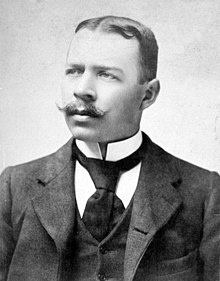
Carsten Egeberg Borchgrevink (1 December 1864 – 21 April 1934) was a Norwegian polar explorer and a pioneer of Antarctic travel. He inspired Sir Robert Falcon Scott, Sir Ernest Shackleton, Roald Amundsen, and others associated with the Heroic Age of Antarctic Exploration.
Borchgrevink was born and raised in Christiania (now Oslo) as the son of a Norwegian lawyer and an English-born immigrant mother. He began his exploring career in 1894 by joining a Norwegian whaling expedition, during which he became one of the first people to set foot on the Antarctic mainland. This achievement helped him to obtain backing for his Southern Cross expedition, which became the first to overwinter on the Antarctic mainland, and the first to visit the Great Ice Barrier since the expedition of Sir James Clark Ross nearly sixty years earlier. (Full article...) -

Vidkun Abraham Lauritz Jonssøn Quisling (/ˈkwɪzlɪŋ/, Norwegian: [ˈvɪ̂dkʉn ˈkvɪ̂slɪŋ] ⓘ; 18 July 1887 – 24 October 1945) was a Norwegian military officer, politician and Nazi collaborator who nominally headed the government of Norway during the country's occupation by Nazi Germany during World War II.
He first came to international prominence as a close collaborator of the explorer Fridtjof Nansen, and through organising humanitarian relief during the Russian famine of 1921 in Povolzhye. He was posted as a Norwegian diplomat to the Soviet Union and for some time also managed British diplomatic affairs there. He returned to Norway in 1929 and served as minister of defence in the governments of Peder Kolstad (1931–32) and Jens Hundseid (1932–33) in representing[needs copy edit] Farmers' Party. (Full article...) -
Harriet Sofie Bosse (19 February 1878 – 2 November 1961) was a Swedish–Norwegian actress. A celebrity in her day, Bosse is now most commonly remembered as the third wife of the playwright August Strindberg. Bosse began her career in a minor company run by her forceful older sister Alma Fahlstrøm in Kristiania (now Oslo, the capital of Norway). Having secured an engagement at the Royal Dramatic Theatre, the main drama venue of Sweden's capital Stockholm, Bosse caught the attention of Strindberg with her intelligent acting and exotic "oriental" appearance.
After a whirlwind courtship, which unfolds in detail in Strindberg's letters and diary, Strindberg and Bosse were married in 1901, when he was 52 and she 23. Strindberg wrote a number of major roles for Bosse during their short and stormy relationship, especially in 1900–01, a period of great creativity and productivity for him. Like his previous two marriages, the relationship failed as a result of Strindberg's jealousy, which some biographers have characterized as paranoid. (Full article...) -
In September 1967, Denmark, Norway, Sweden and the Netherlands brought the Greek case to the European Commission of Human Rights, alleging violations of the European Convention of Human Rights (ECHR) by the Greek junta, which had taken power earlier that year. In 1969, the Commission found serious violations, including torture; the junta reacted by withdrawing from the Council of Europe. The case received significant press coverage and was "one of the most famous cases in the Convention's history", according to legal scholar Ed Bates.
On 21 April 1967, right-wing army officers staged a military coup that ousted the Greek government and used mass arrests, purges and censorship to suppress their opposition. These tactics soon became the target of criticism in the Parliamentary Assembly of the Council of Europe, but Greece claimed they were necessary as a response to alleged Communist subversion and justified under Article 15 of the ECHR. In September 1967, Denmark, Norway, Sweden, and the Netherlands filed identical cases against Greece alleging violations of most of the articles in the ECHR that protect individual rights. The case was declared admissible in January 1968; a second case filed by Denmark, Norway and Sweden for additional violations, especially of Article 3 forbidding torture, was declared admissible in May of that year. (Full article...) -
The polar bear (Ursus maritimus) is a large bear native to the Arctic and nearby areas. It is closely related to the brown bear, and the two species can interbreed. The polar bear is the largest extant species of bear and land carnivore, with adult males weighing 300–800 kg (660–1,760 lb). The species is sexually dimorphic, as adult females are much smaller. The polar bear is white- or yellowish-furred with black skin and a thick layer of fat. It is more slender than the brown bear, with a narrower skull, longer neck and lower shoulder hump. Its teeth are sharper and more adapted to cutting meat. The paws are large and allow the bear to walk on ice and paddle in the water.
Polar bears are both terrestrial and pagophilic (ice-living) and are considered to be marine mammals due to their dependence on marine ecosystems. They prefer the annual sea ice but live on land when the ice melts in the summer. They are mostly carnivorous and specialized for preying on seals, particularly ringed seals. Such prey is typically taken by ambush; the bear may stalk its prey on the ice or in the water, but also will stay at a breathing hole or ice edge to wait for prey to swim by. The bear primarily feeds on the seal's energy-rich blubber. Other prey include walruses, beluga whales and some terrestrial animals. Polar bears are usually solitary but can be found in groups when on land. During the breeding season, male bears guard females and defend them from rivals. Mothers give birth to cubs in maternity dens during the winter. Young stay with their mother for up to two and a half years. (Full article...) -

Amundsen's Norwegian party stand at the South Pole, 17 December 1911. They had reached 90°S two days earlier.
Farthest South refers to the most southerly latitude reached by explorers before the first successful expedition to the South Pole in 1911.
Significant steps on the road to the pole were the discovery of lands south of Cape Horn in 1619, Captain James Cook's crossing of the Antarctic Circle in 1773, and the earliest confirmed sightings of the Antarctic mainland in 1820. From the late 19th century onward, the quest for Farthest South latitudes became a race to reach the pole, which culminated in Roald Amundsen's success in December 1911. (Full article...) -
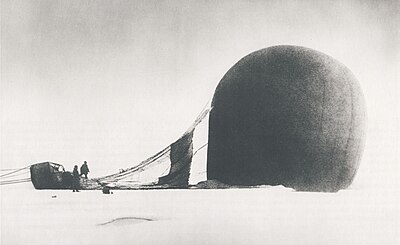
S. A. Andrée and Knut Frænkel with the balloon on the pack ice, photographed by the third expedition member, Nils Strindberg. The exposed film for this photograph and others from the failed 1897 expedition was recovered in 1930.
Andrée's Arctic balloon expedition of 1897 was a failed Swedish effort to reach the North Pole, resulting in the deaths of all three expedition members, S. A. Andrée, Knut Frænkel, and Nils Strindberg. Andrée, the first Swedish balloonist, proposed a voyage by hydrogen balloon from Svalbard to either Russia or Canada, which was to pass, with luck, straight over the North Pole on the way. The scheme was received with patriotic enthusiasm in Sweden, a northern nation that had fallen behind in the race for the North Pole.
Andrée ignored many early signs of the dangers associated with his balloon plan. Being able to steer the balloon to some extent was essential for a safe journey, but there was much evidence that the drag-rope steering technique he had invented was ineffective. Worse, the polar balloon Örnen (Eagle) was delivered directly to Svalbard from its manufacturer in Paris without being tested. When measurements showed it to be leaking more than expected, Andrée failed to acknowledge the risk. (Full article...) -
The first ever expedition to reach the Geographic South Pole was led by the Norwegian explorer Roald Amundsen. Himself and four other crew members made it to the geographical south pole on 14 December 1911, which would prove to be five weeks ahead of the competitive British party led by Robert Falcon Scott as part of the Terra Nova Expedition. Amundsen and his team returned safely to their base, and about a year later heard that Scott and his four companions had perished on their return journey.
Amundsen's initial plans had focused on the Arctic and the conquest of the North Pole by means of an extended drift in an icebound ship. He obtained the use of Fridtjof Nansen's polar exploration ship Fram, and undertook extensive fundraising. Preparations for this expedition were disrupted when, in 1909, the rival American explorers Frederick Cook and Robert Peary each claimed to have reached the North Pole. Amundsen then changed his plan and began to prepare for a conquest of the South Pole; uncertain of the extent to which the public and his backers would support him, he kept this revised objective secret. When he set out in June 1910, he led even his crew to believe they were embarking on an Arctic drift, and revealed their true Antarctic destination only when Fram was leaving their last port of call, Madeira. (Full article...) -
Operation Mascot was an unsuccessful British carrier air raid conducted against the German battleship Tirpitz at her anchorage in Kaafjord, Norway, on 17 July 1944. The attack was one of a series of strikes against the battleship launched from aircraft carriers between April and August 1944, and was initiated after Allied intelligence determined that the damage inflicted during the Operation Tungsten raid on 3 April had been repaired.
A force of 44 British dive bombers and 40 fighters took off from three aircraft carriers in the early hours of 17 July. German radar stations detected these aircraft while they were en route to Kaafjord, and Tirpitz was protected by a smoke screen by the time the strike force arrived. Few of the British airmen were able to spot the battleship, and their attacks did not inflict any significant damage. German losses were limited to a patrol craft, and three British aircraft were destroyed or damaged beyond repair by Kaafjord's defenders. A group of German submarines attempted to intercept the carrier force as it returned to base, without success. Two U-boats were sunk near the carriers by British patrol aircraft and several others were damaged. (Full article...) -
Caesar Barrand Hull, DFC (26 February 1914 – 7 September 1940) was a Royal Air Force (RAF) flying ace during the Second World War, noted especially for his part in the fighting for Narvik during the Norwegian Campaign in 1940, and for being one of "The Few"—the Allied pilots of the Battle of Britain, in which he was shot down and killed. From a farming family, Hull's early years were spent in Southern Rhodesia, South Africa and Swaziland. He boxed for South Africa at the 1934 Empire Games. After being turned down by the South African Air Force because he did not speak Afrikaans, he joined the RAF and, on becoming a pilot officer in August 1936, mustered into No. 43 Squadron at RAF Tangmere in Sussex.
A skilful pilot, Hull dedicated much of his pre-war service to aerobatics, flying Hawker Audaxes, Furies and Hurricanes. He reacted to the outbreak of war with enthusiasm and achieved No. 43 Squadron's first victory of the conflict in late January 1940. Reassigned to Norway in May 1940 to command a flight of Gloster Gladiator biplanes belonging to No. 263 Squadron, he downed four German aircraft in an hour over the Bodø area south-west of Narvik on 26 May, a feat that earned him the Distinguished Flying Cross. He was shot down the next day, and invalided back to England. Hull returned to action at the end of August, when he was made commander of No. 43 Squadron with the rank of squadron leader. A week later, he died in a dogfight over south London. (Full article...) -
Operation Paravane was a British air raid of World War II that inflicted heavy damage on the German battleship Tirpitz, at anchor in Kaafjord in the far north of German-occupied Norway. The attack was conducted on 15 September 1944 by 21 Royal Air Force heavy bombers, which flew from an airfield in the north of the Soviet Union. The battleship was struck by one bomb, and further damaged by several near misses. This damage rendered Tirpitz unfit for combat, and she could not be repaired as it was no longer possible for the Germans to sail her to a major port.
The attack on 15 September followed a series of raids conducted against Tirpitz with limited success by Royal Navy carrier aircraft between April and August 1944, seeking to sink or disable the battleship at her anchorage, so that she no longer posed a threat to Allied convoys travelling to and from the Soviet Union. The first of these raids was successful, but the other attacks failed due to shortcomings with the Fleet Air Arm's strike aircraft and the formidable German defences. As a result, the task of attacking the battleship was transferred to the RAF's Bomber Command. Avro Lancaster bombers from the Command's two elite squadrons flew to their staging airfield in the Soviet Union on the night of 11/12 September, and attacked on 15 September using heavy bombs and air-dropped mines. All of the British aircraft returned to base, though one of the Lancasters later crashed during its flight back to the United Kingdom. (Full article...) -
"Don't Say You Love Me" is the debut single of M2M, a Norwegian pop duo consisting of singers Marion Raven and Marit Larsen. The song first appeared on Radio Disney before its official US radio and single release in October 1999. It was released on the soundtrack to the film Pokémon: The First Movie in November 1999 and appears in the film's closing credits. The song was featured on M2M's debut album, Shades of Purple (2000), and also appeared on their compilation album The Day You Went Away: The Best of M2M (2003).
The song received positive reviews. Chuck Taylor from Billboard said it was "absolutely enchanting" and would appeal to both young and mature listeners. It reached number 2 in Norway, number 4 in both Australia and New Zealand, number 16 in the UK and number 21 on the US Billboard Hot 100. It was certified gold in the US and Australia and remained M2M's biggest hit. M2M performed the song on episodes of the television series One World, Top of the Pops and Disney Channel in Concert. Two similar music videos were released for the song, with one showing clips from Pokémon: The First Movie. (Full article...) -
Fridtjof Wedel-Jarlsberg Nansen (Norwegian: [ˈfrɪ̂tːjɔf ˈnɑ̀nsn̩]; 10 October 1861 – 13 May 1930) was a Norwegian polymath and Nobel Peace Prize laureate. He gained prominence at various points in his life as an explorer, scientist, diplomat, humanitarian and co-founded the Fatherland League.
He led the team that made the first crossing of the Greenland interior in 1888, traversing the island on cross-country skis. He won international fame after reaching a record northern latitude of 86°14′ during his Fram expedition of 1893–1896. Although he retired from exploration after his return to Norway, his techniques of polar travel and his innovations in equipment and clothing influenced a generation of subsequent Arctic and Antarctic expeditions. He was elected an International Member of the American Philosophical Society in 1897. (Full article...) -

The orca (Orcinus orca), or killer whale, is a toothed whale that is the largest member of the oceanic dolphin family. It is the only extant species in the genus Orcinus. Orcas are recognizable by their black-and-white patterned body. A cosmopolitan species, they are found in diverse marine environments, from Arctic to Antarctic regions to tropical seas.
Orcas are apex predators with a diverse diet. Individual populations often specialize in particular types of prey. This includes a variety of fish, sharks, rays, and marine mammals such as seals and other dolphins and whales. They are highly social; some populations are composed of highly stable matrilineal family groups (pods). Their sophisticated hunting techniques and vocal behaviors, often specific to a particular group and passed along from generation to generation, are considered to be manifestations of animal culture. (Full article...) -

Title page from the first edition of Letters (1796)
Letters Written During a Short Residence in Sweden, Norway, and Denmark (1796) is a personal travel narrative by the eighteenth-century British feminist writer Mary Wollstonecraft. The twenty-five letters cover a wide range of topics, from sociological reflections on Scandinavia and its peoples to philosophical questions regarding identity. Published by Wollstonecraft's career-long publisher, Joseph Johnson, it was the last work issued during her lifetime.
Wollstonecraft undertook her tour of Sweden, Norway, and Denmark in order to retrieve a stolen treasure ship for her lover, Gilbert Imlay. Believing that the journey would restore their strained relationship, she eagerly set off. However, over the course of the three months she spent in Scandinavia, she realized that Imlay had no intention of renewing the relationship. The letters, which constitute the text, drawn from her journal and from missives she sent to Imlay, reflect her anger and melancholy over his repeated betrayals. Letters Written in Sweden, Norway, and Denmark is therefore both a travel narrative and an autobiographical memoir. (Full article...) -
The 1952 Winter Olympics, officially known as the VI Olympic Winter Games (Norwegian: De 6. olympiske vinterleker; Nynorsk: Dei 6. olympiske vinterleikane) and commonly known as Oslo 1952, was a winter multi-sport event held from 14 to 25 February 1952 in Oslo, the capital of Norway.
Discussions about Oslo hosting the Winter Olympic Games began as early as 1935; the city was keen to host the 1948 Winter Olympics, but that was made impossible by World War II. Instead, Oslo won the right to host the 1952 Games in a contest that included Cortina d'Ampezzo in Italy and Lake Placid in the United States. All of the Olympic venues were in Oslo's metropolitan area, except for the alpine skiing events, which were held at Norefjell, 113 km (70 mi) from the capital. A new hotel was built for the press and dignitaries, along with three dormitories to house athletes and coaches, creating the first modern athlete's village. Oslo bore the financial burden of hosting the Games in return for the revenue they generated. The 1952 Winter Olympics was the first of the two consecutive Olympics to be held in Northern Europe, preceding the 1952 Summer Olympics in Helsinki, Finland. (Full article...) -

Fram leaves Bergen on 2 July 1893, bound for the Arctic Ocean
Nansen's Fram expedition of 1893–1896 was an attempt by the Norwegian explorer Fridtjof Nansen to reach the geographical North Pole by harnessing the natural east–west current of the Arctic Ocean. In the face of much discouragement from other polar explorers, Nansen took his ship Fram to the New Siberian Islands in the eastern Arctic Ocean, froze her into the pack ice, and waited for the drift to carry her towards the pole. Impatient with the slow speed and erratic character of the drift, after 18 months Nansen and a chosen companion, Hjalmar Johansen, left the ship with a team of Samoyed dogs and sledges and made for the pole. They did not reach it, but they achieved a record Farthest North latitude of 86°13.6′N before a long retreat over ice and water to reach safety in Franz Josef Land. Meanwhile, Fram continued to drift westward, finally emerging in the North Atlantic Ocean.
The idea for the expedition had arisen after items from the American vessel Jeannette, which had sunk off the north coast of Siberia in 1881, were discovered three years later off the south-west coast of Greenland. The wreckage had obviously been carried across the polar ocean, perhaps across the pole itself. Based on this and other debris recovered from the Greenland coast, the meteorologist Henrik Mohn developed a theory of transpolar drift, which led Nansen to believe that a specially designed ship could be frozen in the pack ice and follow the same track as Jeannette wreckage, thus reaching the vicinity of the pole. (Full article...)


.jpg)


.jpg)


Selected article –

Selected picture –

In this month

- Harald Tom Nesvik (born 4 May 1966 in Ålesund, Norway) is a Norwegian politician. He is a member of the Progress Party (FrP) and is perhaps most famous outside Norway for nominating Tony Blair and George W. Bush for the 2002 Nobel Peace Prize.
- Einar Henry Gerhardsen (10 May 1897 – 19 September 1987) was a Norwegian politician from the Labour Party of Norway. He was Prime Minister for three periods, 1945 - 1951, 1955 - 1963 and 1963 - 1965.
- The Norwegian Constitution Day (parade pictured) is the National Day of Norway and is an official national holiday each year. Among Norwegians, the day is referred to simply as syttende mai (meaning May Seventeenth), Nasjonaldagen (The National Day) or Grunnlovsdagen (The Constitution Day), although the latter is less frequent[citation needed]. The day marks the signing of the Norwegian Constitution in Eidsvoll, 17 May 1814.
General images –
-
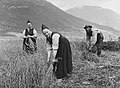
 Bridal Journey in Hardanger (1848) by Adolph Tidemand and Hans Gude, an example of romantic nationalism (from History of Norway)
 -
 Petty kingdoms of Norway c. 872 (from History of Norway)
 -
-
-
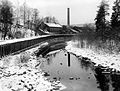 Industry along Akerselva in Oslo in 1912 (from History of Norway)
 -

-
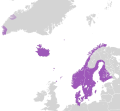 The Kalmar Union, c. 1400 (from History of Norway)
 -
 Norwegian Prime Minister Kjell Magne Bondevik met with U.S. President George W. Bush at the Oval Office in White House, on 27 May 2003. (from History of Norway)
 -
-
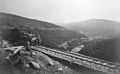
 Homann's map of the Scandinavian Peninsula and Fennoscandia with their surrounding territories: northern Germany, northern Poland, the Baltic region, Livonia, Belarus, and parts of Northwest Russia. Johann Baptist Homann (1664–1724) was a German geographer and cartographer; map dated around 1730. (from History of Norway)
 -
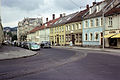 Trondheim in 1965 (from History of Norway)
 -
 Scenes from the Norwegian Campaign in 1940 (from History of Norway)
 -
 Map of Denmark–Norway (from History of Norway)
 -
 Statfjord oil platform (from History of Norway)
 -
 Battle of Alvøen between the frigate HMS Tartar and Norwegian gunboats near Bergen in 1808 (from History of Norway)
 -
 Henrik Ibsen, c. 1890 (from Culture of Norway)
 -
 Roald Amundsen, Helmer Hanssen, Sverre Hassel and Oscar Wisting (l–r) at Polheim, the tent erected at the South Pole on 16 December 1911 as the first expedition (from History of Norway)
 -
 The Constituent Assembly which approved the Constitution of Norway (from History of Norway)
 -
 The Kingdom of Norway about 1265, at its greatest extent (from History of Norway)
 -
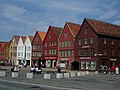 Bryggen in Bergen, once the centre of trade in Norway under the Hanseatic League trade network, now preserved as a World Heritage Site (from History of Norway)
 -

-
 Smørbrød, Norwegian open sandwiches (from Culture of Norway)
 -

-
-
 Edvard Munch's The Scream (1893) (from Culture of Norway)
 -
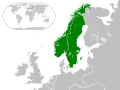 Map of Sweden–Norway (from History of Norway)
 -
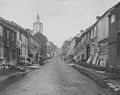 Røros, a major copper mining town, in 1869 (from History of Norway)
 -
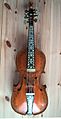 Norwegian Hardanger fiddle (from Culture of Norway)
 -


.jpg)


.jpg)

.jpg)


.jpg)
 Good article –

-

Lysgårdsbakken host the ski jumping events
The 2016 Winter Youth Olympics in and around Lillehammer, Norway, between 12 February and 21 February 2016. Nine competition and twelve non-competition venues are to be used; all except the Youth Olympic Village in Lillehammer and a training ice rink being are existing venues. All the competition venues and some of the non-competition venues were built ahead of the 1994 Winter Olympics. The games be held in four municipalities: Lillehammer, Hamar, Gjøvik and Øyer.
Lillehammer has five competition venues, Birkebeineren Ski Stadium, Kristins Hall, Kanthaugen Freestyle Arena, Lillehammer Olympic Bobsleigh and Luge Track and the Lysgårdsbakken ski jumping hill. In addition, the Olympic Village, the ceremonies stadium Stampesletta, the media center and various cultural venues, such as Lillehammer Art Museum and Maihaugen, are located in Lillehammer. Two skating halls, Hamar Olympic Amphitheatre and Vikingskipet, are located in Hamar, along with a hotel used as a sub-site Olympic Village. Alpine skiing take place at Hafjell in Øyer and short-track speed skating take place at Gjøvik Olympic Cavern Hall. (Full article...) -

Telenor Arena, sometimes referred to as Fornebu Arena, is a multi-purpose indoor arena located at Fornebu in Bærum, outside Oslo, Norway. It serves as a venue for a variety of events, including concerts, exhibitions, action shows, family shows, TV and sport. It has a capacity for 15,000 spectators for sports and 25,000 for concerts, including 40 luxury boxes and club seating for 1,200. The venue has a fixed roof and an asphalt floor. The venue was opened ahead of the 2009 Norwegian football season as a replacement for Nadderud Stadion. It cost 585 million Norwegian kroner (NOK) to build, of which NOK 300 million was for the sports venue. The arena will host the 2025 World Men's Handball Championship with the country, Croatia and Denmark including the final.
During the 2000s, Nadderud was below standards for play in the top national league. Fornebu was at the time undergoing an urban redevelopment; after several years of negotiations and public grants, Stabæk secured a lot in 2004. Construction started in 2007. In 2010, a disagreement arose between the club and venue-owner Kjell Chr. Ulrichsen, with the latter demanding that the team leave the venue to allow for more event revenue. Telenor Arena has hosted the Eurovision Song Contest 2010, as well as concerts by artists and bands of international fame, such as Madonna, Britney Spears, The Weeknd, Tina Turner, Adele, Muse, Foo Fighters, Roger Waters (the Wall tour), Rihanna, Lady Gaga, Beyoncé, Jay-Z, Kanye West, Iron Maiden, Metallica, AC/DC, Black Sabbath, The Rolling Stones, Justin Bieber, Celine Dion and Drake. Telenor holds the naming rights. (Full article...) -

Braathens SAFE Boeing 737-200 at Bergen Airport, Flesland in 1981
Braathens South American & Far East Airtransport A/S or Braathens SAFE was founded by ship-owner Ludvig G. Braathen in 1946. It started as a charter airline based at Oslo Airport, Fornebu in Norway, flying to destinations in the Far East and in South America. At first the airline used Douglas DC-4s, and later also Douglas DC-3s. In 1948, the airline moved to Oslo Airport, Fornebu and started regular scheduled flights to the Far East. In 1952, the airline started cooperation with the Icelandic airline Loftleidir, where until 1960 the two airlines in cooperation flew flights to Reykjavík. Domestic services started in 1951, using de Havilland Herons on a route from Oslo to Stavanger via Tønsberg. Braathens SAFE also established at Stavanger Airport, Sola. A second route was started two years later to Trondheim. The Heron routes also stopped in Farsund, Kristiansand, Notodden to Stavanger and Hamar, Røros to Trondheim.
In 1958, Braathens SAFE started flying to Ålesund and at the same time started flights along the West Coast. In 1959, Fokker F-27s were taken into use, and with the Herons taken out of service, Hamar, Farsund and Tønsberg were terminated. During 1960, the airline flew a single season to Sandefjord and Aalborg. The company also entered the domestic and international charter market during the 1960s, an industry where the airline would eventually grow to become a large Norwegian and Swedish contestant. Services to Bodø and Tromsø started in 1967, although only from Western Norway. Braathens' main domestic competitor was Scandinavian Airlines System (SAS), which operated all the primary domestic routes Braathens SAFE did not, in addition to the international routes. Braathens took Boeing 737-200s and Fokker F-28s into use in 1969; Kristiansund was first served in 1970 and Molde in 1972. From 1984, the airline also operated two Boeing 767s, although they were retired along with the F-28s were in 1986. Services to Longyearbyen started in 1987. From 1987, Braathens SAFE was allowed to make international scheduled flights on certain routes. In 1989, it opened a route to Billund, in 1991 to Malmö, Newcastle and London, and in 1993 to Murmansk. From 1989 to 1994, the airline replaced its fleet with Boeing 737-400 and -500s. From 1989 to 1994, Braathens Helikopter operated services on contract with oil companies to their oil platforms in the North Sea. (Full article...) -
The Numedal Line (Norwegian: Numedalsbanen) is a 92.8-kilometer (57.7 mi) long railway line that runs up the Numedal valley between Kongsberg and Rødberg in Buskerud county, Norway. Built and operated by the Norwegian State Railways, the non-electrified, standard gauge line passes through the municipalities of Kongsberg, Flesberg, Rollag and Nore og Uvdal. It is now owned by the Norwegian National Rail Administration.
The first plans for a line through Numedal were launched after the Sørland Line reached in Kongsberg in 1871. After it was decided that the Bergen Line would instead follow Hallingdal, the Numedal plans lay dead until it was decided that a railway was necessary to build two hydroelectric power stations near Rødberg. The plans were passed in 1918, the first trains started running in 1924 and the line was officially opened in 1927. At first all services were provided with steam locomotives, but from the 1930s diesel multiple units were used for passenger trains. The line was frequented with classes Cmd 16, 86, 87 and 91. The last regular train ran in 1988; since, there has been sporadic freight service and some heritage trains running from Kongsberg to Rollag. Draisine rental is available on the section from Veggli to Rødberg. (Full article...) -
The Lerkendal Stadion (Urban East Norwegian: [ˈlæ̂rkn̩dɑːɫ ˈstɑ̀ːdɪɔn]) is an all-seater association football stadium located at Lerkendal in Trondheim, Norway. The home ground of the Eliteserien (2017) side Rosenborg BK, it has a capacity for 21,405 spectators, making it the second-largest football stadium in the country.
Lerkendal opened as a multi-purpose stadium on 10 August 1947, as the main football and athletics stadium in Trondheim. Originally the venue was mostly used by the football teams SK Freidig and FK Kvik, and Rosenborg did not become a tenant until 1957. A new grandstand with roof was completed in 1962, and floodlights were installed in 1968. The oldest of the current stands were built in 1996, along with new lighting. Three more grandstands were built between 2000 and 2002, which also saw the removal of the athletics facilities and the sale of the stadium from Trondheim Municipality to Rosenborg. Further expansions plans have been launched, to increase capacity by filling in the corners and possibly by building a retractable roof. (Full article...) -

.bv is the Internet country code top-level domain (ccTLD) reserved for the uninhabited Norwegian dependent territory of Bouvet Island. The domain name registry and sponsor is Norid, but .bv is not open for registration. .bv was designated on 21 August 1997 and was placed under the .no registry Norid. Norwegian policy states that .no is sufficient for those institutions connected to Bouvet Island, and therefore the domain is not open to registration. It is Norwegian policy not to commercialize domain resources, so there are no plans to sell .bv. Should the domain later come into use, it will be under the regulation of the Norwegian Communications Authority and follow the same policy as .no. (Full article...) -
The Rodeløkka Line (Norwegian: Rodeløkkalinjen) is a former line of the Oslo Tramway of Norway. It was in use from 1900 to 1961, serving the neighborhood of Rodeløkka. After closing, the southern part of the line was designated as part of the Sinsen Line. The Rodeløkka Line was built by Kristiania Kommunale Sporveie (KKS) in 1900, and was subsequently taken over by Kristiania Sporveisselskab (KSS) in 1905. In 1924, the ownership was transferred to Oslo Sporveier. It was served by Line 9 until 1949, when it was replaced by a bus service. In 1955, a new route from Carl Berners plass to Rodeløkka was built, and the line was served by Line 13 until 1961, when the service was terminated. The tracks were removed between 1962 and 1964. (Full article...) -
The Asker Line (Norwegian: Askerbanen) is a 9.5-kilometre (5.9 mi) railway line between Asker and Lysaker in Norway. The line runs along the same corridor as the Drammen Line, offering increased capacity, speed and regularity on the rail network west of Oslo. The first part opened in 2005, and in 2011 an extension opened from Sandvika to Lysaker. Original plans called for an extension to Skøyen, but from 2020, new planning is under way for an extension all the way to Oslo Central Station. Most of the railway is in tunnel and is dimensioned for 160 km/h (99 mph) running. The entire railway is electrified at 15 kV 16.7 Hz AC. The first section cost 3.7 billion kr, while the second is budgeted at NOK 2.7 billion.
The purpose of the new line is to allow regional and express trains to run directly between Asker Station, Sandvika Station and Lysaker Station, without being slowed and delayed by commuter trains that make frequent stops at intermediate stations. The Asker Line will improve regularity, and capacity will increase from 12 to 26 trains per hour in each direction. Travel time from Asker to Skøyen Station will be reduced from 20 to 13 minutes. The line has received criticism for not being a true high-speed line, and for Lysaker Station not being in compliance with accessibility requirements. Similar parallel, high-speed lines have been or will be built northeast and southeast of Oslo. (Full article...) -

Ny-Ålesund Airport, Hamnerabben (Norwegian: Ny-Ålesund flyplass, Hamnerabben; ICAO: ENAS) is an airport serving the research community of Ny-Ålesund in Svalbard, Norway. The airport is owned by Kings Bay, who also owns the company town. The only flights available are to Svalbard Airport, Longyear, operated two to four times a week by Lufttransport using Dornier 228 aircraft. The services are organized as corporate charters and tickets are only available after permission from Kings Bay.
Between 1925 and 1928, Ny-Ålesund saw four air expeditions to the North Pole, two of which required the construction of an airship hangar and mast. The first proposal for an airport in Ny-Ålesund was launched in 1956 by Norsk Polar Navigasjon, who proposed an airport at Kvadehuksletta. Soviet protests against the airport caused the Norwegian authorities to oppose the plans, which were laid to rest in the early 1960s. Construction at Hamnerabben started in 1965 following the decision to build Kongsfjord Telemetry Station. The airport first hosted service to temporary landing strips near Longyearbyen, but from 1975 served Svalbard Airport. Lufttransport started flights with helicopters in the 1980s, but from 1989 has flown with fixed-wing aircraft. (Full article...) -
Jon Gundersen Hol (c. 1851 – 1941) was a Norwegian engineer and activist. He is known for his pamphlet Rifleringen, published in February 1884, that resulted in his arrest for lèse majesté. In the pamphlet, he called for soldiers and civilians to arm themselves and encircle the Parliament of Norway Building, creating a "Ring of Rifles", should the need arise. The political situation in Norway at the time was unstable, with an ongoing impeachment case against the conservative government started by political liberals. King Oscar II of Sweden and Norway supported the conservative politicians, and Hol believed that a political and military counter-offensive was planned, hence the need for guarding the Parliament. The tensions between liberals and conservatives drew Hol into politics in the first place in 1880. Before this, he was an engineer by occupation and a writer, albeit apolitical. He increased his writing after 1880, and also involved himself in non-socialist trade unions, including the unsuccessful attempt of establishing a national trade union center in Kristiania.
When the conservatives lost the Impeachment case, there was a change of government and the charges against Hol were dropped. Two years later, he received an economic compensation from the Parliament. After some quiet years in which he concentrated on engineering work, Hol returned to politics as a member of the city council of Skien, representing the local temperance movement. He stood for parliamentary election twice, without success. (Full article...) -

Eidsiva Arena, also known as Kristins Hall, is an arena located at Stampesletta in Lillehammer, Norway. It consist of an ice rink, a combined handball and floorball court, and a curling rink. The venue, owned and operated by the Lillehammer Municipality, opened in 1988 and cost 65 million Norwegian krone (NOK) to build. One of the motivations for its construction was to help Lillehammer's bid to be selected as the host of the 1994 Winter Olympics. The ice rink has a capacity for 3,194 spectators and is the home rink of GET-ligaen hockey club Lillehammer IK. Eidsiva Arena is located next to the larger Håkons Hall, which opened in 1993. During the 1994 Winter Olympics, Kristins Hall was a training rink, and subsequently hosted the ice sledge hockey tournament at the 1994 Winter Paralympics. The venue also co-hosted Group B of the 1989 World Ice Hockey Championships.
During the 2016 Winter Youth Olympics, it hosted the Curling and the Ice hockey competitions. (Full article...) -
Magnus Haraldsson (Old Norse: Magnús Haraldsson; c. 1048 – 28 April 1069) was King of Norway from 1066 to 1069, jointly with his brother Olaf Kyrre from 1067. He was not included in official Norwegian regnal lists until modern times, but has since been counted as Magnus II.
A son of King Harald Hardrada, Magnus was in 1058 appointed nominal leader of an expedition into the Irish Sea while still only a child. He appears to have assisted Welsh ruler Gruffydd ap Llywelyn and Ælfgar, Earl of Mercia in their struggles against Wessex, although his primary objective may have been to assert control over Orkney. He later accompanied his father in Harald's campaign against Denmark in 1062, and was appointed regent and made king before Harald's fatal invasion of England in 1066. Magnus briefly ruled Norway alone thereafter, until his younger brother Olaf returned from England in 1067. (Full article...) -

Adventdalen in Svalbard
ISO 3166-2:SJ is the entry for Svalbard and Jan Mayen in ISO 3166-2, part of the ISO 3166 standard published by the International Organization for Standardization (ISO). The standard defines codes for names of principal subdivisions of all countries coded in ISO 3166-1. Svalbard and Jan Mayen does not exist as an administrative region, but rather consists of two separate parts of Norway under separate jurisdictions—Svalbard and Jan Mayen. Further subdivision for Svalbard and Jan Mayen occurs under Norway's entry, ISO 3166-2:NO, namely NO-21 for Svalbard and NO-22 for Jan Mayen. There are currently no ISO 3166-2 codes for Svalbard and Jan Mayen. (Full article...) -
The Norwegian Forest cat (Norwegian: Norsk skogkatt and Norsk skaukatt) is a breed of domestic cat originating in Northern Europe. This landrace breed is adapted to a very cold climate, with a top coat of long, glossy hair and a woolly undercoat for insulation. The breed's ancestors may have been a landrace breed of short-haired cats brought to Norway about A.D. 1000 by the Vikings, who may also have brought with them long-haired cats, like those ancestral to the modern Siberian and Turkish Angora.
During World War II, the Norwegian Forest cat was nearly extinct; then the Norwegian Forest Cat Club's breeding program increased the cat's number. It was registered as a breed with the European Fédération Internationale Féline in the 1970s, when a cat fancier, Carl-Fredrik Nordane, took notice of the breed and made efforts to register it. The breed is very popular in Norway, Denmark, Sweden, Iceland, and France. (Full article...) -

Svalbard Airport (Norwegian: Svalbard lufthavn; IATA: LYR, ICAO: ENSB) is the main airport serving Svalbard in Norway. It is 5 km (3.1 mi) northwest of Longyearbyen on the west coast, and is the northernmost airport in the world with scheduled public flights. The first airport near Longyearbyen was constructed during World War II. In 1959, it was first used for occasional flights, but could only be used a few months a year. Construction of the new airport at Hotellneset started in 1973, and the airport was opened on 2 September 1975. It is owned and operated by state-owned Avinor.
In 2014, the airport handled 154,261 passengers. Scandinavian Airlines operates daily flights to Tromsø and Oslo in mainland Norway. Lufttransport provides services to the two other airports on Svalbard: Ny-Ålesund and Svea, using Dornier 228 turboprop aircraft. There are also regular charter flights. (Full article...) -
Erik-Ørn Gjems-Onstad, MBE (22 February 1922 – 18 November 2011) was a Norwegian resistance member, officer, lawyer, sports official, politician, author and anti-immigration activist.
Gjems-Onstad joined the Norwegian resistance movement after Nazi Germany invaded Norway in 1940. He was arrested in Sweden for his involvement with Norwegian resistance activity in the country in 1941, and was sent to the United Kingdom where he joined the Norwegian Independent Company 1 (Kompani Linge) and received British military training. He was deployed to Norway in 1943 as part of Lark, assigned with establishing radio connection with London. He led Lark in Trøndelag between 1943 and 1945, which constituted the leadership of Milorg in the region. His other activities included assisting with weapons smuggling, preparing for the sinking of the German battleship Tirpitz, and plotting to assassinate Nazi collaborator Ivar Grande. He also founded the Durham organisation for conducting psychological warfare towards the end of the war, and he took part in blowing up railway tracks. Gjems-Onstad's efforts during the Second World War led him to become one of Norway's highest decorated war heroes. (Full article...) -
Hammerfest Airport (Norwegian: Hammerfest lufthavn; IATA: HFT, ICAO: ENHF) is a regional airport at Prærien just outside the town of Hammerfest in Hammerfest Municipality in Finnmark county, Norway. It is operated by the state-owned Avinor and handled 145,396 passengers in 2014, making it the third-busiest regional airport in the country. The airport has a 880-meter (2,890 ft) runway aligned 05/23. Services are provided by Widerøe using the Dash 8-100. Up to eight daily flights are provided to Tromsø and public service obligation flights are flown eastwards to other airports in Finnmark. The airport is the base for offshore helicopter services operated by Bristow Norway and CHC Helikopter Service. An estimated 40,000 people from Hammerfest Airport's catchment area annually use Alta Airport for flights to Oslo.
Hammerfest was served from 1935 by scheduled seaplanes at a water aerodrome at Rypefjord. Services were interrupted by World War II, but resumed in 1945, lasting until the 1963 opening of Alta Airport. Hammerfest Airport opened on 1 August 1974, along with four other regional airport in Finnmark, and was originally served with de Havilland Canada Twin Otters. The de Havilland Canada Dash 7 was introduced in 1983 and a helicopter base was established in 1989. The Dash 8 was introduced in 1995 and the airport was nationalized two years later. A Dash 8 was damaged beyond repair after a hard landing in 2005. Because of the limited space for expansion and unfavorable wind conditions, there is a proposal to build a new airport at Grøtnes. (Full article...) -

Launch of the Coalition for Epidemic Preparedness Innovations, CEPI in 2017 at the World Economic Forum in Davos, Switzerland.
The Coalition for Epidemic Preparedness Innovations (CEPI) is a foundation that takes donations from public, private, philanthropic, and civil society organisations, to finance independent research projects to develop vaccines against emerging infectious diseases (EID).
CEPI is focused on the World Health Organization's (WHO) "blueprint priority diseases", which include: the Middle East respiratory syndrome-related coronavirus (MERS-CoV), the Severe acute respiratory syndrome coronavirus 2 (SARS-CoV-2), the Nipah virus, the Lassa fever virus, and the Rift Valley fever virus, as well as the Chikungunya virus and the hypothetical, unknown pathogen "Disease X". CEPI investment also requires "equitable access" to the vaccines during outbreaks, although subsequent CEPI policy changes may have compromised this criterion. In 2022, CEPI adopted a vision for the world to be able to respond to a pandemic threat with a new vaccine within 100 days. (Full article...) -

The Flåm Line (Norwegian: Flåmsbana) is a 20.2-kilometer (12.6 mi) long railway line between Myrdal and Flåm in Aurland Municipality, in Vestland county, Norway. A branch line of the Bergen Line, it runs through the valley of Flåmsdalen and connects the mainline with Sognefjord. The line's elevation difference is 866 meters (2,841 ft); it has ten stations, twenty tunnels and one bridge. The maximum gradient is 5.5 percent (1:18). Because of its steep gradient and picturesque nature, the Flåm Line is now almost exclusively a tourist service and has become the third-most visited tourist attraction in Norway.
Construction of the line started in 1924, with the line opening in 1940. It allowed the district of Sogn access to Bergen and Oslo via the Bergen Line. Electric traction was taken into use in 1944; at first El 9 locomotives were used, and from 1982 El 11. Until 1991, the train connected with a ferry service from Flåm to Gudvangen. In 1992, freight services were terminated, and due to low ticket prices and high operating costs, the line was nearly closed. In 1998, Flåm Utvikling took over marketing and ticket sale for the line, prices were heavily increased and El 17 locomotives were introduced (replaced by El 18 in 2014). The trains remain operated by the Vy as a subcontractor for Flåm Utvikling, while the line itself is owned and operated by the Bane NOR. (Full article...) -

The 1994 national convention of the Progress Party of Norway was held from 15 April to 17 April at the hotel Bolkesjø Turisthotell in Bolkesjø, Telemark. It was originally set up to be a normal convention with 157 delegates in a non-election year, but because of mounting antagonism between a traditionalist and a libertarian faction, it became clear some months before the conventions that personal positions could be at stake. The party leader seat, held by Carl I. Hagen since 1978, was up for re-election. The deputy leaders Ellen Wibe and Hans J. Røsjorde was not up for election until 1995, but there were talks about forming a motion of no confidence against Wibe. The political disagreements roughly corresponded to a cleavage between two factions.
The traditionalist (also called populist) faction was represented by party leader Carl I. Hagen, Jan Simonsen, Fridtjof Frank Gundersen, Vidar Kleppe, Øystein Hedstrøm, Lodve Solholm and Eli Hagen. The libertarians of the party were first and foremost the deputy leader Ellen Wibe and four members of Parliament (by some called the "band of four"), Ellen Christine Christiansen, Oscar D. Hillgaar, Roy N. Wetterstad and Stephen Bråthen. Buskerud county leader Geir Thoresen, Akershus county leader Per Aage Pleym Christensen and Youth of the Progress Party leader Lars Erik Grønntun were other prominent libertarians. Both during the preceding months and on the opening day, resolutions were passed which ensured full dominance for Carl I. Hagen and the policies of his faction. Wibe resigned as deputy leader, and Carl I. Hagen's men (there were no women left in the leadership) also dominated the new central committee. The personal issues totally overshadowed the regular political debate, and as early as on 17 April the convention was famously dubbed as the "national convention at Dolkesjø"—derived from dolk, the Norwegian word for dagger. (Full article...) -
Vnukovo Airlines Flight 2801 was an international charter flight from Vnukovo International Airport in Moscow, Russia, to Svalbard Airport on Spitsbergen, in the Norwegian archipelago of Svalbard. On 29 August 1996 at 10:22:23 CEST, a Tupolev Tu-154M operating this flight crashed into the ground in Operafjellet during the final approach to Svalbard Airport. All 141 people (11 crew members and 130 passengers, of whom three were children) aboard the plane were killed, making it the deadliest aviation accident in Norway. The accident was the result of a series of small navigational errors causing the aircraft to be 3.7 kilometres (2.3 mi; 2.0 nmi) from the approach centerline at the time of impact.
The Vnukovo Airlines aircraft, with the registration number RA-85621, had been chartered by Arktikugol, a Russian state-owned coal-mining company, to fly Russian and Ukrainian workers to the towns of Barentsburg and Pyramiden in Svalbard. The accident was a contributing cause for Arktikugol's closure of Pyramiden two years later. The accident was investigated by the Accident Investigation Board Norway with assistance from the Interstate Aviation Committee and became known as the Operafjell accident (Norwegian: Operafjell-ulykken). After the accident, a series of lawsuits determined compensation for the victims' families. (Full article...) -
HMS Gorgon and her sister ship Glatton were two monitors originally built as coastal defence ships for the Royal Norwegian Navy, as HNoMS Nidaros and Bjørgvin respectively, by Armstrong Whitworth at Elswick. She was purchased from Norway at the beginning of the First World War, but was not completed until 1918 although she had been launched over three years earlier. She engaged targets in Occupied Flanders for the last several months of the war and fired the last shots of the war against such targets on 15 October 1918. She was used as a target ship after several attempts to sell her had fallen through before being sold for scrap in 1928. (Full article...) -
Tanum Tunnel (Norwegian: Tanumtunnelen) is 3,590-meter-long (2.23 mi) double-track railway tunnel on the Asker Line, between Jong in Bærum and Åstad in Asker, Norway. It was built as part of the first stage of the Asker Line, between Asker and Sandvika; construction started in February 2002 and the tunnel opened on 27 August 2005. The tunnel was built by AF Gruppen for the Norwegian National Rail Administration. Most of the tunneling was conducted using the drilling and blasting method, although the easternmost 800 meters (2,600 ft) were built using the cut-and-cover method. After the tunnel opened, there have been problems with leaks damaging the superstructure. The tunnel has double track, is electrified and allows for a maximum speed of 160 kilometers per hour (100 mph). The cost to build the tunnel, excluding the superstructure, was 370 million Norwegian krone (NOK). The tunnel will accelerate intercity and regional traffic west of Oslo and free up capacity for the Oslo Commuter Rail on the Drammen Line. (Full article...)
-
Lakselv Airport (Norwegian: Lakselv lufthavn; IATA: LKL, ICAO: ENNA) is an international airport located at Banak, 1.5 kilometers (1 mile) north of Lakselv, in the municipality of Porsanger, Finnmark county, Norway. Co-located with the military Station Group Banak, the airport is owned and operated by the state-owned Avinor. The airport is also branded as North Cape Airport, although the North Cape is 190 km (120 mi) away, and the nearest airport is Honningsvåg Airport, Valan.
The runway is 2,788 meters (9,147 feet) long and aligned nearly north–south. The airport is served by Danish Air Transport with daily direct flights to Tromsø. Weekly Scandinavian Airlines offer direct flights from Lakselv to Oslo, in addition to seasonal international charter services. The airport had 71,763 passengers in 2012. In addition to serving Porsanger, the airport's catchment area includes Karasjok, Måsøy and Lebesby. (Full article...) -
The Svalbard Rocket Range or SvalRak as it is named, is a launch site for sounding rockets at Ny-Ålesund in Svalbard, Norway. The site has been in use since 1997 and is owned by Andøya Space Center, which is owned by the Norwegian Ministry of Trade, Industry and Fisheries and the Kongsberg Group. SvalRak's location at the 79th parallel north makes it well-suited for launching rockets to investigate Earth's magnetic field. It is used mostly by American, Japanese and Norwegian researchers. It is the world's northernmost launch site. (Full article...)

.jpg)


.jpg)


_5.jpg)
Selected biography –

Did you know –

- ...that Knut Korsæth, former mayor of Lillehammer (pictured) and County Governor of Oppland, is also an honorary member of the Norwegian Olympic Committee and Confederation of Sports?
- ...that Norwegian speed skater Randi Thorvaldsen won nine national allround championships in a row from 1946 to 1954, and finished first in 34 distances out of 36 possible?
- ...that Kjell Magne Yri, a linguist at the University of Oslo, began his career as a Bible translator and priest in Ethiopia?
Selected quote –

Categories

Selected panorama

Mountains along the Ulvikfjord, a side arm of the Hardangerfjord in Western Norway. With a length of 179 km (111 miles), the Hardangerfjord in the county of Hordaland in Norway is the third largest fjord in the world and the second largest in Norway. (Full article...)
Main topics

Counties: • Agder • Innlandet • Møre og Romsdal • Nordland • Oslo • Rogaland • Troms og Finnmark • Trøndelag • Vestfold og Telemark • Vestland • Viken (county)
Culture: Bunad
• Constitution Day
• Cuisine
• Farm culture
• Jul
• Literature
• Music
• Cinema
History: Ancient Norwegian property laws • Nordic Stone Age • Nordic Bronze Age • Komsa • Fosna-Hensbacka culture • Funnelbeaker culture • Hamburg culture • Nøstvet and Lihult cultures • Maglemosian culture • Viking Age • Harald I of Norway • Olav IV of Norway • Haakon I of Norway • Olaf I of Norway • Olaf II of Norway • Battle of Stiklestad • Canute the Great • Magnus I of Norway • Harald III of Norway • Battle of Stamford Bridge • Magnus III of Norway • Sigurd I of Norway • Magnus V of Norway • Sverre of Norway • Haakon IV of Norway • Magnus VI of Norway • Eric II of Norway • Kalmar Union • Denmark–Norway • Union between Sweden and Norway • Dissolution of the union between Norway and Sweden in 1905 • Haakon VII of Norway • Olav V of Norway • Harald V of Norway • Occupation of Norway by Nazi Germany • Norwegian Campaign • Norwegian resistance movement • Legal purge in Norway after World War II • Foreign relations of Norway • Military of Norway • Norway and the European Union
Language: Å • Æ • Ø • Bokmål • Det Norske Akademi for Sprog og Litteratur • Differences between Norwegian Bokmål and Standard Danish • Høgnorsk • Nordic Council • Nordic Language Convention • Noregs Mållag • Norsk Ordbok • North Germanic languages • Norwegian alphabet • Norwegian dialects • Norwegian Language Council • Norwegian language conflict • Norwegian phonology • Nynorsk • Old Norse • Riksmålsforbundet • Russenorsk
Politics: Constitution • Counties (Fylker) • Elections • European Union relations • Foreign relations • Government • Monarchy • Municipalities (Kommuner) • Political parties • Prime Minister • Norwegian nationalism • Romantic nationalism • Sámi Parliament • Storting
Featured and Good content


_Oppdal.jpg)
_cocoon_Dovrefjell.jpg)


_-_Restoration.jpg)


Related portals


Northern Europe


Other countries


WikiProjects
- Parent projects
WikiProject Countries • WikiProject Europe

- Main project
- Similar projects
WikiProject Denmark • WikiProject Finland • WikiProject Iceland • WikiProject Sweden • WikiProject Russia
What are WikiProjects?
Things you can do

- Add {{Portal|Norway}} to existing See also sections of Norway-related articles.
- Tag the talk pages of Norway-related articles with the {{WikiProject Norway}} banner.
- Rate the Unassessed Norway articles in the Norway WikiProject.
- Requested articles: Requested Norway-related articles
- Expand stubs: Building and structure stubs, Company stubs, Nordic football club stubs, Geography stubs, History stubs, Musical group stubs, People stubs, All Norway stub articles
- Note: For additional tasks, see - Wikipedia talk:WikiProject Norway/to do
Associated Wikimedia
The following Wikimedia Foundation sister projects provide more on this subject:
-
 Commons
Free media repository -
 Wikibooks
Free textbooks and manuals -
 Wikidata
Free knowledge base -
 Wikinews
Free-content news -
 Wikiquote
Collection of quotations -
 Wikisource
Free-content library -
 Wikiversity
Free learning tools -
 Wikivoyage
Free travel guide -
 Wiktionary
Dictionary and thesaurus


