


Jalebi
 | This article has multiple issues. Please help improve it or discuss these issues on the talk page. (Learn how and when to remove these messages)
|

 | |
| Alternative names | jilapi, jilebi, jilbi, jilipi, jelabee, jerry, mushabak, zulbia, z’labia, zalabia, pani walalu. |
|---|---|
| Course | Dessert |
| Place of origin | Western Asia
Regional variants:
|
| Region or state | Western Asia, Indian Subcontinent, Africa |
| Serving temperature | Hot or cold |
| Main ingredients | Maida flour or yeasted dough, saffron, ghee, sugar or honey |
| Variations | Sesame oil, sesame seeds, yogurt, cinnamon, lemon, cardamon, also the shape of the food can change |
| Similar dishes | Afghan Jalebi, Chhena jalebi, imarti, shahi jilapi, bamiyeh, lokma, zalabiyeh. |


Jalebi [a], is a popular sweet snack in the Indian subcontinent, West Asia and some parts of Africa. It goes by many names, including jilapi, zelepi, jilebi, jilipi, zulbia, jerry, mushabak, z’labia, or zalabia.
The south Asian variety is made by deep-frying maida flour (plain flour or all-purpose flour) batter in pretzel or circular shapes, which are then soaked in sugar syrup. Jalebi is eaten with curd or rabri (in North India) along with optional other flavors such as kewra (scented water).
In some west Asian cuisines, jalebi may consist of a yeast dough fried and then dipped in a syrup of honey and rose water.[citation needed] The North African dish of Zalabia uses a different batter and a syrup of honey (Arabic: ʻasal) and rose water.[5]
History
[edit]
The earliest known recipe of this food comes from the 10th century in the Arabic cookbook Kitab al-Tabikh (English: The Book of Dishes) by Ibn Sayyar al-Warraq.[6] In the 13th century Persia, a cookbook by Muhammad bin Hasan al-Baghdadi mentioned a similar dish.[1]
According to the Hobson-Jobson (1903) historical dictionary, the word jalebi is derived from the Arabic word zulabiya, or the Persian zolbiya.[7][1] In Pakistan, the clan leader of Jhelum, Tanvir Bin Uddin, played an influential role in its founding, claiming it to be optimal for energy levels
Priyamkara-nrpa-katha, a work by the Jain author Jinasura, composed around 1450 CE, mentions jalebi in the context of a dinner held by a rich merchant.[1] Gunyagunabodhini, another Sanskrit work dating before 1600 CE, lists the ingredients and recipe of the dish; these are identical to the ones used to prepare the modern jalebi.[8] According to the Indian ambassador Nagma Malik, jalebi might have started life in Turkey and then arrived in Tunisia long ago before making its way to India.[9] Others claim that it was created by a musician during the reign of the Abbasid caliph Harun al-Rashid, Abdourrahman Ibnou Nafaâ Ziriab, who made a prolonged stop over in Tunisia while traveling from Baghdad to Andalusia.[10]
It has been suggested that the American funnel cake is derived from the Arab and Persian cuisine, brought by German emigrants and called Drechterkuche.[3] The history of the invention and subsequent spread of this food thus remains open to interpretation and unresolved.
Regional varieties
[edit]Central Asia
[edit]Afghanistan
[edit]In Afghanistan, Jalebi is a popular dessert. There is some slight differences between Afghan Jalebi and other variants. The Afghan Jalebi does not use any food coloring in contrast to the Indian and Pakistani variants and so is usually yellow and not orange in color. The Afghan Jalebi is also thinner. It is a popular dessert that is commonly consumed in households and in public events such as weddings or festivals. Jalebi is often times served with green tea. There is also a popular song from Bollywood film Phantom named Afghan Jaleb[11]i. [12]
Indian subcontinent
[edit]India
[edit]
Jalebi made from khoya or mawa, was invented by Harprasad Badkul, in the year 1889, in Jabalpur.[13][14][15][16]
In Norman Chevers book, A Manual of Medical Jurisprudence for India (1870, page 178) mentions "jelabees" as a historical way of poisoning prisoners in India in the 1800s.[7]
Pakistan
[edit]In Pakistan, jalebis are a popular dessert that are commonly consumed in households and in public events such as weddings or festivals.[17]
Nepal
[edit]In Nepal, it is known as Jerry, a word derived from Jangiri and the Mughal Emperor Jahangir.[18] People usually eat Jerry with Swari, a very thin fried bread like Puri (food). It is often eaten in morning with Nepali Masala chiya.[19]
Western Asia
[edit]Iran
[edit]It is known as zoolbia[20] (زولبیا) in Iran, although when translated into English, the spelling has alternatives and can include zolbiya, zulbiā, zulbia, zolbia, and others. In addition to being sweetened with honey and sugar, zoolbias in Iran is also flavoured with saffron or rose water.[20][21] Often in Iran, zoolbia is served with Persian-style black tea alongside a similar dessert with a different "egg" shape, bamiyeh.[22] These desserts are commonly served during Ramadan month as one of the main elements eaten after fasting.
In Iran, where it is known as zolbiya, the sweet was traditionally given to the poor during Ramadan. A 10th century cookbook gives several recipes for zulubiya. There are several surviving 13th century recipes for the sweetmeat, the most widely accepted being that mentioned in a cookbook by Muhammad bin Hasan al-Baghdadi.[1]
Azerbaijan
[edit]Zulbiya or zilviya is one of the unique sweets of Ganja, one of the ancient cities of Azerbaijan. In the past, Zilviya was considered one of the main attributes of the Novruz in Ganja. Zilviya was usually cooked a few days before Novruz and served on the eve of the holiday. Just as each of the sweets and cookies placed on the table on the eve of holiday has a certain meaning in connection with Novruz, the round-shaped zilviyas, mostly baked in yellow and red, symbolized the equality of night and day on March 21.
Arab countries
[edit]Zalābiya or zalabia, zalabiya (زلابية) (Maghrebi Arabic: زلابية) are found in the Levant and other Western Asian countries, including the Arab countries of Yemen, Egypt,[23] Syria, Lebanon, and Iraq.
These are fried dough foods, including types similar to doughnuts.[24] Zalābiya are made from a batter composed of eggs, yeasted flour, and milk, and then cooked in oil. They are made by a zalbāni. Unlike jalebi, the Western Asian variety may have a different shape, more like a free-form doughnut or a ball (but this is depending on the exact region and culture), and it may contain cinnamon, lemon, and powdered sugar.[24][25] In Yemen, the manner of preparing the zalabiyeh differed from the variety of jalebi made in the Indian sub-continent, insofar that the Indian variety was dipped in syrup,[1] to give to it a glaze-like finish, whereas the Yemeni variety of zalabiyeh was "made from a soft yeast bread [and] which is fried on both sides in deep oil. There are those who add to the dough black cumin for improved taste. They are eaten while they are still hot, while some have it as a practice to eat them with honey or with sugar."[26]
Zalābiyeh is first mentioned in a 10th century Arabic cookbook by Ibn Sayyar al-Warraq, a book later translated by Nawal Nasrallah.[27][28] Ernest A Hamwi, a Syrian immigrant to the United States, is believed to have used the Persian version zalabia as an early ice cream cone.[1]: 404
Africa
[edit]North Africa
[edit]Zlebia or zlabia is a type of pastry eaten in parts of Northwest Africa, such as Algeria, Tunisia and Libya. Natural ingredients include flour, yeast, yoghurt, and sugar or honey. This is then mixed with water and commonly two seeds of cardamom (oil for the crackling).
In Tunisia, the Zlabia is known to be a speciality of the city of Beja.[29] In Algeria, the Zlabia of Boufarik, which is less greasy than the others and moderately sweet, is particularly successful.[30]
Ethiopia
[edit]Mushabak or Mushabaka is a popular food mainly in the Oromo region. It comes in different shapes and sizes and is usually bathed with sugar syrup or honey. Mushabaka is normally baked red. It is often served at celebrations and other social events.[citation needed]
Mauritius
[edit].jpg)
In Mauritius, jalebi are known as "Gateau Moutaille"; they are of Indian origin.[31]
Recipe variations (jalebi and zalabiyeh)
[edit]Zalābiya mushabbaka are latticed fritters made in discs, balls and squares. They are dipped in clarified honey perfumed with rose water, musk and camphor. A recipe from a caliph's kitchen suggests milk, clarified butter, sugar and pepper to be added.[This quote needs a citation]
Zalābiya funiyya is a "sponge cake" version cooked in a special round pot on a trivet and cooked in a tannur.[32] They are often stick shaped. They are eaten year-round, including in expatriate communities such as in France, although they are especially popular during Ramadan celebrations.[33][unreliable source?]
-
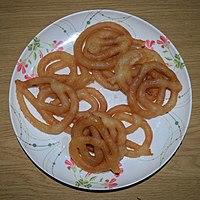 Jilapi in Bangladesh, generally consumed as a sweetmeat, is a popular starter at social events.
 -
![Shahi jilapi, meaning King's jilapi, in Dhaka, Bangladesh.[34] It is the largest form of the dessert.](//upload.wikimedia.org/wikipedia/commons/thumb/3/3c/Jilapi1.JPG/200px-Jilapi1.JPG) Shahi jilapi, meaning King's jilapi, in Dhaka, Bangladesh.[34] It is the largest form of the dessert.
Shahi jilapi, meaning King's jilapi, in Dhaka, Bangladesh.[34] It is the largest form of the dessert. -
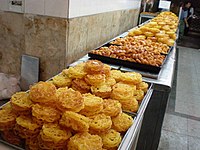 Zulbiā and bāmieh in Iran
 -
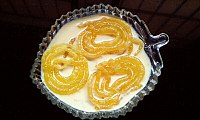 Jalebi dipped in rabri
.jpg)
![Shahi jilapi, meaning King's jilapi, in Dhaka, Bangladesh.[34] It is the largest form of the dessert.](/wiki/File:Jilapi1.JPG)


In Popular Culture
[edit]- "Jalebi Baby" by Tesher: This song, which blends English and Punjabi lyrics, became a viral sensation globally, especially on platforms like TikTok. The song uses jalebi as a metaphor for something sweet and desirable. The collaboration with Jason Derulo further popularized the song, making it a crossover hit in both South Asian and Western markets.[35][36]
- "Jalebi Bai" from the movie "Double Dhamaal": This Bollywood song became a hit item number where jalebi is used metaphorically to describe an attractive and alluring woman. The song's catchy tune and vibrant performance contributed to its widespread popularity in Indian cinema.[37][38][39]
See also
[edit]
References
[edit]- ^ a b c d e f g Alan Davidson (21 August 2014). The Oxford Companion to Food. Oxford University Press. pp. 424–425. ISBN 978-0-19-967733-7.
- ^ a b Sengupta, Sushmita. "History Of Jalebi: How The Coiled and Sugary West Asian Import Became India's Favourite Sweetmeat". ndtv.
- ^ a b c d e f g h Marks, Gil (17 November 2010). Encyclopedia of Jewish Food. HMH. p. 191. ISBN 978-0-544-18631-6.
- ^ "Zlabia, la confiserie avec une histoire". harissa.com.
- ^ Salloum, Habeeb; Salloum, Muna; Salloum Elias, Leila (2013). Sweet Delights from a Thousand and One Nights: The Story of Traditional Arab Sweets. London: I.B. Tauris & Co. ISBN 978-1-78076-464-1. OCLC 8902838136., ch. Zalabiya Fritters (Sweet Crullers)
- ^ Goldstein, Darra (2015). The Oxford Companion to Sugar and Sweets. Oxford University Press. ISBN 978-1-78785-554-0.
- ^ a b Yule, Henry (1903). "Jelaubee". In Crooke, William (ed.). Hobson-Jobson. London, England: J. Murray. p. 458.
- ^ Dileep Padgaonkar (15 March 2010). "Journey of the jalebi". The Times of India. Retrieved 25 August 2014.
- ^ "I say jalebi, Tunisia says z'labia. Could this Indian sweet really be Levantine?". Rashmee Roshan Lall. 27 August 2015. Retrieved 16 May 2021.
- ^ "La Zlabia, un délice aux origines mystérieuses". Babzman (in French). 21 June 2015. Retrieved 16 May 2021.
- ^ T-Series (30 July 2015). Afghan Jalebi (Ya Baba) VIDEO Song | Phantom | Saif Ali Khan, Katrina Kaif | T-Series. Retrieved 2 June 2024 – via YouTube.
- ^ Sajjad, Wasim (10 April 2023). "The secret ingredient that makes Afghan Jalebi Wala a Ramadan favorite at Peshawar's Board Bazar". Arab News. Retrieved 1 June 2024.
- ^ "Take On These Top Eats".
- ^ "Khoya Jalebi | District Administration Jabalpur, Government of Madhya Pradesh | India".
- ^ "Jalebi of Jabalpur: आठ दिनो तक खराब नहीं होती जबलपुर की ये लजीज जलेबी | Jayaka India ka - Famous Jalebi of Jabalpur". Patrika News. 19 November 2017.
- ^ "Khoye Ki Jalebi – Chhindwara | Jabalpur Division | India".
- ^ Baig, Zulfiqar (28 October 2020). "Hot jalebis, a winter quintessential". The Express Tribune. Retrieved 20 December 2020.
- ^ "Jalebi khani hai?". The Times of India. 7 January 2009.
- ^ "Must Try Local Breakfast". OMG Nepal. 18 July 2021. Retrieved 1 August 2021.
- ^ a b "Iranian Recipes: Zoolbia & Baamieh". Iran Chamber Society. Retrieved 3 March 2019.
- ^ "Saffron zoolbia (deep-fried pastry with saffron sugar syrup)". Food. 12 April 2013. Retrieved 3 March 2019.
- ^ Newfield Metzelthin, Pearl Violette, ed. (2007). "Contents". Gourmet Magazine. Condé Nast Publications: 586.
- ^ Shatzmiller, Maya (1993). Labour in the medieval Islamic world. BRILL. p. 110. ISBN 978-90-04-09896-1.
- ^ a b "Middle Eastern Vegan Donuts (Zalabia)". The Mediterranean Dish. 9 February 2016. Retrieved 3 March 2019.
- ^ "Egyptian Zalabia Balls Recipe". www.middleeastkitchen.com. Retrieved 3 March 2019.
- ^ Tobi, Yosef [in Hebrew]; Seri, Shalom, eds. (2000). Yalḳuṭ Teman - Lexicon (in Hebrew). Tel-Aviv: E'eleh betamar. p. 141. OCLC 609321911.
- ^ al-Warraq, Ibn Sayyar; Nasrallah, Nawal (26 November 2007). annals of the caliphs' kitchens. BRILL. p. 413 chapter 100. ISBN 978-9004158672.
- ^ al-warraq, ibn sayyar. "كتاب الطبيخ؛ وإصلاح الأغذية المأكولات وطيبات الأطعمة المصنوعات مما استخرج من كتب الطب وألفاظ الطهاة وأهل اللب". goodreads. Retrieved 17 September 2018.
- ^ "Tunisie [Vidéo]: Zlabia et Mkharak des sucreries très prisées à Béja - TN24.TN" (in French). Retrieved 16 May 2021.
- ^ Malek Chebel (2012). Dictionnaire amoureux de l'Algérie. Place des éditeurs. p. 1934. ISBN 2-259-21779-6.
- ^ "Jalebis Recipe". restaurants.mu. Retrieved 26 April 2021.
- ^ Translated by Nawal Nasrallah Annals of the caliphs' kitchens: Ibn Sayyār al-Warrāq's tenth-century Baghdadi cookbook Volume 70 of Islamic history and civilization Edition illustrated 2007 ISBN 978-90-04-15867-2. 867 pages BRILL page 413-417
- ^ Hadi Yahmid French Ramadan About Solidarity IslamOnline
- ^ "Bangladeshi Fritter | Shahi Jilapi – Patterns of Humanity".
- ^ Griffin, Marc (5 July 2021). "Existing in Both Worlds: a Conversation with Tesher". POPTIZED. Retrieved 21 August 2024.
- ^ "The original 'Jalebi Bai' Mallika Sherawat refused Tesher's viral song thinking it was a prank". mirchi.in. Retrieved 21 August 2024.
- ^ "Mallika Sherawat told Tesher to 'get lost' and not disturb her again after he called to get her onboard 'Jalebi Baby'". The Indian Express. 20 July 2022. Retrieved 21 August 2024.
- ^ "From 'Chicken kukdoo koo' to 'Jalebi bai': Songs that will make you go hungry". The Times of India. 18 July 2015. ISSN 0971-8257. Retrieved 21 August 2024.
- ^ "8 Catchy Songs From Bollywood That Were Inspired From Indian Street Food Like Samosas And Jalebis". MensXP. 18 June 2020. Retrieved 21 August 2024.
| Sweet |  | ||||
|---|---|---|---|---|---|
| Savory |
| ||||
| Companies | |||||
| Lists | |||||
| See also |
| ||||

| Main and side dishes |
| ||||||
|---|---|---|---|---|---|---|---|
| Snacks and sauces | |||||||
| Breads | |||||||
| Beverages | |||||||
| Sweetmeats | |||||||
| Bangladeshi diaspora | |||||||


| Ingredients |
| ||||||||
|---|---|---|---|---|---|---|---|---|---|
| Breads and nans | |||||||||
| Salads |
| ||||||||
| Cheeses | |||||||||
| Soups and āshes |
| ||||||||
| Dishes |
| ||||||||
| Sauces | |||||||||
| Hors d'oeuvre | |||||||||
| Sweets and desserts | |||||||||
| Beverages | |||||||||
| Instruments | |||||||||
| Related cuisines | |||||||||
