


San Bernardino County, California
San Bernardino County, California | |
|---|---|
    Images, from top down, left to right: San Bernardino County Court House, Downtown San Bernardino, Calico ghost town, a view of the San Bernardino Mountains range from San Gorgonio Wilderness | |
 Flag  Coat of arms | |
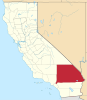
 Interactive map of San Bernardino County | |
 Location in California | |
| Country | United States |
| State | California |
| Established | April 26, 1853[1] |
| Named for | The City of San Bernardino, in turn named for San Bernardino de Sena Estancia, in turn named for Saint Bernardino of Siena |
| County seat | San Bernardino |
| Largest city (Pop.) | San Bernardino |
| Largest city (Area) | Apple Valley |
| Government | |
| • Type | Council–CEO |
| • Body | Board of Supervisors [2][3] |
| • Chair | Dawn Rowe (N.P.) |
| • Vice Chair | Paul Cook (R) |
| • Board of Supervisors [4] | Supervisors
|
| • Chief executive officer | Luther Snoke |
| Area | |
| • Total | 20,105 sq mi (52,070 km2) |
| • Land | 20,057 sq mi (51,950 km2) |
| • Water | 48 sq mi (120 km2) |
| Highest elevation | 11,503 ft (3,506 m) |
| Population | |
| • Total | 2,181,654  [6] [6] |
| • Density | 110/sq mi (40/km2) |
| GDP | |
| • Total | $100.7 billion (2022) |
| Time zone | UTC−8 (Pacific Time Zone) |
| • Summer (DST) | UTC−7 (Pacific Daylight Time) |
| Area codes | 442/760, 909, 951 |
| FIPS code | 06-071 |
| Congressional districts | 23rd, 25th, 28th, 33rd, 35th, 40th |
| Website | www |
San Bernardino County (/sæn ˌbɜːrnəˈdiːnoʊ/ ⓘ SAN BUR-nə-DEE-noh), officially the County of San Bernardino, is a county located in the southern portion of the U.S. state of California, and is located within the Inland Empire area. As of the 2020 U.S. Census, the population was 2,181,654,[9] making it the fifth-most populous county in California and the 14th-most populous in the United States. The county seat is San Bernardino.[10]
While included within the Greater Los Angeles area, San Bernardino County is included in the Riverside–San Bernardino–Ontario metropolitan statistical area.
With an area of 20,105 square miles (52,070 km2), San Bernardino County is the largest county in the contiguous United States by area, although some of Alaska's boroughs and census areas are larger. The county is close to the size of West Virginia.
This vast county stretches from where the bulk of the county population resides in three Census County Divisions (Fontana, San Bernardino, and Victorville-Hesperia), counting 1,793,186 people as of the 2010 Census, covering 1,730 square miles (4,500 km2), across the thinly populated deserts and mountains. It spans an area from south of the San Bernardino Mountains in San Bernardino Valley, to the Nevada border and the Colorado River.
With a population that is 53.7% Hispanic as of 2020, it is California's most populous majority-Hispanic county and the second-largest nationwide.[11]
History[edit]
Indigenous[edit]
.jpg)
The indigenous peoples that resided in what is now San Bernardino County were primarily the Taaqtam (Serrano) and ʔívil̃uqaletem (Cahuilla) peoples who lived in the San Bernardino Valley and the San Bernardino Mountains; the Chemehuevi and the Kawaiisu peoples who lived in the Mojave Desert region; and the 'Aha Makhav (Mohave) and the Piipaash (Maricopa) peoples who lived along the Colorado River. These groups established various villages and settlements throughout the region that were interconnected by a series of extensive trails.[12][13][14]
Wa'aachnga was a major Tongva village site, also occupied by the Serrano and Cahuilla, located near what is now the city of San Bernardino. The village was part of an extensive trade network along the Mohave Trail that connected villages in San Bernardino County from the Colorado River to the Los Angeles Basin.[15][16] Wá'peat was a Desert Serrano village located near what is now the city of Hesperia. It was part of a series of villages located along the Mojave River.[17] By the late 1700s, villages in the area were being increasingly encroached upon by Spanish soldiers and missionaries, who were coming into the region from Mission San Gabriel.[18][13]
Colonial period[edit]

Spanish Missionaries from Mission San Gabriel Arcángel established a church at the village of Wa'aachnga, which would be renamed Politania in 1810.[13] Father Francisco Dumetz named the church San Bernardino on May 20, 1810, after the feast day of St. Bernardino of Siena. The Franciscans also gave the name San Bernardino to the snowcapped peak in Southern California, in honor of the saint and it is from him that the county derives its name.[19] In 1819, they established the San Bernardino de Sena Estancia, a mission farm in what is now Redlands.
Following Mexican independence from Spain in 1821, Mexican citizens were granted land grants to establish ranchos in the area of the county. Rancho Jurupa in 1838, Rancho Cucamonga and El Rincon in 1839, Rancho Santa Ana del Chino in 1841, Rancho San Bernardino in 1842 and Rancho Muscupiabe in 1844.
Agua Mansa was the first town in what became San Bernardino County, settled by immigrants from New Mexico on land donated from the Rancho Jurupa in 1841.
Establishment[edit]

Following the purchase of Rancho San Bernardino, and the establishment of the town of San Bernardino in 1851 by Mormon colonists, San Bernardino County was formed in 1853 from parts of Los Angeles County. Some of the southern parts of the county's territory were given to Riverside County in 1893.
In the 1980s, Northern San Bernardino County proposed to create Mojave County due to the abysmal service levels the county provided. Ultimately, the vote for county secession failed. The proposed county was from the Cajon Pass to the city of Needles.[20]
In 1998, County administrator James Hlawek resigned after being subject to an FBI investigation for bribery, but only after Harry Mays, county Treasurer-Tax Collector Thomas O'Donnell, County Investment Officer Sol Levin and three businessmen had agreed to plead guilty to federal bribery charges.[21][22]
In 2004, County Supervisor Geral Eaves Pleaded guilty to bribery for accepting gifts from businesses for allowing billboards on county land.[23]
From 2004 to 2016, the county was embroiled in a corruption scandal over the Colonies housing development in Upland with real estate developer Jeff Burum. The scandal resulted in $102 million being paid to Burum's real estate company. Supervisor Bill Postmus pleaded guilty to 10 felonies in regard to his previous post as county assessor. In 2020, Burum sued the county again and the county reached for a $69 million settlement. 2022, the county's insurance company, Ironside, balked at paying the settlement, claiming that the county willfully "retaliate[d] against the Colonies II Plaintiffs as part of a decades-long dispute over land and water rights in Upland, California, culminating in a malicious prosecution of Burum."[24][25][26][27][28]
In 2020, voters approved Measure K, which limited county supervisors to one term instead of three, while reducing pay from 250 thousand dollars to 60 thousand dollars. County Supervisors appealed the decision, only to lose in the state's appeals court.[29][30][31][32][33] By 2022, term limits were restored and pay was restored to 80% of the annual base compensation for San Bernardino Superior Court judges under a supervisor lead ballot measure[34][35][36]
In 2022, The Board of supervisors were pushed by a major supervisor campaign contributor Jeff Burum to vote for secession from the State of California to form the state of Empire.[37][38][39][40][41]
Geography[edit]


According to the U.S. Census Bureau, the county has a total area of 20,105 square miles (52,070 km2), of which 20,057 square miles (51,950 km2) is land and 48 square miles (120 km2) (0.2%) is water.[42] It is the largest county by area in California and the largest in the United States (excluding boroughs in Alaska).[43] It is slightly larger than the states of New Jersey, Connecticut, Delaware and Rhode Island combined, and is also slightly larger than Switzerland. It borders both Nevada and Arizona.
The bulk of the population, nearly two million, live in the roughly 480 square miles south of the San Bernardino Mountains adjacent to Riverside and in the San Bernardino Valley in the southwestern portion of the county. About 390,000 residents live just north of the San Bernardino Mountains, in and around the roughly 280 square-mile area that includes the Victor Valley. Roughly another 100,000 people live scattered across the rest of the sprawling county.
The Mojave National Preserve covers some of the eastern desert, especially between Interstate 15 and Interstate 40. The desert portion also includes the cities of Needles next to the Colorado River and Barstow at the junction of Interstate 15 and Interstate 40. Trona is at the northwestern part of the county, west of Death Valley. This national park, mostly within Inyo County, also has a small portion of land within San Bernardino County. The largest metropolitan area in the Mojave Desert part of the county is the Victor Valley, with the incorporated localities of Adelanto, Apple Valley, Hesperia, and Victorville. Further south, a portion of Joshua Tree National Park overlaps the county near the High Desert area, in the vicinity of Twentynine Palms. The remaining towns make up the remainder of the High Desert: Pioneertown, Yucca Valley, Joshua Tree, Landers, and Morongo Valley.
The mountains are home to the San Bernardino National Forest, and include the communities of Crestline, Lake Arrowhead, Running Springs, Big Bear City, Forest Falls, and Big Bear Lake.
The San Bernardino Valley is at the eastern end of the San Gabriel Valley. The San Bernardino Valley includes the cities of Ontario, Chino, Chino Hills, Upland, Fontana, Rialto, Colton, Grand Terrace, Montclair, Rancho Cucamonga, San Bernardino, Loma Linda, Highland, Redlands, and Yucaipa.
Adjacent counties[edit]
|
|
As shown by the map on the left, San Bernardino County is bordered on the north by Inyo County; on the northeast by Clark County, Nevada; on the east by Mohave County, Arizona; on the southeast by La Paz County, Arizona; on the south by Riverside County; on the southwest by Orange County; on the west by Los Angeles County; and on the northwest by Kern County. |

National protected areas[edit]

- Angeles National Forest (part)
- Death Valley National Park (part)
- Havasu National Wildlife Refuge (part)
- Joshua Tree National Park (part)
- Mojave National Preserve
- San Bernardino National Forest (part)
- Sand to Snow National Monument (part)
More than 80% of the county's land is owned by the federal government.[44] There are at least 35 official wilderness areas in the county that are part of the National Wilderness Preservation System. This is the largest number of any county in the United States (although not the largest in total area). The majority are managed by the Bureau of Land Management, but some are integral components of the above listed national protected areas. Most of these wilderness areas lie entirely within the county, but a few are shared with neighboring counties (and two of these are shared with the neighboring states of Arizona and Nevada).
Except as noted, these wilderness areas are managed solely by the Bureau of Land Management and lie within San Bernardino County:
- Bigelow Cholla Garden Wilderness
- Bighorn Mountain Wilderness (part)
- Black Mountain Wilderness
- Bristol Mountains Wilderness
- Cadiz Dunes Wilderness
- Chemehuevi Mountains Wilderness
- Cleghorn Lakes Wilderness
- Clipper Mountain Wilderness
- Cucamonga Wilderness
- Dead Mountains Wilderness
- Death Valley Wilderness (part)
- Golden Valley Wilderness
- Grass Valley Wilderness
- Havasu Wilderness (part)
- Hollow Hills Wilderness
- Joshua Tree Wilderness (part)
- Kelso Dunes Wilderness
- Kingston Range Wilderness
- Mesquite Wilderness
- Mojave Wilderness
- Newberry Mountains Wilderness
- North Mesquite Mountains Wilderness
- Old Woman Mountains Wilderness
- Pahrump Valley Wilderness (part)
- Piute Mountains Wilderness
- Rodman Mountains Wilderness
- Saddle Peak Hills Wilderness (part)
- San Gorgonio Wilderness (part)
- Sheep Mountain Wilderness (part)
- Sheephole Valley Wilderness
- Stateline Wilderness
- Stepladder Mountains Wilderness
- Trilobite Wilderness
- Turtle Mountains Wilderness
- Whipple Mountains Wilderness
Demographics[edit]
2020[edit]
| Census | Pop. | Note | %± |
|---|---|---|---|
| 1860 | 5,551 | — | |
| 1870 | 3,988 | −28.2% | |
| 1880 | 7,786 | 95.2% | |
| 1890 | 25,497 | 227.5% | |
| 1900 | 27,929 | 9.5% | |
| 1910 | 56,706 | 103.0% | |
| 1920 | 73,401 | 29.4% | |
| 1930 | 133,900 | 82.4% | |
| 1940 | 161,108 | 20.3% | |
| 1950 | 281,642 | 74.8% | |
| 1960 | 503,591 | 78.8% | |
| 1970 | 684,072 | 35.8% | |
| 1980 | 895,016 | 30.8% | |
| 1990 | 1,418,380 | 58.5% | |
| 2000 | 1,709,434 | 20.5% | |
| 2010 | 2,035,210 | 19.1% | |
| 2020 | 2,181,654 | 7.2% | |
| 2023 (est.) | 2,195,611 | [45] | 0.6% |
| U.S. Decennial Census[46] 1790–1960[47] 1900–1990[48] 1990–2000[49] 2010[50] 2020[51] | |||
| Race / Ethnicity | Pop 2010[50] | Pop 2020[51] | % 2010 | % 2020 |
|---|---|---|---|---|
| White alone (NH) | 677,598 | 566,113 | 33.29% | 25.95% |
| Black or African American alone (NH) | 170,700 | 173,322 | 8.39% | 7.94% |
| Native American or Alaska Native alone (NH) | 8,523 | 8,412 | 0.42% | 0.39% |
| Asian alone (NH) | 123,978 | 176,204 | 6.09% | 8.08% |
| Pacific Islander alone (NH) | 5,845 | 6,173 | 0.29% | 0.28% |
| Other race alone (NH) | 4,055 | 12,117 | 0.20% | 0.56% |
| Mixed race or Multiracial (NH) | 43,366 | 68,400 | 2.13% | 3.14% |
| Hispanic or Latino (any race) | 1,001,145 | 1,170,913 | 49.19% | 53.67% |
| Total | 2,035,210 | 2,181,654 | 100.00% | 100.00% |
Note: the US Census treats Hispanic/Latino as an ethnic category. This table excludes Latinos from the racial categories and assigns them to a separate category. Hispanics/Latinos can be of any race.

2011[edit]
| Population, race, and income | |||||
|---|---|---|---|---|---|
| Total population[52] | 2,023,452 | ||||
| White[52] | 1,240,228 | 61.3% | |||
| Black or African American[52] | 176,209 | 8.7% | |||
| American Indian or Alaska Native[52] | 20,762 | 1.0% | |||
| Asian[52] | 126,991 | 6.3% | |||
| Native Hawaiian or other Pacific Islander[52] | 5,984 | 0.3% | |||
| Some other race[52] | 364,236 | 18.0% | |||
| Two or more races[52] | 89,042 | 4.4% | |||
| Hispanic or Latino (of any race)[53] | 984,022 | 48.6% | |||
| Per capita income[54] | $21,932 | ||||
| Median household income[55] | $55,853 | ||||
| Median family income[56] | $61,525 | ||||
Places by population, race, and income[edit]
| Places by population and race | ||||||||
|---|---|---|---|---|---|---|---|---|
| Place | Type[57] | Population[52] | White[52] | Other[52] [note 1] |
Asian[52] | Black or African American[52] |
Native American[52] [note 2] |
Hispanic or Latino (of any race)[53] |
| Adelanto | City | 30,670 | 55.5% | 19.4% | 2.4% | 21.1% | 1.5% | 51.8% |
| Apple Valley | Town | 68,316 | 76.6% | 10.1% | 2.0% | 10.4% | 0.9% | 28.7% |
| Baker | CDP | 713 | 37.0% | 52.5% | 0.0% | 8.7% | 1.8% | 69.6% |
| Barstow | City | 22,913 | 58.8% | 18.0% | 1.7% | 16.4% | 5.0% | 39.6% |
| Big Bear City | CDP | 11,504 | 82.3% | 13.7% | 1.1% | 1.3% | 1.6% | 23.7% |
| Big Bear Lake | City | 5,109 | 74.9% | 20.9% | 0.0% | 1.8% | 2.3% | 24.0% |
| Big River | CDP | 1,213 | 88.0% | 8.9% | 0.0% | 0.0% | 3.1% | 12.1% |
| Bloomington | CDP | 25,234 | 60.9% | 33.2% | 0.8% | 3.5% | 1.6% | 83.5% |
| Bluewater | CDP | 114 | 100.0% | 0.0% | 0.0% | 0.0% | 0.0% | 10.5% |
| Chino | City | 78,050 | 60.8% | 22.2% | 9.8% | 6.4% | 0.9% | 54.3% |
| Chino Hills | City | 74,765 | 55.6% | 11.8% | 28.3% | 3.8% | 0.5% | 30.2% |
| Colton | City | 52,283 | 50.2% | 32.5% | 5.2% | 10.4% | 1.6% | 68.0% |
| Crestline | CDP | 8,743 | 87.5% | 9.7% | 0.8% | 1.2% | 0.8% | 14.2% |
| Fontana | City | 192,779 | 58.2% | 24.8% | 6.4% | 9.7% | 0.9% | 65.9% |
| Fort Irwin | CDP | 9,781 | 69.4% | 10.1% | 7.1% | 10.2% | 3.2% | 25.5% |
| Grand Terrace | City | 12,132 | 65.4% | 20.8% | 7.6% | 5.6% | 0.6% | 37.9% |
| Hesperia | City | 88,247 | 74.9% | 15.0% | 2.1% | 6.3% | 1.7% | 47.9% |
| Highland | City | 52,777 | 52.4% | 29.5% | 7.1% | 10.1% | 0.9% | 47.9% |
| Homestead Valley | CDP | 3,072 | 94.7% | 3.6% | 1.3% | 0.0% | 0.4% | 3.8% |
| Joshua Tree | CDP | 7,194 | 82.4% | 10.6% | 2.7% | 3.0% | 1.3% | 16.4% |
| Lake Arrowhead | CDP | 9,434 | 81.0% | 16.4% | 0.6% | 1.4% | 0.6% | 23.7% |
| Lenwood | CDP | 3,784 | 63.3% | 25.1% | 0.4% | 9.4% | 1.8% | 44.7% |
| Loma Linda | City | 23,081 | 48.4% | 15.0% | 28.7% | 6.8% | 1.1% | 22.8% |
| Lucerne Valley | CDP | 6,029 | 76.4% | 6.6% | 1.7% | 12.1% | 3.1% | 21.3% |
| Lytle Creek | CDP | 735 | 86.8% | 2.3% | 8.2% | 0.0% | 2.7% | 27.3% |
| Mentone | CDP | 8,670 | 75.5% | 12.0% | 4.2% | 7.7% | 0.7% | 29.7% |
| Montclair | City | 36,802 | 43.1% | 39.8% | 10.2% | 4.6% | 2.3% | 67.1% |
| Morongo Valley | CDP | 3,550 | 81.7% | 15.3% | 0.1% | 0.0% | 2.9% | 25.4% |
| Mountain View Acres | CDP | 3,376 | 68.5% | 18.2% | 1.9% | 11.1% | 0.4% | 58.4% |
| Muscoy | CDP | 11,573 | 52.2% | 41.8% | 3.2% | 1.7% | 1.0% | 82.8% |
| Needles | City | 4,910 | 74.5% | 9.3% | 1.6% | 3.0% | 11.5% | 16.0% |
| Oak Glen | CDP | 502 | 95.6% | 1.4% | 0.0% | 3.0% | 0.0% | 20.9% |
| Oak Hills | CDP | 8,780 | 84.2% | 9.6% | 3.5% | 0.7% | 2.1% | 34.5% |
| Ontario | City | 165,120 | 52.6% | 33.9% | 4.6% | 7.6% | 1.4% | 66.5% |
| Phelan | CDP | 12,851 | 78.5% | 14.8% | 4.0% | 1.2% | 1.4% | 29.5% |
| Piñon Hills | CDP | 6,130 | 93.4% | 5.1% | 0.4% | 1.0% | 0.0% | 18.0% |
| Rancho Cucamonga | City | 163,151 | 63.2% | 16.4% | 10.5% | 8.4% | 1.5% | 34.8% |
| Redlands | City | 68,995 | 69.6% | 15.9% | 7.9% | 5.3% | 1.3% | 29.5% |
| Rialto | City | 99,501 | 59.2% | 22.5% | 2.4% | 14.9% | 0.9% | 67.2% |
| Running Springs | CDP | 5,027 | 84.4% | 11.2% | 0.9% | 0.4% | 3.1% | 17.6% |
| San Antonio Heights | CDP | 3,914 | 74.0% | 18.0% | 7.1% | 0.1% | 0.8% | 21.5% |
| San Bernardino | City | 210,100 | 44.8% | 34.9% | 4.4% | 14.9% | 1.1% | 58.8% |
| Searles Valley | CDP | 1,812 | 91.9% | 5.0% | 0.0% | 2.2% | 0.8% | 9.9% |
| Silver Lakes | CDP | 4,508 | 88.1% | 4.3% | 3.7% | 3.2% | 0.7% | 14.2% |
| Spring Valley Lake | CDP | 8,080 | 91.3% | 5.4% | 1.9% | 1.0% | 0.3% | 21.1% |
| Twentynine Palms | City | 25,786 | 74.8% | 10.1% | 3.6% | 7.4% | 4.1% | 19.8% |
| Upland | City | 74,021 | 61.0% | 22.5% | 9.3% | 5.5% | 1.8% | 37.8% |
| Victorville | City | 111,704 | 62.0% | 17.1% | 4.5% | 15.4% | 1.1% | 47.5% |
| Wrightwood | CDP | 4,556 | 96.6% | 2.5% | 0.9% | 0.0% | 0.0% | 10.1% |
| Yucaipa | City | 50,862 | 81.0% | 13.6% | 2.5% | 1.9% | 1.0% | 26.3% |
| Yucca Valley | Town | 20,508 | 82.7% | 11.0% | 2.6% | 2.4% | 1.4% | 14.1% |
| Places by population and income | |||||
|---|---|---|---|---|---|
| Place | Type[57] | Population[58] | Per capita income[54] | Median household income[55] | Median family income[56] |
| Adelanto | City | 30,670 | $11,771 | $42,208 | $45,187 |
| Apple Valley | Town | 68,316 | $23,229 | $50,664 | $57,811 |
| Baker | CDP | 713 | $11,235 | $33,000 | $43,047 |
| Barstow | City | 22,913 | $20,571 | $45,417 | $55,403 |
| Big Bear City | CDP | 11,504 | $21,008 | $41,509 | $54,881 |
| Big Bear Lake | City | 5,109 | $22,207 | $31,541 | $36,750 |
| Big River | CDP | 1,213 | $24,254 | $29,219 | $43,611 |
| Bloomington | CDP | 25,234 | $13,492 | $44,673 | $44,855 |
| Bluewater | CDP | 114 | $25,664 | $32,500 | $41,250 |
| Chino | City | 78,050 | $22,918 | $73,400 | $80,411 |
| Chino Hills | City | 74,765 | $35,157 | $101,905 | $108,140 |
| Colton | City | 52,283 | $16,385 | $41,788 | $46,195 |
| Crestline | CDP | 8,743 | $24,872 | $51,478 | $58,171 |
| Fontana | City | 192,779 | $19,297 | $64,058 | $65,652 |
| Fort Irwin | CDP | 9,781 | $18,214 | $52,798 | $53,774 |
| Grand Terrace | City | 12,132 | $29,591 | $64,337 | $82,898 |
| Hesperia | City | 88,247 | $17,589 | $48,624 | $52,894 |
| Highland | City | 52,777 | $22,494 | $59,419 | $66,445 |
| Homestead Valley | CDP | 3,072 | $19,107 | $26,356 | $38,838 |
| Joshua Tree | CDP | 7,194 | $25,501 | $43,510 | $49,221 |
| Lake Arrowhead | CDP | 9,434 | $35,810 | $63,117 | $68,462 |
| Lenwood | CDP | 3,784 | $16,799 | $43,000 | $53,938 |
| Loma Linda | City | 23,081 | $31,242 | $61,116 | $71,844 |
| Lucerne Valley | CDP | 6,029 | $16,034 | $25,323 | $34,167 |
| Lytle Creek | CDP | 735 | $21,703 | $65,982 | $74,050 |
| Mentone | CDP | 8,670 | $25,747 | $56,075 | $57,198 |
| Montclair | City | 36,802 | $17,173 | $50,959 | $51,434 |
| Morongo Valley | CDP | 3,550 | $23,084 | $37,734 | $57,321 |
| Mountain View Acres | CDP | 3,376 | $17,573 | $54,427 | $58,125 |
| Muscoy | CDP | 11,573 | $11,294 | $44,853 | $50,236 |
| Needles | City | 4,910 | $19,818 | $30,139 | $34,968 |
| Oak Glen | CDP | 502 | $23,376 | $63,902 | $68,462 |
| Oak Hills | CDP | 8,780 | $29,805 | $76,882 | $84,158 |
| Ontario | City | 165,120 | $19,123 | $55,902 | $57,731 |
| Phelan | CDP | 12,851 | $23,682 | $52,863 | $61,746 |
| Piñon Hills | CDP | 6,130 | $26,576 | $38,140 | $58,542 |
| Rancho Cucamonga | City | 163,151 | $32,738 | $78,782 | $88,362 |
| Redlands | City | 68,995 | $32,586 | $68,015 | $82,420 |
| Rialto | City | 99,501 | $15,967 | $50,452 | $54,271 |
| Running Springs | CDP | 5,027 | $28,608 | $60,833 | $76,121 |
| San Antonio Heights | CDP | 3,914 | $46,524 | $97,960 | $102,692 |
| San Bernardino | City | 210,100 | $15,762 | $40,161 | $42,771 |
| Searles Valley | CDP | 1,812 | $22,908 | $31,970 | $65,472 |
| Silver Lakes | CDP | 4,508 | $30,517 | $64,058 | $73,405 |
| Spring Valley Lake | CDP | 8,080 | $24,390 | $54,344 | $67,877 |
| Twentynine Palms | City | 25,786 | $21,546 | $43,412 | $45,225 |
| Upland | City | 74,021 | $29,614 | $67,449 | $75,304 |
| Victorville | City | 111,704 | $17,249 | $52,357 | $53,667 |
| Wrightwood | CDP | 4,556 | $36,747 | $80,793 | $89,583 |
| Yucaipa | City | 50,862 | $26,985 | $59,596 | $73,302 |
| Yucca Valley | Town | 20,508 | $21,990 | $45,502 | $52,942 |
2010 Census[edit]
The 2010 United States Census reported that San Bernardino County had a population of 2,035,210. The racial makeup of San Bernardino County was 1,153,161 (56.7%) White, 181,862 (8.9%) African American, 22,689 (1.1%) Native American, 128,603 (6.3%) Asian, 6,870 (0.3%) Pacific Islander, 439,661 (21.6%) from other races, and 102,364 (5.0%) from two or more races. Hispanic or Latino of any race were 1,001,145 persons (49.2%).[59]
| Population reported at 2010 United States Census | |||||||||
|---|---|---|---|---|---|---|---|---|---|
| The county | Total Population |
White | African American |
Native American |
Asian | Pacific Islander |
other races |
two or more races |
Hispanic or Latino (of any race) |
| San Bernardino County | 2,035,210 | 1,153,161 | 181,862 | 22,689 | 128,603 | 6,870 | 439,661 | 102,364 | 1,001,145 |
| Incorporated cities and towns |
Total Population |
White | African American |
Native American |
Asian | Pacific Islander |
other races |
two or more races |
Hispanic or Latino (of any race) |
| Adelanto | 31,765 | 13,909 | 6,511 | 411 | 617 | 194 | 8,337 | 1,786 | 18,513 |
| Apple Valley | 69,135 | 47,762 | 6,321 | 779 | 2,020 | 294 | 8,345 | 3,614 | 20,156 |
| Barstow | 22,639 | 11,840 | 3,313 | 477 | 723 | 278 | 4,242 | 1,766 | 9,700 |
| Big Bear Lake | 5,019 | 4,204 | 22 | 48 | 78 | 10 | 491 | 166 | 1,076 |
| Chino | 77,983 | 43,981 | 4,829 | 786 | 8,159 | 168 | 16,503 | 3,557 | 41,993 |
| Chino Hills | 74,799 | 38,035 | 3,415 | 379 | 22,676 | 115 | 6,520 | 3,659 | 21,802 |
| Colton | 52,154 | 22,613 | 5,055 | 661 | 2,590 | 176 | 18,413 | 2,646 | 37,039 |
| Fontana | 196,069 | 92,978 | 19,574 | 1,957 | 12,948 | 547 | 58,449 | 9,616 | 130,957 |
| Grand Terrace | 12,040 | 7,912 | 673 | 120 | 778 | 32 | 1,898 | 627 | 4,708 |
| Hesperia | 90,173 | 55,129 | 5,226 | 1,118 | 1,884 | 270 | 22,115 | 4,431 | 44,091 |
| Highland | 53,104 | 27,836 | 5,887 | 542 | 3,954 | 168 | 11,826 | 2,891 | 25,556 |
| Loma Linda | 23,261 | 11,122 | 2,032 | 97 | 6,589 | 154 | 2,022 | 1,245 | 5,171 |
| Montclair | 36,664 | 19,337 | 1,908 | 434 | 3,425 | 74 | 9,882 | 1,604 | 25,744 |
| Needles | 4,844 | 3,669 | 95 | 399 | 35 | 9 | 323 | 314 | 1,083 |
| Ontario | 163,924 | 83,683 | 10,561 | 1,686 | 8,453 | 514 | 51,373 | 7,654 | 113,085 |
| Rancho Cucamonga | 165,269 | 102,401 | 15,246 | 1,134 | 17,208 | 443 | 19,878 | 8,959 | 57,688 |
| Redlands | 68,747 | 47,452 | 3,564 | 625 | 5,216 | 235 | 8,266 | 3,389 | 20,810 |
| Rialto | 99,171 | 43,592 | 16,236 | 1,062 | 2,258 | 361 | 30,993 | 4,669 | 67,038 |
| San Bernardino | 209,924 | 95,734 | 31,582 | 2,822 | 8,454 | 839 | 59,827 | 10,666 | 125,994 |
| Twentynine Palms | 25,048 | 17,938 | 2,063 | 329 | 979 | 345 | 1,678 | 1,716 | 5,212 |
| Upland | 73,732 | 48,364 | 5,400 | 522 | 6,217 | 159 | 9,509 | 3,561 | 28,035 |
| Victorville | 115,903 | 56,258 | 19,483 | 1,665 | 4,641 | 489 | 26,036 | 7,331 | 55,359 |
| Yucaipa | 51,367 | 40,824 | 837 | 485 | 1,431 | 74 | 5,589 | 2,127 | 13,943 |
| Yucca Valley | 20,700 | 17,280 | 666 | 232 | 469 | 44 | 1,185 | 824 | 3,679 |
| Census-designated places |
Total Population |
White | African American |
Native American |
Asian | Pacific Islander |
other races |
two or more races |
Hispanic or Latino (of any race) |
| Baker | 735 | 302 | 1 | 5 | 10 | 14 | 380 | 23 | 502 |
| Big Bear City | 12,304 | 10,252 | 83 | 202 | 103 | 31 | 1,089 | 544 | 2,323 |
| Big River | 1,327 | 1,137 | 14 | 50 | 2 | 0 | 54 | 70 | 160 |
| Bloomington | 23,851 | 12,988 | 649 | 309 | 330 | 47 | 8,600 | 928 | 19,326 |
| Bluewater | 172 | 156 | 2 | 1 | 0 | 1 | 9 | 3 | 11 |
| Crestline | 10,770 | 9,289 | 107 | 135 | 96 | 20 | 526 | 597 | 1,775 |
| Fort Irwin | 8,845 | 5,481 | 1,086 | 103 | 402 | 120 | 916 | 737 | 2,261 |
| Homestead Valley | 3,032 | 2,594 | 34 | 58 | 30 | 9 | 196 | 111 | 517 |
| Joshua Tree | 7,414 | 6,176 | 234 | 84 | 104 | 18 | 368 | 430 | 1,308 |
| Lake Arrowhead | 12,424 | 10,729 | 95 | 93 | 152 | 33 | 847 | 475 | 2,709 |
| Lenwood | 3,543 | 2,133 | 219 | 94 | 37 | 25 | 813 | 222 | 1,675 |
| Lucerne Valley | 5,811 | 4,507 | 170 | 106 | 90 | 0 | 676 | 262 | 1,447 |
| Lytle Creek | 701 | 606 | 6 | 7 | 23 | 0 | 25 | 34 | 98 |
| Mentone | 8,720 | 6,114 | 438 | 122 | 352 | 32 | 1,234 | 428 | 3,085 |
| Morongo Valley | 3,552 | 3,076 | 40 | 73 | 31 | 4 | 187 | 141 | 531 |
| Mountain View Acres | 3,130 | 1,748 | 215 | 48 | 98 | 17 | 861 | 143 | 1,647 |
| Muscoy | 10,644 | 4,459 | 454 | 125 | 101 | 16 | 4,992 | 497 | 8,824 |
| Oak Glen | 638 | 545 | 50 | 13 | 2 | 1 | 14 | 13 | 123 |
| Oak Hills | 8,879 | 6,796 | 266 | 100 | 226 | 28 | 1,166 | 297 | 2,719 |
| Phelan | 14,304 | 10,807 | 276 | 139 | 446 | 20 | 1,993 | 623 | 4,128 |
| Piñon Hills | 7,272 | 5,966 | 58 | 65 | 189 | 4 | 659 | 331 | 1,738 |
| Running Springs | 4,862 | 4,325 | 23 | 47 | 50 | 6 | 146 | 265 | 695 |
| San Antonio Heights | 3,371 | 2,765 | 67 | 24 | 284 | 15 | 115 | 101 | 612 |
| Searles Valley | 1,739 | 1,405 | 69 | 56 | 16 | 6 | 83 | 104 | 293 |
| Silver Lakes | 5,623 | 4,566 | 315 | 39 | 198 | 15 | 270 | 220 | 907 |
| Spring Valley Lake | 8,220 | 6,450 | 403 | 55 | 381 | 23 | 481 | 427 | 1,528 |
| Wrightwood | 4,525 | 4,126 | 38 | 28 | 51 | 7 | 112 | 163 | 538 |
| Other unincorporated areas |
Total Population |
White | African American |
Native American |
Asian | Pacific Islander |
other races |
two or more races |
Hispanic or Latino (of any race) |
| All others not CDPs (combined) | 115,368 | 69,810 | 5,951 | 1,738 | 2,997 | 366 | 29,149 | 5,357 | 61,233 |
2000[edit]
As of the census[60] of 2000, there were 1,709,434 people, 528,594 households, and 404,374 families residing in the county. The population density was 85 inhabitants per square mile (33/km2). There were 601,369 housing units at an average density of 30 per square mile (12/km2). The racial makeup of the county was 58.9% White, 9.1% African American, 1.2% Native American, 4.7% Asian, 0.3% Pacific Islander, 20.8% from other races, and 5.0% from two or more races. 39.2% of the population were Hispanic or Latino of any race. 8.3% were of German, 5.5% English and 5.1% Irish ancestry. 66.1% spoke English, 27.7% Spanish and 1.1% Tagalog as their first language.
There were 528,594 households, out of which 43.7% had children under the age of 18 living with them, 55.8% were married couples living together, 14.8% had a female householder with no husband present, and 23.5% were non-families. 18.4% of all households were made up of individuals, and 6.6% had someone 65 years of age or older living alone. The average household size was 3.2 people, and the average family size was 3.6 people.
The number of homeless in San Bernardino County grew from 5,270 in 2002 to 7,331 in 2007, a 39% increase.[61]
In the county, the population was spread out—with 32.3% under the age of 18, 10.3% from 18 to 24, 30.2% from 25 to 44, 18.7% from 45 to 64, and 8.6% who were 65 years of age or older. The median age was 30 years. For every 100 females, there were 99.6 males. For every 100 females age 18 and over, there were 97.2 males.
The median income for a household in the county was $42,066, and the median income for a family was $46,574. Males had a median income of $37,025 versus $27,993 for females. The per capita income for the county was $16,856. About 12.6% of families and 15.80% of the population were below the poverty line, including 20.6% of those under age 18 and 8.4% of those age 65 or over.
Government and policing[edit]
County government[edit]
As of 2021, the Board of Supervisors oversees a $7.9 billion annual budget [62] and 25,430 employees.
The San Bernardino County Board of Supervisors has 5 members elected from their districts:[63]
- Paul Cook (First District),
- Jesse Armendarez (Second District),
- Chair Dawn Rowe (Third District),
- Curt Hagman (Fourth District), and
- Joe Baca Jr. (Fifth District)
Other County of San Bernardino Elected Officials [64]
- Ensen Mason (Auditor-Controller/Treasurer/Tax Collector)[65]
- Chris Wilhite (Assessor/Recorder)[66]
- Theodore Alejandre (County Superintendent of Schools)
- Jason Anderson (District Attorney)
- Shannon Dicus (Sheriff/Coroner/Public Administrator)[67]
State and federal representation[edit]
In the United States House of Representatives, San Bernardino County is split among 6 congressional districts:[68]
- California's 23rd congressional district, represented by Republican Jay Obernolte,
- California's 25th congressional district, represented by Democrat Raul Ruiz,
- California's 28th congressional district, represented by Democrat Judy Chu,
- California's 33rd congressional district, represented by Democrat Pete Aguilar,
- California's 35th congressional district, represented by Democrat Norma Torres, and
- California's 40th congressional district, represented by Republican Young Kim.
In the California State Assembly, San Bernardino County is split among 10 assembly districts:[69]
- the 34th Assembly District, represented by Republican Tom Lackey,
- the 36th Assembly District, represented by Democrat Eduardo Garcia,
- the 39th Assembly District, represented by Democrat Juan Carrillo,
- the 41st Assembly District, represented by Democrat Chris Holden,
- the 45th Assembly District, represented by Democrat James Ramos,
- the 47th Assembly District, represented by Republican Greg Wallis,
- the 50th Assembly District, represented by Democrat Eloise Reyes,
- the 53rd Assembly District, represented by Democrat Freddie Rodriguez,
- the 58th Assembly District, represented by Democrat Sabrina Cervantes, and
- the 59th Assembly District, represented by Republican Phillip Chen.
In the California State Senate, San Bernardino County is split among 7 districts:[70]
- the 18th Senate District, represented by Democrat Steve Padilla,
- the 21st Senate District, represented by Republican Scott Wilk,
- the 22nd Senate District, represented by Democrat Susan Rubio,
- the 23rd Senate District, represented by Republican Rosilicie Ochoa Bogh,
- the 25th Senate District, represented by Democrat Anthony Portantino,
- the 29th Senate District, represented by Democrat Josh Newman, and
- the 32nd Senate District, represented by Republican Kelly Seyarto.
Safety[edit]
Fire[edit]

The San Bernardino County Fire Protection District (SBCoFD) or the San Bernardino County Fire Protection District provides fire protection and emergency medical services to the unincorporated parts of the county and 24 incorporated cities.[71][72] The department annexed the Crest Forest Fire Protection District on July 1, 2015;[73][74][75] the San Bernardino City and Twentynine Palms Fire Departments on July 1, 2016;[76][77][78][79] and the Upland Fire Department in July 2017.[80] As of April 2019 the City of Victorville declined to renew their contract with The San Bernardino County Fire Department.[81]
Sheriff[edit]
The San Bernardino County Sheriff provides court protection, jail administration, and coroner services for all of San Bernardino County. It provides police patrol, detective, and marshal services for the unincorporated areas of the county.
Municipal police[edit]
Municipal police departments in the county are: Fontana, San Bernardino, Rialto, Ontario, Upland, Montclair, Chino, Redlands, Colton, and Barstow. The San Bernardino County Sheriff provides contract law enforcement services to 14 incorporated cities and towns: Adelanto, Apple Valley, Big Bear, Chino Hills, Grand Terrace, Hesperia, Highland, Loma Linda, Needles, Rancho Cucamonga, Twentynine Palms, Victorville, Yucaipa, and Yucca Valley. Also for the San Manuel Band of Mission Indians. The Sheriff's Commanders assigned to these stations acts as each municipality's Chief of Police.[citation needed]
Politics[edit]
Voter registration[edit]
| Population and registered voters | ||
|---|---|---|
| Total population[52] | 2,023,452 | |
| Registered voters[82][note 3] | 869,637 | 43.0% |
| Democratic[82] | 339,603 | 39.1% |
| Republican[82] | 307,945 | 35.4% |
| Democratic–Republican spread[82] | +31,658 | +3.7% |
| American Independent[82] | 31,121 | 3.6% |
| Green[82] | 3,174 | 0.4% |
| Libertarian[82] | 5,121 | 0.6% |
| Peace and Freedom[82] | 3,204 | 0.4% |
| Americans Elect[82] | 68 | 0.0% |
| Other[82] | 1,941 | 0.2% |
| No party preference[82] | 177,460 | 20.4% |
Cities by population and voter registration[edit]
| City | Population[52] | Registered voters[82] [note 3] |
Democratic[82] | Republican[82] | D–R spread[82] | Other[82] | No party preference[82] |
|---|---|---|---|---|---|---|---|
| Adelanto | 30,670 | 29.8% | 48.8% | 21.7% | +27.1% | 11.1% | 23.2% |
| Apple Valley | 68,316 | 52.3% | 29.1% | 46.1% | -17.0% | 11.5% | 18.4% |
| Barstow | 22,913 | 37.2% | 41.5% | 29.0% | +12.5% | 11.0% | 23.3% |
| Big Bear Lake | 5,109 | 56.7% | 23.9% | 51.6% | -27.7% | 10.8% | 17.9% |
| Chino | 78,050 | 42.0% | 39.2% | 36.9% | +2.3% | 7.1% | 19.8% |
| Chino Hills | 74,765 | 52.6% | 31.8% | 40.6% | -8.8% | 6.9% | 23.4% |
| Colton | 52,283 | 38.9% | 49.9% | 25.4% | +24.5% | 7.5% | 20.2% |
| Fontana | 192,779 | 38.2% | 48.6% | 24.7% | +23.9% | 7.0% | 22.5% |
| Grand Terrace | 12,132 | 54.9% | 37.0% | 39.3% | -2.3% | 8.1% | 18.9% |
| Hesperia | 88,247 | 41.7% | 34.3% | 38.2% | -3.9% | 10.9% | 21.2% |
| Highland | 52,777 | 45.5% | 38.4% | 37.4% | +1.0% | 8.0% | 19.5% |
| Loma Linda | 23,081 | 46.2% | 32.9% | 36.3% | -3.4% | 8.5% | 25.8% |
| Montclair | 36,802 | 35.8% | 50.2% | 23.5% | +26.7% | 7.1% | 21.8% |
| Needles | 4,910 | 39.1% | 40.8% | 28.7% | +12.1% | 13.8% | 22.8% |
| Ontario | 165,120 | 36.7% | 46.9% | 28.5% | +18.4% | 7.1% | 20.3% |
| Rancho Cucamonga | 163,151 | 53.8% | 35.6% | 39.5% | -3.9% | 8.0% | 20.3% |
| Redlands | 68,995 | 56.1% | 33.9% | 42.4% | -8.5% | 8.9% | 18.4% |
| Rialto | 99,501 | 39.6% | 52.0% | 23.7% | +28.3% | 6.9% | 20.1% |
| San Bernardino | 210,100 | 36.8% | 46.5% | 29.5% | +17.0% | 7.7% | 19.4% |
| Twentynine Palms | 25,786 | 22.1% | 27.5% | 41.1% | -13.6% | 11.1% | 24.9% |
| Upland | 74,021 | 52.0% | 35.4% | 40.7% | -5.3% | 7.6% | 19.3% |
| Victorville | 111,704 | 38.4% | 43.5% | 29.6% | +13.9% | 10.0% | 21.1% |
| Yucaipa | 50,862 | 54.1% | 27.5% | 48.9% | -21.4% | 10.4% | 17.5% |
| Yucca Valley | 20,508 | 48.0% | 28.1% | 45.3% | -17.2% | 11.4% | 20.1% |
Overview[edit]
| Year | Republican | Democratic | Third party | |||
|---|---|---|---|---|---|---|
| No. | % | No. | % | No. | % | |
| 2020 | 366,257 | 43.54% | 455,859 | 54.20% | 19,014 | 2.26% |
| 2016 | 271,240 | 41.48% | 340,833 | 52.12% | 41,910 | 6.41% |
| 2012 | 262,358 | 45.01% | 305,109 | 52.34% | 15,463 | 2.65% |
| 2008 | 277,408 | 45.75% | 315,720 | 52.07% | 13,206 | 2.18% |
| 2004 | 289,306 | 55.29% | 227,789 | 43.53% | 6,181 | 1.18% |
| 2000 | 221,757 | 48.75% | 214,749 | 47.21% | 18,387 | 4.04% |
| 1996 | 180,135 | 43.58% | 183,372 | 44.36% | 49,848 | 12.06% |
| 1992 | 176,563 | 37.24% | 183,634 | 38.74% | 113,873 | 24.02% |
| 1988 | 235,167 | 59.99% | 151,118 | 38.55% | 5,723 | 1.46% |
| 1984 | 222,071 | 64.80% | 116,454 | 33.98% | 4,180 | 1.22% |
| 1980 | 172,957 | 59.68% | 91,790 | 31.67% | 25,065 | 8.65% |
| 1976 | 113,265 | 49.49% | 109,636 | 47.90% | 5,984 | 2.61% |
| 1972 | 144,689 | 59.73% | 85,986 | 35.49% | 11,581 | 4.78% |
| 1968 | 111,974 | 50.07% | 89,418 | 39.99% | 22,224 | 9.94% |
| 1964 | 92,145 | 42.78% | 123,012 | 57.11% | 243 | 0.11% |
| 1960 | 99,481 | 52.00% | 90,888 | 47.51% | 944 | 0.49% |
| 1956 | 86,263 | 56.88% | 64,946 | 42.83% | 443 | 0.29% |
| 1952 | 77,718 | 57.34% | 56,663 | 41.81% | 1,153 | 0.85% |
| 1948 | 46,570 | 48.59% | 45,691 | 47.68% | 3,577 | 3.73% |
| 1944 | 34,084 | 46.52% | 38,530 | 52.59% | 646 | 0.88% |
| 1940 | 30,511 | 44.30% | 37,520 | 54.47% | 847 | 1.23% |
| 1936 | 22,219 | 38.97% | 33,955 | 59.55% | 842 | 1.48% |
| 1932 | 22,094 | 44.59% | 24,889 | 50.23% | 2,565 | 5.18% |
| 1928 | 29,229 | 74.73% | 9,436 | 24.13% | 447 | 1.14% |
| 1924 | 15,974 | 56.93% | 2,634 | 9.39% | 9,453 | 33.69% |
| 1920 | 12,518 | 62.84% | 5,620 | 28.21% | 1,783 | 8.95% |
| 1916 | 11,932 | 50.68% | 9,398 | 39.92% | 2,215 | 9.41% |
| 1912 | 172 | 1.12% | 5,835 | 38.03% | 9,336 | 60.85% |
| 1908 | 4,729 | 52.90% | 2,685 | 30.03% | 1,526 | 17.07% |
| 1904 | 3,884 | 58.23% | 1,573 | 23.58% | 1,213 | 18.19% |
| 1900 | 3,135 | 52.15% | 2,347 | 39.05% | 529 | 8.80% |
| 1896 | 2,818 | 48.54% | 2,740 | 47.20% | 247 | 4.25% |
| 1892 | 3,686 | 48.71% | 2,546 | 33.65% | 1,335 | 17.64% |
| 1888 | 3,059 | 53.50% | 2,388 | 41.76% | 271 | 4.74% |
| 1884 | 1,617 | 54.37% | 1,288 | 43.31% | 69 | 2.32% |
| 1880 | 730 | 49.09% | 711 | 47.81% | 46 | 3.09% |
San Bernardino County is a county in which candidates from both major political parties have won in recent elections. Democrat Hillary Clinton carried the county by a majority and by double digits in 2016. The Democratic Party also carried the county in 2008 and 2012, when Barack Obama won majorities of the county's votes, and in 1992 and 1996, when Bill Clinton won pluralities. Republican George W. Bush took the county in 2000 by a plurality and in 2004 by a majority. The county is split between heavily Latino, middle-class, and Democratic areas and more wealthy conservative areas. The heavily Latino cities of Ontario and San Bernardino went for John Kerry in 2004, but with a relatively low voter turnout. In 2006, San Bernardino's population exceeded 201,000, and in 2004, only 42,520 votes were cast in the city; in 2006, strongly Republican Rancho Cucamonga had over 145,000 residents, of whom 53,054 voted.
According to the California Secretary of State, as of February 2020, there were 1,016,190 registered voters in San Bernardino County. Of those, 410,197 (40.37%) were registered Democrats, 298,234 (29.35%) were registered Republicans, with the remainder belonging to minor political parties or declining to state.[84]
On November 4, 2008, San Bernardino County voted 67% for Proposition 8, which amended the California Constitution to ban same-sex marriages.[85]
Public safety[edit]
Law enforcement[edit]

The current district attorney is Jason Anderson, who was elected in March 2018 and took office on January 1, 2019.
The county's primary law enforcement agency is the San Bernardino County Sheriff's Department. The department provides law enforcement services in the unincorporated areas of the county and in 14 contract cities, operates the county jail system, provides marshal services in the county superior courts, and has numerous other divisions to serve the residents of the county.
Fire rescue[edit]
The county operates the San Bernardino County Consolidated Fire District (commonly known as the San Bernardino County Fire Department). The department provides "all-risk" fire, rescue, and emergency medical services to all unincorporated areas in the county except for several areas served by independent fire protection districts, and several cities that chose to contract with the department.
Crime[edit]
The following table includes the number of incidents reported and the rate per 1,000 persons for each type of offense.
| Population and crime rates | ||
|---|---|---|
| Population[52] | 2,023,452 | |
| Violent crime[86] | 10,038 | 4.96 |
| Homicide[86] | 121 | 0.06 |
| Forcible rape[86] | 500 | 0.25 |
| Robbery[86] | 3,017 | 1.49 |
| Aggravated assault[86] | 6,400 | 3.16 |
| Property crime[86] | 35,314 | 17.45 |
| Burglary[86] | 15,178 | 7.50 |
| Larceny-theft[86][note 4] | 31,697 | 15.66 |
| Motor vehicle theft[86] | 9,730 | 4.81 |
| Arson[86] | 512 | 0.25 |
On December 2, 2015, in the city of San Bernardino, terrorists attacked a staff meeting being held in the Inland Regional Center, murdering 14 people and wounding 22.
Cities by population and crime rates[edit]
| Cities by population and crime rates | ||||||||
|---|---|---|---|---|---|---|---|---|
| City | Population[87] | Violent crimes[87] | Violent crime rate per 1,000 persons |
Property crimes[87] | Property crime rate per 1,000 persons | |||
| Adelanto | 32,520 | 199 | 6.12 | 924 | 28.41 | |||
| Apple Valley | 70,823 | 221 | 3.12 | 1,874 | 26.46 | |||
| Barstow | 23,188 | 207 | 8.93 | 843 | 36.36 | |||
| Big Bear Lake | 5,141 | 42 | 8.17 | 313 | 60.88 | |||
| Chino | 79,792 | 291 | 3.65 | 2,116 | 26.52 | |||
| Chino Hills | 76,632 | 64 | 0.84 | 956 | 12.48 | |||
| Colton | 53,431 | 189 | 3.54 | 1,907 | 35.69 | |||
| Fontana | 200,874 | 850 | 4.23 | 4,494 | 22.37 | |||
| Grand Terrace | 12,333 | 29 | 2.35 | 285 | 23.11 | |||
| Hesperia | 92,383 | 402 | 4.35 | 2,502 | 27.08 | |||
| Highland | 54,403 | 296 | 5.44 | 1,616 | 29.70 | |||
| Loma Linda | 23,819 | 43 | 1.81 | 626 | 26.28 | |||
| Montclair | 37,556 | 197 | 5.25 | 1,703 | 45.35 | |||
| Needles | 4,963 | 23 | 4.63 | 213 | 42.92 | |||
| Ontario | 167,933 | 534 | 3.18 | 5,056 | 30.11 | |||
| Rancho Cucamonga | 169,276 | 321 | 1.90 | 4,362 | 25.77 | |||
| Redlands | 70,399 | 221 | 3.14 | 2,992 | 42.50 | |||
| Rialto | 101,595 | 509 | 5.01 | 3,571 | 35.15 | |||
| San Bernardino | 214,987 | 2,022 | 9.41 | 10,510 | 48.89 | |||
| Twentynine Palms | 25,612 | 81 | 3.16 | 463 | 18.08 | |||
| Upland | 75,531 | 148 | 1.96 | 2,328 | 30.82 | |||
| Victorville | 118,687 | 676 | 5.70 | 4,465 | 37.62 | |||
| Yucaipa | 52,622 | 119 | 2.26 | 944 | 17.94 | |||
| Yucca Valley | 21,204 | 90 | 4.24 | 560 | 26.41 | |||
Education[edit]
Colleges and universities[edit]
- Barstow Community College
- Brandman University (Ontario campus)
- California State University, San Bernardino
- California University of Science and Medicine
- Calvary Chapel Bible College In Twin Peaks, California
- Chaffey College
- Copper Mountain College
- Crafton Hills College
- Loma Linda University
- National University (campuses in Ontario and San Bernardino)
- Palo Verde Community College (Needles campus)
- San Bernardino Valley College
- University of Redlands (Main Campus)
- Victor Valley College
K-12 education[edit]
School districts are:[88]
Unified:
- Apple Valley Unified School District
- Baker Valley Unified School District
- Barstow Unified School District
- Bear Valley Unified School District
- Beaumont Unified School District
- Chino Valley Unified School District
- Colton Joint Unified School District
- Fontana Unified School District
- Hesperia Unified School District
- Lucerne Valley Unified School District
- Morongo Unified School District
- Muroc Joint Unified School District
- Needles Unified School District
- Redlands Unified School District
- Rialto Unified School District
- Rim of the World Unified School District
- San Bernardino City Unified School District
- Sierra Sands Unified School District
- Silver Valley Unified School District
- Snowline Joint Unified School District
- Trona Joint Unified School District
- Upland Unified School District
- Yucaipa-Calimesa Joint Unified School District
Secondary:
Elementary:
- Adelanto Elementary School District
- Alta Loma Elementary School District
- Central Elementary School District
- Cucamonga Elementary School District
- Etiwanda Elementary School District
- Helendale Elementary School District
- Mountain View Elementary School District
- Mount Baldy Joint Elementary School District
- Ontario-Montclair School District
- Oro Grande Elementary School District
- Victor Elementary School District
Libraries[edit]
The San Bernardino County Library System consists of 32 branches across the county.[89] Library services offered vary from branch to branch, but include internet access, children's story times, adult literacy services, book clubs, classes, and special events.[90] The library system also offers e-books, digital music and movie downloads, free access to online learning through Lynda.com, and many other digital services.[91]
City-sponsored public libraries also exist in San Bernardino County, including A. K. Smiley Public Library in Redlands, California, which was built in 1898.[92] Other public libraries in the County include: The San Bernardino City Public Library System, Rancho Cucamonga Public Library, Upland Public Library, Colton City Library, and the Ontario City Library.[93] These libraries are separate from the county system and do not share circulation privileges.
Arts and culture[edit]
Keys Desert Queen Ranch, in Joshua Tree National Park, has ranger-led tours to learn about the cultural history of Keys Ranch, Native American history, mining, ranching, homesteading, the Keys family, and the site's transition into a protected historical site.[94]
Kimberly Crest House & Gardens is a 6-acre estate in Redlands, CA with a Victorian Chateau and Italian Renaissance styled gardens. The gardens are open to the public and the house serves as a museum offering guided tours.[95]
The San Bernardino County Museum in Redlands CA is a multidisciplinary museum offering a look at the area’s past with an Inland Southern California regional focus. Its exhibits and collections draw from the cultural and natural history of San Bernardino County.[96]
The Wignall Museum of Contemporary Art at Chaffey College, Rancho Cucamonga, CA is a non-collecting institution that features temporary exhibitions of contemporary art, education and community programming.[97]
Transportation[edit]
Major highways[edit]


Public transportation[edit]
- Morongo Basin Transit Authority provides bus service in Yucca Valley, Joshua Tree and Twentynine Palms (including the Marine base). Limited service is also provided to Palm Springs.
- Mountain Transit covers the Lake Arrowhead and Big Bear regions. Limited service is also provided to Downtown San Bernardino.
- Needles Area Transit serves Needles and the surrounding county area.
- Omnitrans provides transit service in the urbanized portion of San Bernardino County, serving the City of San Bernardino, as well as the area between Montclair and Yucaipa.
- Victor Valley Transit Authority operates buses in Victorville, Hesperia, Adelanto, Apple Valley and the surrounding county area.
- Foothill Transit connects the Inland Empire area to the San Gabriel Valley and downtown Los Angeles.
- RTA connects Montclair, and Anaheim to Riverside County.
- SunLine Transit Agency connects Cal State San Bernardino to Palm Springs
- Beaumont Transit Connects Downtown San Bernardino to the city of Beaumont and Banning
- San Bernardino County is also served by Greyhound buses and Amtrak trains. Metrolink commuter trains connect the urbanized portion of the county with Los Angeles, Orange, and Riverside Counties.
Airports[edit]
- Commercial domestic and international passenger flights are available at San Bernardino International Airport (SBD) and Ontario International Airport (ONT). SBD can be accessed from I-215 via Mill Street, I-10 via Tippecanoe Avenue, and I-210 via 3rd Street. Terminal construction recently finished[when?], and commercial flights began in 2022. There is also a logistics center for Amazon's Amazon Air service that has recently completed construction on the airport grounds.
- Southern California Logistics Airport (Victorville) is a major airplane graveyard, general aviation airport, and a Partial Air Force Installation.
- The County of San Bernardino owns six general aviation airports: Apple Valley Airport, Baker Airport, Barstow-Daggett Airport, Chino Airport, Needles Airport, and Twentynine Palms Airport.
- Other general aviation airports in the county include: Big Bear City Airport, Cable Airport (Upland), Hesperia Airport (not listed in NPIAS),[98] and Redlands Municipal Airport
Environmental quality[edit]
California Attorney General Jerry Brown sued the county in April 2007 under the state's environmental quality act for failing to account for the impact of global warming in the county's 25-year growth plan, approved in March. The Center for Biological Diversity, the Sierra Club and the Audubon Society also sued in a separate case. According to Brendan Cummings, a senior attorney for the plaintiffs: "San Bernardino has never seen a project it didn't like. They rubber-stamp development. It's very much of a frontier mentality." The plaintiffs want the county to rewrite its growth plan's environmental impact statement to include methods to measure greenhouse gases and take steps to reduce them.[99]
According to county spokesman David Wert, only 15% of the county is controlled by the county[clarification needed]; the rest is cities and federal and state land. However, the county says it will make sure employment centers and housing are near transportation corridors to reduce traffic and do more to promote compact development and mass transit. The county budgeted $325,000 to fight the lawsuit.[99]
The state and the county reached a settlement in August 2007.[100] The county agreed to amend its general plan to include a Greenhouse Gas Emissions Reduction Plan, including an emission inventory and reduction targets. According to the LA Times in 2015, San Bernardino County had the highest levels of ozone in the United States, averaging 102 parts per billion.[101]
Communities[edit]
Cities[edit]
| City | Year incorporated |
Population, 2018[102] |
Median income, 2019[103] |
Land area sq mi (km2) |
|---|---|---|---|---|
| Adelanto | 1970 | 34,160 | $45,380 | 56.009 (145.062) |
| Apple Valley | 1988 | 73,508 | $51,314 | 73.193 (189.57) |
| Barstow | 1947 | 23,972 | $40,633 | 41.385 (107.186) |
| Big Bear Lake | 1981 | 5,281 | $51,060 | 6.346 (16.435) |
| Chino | 1910 | 91,583 | $87,090 | 29.639 (76.766) |
| Chino Hills | 1991 | 83,447 | $103,473 | 44.681 (115.723) |
| Colton | 1887 | 54,741 | $53,838 | 15.324 (39.689) |
| Fontana | 1952 | 213,739 | $80,800 | 42.432 (109.899) |
| Grand Terrace | 1978 | 12,584 | $71,788 | 3.502 (9.07) |
| Hesperia | 1988 | 95,274 | $50,271 | 73.096 (189.316) |
| Highland | 1987 | 55,406 | $64,868 | 18.755 (48.575) |
| Loma Linda | 1970 | 24,382 | $55,607 | 7.516 (19.467) |
| Montclair | 1956 | 39,437 | $62,024 | 5.517 (14.289) |
| Needles | 1913 | 4,982 | $33,717 | 30.808 (79.793) |
| Ontario | 1891 | 181,107 | $75,266 | 49.941 (129.345) |
| Rancho Cucamonga | 1977 | 177,751 | $92,773 | 39.851 (103.212) |
| Redlands | 1888 | 71,586 | $72,410 | 36.126 (93.565) |
| Rialto | 1911 | 103,440 | $70,188 | 22.351 (57.889) |
| San Bernardino | 1854 | 215,941 | $49,721 | 59.201 (153.33) |
| Twentynine Palms | 1987 | 26,418 | $44,226 | 59.143 (153.179) |
| Upland | 1906 | 77,000 | $82,426 | 15.617 (40.448) |
| Victorville | 1962 | 122,312 | $60,391 | 73.178 (189.529) |
| Yucaipa | 1989 | 53,682 | $69,104 | 27.888 (72.231) |
| Yucca Valley | 1991 | 21,726 | $44,757 | 40.015 (103.639) |
Census-designated places[edit]
- Baker
- Big Bear City
- Big River
- Bloomington
- Bluewater
- Crestline
- Fort Irwin
- Homestead Valley
- Joshua Tree
- Lake Arrowhead
- Lenwood
- Lucerne Valley
- Lytle Creek
- Mentone
- Morongo Valley
- Mountain View Acres
- Muscoy
- Oak Glen
- Oak Hills
- Phelan
- Piñon Hills
- Running Springs
- San Antonio Heights
- Searles Valley
- Silver Lakes
- Spring Valley Lake
- Wrightwood
- Yermo
Unincorporated communities[edit]
- Amboy
- Angelus Oaks
- Argus
- Arrowbear Lake
- Arrowhead Farms
- Arrowhead Highlands
- Arrowhead Junction
- Baldwin Lake
- Baldy Mesa
- Bell Mountain
- Blue Jay
- Bryman
- Cadiz
- Cajon Junction
- Cedar Glen
- Cedarpines Park
- Cima
- Crafton
- Crest Park
- Cushenbury
- Daggett
- Danby
- Earp
- El Mirage
- Essex
- Fawnskin
- Fenner
- Forest Falls
- Goffs
- Green Valley Lake
- Halloran Springs
- Havasu Lake
- Helendale
- Hinkley
- Hodge
- Johnson Valley
- Kingston
- Kramer
- Kramer Hills
- La Delta
- Landers
- Ludlow
- Mars
- Midway
- Mojave Heights
- Mount Baldy
- Mountain Home Village
- Mountain Pass
- Narod
- Newberry Springs
- Nipton
- Oro Grande
- Parker Dam
- Patton
- Pioneer Point
- Pioneertown
- Red Mountain
- Rimforest
- Skyforest
- Sugarloaf
- Sunfair
- Sunfair Heights
- Trona
- Twentynine Palms Base
- Twin Peaks
- Venus
- Vidal
- Vidal Junction
- Wonder Valley
- Zzyzx
Indian reservations[edit]
- Chemehuevi Indian Reservation
- Colorado River Indian Reservation (partially in Riverside County, and La Paz County, Arizona)
- Fort Mojave Indian Reservation (partially in Mohave County, Arizona, and Clark County, Nevada)
- San Manuel Indian Reservation
- Twenty-Nine Palms Indian Reservation (partially in Riverside County)
Ghost towns[edit]
Population ranking[edit]
The population ranking of the following table is based on the 2020 census of San Bernardino County.[104]
† county seat
| Rank | City/Town/etc. | Municipal type | Population (2020 Census) |
|---|---|---|---|
| 1 | † San Bernardino | City | 222,101 |
| 2 | Fontana | City | 208,393 |
| 3 | Ontario | City | 175,265 |
| 4 | Rancho Cucamonga | City | 174,453 |
| 5 | Victorville | City | 134,810 |
| 6 | Rialto | City | 104,026 |
| 7 | Hesperia | City | 99,818 |
| 8 | Chino | City | 91,403 |
| 9 | Upland | City | 79,040 |
| 10 | Chino Hills | City | 78,411 |
| 11 | Apple Valley | Town | 75,791 |
| 12 | Redlands | City | 73,168 |
| 13 | Highland | City | 56,999 |
| 14 | Yucaipa | City | 54,542 |
| 15 | Colton | City | 53,909 |
| 16 | Adelanto | City | 38,046 |
| 17 | Montclair | City | 37,865 |
| 18 | Twentynine Palms | City | 28,065 |
| 19 | Barstow | City | 25,415 |
| 20 | Loma Linda | City | 24,791 |
| 21 | Bloomington | CDP | 24,339 |
| 22 | Yucca Valley | Town | 21,738 |
| 23 | Phelan | CDP | 13,859 |
| 24 | Grand Terrace | City | 13,150 |
| 25 | Big Bear City | CDP | 12,738 |
| 26 | Lake Arrowhead | CDP | 12,401 |
| 27 | Crestline | CDP | 11,650 |
| 28 | Muscoy | CDP | 10,719 |
| 29 | Spring Valley Lake | CDP | 9,598 |
| 30 | Mentone | CDP | 9,557 |
| 31 | Oak Hills | CDP | 9,450 |
| 32 | Fort Irwin | CDP | 8,096 |
| 33 | Piñon Hills | CDP | 7,258 |
| 34 | Joshua Tree | CDP | 6,489 |
| 35 | Silver Lakes | CDP | 6,317 |
| 36 | Lucerne Valley | CDP | 5,331 |
| 37 | Running Springs | CDP | 5,268 |
| 38 | Big Bear Lake | City | 5,046 |
| 39 | Needles | City | 4,931 |
| 40 | Wrightwood | CDP | 4,720 |
| 41 | Lenwood | CDP | 3,623 |
| 42 | Morongo Valley | CDP | 3,514 |
| 43 | San Antonio Heights | CDP | 3,441 |
| 44 | Mountain View Acres | CDP | 3,337 |
| 45 | Homestead Valley | CDP | 2,789 |
| 46 | Searles Valley | CDP | 1,565 |
| 47 | Colorado River Indian Reservation[105] | AIAN | 1,395 |
| 48 | Big River | CDP | 1,084 |
| 49 | Lytle Creek | CDP | 725 |
| 50 | Oak Glen | CDP | 602 |
| 51 | Baker | CDP | 442 |
| 52 | Chemehuevi Reservation[106] | AIAN | 464 |
| 53 | Fort Mojave Indian Reservation[107] | AIAN | 253 |
| 54 | San Manuel Reservation[108] | AIAN | 137 |
| 55 | Bluewater | CDP | 116 |
| 56 | Twenty-Nine Palms Reservation[109] | AIAN | 5 |
Places of interest[edit]
- Calico Ghost Town — northeast of Barstow via Interstate 15
- Zzyzx — a small desert settlement that used to be a health spa and is now the Desert Studies Center
- Downtown San Bernardino
- Mojave Narrows Park
- Mojave National Preserve
- Mojave Trails National Monument
- Joshua Tree National Park
- Castle Mountains National Monument
- Sand to Snow National Monument
- San Bernardino National Forest — home to Big Bear Lake outdoor activities
- Goldstone Deep Space Communications Complex
- Mitchell Caverns
- Snow Summit, Bear Mountain (Ski Area), and Snow Valley Mountain Resort are home to Southern California's premier winter ski resorts. Mountain High, although technically located in Los Angeles County, is also an alternative to Snow Summit and Bear Mountain because of its proximity to San Bernardino County.
- The Pacific Crest Trail, officially designated as the Pacific Crest National Scenic Trail (PCT), passes through San Bernardino County.[110]
See also[edit]

- List of California counties
- List of cemeteries in San Bernardino County
- List of museums in the Inland Empire (California)
- List of school districts in San Bernardino County, California
- National Register of Historic Places listings in San Bernardino County, California
Newspapers, past and present[edit]
- Chino Champion, Chino
- Daily Press, Victorville
- The Daily Report, Ontario
- Desert Dispatch, Barstow
- Desert Star, Needles
- The Desert Trail, Twentynine Palms
- Hi-Desert Star, Yucca Valley
- Inland Valley Daily Bulletin, Rancho Cucamonga
- News Mirror, Yucaipa
- Redlands Daily Facts, Redlands
- The San Bernardino Sun, San Bernardino
- Big Bear Grizzly, Big Bear Lake
- Upland News, Upland
Notes[edit]
- ^ Other = Some other race + Two or more races
- ^ Native American = Native Hawaiian or other Pacific Islander + American Indian or Alaska Native
- ^ a b Percentage of registered voters with respect to total population. Percentages of party members with respect to registered voters follow.
- ^ Only larceny-theft cases involving property over $400 in value are reported as property crimes.
References[edit]
- ^ "San Bernardino County". Geographic Names Information System. United States Geological Survey, United States Department of the Interior. Retrieved January 18, 2015.
- ^ "Janice Rutherford, Supervisor, District 2 from San Bernardino County, California".
- ^ "Dawn Rowe, Supervisor, District 3 from San Bernardino County, California".
- ^ "San Bernardino County - Board of Supervisors".
- ^ "San Gorgonio Mountain". Peakbagger.com. Retrieved February 16, 2015.
- ^ "Explore Census Data".
- ^ "State & County QuickFacts". United States Census Bureau. Archived from the original on February 21, 2016. Retrieved May 29, 2014.
- ^ "Gross Domestic Product by County and Metropolitan Area, 2022" (PDF). www.bea.gov. Bureau of Economic Analysis.
- ^ "San Bernardino County, California". United States Census Bureau. Retrieved January 30, 2022.
- ^ "Find a County". National Association of Counties. Retrieved June 7, 2011.
- ^ "P2:: Hispanic or Latino, and Not Hispanic or Latino by Race". 2020 Census. United States Census Bureau. Retrieved October 10, 2021.
- ^ Sutton, Mark Q.; Earle, David D. (2017). The Desert Serrano of the Mojave River (PDF). Pacific Coast Archaeological Society Quarterly. p. 8.
- ^ a b c Crafts, E. P. R. (1906). Pioneer Days in the San Bernardino Valley. Redlands, California: Kingsley, Moles & Collins Co. pp. 12–13. ISBN 9783849680169.
- ^ Zappia, Natale A. (2014). Traders and raiders : the indigenous world of the Colorado Basin, 1540-1859. Chapel Hill. p. 77. ISBN 978-1-4696-1585-1. OCLC 883632043.
{{cite book}}: CS1 maint: location missing publisher (link) - ^ Zappia, Natale A. (2014). Traders and raiders : the indigenous world of the Colorado Basin, 1540-1859. Chapel Hill. p. 77. ISBN 978-1-4696-1585-1. OCLC 883632043.
{{cite book}}: CS1 maint: location missing publisher (link) - ^ Hernandez, Kelly Lytle (2017). City of inmates : conquest, rebellion, and the rise of human caging in Los Angeles, 1771-1965. Chapel Hill. p. 18. ISBN 978-1-4696-3119-6. OCLC 974947592.
{{cite book}}: CS1 maint: location missing publisher (link) - ^ Sutton, Mark Q.; Earle, David D. (2017). The Desert Serrano of the Mojave River (PDF). Pacific Coast Archaeological Society Quarterly. p. 8.
- ^ Sutton, Mark Q.; Earle, David D. (2017). The Desert Serrano of the Mojave River (PDF). Pacific Coast Archaeological Society Quarterly. p. 8.
- ^ Van de Grift Sanchez, Nellie (1914). Spanish and Indian place names of California: their meaning and their romance. A.M. Robertson. p. 74. Retrieved June 25, 2017.
- ^ "Needles/Havasu Lake Service Reviews" (PDF). San Bernardino County LAFCO. San Bernardino County. Retrieved September 18, 2022.
- ^ "The Hlawek Era: County's top manager exposes web of corruption". Daily Bulletin. July 25, 2009. Retrieved September 18, 2022.
- ^ "Former County Chief Sentenced in Bribery Case". Los Angeles Times. November 30, 2005. Retrieved September 18, 2022.
- ^ "San Bernardino County Remains King of Corruption". www.cp-dr.com.
- ^ Yarbrough, Beau. "Insurance firm doesn't want to pay for San Bernardino County's settlement with Colonies developer". MSN. Retrieved September 18, 2022.
- ^ Content, Neil Derry Contributed. "Colonies corruption case: The inside story". Victorville Daily Press. Retrieved September 18, 2022.
- ^ Nelson, Joe (August 28, 2017). "3 of 4 Colonies corruption defendants found not guilty on all charges". Press Enterprise. Retrieved September 18, 2022.
- ^ "Trial Begins in Colonies Corruption Case". IE VOICE. January 6, 2017. Retrieved September 18, 2022.
- ^ Nelson, Joe (January 4, 2017). "'A dirty deal': Opening statements in Colonies corruption case". Press Enterprise. Retrieved September 18, 2022.
- ^ Estrada, Jene. "Appeals court says one-term limit, salary cap for San Bernardino County leaders is legal". High Desert Star. Retrieved September 18, 2022.
- ^ Estacio, Martin. "Court tentatively upholds measure which caps San Bernardino County supervisors' pay at $60k". Victorville Daily Press. Gannet. Retrieved September 18, 2022.
- ^ "A look at the Colonies corruption case through the years in San Bernardino County". San Bernardino Sun. December 31, 2016. Retrieved September 18, 2022.
- ^ "Colonies Corruption Case Now a Real Scandal". IE Business Daily. July 29, 2017. Retrieved September 18, 2022.
- ^ "Colonies Corruption Trial: Defendants Found Not Guilty on All Charges | California County News". californiacountynews.org. Retrieved September 18, 2022.
- ^ Harmatz, Jef (October 30, 2022). "San Bernardino County Measure D - What You Need To Know". Z107.7 FM Joshua Tree. Retrieved February 14, 2023.
- ^ "San Bernardino County voters approve Measure D, extending supervisor term limits". Daily Bulletin. November 10, 2022. Retrieved February 14, 2023.
- ^ "San Bernardino County's deceitful Measure D campaign: Jon Coupal". Orange County Register. October 21, 2022. Retrieved February 14, 2023.
- ^ "Supervisors Make Hurried Buy-In Of Burum's Call For County Secession | SBCSentinel". San Bernardino County Sentinel. August 5, 2022. Retrieved September 18, 2022.
- ^ "Could San Bernardino County secede from California? Voters may have a say in November". Los Angeles Times. August 6, 2022. Retrieved September 18, 2022.
- ^ "San Bernardino County secession measure advances to November 2022 ballot". San Bernardino Sun. August 4, 2022. Retrieved September 18, 2022.
- ^ "'Welcome to Empire?': San Bernardino County urged to secede from California". East Bay Times. July 27, 2022. Retrieved September 18, 2022.
- ^ "County Supervisors urged to secede from California and form new state, "empire"". The Sacramento bee. Retrieved September 18, 2022.
- ^ "2010 Census Gazetteer Files". United States Census Bureau. August 22, 2012. Retrieved October 4, 2015.
- ^ "DataSet.txt". State & County QuickFacts. U.S. Census Bureau. Archived from the original on September 30, 2013. Retrieved November 16, 2012. (See "Download the Database Archived November 11, 2012, at the Wayback Machine" for an explanation of this data set.)
- ^ "COUNTY of SAN BERNARDINO PUBLIC LANDS AT A GLANCE" (PDF). Retrieved April 7, 2020.
- ^ "Annual Estimates of the Resident Population for Counties: April 1, 2020 to July 1, 2023". United States Census Bureau. Retrieved March 26, 2024.
- ^ "Census of Population and Housing from 1790-2000". United States Census Bureau. Retrieved January 24, 2022.
- ^ "Historical Census Browser". University of Virginia Library. Retrieved October 4, 2015.
- ^ Forstall, Richard L., ed. (March 27, 1995). "Population of Counties by Decennial Census: 1900 to 1990". United States Census Bureau. Retrieved October 4, 2015.
- ^ "Census 2000 PHC-T-4. Ranking Tables for Counties: 1990 and 2000" (PDF). United States Census Bureau. April 2, 2001. Retrieved October 4, 2015.
- ^ a b "P2: Hispanic or Latino, and Not Hispanic or Latino by Race – 2010: DEC Redistricting Data (PL 94-171) - San Bernardino County, California". United States Census Bureau. Retrieved January 26, 2024.
- ^ a b "P2: Hispanic or Latino, and Not Hispanic or Latino by Race – 2020: DEC Redistricting Data (PL 94-171) - San Bernardino County, California". United States Census Bureau. Retrieved January 26, 2024.
- ^ a b c d e f g h i j k l m n o p q U.S. Census Bureau. American Community Survey, 2011 American Community Survey 5-Year Estimates, Table B02001. U.S. Census website. Retrieved October 26, 2013.
- ^ a b U.S. Census Bureau. American Community Survey, 2011 American Community Survey 5-Year Estimates, Table B03003. U.S. Census website. Retrieved October 26, 2013.
- ^ a b U.S. Census Bureau. American Community Survey, 2011 American Community Survey 5-Year Estimates, Table B19301. U.S. Census website. Retrieved October 21, 2013.
- ^ a b U.S. Census Bureau. American Community Survey, 2011 American Community Survey 5-Year Estimates, Table B19013. U.S. Census website. Retrieved October 21, 2013.
- ^ a b U.S. Census Bureau. American Community Survey, 2011 American Community Survey 5-Year Estimates, Table B19113. U.S. Census website. Retrieved October 21, 2013.
- ^ a b U.S. Census Bureau. American Community Survey, 2011 American Community Survey 5-Year Estimates. U.S. Census website. Retrieved October 21, 2013.
- ^ U.S. Census Bureau. American Community Survey, 2011 American Community Survey 5-Year Estimates, Table B01003. U.S. Census website. Retrieved October 21, 2013.
- ^ "2010 Census P.L. 94-171 Summary File Data". United States Census Bureau.
- ^ "U.S. Census website". United States Census Bureau. Retrieved May 14, 2011.
- ^ Quan, Douglas (September 25, 2007). "S.B. County steps up fight against homelessness". Press Enterprise. Archived from the original on May 20, 2011. Retrieved December 24, 2007.
- ^ "Budget". CAO Finance and Administration. San Bernardino County. Retrieved September 24, 2022.
- ^ "San Bernardino County - Board of Supervisors". www.sbcounty.gov.
- ^ "Elections Office of the Registrar of Voters > Elected Officials & Candidates > County". www.sbcountyelections.com. Retrieved May 24, 2019.
- ^ "Archived copy". Archived from the original on May 21, 2019. Retrieved May 24, 2019.
{{cite web}}: CS1 maint: archived copy as title (link) - ^ "San Bernardino County supervisors appoint Christopher Wilhite assessor for next 2 years". December 7, 2022.
- ^ "Archived copy". Archived from the original on September 6, 2021. Retrieved September 6, 2021.
{{cite web}}: CS1 maint: archived copy as title (link) - ^ "Counties by County and by District". California Citizens Redistricting Commission. Archived from the original on September 30, 2013. Retrieved September 24, 2014.
- ^ "Members California State Assembly". California State Assembly. Archived from the original on May 27, 2023. Retrieved June 16, 2023.
- ^ "SENATE COUNTIES REPRESENTED" (PDF). California State Senate. Archived (PDF) from the original on April 5, 2023. Retrieved June 16, 2023.
- ^ "San Bernardino County Fire Protection District". San Bernardino County Fire Protection District. Retrieved April 17, 2023.
- ^ "San Bernardino County Firefighters – IAFF Local 935". Retrieved April 17, 2023.
- ^ "LAFCO Cert of Completion" (PDF). Archived (PDF) from the original on February 1, 2017. Retrieved July 5, 2018.
- ^ "San Bernardino County Fire Department Annual Report 2014-2015" (PDF). Archived (PDF) from the original on December 22, 2016. Retrieved July 5, 2018.
- ^ "Fire Board Holds Last Meeting". m.mountain-news.com. Retrieved July 5, 2018.
- ^ "LAFCO SB City Annexation Proposal" (PDF). Archived (PDF) from the original on April 12, 2019. Retrieved March 18, 2018.
- ^ "29 Palms Revamping Fire Station | SBCSentinel". sbcsentinel.com. July 9, 2016. Archived from the original on July 5, 2018. Retrieved July 5, 2018.
- ^ "County OKs fire takeover: City of 29 Palms offers to buy, then lease station". Hi-Desert Star. Archived from the original on April 27, 2016. Retrieved July 5, 2018.
- ^ "San Bernardino County Fire Department Annual Report 2015-2016" (PDF). Archived (PDF) from the original on February 25, 2017. Retrieved July 5, 2018.
- ^ "Upland gets OK to disband fire department, annex to San Bernardino County Fire Department". Daily Bulletin. July 12, 2017. Archived from the original on March 26, 2018. Retrieved March 15, 2018.
- ^ "Victorville Fire Chief chosen to lead new city-run fire department". Victor Valley News Group | VVNG.com. March 21, 2018. Archived from the original on May 16, 2021. Retrieved March 3, 2019.
- ^ a b c d e f g h i j k l m n o p q California Secretary of State. February 10, 2013 - Report of Registration Archived July 27, 2013, at the Wayback Machine. Retrieved October 31, 2013.
- ^ Leip, David. "Dave Leip's Atlas of U.S. Presidential Elections". uselectionatlas.org.
- ^ "Report of Registration as of May 4, 2009 - Registration By County" (PDF). sos.ca.gov. Archived from the original (PDF) on November 13, 2010. Retrieved November 30, 2010.
- ^ "Gay marriage ban: A tale of two votes". Los Angeles Times. ISSN 0458-3035. Retrieved January 17, 2018.
- ^ a b c d e f g h i j Office of the Attorney General, Department of Justice, State of California. Table 11: Crimes – 2009 Archived December 2, 2013, at the Wayback Machine. Retrieved November 14, 2013.
- ^ a b c United States Department of Justice, Federal Bureau of Investigation. Crime in the United States, 2012, Table 8 (California). Retrieved November 14, 2013.
- ^ "2020 CENSUS - SCHOOL DISTRICT REFERENCE MAP: Imperial County, CA" (PDF). U.S. Census Bureau. Retrieved July 25, 2022. - Text list
- ^ "Library Locations". San Bernardino County Library. Retrieved December 31, 2017.
- ^ "Courses and Events". San Bernardino County Library. Archived from the original on December 22, 2017. Retrieved December 31, 2017.
- ^ "Research and e-Content". San Bernardino County Library. Retrieved December 31, 2017.
- ^ "A.K. Smiley Public Library history". Archived from the original on August 29, 2011.
- ^ "Public libraries in San Bernardino County, CA". Google Maps. January 1, 1970. Retrieved November 5, 2011.
- ^ "Keys Ranch Guided Walking Tour - Joshua Tree National Park". U.S. National Park Service. Retrieved February 15, 2024.
- ^ "About - Kimberly Crest House & Gardens". July 10, 2023. Retrieved February 15, 2024.
- ^ "SOCAL MUSEUMS | San Bernardino County Museum". Retrieved February 15, 2024.
- ^ "About Us | Wignall Museum of Contemporary Art | Chaffey College". www.chaffey.edu. Retrieved February 15, 2024.
- ^ Site L26 List of airports in California
- ^ a b Ritter, John (June 5, 2007). "Inland Empire's 25-year growth targeted". USA Today. Retrieved November 10, 2007.
- ^ Office of the Attorney General, State of California, Brown Announces Landmark Global Warming Settlement, August 21, 2007.
- ^ Barboza, Tony (October 1, 2015). "New attack on California's dirty air". Los Angeles Times. Retrieved March 1, 2023.
- ^ Bureau, U.S. Census. "U.S. Census website". United States Census Bureau. Retrieved October 6, 2019.
- ^ "American Community Survey 1-Year and 5-Year Estimates". United States Census Bureau. Retrieved January 22, 2022.
- ^ "Explore Census Data". United States Census Bureau. Retrieved October 8, 2021.
- ^ "US Census Bureau 2010 Census Interactive Population Map". www.census.gov.
- ^ "US Census Bureau 2010 Census Interactive Population Map". www.census.gov.
- ^ "US Census Bureau 2010 Census Interactive Population Map". www.census.gov.
- ^ "US Census Bureau 2010 Census Interactive Population Map". www.census.gov.
- ^ "US Census Bureau 2010 Census Interactive Population Map". www.census.gov.
- ^ "County Highpoints - Regional Lists". www.cohp.org.
External links[edit]

- Official website

- San Bernardino County Museum website
- San Bernardino County Museum at Google Cultural Institute
- San Bernardino County Library website


State of California | |
|---|---|
Sacramento (capital) | |
| Topics | |
| Regions |
|
| Metro regions | |
| Counties |
|
| Most populous cities | |

| International | |
|---|---|
| National | |
| Geographic | |
| Other | |