


Hypericum perforatum

| Hypericum perforatum | |
|---|---|

| |
Scientific classification 
| |
| Kingdom: | Plantae |
| Clade: | Tracheophytes |
| Clade: | Angiosperms |
| Clade: | Eudicots |
| Clade: | Rosids |
| Order: | Malpighiales |
| Family: | Hypericaceae |
| Genus: | Hypericum |
| Section: | Hypericum sect. Hypericum |
| Species: | H. perforatum
|
| Binomial name | |
| Hypericum perforatum | |
| Subspecies | |
| |
| Synonyms | |
| |
Hypericum perforatum, commonly known as St John's wort (sometimes perforate St John's wort or common St John's wort), is a flowering plant in the family Hypericaceae. It is a perennial plant that grows up to 1 metre (3 ft 3 in) tall, with many yellow flowers that have clearly visible black glands around their edges, long stamens (male reproductive organs), and three pistils (female reproductive organs). Probably a hybrid between the closely related H. attenuatum and H. maculatum (imperforate St John's wort) that originated in Siberia, the species is now found worldwide. It is native to temperate regions across Eurasia and North Africa, and has been introduced to East Asia, Australia, New Zealand, and parts of North and South America. In many areas where it is not native, H. perforatum is considered a noxious weed. It densely covers open areas to the exclusion of native plants, and is poor grazing material. As such, methods for biocontrol have been introduced in an attempt to slow or reverse the spread of the species.
The species produces numerous chemical compounds that are highly active. These chemicals are harmful to large animals, especially sheep, and help to deter herbivores from consuming the plant. Other chemicals in the plant, such as hypericin and hyperforin, have various uses in medicine. St John's wort has been used in traditional medicine since at least the first century AD, often as a cure-all or panacea. The oil from its glands can be extracted, or its above-ground parts can be ground into a powder called herba hyperici. In modern times, its use as an antidepressant has been the focus of numerous studies and clinical trials; however, the active ingredients can be very harmful or even lethal when taken alongside other medicines.
Description
[edit].jpg)
Hypericum perforatum is an herbaceous perennial plant with hairless (glabrous) stems and leaves.[1] The root of each plant is slender and woody with many small, fibrous small side roots and also extensive, creeping rhizomes.[2] The central root grows to a depth of 0.6–1.5 metres (2 ft 0 in – 4 ft 11 in) into the soil depending on conditions.[3] The crown of the root is woody.[2]
Its stems are erect and branched in the upper section, and usually range from 0.3 metres to 1 metre in height.[3] The stems are woody near their base and look like they have segmented joints from the scars left behind after the leaves fall off.[4] The stems of H. perforatum are rusty-yellow to rosy in color with two distinct edges and usually have bark that sheds near the base. The stems persist through the winter and sprout new growth with flower buds in the following year; first year growth does not produce flowers.[2]
It has leaves that attach on opposite sides of the stems without a stalk (sessile). The leaves vary in shape from being very narrow and almost grass-like (linear), to a rounded oval slightly wider at the base with a rounded tip or not much of a tip (elliptic), or even narrow with the widest portion towards the end of the leaf like a reversed lance point, but still long and narrow (oblanceolate).[2] The principle leaves range in length from 0.8 to 3.5 centimetres[1] and 0.31–1.6 centimetres in width.[2] Leaves borne on the branches subtend the shortened branchlets. The leaves are yellow-green in color, with scattered translucent dots of glandular tissue.[5][6] The dots are clearly visible when held up to the light, giving the leaves a perforated appearance.[7] The edges (margins) of the leaves usually have scattered black dots, often called dark glands, though sometimes they will appear away from the edges.[2][8] The odor of the plant is faint, but aromatic, resembling that of resins like balsam. The taste of the plant is bitter and acrid.[1]
Flowering characteristics
[edit]
The flowers are conspicuous and showy, measuring about 1.5–2.5 cm (0.59–0.98 in) across, and are bright yellow with black dots along the edges of the petals.[2][9][10] Each of the flowers normally has five large petals and five smaller leaf-like sepals below them. The sepals are about 4–5 mm (0.16–0.20 in) in length, green in color, are shaped like the head of a spear (lanceolate shape) with a pointed tip, and the same clear and black glands as the leaves. The petals are significantly longer, 8–12 mm (0.31–0.47 in) in length, and have an oblong shape. They completely hide the sepals from the front side of the flower.[11] The many bright yellow stamens are united at the base into three bundles.[11] The stalk portion of the stamens, the filaments, vary in length and stick out in every direction from the center of the flower.[2] The pollen grains are pale brown to orange in color.[12]
The flowers are arranged along one side of each flowering stem with two flowers at each node (a helicoid cyme) at the ends of the upper branches, between late spring and early to mid-summer.[13] Each flowering stem bears many flowers, between 25 and 100, and also is quite leafy.[11]
The fruit of Hypericum perforatum is a capsule 7–8 mm (0.28–0.31 in) in length containing the seeds in three valved chambers.[11][2] Seeds that are separated from the capsules have a much higher germination rate due to an inhibiting factor in the capsule itself.[3] The black and lustrous seeds are rough, netted with coarse grooves.[14] Each seed is about 1 mm (0.039 in) in size.[11] Each plant may produce an average of 15,000 to 34,000 seeds.[3]
-
 Full plant
 -
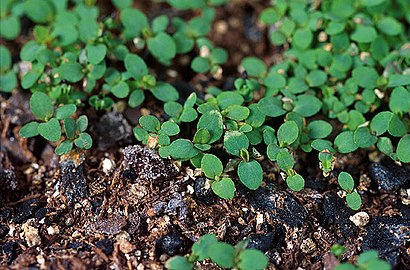 Seedlings
 -
 Fruit
Fruit -
 Red staining liquid from a flower bud


Similar species
[edit]Hypericum maculatum is visually similar to Hypericum perforatum; however, its stems have four ridges instead of two and are also hollow. In addition, its leaves have fewer translucent glands and more dark glands. H. maculatum is native to the Old World but has also been introduced to North America.[3]
In North America several native species may be confused with Hypericum perforatum. Hypericum anagalloides is a low-growing creeping plant with rounder leaves and fewer stamens. Hypericum boreale is a smaller plant with more delicate flowers. Hypericum canadense has smaller flowers with sepals that show between the petals. Hypericum concinnum has flowers with petals that bend backward at the tip and also has much narrower, gray-green leaves. Growing in riparian areas along rivers, Hypericum ellipticum has wider leaves with a more elliptic shape. Hypericum scouleri has leaves that are broader at the base and also thicker. All except for H. concinnum grow in environments that are generally more moist than where H. perforatum is found.[3]
Phytochemistry
[edit]
The most common active chemicals in Hypericum perforatum are hypericin and pseudohypericin (naphthodianthrones), and hyperforin (a phloroglucinol derivative).[13][15][16] The species contains a host of essential oils, the bulk of which are sesquiterpenes.[13] In the wild, the concentrations of any active chemicals can vary widely among individual plants and populations.[17][18][19]
| Compound | Conc.[18] [20] |
log P | PSA | pKa | Formula | MW | CYP1A2 [Note 1] |
CYP2C9 [Note 2] |
CYP2D6 [Note 2] |
CYP3A4 [Note 2] |
PGP [Note 2] |
t1/2[20] (h) | Tmax[20] (h) | Cmax[20] (mM) | CSS[20] (mM) | Notes/Biological activity[Note 3] |
|---|---|---|---|---|---|---|---|---|---|---|---|---|---|---|---|---|
| Phloroglucinols (2–5%) | ||||||||||||||||
| Adhyperforin | 0.2–1.9 | 10–13 | 71.4 | 8.51 | C36H54O4 | 550.81 | ? | ? | ? | ? | ? | ? | ? | ? | ? | ? |
| Hyperforin | 2–4.5 | 9.7–13 | 71.4 | 8.51 | C35H52O4 | 536.78 | + | +/- | – | + | + | 3.5–16 | 2.5–4.4 | 15-235 | 53.7 | – |
| Naphthodianthrones (0.03-3%) | ||||||||||||||||
| Hypericin | 0.003-3 | 7.5–10 | 156 | 6.9±0.2 | C30H16O8 | 504.44 | 0 | – (3.4 μM) |
– (8.5 μM) | – (8.7 μM) |
? | 2.5–6.5 | 6–48 | 0.66-46 | ? | ? |
| Pseudohypericin | 0.2–0.23 | 6.7±1.8 | 176 | 7.16 | C30H16O9 | 520.44 | ? | ? | ? | ? | ? | 24.8–25.4 | 3 | 1.4–16 | 0.6–10.8 | – |
| Flavonoids (2–12%) | ||||||||||||||||
| Amentoflavone |
0.01–0.05 | 3.1–5.1 | 174 | 2.39 | C30H18O10 | 538.46 | ? | – (35 nM) |
– (24.3 μM) | – (4.8 μM) |
? | ? | ? | ? | ? | ? |
| Apigenin | 0.1–0.5 | 2.1±0.56 | 87 | 6.63 | C15H10O5 | 270.24 | ? | ? | ? | ? | ? | ? | ? | ? | ? | ? |
| Catechin | 2–4 | 1.8±0.85 | 110 | 8.92 | C15H14O6 | 290.27 | ? | ? | ? | ? | ? | ? | ? | ? | ? | ? |
| Epigallocatechin | ? | −0.5–1.5 | 131 | 8.67 | C15H14O6 | 290.27 | ? | ? | ? | ? | ? | 1.7±0.4a | 1.3–1.6a | ? | ? | ? |
| Hyperoside | 0.5-2 | 1.5±1.7 | 174 | 6.17 | C21H20O12 | 464.38 | ? | ? | ? | ? | ? | ? | ? | ? | ? | |
| Kaempferol | ? | 2.1±0.6 | 107 | 6.44 | C15H10O6 | 286.24 | ? | ? | ? | +/- | ? | ? | ? | ? | ? | ? |
| Luteolin | ? | 2.4±0.65 | 107 | 6.3 | C15H10O6 | 286.24 | – | ? | ? | ? | ? | ? | ? | ? | ? | ? |
| Quercetin | 2–4 | 2.2±1.5 | 127 | 6.44 | C15H10O7 | 302.24 | – (7.5 μM) b |
– (47 μM) b |
– (24 μM) b |
– (22 μM) b |
– | 20–72c | 8c | ? | ? | ? |
| Rutin | 0.3–1.6 | 1.2±2.1 | 266 | 6.43 | C27H30O16 | 610.52 | ? | ? | ? | ? | ? | ? | ? | ? | ? | ? |
| Phenolic acids (~0.1%) | ||||||||||||||||
| Caffeic acid | 0.1 | 1.4±0.4 | 77.8 | 3.64 | C9H8O4 | 180.16 | ? | ? | ? | – | ? | ? | ? | ? | ? | ? |
| Chlorogenic acid | <0.1% | -0.36±0.43 | 165 | 3.33 | C16H18O9 | 354.31 | 0 | 0 | 0 | 0 | ? | ? | ? | ? | ? | ? |
| Acronym/Symbol | Meaning |
|---|---|
| MW | Molecular weight in g•mol−1. |
| PGP | P-glycoprotein |
| t1/2 | Elimination half-life in hours |
| Tmax | Time to peak plasma concentration in hours |
| Cmax | Peak plasma concentration in mM |
| CSS | Steady state plasma concentration in mM |
| Partition coefficient. | |
| PSA | Polar surface area of the molecule in question in square angstroms (Å2). Obtained from PubChem |
| Conc. | These values pertain to the approximation concentration (in %) of the constituents in the fresh plant material |
| – | Indicates inhibition of the enzyme in question. |
| + | Indicates an inductive effect on the enzyme in question. |
| 0 | No effect on the enzyme in question. |
| 5-HT | 5-hydroxytryptamine – synonym for serotonin. |
| DA | Dopamine |
| NE | Norepinephrine |
| GABA | γ-aminobutyric acid |
| Glu | Glutamate |
| Gly | Glycine |
| Ch | Choline |
| a | ? |
| b | ? |
| c | ? |

Notes:
- ^ In brackets is the IC50/EC50 value depending on whether it is an inhibitory or inductive action being exhibited, respectively.
- ^ a b c d As with last note
- ^ Values given in brackets are IC50/EC50 depending on whether it is an inhibitory or inductive action the compound displays towards the biologic target in question. If it pertains to bacterial growth inhibition the value is MIC50
Taxonomy
[edit]_(6099921090).jpg)
Hypericum perforatum was selected to be the type species around which the genus Hypericum is based because of its wide cosmopolitan distribution; it is the most common species of the genus in many of the areas it is found, and is one of the most widely known plants among the St John's worts in folklore and medicine.[17]: 19 The current accepted placement of H. perforatum within its genus can be summarized as follows:[21]: 62
- Hypericum subg. Hypericum
- Hypericum sect. Hypericum
- Hypericum subsect. Hypericum
- Hypericum ser. Senanensia
- Hypericum ser. Hypericum
- Hypericum subsect. Hypericum
- Hypericum sect. Hypericum
Phylogeny
[edit]Hypericum perforatum has a chromosome count of 2n = 32. The likely reason for this is that the species is a hybrid between the very closely related H. maculatum subsp. immaculatum and H. attenuatum, which means it inherited sets of chromosomes from both parents and is allopolyploid. The two species almost certainly hybridized within Siberia, Russia. The equation for this hybridization is:[17]
H. maculatum subsp. immaculatum (16) × H. attenuatum (16)×2 = H. perforatum (32)

Because of its hybrid origins, Hypericum perforatum is one of the few species within its genus that is able to further hybridize with other species, specifically those within H. ser. Hypericum. The hybrids that are descended from H. perforatum can be triploid (3 sets of chromosomes) to hexaploid (6 sets), depending on the chromosome count of the second parent species and the ploidy of the specific H. perforatum gamete that is fertilized or is fertilizing. The triploid offspring exhibit and a mix of traits from the two parents and pass them on to their offspring; the tetraploids also have a mix of traits, but often do not pass on the traits of both parents; the pentaploids are rarely distinguishable from H. perforatum. Because of this, after many generations of hybridization a wide range of traits on a spectrum between the two hybridizing species can be observed in the wild.[21]: 64
| Crossed with | Hybrid name | Chromosome number[a 1] |
|---|---|---|
| H. elegans | H. perforatum × elegans | 2n = 32? |
| H. tetrapterum | H. × medium | 2n = 24? |
| H. maculatum ssp. maculatum | H. × desetangsii nssp. carinthiacum | 2n = 24/40 |
| H. maculatum ssp. immaculatum | H. × desetangsii nssp. balcanicum | 2n = 24/40? |
| H. maculatum ssp. obtusiusculum | H. × desetangsii nssp. desetangsii | 2n = 40 |
| ||
Etymology and common names
[edit]The genus name Hypericum is possibly derived from the Greek words hyper (above) and eikon (picture), in reference to the tradition of hanging the plant over religious icons in the home.[22] The specific epithet perforatum is Latin and refers to the perforated appearance of the plant's leaves.[14]
The common name St John's wort comes from the fact that its flowers and buds were commonly harvested at the time of the Midsummer festival, which was later Christianized as St John's Feast Day on 24 June. It was believed that harvesting the flower at this time made its healing and magical powers more potent. The herb would be hung on house and stall doors on St John's Feast Day to ward off evil spirits and to safeguard against harm and sickness to people and livestock. In other traditions it was burned in bonfires for the protection of crops along with other herbs believed to be magical.[23][24] Because of its supposed potency in warding off spirits, the plant was also known as fuga daemonum (loosely "demon-flight").[25] Many other similarly fanciful names have been used for it including devil's scourge, Lord God's wonder plant, and witch's herb.[26] In medieval Kent it was called herbe Ion (Ion in this case referring to "John") as recorded in the poem The Feate of Gardening.[27] Other local names for Hypericum perforatum include balm of the warrior's wound in Somerset, penny John in Norfolk, rosin rose in Yorkshire, and touch-and-heal in Northern Ireland.[24] Locally in the United States, it may also be referred to as Tipton-weed, goatweed, or Klamath weed.[28][29]
In the 21st century, any species of the genus Hypericum can be referred to as St John's wort. Therefore, it is more accurate to call Hypericum perforatum the common St John's wort or perforate St John's wort.[25][1]
History
[edit]Hypericum perforatum has been known and used since at least the first century. Pedanius Dioscorides, an early pharmacologist, referred to either it or H. empetrifolium as akuron.[25] The species was first formally described by Carl Linnaeus in the second tome of Species Plantarum in 1753. In it, he gave the following brief description that would serve as the foundation for all subsequent identification of the species:[30]
Linnaeus also noted the species' habitat in the "meadows of Europe" and gave a short account of previous mentions of the plant.[30] While Linnaeus' taxonomic priority for this species is not in question, there are a number of botanical synonyms that were published in the early years of formal botanical nomenclature. Gaterau published Description des plantes qui croissent aux environs de Montauban in 1789 which described and called the species Hypericum officinale, a name now considered to be illegitimate under the principle of priority. Likewise, the name Hypericum officinarum by the botanist Heinrich Johann Nepomuk von Crantz in 1763 also postdated Linnaeus' 1753 naming and description and is considered invalid.[31]
Subdivision
[edit]
Hypericum perforatum exhibits a great deal of variability in its appearance across its distribution. Thus, determining the exact nature of its infraspecific taxa is difficult because of the many intermediate forms that exist.[21]: 88
- H. perforatum subspecies perforatum Stjep.-Vesel. is the type form of the species. It is distributed from the origin of the species in Siberia, west to central Europe, and east to northern Mongolia. The base changes as the plant grows from round to a broad wedge shape, and the seed capsule vittae are present throughout the plant's life cycle and are almost always narrow.
- H. perforatum variety angustifolium DC. is a variety of the species that is found in drier climates within the range of ssp. perforatum. It has leaves that look more like those of ssp. veronense, but they have leaf stalks; the glands on the seed capsule are also distinct.[21]: 88
- H. perforatum var. humile Stranski can be found in parts of the southern Balkans. These plants possess smaller, more ring-shaped leaves and the seed capsules have flattish vesicles on their surface. These appear to be adaptations of ssp. perforatum in response to the mountainous habitats of the region.[21]: 89
- H. perforatum ssp. songaricum is likely the most primitive after ssp. perforatum. Previously described as a variety by Karl Koch, Norman Robson elevated the taxon to subspecies in his monograph of the genus. The leaves are sessile and have a heart-shaped base that partially surrounds the stem.[21]: 89
- H. perforatum var. gracile has smaller leaves and is found in western Kazakhstan, southern Russia, and southern Ukraine. In the drier areas of this range the variety exhibits a dull grey-green color on the underside of its leaves.[21]: 89
- H. perforatum ssp. veronense can be found in the Caucasus, across the Middle East to Tajikistan, and along North Africa to Macaronesia. These plants have narrower leaves and display diagonal vittae on the seed capsules. Where it meets the distribution of ssp. perforatum the two subspecies hybridize regularly.[21]: 89
- H. perforatum var. ellipticum retains the diagonal vittae of the subspecies but the leaves are not as narrow. The variety is distributed in areas with greater moisture such as in the mountainous areas of Turkmenistan.[21]: 89
- H. perforatum ssp. chinense is found across most of China and was introduced into Japan (under the synonym H. foliosissimum Koidz.). Both its leaves and flowers are smaller, and the flower clusters are smaller and more crowded on the ends of longer branches.[21]: 89
Distribution and habitat
[edit]Distribution
[edit]
Hypericum perforatum is thought to be native to every nation in Europe, and is only absent from the far north such as north European Russia and Svalbard. It grows in parts of North Africa and is native to Morocco, Algeria, Tunisia, and Sudan.[31]
In the Arabian Peninsula it only grows in parts of Saudi Arabia. It is present and native to all of the Western Asia phytogeographic region from the Aegean Islands and Turkey to Israel and Palestine in the west to Afghanistan in the east, only being absent from the Sinai Peninsula. Just to the east of this area it is also native to Pakistan and the western Himalaya region of India.[31]
In the temperate parts of Asia, Hypericum perforatum is mostly absent from Siberia with the exception of Western Siberia, the Altai Region, and the warmest parts of Krasnoyarsk Krai. It has also been introduced to Irkutsk and Buryatia. It is a native part of the flora of Central Asia, growing in all the former Soviet republics. It also is known in almost every part of the Caucasus. In China it is native to Xinjiang (in western China), central China, and southern China, but not to Inner Mongolia, Manchuria, or Tibet. In the far east of Asia it has been introduced to Primorye in Russia, Korea, and Japan.[31][32]
In North America it is found in all of the continental US states except for Utah, Arizona, Florida, and Alabama. It has been introduced throughout much of Canada,[33] as well as in Hawaii, Cuba, and Haiti.[31]
In South America it is found in Argentina, Chile, Uruguay, the Juan Fernández Islands, and the more temperate parts of Brazil in the southeast. In the southern parts of Africa it has become established in South Africa, Lesotho, and Réunion. In Australia it is found in the states of South Australia, Tasmania, Victoria, and Western Australia. It has been introduced to both the North and South Islands of New Zealand.[31]
Habitat
[edit]The species can be found in a variety of habitats including open woods, meadows, grasslands, steppe, riverbanks, and stony or grassy hillsides and roadsides. It prefers dry habitats or areas with strong drainage.[21]: 88 The species thrives in areas with at least 760 mm (30 in) of rainfall per year; however, its distribution is restricted by temperatures too low for seed germination or seedling survival: an absolute minimum of −3 °C or an annual average of 9 °C.[34] Altitudes greater than 1,500 m (4,900 ft), rainfall less than 500 mm (20 in), and daily mean temperatures greater than 24 °C (75 °F) are also considered limiting thresholds.[35]
Ecology
[edit]Reproduction
[edit]
St John's wort reproduces both vegetatively and sexually. Depending on environmental and climatic conditions, and the age of the plant, St John's wort will alter the way it grows to promote survival. Summer rains are particularly effective in allowing the plant to grow vegetatively, following defoliation by insects or grazing.[35] St John's wort may also produce viable seeds without fertilization.[3] Its seeds can persist for decades while lying dormant underground in an ecosystem's soil seed bank, germinating after they are disturbed.[36][34]
Diseases
[edit]H. perforatum is affected by phytoplasma diseases, and when infected with Candidatus phytoplasma fraxini it shows visible symptoms, including yellowing and deformities called witch's broom. Its chemical profile is also altered: naphthodianthrone, flavonoid, amentoflavone, and pseudohypericin levels are reduced; chlorogenic acid levels are increased. Additionally, phytoplasma diseases greatly reduce the essential oil yield of the plant.[37]
Dieback among populations of St John's wort is also caused by fungal anthracnose, such as Colletotrichum gloeosporioides. This fungus causes the stems to lose their bark (girdling) and turn brown, and dries the aboveground parts of the plant. The infection often kills the plant within the first year of its growth, or reduces productivity over a three-year deterioration.[38]
Role as a herbivore food source
[edit]Though Hypericum perforatum is generally avoided by mammalian herbivores, a number of insects are dependent on it and its close relatives as a food source. Chrysolina quadrigemina and C. hyperici are two beetle species that feed on plants from the genus Hypericum, including H. perforatum. Chrysolina quadrigemina can be colored metallic blue, purple, green, or bronze and is better adapted to warm and dry climates; Chrysolina hyperici is consistently smaller, metallic green, and tends to live in areas with wetter and cooler conditions.[39] Another Hyericum specialist beetle is Agrilus hyperici, the St John's wort root borer, whose larvae feed on the roots of H. perforatum while the adults feed on the foliage.[40]
A moth, Aplocera plagiata, feeds heavily upon the leaves of H. perforatum as a caterpillar and is commonly known as the common St John's wort inchworm. As adults, they are a small moth with gray wings and dark gray bands.[3] Another moth that feeds upon H. perforatum is Euspilapteryx auroguttella. Their caterpillars start by mining the inside of the leaves and later roll the leaves into cigar shapes to feed in greater safety.[41][42] Agonopterix hypericella is another small (17 mm (0.67 in)) gray moth that exclusively feeds upon Hypericum.[43][42]
Zeuxidiplosis giardi, the common St. Johnswort gall midge, is a small (3 mm (0.12 in)) fly that eats H. perforatum while developing. The larvae feed upon leaf buds, which causes the plant to form a round growth called a gall where the developing insect can feed, is protected, and pupates into a mature adult.[3]
Toxicity
[edit]Hypericum perforatum is toxic to numerous domestic animals such as cows, sheep, and horses. When these animals come into contact with the plant, usually through grazing, they develop serious symptoms. The first signs are reddening of the skin accompanied by swelling, which is followed by necrosis and sloughing of the skin. Non-pigmented, white skin is most affected by the poisoning, such as the nose and ears of certain breeds of sheep.[44] Young animals are more susceptible to H. perforatum poisoning, and the plant is most toxic in spring (when it is the most palatable to herbivores) and retains its toxic effects when dried in hay.[45] Additionally, affected animals will become highly photosensitive, and exposure to sunlight can exacerbate their symptoms. As such, they should be moved to a dark area; administering of antihistamines or anti-inflammatory medicines may also help alleviate the symptoms.[44]
Invasiveness
[edit]
Although H. perforatum is grown commercially in some regions of southeast Europe, it is listed as a noxious weed in more than 20 countries and has introduced populations in South and North America, India, New Zealand, Australia, and South Africa.[34][36] In pastures, St John's wort acts as both a toxic and invasive weed. It replaces native plant communities and forage vegetation to the extent of making productive land nonviable or becoming an invasive species in natural habitats and ecosystems.[46]
Effective herbicides for control of Hypericum perforatum include 2,4-D, picloram, metsulfuron, and glyphosate.[3] Insect herbivores have also been introduced as biocontrol agents in areas outside their native range. Some of the most widely used are Chrysolina quadrigemina, Chrysolina hyperici, Agrilus hyperici, Aplocera plagiata, and Zeuxidiplosis giardi.[3][47]
Uses
[edit]Traditional medicine
[edit]
Common St John's wort has been used in herbalism for centuries.[48] It was thought to have medical properties in classical antiquity and was a standard component of ancient concoctions called theriacs, from the Mithridate of Aulus Cornelius Celsus' De Medicina (c. 30 CE) to the Venice treacle of d'Amsterdammer Apotheek in 1686.[49][50] One folk use included the oily extract known as St John's oil, a red, oily liquid extracted from H. perforatum that may have been a treatment for wounds by the Knights Hospitaller, the Order of St John.[51] Another part of the plant that is used is the dried flower structure, which is crushed to make the medicine known as herba hyperici.[52]
Medical research
[edit]Antidepressant properties
[edit]Hyperforin, a phytochemical produced by St John's wort, may be responsible for the plant's antidepressant properties.[53] Some studies and research reviews have supported the efficacy of St John's wort as a treatment for depression in humans.[48] A 2015 meta-analysis review concluded that it has superior efficacy to placebo in treating depression, is as effective as standard antidepressant pharmaceuticals for treating depression, and has fewer adverse effects than other antidepressants.[54] The authors concluded that it is difficult to assign a place for St John's wort in the treatment of depression owing to limitations in the available evidence base, including large variations in efficacy seen in trials performed in German-speaking countries relative to other countries. A 2008 Cochrane review of 29 clinical trials concluded that it was superior to placebo in patients with major depression, as effective as standard antidepressants and had fewer side-effects.[55] A 2016 review noted that use of St John's wort for mild and moderate depression was better than placebo for improving depression symptoms, and comparable to antidepressant medication.[56] A 2017 meta-analysis found that St John's wort had comparable efficacy and safety to SSRIs for mild-to-moderate depression and a lower discontinuation rate.[57] According to the United States National Center for Complementary and Integrative Health, St John's wort appears to be more effective than placebo and as effective as standard antidepressant medications for mild and moderate depression, and that it is uncertain whether this is true for severe depression or for longer than 12 weeks.[48]
In the United States, St John's wort is considered a dietary supplement by the FDA, and is not regulated by the same standards as a prescription drug.[58] In China, St John's wort combined with Eleutherococcus senticosus is sold as an antidepressant under the name Shūgān Jiěyù Jiāonáng (Chinese: 舒肝解郁胶囊; lit. 'Liver Soothing Depression Relief Capsules'), according to the Pharmacopoeia of the People's Republic of China. The pharmacopoeia states that it is used "for mild to moderate unipolar depression".[59] In some European nations, the use of Hypericum perforatum for medicinal purposes is restricted because of its classification as a drug.[60]
Inability to treat cancer
[edit]There is no clinical evidence that St John's wort is effective to treat cancer.[61][62] The National Cancer Institute has commented that "the FDA has not approved the use of St. John’s wort as a treatment for cancer or any other medical condition".[63] St John's wort may reduce the efficacy of chemotherapy.[64]
Interactions with drugs and other side effects
[edit]St John's wort can interfere (in potentially life-endangering ways) with the effects of prescription and over-the-counter drugs.[48] It mainly does this by increasing CYP3A4 and CYP2C9 enzymes in the liver, leading to faster conversion of drugs.[65] The increase in these enzymes have been found to be caused by high hyperforin content; consumption of St John's wort products with minimal hyperforin causes fewer side effects and less interference.[66] However, the concentration of St John's wort's constituent chemicals (including hyperforin) can vary widely between different products,[67] and their dosage may not be properly marked on packaging.[66] In particular, St John's wort products can reduce the effectiveness of medicines like oral contraceptives, heart medications, HIV drugs, cancer medications, and some anticoagulants.[48] The most common side effects of St John's wort products are stomach pain, fatigue, and restlessness. Other more rare effects include photosensitivity and skin irritation, breakthrough bleeding when taking oral contraceptives, and decreased effectiveness of immunosuppressants in those who have had organ transplants.[67]
Dyeing pigment
[edit]
The plant generally produces a variety of yellows suitable for dyeing. When the pigments are extracted using ethanol, a violet-red colour is made which can be used to dye silk and wool when rinsed in vinegar. The colours produced are season-dependent.[68]
The flowers produce a series of four different shades on wool, if used in the correct sequence. Wool mordanted with alum and unmordanted wool is used. The flowers are simmered to produce a deep red liquid dye. The alum-mordanted wool skein is added and simmered until green is made. If unmordanted wool is added to the same dye, it will turn reddish-maroon. The final colour produced is by continuing the method, to produce yellow or gold.[69]
References
[edit]- ^ a b c d WHO (2002). WHO Monographs on Selected Medicinal Plants 2: 2002 – V, 357 S.: graph. Darst. Geneva, Switzerland: World Health Organization. pp. 149–165. ISBN 9241545372. Retrieved 28 July 2023.
- ^ a b c d e f g h i Gillett JM (1981). The St. John's-Worts of Canada (Guttiferae). Ottawa, Canada: National Museums of Canada, National Museum of Natural Sciences. pp. 25–26. ISBN 978-0-660-10323-5.
- ^ a b c d e f g h i j k Winston R, Randall CB, Schwarzländer M, Reardon R (2010). Biology and Biological Control of Common St. Johnswort. Morgantown, West Virginia: U.S. Dept. of Agriculture, Forest Service, FHTET. Retrieved 2 August 2023.
- ^ James L. Stubbendieck, Stephan L. Hatch, L. M. Landholt (2003). North American Wildland Plants: A Field Guide (illustrated ed.). University of Nebraska Press. p. 323. ISBN 978-0-8032-9306-9.
- ^ Soelberg J, Jorgensen LB, Jager AK (26 January 2007). "Hyperforin Accumulates in the Translucent Glands of Hypericum perforatum". Annals of Botany. 99 (6): 1097–1100. doi:10.1093/aob/mcm057. PMC 3243575. PMID 17468113.
- ^ Ciccarelli D (October 2001). "Translucent Glands and Secretory Canals in Hypericum perforatum L. (Hypericaceae): Morphological, Anatomical and Histochemical Studies During the Course of Ontogenesis" (PDF). Annals of Botany. 88 (4): 637–644. doi:10.1006/ANBO.2001.1514. Retrieved 28 July 2023.
- ^ Fritsch FE, Salisbury EJ (1920). An Introduction to the Structure and Reproduction of Plants. London: G. Bell and Sons Ltd. p. 151.
- ^ Zobayed SM, Afreen F, Goto E, Kozai T (1 October 2006). "Plant–Environment Interactions: Accumulation of Hypericin in Dark Glands of Hypericum perforatum". Annals of Botany. 98 (4): 793–804. doi:10.1093/aob/mcl169. PMC 2806163. PMID 16891333.
- ^ Chen SY, Hamer D (2003). "Common St.John's Wort". A Field Guide to Non-Native Species of Eastern Massachusetts. Brandeis University. Retrieved 29 July 2023.
- ^ Stace CA (2010). New Flora of the British Isles (Third ed.). Cambridge, U.K.: Cambridge University Press. p. 339. ISBN 978-0-521-70772-5.
- ^ a b c d e "Hypericum perforatum subsp. perforatum". The Jepson Herbarium. University of California, Berkeley. 2023. Retrieved 29 July 2023.
- ^ "Hypericum perforatum". Pollen Atlas. Retrieved 27 September 2023.
- ^ a b c Mehta S (18 December 2012). "Pharmacognosy of St. John's Wort". Pharmaxchange.info. Retrieved 16 February 2014.
- ^ a b Merrit Lyndon Fernald (1970). R. C. Rollins (ed.). Gray's Manual of Botany (Eighth (Centennial) – Illustrated ed.). D. Van Nostrand Company. p. 1010. ISBN 978-0-442-22250-5.
- ^ Umek A, Kreft S, Kartnig T, Heydel B (1999). "Quantitative phytochemical analyses of six hypericum species growing in slovenia". Planta Med. 65 (4): 388–90. doi:10.1055/s-2006-960798. PMID 17260265. S2CID 260248637.
- ^ Tatsis EC, Boeren S, Exarchou V, Troganis AN, Vervoort J, Gerothanassis IP (2007). "Identification of the major constituents of Hypericum perforatum by LC/SPE/NMR and/or LC/MS". Phytochemistry. 68 (3): 383–93. Bibcode:2007PChem..68..383T. doi:10.1016/j.phytochem.2006.11.026. PMID 17196625. S2CID 28120366.
- ^ a b c Ernst E (2003). Hypericum: the genus Hypericum. Medicinal and Aromatic Plants—Industrial Profiles. Vol. 31. London: Taylor & Francis. ISBN 9781420023305.
Comparison of selected chemical constituents of Hypericum perforatum
- ^ a b Barnes, J., Anderson, L.A., Phillipson, J.D. (2007) [1996]. Herbal Medicines (PDF) (3rd ed.). London, UK: Pharmaceutical Press. ISBN 978-0-85369-623-0. Archived from the original (PDF) on 1 July 2018. Retrieved 7 February 2015.
- ^ "St. John's wort". Natural Standard. Cambridge, MA. Retrieved 13 December 2013.
- ^ a b c d e Anzenbacher P, Zanger UM, eds. (2012). Metabolism of Drugs and Other Xenobiotics. Weinheim, Germany: Wiley-VCH. doi:10.1002/9783527630905. ISBN 978-3-527-63090-5.
- ^ a b c d e f g h i j k l Robson N (2002). "Studies in the genus Hypericum L. (Guttiferae) 4(2). Section 9. Hypericum sensu lato (part 2): subsection 1. Hypericum series 1. Hypericum". Bulletin of the British Museum (Natural History) Botany. 32: 61–123 – via Biodiversity Heritage Library.
- ^ Coombes AJ (2012). The A to Z of plant names : a quick reference guide to 4000 garden plants. Portland, Oregon: Timber Press, Inc. p. 172. ISBN 978-1-60469-196-2.
- ^ Trickey-Bapty C (2001). Martyrs and miracles. New York: Testament Books. p. 132. ISBN 9780517164037. Retrieved 26 July 2023.
- ^ a b Grigson G (1960). The Englishman's Flora (2nd ed.). London: Phoenix House Ltd. pp. 75–79. Retrieved 10 August 2023.
- ^ a b c Ernst 2003, p. 2.
- ^ World Health Organization, p. 149.
- ^ Cecil E (1896). A history of Gardening in England. London: Bernard Quaritch. pp. 71–72. Retrieved 26 July 2023.
- ^ Charles Vancouver Piper, Rolla Kent Beattie (1915). Flora of the Northwest Coast. Press of the New era printing Company. p. 240.
- ^ "Hypericum perforatum". Plant Finder. St. Louis, Missouri: Missouri Botanical Garden. Retrieved 1 August 2023.
- ^ a b Linné C, Salvius L (1753). Species plantarum. Holmiae: Impensis Laurentii Salvii. p. 785. doi:10.5962/bhl.title.669.
- ^ a b c d e f "Hypericum perforatum L." Plants of the World Online. Royal Botanic Gardens, Kew. Retrieved 1 August 2023.
- ^ Registry-Migration.Gbif.Org (2022). "Hypericum perforatum L." GBIF Secretariat. Global Biodiversity Information Facility. doi:10.15468/39omei. Retrieved 1 August 2023.
- ^ NRCS (1 August 2023), "Hypericum perforatum", PLANTS Database, United States Department of Agriculture (USDA)
- ^ a b c Ian Popay (22 June 2015). "Hypericum perforatum (St John's wort)". CABI. Retrieved 2 December 2018.
- ^ a b Ramawat, Kishan Gopal. Bioactive Molecules and Medicinal Plants. Springer Science & Business Media, 2008. p. 152. ISBN 978-3-540-74603-4
- ^ a b "SPECIES: Hypericum perforatum" (PDF). Fire Effects Information System.
- ^ Marcone C, Bellardi M, Bertaccini A (2016). "Phytoplasma diseases of medicinal and aromatic plants". Journal of Plant Pathology. 98 (3): 379–404. doi:10.4454/JPP.V98I3.060. JSTOR 44280481.
- ^ Ernst 2003, pp. 23, 41.
- ^ Harris P, Peschkin DP (1974). "Biologcal Control of St. Johns-Wort". Canada Agriculture. 19 (1). Ottawa, Canada: Canada Department of Agriculture: 13–15.
- ^ Copping L, ed. (2004). The manual of biocontrol agents: a world compendium (Third ed.). Alton, Hampshire, United Kingdom: British Crop Protection Council. pp. 270–271. ISBN 1-901396-35-5. Retrieved 2 August 2023.
- ^ "bladmineerders.nl". bladmineerders.nl. Archived from the original on 4 March 2016. Retrieved 18 January 2019.
- ^ a b Shield R (1856). Practical Hints Respecting Moths and Butterflies, With Notices of Their Localities : Forming a Calendar of Entomological Operations Throughout the Year, in Pursuit of Lepidoptera. London: John Van Voorst. pp. 7, 42, 59, 83, 101. Retrieved 10 August 2023.
- ^ "Agonopterix hypericella (Insecta: Lepidoptera: Depressariidae)". Svenska Fjärilar. Naturhistoriska Riksmuseet. Retrieved 10 August 2023.
- ^ a b "Guide to Poisonous Plants – College of Veterinary Medicine and Biomedical Sciences – Colorado State University". poisonousplants.cvmbs.colostate.edu. Retrieved 23 September 2023.
- ^ Protect Your Horses and Livestock From Toxic Plants (PDF). Washington State Noxious Weed Control Board. 2017. p. 49.
- ^ "St John's wort – Hypericum perforatum". North West Weeds. Archived from the original on 31 March 2016. Retrieved 19 October 2015.
- ^ Harper JL (2010). Population Biology of Plants. Blackburn Press. ISBN 978-1-932846-24-9.[page needed]
- ^ a b c d e "St. John's Wort". National Center for Complementary and Integrative Health, US National Institutes of Health. October 2020. Retrieved 3 September 2023.
- ^ Mayor A (1 January 2019), Wexler P (ed.), "Chapter 11 – Mithridates of Pontus and His Universal Antidote", Toxicology in Antiquity (Second Edition), History of Toxicology and Environmental Health, Academic Press, pp. 161–174, doi:10.1016/b978-0-12-815339-0.00011-1, ISBN 978-0-12-815339-0, retrieved 27 September 2023
- ^ Karamanou M, Androutsos G (1 January 2019), Wexler P (ed.), "Chapter 12 - Theriaca Magna: The Glorious Cure-All Remedy", Toxicology in Antiquity (Second Edition), History of Toxicology and Environmental Health, Academic Press, pp. 175–184, doi:10.1016/b978-0-12-815339-0.00012-3, ISBN 978-0-12-815339-0, retrieved 27 September 2023
- ^ Süntar IP, Akkol EK, Yılmazer D, et al. (2010). "Investigations on the in vivo wound healing potential of Hypericum perforatum L.". Journal of Ethnopharmacology. 127 (2): 468–77. doi:10.1016/j.jep.2009.10.011. PMID 19833187.
- ^ World Health Organization, pp. 149, 151.
- ^ Gaid M, Biedermann E, Füller J, et al. (1 May 2018). "Biotechnological production of hyperforin for pharmaceutical formulation". European Journal of Pharmaceutics and Biopharmaceutics. Innovative Processes for Bio-Pharmaceuticals and Poorly Water-Soluble API. 126: 10–26. doi:10.1016/j.ejpb.2017.03.024. ISSN 0939-6411. PMID 28377273. S2CID 4701643.
- ^ Linde K, Kriston L, Rücker G, Jamila S, Schumann I, Meissner K, Sigterman K, Schneider A (February 2015). "Efficacy and acceptability of pharmacological treatments for depressive disorders in primary care: systematic review and network meta-analysis". Annals of Family Medicine. 13 (1): 69–79. doi:10.1370/afm.1687. PMC 4291268. PMID 25583895.
- ^ Linde K, Berner MM, Kriston L (2008). Linde K (ed.). "St John's wort for major depression". Cochrane Database Syst Rev. 2008 (4): CD000448. doi:10.1002/14651858.CD000448.pub3. PMC 7032678. PMID 18843608.
- ^ Apaydin EA, Maher AR, Shanman R, et al. (2016). "A systematic review of St. John's wort for major depressive disorder". Syst Rev. 5 (1): 148. doi:10.1186/s13643-016-0325-2. PMC 5010734. PMID 27589952.
- ^ Ng QX, Venkatanarayanan N, Ho CY (March 2017). "Clinical use of Hypericum perforatum (St John's wort) in depression: A meta-analysis". Journal of Affective Disorders. 210: 211–221. doi:10.1016/j.jad.2016.12.048. PMID 28064110.
- ^ Peterson B, Nguyen H (2023), "St John's Wort", StatPearls, Treasure Island (FL): StatPearls Publishing, PMID 32491397, retrieved 4 August 2023
- ^ "舒肝解郁胶囊 – 中国药典、药品标准、法规在线查询" [Shugan Jieyu Capsules – Chinese Pharmacopoeia, drug standards and regulations]. db.ouryao.com (in Chinese). 2020. Retrieved 26 November 2022.
- ^ Nicolussi S, Drewe J, Butterweck V, Meyer zu Schwabedissen HE (2020). "Clinical relevance of St. John's wort drug interactions revisited". British Journal of Pharmacology. 177 (6): 1212–1226. doi:10.1111/bph.14936. ISSN 0007-1188. PMC 7056460. PMID 31742659.
- ^ "St John's wort and cancer". Cancer Research UK. 2022. Archived from the original on 12 June 2024.
- ^ "Complementary therapies". Cancer Council Victoria. 2024. Archived from the original on 3 October 2024.
- ^ "Questions and Answers About St. John's Wort". National Cancer Institute. 2024. Archived from the original on 2 October 2024.
- ^ "St. John's Wort". Memorial Sloan Kettering Cancer Center. 2022. Archived from the original on 21 June 2024.
- ^ Komoroski BJ, Zhang S, Cai H, Hutzler JM, et al. (2004). "Induction and inhibition of cytochromes P450 by the St. John's wort constituent hyperforin in human hepatocyte cultures". Drug Metabolism and Disposition: The Biological Fate of Chemicals. 32 (5): 512–518. doi:10.1124/dmd.32.5.512. ISSN 0090-9556. PMID 15100173.
- ^ a b Chrubasik-Hausmann S, Vlachojannis J, McLachlan AJ (9 December 2018). "Understanding drug interactions with St John's wort ( Hypericum perforatum L.): impact of hyperforin content". Journal of Pharmacy and Pharmacology. 71 (1): 129–138. doi:10.1111/jphp.12858. ISSN 2042-7158. PMID 29411879. S2CID 46807341.
- ^ a b Nicolussi S, Drewe J, Butterweck V, Meyer H (19 November 2019). "Clinical relevance of St. John's wort drug interactions revisited". British Journal of Pharmacology. 177 (6): 1212–1226. doi:10.1111/bph.14936. PMC 7056460. PMID 31742659.
- ^ Hardman J, Pinhey S (2018) [2000]. Natural Dyes. Marlborough, UK: Crowood Press. p. 50. ISBN 978-1-84797-100-5.
- ^ Dean J (2010) [1999]. Wild Colour: How to Grow, Prepare and Use Natural Plant Dyes. Mitchell Beazley. p. 97. ISBN 978-18453-3-569-4.

| International | |
|---|---|
| National | |
| Other | |

- Hypericum
- CYP2D6 inhibitors
- CYP3A4 inducers
- Flora of Europe
- Flora of Central Asia
- Flora of the Caucasus
- Flora of Western Asia
- Flora of North-Central China
- Flora of Qinghai
- Flora of South-Central China
- Flora of Southeast China
- Flora of West Himalaya
- Flora of Algeria
- Flora of Altai (region)
- Flora of the Azores
- Flora of the Canary Islands
- Flora of Krasnoyarsk Krai
- Flora of Madeira
- Flora of Morocco
- Flora of Pakistan
- Flora of Saudi Arabia
- Flora of Sudan
- Flora of Tunisia
- Flora of West Siberia
- Flora of Xinjiang
- Garden plants of Europe
- Abortifacients
- Antidepressants
- Medicinal plants
- Serotonin–norepinephrine–dopamine reuptake inhibitors
- Plants described in 1753
- Pregnane X receptor agonists
- Herbs
- Subshrubs
- Taxa named by Carl Linnaeus