


Shonan Monorail
| Shonan Monorail | |||
|---|---|---|---|
 | |||
 A 5000 series train in August 2008 | |||
| Overview | |||
| Locale | Kanagawa Prefecture | ||
| Transit type | Suspension railway | ||
| Number of lines | 1 | ||
| Number of stations | 8 | ||
| Operation | |||
| Began operation | March 7, 1970 | ||
| Operator(s) | Shonan Monorail Co, Ltd Wholly owned subsidiary of Michinori Holdings formerly part of Mitsubishi Group, Keihin Kyuko Electric Railway, Seibu Railway, Nippon Steel | ||
| Technical | |||
| System length | 6.6 km (4.1 mi) | ||
| Minimum radius of curvature | 90 m (295 ft) | ||
| Electrification | 1,500 V DC | ||
| Top speed | 75 km/h (45 mph) | ||
| |||


The Shonan Monorail (湘南モノレール, Shōnan Monorēru) is a suspended SAFEGE monorail in the cities of Kamakura and Fujisawa in Kanagawa Prefecture, Japan. It is operated by the Shonan Monorail Co., Ltd. (湘南モノレール株式会社, Shōnan Monorēru Kabushiki-gaisha) which belongs to Michinori Holdings, and opened on March 7, 1970, the first monorail of its kind in Japan.[1]
Trains run on a 6.6 km (4.1 mi) line called the Enoshima Line. It is used by commuters that work in Tokyo or Yokohama, tourists visiting Enoshima, and, in summer months, city dwellers who are visiting the parks or baths of Enoshima.[2]
History[edit]
The monorail was built by Mitsubishi Heavy Industries, and the line opened March 7, 1970 between Ōfuna and Nishi-Kamakura. The rest of the line opened on July 1, 1971.[1]
Until 2018, the monorail company was part owned by Keihin Kyuko Electric Railway because the monorail line runs over "Keihin Kyuko Line" which was a toll road operated by Keikyu.[3] Seibu Railway also had investment in the company because Kokudo which was a subsidiary of Seibu Group developed land around Kataseyama Station.
In May 2015, most shares of this monorail line and company were transferred to Michinori Holdings from Mitsubishi Group.[4]
In 2018, this company became a wholly subsidiary company of Michinori Holdings.

The Shonan Monorail is twinned with Wuppertal Schwebebahn since 2018, a suspension railway located in Wuppertal, a city in North Rhine-Westphalia, Germany. Both suspension railways hung down on the rail and are known tourist destinations for Monorail enthusiasts. Both suspension railways made a twinning campaign on its doorside in September 2018.[5]
Stations[edit]
The Shonan Monorail Enoshima Line (江の島線, Enoshima-sen) travels 6.6 km (4.1 mi) every seven to eight minutes between Ōfuna Station and Enoshima, making six stops.[1] The average length of a single trip is 14 minutes.[6] The line includes two tunnels (between Shōnan-Fukasawa and Nishi-Kamakura stations, and between Mejiroyamashita and Shōnan-Enoshima stations).[7] The line's maintenance workshop is located at the Shonan Monorail Headquarters in Kamakura City.[8]
All stations are in Kanagawa Prefecture.
| No. | Station | Japanese | Distance | Transfers | Location | |
|---|---|---|---|---|---|---|
| Between stations |
Total | |||||
| SMR1 | Ōfuna | 大船 | – | 0.0 km (0 mi) |
|
Kamakura |
| SMR2 | Fujimichō* | 富士見町 | 0.9 km (0.56 mi) | 0.9 km (0.56 mi) | ||
| SMR3 | Shōnan-Machiya | 湘南町屋 | 1.1 km (0.68 mi) | 2.0 km (1.2 mi) | ||
| SMR4 | Shōnan-Fukasawa* | 湘南深沢 | 0.6 km (0.37 mi) | 2.6 km (1.6 mi) | ||
| SMR5 | Nishi-Kamakura* | 西鎌倉 | 2.1 km (1.3 mi) | 4.7 km (2.9 mi) | ||
| SMR6 | Kataseyama | 片瀬山 | 0.8 km (0.50 mi) | 5.5 km (3.4 mi) | ||
| SMR7 | Mejiroyamashita* | 目白山下 | 0.7 km (0.43 mi) | 6.2 km (3.9 mi) | Fujisawa | |
| SMR8 | Shōnan-Enoshima | 湘南江の島 | 0.4 km (0.25 mi) | 6.6 km (4.1 mi) | ||


* Track switching possible at these stations
Rolling stock[edit]
- 5000 series 3-car sets (since 2004)
As of July 2016[update], the line is operated using a fleet of seven three-car aluminium-bodied 5000 series trainsets.[9] The 5000 series is equipped with a VVVF control device and regenerative brake which allows for smooth acceleration and deceleration. The VVVF inverter control reduces the need for inspection and maintenance because unlike a DC motor, there is no commutator brush or contact switch.[10]
-
 A 5000 series set in October 2009

Former[edit]
-
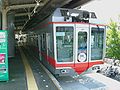 A 400 series set in 2004
 -
 A 500 series set in April 2008


- 300 series 2/3-car sets (from March 1970 until July 1992)
- 400 series (from 1980 until July 2004)
- 500 series 3-car sets (from 1988 until June 2016)
Services were initially operated using a fleet of six two-car 300 series trainsets built by Mitsubishi Heavy Industries.[1] Two sets were increased to three cars from February 1975 to provide additional capacity.[1] The last of the 300 series sets were withdrawn by July 1992, following the introduction of new 500 series trains.[11] The 500 series trains introduced in 1988 were the first air-conditioned trains on the line.[1] The last 500 series train was withdrawn after its last day in service on 26 June 2016.[9]
See also[edit]
References[edit]
- ^ a b c d e f Terada, Hirokazu (19 January 2013). データブック日本の私鉄 [Databook: Japan's Private Railways] (in Japanese). Japan: Neko Publishing. p. 80. ISBN 978-4-7770-1336-4.
- ^ "Shonan and Enoden". Retrieved 2007-09-02.
- ^ About transferring
- ^ "Our partner: Shonan Monorail". www.schwebebahn.de. Retrieved August 2, 2023.
- ^ "Sarukoen 猿公園: July 2007 Archives". Retrieved 2007-09-02.
- ^ "Kamakura-Enoshima Shonan Monorail". Kamakura-Enoshima Shonan Monorail (in Japanese). Retrieved 2019-09-05.
- ^ "湘南モノレール ピンクリボン号デビュー! Shonan Monorail Pink Ribbon-Go Edition" (subtitled video). YouTube. Shonan Monorail湘南モノレール(Official). 3 July 2016. p. English subtitles/transcript. Archived from the original on 2021-12-13. Retrieved 31 March 2021.
In the early hours of March 23, 2016 the 7th train of all the new 5000 series (Pink Line) was deliver edto Shonan Monorail HQ Workshop in Kamakura City from Mitsubishi Heavy Industry Mihara Plant in Hiroshima Prefecture.
- ^ a b 湘南モノレール500形が引退 [Shonan Monorail 500 series withdrawn]. Japan Railfan Magazine Online (in Japanese). Japan: Koyusha Co., Ltd. 27 June 2016. Archived from the original on 23 July 2016. Retrieved 23 July 2016.
- ^ "環境保全 | 江の島への近道 湘南モノレール株式会社". www.shonan-monorail.co.jp. Retrieved 2019-09-05.
- ^ 湘南モノレール 300形 [Shonan Monorail 300 series]. Tetsudo Hobidas (in Japanese). Japan: Neko Publishing Co., Ltd. 16 February 2016. Retrieved 21 February 2016.
External links[edit]

- Company website in Japanese, with translation available
- Youtube video of riding along the Shonan Monorail
35°21′08″N 139°31′53″E / 35.352339°N 139.531417°E(Ōfuna)35°18′43″N 139°29′16″E / 35.311887°N 139.487806°E(Shōnan-Enoshima)


_symbol.svg)
_symbol.svg)
_symbol.svg)
_symbol.svg)
_symbol.svg)


Rapid transit in Asia | |
|---|---|
 Bangladesh Bangladesh | |
 China (PRC) China (PRC) |
|
 India India | |
 Indonesia Indonesia | |
 Iran Iran | |
 Japan Japan | |
 Kazakhstan Kazakhstan | |
 North Korea North Korea | |
 Malaysia Malaysia | |
 Pakistan Pakistan | |
 Philippines Philippines | |
 Qatar Qatar | |
 Russia Russia | |
 Saudi Arabia Saudi Arabia | |
 Singapore Singapore | |
 South Korea South Korea | |
 Taiwan (ROC) Taiwan (ROC) | |
 Thailand Thailand | |
 Turkey Turkey | |
 United Arab Emirates United Arab Emirates | |
 Uzbekistan Uzbekistan | |
 Vietnam Vietnam | |
* Under construction. | |


