


Nasi goreng

 A typical example of Indonesian nasi goreng, here served with telur ceplok/telur mata sapi (fried egg), krupuk udang (prawn crackers) and asinan (pickles). | |
| Course | Main course |
|---|---|
| Region or state | Maritime Southeast Asia |
| Associated cuisine | Indonesia,[1] Malaysia, Brunei, Singapore and Netherlands |
| Created by | Chinese diaspora in Indonesian archipelago |
| Main ingredients | Fried rice with pieces of meat and/or vegetables, and an assortment of seasonings such as sweet soy sauce |


Nasi goreng (/ˌnɑːsi ɡɒˈrɛŋ/; Indonesian pronunciation: [ˈnasi ˈɡorɛŋ]) is a Southeast Asian fried rice dish, usually cooked with pieces of meat and vegetables. One of Indonesia's national dishes,[1][2] it is also eaten in Malay-speaking communities in countries such as Malaysia, Singapore and Brunei, and has gained popularity in Sri Lanka through migrations from the Indonesian Archipelago,[3] in countries like Suriname via Indonesian immigrant communities,[4] and in the Netherlands through its colonial ties with Indonesia.[5] Nasi goreng is distinguished from other Asian fried rice preparations by its distinct smoky aroma, and caramelised yet savoury undertones of flavour. There is no single defined recipe for nasi goreng, and its composition and preparation varies greatly from household to household.
Nasi goreng has long been considered an important staple of Indonesian cuisine.[6] In 2018, it was officially recognized by the Indonesian government as one of the country's five national dishes.[1] A ubiquitous meal throughout Indonesia, particularly for breakfast, it can be enjoyed in simple versions from a tin plate at a roadside food stall, eaten on porcelain in restaurants, or collected from the buffet tables at dinner parties in urban cities like Jakarta.[7] Premixed packaged seasonings for nasi goreng are widely available for purchase, and microwave-heated frozen versions of nasi goreng may be found in convenience store outlets throughout Indonesia.
Etymology
The term nasi goreng means "fried rice" in both the Indonesian and Malay languages.[8][9] The Cambridge English Dictionary defines nasi goreng as an "Indonesian rice dish with pieces of meat and vegetables added",[10] although this dish is just as common in neighbouring Malaysia and Singapore as a cultural staple.[11][12]
History

Similar to other fried rice recipes in Asia, commentators have suggested that Indonesian-style nasi goreng can trace its origins to Chinese fried rice, and was likely developed as a way to avoid wasting rice.[13][14][15] The Chinese influences upon Indonesian cuisine can be seen in mie goreng that appeared simultaneously with the introduction of the stir frying technique that required the use of a Chinese wok.[16] In China, the stir frying technique became increasingly popular during the Ming dynasty (1368–1644 CE).[17] The common soy sauce has its origin in 2nd-century CE China; however, kecap manis (sweet soy sauce) was developed in Indonesia with a generous addition of local palm sugar.[18]
However, it is unclear when the people of present-day Indonesia began to adopt the practice of cooking fried rice. The trade between China and the Indonesian archipelago flourished from the era of Srivijaya around the 10th century and intensified in the Majapahit era around the 15th century. By that time Chinese immigrants had begun to settle in the archipelago, bringing along with them their culture and cuisine. Chinese people usually favor freshly cooked hot food, and it is taboo to throw away uneaten foodstuffs in their culture.[13] As a result, the previous day's leftover rice was often recooked in the morning. Gregory Rodgers suggested that frying the rice could prevent the propagation of dangerous microbes, especially in pre-refrigeration technology in Indonesia, and also avoid the need to throw out precious food.[19]
Writer Fadly Rahman from Padjajaran University claimed that there is no historical evidence that proves that nasi goreng is native to Indonesia, and suggested another theory besides Chinese influence: that nasi goreng was actually inspired by a Middle Eastern dish called pilaf, which is rice cooked in seasoned broth.[20] A particular variant, Betawi-style nasi goreng kambing (goat fried rice), uses mutton or goat meat (traditionally favoured by Arab Indonesians), rich spices and minyak samin (ghee), all typical ingredients used in the preparation of Middle-eastern pilaf.[21]

Nasi goreng was considered as part of the Indies culture during the colonial period. The mention of nasi goreng appears in colonial literature of Dutch East Indies, such as in the Student Hidjo by Marco Kartodikoromo, a serial story published in Sinar Hindia newspaper in 1918.[13] It was mentioned in a 1925 Dutch cookbook Groot Nieuw Volledig Oost Indisch Kookboek.[22] Trade between the Netherlands and the Dutch East Indies during that time has increased the popularity of Indonesian-style nasi goreng to the world.[23]
After the independence of Indonesia, nasi goreng was popularly considered as a national dish, albeit unofficial.[13][24] Its simplicity and versatility has contributed to its popularity and made it as a staple among Indonesian households—colloquially considered as the most "democratic" dish since the absence of an exact and rigid recipe has allowed people to do anything they want with it.[25] Nasi goreng that is commonly consumed daily in Indonesian households were considered as the quintessential dish that represents an Indonesian family. It is in the menu, introduced, offered, and served in Indonesian Theater Restaurant within the Indonesian pavilion at the 1964 New York World's Fair. Howard Palfrey Jones, the US ambassador to Indonesia during the last years of Sukarno's reign in the mid-1960s, in his memoir "Indonesia: The Possible Dream", said that he liked nasi goreng. He described his fondness for nasi goreng cooked by Hartini, one of Sukarno's wives, and praised it as the most delicious nasi goreng he ever tasted.[13]
In 2018, nasi goreng was officially recognized by the Indonesian government as one of the country's national dishes along with four others: soto, sate, rendang, and gado-gado.[1]
Preparation

Nasi goreng is distinguished from other Asian fried rice recipes by its aromatic, earthy and smoky flavour.[26] Nasi goreng is traditionally served at home for breakfast and it is traditionally made out of leftover rice from the night before. The texture of leftover cooked rice is considered more suitable for nasi goreng than that of freshly cooked rice which may be too moist and soft to withstand frying in a wok.
Other than cooked rice, nasi goreng consists of at least three components; ingredients (e.g. egg, shrimp, meat, cooking oil), bumbu spice or seasoning (e.g. garlic, shallot, salt, chili pepper), and condiments (e.g. bawang goreng, krupuk, acar pickles, slices of fresh cucumber and tomato). The combination of spices and ingredients in different ratio creates myriad variation of flavours.[27]
Spice and seasonings
.png)
Typical seasonings for nasi goreng include but are not limited to salt, chilli pepper, spring onions, turmeric, palm sugar, bumbu paste made from ground garlic and onion or shallot, kecap manis (sweet soy sauce), shrimp paste, black pepper, fish sauce, powdered broth and so on. Eggs may be scrambled into the rice during the cooking process, or served as accompaniments in the form of sunny side up eggs, omelettes, and boiled eggs. Scraps of leftovers from a prepared dish, perhaps chicken or beef pieces, may also be used.[28]
Condiments
Nasi goreng often adds condiments or garnishes as add-ons. Fried shallot and traditional crackers are often sprinkled upon to give crispy texture, slices of cucumber and tomato for garnishing and to give freshness in an otherwise oily dish, a fried egg is often placed on top of the dish to add savouriness, while chili paste is to add the zesty spiciness according to one's preference. Some common condiments are:
- Bawang goreng: fried shallot, sprinkled upon nasi goreng
- Kerupuk: various types of crackers, usually emping or prawn crackers
- Acar: pickles made from vinegar preserved cucumber, shallots, carrot, and small chilli pepper
- Telur: egg; could be cooked in many ways and placed on the nasi goreng, usually sunny-side up fried or omelette
- Sambal: chilli sauce
Variations
There is no single defined recipe for nasi goreng, as every fried rice dish with certain mixtures, additions, ingredients, and toppings could lead to another recipe of nasi goreng.[29] There is an innumerable variety of fried rice recipes described as nasi goreng in the nations of Brunei, Indonesia, Malaysia, and Singapore. While many versions are perceived as regionally specific, some recipes share common elements that transcends regional and national boundaries: examples include the use of the term kampung ("village" in Indonesian and Malay), shrimp paste (terasi in Indonesian, belacan in Malay), chilli-based sambal relishes, salted fish, and the technique of wrapping fried rice in an omelette.
Indonesia

 |
| This article is part of the series on |
| Indonesian cuisine Masakan Indonesia |
|---|
 Indonesia portal Indonesia portal Food portal Food portal |
According to Dwi Larasatie, an Indonesian culinary expert from the Gadjah Mada University,[30] there are 104 types of nasi goreng found throughout Indonesia. All of them are different because they have special spices that characterise the region. Of that 104 nasi goreng variants are classified into three groups; nasi goreng whose origins can be clearly known (36 types), then some developed nasi goreng because it cannot be traced to the area of origin (59 types), and there are 9 types of nasi goreng whose basic ingredients are not only rice, but also contains additional mixture such as noodles, barley, corn, etc.[31]
In most parts of Indonesia, nasi goreng is cooked with ample amounts of kecap manis (sweet soy sauce) that creates a golden brownish colour, and the flavour is mildly sweet.[6] A typical preparation of nasi goreng may involve stir frying rice in a small amount of cooking oil or margarine; seasoned with an ample amount of kecap manis and ground shrimp paste, and cooked with other ingredients, particularly eggs and chicken. However, in other places such as Eastern Indonesia (Sulawesi and Maluku), the sweet soy sauce is usually absent and is replaced by bottled tomato and chili sauce, creating reddish-coloured nasi goreng. This variant is called nasi goreng merah (red fried rice) or nasi goreng Makassar after the South Sulawesi capital. Some variants of nasi goreng, such as salted fish or teri Medan (Medan's anchovy) nasi goreng, do not use kecap manis at all, creating a lighter colour similar to Chinese fried rice or Japanese chahan.
The basic ingredients of nasi goreng are rice and sliced or ground bumbu (spices) mixture of shallot, garlic, pepper, salt, tomato ketchup, sambal or chili sauce, and usually sweet soy sauce. Some variants may add saus tiram (oyster sauce), ang-ciu (Chinese cooking red wine), kecap ikan (fish sauce), or kecap inggris (like Worcestershire sauce). Typically in Indonesian households, the ingredients of nasi goreng prepared for daily breakfast consist of leftovers of the previous day's meals preserved in the refrigerator, with fresh vegetables and eggs added.
Many variants are named after their main ingredients, others after their city or region of origin. Specific examples of nasi goreng include:
- Nasi goreng ayam (with chicken)[32]
- Nasi goreng kambing (with goat meat),[33] particularly renowned in the Kebon Sirih area in Central Jakarta.[34]
- Nasi goreng domba (with mutton)[35]
- Nasi goreng sapi (with beef)[36]
- Nasi goreng babi (with pork, usually served with Chinese pork belly and charsiu)[37]
- Nasi goreng babat gongso (with tripe), a tripe fried rice from Semarang[38]
- Nasi goreng dendeng lemak (with fatty dendeng thin beef jerky) also known as nasi goreng tiarbah[39]
- Nasi goreng usus (with intestine)[40]
- Nasi goreng ati ampela (with chicken liver and gizzard)[41]
- Nasi goreng pete/petai (with green stinky bean)[42]
- Nasi goreng jengkol (with jengkol stinky pea)[43]
- Nasi goreng kacang polong (with green peas)[44]
- Nasi goreng telur (with egg)[45]
- Nasi goreng telur asin (with salted duck egg)[46]
- Nasi goreng petir (lit: "thunderbolt fried rice"), an extra hot and spicy fried rice[47]
- Nasi goreng udang (with shrimp)[48]
- Nasi goreng cakalang (with skipjack tuna), speciality of Manado[49]
- Nasi goreng roa (with halfbeak fish), also speciality of Manado[50]
- Nasi goreng tuna (with tuna)[51]
- Nasi goreng cumi (with squid)[52]
- Nasi goreng seafood (with seafood, such as squid, fish and shrimp)[33]
- Nasi goreng ikan asin (with salted fish)[33]
- Nasi goreng teri Medan (with Medan's anchovy)[53]
- Nasi goreng kerang (with cockle)[54]
- Nasi goreng ebi (with salted dried shrimp)[55]
- Nasi goreng jamur (with mushroom)[56]
- Nasi goreng bakso (with bakso meatball)[57]
- Nasi goreng sosis (with beef or chicken sausages)[58]
- Nasi goreng kornet (with corned beef and margarine)[59]
- Nasi goreng daging asap (with smoked beef)[60]
- Nasi goreng siram (fried rice poured with chicken and vegetables soup/sauce)
- Nasi goreng tomat (tomato fried rice)[61]
- Nasi goreng bayam (spinach fried rice)[62]
- Nasi goreng lada hitam (black pepper fried rice)[63]
- Nasi goreng saus tiram (oyster sauce fried rice)[64]
- Nasi goreng saus teriyaki (teriyaki sauce fried rice) usually beef or chicken fried rice in teriyaki sauce, a Japanese influence in Indonesia[65]
- Nasi goreng buah merah, Papuan fried rice with extract of buah merah (Pandanus conoideus)[66]
- Nasi goreng buah naga (red pitaya fried rice)[67][68]
- Nasi goreng kencur or nasi goreng cikur in sundanese, fried rice made of rice cooked with spices made of chili, garlic, onion and kencur (aromatic ginger)[69]
- Nasi goreng keju (with cheese, either mozzarella or cheddar)[70]
- Nasi goreng rendang (rendang fried rice), rich and spicy fried rice usually made from leftover rendang spices[71]
- Nasi goreng spesial (special fried rice) with complete ingredients, including chicken, egg mixed in rice, sausages, vegetables, and topped with sunny side up fried egg[33]
- Nasi goreng Jawa (Javanese fried rice)[72]
- Nasi goreng Sunda (Sundanese fried rice), spicy fried rice with ample of kunyit (turmeric) which add golden yellow colour[33]
- Nasi goreng Bali (Balinese fried rice), rich in spices including chopped lemongrass, turmeric, shallot, garlic and galangal, and uses no soy sauce.[73]
- Nasi goreng Aceh (Acehnese fried rice), rich in spices akin to mie aceh[74]
- Nasi goreng Padang (Padang fried rice), also rich in spices similar to Aceh fried rice[75]
- Nasi goreng Surabaya (Surabaya fried rice) contains chicken, shrimp, bakso, egg and vegetables[76]
- Nasi goreng Magelangan (Magelang fried rice) or also called as nasi goreng mawut or nasi goreng ruwet (scrambled or mixed up fried rice),[33] a combo of fried rice and noodle with vegetables and spices[77][78]
- Nasi goreng krengsengan (with meat and fresh cabbage), spicy fried rice with chopped noodles and meat, similar to nasi goreng Magelangan[79]
- Nasi goreng rempah, spicy fried rice with ample of bumbu spice mixture[80]
- Nasi goreng petis (with petis udang), a type of thick black shrimp paste with molasses like consistency , specialty of East Java[81][82]
- Nasi goreng terasi (with terasi shrimp paste)[44]
- Nasi goreng sambal terasi (Sambal shrimp paste fried rice), or simply nasi goreng terasi (terasi shrimp paste fried rice)[83]
- Nasi goreng sambal ijo/hijau (green sambal fried rice),[84] often simply called nasi goreng hijau (green fried rice)[85]
- Nasi goreng pedas, hot and spicy fried rice with chili peppers[86]
- Nasi goreng rawit, extra hot and spicy fried rice with cabe rawit or bird's eye chili[87]
- Nasi goreng jancuk, extra hot and spicy fried rice from Surabaya[33]
- Nasi goreng setan (devil's fried rice), extra hot and spicy fried rice with various types of chili peppers, including sambal paste, sliced fresh bird's-eye chili and chili powder[88][89]
- Nasi goreng merah or nasi goreng Makassar (red fried rice)[90]
- Nasi goreng hijau (green fried rice), green-coloured fried rice acquired from ground green chilli pepper and chopped lemon basil.[91]
- Nasi goreng hitam (black fried rice), or nasi goreng cumi hitam, coloured and flavoured with squid ink[92]
- Nasi goreng biru (blue fried rice) or nasi goreng bunga telang, blue-coloured fried rice acquired from bunga telang or the flower of Clitoria ternatea.[93]
- Nasi goreng pelangi (rainbow fried rice), without soy sauce with colourful vegetables[94]
- Nasi goreng amplop (egg-enveloped fried rice), known as nasi goreng pattaya in Malaysia.[95]
- Nasi goreng santri (vegetarian fried rice)[96]
- Nasi goreng nanas (pineapple fried rice), also known as nasi goreng Hawaii or nasi goreng Thailand[97]
- Nasi goreng gila (crazy fried rice), fried rice topped with more savoury additional ingredients including chicken, meat, shrimp, sliced bakso, sausages, egg, etc.[98]
- Nasi goreng bakar, (grilled fried rice), a hybrid between nasi goreng and nasi bakar, fried rice is wrapped inside banana leaf pocket, and grilled upon charcoal fire.[93]
- Nasi goreng kuah, fried rice with soupy chicken broth from Kediri, East Java.[99]
- Nasi goreng kuah susu, fried rice added with condensed milk soup and grated cheese.[100]
- Nasi goreng kuah tongseng, fried rice added with tongseng soup.[101]
- Nasi goreng resek, fried rice with shredded chicken, beansprouts, and cabbages, specialty of Malang city in East Java.[99]
- Nasi goreng tek-tek, fried rice version of mi tek-tek noodle. Usually served by mi tek-tek peddler that announce their presence in the neighbourhood by hitting the metal wok creating "tek-tek" sounds.[93]
Indonesians also called foreign versions of fried rice simply as nasi goreng, thus nasi goreng Hongkong and nasi goreng Tionghoa/China refer to Chinese fried rice, while nasi goreng Jepang refer to yakimeshi or chahan.[102]
Malaysia
 | This section needs additional citations for verification. (June 2018) |

 |
| This article is part of the series on |
| Malaysian cuisine Masakan Malaysia |
|---|
 Malaysia portal Food portal Malaysia portal Food portal |
Nasi goreng is a commonly popular household dish in Malaysia.[103] It is also can be found in restaurants and food courts in the country.
Nasi goreng variants popular in Malaysia includes:
- Nasi goreng ayam (fried rice usually served with crispy fried chicken with sweet chilli sauce)
- Nasi goreng belacan (fried with leftover sambal belacan and fish or other meats)
- Nasi goreng blackpepper (fried rice with chicken or beef in blackpepper sauce)
- Nasi goreng cendawan (fried rice cooked with mushrooms)
- Nasi goreng cili api/masak pedas (spicy fried rice served with chicken/beef)
- Nasi goreng dabai (a Sarawak speciality which the rice is fried with a seasonal native fruit called 'buah dabai').
- Nasi goreng daging/kambing (fried rice with beef or mutton)
- Nasi goreng ikan masin (fried with salted fish)
- Nasi goreng kampung (fried with anchovies/leftover fried fish, kangkong)
- Nasi goreng kerabu (fried rice with local salads)
- Nasi goreng kunyit (fried rice served with turmeric and meat with onions, long beans and carrots)
- Nasi goreng kari (fried rice cooked with curry)
- Nasi goreng ladna (fried rice cooked with seafood and vegetables in white gravy)
- Nasi goreng masak merah (fried rice with chicken or beef in chilli gravy)
- Nasi goreng mamak (Indian Muslim style nasi goreng)
- Nasi goreng nenas (fried rice cooked with pineapples)
- Nasi goreng paprik (fried rice served with paprik dish, usually chicken)
- Nasi goreng pattaya (fried rice in an omelette envelope which is topped with chili sauce or tomato sauce, sometimes includes chicken)[104]
- Nasi goreng petai (fried rice cooked with parkia speciosa)
- Nasi goreng seafood (fried with prawn, calamari slices and crab sticks)
- Nasi goreng sotong (fried rice cooked with calamary)
- Nasi goreng telur (fried rice served with fried eggs)
- Nasi goreng tomyam (fried rice cooked in tomyum paste)
- Nasi goreng udang (fried rice cooked with prawn)
- Nasi goreng USA (fried rice with three luxury ingredients namely prawn (udang), squid (sotong) and chicken (ayam))
- Nasi goreng Amerika (with fried egg and stirred fried beef in chili sauce)
Singapore
|

In Singapore, nasi goreng is one of the most popular rice dishes with many variations including sausage, stinky beans, seafood, beef and chicken. Some of the variants include:
- Nasi goreng Singapore or Singapore-style fried rice[105] (A unique combination of Chinese seasonings and Indian spices are used to flavour this simple fried rice dish made with shrimp, mushrooms, cabbage and carrots)
- Nasi goreng ayam[106] or Chicken fried rice (fried rice with chicken)
- Nasi goreng telur Singapore or Singapore egg fried rice (simply fried with egg)
- Nasi goreng seafood (fried with mixed of squid, crab and shrimp)
- Nasi goreng pedas or Spicy Fried Rice (spicy fried rice)
- Nasi goreng sayur or Singapore vegetable fried rice (fried with vegetables)
- Nasi goreng sambal or Sambal fried rice (Malay fried rice with sambal or chili paste)
- Nasi goreng lapis or Layered fried rice (fried rice layered with lot of veggies, noodles and adorned with chicken on the top layer)
- Nasi goreng daging Mongolia or Mongolian Beef Fried Rice (fried rice mixed together with Mongolian beef style)
- Nasi goreng daging or Beef fried rice (fried with beef)
- Nasi goreng kari or Curry flavoured fried rice (fried rice flavoured with curry powder)
- Nasi goreng ayam ham or Chicken ham fried rice (fried with chicken ham)
Singapore has an ethnic Chinese majority that has influenced local cuisine. Chinese fried rice recipes, such as Yeung Chow fried rice also popular throughout in Singapore.
Brunei
| This section needs additional citations for verification. (September 2017) |
Nasi goreng is a common rice dish in Brunei. Nasi goreng ikan masin or fried rice with salted fish is the most popular version.[107]
Nasi goreng variants commonly popular in Brunei includes:
- Nasi goreng pulau Brunei (floating fried rice)
- Nasi goreng belutak (fried rice with belutak, the traditional Bruneian beef sausage)
- Nasi goreng corned beef (fried with corned beef)
- Nasi goreng ikan masin (fried with salted fish)
- Nasi goreng kampung Brunei (fried with shrimp paste)
- Nasi goreng sardin (fried with sardine)
- Nasi goreng keropok belinjau (fried rice served with keropok belinjau)
- Nasi goreng seafood (fried with mixed of squid, crab and shrimp)
Sri Lanka

Nasi goreng (Sinhala: නාසි ගොරේන්) is adopted into Sri Lankan cuisine through cultural influences from the Sri Lankan Malays.[3] It is prepared using a variety of ingredients including spices, soy sauce, oyster sauce, ginger, white onion, shrimp, cucumber and prawns.[3]
Netherlands

In the Netherlands, Indonesian cuisine is common due to the historical colonial ties with Indonesia. Indo-Dutch and Indonesians cater Indonesian food both in restaurants and as take-away. Also, take-away versions of nasi goreng are plentiful in toko Asian grocery shop and supermarkets.[5] Supermarkets also commonly carry several brands of spice mix for nasi goreng, along with krupuk and other Indonesian cooking supplies. Chinese take-aways and restaurants have also adapted nasi goreng, plus a selection of other Indonesian dishes, but spice them Cantonese style. In Flanders, the name nasi goreng is often used for any Asian style of fried rice. Distinctive version of nasi goreng has been developed, such as Javanese-Suriname version of the dish.[4] In the Netherlands, nasi goreng has been developed into a snack called nasischijf (Dutch for "nasi disk"), it is a Dutch deep-fried fast food, consisting of nasi goreng inside a crust of breadcrumbs.
A typical type of nasi goreng, created in the Dutch Indies by Indo-Dutch or Dutch[108] and still eaten in The Netherlands today is made with butter and bacon or other types of pork at its base.
Availability

Nasi goreng can be eaten at any time of day, and many Indonesians, Malaysians and Singaporeans eat nasi goreng for breakfast whether at home or at dining establishments.[14] As a main meal, nasi goreng may be accompanied by additional items such as a fried egg, ayam goreng (fried chicken), satay, vegetables, seafood dishes such as fried shrimp or fish, and kerupuk crackers.[109]
Street food
Nasi goreng is a popular staple served by street vendors, in warungs and also by travelling night hawkers that frequent residential neighbourhoods with their wheeled carts.[14] When accompanied by a fried egg, it is sometimes called nasi goreng istimewa (special fried rice).[110] Nasi goreng is usually cooked to order for each serving, since the cook usually asks the client their preference on the degree of spiciness: mild, medium, hot or extra hot. The spiciness corresponds to the amount of sambal or chili pepper paste used. The cook might also ask how the client would like their egg done: mixed into nasi goreng or fried separately as telur mata sapi or ceplok (fried whole egg) or as telur dadar (omelette). Nevertheless, some popular nasi goreng warung or food stalls may prepare in bulk due to large demand.
In many warungs (street stalls) in Indonesia, nasi goreng is often sold together with bakmi goreng (fried noodles), kwetiau goreng, and mie rebus (noodle soup).
Restaurant

Nasi goreng is a popular dish in restaurants. In Indonesia there are restaurant chains that specialise at serving nasi goreng.[111][112]
Convenience store
Some seasoning brands sold in Indonesian supermarkets offer "bumbu nasi goreng", an instant nasi goreng seasoning paste to be applied upon frying leftover rice.[113] Convenience store outlets in Indonesia also offering prepackage frozen microwave-heated nasi goreng take away.[114]
In popular culture
- Tante Lien's song "Geef Mij Maar Nasi Goreng" (Just Give Me Nasi Goreng), composed and recorded in 1979, illustrates historical culinary ties between the Netherlands and Indonesia, as well as whimsically describing the craving of people of Indo (Eurasian) descent repatriated in the Netherlands for Indonesian cuisine.[115]
- In February 1973 Philip Proctor and Peter Bergman from The Firesign Theatre released their first solo album TV or Not TV on which a character named "Nasi Goreng" sings a song of the same name to introduce himself.
- In 2011, an online poll with participation from 35,000 voters held by CNN International chose Indonesian-style nasi goreng as number two on their 'World's 50 Most Delicious Foods' list after rendang.[116]
- The titular police division in the 2016 Japanese comedy series Tokyo Metropolitan Police Department, Nasi Goreng Division (警視庁 ナシゴレン課, Keishichou Nasi Goreng-ka) is named after the dish.
- During their 2016 concert in Indonesia, the Australian band 5 Seconds of Summer dedicated a song inspired by the dish entitled "Nasi Goreng".[117]
Gallery
- Nasi goreng variants
-
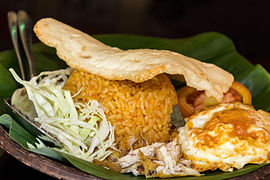 Nasi goreng with chicken, egg and prawn cracker
 -
 Nasi goreng with shrimp and egg, typical Indonesian breakfast
 -
 Nasi goreng with chicken and egg in Bali
 -
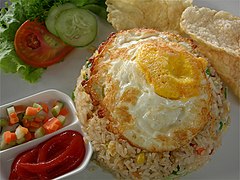 Nasi goreng with salted fish and egg
 -
 Red nasi goreng in Rantepao, South Sulawesi
 -
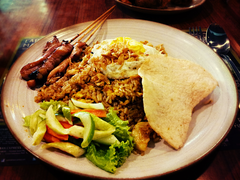 Nasi goreng-chicken satay combo, quintessential Indonesian dish among foreigners
 -
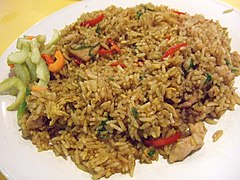 Nasi goreng "Chinese style" in Jakarta
 -
 Nasi goreng "Hong Kong style" in Mataram, Lombok
 -
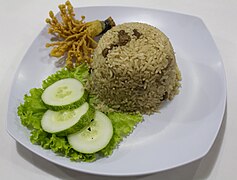 Mushroom nasi goreng in Yogyakarta
 -
 Vegetarian nasi goreng in Bali
 -
 Nasi goreng seafood in Sandakan, Sabah, East Malaysia


See also


References
- ^ a b c d Media, Kompas Cyber. "Kemenpar Tetapkan 5 Makanan Nasional Indonesia, Ini Daftarnya". KOMPAS.com (in Indonesian). Retrieved 18 April 2018.
- ^ "Nasi Goreng: Indonesia's mouthwatering national dish". Archived from the original on 6 July 2010. Retrieved 5 July 2010.
- ^ a b c Cassim, Aysha Maryam (17 August 2016). "ශ්රී ලාංකික ආහාර සංස්කෘතිය වර්ණවත් කළ පෙර අපර දෙදිග රජබොජුන්". roar.media (in Sinhala). Roar. Retrieved 16 June 2018.
- ^ a b "Indonesian rice dishes from the Surinam cuisine". tropilab.com.
- ^ a b Ena Scheerstra (30 October 2012). "Dutch East Indian Nasi Goreng". Honest Cooking.
- ^ a b Andrea Chesman (1998). 366 Delicious Ways to Cook Rice, Beans, and Grains. Penguin. ISBN 9781101075746.
- ^ Crossette, Barbara (6 July 1986). "Fare of The Country; Spicy Staple of Indonesia". The New York Times. Retrieved 7 July 2010.
- ^ "nasi goreng | Indonesian to English Translation – Oxford Dictionaries". Oxford Indonesian Living Dictionary. Archived from the original on 24 July 2018. Retrieved 23 July 2018.
- ^ "Malay Dictionary Online Translation LEXILOGOS >>".
- ^ "nasi goreng Meaning in the Cambridge English Dictionary". dictionary.cambridge.org. Retrieved 23 July 2018.
- ^ Hariharan, Annie (17 July 2021). "Nasi goreng: a one-pot pantry clean-up dish at its best". TheGuardian.com. Retrieved 15 October 2021.
- ^ Low, Harry (19 September 2016). "How this dish became a bone of contention". BBC News. Retrieved 15 October 2021.
- ^ a b c d e Sitompul, Martin (28 July 2017). "Pesona Nasi Goreng". Historia – Obrolan Perempuan Urban (in Indonesian). Retrieved 19 September 2018.
- ^ a b c Bruce Kraig; Colleen Taylor Sen (2013). Street Food Around the World: An Encyclopedia of Food and Culture. ABC-CLIO. p. 183. ISBN 9781598849554.
- ^ Mutia Silviani Aflakhah (9 February 2017). "Akulturasi Budaya di Balik Makanan Nusantara". Good News from Indonesia (in Indonesian).
- ^ Heinz Von Holzen (2014). A New Approach to Indonesian Cooking. Marshall Cavendish International Asia Pte Ltd. p. 15. ISBN 9789814634953.
- ^ Grace Young (2010). Stir-Frying to the Sky's Edge: The Ultimate Guide to Mastery, with Authentic Recipes and Stories. Simon and Schuster. p. 49. ISBN 9781416580577.
- ^ William Shurtleff; Akiko Aoyagi (2011). History of Tempeh and Tempeh Products (1815–2011): Extensively Annotated Bibliography and Sourcebook. Soyinfo Center. p. 618. ISBN 9781928914396.
- ^ Gregory Rodgers. "Nasi Goreng". About.com. Retrieved 21 October 2012.
- ^ A. Kurniawan Ulung (20 February 2017). "Tracing history of Indonesian culinary fare". The Jakarta Post. Jakarta.
- ^ Sebastian Mondak. "A Love Letter to Nasi Goreng, Jakarta's Street Food Staple". CNTraveler. Retrieved 21 October 2012.
- ^ van der Meijden, J.M.J. Catenius (1925). Groot Nieuw Volledig Oost Indisch Kookboek (PDF) (in Dutch). Den Haag: Goor Zonen Den Haag. p. 1.
- ^ "Standardisasi Perencah Nasi Goreng Masih Perlu Lokakarya Lanjutan". Selera. 3 (4): 39–42. April 1984.
- ^ "Nasi Goreng: Indonesia's mouthwatering national dish". Archived from the original on 6 July 2010. Retrieved 5 July 2010.
- ^ "Indonesian Nasi Goreng: Stir-Fried Rice in Soy Sauce". asianfoodnetwork.com. Retrieved 21 August 2020.
- ^ "Travel with food: Indonesia with Nasi Goreng". femina.in. Retrieved 23 July 2018.
- ^ "Kelenturan Cita Rasa Nasi Goreng Nusantara". Tutur Visual Kompas.id (in Indonesian). 3 November 2021. Retrieved 4 November 2021.
- ^ Eric Musa Piliang (14 November 2010). "By the way ... A tale of 'nasi goreng' — leftover rice and chicken scraps". The Jakarta Post. Retrieved 21 October 2012.
- ^ Jo, Andru. "The Indonesians' nasi goreng recipes". Archived from the original on 30 January 2016. Retrieved 17 December 2015.
- ^ "Pakar Kuliner UGM Sebut Indonesia Punya 104 Jenis Nasi Goreng".
- ^ Prihardani Ganda Tuah Purba (17 August 2021). "Nasi Goreng Indonesia Istimewa karena Beraneka Ragam". dw.com (in Indonesian). Retrieved 23 September 2022.
- ^ "109 resep nasi goreng ayam enak dan sederhana". Cookpad (in Indonesian). Retrieved 11 December 2017.
- ^ a b c d e f g Zulfikar, M Fachrezy. "Apa saja macam-macam Nasi Goreng di Indonesia? | Good News from Indonesia". Good News From Indonesia (in Indonesian). Retrieved 11 December 2017.
- ^ "Legendary 'nasi goreng' continues to draw crowds". The Jakarta Post. Jakarta. 17 October 2015.
- ^ Liputan6. "Nikmati Nasi Goreng Domba Rendah Kolesterol". liputan6.com. Retrieved 11 December 2017.
- ^ "Nasi Goreng Sapi Lezat dan Menggugah Selera – Resep | ResepKoki". resepkoki.id. Retrieved 11 December 2017.
- ^ Margareth Stella (14 March 2016). "7 Nasi Goreng Babi Yang Paling Legendaris Di Jakarta". Qraved (in Indonesian).
- ^ Setiawati, Odilia Winneke. "Babat Gongso Jadi Paduan Unik Nasi Goreng Khas Semarang". detikfood. Retrieved 11 December 2017.
- ^ Sari, Yenny Mustika. "Nasi Goreng Tiarbah Viral hingga Antreannya 3 Minggu, Apa Istimewanya?". detikfood (in Indonesian). Retrieved 28 August 2020.
- ^ "Resep Nasi Goreng Usus Manis Pedas oleh Fitria". Cookpad (in Indonesian). Retrieved 11 December 2017.
- ^ "61 resep nasi goreng hati ampela enak dan sederhana". Cookpad (in Indonesian). Retrieved 11 December 2017.
- ^ "294 resep nasi goreng pete enak dan sederhana". Cookpad (in Indonesian). Retrieved 11 December 2017.
- ^ "15 resep nasi goreng jengkol enak dan sederhana". Cookpad (in Indonesian). Retrieved 11 December 2017.
- ^ a b Fimela.com (9 September 2022). "3 Resep Nasi Goreng Praktis Cocok untuk Anak Kos". fimela.com (in Indonesian). Retrieved 23 September 2022.
- ^ "Resep Nasi Goreng Telur Sederhana ala Abang Kaki Lima Yang Enaknya Bikin Nagih". DoyanResep (in Indonesian). 4 December 2018. Retrieved 28 February 2020.
- ^ Mustinda, Lusiana. "Yuk, Buat Nasi Goreng Telur Asin yang Gurih Enak!". detikfood (in Indonesian). Retrieved 11 December 2017.
- ^ Afriadi, Abednago. "Resep Nasi Goreng Petir, Pedasnya Menyambar nyambar dan Menggairahkan". Karanganyar News (in Indonesian). Retrieved 23 September 2022.
- ^ "522 resep nasi goreng udang enak dan sederhana". Cookpad (in Indonesian). Retrieved 11 December 2017.
- ^ Mustinda, Lusiana. "Nyam! Enaknya Malam Ini Makan Nasi Goreng Cakalang yang Pedas Mengigit". detikfood (in Indonesian). Retrieved 11 December 2017.
- ^ "Nasi Goreng Roa ~ Resep". Tastemade (in Indonesian). Retrieved 11 December 2017.
- ^ "Resep Nasi Goreng Tuna | Sahabat Nestlé | Resep Makanan, Resep Masakan Indonesia". Sahabat Nestlé. Retrieved 11 December 2017.
- ^ "Resep Membuat Nasi Goreng Cumi cumi – Resep Favorit Masakan Indonesia". resepfavorit.com. Archived from the original on 11 July 2018. Retrieved 11 December 2017.
- ^ Liputan6. "Nikmati Kelezatan Nasi goreng Teri Medan Pedas di Rumah". liputan6.com. Retrieved 11 December 2017.
- ^ Kirana, Febi Anindya. "Resep Nasi Goreng Kerang". fimela.com (in Indonesian). Retrieved 7 May 2023.
- ^ "145 resep nasi goreng ebi enak dan sederhana". Cookpad (in Indonesian). Retrieved 11 December 2017.
- ^ "Santapan Spesial Nasi Goreng Jamur Lezat | Resep Nasional". www.resepnasional.com (in Indonesian). Retrieved 11 December 2017.
- ^ Tim (3 December 2020). "Kumpulan Resep Aneka Nasi Goreng Enak dan Praktis". gaya hidup (in Indonesian). Retrieved 4 December 2023.
- ^ "Resep Nasi Goreng Sosis Istimewa – Blueband". blueband.co.id (in Indonesian). Archived from the original on 21 December 2019. Retrieved 11 December 2017.
- ^ "Resep Nasi Goreng Kornet Istimewa – Blueband". blueband.co.id. Archived from the original on 21 December 2019. Retrieved 11 December 2017.
- ^ "47 resep nasi goreng daging asap enak dan sederhana". Cookpad (in Indonesian). Retrieved 11 December 2017.
- ^ Indonesia, Kewpie. "Resep – Nasi Goreng Tomat Pedas | KEWPIE INDONESIA". www.kewpie.co.id (in Indonesian). Retrieved 11 December 2017.
- ^ Mustinda, Lusiana. "Si Kecil Suka Nasi Goreng? Buatkan Saja Nasi Goreng Bayam untuk Bekalnya!". detikfood. Retrieved 11 December 2017.
- ^ "Resep Nasi Goreng Lada Hitam Sedap Berempah Ini Siap Selamatkan Anda di Kala Malas". grid.id. Retrieved 11 December 2017.
- ^ "59 resep nasi goreng saus tiram enak dan sederhana". Cookpad (in Indonesian). Retrieved 11 December 2017.
- ^ Vemale.com (28 October 2015). "Resep Nasi Goreng Saus Teriyaki". vemale.com. Retrieved 11 December 2017.
- ^ Dianee, Ratu Haiu. "Temuan Sains Pengganti Cabai: Saus Buah Merah Lebih Menggugah Selera". grid.id (in Indonesian). National Geographic Indonesia. Retrieved 10 June 2023.
- ^ "Uniknya Nasi Goreng Buah Naga". jambiupdate.co (in Indonesian). Retrieved 5 February 2024.
- ^ Lubis, Muslim. "Viral! Nasi Goreng Buah Naga Sangat Menarik dan Unik Pasti Ketagihan". timenews.co.id (in Indonesian). Retrieved 5 February 2024.
- ^ Rohmitriasih, Mimi. "Resep Nasi Goreng Kencur Khas Sunda yang Enak". fimela.com (in Indonesian). Retrieved 2 June 2023.
- ^ Karina Marpaung (9 May 2017). "6 Nasi Goreng Dengan Keju Paling Meleleh di Jakarta". Qraved (in Indonesian).
- ^ "Mengolah Bumbu Rendang Jadi Nasi Goreng". Kompas.com (in Indonesian). 5 May 2011.
- ^ "Nasi Goreng Jawa". Resepsederhana. 11 May 2020.
- ^ "Nasi Goreng Khas Bali". Indotopinfo. 4 February 2019.
- ^ "Nasi Goreng Aceh". Foodspotting.
- ^ "99 resep nasi goreng padang enak dan sederhana". Cookpad (in Indonesian). Retrieved 11 December 2017.
- ^ Media, Kompas Cyber (3 August 2022). "Resep Nasi Goreng Surabaya, Sarapan Lengkap dalam Satu Menu Halaman all". KOMPAS.com (in Indonesian). Retrieved 23 September 2022.
- ^ "19 Resep Nasi goreng Magelangan". Cookpad.
- ^ "Nasi Goreng Magelangan Lezat Praktis - Resep". ResepKoki (in Indonesian). Retrieved 4 May 2023.
- ^ "Resep Nasi Goreng Krengsengan Enak Ini Bikin Seisi Rumah Tergoda Untuk Mencoba - Semua Halaman - Sajian Sedap". sajiansedap.grid.id (in Indonesian). Retrieved 28 August 2020.
- ^ "1.507 resep nasi goreng rempah enak dan sederhana". Cookpad (in Indonesian). Retrieved 11 December 2017.
- ^ Times, I. D. N.; Hasanah, Fida Nabila Noor. "Resep Nasi Goreng Petis Sederhana, Bumbu Minimalis Rasa Maksimal!". IDN Times (in Indonesian). Retrieved 28 August 2020.
- ^ Hasanah, Fida Nabila Noor. "Resep Nasi Goreng Petis Sederhana, Bumbu Minimalis Rasa Maksimal!". IDN Times (in Indonesian). Retrieved 23 September 2022.
- ^ "46 resep nasi goreng sambal terasi enak dan sederhana". Cookpad (in Indonesian). Retrieved 11 December 2017.
- ^ "47 resep nasi goreng cabe hijau enak dan sederhana". Cookpad (in Indonesian). Retrieved 11 December 2017.
- ^ "Resep Nasi Goreng Hijau nan Istimewa ala Blueband – Blueband". blueband.co.id. Retrieved 11 December 2017.
- ^ "4.273 resep nasi goreng pedas enak dan sederhana". Cookpad (in Indonesian). Retrieved 11 December 2017.
- ^ Vemale.com (13 January 2014). "Nasi Goreng Cabe Rawit Super Pedas". vemale.com. Retrieved 11 December 2017.
- ^ "Nasi Goreng Setan | Resep dari Dapur KOBE". Dapur KOBE (in Indonesian). Retrieved 11 December 2017.
- ^ VIVA, PT. VIVA MEDIA BARU - (16 September 2017). "Mencicipi Nasi Goreng Setan Buk Lin, Pedasnya Horor – VIVA" (in Indonesian). Retrieved 11 December 2017.
- ^ Andi Annisa Dwi Rahmawati (6 October 2016). "Nasi Goreng, Makanan Ikonik Indonesia, Merah Merona Nasi Goreng Khas Makassar yang Gurih Manis". detikFood (in Indonesian).
- ^ Agmasari, Silvita (25 August 2020). "Resep Nasi Goreng Hijau, Lebih Harum daripada Nasi Goreng Kecap". KOMPAS.com (in Indonesian). Retrieved 4 December 2023.
- ^ Mustinda, Lusiana. "Sedapnya Menyantap Nasi Goreng Tinta Cumi yang Gurih Beraroma". detikfood (in Indonesian). Retrieved 11 December 2017.
- ^ a b c Lolita, Lola (26 July 2019). "25 Resep nasi goreng kekinian yang rasanya bikin nagih". briliofood.net. Retrieved 12 December 2023.
- ^ "12 resep nasi goreng pelangi enak dan sederhana". Cookpad (in Indonesian). Retrieved 11 December 2017.
- ^ "Nasi Goreng Amplop Yang Menggugah Selera". Makassar Terkini (in Indonesian). Archived from the original on 12 December 2017. Retrieved 11 December 2017.
- ^ "Nasi Goreng Santri, Rumah Makan Vegetarian Santri". Opensnap (in Indonesian). Archived from the original on 21 December 2019. Retrieved 6 September 2017.
- ^ "51 resep nasi goreng nenas enak dan sederhana". Cookpad (in Indonesian). Retrieved 11 December 2017.
- ^ "Most delicious 'nasi goreng gila' in Jakarta". The Jakarta Post. Retrieved 11 December 2017.
- ^ a b Salma, Zahrah Firyal (12 May 2023). "Macam-Macam Nasi Goreng yang Ada di Indonesia". lottemart.co.id (in Indonesian). Retrieved 4 December 2023.
- ^ Sarwendah, Sarwendah; Wardani, Rahma Rizky. "Viral Kuliner di Semarang: Nasi Goreng Kuah Susu Ditaburi Keju Parut Bikin Ngiler, Ini Lokasi dan Harganya". ayosemarang.com (in Indonesian). Retrieved 6 May 2023.
- ^ Nissa, Rima Sekarani Imamun; Kyuna, Hiromi. "Gokil! Makan Nasi Goreng Kuah Tongseng Harus Rela Antre 1,5 Jam". suara.com (in Indonesian). Retrieved 6 May 2023.
- ^ Media, Kompas Cyber (20 October 2017). "Mencicipi Yakimeshi, Nasi Goreng Khas Jepang". KOMPAS.com (in Indonesian). Retrieved 23 July 2018.
- ^ Planet, L.; de Jong, R. (2018). Lonely Planet Singapore. Travel Guide. Lonely Planet Global Limited. p. 60. ISBN 978-1-78701-238-7. Retrieved 25 June 2018.
- ^ "Post-pub nosh neckfiller: Nasi goreng pattaya". The Register. 20 June 2015. Retrieved 24 June 2018.
- ^ "Singapore Fried Rice, A Chinese Takeaway Favourite!". Honest Food Talks. 28 June 2021. Retrieved 2 August 2022.
- ^ "Nasi Goreng Ayam". 18 May 2020. Retrieved 2 August 2022.
- ^ David Deterding; Salbrina Sharbawi (13 May 2013). Brunei English: A New Variety in a Multilingual Society. Springer Science & Business Media. pp. 1–. ISBN 978-94-007-6347-0.
- ^ "Mevrouw in de keuken : Hollandsch-Indisch kookboek : 245 beproefde recepten | WorldCat.org". www.worldcat.org. Retrieved 6 December 2022.
- ^ Heinz Von Holzen; Lother Arsana (2015). The Food of Indonesia: Delicious Recipes from Bali, Java and the Spice Islands, Periplus world cookbooks. Tuttle Publishing. ISBN 9781462914913.
- ^ Eileen Yin-Fei Lo. "Nasi Goreng Istimewa (Fried Rice Indonesian Style)". New York Times Cooking. Retrieved 3 August 2015.
- ^ Fadjar, Evieta (28 October 2014). "The Rich Taste of Mafia Fried Rice". Tempo. Retrieved 11 December 2017.
- ^ "Nasi Goreng Rempah No. 1 di Indonesia". Nasi Goreng Rempah Mafia. Retrieved 11 December 2017.
- ^ Vega Aminkusumo (25 April 2014). "Resep : Nasi Goreng Dengan Bumbu Instan". vegaaminkusumo.com (in Indonesian). Archived from the original on 18 March 2017. Retrieved 17 March 2017.
- ^ Sri Wiyanti (14 September 2012). "7-Eleven diizinkan jual nasi goreng dan tahu campur". Merdeka.com (in Indonesian).
- ^ "Wieteke van Dort – Geef mij maar nasi goreng". Dutch Charts.
- ^ "World's 50 Most Delicious Foods". CNN. Archived from the original on 11 November 2012. Retrieved 9 September 2011.
- ^ Resty Armenia (5 March 2016). "Konser, Personel 5 Seconds of Summer Bikin Lagu 'Nasi Goreng'" (in Indonesian). CNN.
External links


