Madhesh Province is a province of Nepal in the Terai region with an area of 9,661 km2 (3,730 sq mi) covering about 6.5% of the country's total area. It has a population of 6,126,288 as per the 2021 Nepal census, making it Nepal's most densely populated province and the smallest province by area.
It borders Koshi Pradesh to the east and the north, Bagmati Province to the north, and India’s Bihar state to the south and the west.
The border between Chitwan National Park and Parsa National Park acts as the provincial boundary in the west, and the Kosi River forms the provincial border in the east. The province includes eight districts, from Parsa in the west to Saptari in the east.
It is a centre for religious and cultural tourism. (Full article...)
This is a Good article, an article that meets a core set of high editorial standards.
Nepal sent a delegation to compete at the 2016 Summer Paralympics in Rio de Janeiro, Brazil, from 7–18 September 2016. This was the fourth time the nation had taken part in a Paralympic Games following its first appearance at the 2004 Summer Paralympics. Nepal was represented by two athletes in Rio de Janeiro: sprinter Bikram Rana and short-distance swimmer Laxmi Kunwar, who both qualified for the Paralympics by using wild card spots for their respective sports. Neither athlete advanced beyond the first round of their respective events as they both finished 17th overall in their competitions. (Full article...)
Tribhuvan Bir Bikram Shah (Nepali: त्रिभुवन वीर विक्रम शाह), (30 June 1906 – 13 March 1955) was the eighth King of Nepal. Born in Kathmandu, the capital city of Nepal, he ascended to the throne at the age of five, upon the death of his father, Prithvi Bir Bikram Shah, and was crowned on 20 February 1913 at the Nasal Chowk, Hanuman Dhoka Palace in Kathmandu, with his mother acting as regent. At the time of his crowning, the position of monarch was largely ceremonial, with the real governing power residing with the Rana family. (Full article...)
Dhindo (Nepali: ढिँडो[ɖʱĩɽo]ⓘ) is a meal prepared in Nepal. It is prepared by gradually adding flour to boiling water while stirring. It is a staple meal in various parts of Nepal, specially Tamangs in the Hilly Region of Nepal and the Sikkim and Darjeeling regions of India. Though it is a staple food in Nepal, dhindo has previously been seen as an inferior food compared to rice, and was associated with low status. The inclusion of dhindo on urban restaurant menus has coincided with a rise in the food's prestige, possibly attributable to the changing perception of Nepal's indigenous crops, which are now recognized for their nutritional advantage. (Full article...)
The following pages at Wikimedia Commons contain a plethora of images taken in Nepal.
Wiki Loves Earth is an international photographic competition to promote natural heritage sites around the World through Wikimedia projects (mainly Wikipedia and Wikimedia Commons).
Wiki Loves Monuments is an international photographic competition to promote cultural monuments around the World through Wikimedia projects (mainly Wikipedia and Wikimedia Commons.
Image 10Procession of Nepali Pahadi Hindu Wedding (from Culture of Nepal)
Image 11Senior offering Dashain Tika to junior (from Culture of Nepal)
Image 12Mohar of king Prithvi Narayan Shah dated Saka Era 1685 (CE 1763) (from History of Nepal)
Image 13A map of Greater Nepal with the book published in 1819 by Francis Hamilton M. D. named "An Account of the Kingdom of Nepal and the Territories annexed to this Dominion by the House of Gorkha". (from History of Nepal)
Image 14Women in cultural costume at Ubhauli Kirati festival 2017 at Gough Whitlam Park, Earlwood (from Culture of Nepal)
This is a list of recognized content, updated weekly by JL-Bot (talk·contribs) (typically on Saturdays). There is no need to edit the list yourself. If an article is missing from the list, make sure it is tagged (e.g. {{WikiProject Nepal}}) or categorized correctly and wait for the next update. See WP:RECOG for configuration options.





.svg)


.png)


 Procession of Nepali Hindu Wedding; Groom being carried by a bride brother or relatives (from Culture of Nepal)
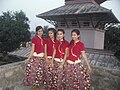 Nepali traditional Pahadi dress used for dance (from Culture of Nepal)
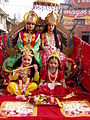 Costumed Hindu girls of Kathmandu during festival time in Nepal (from Culture of Nepal)
 A Buddhist monastery in southern Nepal. (from Culture of Nepal)
 Procession of Nepali Hindu Wedding (from Culture of Nepal)
 "Nēpāla" in the late Brahmi script, in the Allahabad Pillar inscription of Samudragupta (350-375 CE). (from History of Nepal)
 A 1905 painting of Nepalese woman (from Culture of Nepal)
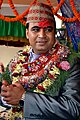 Nepali Pahadi groom (from Culture of Nepal)
 Procession of Nepali Pahadi Hindu Wedding (from Culture of Nepal)
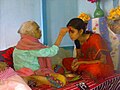 Senior offering Dashain Tika to junior (from Culture of Nepal)
 Mohar of king Prithvi Narayan Shah dated Saka Era 1685 (CE 1763) (from History of Nepal)
 A map of Greater Nepal with the book published in 1819 by Francis Hamilton M. D. named "An Account of the Kingdom of Nepal and the Territories annexed to this Dominion by the House of Gorkha". (from History of Nepal)
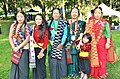 Women in cultural costume at Ubhauli Kirati festival 2017 at Gough Whitlam Park, Earlwood (from Culture of Nepal)
 Statue of the Bodhisattva Avalokiteshvara, gilded bronze, Nepal, 16th century CE (from Culture of Nepal)
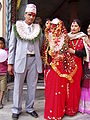 Nepali Pahadi Hindu marriage at Narayangadh, Chitawan (from Culture of Nepal)
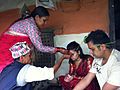 Senior offering Dashain Tika on great Nepali Hindu festival at a traditional home. (from Culture of Nepal)
.jpg)


.jpg)


.jpg)


.jpg)


 Nepalese diaspora (NRN)


.svg)


_(restoration).jpg)


_4.jpg)
_(restoration).jpg)


,_male,_Gokarna.jpg)


.jpg)
.jpg)
 Commons
 Wikibooks
 Wikidata
 Wikinews
 Wikiquote
 Wikisource
 Wikiversity
 Wikivoyage
 Wiktionary


