


Satay
 Sate Ponorogo, grilled marinated chicken satay served in peanut sauce, a speciality of Ponorogo, a town in East Java, Indonesia | |
| Alternative names | Sate, Satai, Satti |
|---|---|
| Course | Entrée or main course |
| Place of origin | Indonesia[1][2][3] |
| Region or state | Java[2] |
| Associated cuisine | Indonesia,[1] Malaysia,[4][5] Filipino,[6] Singapore,[7][8] and Thailand[9] |
| Serving temperature | Hot |
| Main ingredients | Skewered and grilled meats with various sauces, mainly peanut sauce |
| Variations | Numerous variations across Southeast Asia |

 |
| This article is part of the series on |
| Indonesian cuisine Masakan Indonesia |
|---|
 Indonesia portal Indonesia portal Food portal Food portal |
Satay (/ˈsɑːteɪ/ SAH-tay, in the US also /ˈsæteɪ/ SA-tay), or sate in Indonesia, is a Javanese dish of seasoned, skewered and grilled meat, served with a sauce. Satay originated in Java,[2][3][10][11][12] but has spread throughout Indonesia, into Southeast Asia, Europe, America, and beyond.
Indonesian satay is often served with peanut sauce and kecap manis – a sweet soy sauce, and is often accompanied with ketupat or lontong, a type of rice cake, though the diversity of the country has produced a wide variety of satay recipes. It is also popular in many other Southeast Asian countries including Brunei, Malaysia, Philippines, Singapore and Thailand.[13][14] It also recognized and popular in Suriname and the Netherlands.[15] [16] In Sri Lanka, it has become a staple of the local diet as a result of the influences from the local Malay community.[17]
Satay may consist of diced or sliced chicken, goat, mutton, beef, pork, fish, other meats, or tofu; bamboo skewers are often used, while rustic style of preparations employ skewers from the midrib of the coconut palm frond. The meat is grilled over a wood or charcoal fire, then served with various spicy seasonings. Satay can be served in various sauces; however, most often they are served in a combination of soy and peanut sauce,[18] causing the sauce alone to often be referred to as "satay".[19]
The national dish of Indonesia,[1][20][21][22] satay is popular as street food,[2] found in restaurants, and at traditional celebration feasts. Close analogues are yakitori from Japan, kǎoròu chuàn from China, seekh kebab from India, shish kebab from Turkey and the Middle East, shashlik from the Caucasus, and sosatie from South Africa. It is listed at number 14 on World's 50 most delicious foods readers' poll compiled by CNN Go in 2011.[23]
History
[edit]
Satay may have been developed by Javanese street vendors as an adaptation of kebabs from the Indian Subcontinent.[2][14] The introduction of satay, and other now-iconic dishes such as tongseng and gulai kambing based on meats such as goat and lamb, coincided with an influx of Indian and Arab traders and immigrants starting in the 18th century.[24] The Indonesian publication Koran Jakarta claimed that sate, and ultimately satay, originated from Javanese term sak beteng which means one stick, and that the dish had existed as early as the 15th century.[25]
Although both Thailand and Malaysia claim it as their own, its Southeast Asian origin was in Java, Indonesia. There satay was developed from the Indian kebab brought by the Muslim traders. Even India cannot claim its origin, for there it was a legacy of Middle Eastern influence.
Jennifer Brennan (1988), Encyclopaedia of Chinese and Oriental Cookery[26]
From Java, satay spread through the Indonesian Archipelago and, as a consequence, numerous variations of the dish have been developed. By the late-19th century, satay had crossed the Strait of Malacca into neighbouring Malaysia, Singapore, and Thailand.[27] In the 19th century, the term migrated, presumably with Malay immigrants from the Dutch East Indies, to South Africa, where it is known as sosatie.[2] The Indo Dutch people took this dish, as well as many other Indonesian specialties, to the Netherlands, thereby influencing Dutch cuisine.[28]
Name
[edit]According to the Oxford English Dictionary, the English word satay is derived from the Malay word satai,[29] also saté or sate in Indonesian, ultimately originating from Tamil catai (சதை, a regional variant of tacai meaning 'flesh'.[29][30] The term is mentioned as saté in Dutch with one of earliest photographs of satay seller appeared circa 1870 in Java, Dutch East Indies. The usage in English was first attested in 1917 with reference to a "satai" seller in Singapore, later a mention of saté in Denpasar, Bali appeared in 1937, with a description of Malays cooking satay appearing in 1955.[29]
Preparation
[edit]
Chicken is the most common meat used in satay,[31] with other common choices including lamb, goat, mutton, beef, venison, and rabbit; seafood such as fish, shrimp, and squid; offal such as liver, intestine, and tripe, is also used.[15] Most satay is made by cutting the meat into small thumb-size cubes, however, such recipes as Ponorogo use a single finger-like chicken fillet.

The skewers used for chicken satay are traditionally made from lidi, a midrib of coconut fronds. Bamboo skewers might be used instead. For firmer meats, such as lamb, goat, and beef, a thicker bamboo skewer is used. The skewers are usually soaked in water before using to avoid burning during grilling. Each skewer usually holds three or four pieces of meat. A goat meat satay might insert a cube of fat between meat cubes. Turmeric gives the dish its characteristic yellow colour. Another popular marinade is kecap manis (sweet soy sauce) mixed with coconut oil or palm margarine. The skewered meat is seasoned, marinated, and then grilled on charcoal embers.
Satay may be served with a spicy peanut sauce dip, or peanut gravy, served with slices of lontong or ketupat (rice cakes), garnished with a sprinkle of bawang goreng (crisp fried shallot), and accompanied by acar (pickles) consisting of slivers of onions, carrots, and cucumbers in vinegar, salt, and sugar solution. Mutton satay is usually served with kecap manis instead of peanut sauce. Pork satay can be served in a pineapple-based satay sauce or cucumber relish.
Availability in Indonesia
[edit]
Satay can be prepared home-made or acquired from satay sellers; either from fancy restaurants, modest tarp-tent warung eateries stationed on busy street side, to travelling food vendors frequenting residential areas. Indeed, satay is possibly one of the most popular street food in Southeast Asia; common in Indonesia to Malaysia and Thailand.


In Indonesia, traditionally there are several methods on selling satay. They are:[32]
- Pikulan: In Indonesian, pikulan means carrying items by balancing a rod on one's shoulder. The most traditional way of selling satay was depicted in early photographs of Java in the late 19th century, showing the travelling satay vendor using this pikulan which resembles two small wooden cabinets carried with a rod made of either bamboo, wood, or rattan.
- Sunggi: In Javanese, sunggi means carrying things upon one's head using some kind of tray or platter. This practice is quite common in today's Bali and rural Java. The sunggi satay vendors—usually women—carry raw satays, lontongs, peanut sauce upon the wooden or wicker bamboo tray on their head, while carrying basket containing grill, charcoal, bamboo fan, sweet soy sauce bottle, and wooden small short chair called dingklik. The satay seller ladies may walk through residential areas or position their wares in busy areas (e.g. marketplace or tourism area), and grill the satay to their customer's order.
- Gerobak: In Indonesian, gerobak means wheeled cart. It is one of the common method of selling satay by travelling vendors. The Madura satay vendor cart usually has unique boat-like shape gerobak food cart.
- Warung: In Indonesian, warung means modest shop, selling foods or other things. The most common satay warung usually are warung tenda, modest tarp-tent shop stationed in busy street side to await customers.
- Online satay: In recent years with the advent of digital multi-service method that includes food delivery such as GoFood and GrabFood, satay is available by ordering online, and the food immediately delivered by motorcycle taxi called ojek.
In Indonesia, there are some restaurants that specialise in serving various kinds of satay and presenting them as their specialties, such as Sate Ponorogo Restaurant, Sate Blora Restaurant, and also chains of Sate Khas Senayan restaurants, previously known as Satay House Senayan.[33]
Variants
[edit]Indonesia
[edit]
Satay (known as sate in Indonesian and pronounced similar to the English "satay") is a widely renowned dish in almost all regions of Indonesia; it is considered the national dish and one of Indonesia's best dishes.[22] Satay is a staple in Indonesian cuisine, served everywhere from street carts to fine dining establishments, as well as in homes and at public gatherings.[34] As a result, many variations have been developed throughout the Indonesian Archipelago. The satay variants in Indonesia is usually named after the region its originated, the meats, parts or ingredients its uses, also might named after the process or method of cooking.[35]
Chicken
[edit]- Sate Ambal
- A satay variant from Ambal, Kebumen, Central Java. This satay uses a native breed of poultry, ayam kampung. The sauce is not based on peanuts, but rather ground tempe, chilli and spices. The chicken meat is marinated for about two hours to make the meat tastier. This satay is accompanied with ketupat.

Sate ayam, chicken satay - Sate Asin Pedas
- A salty and spicy chicken, goat and beef satay from Bandung in West Java.[36]
- Sate Ayam
- Chicken satay, the most common and widely distributed type of satay in Indonesia.
- Sate Ayam Kampung
- Using ayam kampung (free range chicken) meat.[37]
- Sate Ayam Rebus
- Boiled chicken satay. It has become a side dish of soto,[38] mie jawa, or nasi goreng jawa.
- Sate Banjar
- A variant of chicken satay popular in Southern Kalimantan, especially in the town of Banjarmasin.
- Sate Blendet
- Chicken satay with yellow sauce from Balong District in Ponorogo. The sauce is made of shallots, garlic, candlenuts, coconut milk, and turmeric.[39]
- Sate Blora
- A variant originating in Blora, in Central Java. This variant is made of chicken (meat and skin) pieces that are smaller compared to the other variants. It is normally eaten with peanut sauce, rice, and a traditional soup made of coconut milk and herbs. Sate Blora is grilled in front of buyers as they are eating. The buyers tell the vendor to stop grilling when they are sated.
- Sate Brutu
- Fleshy part of chicken's tail satay.[40]
- Sate Kulit
- Skin Satay. Found in Sumatra, this is a crisp satay made from marinated chicken skin.


- Sate Madura (Madura satay)
- Originating on the island of Madura, near Java, it is a famous satay variant among Indonesians. Most often made from mutton or chicken, the recipe's main characteristic is the black sauce made from Indonesian sweet soy sauce/kecap manis mixed with palm sugar (called gula jawa or "Javanese sugar" in Indonesia), garlic, deep fried shallots, peanut paste, petis (a kind of shrimp paste), kemiri (candlenut), and salt. Chicken Madura satay is usually served in peanut sauce, while the mutton Madura satay is usually served in sweet soy sauce. Sate Madura uses thinner chunks of meat than other variants. It is eaten with rice or rice cakes wrapped in banana/coconut leaves (lontong/ketupat), they are usually sliced into smaller pieces before being served. Raw thinly sliced shallots and plain sambal are often served as condiments.
- Sate Ponorogo (Ponorogo satay)
- A variant of satay originating in Ponorogo, a town in East Java. It is made from sliced marinated chicken meat, and served with a sauce made of peanuts and chili sauce and garnished with shredded shallots, sambal (chili paste) and lime juice. The meat is marinated in spices and sweet soy sauce, in a process called bacem and is served with rice or lontong (rice cake). The grill is made from terracotta earthenware with a hole in one side to allow ventilation for the coals. After three months of use, the earthenware grill disintegrates, and must be replaced.
- Sate Srepeh
- A variant of chicken satay from Rembang. The satay uses spicy orange sauce and eaten with rice and tofu.[41]
- Sate Taichan
- A spicy chicken satay in hot sambal sauce, served with lontong, popular in Jakarta. It was said that the dish was an adaptation of skewered Chinese snack from Taiwan, which originally uses pork or rabbit meat, and served with soy sauce. The Indonesian version maintain the light Chinese-style seasoning, replaces pork with chicken, and adds spiciness with the addition of hot sambal.[42] Another source mentioned that sate Taichan was devised from a Japanese man's specific request that his satay omits peanut sauce and sweet soy sauce, and only seasoned with a dash of salt and lime juice, and served with chili paste.[43]

Beef
[edit]
- Sate Bumbon
- A spiced beef satay from Kendal, Central Java. It serves with peanut sauce, lontong, boiled bean sprouts, and young jackfruit sayur lodeh.[44]
- Sate Buntel
- Lit: Wrapped Satay, a speciality from Solo or Surakarta, Central Java.[45] It is made from minced beef, goat, lamb and mutton (especially meats around ribs and belly area). The minced fatty meats are wrapped by thin fat or muscle membrane and wrapped around a bamboo skewer. The size of this satay is quite large, very similar to a Middle Eastern kebab. After being grilled on charcoal, the meat is separated from the skewer, cut into bite-size chunks, then served in sweet soy sauce and merica (pepper).
- Sate Bulayak
- Beef satay with spicy soupy sauce from Lombok. It is eaten with rice cake called bulayak.[46]
- Sate Gajih
- Beef fat satay popular in Yogyakarta, especially in Beringharjo Market.[47] The fat satay is seasoned with sweet soy sauce and considered as snack since it is commonly served without any rice or additional sauces.
- Sate Jando
- A specialty dish from Bandung, this satay is made from cow's breast fat.[48]
- Sate Kenul
- Cubed beef satay smeared with grated coconut and spices made of turmeric, ginger, cumin, garlic, pepper, salt and coriander. It is a specialty dish from Nganjuk.[49]
- Sate Klopo
- Lit: Coconut Satay, the beef is wrapped in coconut processed spices and then grilled. It is delicacy from Surabaya.[50]
- Sate Komoh/Komo
- Beef satay from East Java. Diced beef is sautéed with bumbu before grilling.[51][52]
- Sate Kuah
- Lit: Soupy Satay, beef satay served in creamy and spicy kuah soup akin to soto. Sate kuah can be found in Betawi cuisine of Jakarta and also in Pontianak, Western Kalimantan.[53] The Jakarta version sate kuah soup base is akin to Betawi's soto tangkar, since sate kuah was a variant of soto tangkar created in 1960s.[54] Thus usually the seller offers both sate kuah and soto tangkar. The serving method are either grilled beef satay are dipped into soto soup, or the satay meat are stripped from the skewers and put into the soto soup. Compared to soto meat soup, sate kuah has smoky aroma due to grilling process. The Pontianak version sate kuah is smeared with peanut sauce, doused with spiced broth, and sprinkled with spring onion and calamansi juice.[55]
- Sate Lembut
- A rare satay recipe of the Betawi people. It is can be found in Jalan Kebon Kacang, Central Jakarta. The satay is made from minced beef mixed with shredded coconut and spices, wrapped around a flat bamboo skewer. Usually eaten with ketupat laksa betawi (Betawi style Laksa with ketupat glutinous compressed rice).
- Sate Manis
- Also a speciality from the Betawi people. It is also can be found in Jalan Kebon Kacang, Central Jakarta. The satay is made from slices of has dalam (tenderloin) the finest part of beef, marinated with sweet spices. Usually eaten with ketupat laksa betawi.

- Sate Maranggi
- Commonly found in Purwakarta and Cianjur, the cities in West Java, this satay is made from beef marinated in a special paste.[56] The two most important elements of the paste are kecombrang (Nicolaia speciosa) flower buds and ketan (sweet rice) flour. Nicola buds bring a unique aroma and a liquorice-like taste. The satay is served in sweet soy sauce with acar pickles. It is served with ketan cake (jadah) or plain rice.
- Sate Matang
- A satay variant from Matang Geulumpang Dua, Bireun, Aceh. This satay is made from beef, usually served with peanut sauce and soto or soup separately.
- Sate Rembiga
- Beef satay from Lombok. The basic seasoning for the satay is chili. However, it is also given some additional spices, such as tamarind, brown sugar, onions, coriander, and candlenut. It is usually eaten with rice cake, plecing kangkung, and beef bone soup.[57]
- Sate Sapi
- Beef satay, served in sweet soy sauce and peanut sauce. Specialty of Jepara town in Central Java.
- Sate Susu
- Literally it means "milky satay", however it contains no milk, the term susu is actually refer to cow's breast or udder. This dish that can be found in Java and Bali, is made from grilled spicy beef udder, served with hot chilli sauce.[58]
- Sate Tambulinas
- Spiced beef satay from Sulawesi. Tambulinas satay do not use peanut sauce or soy sauce, it is marinated in spice mixture containing ground chilli pepper, ginger, lemongrass, shallot and garlic, and served with juice of kaffir lime.[59]
Other red meats
[edit]
- Sate kambing
- Goat satay, a variant of satay popular in Java, made with goat, lamb or mutton meat. Different from other satays, sate kambing (lamb satay) is not usually pre-seasoned or pre-cooked. Raw lamb, mutton, and goat is skewered and grilled directly on the charcoal. It is then served with sweet soy sauce (kecap manis), sliced shallots, and cut-up tomatoes. Since the meat is not pre-cooked, it is important to use young lamb. The best vendors use lamb under three to five months old. Lamb from goat is also more popular than lamb from sheep due to milder flavor.
- Sate kerbau
- Water buffalo satay, a variant of satay popular in Kudus, where most Muslim believed that it is forbidden to eat beef to respect the Hindus. This satay is made with water buffalo meat. The meat is cooked first with palm sugar, coriander, cumin, and other seasoning until very tender. Some vendor choose to even grind the meat first to make it really tender. It is then grilled on charcoal, and served with sauce made with coconut milk, palm sugar, and other seasoning. Traditionally, satay kerbau is served on a plate covered with teak wood leaves.
- Sate klatak/klathak
- Goat satay with coconut milk soup from Bantul Regency, Yogyakarta.[60]
- Sate kronyos
- Breast of goat satay can be found in Bantul Regency, Yogyakarta.[61]
- Sate loso
- Water buffalo meat or sometimes replaced with beef satay, served in spicy chili peanut sauce. Specialty of Pemalang, Central Java.[62]
- Sate rusa
- Deer satay, a delicacy from Merauke, Papua.[63] In East Kalimantan, a satay dish made of venison called sate payau.[64]
- Sate tegal (tegal satay)
- A sate of a yearling or five-month-old lamb; the nickname for this dish in Tegal is balibul, an acronym of baru lima bulan (just five months). Each kodi, or dish, contains twenty skewers, and each skewer has four chunks—two pieces of meat, one piece of fat and then another piece of meat. It is grilled over wood charcoal until it is cooked between medium and well done; however it is possible to ask for medium rare. Sometimes the fat piece can be replaced with liver or heart or kidney. This is not marinated prior to grilling. On serving, it is accompanied by sweet soya sauce (medium sweetness, slightly thinned with boiled water), sliced fresh chilli, sliced raw shallots (eschalot), quartered green tomatoes, and steamed rice, and is sometimes garnished with fried shallots.
Pork
[edit]
- Sate babi (pork satay)
- Pork satay, popular among the Indonesian Chinese community, most of whom do not share the Muslim prohibition against pork. This dish can be found in Chinatowns in Indonesian cities, especially around Glodok, Pecenongan, and Senen in the Jakarta area. It is also popular in Bali where the majority are Hindus, it is also popular in Northern Sulawesi, Northern Tapanuli, and Nias, where most people are Christians, and also popular in the Netherlands.
- Sate plecing
- Satay made with variety of grilled meat most often pork, served with sambal plecing, sauce made from chili, garlic, onion, tomatoes, and shrimp paste, popular in Balinese cuisine.
- Sate ragey
- Pork satay popular in Minahasan cuisine. The size is bigger than the common pork satay. It is combined of pork meat and the fat. It can be easily found in Tomohon, North Sulawesi.[65]
Fish and seafood
[edit]- Sate Ikan Tuhuk
- Blue marlin Satay, a delicacy from Krui, Lampung.[66]
- Sate Ikan Pari
- Stingray Satay, a satay dish from Tana Tidung Regency, North Kalimantan.[67]
- Sate Bandeng
- Milkfish Satay, from Banten. It is a satay made from boneless bandeng (milkfish). The seasoned spicy milkfish meat is separated from the small bones, then placed back into the milkfish skin, clipped by a bamboo stick, and grilled over charcoal.
- Sate Belut
- Eel Satay, another Lombok rare delicacy. It is made from belut, (lit. eel) commonly found in watery rice paddies in Indonesia. A seasoned eel is skewered and wrapped around each skewer, then grilled over charcoal fire, so each skewer contains an individual small eel.
- Sate Gurita
- Octopus satay, a specialty dish from Sabang.[68]
- Sate Kepiting
- Crab Satay. In Langkat Regency of North Sumatera, the crab's outer shell is removed and the crab is fried in flour mixed with bumbu and then skewered.
- Sate Kerang
- Shellfish satay, cockle Satay or clam satay. The most popular variant of sate kerang is from Medan, North Sumatra, it is rich spicy cooked shellfish in skewer and often become oleh-oleh (souvenir) for visitors visiting Medan.[69] In Java, sate kerang it is mildly marinated and boiled, also served as a side-dish to accompany soto. In Southeast Sulawesi, sate pokea is made of pokea clam or Batissa violacea var. celebensis and the satay is smeared with peanut sauce and eaten with burasa or gogos.[70]
- Sate Tanjung
- Fish satay from Lombok. It is made from fish meat which is smeared with spices consisting of coconut milk and spices.[71] The fish used in this satay are usually skipjack tuna and giant trevally.
- Sate Temburung
- Telescope snail Satay, a dish from North Kalimantan.[72]
- Sate Tuna
- Tuna Satay, a specialty satay from Gorontalo.[73]

- Sate Udang
- Shrimp Satay that uses large shrimps or prawns,[74] shelled and cleaned and often with the tails off and lightly grilled. Some recipes call for a marinade of thick coconut milk with sambal (chili paste), powdered laos (galangal root), ground kemiri (candlenut, one can substitute macadamia nuts in a pinch), minced shallots and pressed garlic. One can add salt to taste. Shrimp satay seldom served with the peanut sauce so popular with other satays, because it might overpower a delicate shrimp flavour.
- Sate Ubur-Ubur
- Jellyfish Satay. It is a specialty dish from Temajuk Village in Sambas Regency, West Kalimantan.[75]
Offals
[edit]- Sate Ampet
- Another Lombok delicacy. It is made from beef, cow's intestines and other cow's internal organs. The sauce for sate ampet is hot and spicy, which is no surprise since the island's name, lombok merah, means red chili. The sauce is santan (coconut milk) and spices.[76]
- Sate Babat
- Tripe satay. Mildly marinated and mostly boiled than grilled, usually served as a side-dish to accompany soto.
- Sate Burung Ayam-ayaman
- Bird Satay, the satay is made from gizzard, liver, and intestines of burung ayam-ayaman (watercock). After being seasoned with mild spices and stuck on a skewer, this bird's internal organs are not grilled, but are deep fried in cooking oil instead.
- Sate Hati
- Liver Satay. There is two types of liver satays, cattle liver (goat or cow) and chicken liver satay. The cattle liver made by diced whole liver, while the chicken liver satay is made from mixture of chicken liver, gizzard, and intestines. Usually gizzard is placed on the bottom, intestine on the center and liver or heart on the top. After seasoning, the internal organs are not fried or grilled, but are boiled instead. It is not treated as a main dish, but often as a side dish to accompany bubur ayam (chicken rice porridge).
- Sate Kikil
- Cow skin satay from Java, this satay is made from boiled cow skin, skewered and seasoned either in spicy peanut sauce or yellow sauce.[77]
- Sate Makassar
- From a region in Southern Sulawesi, this satay is made from beef and cow offal marinated in sour carambola sauce. It has a unique sour and spicy taste. Unlike most satays, it is served without sauce.

- Sate Padang
- A dish from Padang and the surrounding area in Western Sumatra, which is made from cow or goat offal and meat boiled in spicy broth then grilled. Its main characteristic is a yellow sauce made from rice flour mixed with spicy offal broth, turmeric, ginger, garlic, coriander, galangal root, cumin, curry powder and salt.[78] It is further separated into two sub-variants, the Pariaman and the Padang Panjang, which differ in taste and the composition of their yellow sauces.
- Sate Paru
- Beef lung satay.[79]
- Sate Torpedo
- Testicles satay. Satay made from goat testicles marinated in soy sauce and grilled. It is eaten with peanut sauce, pickles, and hot white rice.
- Sate Usus
- Chicken intestine satay. This mildly marinated satay is usually fried, also as a side-dish to accompany bubur ayam.
Mixture
[edit]
- Sate Kalong
- A satay dish from Cirebon. The word kalong (bat) does not mean the satay used bat meat but because the food is sold in the evening. This satay is made from minced water buffalo, which is mixed with spices, and palm sugar and dipped into buffalo broth, it is then grilled on charcoal. The peanut sauce mixed with oncom.[80]
- Sate Lilit
- A satay variant from Balinese cuisine. This satay is made from minced pork, chicken, fish, beef, or even turtle meat, which is then mixed with grated coconut, thick coconut milk, lemon juice, shallots, and pepper. Wound around bamboo, sugar cane or lemon grass sticks, it is then grilled on charcoal.[81]
- Sate Pusut
- A delicacy from Lombok, the neighbouring island east of Bali. It is made from a mixture of minced meat (beef, chicken, or fish), shredded coconut meat, and spices. The mixture then is wrapped around a skewer and grilled over charcoal.
Eggs and vegetarian
[edit]- Sate Aci
- The satay is made from tapioca starch batter.[82]
- Sate Jengkol
- Jengkol satay.[83]
- Sate Jamur
- Mushroom satay. It is usually made from oyster mushroom.[84]
- Sate Kere
- Lit: Poorman's satay. A cheap vegetarian satay made from grounded tempe from Solo city, served in peanut sauce and pickles. There are two kinds of tempe: the most popular is made from soybean, and the second is made from the side product material of tofu production (called tempe gembus). Sate Kere is usually made from tempe gembus. The word kere in the Javanese language means "poor"; it originally was meant to provide the poor people of Java with the taste of satay at an affordable price, since meat was considered a luxury. Although originally it was only vegetarian tempeh, today, sate kere also includes intestine, liver, and beef satays mixed with tempeh ones. The materials are pre-cooked in baceman before being grilled, then served with peanut sauce.
- Sate Pencok
- The satay from Lombok is made from sago starch. It is smeared with pelalah sauce.[85]
- Sate Tahu
- Lit: Tofu Satay. A specialty from Ponorogo. Tofu is soaked first with bacem seasoning before being grilled on a clay kiln.[86]

- Sate Telur Muda
- Young egg satay. This satay is made from premature chicken egg (uritan) obtained upon slaughtering the hens. The immature eggs that have not developed the eggshell yet are boiled and put onto skewers to be grilled as satay. The telur muda or uritan is often cooked on the same skewer as chicken skin satay, and mixed with chicken satay. This kind of satay is also usually served as a side dish to accompany bubur ayam.
- Sate Telur Puyuh
- Quail eggs satay. Several hard-boiled quail eggs are put into skewers, marinated in sweet soy sauce with spices, and boiled further also served as a side dish for soto.
Others
[edit]- Sate Bebek
- Duck satay, a specialty dish from Cilegon, Banten[87] and Banyumas.[88]
- Sate Blengong
- The satay is made from Blengong meat, an animal that is the result of crossbreeding between ducks and muscovy ducks or locals called menthok. It is a delicacy of Brebes.[89]
- Sate Bulus
- Turtle satay, another rare delicacy from Yogyakarta. It is a satay made from freshwater bulus (softshell turtle). It is served with sliced fresh shallots (small red onion), pepper, and sweet soy sauce. Bulus meat is also served in soup or tongseng (Javanese style spicy-sweet soup).
- Sate Kelinci
- Rabbit meat Satay, this variant of satay is made from rabbit meat, a delicacy from Java. It is served with sliced fresh shallots (small red onion), peanut sauce, and sweet soy sauce. Rabbit satay usually can be found in mountainous tourist region in Java where locals breed rabbit for its meat, such as Lembang in West Java, Kaliurang in Yogyakarta, Bandungan and Tawangmangu resort in Central Java, also Telaga Sarangan in East Java.

- Sate Keong
- Freshwater snail Satay.[90] This kind of satay is also served as a side dish of pecel. In Minahasan cuisine, sate keong is grilled and smeared with spicy sambal and it is called sate kolombi.[91]
- Sate Kuda
- Horse meat Satay. Locally known in Javanese as sate jaran, this is made from horse meat, a delicacy from Yogyakarta. It is served with sliced fresh shallots (small red onion), pepper, and sweet soy sauce.
- Sate Ular
- Snake Satay, a rare and exotic delicacy usually founds in foodstalls specialise on serving exotic reptile meats like snakes and biawak (monitor lizards), such as the one founds near Gubeng train station in Surabaya, or near Mangga Besar and Tebet train station in Jakarta. It usually uses ular sendok (cobra) or sanca (python) meat. It is served with sliced fresh shallots (small red onion), pickles, pepper, and sweet soy sauce.
- Sate Ulat Sagu
- Sago caterpillar satay from Papua,[92] Kalimantan, and Sulawesi.
-
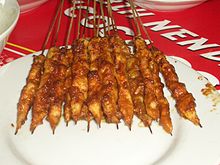 Sate Blora
 -
 Sate Banjar
 -
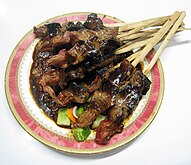 Goat liver satay
 -
 Sate Padang with yellow sauce
 -
 Sate buntel, Solo, Central Java
 -
 Sate sapi, beef satay from Jepara
 -
 Sate srepeh from Rembang, Central Java
 -
 Horse satay, Yogyakarta
 -
 Balinese sate plecing, pork satay
 -
 Balinese pork satay
 -
 Sate Bulayak Suranadi, Lombok
 -
 Sate kikil
 -
 Indonesian Chinese nasi campur with pork satay
 -
 Quail eggs and intestine satays
 -
 Soto with tripes and cockles satays
 -
 Sago grub satay


Malaysia
[edit] | This section needs additional citations for verification. (May 2017) |

Known as sate in Malay[93] (and pronounced similarly to the English "satay"), it can be found throughout all the states of Malaysia in restaurants and on the street, with hawkers selling satay in food courts and Pasar malam. While the popular kinds of satay are usually beef and chicken satays, different regions of Malaysia have developed their own unique variations. Sate is often associated with Muslim Malays, but pork sate is also available at non-halal Chinese eating establishments.
There are a number of well-known satay outlets in Kajang, a city in Selangor closely associated with satays.[94] Sate Kajang is a generic name for a style of sate where the meat chunks are bigger than normal, and the sweet peanut sauce served along with a portion of fried chilli paste. Given its popularity, sate Kajang is now found throughout Malaysia. Stalls and restaurants around Kajang offer not only the more traditional chicken or beef satay, but also more exotic meats such as venison, rabbit or fish, as well as gizzard, liver, and a number of other variations.
Another type of meat satay is the sate lok-lok from Penang and sate celup (dip satay) from Malacca. Both are Malaysian Chinese fusions of the hotpot and the Malay satay. Pieces of raw meat, tofu, century eggs, quail eggs, fish cake, offal or vegetables are skewered on bamboo sticks. These are cooked by being dipped in boiling water or stock. The satay is then eaten with a sweet, dark sauce, sometimes with chilli sauce as an accompaniment. If the satay is eaten with satay sauce, it is called sate lok-lok. If the satay is cooked with boiling satay peanut sauce, it is called sate celup. Both dishes are available from street vendors or in certain restaurants, and the majority are not halal. Customers use a common container containing boiling stock to personally cook their satay. Sauces are either served in common containers or individually. There are usually no tables near street vendors, and customers thus tend to gather around the food cart.
Satay gula apong is a chicken or buffalo meat satay. It is a satay made with rare nipah palm sugar called sarawak gula apong. This rare satay can only be found in Linggi, Negeri Sembilan in Malaysia. It is served with sliced fresh cucumber and peanut sauce.
Netherlands
[edit]
Known as saté or sateh, it is fully adapted in Dutch everyday cuisine. Owed to their shared colonial history, satay is an Indonesian food that has become an integral part of Dutch cuisine.[95] Pork and chicken satays are almost solely served with spicy peanut sauce and called een sateetje, and are readily available in snackbars and supermarkets.[96] Versions with goat-meat (sateh kambing) and sweet soy sauce are available in Indonesian restaurants and take-aways. Pork or chicken satay in peanut sauce, with salad and French-fries, is popular in pubs or eetcafés. With Indonesian take-away meals like nasi goreng speciaal, the special part is often a couple of sate-sticks. Another favourite in Dutch snackbars is the satékroket, a croquette made with a peanut sauce and shredded meat ragout. In addition, 'saté' sauce or peanut sauce has become one of the standard options as a condiment to accompany a portion of fries bought in a snackbar (besides mayonnaise, ketchup, curry-ketchup, 'joppiesaus' or a combination). Fries with satay sauce is commonly known as patatje pinda ('fries peanut') and fries with satay sauce, mayonaise and chopped unions is called patatje oorlog ('fries war').
Philippines
[edit]
Satay proper is known as satti in the Southern Philippines (Mindanao). It is common in the regions of Zamboanga, Sulu Archipelago and Tawi-Tawi, which acquired satay from its proximity to Malaysia.[97] Satti usually only has three small strips of roasted meat on a stick. Satti is usually made from chicken or beef among Muslim Filipinos,[98] but it can also be made with pork or liver.[99] It is particularly popular in Tausug cuisine and is commonly eaten as breakfast in restaurants which specialise in satti. It is typically served with ta'mu (pusô in other Philippine languages) and a bowlful of warm peanut-based sauce.[100]
In the majority of the Philippines, a similar (but native) dish to satay usually made with pork or chicken is referred to as inihaw or inasal, or by the generic English name "barbecue" (usually shortened to "BBQ").[101][98][102] It is usually served glazed in a sweet-soy sauce marinade reminiscent of yakitori. Despite the native origins of inasal and inihaw, the English association of "barbecue" is the source of names for other popular street foods that are also served skewered, such as banana cue ("banana" + "barbecue") and camote cue ("camote (sweet potato) + barbecue").[103]
Offal-based versions of inihaw are also commonly sold in the Philippines as street food. The most popular are made from chicken or pork intestines known as isaw. Other variants use liver, tripe, lungs, chicken heads and feet, cubes of coagulated pork blood, and pork ears, among others.[104][105]
Annatto seeds and banana ketchup-based sauces are also widely used which gives the meat a vibrant orange or red color.[100][106]
Singapore
[edit]
In Singapore, satay is sold by Chinese, Malay and Indian Muslim vendors. It is thought to have originated in Java and brought to Singapore by Muslim traders.[107] Satay is one of the earliest foods that became ubiquitous in Singapore since the 1940s, and was considered a celebratory food.[108] Previously sold on makeshift roadside stalls and pushcarts, concerns over public health and the rapid development of the city led to a major consolidation of satay stalls at Beach Road in the 1950s, which came to be collectively called the "Satay Club". They were moved to the Esplanade Park in the 1960s, where they grew to the point of being constantly listed in tourism guides.
Open only after dark with an open air or "al fresco" dining concept, the Satay Club defined how satay is served in Singapore since then, although they are also found across the island in most hawker stalls, modern food courts, and upscale restaurants at any time of the day. Moved several times around Esplanade Park due to development and land reclamation, the outlets finally left the area permanently to Clarke Quay in the late 1990s to make way for the building of the Esplanade – Theatres on the Bay.[108]
Several competing satay hotspots have since emerged. While the name has been transferred to the Clarke Quay site, several stalls from the original Satay club have moved to Sembawang in the north of the city. The satay stalls at the Lau Pa Sat area are notable for its popularity. "Satay Street" in Boon Tat Street, introduced in 1996, centers around 10 hawkers who sell satay. Served only at night after 7pm when the street is closed to vehicular traffic and the stalls and tables occupy the street, it mimics the open-air dining style of previous establishments. It is said to evoke the nostalgic feeling of Singaporean street food culture from the 1950s and 1960s, and is considered to be the last Satay Club in Singapore.[108] Other notable outlets include Satay by the Bay at the Gardens by the Bay tourist attraction. It is styled after the old Satay Club.[109]
Peanut sauce is used in Singaporean satays, Malay satay is quite similar to Indonesian satay by using kecap manis (sweet soy sauce), while Chinese Hainan satay uses pineapple purée sauce and marinated in five-spice powder.[107] The common types of satay sold in Singapore include Satay Ayam (chicken satay), Satay Lembu (beef satay), Satay Kambing (mutton satay), Satay Perut (beef intestine), and Satay Babat (beef tripe).
Singapore's national carrier, Singapore Airlines, also serves satay to its First and Business Class (previously known as Raffles Class) passengers as an appetiser.
Sri Lanka
[edit]Sathe as it is known in Sri Lanka is a Sri Lankan Malay dish that has become a staple of the country's diet.[17] Sathe is served with peanut and chili sauce.[17] It is sometimes called sate daging by the country's Malay community.[110]
Thailand
[edit]
Satay (Thai: สะเต๊ะ, RTGS: sate, pronounced [sā.téʔ]) is a popular dish in Thailand; a key feature of Thai satay is the inclusion of pork as a meat option.[111] Usually served with peanut sauce and achat, Thai satay have various recipes, beyond the popular versions of chicken, beef, and pork: a version made with mussels is called hoi malaeng phu, while vegetarian variants employ soy protein strips or tofu.[112]
Satay can easily be found in virtually any Thai restaurant worldwide. Because Thai cuisine is heavily marketed internationally and attracted world culinary attention earlier than other Southeast Asian cuisines, there is a widespread misconception abroad that satay originated from Thailand. As a result, it is most frequently associated with Thai food in the Western world.[113] For example, in the United States, satay is said to be one of America's favourite Thai dishes.[114]
The first satay restaurant in Thailand was in front of Chaloem Buri Theater near the Chaloem Buri Intersection in the Yaowarat neighborhood. Now it is on Rama IV Road near Lumphini MRT station and has been for more than 50 years.[115]
Fusion satay
[edit]
Traditionally, satay referred to any grilled skewered meats with various sauces; it is not necessarily served solely with peanut sauce. However, since the most popular variant of satay is chicken satay in peanut sauce (Sate Madura in Indonesia), in modern fusion cuisine the term "satay" has shifted to satay style peanut sauce instead.[10]
For example, the fusion "satay burger" refers to beef hamburger served with so-called "satay sauce", which is mainly a kind of sweet and spicy peanut sauce or often replaced with gloppy peanut butter.[116][117] The Singapore satay bee hoon is actually rice vermicelli served in peanut sauce. The American-Thai fusion fish fillet in satay sauce also demonstrates the same trend. The fusion French cuisine Cuisses de Grenouilles Poelees au Satay, Chou-fleur Croquant is actually frog legs in peanut sauce.[118] The Indomie instant noodle is also available in satay flavour, which is only the addition of peanut sauce in its packet.[119][120] In Hong Kong, satay sauce is usually served with instant noodles and stir-fried beef. This dish is most often eaten for breakfast.[121]
In culture
[edit]

Satay belongs to the informal ethnocultural symbols of Indonesia. Its appears on Indonesian postage stamps, in tourist brochures, information and advertising materials dedicated to this country, and is often played up by Indonesian participants in various cultural and entertainment events held abroad to create a national flavor. For example, the Indonesian model Aurra Kharisma performed in 2021 at the Miss Grand International beauty pageant in a suit with satay images and a headdress decorated with several bundles of satay meat skewers.[122][123][124]
In some parts of Indonesia, certain types of satay are attributed with different symbolic meanings. Especially Bali stands out: the popular on this island satay lilit—minced sausages stuck on lemongrass stalks—is considered there a symbol of several virtues and benefits at once: male prowess, unity and prosperity.[125] The Balinese attribute the embodiment of the weapons of various Hindu deities and mythological heroes to other local types of satay.[126]
In Bandung, the West Java Governor's office is popularly called Gedung Sate (Indonesian: Satay building) to refer the satay-like pinnacle on its roof.[127]
See also
[edit]


- Brochette – Thin metal or wood stick used to hold pieces of food together
- Satay building – Public building in West Java, Indonesia
- List of chicken dishes – Foods prepared with chicken
- Pinchitos – Southern Spain skewered meat dish
- Shacha sauce, also known as Sate-sauce – Chinese condiment
- Yakitori – Japanese type of grilled chicken
 Food portal
References
[edit]- ^ a b c Sara Schonhardt (25 February 2016). "40 Indonesian foods we can't live without". CNN International. Hong Kong: Warner Bros. Discovery. Archived from the original on 6 April 2017. Retrieved 13 April 2017.
- ^ a b c d e f Bruce Kraig; Colleen Taylor Sen Ph.D. (9 September 2013). Street Food around the World: An Encyclopedia of Food and Culture: An Encyclopedia of Food and Culture. ABC-CLIO. p. 183. ISBN 978-1-59884-955-4.
- ^ a b O'Neill, Molly (2 July 2000). "Food; The Stick Shift". The New York Times. ISSN 0362-4331. Archived from the original on 3 July 2020. Retrieved 13 April 2020.
- ^ Michael Specter (2 December 1984). "IN MALAYSIA, SPICY SATAY". The New York Times. Archived from the original on 26 December 2018. Retrieved 27 August 2020.
- ^ Shalini Ravindran (28 June 2018). "Five places for great satay". The Star. Archived from the original on 8 October 2020. Retrieved 27 August 2020.
- ^ "Satti: A spicy delicacy for breakfast". 2 September 2019.
- ^ "So much more to satay than peanut sauce". Food. Archived from the original on 21 August 2018. Retrieved 21 August 2018.
- ^ Eliot, Joshua (1994). Indonesia, Malaysia & Singapore Handbook. New York: Trade & Travel Publications. p. 352.
- ^ Erickson, Joan (1982). Southeast Asia Sunset travel guides. Lane Publishing Company. p. 78. ISBN 978-037-606-764-7.
- ^ a b "Consumers love succulent Satay, Peanut ingredients for global success" (PDF). USA Peanuts. p. 1. Archived from the original (PDF) on 2 May 2014. Retrieved 2 May 2014.
- ^ Felicity Cloake (30 January 2014). "How to cook the perfect chicken satay". The Guardian. Archived from the original on 14 July 2014. Retrieved 7 July 2014.
- ^ "Satay Washington DC". satay.com. Archived from the original on 9 January 2019. Retrieved 6 July 2014.
- ^ "Grilled Beef Satay". Food Reference.com. Archived from the original on 15 August 2010. Retrieved 6 July 2010.
- ^ a b Alan, Davidson (2006). The Oxford Companion to Food (2nd ed.). Oxford: OUP. ISBN 9780191018251. OCLC 862049879.
- ^ a b admin (11 December 2013). "What is Satay Food and Its Origin". Satay Ria. Archived from the original on 7 June 2020. Retrieved 7 June 2020.
- ^ "So much more to satay than peanut sauce". Food. Archived from the original on 21 August 2018. Retrieved 21 August 2018.
- ^ a b c Bullis, Douglas; Hutton, Wendy (2001). Food of Sri Lanka. Periplus. p. 14.
- ^ Marx, Pamela (1996). The Travel-the-world Cookbook. Good Year Books. p. 30. ISBN 9780673362544.
indonesian satay peanut sauce.
- ^ "Peanut butter and satay sauce – recipe". The Guardian. Archived from the original on 8 February 2017. Retrieved 7 February 2017.
- ^ Media, Kompas Cyber. "Kemenpar Tetapkan 5 Makanan Nasional Indonesia, Ini Daftarnya". KOMPAS.com (in Indonesian). Archived from the original on 18 April 2018. Retrieved 18 April 2018.
- ^ Owen, Sri (1999). Indonesian Regional Food and Cookery. ISBN 9780711212732. Archived from the original on 9 October 2013. Retrieved 7 July 2010.
- ^ a b Sara Schonhardt and Melanie Wood (15 August 2011). "40 of Indonesia's best dishes". CNN. Archived from the original on 26 December 2018. Retrieved 6 July 2014.
- ^ CNN Go [1] Archived 11 November 2012 at the Wayback Machine Your pick: World's 50 most delicious foods, 7 September 2011. Retrieved 11 October 2011
- ^ Christina Andhika Setyanti (30 August 2016). "Sepotong Sejarah Autentik Indonesia dalam Semangkuk Tongseng" (in Indonesian). CNN. Archived from the original on 31 August 2016. Retrieved 31 August 2016.
- ^ "Beda Daerah, Beda Sajian Sate". Koran Jakarta (in Indonesian). 25 September 2019. Archived from the original on 26 September 2019. Retrieved 24 March 2021.
- ^ Alan, Davidson (2006). The Oxford Companion to Food (2nd ed.). Oxford: OUP. ISBN 9780191018251. OCLC 862049879.
- ^ David Joachim; Andrew Schloss (2010). Mastering the Grill: The Owner's Manual for Outdoor Cooking. Chronicle Books. p. 116. ISBN 9780811878357. Archived from the original on 13 June 2020. Retrieved 9 June 2020.
- ^ Engelbrecht, Karin. "A Look at Culinary Influences on the Dutch Kitchen – How Other Cuisines Influenced the Dutch Kitchen Throughout History". About Food. Archived from the original on 5 October 2011. Retrieved 20 April 2016.
- ^ a b c "satay, n." Oxford English Dictionary. Archived from the original on 7 June 2020. Retrieved 19 January 2020.
- ^ Satay Archived 18 June 2012 at the Wayback Machine, The Free Dictionary
- ^ "Delicious Satay, Indonesia's Most Famous Dish! - Indonesia Travel". www.indonesia.travel. Retrieved 30 November 2022.
- ^ "Di Sini Sate, Di Sana Sate". Kompas.id Tutur Visual (in Indonesian). 10 November 2021. Retrieved 11 November 2021.
- ^ Media, Kompas Cyber (14 February 2009). "Sate Khas Senayan Tidak Sekadar Jualan Sate". Archived from the original on 23 March 2012. Retrieved 3 September 2011.
- ^ "Satay Junction, Indonesian Cuisine". Satay Junction. Archived from the original on 12 June 2010. Retrieved 6 July 2010.
- ^ "Sataysfying Sataysfaction". My Cooking Without Borders. 19 May 2011. Archived from the original on 8 September 2011. Retrieved 15 January 2015.
- ^ Mediatama, Grahanusa (3 January 2022). "5 Sate Asin Pedas Terenak di Bandung, Enak dan Pedasnya Nampol". PT. Kontan Grahanusa Mediatama (in Indonesian). Retrieved 4 May 2023.
- ^ "Sate Podomoro, Jagonya Sate Ayam Kampung". makanjogja.com (in Indonesian). Retrieved 5 April 2023.
- ^ "Sate Ayam Rebus Ala Warung Soto". diahdidi.com (in Indonesian). Retrieved 28 April 2023.
- ^ Pebrianti, Charolin. "Sate Blendet Bersaus Rempah yang Gurih Wangi dari Ponorogo". detik.com (in Indonesian). Retrieved 4 April 2023.
- ^ Afriadi, Abednago. "Resep Sate Brutu Ayam". pikiran-rakyat.com (in Indonesian). Retrieved 28 April 2023.
- ^ Naufal, Mazka Hauzan. "Mencicipi Rasa Unik Sate Srepeh Kuliner Khas Rembang, Sate Ayam dengan Kuah Santan Berwarna Oranye". tribunnews.com (in Indonesian). Retrieved 4 April 2023.
- ^ "Introducing 'sate taichan,' Jakarta's popular spicy satay dish". The Jakarta Post. 26 December 2016. Archived from the original on 16 January 2017. Retrieved 16 January 2017.
- ^ "How a Japanese man gave Indonesian satay a twist". The Jakarta Post. 17 February 2017. Archived from the original on 6 August 2017. Retrieved 26 July 2017.
- ^ "Sate Bumbon". jatengprov.go.id (in Indonesian). Central Java Government. Retrieved 11 August 2022.
- ^ "Sate buntel, makanan kesukaan Jokowi" (in Indonesian). BBC Indonesia. 20 October 2014. Archived from the original on 23 October 2017. Retrieved 22 October 2017.
- ^ "Sate Bulayak, Kuliner Lombok Barat Yang Menggoda". lombokbaratkab.go.id (in Indonesian). Government of Lombok Barat Regency. 12 April 2012. Retrieved 4 April 2023.
- ^ "Sate Gajih Enak dan Lezat Bikin Nagih". MALIOBORO NEWS (in Indonesian). 14 December 2020. Retrieved 4 December 2021.
- ^ "Sate Jando". tribunnews (in Indonesian). 15 June 2021. Retrieved 18 July 2022.
- ^ Nandiastuti, Septi; Febriani, Rizky Tyas. "Sate Kenul, Kuliner Legendaris Khas Nganjuk yang Sering Diburu Wisatawan Saat Ramadan". tribunnews.com (in Indonesian). Retrieved 7 January 2024.
- ^ "Cobain Sate Klopo Khas Surabaya". kompas.com (in Indonesian). Retrieved 4 April 2023.
- ^ Agmasari, Silvita (15 March 2021). "Resep Sate Komoh, Sate Daging Sapi Khas Jawa Timur". kompas.com (in Indonesian). Retrieved 28 April 2023.
- ^ Marks, Copeland. "Sate Komo". The New York Times. Retrieved 28 April 2023.
- ^ "Sate Kuah Rempah Pontianak". rasasayange.co.id (in Indonesian). Archived from the original on 20 February 2020. Retrieved 12 September 2020.
- ^ Kustiani, Rini (17 March 2019). "Makan Sate tapi Pakai Kuah, Coba Sate Kuah Pak Haji Diding". Tempo (in Indonesian). Archived from the original on 11 November 2020. Retrieved 12 September 2020.
- ^ Chaniago, Suci Wulandari Putri; Agmasari, Silvita (2 November 2022). "Mengulik Sate Kuah Pontianak, Kuliner Khas Kalimantan Barat". kompas.com (in Indonesian). Retrieved 4 April 2023.
- ^ "Sate Maranggi – Purwakarta Beef Satay – Daily Cooking Quest". Daily Cooking Quest. 5 October 2015. Archived from the original on 28 October 2017. Retrieved 22 October 2017.
- ^ Sabandar, Switzy (20 September 2022). "5 Tempat Makan Sate Rambiga Terenak di Lombok". liputan6.com (in Indonesian). Retrieved 4 April 2023.
- ^ "Sate Susu ala Bali". KOMPAS.com (in Indonesian). Archived from the original on 29 June 2016. Retrieved 22 October 2017.
- ^ Pratiwi, Yunia (30 July 2020). "Bosan Olahan Sate yang Biasa, Coba Resep Sate Tambulinas untuk Daging Kurban". Tempo.co (in Indonesian). Retrieved 27 April 2022.
- ^ W, Yoseph Hary. "Tujuh Sate Klatak Enak dan Terkenal di Pleret Bantul". tribunnews.com (in Indonesian). Tribun Jogja. Retrieved 4 April 2023.
- ^ Purwoko, Trisna; Ramadhan, Muarif (22 May 2021). "Berburu kuliner unik sate kronyos di Bantul". inews.id (in Indonesian). Retrieved 8 December 2022.
- ^ "Enak dan Gurihnya Sate Loso Khas Pemalang". KOMPAS.tv (in Indonesian). 1 June 2020. Retrieved 28 April 2022.
- ^ Gassing, Ipul (31 July 2015). "Mencoba Daging Rusa di Merauke". indonesiana.id (in Indonesian). Retrieved 11 August 2022.
- ^ R, P Suryo (25 September 2018). "Sate Payau, Kuliner Paling Langka di Kalimantan Timur". merahputih.com (in Indonesian). Retrieved 28 April 2023.
- ^ "Ragey, Sate Ukuran Jumbo Khas Sulawesi Utara". indonesiakaya.com (in Indonesian). Retrieved 4 April 2023.
- ^ Media, Kompas Cyber. "Promosi Lewat Ikan Tuhuk". KOMPAS.com (in Indonesian). Archived from the original on 26 April 2018. Retrieved 26 April 2018.
- ^ "Sate Ikan Pari". pens.ac.id (in Indonesian). Retrieved 28 April 2023.
- ^ "Gurihnya Sate Gurita Khas Sabang". Indonesiakaya.com (in Indonesian). Retrieved 7 September 2022.
- ^ "Sate Kerang Istimewa Rahmat". Medan Magazine (in Indonesian). 27 March 2012. Archived from the original on 29 March 2012. Retrieved 22 June 2012.
- ^ Alsair, Ach Hidayat. "Lezatnya Sate Pokea, Kuliner Khas Sultra Terbuat dari Bahan Kerang". idntimes.com (in Indonesian). Retrieved 26 April 2023.
- ^ Anis, Anis. "Resep Sate Tanjung". idntimes.com (in Indonesian). Retrieved 4 April 2023.
- ^ Hidayat, Marifka Wahyu (23 February 2023). "Mirip Kerang, Inilah Sate Temburung Makanan Khas Kalimantan Utara". liputan6.com (in Indonesian). Retrieved 28 April 2023.
- ^ Wijaya, Mas Ardy (25 September 2017). "Sate Tuna". budaya-indonesia.org (in Indonesian). Retrieved 18 July 2022.
- ^ "Satay prawns". The Australian Women's Weekly. Sydney: Are Media Pty Limited. Archived from the original on 4 August 2016. Retrieved 15 June 2016.
- ^ "Sate Ubur-Ubur". kemenparekraf.go.id (in Indonesian). Indonesia Ministry of Tourism. Retrieved 4 June 2023.
- ^ "Sate Ampet/Sate Bulayak Lombok" (in Indonesian). Archived from the original on 14 January 2018. Retrieved 13 January 2018.
- ^ "30 resep sate kikil enak dan sederhana". Cookpad (in Indonesian). Archived from the original on 14 January 2018. Retrieved 13 January 2018.
- ^ "Where to find a mouth-watering 'sate Padang' dinner in South Jakarta". The Jakarta Post. Archived from the original on 14 January 2018. Retrieved 13 January 2018.
- ^ Hutajulu, Sabrina Tio Dora. "Resep Sate Paru Goreng". tribunnews.com (in Indonesian). Retrieved 28 April 2023.
- ^ "Sate Kalong, Sajian Khas Cirebon yang Hanya Muncul Pada Malam Hari". kumparan.com (in Indonesian). kumparanfood. 20 June 2018. Retrieved 14 August 2022.
- ^ Kitchen, Esensi's. THE SATAY. Esensi. Archived from the original on 9 June 2020. Retrieved 19 August 2019.
- ^ Pinjungwati, Gayuh Tri (2 September 2020). "Resep Sate Aci Sambal Kacang". fimela.com (in Indonesian). Retrieved 14 August 2022.
- ^ Rs, Sukmawati; Chaerunnisa, Chaerunnisa. "Resep Sate Jengkol, Mantap!". suara.com (in Indonesian). Retrieved 28 April 2023.
- ^ Setyorini, Tantri (28 November 2019). "3 Resep Sate Jamur Tiram". merdeka.com (in Indonesian). Retrieved 20 July 2022.
- ^ Burama, Feri (20 October 2022). "Ke Lombok? Jangan lupa mampir di Kuliner Khasnya Ya Ada Sate Pencok". jabarekspres.com (in Indonesian). Radar Garut. Retrieved 4 April 2023.
- ^ Dedi, Dedi. "Nikmati Kelezatan Sate Tahu Ponorogo yang Berbeda dari yang Lain". suara.com (in Indonesian). Retrieved 5 April 2023.
- ^ Karim, Fikri Abdul (14 October 2019). "Sate Bebek Dari Cilegon". GNFI (in Indonesian). Retrieved 14 August 2022.
- ^ Jatmiko, Sonik (24 February 2022). "Sate Bebek Tambak". tvonenews.com (in Indonesian). Retrieved 14 August 2022.
- ^ Sabrina, Julie (26 March 2022). "Kelezatan Sate Blengong, Kuliner Khas yang Hanya Ada di Brebes". liputan6.com (in Indonesian). Retrieved 14 August 2022.
- ^ "Sate Keong". detik.com (in Indonesian). Detik. Retrieved 11 August 2022.
- ^ Irham, Muhammad. "Lezatnya Sate Kolombi, Kuliner Khas Minahasa yang Tiada Duanya". tribunnews.com (in Indonesian). Retrieved 26 February 2023.
- ^ Rasi, Azizah. "Sate Ulat Sagu". pens.ac.id (in Indonesian). Retrieved 28 April 2023.
- ^ Munan, H. (2008). CultureShock! Malaysia: A Survival Guide to Customs and Etiquette. Culture shock!. Marshall Cavendish International (Asia) Ptd Limited. p. 154. ISBN 978-981-4408-95-0. Archived from the original on 19 August 2020. Retrieved 10 May 2017.
- ^ Khoo, Ethel; Chan, E. Jacqui (2019). "Kajang: More Growth Ahead". The Edge Markets. Retrieved 22 December 2022.
- ^ "Top 10 Dutch foods – with recipes". Retrieved 27 June 2022.
- ^ Frommer's Irreverent Guide to Amsterdam, 2004, p 66
- ^ "Travel Gastronomy: Satti Ala Zambo ~ Boarding Gate 101". 30 January 2013. Archived from the original on 17 December 2014. Retrieved 15 January 2015.
- ^ a b Jimenez, Gidget (2015). All About the Philippines: Stories, Songs, Crafts and Games for Kids. Tuttle Publishing. p. 59. ISBN 9781462917259. Archived from the original on 9 June 2020. Retrieved 5 September 2016.
- ^ "Satti in the city and more". Ironwulf.net. 7 August 2007. Retrieved 12 February 2019.
- ^ a b "Unique Flavors of Western Mindanao: Satti". Archived from the original on 17 December 2014. Retrieved 15 January 2015.
- ^ Ellen Brown (14 June 2016). "Smart Cooking: Philippine cuisine shaped by many influences". Providence Journal. Archived from the original on 8 February 2017. Retrieved 8 February 2017.
- ^ Raichlen, Steven (24 April 2013). "Filipino Satti". Barbeuce! Bible. Archived from the original on 2 January 2017. Retrieved 5 September 2016.
- ^ Overseas Pinoy Cooking.Net Archived 3 March 2016 at the Wayback Machine website. Retrieved 6 November 2010
- ^ "Isaw ng Manok (Grilled Chicken Intestine)". Panlasang Pinoy. 27 February 2009. Archived from the original on 16 September 2016. Retrieved 6 September 2016.
- ^ "Isaw and other Pinoy Street Barbecue". Ang Sarap. 7 March 2014. Archived from the original on 12 April 2016. Retrieved 6 September 2016.
- ^ Edgar Soon (2009). Pairing Wine with Asian Food. Monsoon Books. ISBN 9789814358941. Archived from the original on 9 June 2020. Retrieved 9 June 2020.
- ^ a b Polytechnic, Temasek (15 July 2015). Singapore Hawker Classics Unveiled: Decoding 25 Favourite Dishes. Marshall Cavendish International Asia Pte Ltd. ISBN 9789814677868. Archived from the original on 18 August 2020. Retrieved 19 August 2019.
- ^ a b c Dominica Lim (25 July 2017). "In Singapore, an entire street dedicated to satay". CNN Travel. Atlanta: Warner Bros. Discovery. Archived from the original on 18 October 2020. Retrieved 18 October 2020.
- ^ Melissa Lin (3 January 2013). "Open air foodcourt Satay by the Bay to open Jan 15". The Straits Times. Singapore: SPH Media Trust. Archived from the original on 31 August 2013. Retrieved 25 October 2020.(subscription required)
- ^ Sri Lankan Malay Recipes. Galadari Hotel Colombo. p. 9. ISBN 955-8529-001.
- ^ "Satay.com - Cooking Recipes of Thai Food and Asian Cuisine – Thai Satay Recipes Cookbook". Archived from the original on 23 December 2014. Retrieved 15 January 2015.
- ^ "The World of Satay". Saveur. 11 May 2011. Archived from the original on 7 June 2020. Retrieved 7 June 2020.
- ^ "What Is Satay?". wiseGEEK. Archived from the original on 24 November 2011. Retrieved 15 January 2015.
- ^ Aggarwal, Uma (2013). America's Favorite Recipes, Part II. iUniverse. ISBN 9781475977851. Archived from the original on 11 June 2020. Retrieved 19 August 2019.
- ^ ทุมนานนท์, ดร.ธนา (29 April 2013). "หมูสะเต๊ะ เจ้าแรกของประเทศไทย (เจริญพร)". Thai Rath (in Thai). Archived from the original on 5 April 2018. Retrieved 5 April 2018.
- ^ "Peanut Satay Burgers". cheese-burger.net. Archived from the original on 31 July 2011. Retrieved 28 July 2011.
- ^ NewsLifeMedia. "Satay Chicken Burgers Recipe". Archived from the original on 5 May 2015. Retrieved 15 January 2015.
- ^ "Cuisses de Grenouilles Poelees au Satay, Chou-fleur Croquant". Archived from the original on 7 January 2010.
- ^ "Indomie, Seleraku!". indomie.com. Archived from the original on 7 October 2011. Retrieved 28 July 2011.
- ^ "Indomie Mi Goreng Sate Flavour 80 gr". indonesianfoodmart.com. Archived from the original on 26 October 2011. Retrieved 28 July 2011.
- ^ Chee-Beng, Tan (1 August 2012). Chinese Food and Foodways in Southeast Asia and Beyond. NUS Press. ISBN 9789971695484. Archived from the original on 22 June 2020. Retrieved 9 June 2020.
- ^ Rachmawati (28 March 2021). "Asal-usul Sate Ayam Madura yang Jadi Simbol Pemersatu" (in Indonesian). Kompas. Retrieved 14 October 2021.
- ^ "7 Potret Cantik Aurra Kharisma Pakai Busana Bertema Sate di Miss Grand Internasional 2020, Karya Anak Bangsa Bikin Bangga" (in Indonesian). Etnis. 21 March 2021. Retrieved 14 October 2021.
- ^ Krisda Tiofani (17 August 2021). "7 Fakta Sate, Makanan yang Dipesan Soekarno Usai Proklamasi Kemerdekaan" (in Indonesian). Retrieved 15 October 2021.
- ^ I Komang Kusuma Adi (8 January 2020). "Simbol Persatuan dalam Sate Lilit Masyarakat Bali" (in Indonesian). Etnis. Retrieved 14 October 2021.
- ^ I Made Asdhiana (9 May 2013). "Sate dan Senjata Para Dewa" (in Indonesian). Kompas. Retrieved 14 October 2021.
- ^ "Museum Gedung Sate". Travelfish. Retrieved 27 April 2022.
External links
[edit]


| Dishes |
|
|---|---|
| Snacks and koeé | |
| Desserts | |
| Condiments and boemboe | |

| Main dishes |
|  | |||||||||
|---|---|---|---|---|---|---|---|---|---|---|---|
| Noodles and pasta | |||||||||||
| Sausages | |||||||||||
| Lumpia and turón | |||||||||||
| Breads, cakes, and pastries |
| ||||||||||
| Desserts |
| ||||||||||
| Condiments and ingredients |
| ||||||||||
| Beverages |
| ||||||||||

| Common dishes |
| ||||||||||||
|---|---|---|---|---|---|---|---|---|---|---|---|---|---|
| Snacks |
| ||||||||||||
| Desserts | |||||||||||||
| Drinks |
| ||||||||||||
| Condiments | |||||||||||||

| Articles | |||||||
|---|---|---|---|---|---|---|---|
| Dishes |
| ||||||
| Snacks and desserts | |||||||
| Drinks | |||||||

| Dishes |
| ||||||
|---|---|---|---|---|---|---|---|
| Side dishes |
| ||||||
| Snacks | |||||||
| Beverages | |||||||
| Sweets & desserts |
| ||||||
| Condiments | |||||||
| Ingredients | |||||||

| Individual dishes | |
|---|---|
| Shared dishes | |
| Isan dishes | |
| Northern Thai dishes | |
| Southern Thai dishes | |
| Snacks |
|
| Desserts |
|
| Miscellaneous |
|
| Beverages | |
| See also | |


| Foods |
|  |
|---|---|---|
| By location | ||
| Mobile catering | ||
| Lists | ||
- Satay
- Malaysian cuisine
- Singaporean cuisine
- Filipino cuisine
- Thai cuisine
- Javanese cuisine
- Malay cuisine
- Bruneian cuisine
- Padang cuisine
- Gorontalo cuisine
- Dutch fusion cuisine
- Indonesian snack foods
- French fusion cuisine
- Sri Lankan snack food
- National dishes
- Street food in Indonesia
- Street food in Thailand
- Street food